Establishment of Honey Mesquite and Huis-
ache on a Native Pasture
R.E. MEYER AND R.W. BOVEY
Abstract
Scarified honey mesquite [Prosopis julqiora (Swartz) DC. var. ghzndulosa (Torr.) Cockerell] and huisache [haciafarnesiana(L.) Willd.] seeds were broadcast on a native pasture to study their ability to establish plants under several mechanical and chemical treatments. Plots were subjected to mowing, disking, or herbicide treatments. After 5 years, no more than 1 and 2% of the original honey mesquite and huisache seeds ultimately produced estab- lished plants. However, no treatment entirely prevented the estab- lishment of either species. During the 3- to 5-year period following seeding, honey mesquite plant numbers increased with close mow- ing (3 to 5 cm high) and high mowing (25 to 30 cm high) without fertilization. Huisache plant numbers increased most prominently on the untreated plots, on plots mowed close and high but without fertilizer, and on plots sprayed with a 1.1 kg/ha of 2,4-D [(2,4- dichlorophenoxy)acetic acid] the year of seeding. Overall, the most effective treatment for controlling both species was 1.1 kg/ha of picloram (4-amino-3,5,6-trichloropicolinic acid) applied during the fall following seeding in the spring. Neither the treatments nor the brush cover affected herbaceous vegetative cover or estimated herbage yield during the 3- to 5-year period following seeding.
Honey mesquite [Prosopis julzji’oru (Swartz) DC. var. ghndu- loso (Torr.) Cockerell] and huisache [Acuciu jbme.siu?zu (L.)
Willd.] infest about 22.7 and 1.0 million hectares, respectively, of rangeland in Texas (Smith and Rechenthin 1964). Honey mesquite can be controlled by broadcast foliar sprays containing 2,4,5-T (Beck et al. 1975a,b; Boyd et al. 1978; Fisher et al. 1972) and to a lesser extent by herbicides applied subsurface to the soil (Meyer and Bovey 1979). Huisache can be controlled either by foliar applications of picloram or picloram + 2,4,5-T(Bovey et al. 1969) or by soil surface of subsurface applications of tebuthiuron (N-[5-( I, I- dimethylethyl)-l,3,4-thiadiazol-2-yll_N,Ndimethylurea) (Bovey and Meyer 1978). These species can also be controlled at least partially by basal oiling, grubbing, chaining, mowing, rootplowing, or fire (Boyd et al. 1978, Fisheretal. 1959, Weddleand Wright 1970, Wiedemannet al. 1977, Wright et al. 1976).
These troublesome species are spread by seed carried primarily in the digestive tract of animals and subsequently excreted unin- jured on the soil surface. Seeds of both species have a hard, impervious seed coat; germination occurs only sporadically until the seeds are scarified either mechanically or chemically, generally either by natural forces or by passing through the digestive tract of animals (Fisher et al. 1959).
Honey mesquite germinates and produces more vigorous see- hings at 29’C than at 21 or 38°C (Scifres and Brock 1969). Seedlings can emerge and survive in continuous 50% reduction in radiant energy from full sunlight, but they cannot survive in over 90% reduction in radiant energy (Scifres et al. 1973). Maximum seedling emergence occurred when the seeds were planted 0.5 cm deep at 27°C soil temperature (Scifres and Brock 1972). Seeds The authors are plant physiologist and research agronomist. Agr. Res. Serv. U.S. Dep. Agr., Department of Range Science, Texas A&M University, College Station 77843.
Cooperative investigation of Agr. Res. Serv., U.S. Dep. Agr., and the Texas Agr. Exp. Sta., Texas A&M University.
Manuscript received October 9, 1980.
548
placed on the soil suiface germinated, but the seedlings did not survive. Seeds planted 5 to 6 cm deep germinated but failed to emerge.
The honey mesquite radicle usually emerges 12 to I8 hr after planting in a warm, moist environment. A noticeable collar of cortical tissue separates the radicle from the hypocotyl within48 hr (Meyer et al. 197 I, Scifres and Hahn I97 1). Generally, the cotyled- ons are fully expanded, and the epicotyl is prominent by the third or fourth day. The first true leaf above the cotyledons is com- pound; subsequent leaves are doubly compound. Plants grown in a warm greenhouse are usually IO to 20 cm tall after 2 months. Reproduction and establishment of velvet mesquite [Prosopis jzdi- from var. velutinu (Woot.) Sarg.] are similar to that of honey
mesquite (Glendening and Paulsen 1955).
Honey mesquite seedlings, regardless of age, fail to survive when the tops are removed below the cotyledonary node (Meyer et al. 1971, Scifres and Hahn 1971). Scifres and Hahn (1971) found that 60% of 7-day-old seedlings grown in the greenhouse survived top removal above the cotyledons. Top removal just above the cotyled- ons resulted in branching from the cotyledonary node. The number of sprouts per seedling increased progressively as the seedlings were allowed to develop up to 56 days after emergence before top removal. Honey mesquite seedlings grown in the greenhouse and field normally have a single stem unless the top is injured or removed above the cotyledonary node.
Scifres (1974) found that more huisache seeds germinated at 30° C than at 16,2 I, or 38O C. The seeds were not light-senstive, and optimum seedling emergence occurred when the seeds had been planted 2 cm deep. Few seedlings became established when the seeds had been left exposed on the soil surface. When planted deeper than 6 cm, huisache seeds germinated but failed to emerge. Bovey and Meyer (I 974) reported that either picloram or 2,4,5-T applied broadcast at 0.28 kg/ ha killed 73% or more of greenhouse- grown honey mesquite seedlings up to 8 weeks after emergence, but the percentage killed declined thereafter. Picloram killed 90% or more of the huisache up to 8 weeks after emergence; 2,4,5-T killed only 72% I week after emergence and killed a significantly fewer plants thereafter.
Few data are available concerning the influence of existing vegetation and the microenvironment on seed germination and seedling growth and survival of honey mesquite and huisache under natural conditions. However, Ueckert et al. (1979) found that competition with associated vegetation overshadowed the effects of soil properties on honey mesquite seedling survival.
This study was undertaken to determine the influence of various herbicide and mechanical practices on the establishment of honey mesquite and huisache from seed on a native pasture.
Materials and Methods
The study was conducted on a Bleibetville clay (a member ofthe Thermic Udic Pellusterts) with a 3% slope near Bryan, Texas, in the Post Oak Savannah resource area. The experimental area had been cultivated about 8 years prior to the establishment of the plots. The area was ungrazed during those 8 years and the 5-year
study period.
Predominate grasses on the site included: broomsedge (Andro- pogon virginicus L.), johnsongrass [Sorghum halepense (L.)
Pers.], King Ranch bluestem [Bothriochluu ischuemum (L.) Keng. var. songurica (Rupr.) Celerier & Harlan], longspike silver blues- tern [Bothriochloa saccharoides var. longipuniculutu (Gould) Gould], and purple threeawn (Aristidupurpureu Nutt.). Principal broadleaf species included western ragweed (Ambrosia psilosta- chyu DC.) with scattered plants of lemon beebalm (Monurdo citriodoru Cerv.), saw greenbrier (Smifux bona-nox L.), southern dewberry (Rubus trivia/is Michx.), and threadleaf groundsel (Senecio longilobus Benth.).
Twenty-four plots, 21 by 38 m, were established with mowed buffer zones 6 m wide between them. Eight treatments with three replicates each were arranged in a randomized, complete block design.
Approximately 6,000 scarified seeds each of honey mesquite (226 g) and huisache (357 g) were distributed evenly by hand over each plot at the beginning of the study on March 14,1974. Before dispersal, honey mesquite seeds had been mechanically scarified by a process described by Flynt and Morton (1969),and huisache had been chemically scarified by soaking for 45 minutes in concen- trated sulfuric acid (Bovey et al. 1979).
The close mowing plots were shredded to a stubble height of 3 to 5 cm to simulate heavy grazing. High mowing plots were shredded 25 to 30 cm high to simulate moderate herbage use. The third treatment consisted of an application of 12-12-12 fertilizer at 280 kg/ ha followed by mowing at a height of 25 to 30 cm. During 1974 through 1977, plots were mowed in May, July, and October. No mowing was done in 1978 or 1979 in order to allow the woody plants to grow large enough to be visible for counts and to allow sufficient growth of herbaceous plants for composition and yield measurements.
A fourth treatment consisted of disking the soil 15 cm deep and harrowing to form a good seed bed. The honey mesquite and huisache seeds were sown on the soil surface, but not subsequently covered with soil.
Three broadcast herbicide spray treatments were established. Tebuthiuron (80% wettable powder) and the propylene glycol butyl ether esters of 2,4-D were applied on May 6, 1974. The potassium salt of picloram was applied October 7, 1974. All herbi- cides were applied at 1.1 kg/ha in water equivalent to 187 L/ha with a tractor-mounted boom sprayer. No additional herbicide applications were made. The eighth set of plots was left untreated. Honey mesquite and huisache plants were counted in each plot on June 1,26, and 22 in 1977,1978, and 1979, respectively. Percent canopy cover of each herbaceous species was estimated visually for each plot on June I, 1977, and June 22, 1979. Herbage production was estimated October 27,1978 by harvesting all herbaceousvege- tation mowed to a stubble height of about 4 cm from two areas 1 by 3 m near the center of each plot. Herbage was separated into
grasslike plants and broadleaf plants and oven-dried at 7oOC. Herbage yield is expressed on an oven-dry-weight basis.
Results and Discussion
In 1979, untreated honey mesquite and huisache averaged I .2 and 2.5 m tall, respectively. Within a treatment, at least in 1978 and
1979, more huisache than honey mesquite became established, except for the picloram spray treatment where no appreciable difference occurred (Table 1). Seedlings of huisache were more able than honey mesquite to become established even under the competition from existing herbaceous vegetation and attack by rabbits which nipped the tops of both species during the seedling stage. Regardless of treatment, however, both woody species were able to compete with the herbaceous vegetation and become estab- lished. Consequently, it does not seem possible to exclude the establishment of either honey mesquite or huisache in a native pasture containing viable seeds even without grazing, mowing, or other forage use. Herbicides and probably prescribed burning on a regular basis would control young woody plants better than the competitive effect of existing vegetation.
The number of huisache plants tended to increase more during the study than honey mesquite (Table I). Huisache plant numbers continued to increase most prominently in plots mowed close, mowed high without fertilizer, sprayed with 2,4-D, and left untreated. Honey mesquite plant numbers only increased with close mowing and high mowing without fertilizer. Apparently, as is found in greenhouse experiment, a higher percentage of scarified honey mesquite germinates immediately than does huisache. Pro- gressive seed germination over a 5-year period would make huis- ache more likely to have some seedlings become established than honey mesquite which germinates only over a l- to 3-year period. Also, the growth rate of huisache seedlings is greater than that of honey mesquite.
The two species responded similarly regarding plant numbers to the various treatments (Table I). In 1977, the most honey mesquite plants occurred on plots receiving disking and high mowing, with or without fertilizer. The fewest plants were present on the untreated plots and on areas receiving close mowing and 2,4-D or picloram sprays. In subsequent years, treatment differences decreased so that the only significant difference in honey mesquite establishment was between high mowing without fertilizer and the picloram treatment.
In 1977, huisache seedling establishment was greatest on untreated plots and on those receiving disking and high mowing, particularly with fertilizer. In 1978, the only significant difference occurred between high mowing with fertilizer and the picloram spray. In 1979, fewer huisache plants were present in the plots treated with picloram than either the untreated or those receiving high or close mowing.
Thus, picloram at I. I kg/ ha during the fall after spring seeding
Table 1. Honey mesquite and b&ache pht numbers on plots 21 by 38 m on which 6,000 seeds bad been broadcast March 14,1974, and were counted in June 3,4, sod 5 years later.
Seedlings (number per plot)’
Honey mesquite Huisache
Treatment 1977 1978 1979 1977 1978
1. Close mowing 8d 42ab 56ab 15cd 60ab
2. High mowing 31ab 47a 74a 46ad 72ab
3. Fertilizer i- high mowing 40a 30ab 34ab 85a 78a
4. Disking 31ab 36ab 39ab 50a-c 54ab
5. 2,4-D at 1.1 kg/ha Ild l4ab 24ab llcd 3lab
6. Picloram at I.1 kg/ha 3d 9b 7b 6d 6b
7. Tebuthiuron at I.1 kg/ ha 24bc 16ab 29ab 30bd 28ab
8. Untreated 14cd l6ab 22ab 65ab 58ab
Mean 20 26 36 38 48
‘Values in columns followed by the same letter are not significantly different at the 5% level using the Duncan multiple range test.
1979 114a 119a 94a g6ab 57ab 12b 50ab 105a 80
was the most effective treatment overall for limiting the establish- ment either of honey mesquite or huisache. This is not surprising since picloram is one of the most effective herbicides known for the control of these two species. However, no more than 1 and 2% of the honey mesquite and huisache seeds, respectively, had germi- nated and established plants by 5 years after seeding.
Herbaceous cover was estimated in June of 1977 and 1979. No significant differences in cover values were detected among treat- ments for either year. In 1977, foliarcovers of total grass, perennial grass, annual grass, and total broadleaf plants (data for treatments not shown) were 87,50,37, and 7%, respectively for all treatments; in 1979, the same vegetation categories were 81, 76, S? and 14%, respectively. Johnsongrass composed 29 and 18% of the perennial grass cover in 1977 and 1979, respectively. The largest vegetation difference between 1977 and 1979 was the increase in perennial grasses other than johnsongrass and the decrease in annual grasses in 1979. Likewise, in 1978, there were no significant differences among treatments in herbaceous standing crop (data not shown). The mean total vegetation, grass, and broadleaf oven-dry standing crop were 2,378 2,336, and 42 kg/ ha, respectively, averaged across all treatments. Thus, 3 to 5 years after planting, neither the treat- ments imposed nor the infestations of honey mesquite or huisache had a significant influence on either herbaceous cover or estimated herbage yield.
Although no more than 2% of the seeds planted produced estab- lished plants 5 years after treatment, none of the treatments entirely prevented the establishment of some plants. A broadcast spray of picloram at 1.1 kg/ ha during the fall of the year of seeding gave the best control of both woody species. Thus, competition from native herbaceous plants alone will not prevent the invasion of either honey mesquite or huisache in the Post Oak Savannah resource area of Texas.
Literature
CitedBeck, D.L., R.E. Sosebee, and E.B. Herndon. 197%. Chemical control of mesquite regrowth of different ages. J. Range Manage. 28408410. Beck, D.L., R.E. Sosebee, and E.B. Herndon. 1975b. Control of honey
mesquite by shredding and spraying. J. Range Manage. 28:487-490. Bovey, R.W., J.R. Baur, and H.L. Morton. 1969. Control of huisache and
associated woody species in south Texas. J. Range Manage. 23:47-50. Bovey, R.W., and R.E. Meyer. 1978. Control of huisache with soil-applied
herbicides. J. Range Manage. 31:179-182.
Bovey, R.W., and R.E. Meyer. 1974. Mortality of honey mesquite and huisache seedlings from herbicides and top removal. Weed Sci. 22:276- 279.
Bovey, R.W., R.E. Meyer, and H.L. Morton. 1979. The use of a woody p&t nursery in herbicide research. Tex. Agr. Exp. Sta. Bull. 1216.80 i. Bord. W.E., R.E. Sosebee. and E.B. Herndon. 1978. Shreddineand s~rav-
fng hone; mesquite. J. kange Manage. 31:230-233. ” ’ - Fisher, C.E., C.H. Meadors, R. Behrens, E.D. Robison, P.T. Mnrion,and
H.L. Morton. 1959. Control of mesquite on grazing lands. Tex. Agr. Exp. Sta. Bull. 935. 24 p.
Fisher, C.E., H.T. Wiedemann, J.P. Walter, C.H. Meadows, J.H. Block, and B.T. Cross. 1972. Brush control research on rangeland. Tex. Agr. Exp. Sta. Misc. Pub. 1043. 18 p.
Fiynt, T.O., and H.L. Morton, 1969. A device for threshing mesquite seed. Weed Sci. 17:302-303.
Glendening, G.E., and H.A. Paulsen. 1955. Reproduction and establish- ment of velvet mesquite as related to invasion of semidesert grasslands. U.S. Dep. Agr. Tech. Bull. I1 27. 50 p.
Mever. R.E.. and R.W. Bovev. 1979. Control of honev mesauite CProsoDis jhjiora var. glandulosa) Hnd Macartney Rose (iosa biactiata) w\th
soil-applied herbicides. Weed Sci. 27:280-284.
Meyer, R.E., H.L. Morton, R.H. Haas, E.D. Robison, and T.E. Riley. 1971. Morphology and anatomy of honey mesquite. U.S. Dep. Agr. Tech. Bull. 1423. 186 p,
Scifres, C.J. 1974. Salient aspects of huisache seed germination. South- western Naturalist 18:383-392.
Scifres, C.J., and J.H. Brock. 1972. Emergence of honey mesquite seedlings relative to planting depth and soil temperature. J. Range Manage. 25217-219.
Seifres, C.J., and J.H. Brock. 1969. Moisture-temperature interrelationsin germination and early seedling development of mesquite. J. Range Man- age. 22~334-337.
Scifres. Cd.. and R.R. Hahn. 1971. Response of honey mesquite seedlings to top removal. J. Range Manage. 24:296-298. _ _
Scifres. C.H.. C.R. Kiinast. and D.J. Elrod. 1973. Honey mesquite seedling growth an> 2,4,5-T susceptibility as influenced by shading. J. Rang; Manage. 26:58-60.
Smith, H.N., and C.A. Rechenthin. 1964. Grassland restoration. Part 1. The Texas brush problem. U.S. Dep. Agr. Soil Conserv. Serv. Bull. 4-19114. 17 p.
Ueekert, D.N., L.S. Smith, and B.L. Allen. 1979. Emergence and survival of honey mesquite seedlings on several soils in west Texas. J. Range Manage. 32:284-287.
Weddle, J.P., and H.A. Wright. 1970. An evaluation of five methods to retreat sprayed mesquite. J. Range Manage. 23:41 l-414.
Wiedemann, H.T., B.T. Cross, and C.E. Fisher. 1977. Low-energy grubber for controlling brush. Trans. Amer. Sot. Agr. Engineers 20:210-213. Wright, H.A., S.C. Bunting, and L.F. Neuenschwander. 1976. Effect of fire
on honey mesquite. J. Range Manage. 29:467471.
Changes in Vegetation and Grazing Capac-
ity Following Honey Mesquite Control
KIRK C. MCDANIEL, JOHN H. BROCK, AND ROBERT H. HAAS
Abstract
Honey mesquite kill and suppression, vegetation response, and changes in grazing use and capacity were evaluated following brush control in north-central Texas. Tree grubbing was most effective for eliminating honey mesquite, but because of soil and plant damage the treatment did not increase grazing capacity or improve range condition compared to nontreated rangeland. Aerial application of 2,4,5-T -i- picloram was more effective in klllmg and defoliating honey mesquite than 2,4,5-T alone, but both treatments significantly increased forage production. The 2,4,5-T + picloram and 2,4,5-T sprays provided a 7 to 16% increase in grazing capacity over a 4-year period on light and heavy honey mesquite infested pastures, respectively.
Nearly 6 million hectares in the Rolling Plains of Texas are infested with woody plants of low forage value(Smith and Rechen- thin 1969). Honey mesquite (Prosopis glandulosa Torr. var. glan- dulosa)f is the most abundant woody invader having increased in density over the past century with drought, overgrazing, and the cessation of natural fires (Fisher 1948, Bogoush 1951, Rechenthin and Smith 1967). Chemical and mechanical control of honey mes- quite has been used extensively throughout the Rolling Plains with the objective of reducing the size and number of plants and to promote secondary succession (Fisher 1977, Scifres 1980).
Thirty years of experience have shown that total eradication of honey mesquite is neither practical nor feasible. Several methods for controlling honey mesquite have been developed, however, and are widely used to maintain and increase forage production. Foliar applications of herbicides, such as 2,4,5-trichlorophenoxyacetic acid (2,4,5-T), and 2,4,5-T plus 4-amino-3,5,6 trichloropicolinic acid (picloram), usually “root-kill” only 25 to 40% of the honey mesquite plants (Fisher et al. 1972). Plants not killed by the herbi- cides develop new stems from previously defoliated branches or ‘from the root crown (Younget al. 1948, Scifres et al. 1974). Prolific
sprouting from the root crown can result in a multi-stemmed, shrubby growth requiring retreatment in 4 to 7 years (Scifres and Hoffman 1974). Grass response following spraying is most signifi- cant under the honey mesquite canopy and over a period of years expands into interspace areas between the plants (Brock et al. 1979).
Tree grubbing with a low energy crawler tractor equipped with a sharp, U-shaped blade attached to the front can eliminate over 90% of the honey mesquite by cutting roots 15 to 30 cm below the soil surface (McDaniel et al. 1978). Grasses growing beneath the can- opy are often uprooted with the grubbed honey mesquite leaving a pit of bare exposed soil. Grubbing honey mesquite usually induces a lower seral stage of succession because of the disturbance of soil under the canopy area.
The authors arc assistant professor, Range Improvement Task Force, Department of Animal and Range Sciences, New Mexico State University, Las Cruces; assistant professor, Division of Agriculture, Arizona State University, Tempt; and principal application scientist-range science. EROS Data Center, Sioux Falls, South Dakota.
The paper is published with approval of the Director,Texas Agr. Sta., asTA-168 19. Research reported in this paper was funded in part by a grant from the E. Paul and Helen Buck Waggoner Foundation, Inc.
Manuscript received March IO. 1981. ‘Scientific names follow Gould, F.W. 1975.
Spraying honey mesquite is expected to give maximum increases in grazing capacity the first 3 years, whereas mechanical control may not yield a return until after 3 or 4 years( Workman et al. 1965, Dahl et al. 1978, Wiedeman et al. 1977). Following interviews with range trained personnel, Whitson and Scifres (1980) reported an annual rate of return from aerial applications of 2,4,5-T on honey mesquite in the Rolling Plains to be from 12.7 to 16.9% over a 20-year planning horizon. Five to 9 years are required to recover the initial investment of aerial application of 2,4,5-T on deep soils, and 12 to 13 years are required on shallow soils. Tree dozed or grubbed areas seeded to a native mixture of adapted species require nearly three times the number of years to yield a return on the original investment compared to spraying 2,4,5-T.
The choice of which method to use for honey mesquite control is more complex than the treatment’s ability to kill the plant or yield the greatest economic return. Environmental and management variables enter into the decision-making process making the choice of no single specific practice uniformly superior for every situation (Whitson and Scifres 1980). A brush control method which pro- vides a favorable vegetation response and which allows an increase in red meat production is likely to be the preferred practice. The objective of this research was to evaluate changes in vegetation and grazing capacity following several different brush control tech- niques on light and heavy infested honey mesquite rangeland.
Study Area
Research was conducted within two 280-ha pastures located 37 km southwest of Vernon, Texas, on the W.T. Waggoner Ranch. Elevation is about 384 m above sea level and topography isa gently sloping upland plain typical of rangeland in northcentral Texas. Tillman clay loam soil, a member of the fine, mixed thermicfamily of Typic Paleustolls, is the dominant soil series (Koos et al. 1962). The soil has a noncalcareous brown silty clay loam surface horizon, a thick red argillic horizon, and becomes calcareous at depths greater than 60 cm (Rogers et al. 1976). The two study pastures, about I 1 km apart, occupy areas classified as deep hard- land range sites.
Normal annual rainfall is 65.2 cm, with May, June, and October being months with highest rainfall (USDC 1976). January and February are the driest months. The growing season is approxi- mately 232 days (Koos et al. 1962).
Climax vegetation is representative of the honey mesquite/ lote- bush/mixed grass association (McDaniel 1978). Dominant mid- grasses present are Arizona cottontop [Digitaria californica (Benth.) Henr.], Texas wintergrass (Stipa leucotricho Trin & Rupr), and sideoats grama [Boureloua curtipenduh (Michx.) Torr.]. Buffalograss [Buchloe dactyloides (Nutt.) Engelm.] is the dominant shortgrass species. Sand dropseed [Sporoboluscryptun- drus (Torr.) Gray], purple threeawn (Aristidu purpurea Nutt.), hairy tridens [Erioneuron pilosum (Buckl.) Nash], and tumble windmill (Chloris verticilluta Nutt.) have increased with grazing. Broadleaf plants which vary in importance depending onavailable soil moisture include common broomweed [Xunthocephalum dru-
cunculoides (DC.) Shinners], Texas filaree (Erodium texanum Gray), wooly plantain (Plantago purshii R & S. var. purshii), silvery leaf nightshade (Solanum elaenifolium Car.), and heath aster (Aster ericoides L.). Lotebush [Condalia obtusifolia (Hook.) Weberb.], tasajillo (Opuntia kptocaulis DC. var leptocaulis), and grassland prickly pear cactus (Opuntia macrorhizu Engelm.) are woody and succulent plants associated with honey mesquite domi- nated vegetation.
Materials and Methods
Replicated brush control treatments were applied in spring 1973 in a randomized complete block design. Each treatment was app- lied to two blocks 503 m long by 128 m wide. Honey mesquite control treatments included: (1) no treatment (control); (2) aerial application of 0.56 kg/ ha of 2,4,5-T; (3) aerial application of 0.56 kg/ ha of 2,4,5-T plus picloram; (4) basal spray with a 2,4,5-T-diesel oil mixture; and (5) tree grubbing in Pasture 1, and tree grubbing followed by chaining and seeding in Pasture 2.
Honey mesquite control was determined by counting the number of plants either dead or alive three growing seasons after treatment. Live honey mesquite was noted as sprouting either from stems in the canopy or from basal buds near the soil line. Plants were counted within 6-m wide belt transects taken along six per- manent sample lines, 61 m in length, established in each treated area. Canopy cover of honey mesquite was estimated from color infrared aerial photography (SC. 1:3000) taken prior to treatment in spring 1973, and each spring or fall through 1976.
Species composition by weight of herbaceous vegetation was taken 120 days after spraying the first year (October) and each successive spring (May-June) through 1976. Herbage production estimates were collected using a double sampling technique des- cribed previously by McDaniel et al. (1978). Ground cover for grasses, forbs, litter, and bare ground was estimated at the same time composition date were collected. All data were acquired from ten 0.22 m* permanent plots, located 6 m apart along the perman- ent transect lines.
Forbs and grasses were grouped into one of six ecological classes, based on their successional status and forage value. The ecological classes and one or two dominant plants in each group were: (1) warm-season decreasers-Arizona cottontop and side- oats grama; (2) warm-season increasers-buffalograss and sand dropseed; (3) warm-season invaders-purple threeawn and tumble grass [Schedonnardus paniculatus (Nutt.) Trel.]; (4) cool-season grasses-Texas wintergrass; (5) annual grasses-rescue grass (Bro- mus unioloides H.B.K.) and Japanese brome (B. japonicus Thunb.); and (6) forbs. No measurements were made on individual forb species, except for common broomweed. A special seeded grass category was added for the tree grub treatment to include sideoats grama and sorghum almum (Sorghum almum L.), which were aerially seeded after grubbing in Pasture 2.
Grazing capacity was determined from the forage production data. Using our best judgment, a proper use factor (PUF) was assigned to every species and multiplied by the dry weight to determine kilograms of potentially usable forage per hectare. Warm- and cool-season decreaser plants were given a 50% PUF
value; the PUF for warm-season increasers ranged from 20 to400/a; and PUF’s for invaders and forbs were 10 to 20%. Annual grasses were not included in the calculation. Forage intake for a 400-kg cow was estimated as 275 kg/month based on data provided by Allison and Kothmann (1979). Grazing capacity was estimated by taking the sum of the potentially usable forage, multipled by the number of hectares in a treated area, and divided by the animal intake requirement. This calculated total divided by 12 provides an estimate of animal unit months of grazing.
Actual grazing during the 4-year study was restricted to the December through March winter dormant season. Both pastures were stocked with pregnant Hereford cows at the equivalent of one animal per 6.9 ha season-long. Occular estimates of forage removed at the end of the grazing period were made using 100 randomly placed 30 X 30 cm quadrats in each treated area.
Data were analyzed using analysis of variance techniques. Fol- lowing a significant F-Test, mean separation was made using Duncan’s new multiple range test (Steel and Torrie 1960).
Results and Discussion
Honey Mesquite Control
Before the brush control treatments were applied, honey mes- quite canopy cover was 8% and honey mesquite density about 247 plants/ha in Pasture 1, and 25% and 680 plants/ ha in Pasture 2 (Table I). Three growing seasons after brush control, honey mes- quite canopy cover increased 1.5% on untreated areas in Pasture 1, and 5.1% on the more dense Pasture 2 site.
Tree grubbing was the most effective method of eliminating honey mesquite, with 94% of the plants killed in Pasture 1, and 87% killed in Pasture 2 (Table 1). Tree grubbing resulted in a 98% reduction in honey mesquite canopy cover at both sites after 3 years. Honey mesquite top and lateral roots not completely severed during the grubbing operation did allow some resprouting to occur from the root crown.
Basal spraying the trunk of honey mesquite with the diesel oil-2,4,5-T mixture killed 43 and 52% of the plants in Pastures I and 2, respectively (Table 1). Honey mesquite not killed by basal spraying resprouted primarily from crown buds, resulting in a 90% reduction in canopy cover after 3 years.
The effectiveness of aerially applied 2,4,5-T and 2,4,5-T+ piclo- ram was somewhat reduced in Pasture 2 by a partial defoliation of honey mesquite by hail approximately 1 month before spraying the herbicides. Honey mesquite growing in Pasture 1 was not damaged by the storm. The 2,4,5-T -I- picloram treatment killed 43.8% of the honey mesquite in Pasture 1 and 25.3% in Pasture 2 (Table 1). Fisher et al. (1972) reported the 2,4,5-T + picloram combination killed on the average about 42% of the plants compared to a long-term average of 26% mortality on honey mesquite sprayed with 2,4,5-T only. Application of 2,4,5-T in Pasture 2 killed only 9.7% of the honey mesquite, whereas the plant kill in Pasture 1 was near the reported long-term average at 26.7% (Fisher et al. 1972). Honey mesquite was completely defoliated within aerially app- lied 2,4,5-T and 2,4,5-T -I- picloram treatments 120 days after applying the herbicides (Fig. 1). The following spring, mesquite not killed in the sprayed areas provided a 7% canopy cover in Pasture
Table 1. Field estimates of dead honey mesquite ($$I), plants with basal growth (%), and canopy growth (96) in the third growing season after brush control in light (Pasture 1) and dense honey mesquite (Pasture 2) infested pastures.
Honey mesquite kill and regrowth (%)
Pasture 1 Pasture 2
Treatment Dead plants Basal growth Canopy growth Dead plants Basal growth Canopy growth
Control 2.3 at 2.3 a 95.4 d 0.5 a 20.6 c 78.9 c
2,4,5-T 26.7 b 42.4 c 30.9 b 9.7 b 45.1 d 45.1 d
2,4,5-T + picloram 43.8 c 51.7 c 4.5 a 25.3 c 61.3 d 13.4 b
Basal spray 43.2 c 32.0 b 24.8 b 52.0 d 35.9 cd 12.1 b
Tree grubbing 94.1 d 3.6 a 2.3 a 86.6 e 12.4 b I.0 a
lPlant control within a pasture followed by the same letter are not significantly different according to Duncan’s multiple range test (X0.05).
Parturo 1 Pasture 2
,A control A control
o 2,4,5-l o 2,4,5-T
. q 2,4,5-l + picloram n 2,4,5-T + pidorom
25
10
t I I I
5P Fall Sp 5P S’p
1973 1973 1974 1975 1976 1%7
Fig. 1. Honey mesquite canopy cover (%)from aerialphoto measurements prior to rrearmenr(l973)andin 1976afterspraying2.4,5-Tand2,4,5-T+ picloram in light (Pasture 1) and dense (Pasture 2) honey mesquite infested pastures.
2, and less than 1% canopy cover in Pasture 1. Honey mesquite canopy cover was gradually increased in the aerial spray treat- ments from 1974 to 1977. The most significant regrowth occurred within the 2,4,5-T treatments, where honey mesquite canopy growth nearly doubled that found in the 2,4,5-T+ picloram treat- ments 3 and 4 years after spraying.
Herbrge Response to Brush Control
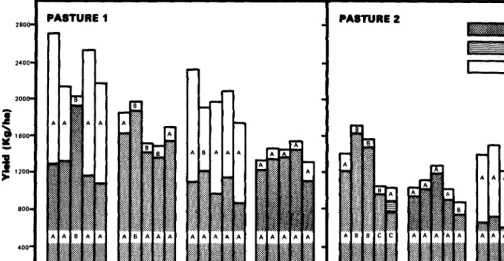
Pretreatment evaluation showed no differences (X0.95) in grass cover or yield between areas to be treated by a particular brush control method (Fig. 2 and 3). Total herbage yield in Pasture
100
n
PASTURE 1
1 was about 2769 kg/ ha and grass cover about 25%. In the more dense honey. mesquite infested Pasture 2, herbage yield was signifi- cantly less than Pasture 1 at 1023 kg/ ha and grass cover about 17%.
One year after brush control, grass cover increased significantly on aerial and basal spray treatments in Pasture 1 (Fig. 2). Tree grubbing followed by chaining significantly reduced grass cover and increased bare ground cover the first year in Pasture 2, and in the second year after tree grubbing in Pasture 1. There were few significant differences in ground cover parameters measured on sprayed and unsprayed rangeland after the second year. Overall, grass and litter cover was generally higher in aerial and basal spray treatments compared to the control or tree grub treatments, but these differences could not always be substantiated statistically. Conversely, forb and bare ground cover was generally greatest on nontreated and tree grubbed areas compared to sprayed rangeland.
Several ecological and environmental factors influenced the vegetation response besides simply reducing honey mesquite activ- ity. Annual fluctuation in rainfall was a most important factor influencing vegetation growth in this study. During 2 years (1973 and 1975) when rainfall was above the annual average (Fig. 4) broadleaf forbs were very productive (Fig. 3). However, above- normal rainfall did not greatly increase the production of perennial grasses. Grass production in the 2 years( 1974 and 1976) with below annual average rainfall was equal to or greater than in the wet years. Competition from annual broadleaf plants, especially com- mon broomweed, was largely responsible for the suppressed peren- nial grass production in the two wet years. In 1973 and 1975 when precipitation was above the annual average (14.1 and 33.3 cm, respectively), broadleaf forbs made up more than 50% of the total composition by weight. In 1974 and 1976, with below average precipitation (-7.8 and -6.7 cm, respectively), nearly 90% of the herbage consisted of grasses. Scifres and Polk (1974) inastudy on vegetation response following spraying of a light infestation of honey mesquite in northcentral Texas, reported grass production to increase 21.8 kg/ ha for every centimeter of precipitation received above the annual average. They also reported treatment
Fig. 2. Percenr ground cover pn’or IO treatmem (1973) and after honey mesquite control. Treatments include: (I) control:(2)2.4.5-T; (3)2,4,5-T
+ picloram; (4) basal spray; and (5) tree grubbing. Cover values followed by the same letter are not significantly di/ferent.
2800
2400
2000
1
2 ,600
f >
1200’
800’
400’
0
PASTURE 1
Fig. 3. Yield of grosses andforbs (kg/ha) 120 days lfall1973)andannually for three growing seasons after honey mesquite control. Treatments
include: (I) control; (2) 2,4.5-T; (3) 2.45 T i- picloram; (4) baralspray; effects to be masked in a low rainfall and high air temperature years. In this study, grass production did not necessarily increase with additional precipitation, although total herbage production did. Further, grass yield in sprayed areas exceeded nonsprayed areas during both wet and dry years.
Herbage production differences 120 days after application of foliar herbicides were closely related to the control of broadleaf species in addition to honey mesquite. Annual forbs, especially common broomweed, were abundant in spring 1973, but were reduced by the 2,4,5-T -I- picloram combination in Pasture 1 resulting in a significant increase in grass production (1940 kg/ ha) compared to the control (1286 kg/ ha) (Fig. 3). Aerial spray treat- ments in Pasture 2 also had significantly fewer forbs and greater grass produced compared to the basal spray, tree grub, and control.
One year after brush control, the 2,4,5-T spray at Pasture I was the only treatment to exceed the control in total grass yield (Figure
PASTURE 2
-1
Fork1 2 3 4 5 12345 1 2 3 4 5 1 2 3 4 5
F8tl
1973 %i? %kg Sg~*fI
and (5) tree grubbing. Yield values followed by the some letter are not signz#cantIy dlyferent.
3). No treatment within Pasture 1 was different from nontreated rangeland after the second or third year. In Pasture 2, grass pro- duction within 2,4,5-T and 2,4,5-T i- picloram treatments exceeded the control by significant amounts 120 days and three years after spraying. Workman et al. (I 965) reported maximum increases in grazing capacity to generally occur the first 2 or 3 years after spraying honey mesquite. Dahl et al. (1978) showed signifi- cant grass responses from 2,4,5-T spraying the first year in west and northcentral Texas. Our results show that a significant grass response may occur within 120 days to 3 years after spraying, but the increase may not occur over consecutive years.
Crazing Capacity and Plant Succession
The mean estimated grazing capacity from 1973 to 1976 on nontreated rangeland averaged one cow per 6.7 ha/cow/yr in Pasture I, and 8.3 ha/cow/yr in Pasture 2 (Table 2). Grazing capacity in the control exceeded the 4-year average in 1974 in Pasture I (5.6 ha/cow/yr), and was below the average in Pasture 2
Table 2. Grazing capacity (ha/cow/yr) 120 days (fail 1973) and for three growing seasons after honey mesquite control on a light (Pasture 1) and dense (Pasture 2) honey mesquite infested pastures.
Treatments 1973 1974
Grazing capacity (ha/cow/yr)
1975 1976 X
Pasture I Control 2.45-T
2,4,5-T + picloram Basal spray Tree grub Pasture 2
Control 2,4,5-T
2,4,5-T + picloram Basal spray Tree grub-no seed Tree grub-seed
6.72 c’ 5.63 d 7.62 lx 7.38 bc
6.61 c 4.76 d 7.49 bc 6.66 c
4.47 d 6.66 c 9.32 a 6.89 c
6.66 c 6.17 cd 8.44 ab 6.37 cd
7.83 b 6.42 cd 10.01 a 7.83 b
6.75 c 7.98 c 10.85 b 7.67 c 8.31 A
5.15 e 7.04 c 10.45 b 5.84 d 7.12 A
5.45 e 7.49 c 9.78 b 6.03 d 7.18 A
8.31 c 8.18 c 11.32 b 6.23 d 8.51 A
10.58 b 15.43 a 10.54 b 8.64 c 11.30 B
9.32 b 13.50 a 10.25 b 6.03 d 9.77 B
6.69 A2 6.38 A 6.84 A 6.91 A 8.02 B
1Means within a study pasture followed by the same letter are not significrantly different at the 95% level of probabily according to Duncan’s multiple range test. ‘Four-year mean average within a study pasture followed by the same letter are not significantly different at the95% level of probabilityaccording toDuncan’s multiple range test.
(10.9 ha/cow/yr) in 1975. The estimated grazing capacity deter- mined from the forage production data was nearly equivalent to the 6.8 and 8.4 ha/cow/yr stocking rate maintained by the W.T. Waggoner Ranch on nontreated rangeland adjacent to Pastures I and 2, respectively.
From fall 1973 to spring 1976, the yield of all ecological classes of grasses was greater in aerial and basal spray treatments as com- pared to the control, with the exception of annuals and warm- season invaders in Pasture 2 (Table 3). The especially favorable response of high producing cool- and warm-season decreasers in the 2,4,5-T and 2,4,5-T + picloram treatments provided a 7 to 16% increase in grazing capacity over the four-year period in Pastures 1 and 2, respectively (Table 2). Texas wintergrass, Arizona cotton- top, and the cool-season annual, rescue grass, were abundant beneath the sprayed honey mesquite canopy making up more than 50% of the total composition by weight (Brock et al. 1978). Cattle grazing in the winter showed a strong preference for these grasses and utilized nearly twice as much grass growing beneath sprayed honey mesquite canopies as compared to the interspace area between honey mesquite plants (Table 4 and Fig. 5). Cattle grazing in the 2,4,5-T spray treatment removed two to three times more forage than from comparable untreated and tree grubbed rangeland.
Tree grubbing encouraged the production of early successional species of low forage value (Table 3). As a result, grazing capacity
Tablt 3. Mean production differences, as a percent of the untreated con- trol, for brush control treatments applied on a light infestation (Pasturt 1) and dense infestation of bonty mesquitt (Pasture 2).
Brush control Cool and-warm- Increaser Annual and treatment season decreasers grasses invader grasses
Mean Percent Difference’ Pasture 1
Aerial spray t 28 t 6 I 1
Basal spray t 4 1 8 31
Tree grubbing 41 I8 1 t II
Pasture 2
Aerial spray t 30 t II 1 26
Basal spray t 29 1 8 t II
Tree grubbing 25 1 441 140
‘Mean percent Diflerence = Mean treatment Wt X Mean control Wt x loo Mean control wt
llndicates the percent increase in yield relative to the control. llndicates the percent decrease in yield relative to the control.
in tree grubbed areas was less than the othertreatments throughout most of the study (Table 2). Sideoats grama and sorghum almum seeded into denuded areas did not become established until 3 years after tree grubbing when they constituted 34% of the total compo-
15.0
12.5
10.0
+1.30
I
+14.12 I -7.77 1 +33 i.3 I -6.68.
I 1
,’ JFMAMJJASOND JFMAMJJASOND JFMAMJJASOND JFMAMJJASOND JFMAMJJASOND
1972 1973 1974 1975 1976
Fig. 4. Monthly normal precipitation and deviation from normal at Ver-
non, Texas from 1972 to 1976. Long-time precipitation is 65.61 cm. Annual
deviations from normal are shown on the top of the graph,
Conclusions and Management Implications To a largedegree, the results document what is knownaboutthe effectiveness of the different treatments for controlling honey mes- quite. Tree grubbingeliminated most ofthe honey mesquite plants but because of excessive grass damage and cost, this method should be confined to relatively sparse brush stands(less than 250 plants/ha). Aerial application of 2,4,5-T + piclomm was more effective in killing and defoliating honey mesquite than 2,4,5-T alone, but both treatments gave similar forage responses. Individ- ual plant treatment, such as basal spraying, yields a forage response similar to aerial spraying, but is an impractical method when the density of honey mesquite is great.
The 4-year duration of this study did not make it possible to evaluate treatment longevity. Treatment effectiveness, however, is not necessarily related to the number of honey mesquite killed but rather to the length of time that honey mesquite canopy growth is suppressed. Although it is still to be verified, it appears that when the honey mesquite canopy increases beyond I5 to 20%. there is a
detectable decline in forage production. Brush control in dense stands is likely to produce the most significant increases in herbage production (Dahletal. 1979). On theotherhand, it ismoredifficult to measure a significant forage response related to control of honey mesquite with less than IO to 15% canopy cover(Scifres and Polk 1974).
An increase in the production of more desirable perennial grasses 1s most significant beneath the canopy zone of sprayed honey mesquite mther,than interspace areas (Brock et al. 1978). The canopy zone is cntical for the production and “release” of cool- and warm-season decreaser grasses into interspace areas between honey mesquite plants. The canopy zone isthe focal point for range improvement and is very susceptible to overgrazing if improperly managed. Deferment through the first growing season allows warm-season mid-grasses the opportunity to increase vigor and set s,eed prior to the initiation ofgrazingin thedormant season (approxfmately November I to April I). Ending thegraringseason by Aprd I provides Texas wintergrass and other cool-season grasses an opportunity to reproduce.
A dormant season grazing regime following honey mesquite control should be carried out for one or more years, depending upon the range condition of treated pastures and the management goals. Growing season deferment and dormant season grazing
Forage removed (%) from brush control treatments
Control 2,4,5-T Tree grub
3.2 8.8
5.7 9.2 6.9
17.3 26.1 3.3
8.7 14.7 8.4 6.2
Forage removed (%) from honey mesquite zones
Canopy lntenpace
----No Data---
13.8 6.6
28.4 13.6
maximizes range improvement on rangeland in poor to fair condition.
Literature Cited
Aliison, C.D., and M.M. Kothmrnn. 1979. Effect of level of stocking pressure on forage intake and diet quality of range cattle. Proc., Western Section, Amer. Sot. of Animal Sci. 30:174-178.
Bogousb, E.R. 1951. Climatic limits affecting distribution of mesquite (Prosopis juliflora) in Texas. Tex. J. of Sci. 3554-558.
Broek, J.H., R.H. Haas, and J.C. Shaver. 1978. Zonation of herbaceous vegetation associated with honey mesquite in northcentral Texas. p.
187-189 In: Proc., 1st Internat. Range. Cong. Denver, Cola. Dahl, B.E., R.E. Sosebee, J.P. Goen, and C.S. Brumley. 1978. Will mes-
quite control with 2,4,5-T enhance grass production? J. Range Manage. 31:129-131.
Fisher, C.E. 1948. The mesquite problem in the Southwest. J. Range Manage. 3:60-70.
Fisher, C.E., H.T. Wiedemnnn, J.P. Walter, C.H. Meaders, J.H. Broek, and B.T. Cross. 1972. Brush control research on rangeland. Texas Agr. Exp. Sta. MP-1043. I8 p.
Fisher, C.E. 1977. Mesquite and modern man in southwestern North America. p. 177-188. in: Mesquite-Its Biology in Two Shrub Ecosys- tems. US/IBP synthesis series 4. Dowden, Hutchinson, and Rosslncorp. Gould, F.W. 1975. Texas plants. A checklist and ecological summary.
Texas Agr. Exp. Sta. MP_585/Revised. 121 p.
Koos, W.M., J.C. Williams, and M.L. Dixon. 1%2. Soil survey of Wil- barger Co., Texas. U.S. Dep. Agr., Soil Conserv. Serv. 64 p. McDaniel, K.C. 1978. Evaluation of landsat MSS data for classifying and
characterizing natural vegetation on a regional basis. Ph.D. Diss. Texas A&M Univ., College Station. 185 p.
McDaniel, K.C., R.H. Haas,and J.H. Brock. 1978. Range condition trends following control of honey mesquite on deep hardlands in northcentral Texas. p. 530-533. In: Proc., 1st Internat. Range. Cong. Denver, Cola.
Pechanec, J.F., and G.D. Pickford. 1937. A weight estimate method for the determination of range or pasture production. J. Amer. Sot. Agron. 29:894-904.
Rechenthin, C.A., and H.N. Smith. 1967. Grassland restoration. V. Effect on water yield and supply. Unnumb. Bull. U.S. Dep. Agr. Soil Conserv. Serv. Temple, Texas. 46 p.
Rogers, C.A., G.D. Passmore, and W.M. Risenger. 1976. Soil survey, Baylor County, Texas. U.S. Dep. Agr., Soil Conserv. Serv. 754 p. Scifres, C.J., and D.B. Polk, Jr. 1974. Vegetation response following
spraying a light infestation of honey mesquite. J. Range Manage. 27:462- 465.
Scifres, CJ., M.M. Kothmann, and G.W. Mathis. 1974. Range site and grazing system influence regrowth after spraying honey mesquite. J. Range Manage. 27:97-100.
Scifreq CJ., and G.O. Hoffman. 1974. Mesquite: growth and develop- ment, management, economics, control, uses-a brief Texas Agr. Exp. Sta. Res. Monogr. I. Texas A&M Univ.. College Station. I I i. _ Scifres, C.J. 1980. Brush management-principles and nractices for Texas and the Southwest. Texas A&M Univ. Press’College Station, Texas. 360 P.
Steel, R.G.D., and J.H. Torrie.1960. Principles and procedures of statis- tics. McGraw-Hill Book Co., New York. 481 p.
United States Department of Commerce. 1976. Climatologicaldata, Texas. National Oceanic and Atmospheric Admin. Vol. 78.
Whitson, R.E., and C.J. Scifres. 1980. Economic comparison of alterna- tives for improving honey mesquite infested rangeland. Tex. Agr. Exp. Sta. B-1307. I85 p.
Wiedemann, H.T., B.T. Cross, and C.E. Fisher. 1977. Low-energygrubber for controlling brush. Trans. Amer. Sot. Agr. Eng. 20:210-213. Workman, D.R., K.R. Tefertiller, and C.L. Leinweber. 1965. Profitability
of aerial spraying to control mesquite. Texas Agr. Exp. Sta. MP425.8 p. Young, V.A., F.R. Anderwald,and W.G. McCully. 1948. Brush problems
on Texas ranges. Tex. Agr. Exp. Sta. MP 21. 19 p.
Interrelationships
of Huisache Canopy
Cover with Range Forage on the Coastal
Prairie
C.J. SCIFRES, J.L. MUTZ, R.E. WHITSON, AND D.L. DRAWE
Abstract
Grass production was monitored based on seasonal harvests under various canopy covers of h&ache on a Coastal Prairie blackland range site during 1978 and 1979. Grass production (Y) was not decreased in 1978, compared to that on essentially brush- free areas, until huisache canopy cover (X) exceeded 30% based on the reiationship, Y = 2,346 -I- 20X - 0.62X*. Texas wintergrass standing crop apparently increased as huisache canopy cover increased to 25% and its growth during winter partly compensated for standing crop losses of warm season species during the winter. In 1979, the contribution of the cool-season species was masked by greater production of warm-season species. Consequently, grass production decreased with increasing huisache canopy cover according to the relationship, Y = 4,047 - 14.9X -0.29X2. Based on the functional relationship Y = a - blX-bzX*, coefficients of determinations (P) ranged from 0.50 to 0.96 when estimates of annual production of grasses or production for the growing season only were regressed against huisache canopy cover.
Excessive brush cover is frequently cited as the primary limita- tion to effective management of Texas rangelands for livestock production (Smith and Rechenthin 1964). The generally negative attitude toward the role of woody plants on rangeland has pro- vided the impetus for intensive research on control methods and implementation of control measures on hundreds of thousands of hectares of rangeland during the past 25 years (Scifres 1980). However, the increasing value of rangeland resources for wildlife habitat and recreation has stimulated an awareness of the need for maintaining adequate brush cover for wildlife. This awareness has provided the basis for reconsidering “brush management”in lieu of “brush control” for optimizing overall secondary production from rangelands (Box and Powell 1965, Scifres 1980).
Understanding the interactions of woody plants, required in certain amounts as food and cover for important game animals such as white-tailed deer (Odocoileus virginianus), and the produc- tion of herbaceous range forages vital for livestock production is critical to development of effective brush management systems. Most research on this subject has related tree stand density and/ or canopy cover to end-of-year herbaceous standing crop. In general, these studies have shown that as the density of canopy cover of woody plants increases, herbaceous standing crop decreases (Jameson 1967, Halls and Schuster 1965, Dahl et al. 1978). Grelen and Lohrey (1978) reported that the relationship between basal
Authors arc professor, Department of Range Science, Texas A&M University, College Station 77843; assistant research scientist, Texas ABM University Agr. Res. and Extension Center, Corpus Christi 78410; associate professor, Department of Range Science and Agricultural Economics, Texas A&M University, College Station; and assistant director, Rob and Bessic Welder Wildlife Foundation, Sinton, Texas 78287. Published with approval of the Director, Texas Agricultural Experiment Station as TA-16276 in cooperation with the Rob and Bessie Welder Wildlife Founda- tion as Welder Wildlife Contribution No. 259. The authors appreciate the efforts of Julia Scifres in manuscript preparation, and of W.C. Mohr in research plot installa- tion, evaluation, and maintenance.
Manuscript received October 23, 1980.
558
area (X) of longleaf pine(Pinuspalustris)and herbaceous standing crop (Y) was Y = 1,670 - 6.8X. Although the coefficient of determination was low (rz = .20), the variation in the relationship could be reduced when that proportion of the variation attributa- ble to May through September rainfall was isolated as an inde- pendent variable. Koshi (1953) reported the relationship Y= 1,250 - 18.39X between predicted end-of-season herbaceous forage standing crop (Y) and canopy cover of woody plants (X) in the Texas Post Oak (Quercusstellata) Savannah. The relationship was developed within a canopy cover range of 0 to 20%, and with about 80% of the long-term average annual rainfall.
No research results are available concerning range herbage pro- duction interrelationships with woody plant canopy cover on the Coastal Prairie. The Coastal Prairie supports extensive stands of huisache (Acacia farnesiana) and mixed brush (Prosopis-Acacia). However, native vegetation in this resource area gives the Coastal Prairie high potential for livestock production, and it supports large herds of white-tailed deer. The objective of this research was to quantify the influence of increasing huisache canopy cover on herbaceous production on the Coastal Prairie.
Description of the Study Site
The research was conducted on the Rob and Bessie Welder Wildlife Refuge about 8 km south of Sinton, Texas, on the Coastal Prairie. The Coastal Prairie is the southernmost extension of the tallgrass prairie. Long-term records indicate that the area has an annual average rainfall greater than 76 cm (Drawe et al. 1978). Average annual rainfall for the Welder Wildlife Refuge during the past 20 years is about 93 cm with a low of 43 cm in 1963 and a high of 127 cm in 1973 and 1976 (Mutz et al. 1978). The growing season lasts about 300 days, and the Coastal Prairie is characterized by warm temperatures, coastal air movements, and high relative humidities.
The study area was composed primarily of blackland range sites typified by Victoria clay (Udic Pellustert) and Monteola clay and Monteola complex (Typic Pellustert). Upland vegetation is typi- fied by mixed-brush communities interspersed with almost solid stands of huisache. Drawe et al. (1978) classified the mixed-brush stands as “chaparral-bristlegrass communities” with blackbrush acacia (Acacia rigidula), lime pricklyash (Zanthoxylum fagara), lotebush (Zizyphus obtusijblia), brazil (Condalia obovata), Texas persimmon (Diospyros texana), agarito (Berberis trifoli?lata). and spiny hackberry (Celtis pallida) as the primary woody compo- nents. Huisache, the primary woody species in the “huisache- mixed grass communities,” invaded the immediate study site after application of mechanical brush control treatment of the original “chaparral-bristlegrass” communities in 1963 (Mutz et al. 1978). The huisache stands are composed of plants usually having from 1 to 5 main stems 4 to 20 cm in diameter.
The 480-ha study pasture was part of a three-herd, four-pasture grazing system stocked with cows and calves at roughly 1 AU/ 5 ha except for December 5, 1979, through March 14, 1979 when it was deferred.
Materials and Methods
On May 11, 1978, 12 huisache stands of varying canopy cover were selected based on visual assessment. Brush canopy cover was estimated based on intercepts along five permanent lines, 47 m long and spaced 1.6 m apart, established in each stand.
Five grazing exclosures were equidistantly spaced along each center line in May 1978. After random selection of one of the cardinal directions, herbaceous vegetation in a 0.25 m* area was harvested to ground line at 1 m from each grazing exclosure immediately following their establishment. These samples were separated into grasses and forbs, oven-dried, and weighed to pro- vide an estimate of initial standing crop (SC). Standingcrop(SCr) in a 0.25 m* plot inside each exclosure was harvested to ground line, separated into grasses and forbs, oven-dried and weighed the following July 1978. A 0.25 m* plot located 1 m from each exclo- sure was also harvested in July for an estimate of standing crop under grazing (SCGl). The difference in standing crop inside the exclosure and initial standing crop (SCl-SC) was considered an estimate of herbaceous production since the previous sampling. The exclosures were relocated, and this procedure was repeated during the fall (October), winter (February), spring (April-May), and summer (July-August) until late fall (November) 1979. For grazing periods subsequent to the first evaluation (spring 1978), herbage produced for the period was estimated from thedifference between standing crop inside the exclosures (SCt) and that on adjacent grazed areas harvested at the beginning of that grazing period (KG+& In November 1979, the grasses were further separ- ated into cool-season and warm-season categories.
Herbage production for each year was estimated as the summa- tion of standing crop differences (SCt - SCGt-1) categories (grasses, forbs) for each of the sampling periods. The functional relation- ship,Y=a+bX,Y=a+blX+4X*,logY=a+bX,andlogY=
a i- b(log X) were used to evaluate the response of the dependent variables [grass production for the year, grass produced for the growing season (May-October), and total herbage (grasses i- forbs) produced for the growing season each year] to variation in the independent variable, huisache canopy cover. Based onsignifi- cance of regression coefficients (b) using t-test (E.05) and magni- tude of coefficients of determination (IQ), the quadratic equation was chosen as the best expression of the relationships. Data from
1978 and 1979 were compared by testing differences between Y intercepts by F-tests and regression coefficients by t-tests (pI.05).
Results and Discussion Rainfall Conditions
Annual rainfall was 83 cm in 1978 and 87 cm in 1979, 89 and 94%, respectively, of the average for the preceeding 20 years. During 1978, 14% of the annual rainfall occurred during the first quarter (January-March), compared to 25% of the annual total occurring during the same period in 1978 (Fig. 1). About 24% of the annual rainfall during both years was received during the second quarter (April-June). However, about half of the second quarter rainfall in 1978 was received in June, whereas rainfall was more evenly distributed during the second quarter in 1979. Rainfall during the third quarter (July-September) of 1979 represented 44% of the annual total compared to 39% of the total rainfall occurring at the same time in 1978. The fourth quarter (October- December) was relatively dry in 1979 (7% of the annual rainfall) compared to the fourth quarter of 1978 when 23% of the annual rainfall was received. Thus, the primary difference between the years of study was the slightly greater amount and improved uniformity of distribution of rainfall from March through Sep- tember 1979, compared to the same period in 1978 (Fig. 1). Functional Relationships
Based on comparisons of Y intercepts and regression coeffi- cients, data for years of study could not be pooled. In 1978,5O%of the variation in annual production (kg/ ha) of grasses (Y) was attributed to variation in huisache canopy cover LX(%)] with the
= 20 l 5
16 '
12
a
4
n
“J F MAMJJAS 0 N D
MONTH
Fig. 1. Monrhly precipitation (cm) on the Welder Wildlife Refuge where the influence of huisache on herbage production was evaluated in 1978 and 1979.
relationship Y = 2,345 + 20X-0.62X* (Fig. 2). Annual production of grasses did not decrease until huisache canopy cover exceeded 32%. This response curve was assumed to reflect the increasing importance of Texas wintergrass (Sripa leucotricha), the most abundant cool-season species on the study area, as huisache can- opy cover increased from 0 to 32%. Although grasses were not separated into season-of-growth fractions to allow direct evalua- tion of the contribution of Texas wintergrass to annual produc- tion, consideration of grass produced during the warm season only was accepted as an indirect test. Based on the warm season only, 74% of the variation in NCSC of grasses could be attributed to variation in huisache canopy with the relationship, Y = 3,569 - 3.1X - 0.43X* (Fig. 3). The negative sign of the linear regression coefficient, compared to the positive value in the equation for annual production of grasses, supports the hypothesized effect of cool-season species, primarily Texas wintergrass, on grass produc- tion in 1978.
Brock et al. (1978) reported that canopy zones of honey mesquite
(Prosopis gfandulosa var. glandulosa) on the Rolling Plains of
Texas were characteristically dominated by Texas wintergrass while relatively small amounts of cool-season species occurred in the interstitial zones. Honey mesquite canopy reduction by various brush control methods caused a shift in the botanical composition of the stand towards increased relative abundance ofwarm-season species.
The difference (1,223 kg/ha) between the Y intercept of the functional relationship describing influence of huisache canopy cover on annual production of grasses (Fig. 2), compared to that of the equation for grass produced during the growing season only (Fig. 3) for 1978, provided an estimate of loss of the warm-season fraction during the winter, attributed primarily to weathering, in the absence of huisache canopy cover. The magnitude of weather- ing loss decreased as huisache canopy increased. For example, predicted weathering loss of 40% huisache canopy cover in 1978 was 603 kg/ ha and 52 1 kg/ ha at 60% huisache canopy cover, about half the predicted loss in the absence of huisache.
Response of annual production of grasses in 1978 to increasing huisache canopy cover differed somewhat from the relationship in 1978. Coefficients of variation were reduced, compared to those in 1978, regardless of dependent variable (Table 1). In 1979,72% of