Collision Attacks on Up to 5 Rounds of SHA-3
Using Generalized Internal Differentials
Itai Dinur1, Orr Dunkelman1,2,?, and Adi Shamir1
1 Computer Science department, The Weizmann Institute, Rehovot, Israel 2 Computer Science Department, University of Haifa, Israel
Abstract. On October 2-nd 2012 NIST announced its selection of the Keccak scheme as the new SHA-3 hash standard. In this paper we present the first published collision finding attacks on reduced-round versions of Keccak-384 and Keccak-512, providing actual collisions for 3-round versions, and describing an attack which is 245times faster than birthday attacks for 4-round Keccak-384. For Keccak-256, we increase the number of rounds which can be attacked to 5. All these results are based on a generalizedinternal differential attack (introduced by Peyrin at Crypto 2010), and use it to map a large number of Keccak inputs into a relatively small subset of possible outputs with a surprisingly large probability. In such asqueeze attack it is easier to find random collisions in the reduced target subset by a standard birthday argument.
Keywords:Hash function, cryptanalysis, SHA-3, Keccak, collisions, in-ternal differentials, squeeze attack.
1
Introduction
One of the stated reasons for the recent selection of Keccak by NIST as the new SHA-3 hash standard was its exceptional resistance to cryptanalytic attacks [10]. Even though it was a prime target for several years and many cryptanalysts have tried to break it (see [1, 2, 4, 8, 11–14, 16, 20, 21]), there was very limited progress so far in finding collisions even in greatly simplified versions of its various flavors. In particular, there were no published collision finding attacks on any number of roundsof its two largest flavors (Keccak-384 and Keccak-512), and only three published collision finding attacks on Keccak-256 ([16, 21] attacked two rounds, and [12] doubled the number of rounds to 4). One of the main reasons for this lack of progress is that the probabilities of the standard differential characteristics of Keccak’s internal permutation are extremely small, as was rigorously shown in [11]. We bypass this seemingly insurmountable barrier by using a different kind of differential property, whose probability is not bounded by such a proof.1 By using the new property, we provide in this paper either the first or an improved
?The second author was supported in part by the Israel Science Foundation through grant No. 827/12.
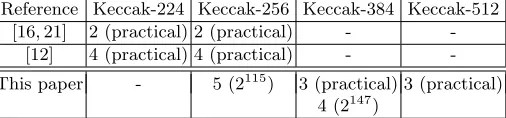
attack on all these flavors: For Keccak-384 and Keccak-512 we describe practical attacks (with actual collisions) on three rounds, and impractical attacks on four rounds of Keccak-384. For Keccak-256 we increase the number of rounds which can be attacked from 4 to 5. The previous collision attacks and our new results are summarized in Table 1.
Reference Keccak-224 Keccak-256 Keccak-384 Keccak-512 [16, 21] 2 (practical) 2 (practical) -
-[12] 4 (practical) 4 (practical) -
-This paper - 5 (2115) 3 (practical) 3 (practical) 4 (2147)
Table 1.Collision attacks on round-reduced Keccak: the number of rounds attacked with the corresponding time complexity in parentheses
Our new attacks use many ideas which were already known in some limited form, but improves and combines them in new ways. They are a special type of the very general notion ofsubset cryptanalysis, which tries to track the sta-tistical evolution of a certain set of values (which could be single states, pairs of states, or a collection of states with “don’t care parts”) through the various operations in the cryptographic scheme. In general, the goal in subset cryptanal-ysis is to find a subset of inputs which are mapped with larger than expected probability to some pre-fixed subset of all possible outputs. This is a widely used technique, which includes as special cases most of our standard cryptanalytic at-tacks, including differential, integral, and linear atat-tacks, both in the single key and in the related key cases. The first step in subset cryptanalysis is to construct a subset characteristic which associates a triplet (input subset, output subset, transition probability) to each internal operation f of the cryptosystem. The transition probability specifies the probability that a random state chosen from the input subset will be a member of the output subset after applyingf. Based on standard randomness assumptions, the total probability of the characteristic is calculated by multiplying the various transition probabilities. Subset crypt-analysis is typically used in order to construct a distinguisher, which makes it possible to extract information about the last subkey of a cryptosystem.
AES. We also note the close relationship between our approach and many of the self-similarity properties identified over the years. Slide attacks [6] (as well as the original flavor of related-key attacks [5]) is built over pairs of plaintexts which are shifted versions of each other in the encryption process. In many cases (e.g., Feistel ciphers), it is easy to rewrite the slide requirement as a relation between the slid pairs by defining the subsets according to the slid relation.
Squeeze Attacks In the case of hash functions, we can use subset characteristic in a different way, which we call asqueeze attack. To motivate this attack, assume that the hash function maps a setS of possible inputs into a setD of possible outputs. By the birthday paradox, we have to try a subsetS0 ⊆S of size p|D| of inputs before we expect to find the first collision in D. Consider now the variant of this attack in which we discard all the outputs we generate which do not fall into a particular subset D0 ⊆ D. Since D0 is smaller than D we need fewer samples in it in order to find a collision, but finding each sample is more expensive. To find which effect is stronger, assume that the probability of picking an input inS0 whose output is inD0isp, and thatD0contains a fraction q of the points inD. The number of outputs inD0 we need is p|D0|=p
q|D|, and the number of inputs in S0 we have to try ispq|D|/p. When the mapping is random, p = q and this variant of the attack is worse than the birthday bound for all D0 which are smaller than D. However, if we can exploit some non-random behavior of the hash function in order to find sets S0 and D0 for which p2 > q, we can get an improved collision finding algorithm. We call it a
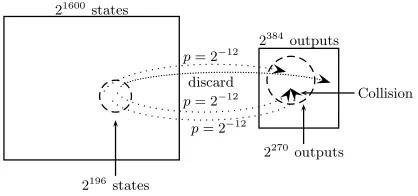
squeeze attack since we are forcing a larger than expected number of inputs to squeeze into a smaller subset of possible outputs in which collisions are more likely. By memorizing only such outputs and discarding all the other outputs we generate, we can reduce both the time and the space needed to find collisions in the given hash function (see Figure 1). The analysis above shows that any
subset characteristic for which p2 > qsuffices for an efficient squeeze attack on
a hash function, provided only that we can generate sufficiently many inputs in the initial subset of the characteristic. This is more flexible than standard differential cryptanalysis of hash functions, where a high-probability differential characteristic can be directly used in a collision attack only if it leads to a zero difference in the output value.
21600states
2384outputs
2196states
2270outputs
p= 2−12
p= 2−12
p= 2−12
discard
Collision
Fig. 1.A Squeeze Attack with|S|= 21600,|S0|= 2196,|D|= 2384,|D0|= 2270, p= 2−12
Generalized Internal Differential Cryptanalysis. In this paper, we
gener-alize the technique ofinternal differential cryptanalysisdeveloped by Peyrin [22] in the cryptanalysis of the Grøstl hash function. While in standard differen-tial attacks we consider two different plaintexts, and follow the evolution of the difference between them, in internal differential attacks we consider only one plaintext, and follow the statistical evolution of the differences between its parts. In the case of Keccak, we use internal differential cryptanalysis in order to follow the statistical evolution of almost symmetric states through the first few rounds of Keccak. For example, if the symmetry we consider is that the first half of the state should be equal to the second half of the state, then we follow the evolution of small differences between these two parts through the various cryptographic operations. Note that fully symmetric states have a zero internal difference, which remains zero as the state goes through symmetry preserving operations, whereas almost symmetric states have a low Hamming weight in-ternal difference, which in many cases remains low Hamming weight after such operations.
2
Description of Keccak
In this section, we briefly describe the sponge construction and the Keccak hash function. More details can be found in the Keccak specification [4]. The sponge construction [3] works on a state ofbbits, which is split into two parts: the first part contains the firstrbits of the state (called the outer part) and the second part contains the lastc=b−rbits of the state (called the inner part).
Given a message, it is first padded and cut intor-bit blocks, and thebstate bits are initialized to zero. The sponge construction then processes the message in two phases: In the absorbing phase, the message blocks are processed iteratively by XORing each block into the firstrbits of the current state, and then applying a fixed permutation on the value of theb-bit state. After processing all the blocks, the sponge construction switches to the squeezing phase. In this phase,noutput bits are produced iteratively, where in each iteration the firstrbits of the state are returned as output and the permutation is applied to the state.
The Keccak hash function uses multi-rate padding: given a message, it first appends a single 1 bit. Then, it appends the minimum number of 0 bits followed by a single 1 bit, such that the length of the result is a multiple of r. Thus, multi-rate padding appends at least 2 bits and at mostr+ 1 bits.
The Keccak versions submitted to the SHA-3 competition haveb= 1600 and c = 2n, where n ∈ {224,256,384,512}. The 1600-bit state can be viewed as a 3-dimensional array of bits, a[5][5][64], and each state bit is associated with 3 integer coordinates, a[x][y][z], wherexandyare taken modulo 5, andz is taken modulo 64.
The Keccak permutation consists of 24 rounds, which operate on the 1600 state bits. Keccak uses the following naming conventions, which are helpful in describing its round function:
– A row is a set of 5 bits with constant y and z coordinates, i.e.a[∗][y][z], or r(y, z).
– A column is a set of 5 bits with constant x and z coordinates, i.e.a[x][∗][z]. – A lane is a set of 64 bits with constant x and y coordinates, i.e.a[x][y][∗]. – A slice is a set of 25 bits with a constant z coordinate, i.e.a[∗][∗][z].
Each round of the Keccak permutation consists of five mappingsR=ι◦χ◦ π◦ρ◦θ. The five mappings given below are applied for each x,y, and z (where the state addition operations are overGF(2)):
1. θis a linear map, which adds to each bit in a column, the parity of two other columns.
θ:a[x][y][z]←a[x][y][z] +
4
X
y0=0
a[x−1][y0][z] +
4
X
y0=0
a[x+ 1][y0][z−1]
2. ρrotates the bits within each lane by T(x,y), which is a predefined constant for each lane.
3. πreorders the lanes.
π:a[x][y][z]←a[x0][y0][z], where
x y
=
0 1 2 3
·
x0 y0
4. χis the only non-linear mapping of Keccak, working on each of the 320 rows independently.
χ:a[x][y][z]←a[x][y][z] + ((¬a[x+ 1][y][z])∧a[x+ 2][y][z])
Sinceχworks on each row independently, it can be viewed as an Sbox layer which simultaneously applies the same 5 bits to 5 bits Sbox to the 320 rows of the state. We note that the Sbox function is an invertible mapping, and some of our techniques are based on the known observation that the algebraic degree the algebraic degree of each output bit ofχ as a polynomial in the five input bits is only 2.
5. ιadds a 64-bit round constant to the first lane of the state. ι: a[0][0][*]←a[0][0][*]+RC[ir]
Since we analyze in this paper round-reduced variants of Keccak with at most 5 rounds, we are only interested in the first five round constants: 0000000000000001, 0000000000008082, 800000000000808a, 8000000080008000, 000000000000808b(given respectively in hexadecimal using the little-endian format). Note that all five round constants have a low Hamming weight and the first round-constant has a Hamming weight of only 1.
3
Notations
Given a message M, we denote its length in bits by |M|. Unless specified oth-erwise, in this paper we assume that |M| = r−2, namely we consider only single-block messages of maximal length. GivenM, we denote the initial state of the Keccak permutation as the 1600-bit wordM ,M||11||02n, where||denotes concatenation.
The first three operations of Keccak’s round function are linear mappings, and we denote their composition byL,ρ◦π◦θ. We sometimes refer toLas a “half round” of the Keccak permutation, where ι◦χ represents the other half. We denote the Keccak nonlinear function on 5-bit words defined by varying the first index byχ|5. The difference distribution table (DDT) of this function is a
two-dimensional 32×32 integer table, where all the differences are assumed to be overGF(2). The entryDDT(δin, δout) specifies the number of input pairs to
this Sbox with difference δin that produce the output difference δout (i.e., the
size of the set {x∈ {0,1}5 |χ
|5(x) +χ|5(x+δin) =δout}).
Given a set S of internal states of Keccak, we define the action of each of Keccak’s mappings on the set by applying it to every element of the set (e.g., θ(S) ={θ(u)|u∈S}).
4
Description of Our Basic Techniques
1. Pick an arbitrary message for which the values entering the compression function are in the initial subset of the characteristic.
2. Apply the compression function. If the subset characteristic is satisfied, com-pute the output of the compression function. Otherwise, discard the message and go back to Step 1.
3. Store the output in a table (along with the message). In case a collision is found, stop and output the collision. Otherwise, go back to Step 1.
If the size of the output set is 2d (i.e., |D0|=q|D|= 2d using the notation of the Introduction), then after 2d/2 messages for which the characteristic is
followed, we expect a collision due to the birthday paradox. Hence, when the probability of the subset characteristic is p, the time complexity of finding a collision isp−1·2d/2and the memory complexity is22d/2. To optimize the attack,
we need a subset characteristic for whichpis as high as possible anddis as small as possible.
4.1 Internal Difference Sets
A very interesting observation concerning Keccak is that four out of its five internal mappings (all but ι), are translation invariant in the direction of thez axis (as was already noted in the Keccak submission paper [4]). Namely, if one state is the rotation of another state with respect to the z-axis (i.e., satisfies b[x][y][z] = a[x][y][z+i], for some value of i), then applying to them any of theθ, ρ, π, χ operations, maintains this property. To exploit this symmetry, we pick subsets which are invariant with respect to the rotation along the z-axis with all the non-trivial possible choices ofi. Namely, given a rotation index i∈ {1,2,4,8,16,32}, the subsets are all the states for whicha[x][y][z] =a[x][y][z+i]. In most of the remainder of this section, we assume for the sake of simplicity that i = 16, but note that all of our definitions extend naturally to any i ∈ {1,2,4,8,16,32}. For i = 16, a symmetric state a[x][y][z] is composed of four repetitions of slices 0–15 (see Example 1). Each such sequence of slices (0–15, 16–31, 32–47, 48–63) is called aconsecutive slice setor CSSin short. Applying any of the four operations θ, ρ, π, χto a symmetric state in which all CSS’s are equal, does not disturb its symmetry. The application of ι interferes with this symmetry, since the round constants are not the same among the consecutive slice sets. However, given the low weight of the constants used by ι, the state remains close to being symmetric.
To deal withι, we have to extend our point of view, and consider states for which the equality “almost holds”. The subsets used in our subset characteristics are internal differences, which measure how close the state is to a symmetric state. Generally speaking, this can be done by computing the XOR differences between the first consecutive slice set, and each of the three other ones, denoted by the triplet (∆1, ∆2, ∆3). We define an internal difference in Keccak to be
2 Notice that we can use either Floyd’s cycle finding algorithm [17] or the parallel
|169D169D169D169D|A965A965A965A965|3EC73EC73EC73EC7|9025902590259025|C264C264C264C264| |A34BA34BA34BA34B|0F330F330F330F33|4902490249024902|3D683D683D683D68|613D613D613D613D| |C684C684C684C684|B368B368B368B368|589B589B589B589B|5F335F335F335F33|E27AE27AE27AE27A| |22E822E822E822E8|3D583D583D583D58|B37AB37AB37AB37A|1047104710471047|D525D525D525D525| |60F360F360F360F3|C3E4C3E4C3E4C3E4|37FA37FA37FA37FA|8193819381938193|69BA69BA69BA69BA|
The state is described as a matrix of 5×5 lanes of 64 bits, ordered from left to right, where each lane is given in hexadecimal using the little-endian format. Each lane of the state consists of 4 repetitions of a 16-bit word.
Example 1:A symmetric state withi= 16
the set of states with a fixed value of (∆1, ∆2, ∆3). Obviously, when all 4 CSS’s
are equal, the differences between them are zero and the subset is called a zero internal difference.
Alternatively, we can define an internal difference set as a coset in a group, using a single representative state v and adding to it all the fully symmetric states:{v+w|w is symmetric}. In general, given a rotation indexi, we represent an internal difference using the pair [i, v] (or [16, v] in casei= 16). Obviously, this representation is redundant as we can select anyu∈[16, v] as the representative state. However, as shown in the next subsection, it allows us to describe the evolution of an internal difference [i, v] through Keccak’s linear mappings in a very compact way.
Since an internal difference does not place any constraint on the value of the first CSS, it will sometimes be convenient to choose a canonical representative statefor which this value is zero, and we denote it by ˆv. Namely, for an internal difference defined by (∆1, ∆2, ∆3), thevaluesof the four CSS’s in the canonical
representative state are0,∆1,∆2 and∆3, respectively.
4.2 The Evolution of Internal Differences Through Keccak’s
Permutation
As in standard differential cryptanalysis, we consider the difference between the CSS’s, rather than the actual values. Hence, the zero internal difference passes with probability 1 all the four operationsθ, ρ, π, χ, just as a zero difference in a differential characteristic passes through any operation.
Unlike a classical differential characteristic, in an internal differential charac-teristic, the addition of a constant (i.e., theιoperation) effects the characteristic by introducing a difference between the equal CSS’s. This difference then prop-agates through the other operations, and its development has to be studied and controlled. Luckily, we can construct internal differential characteristics for Kec-cak (with good probability) that track this evolution of “distance” from a zero internal difference through the various Keccak mappings.
θ([i, v]) = [i, θ(v)],ρ([i, v]) = [i, ρ(v)] andπ([i, v]) = [i, π(v)]. Sinceιsimply adds a constant to each state of the set then ι([i, v]) = [i, ι(v)] as well.
The Evolution of Internal Differences throughχ. In contrast to the linear mappings, applying χ, the non-linear mapping, to a randomly selected state from an internal difference, the output internal difference depends on the actual input, i.e., the output can belong to one of several internal differences. Just as in differential cryptanalysis, we can choose a single output internal difference, and then calculate the probability of the transition from the input internal difference to this output internal difference.
When a state of an internal difference which is not symmetric enters the χ function, we have to consider the possible outcomes in terms of “distance” from the zero internal difference. To do so, we consider the rows on which χ operates using an object called a rotated row set. Fori= 16, a rotated row set contains a rowr(y, z) in the first CSS, along with its 3 symmetric counterparts r(y, z+ 16), r(y, z+ 32) andr(y, z+ 48) in the other CSS’s (see Example 2). We note that given the input internal difference, once the value ofr(y, z) is set, we know the value of the remaining rows as well. Hence, given the value ofr(y, z) we can compute the corresponding outputs, and check the resulting output internal difference.
Once we perform this operation, we can associate with each input internal difference all the possible output internal differences (and the corresponding probabilities) by trying all 32 possible values for r(y, z). In the particular case where the input internal difference assigns a zero difference to all the rows of a rotated row set, it passes through theχmapping with probability 1. Similarly to differential cryptanalysis, we call such a rotated row set inactive (with respect to the internal difference), whereas a rotated row set with a non-zero difference is called active.
For i = 32, each rotated row set contains exactly 2 Sboxes (rows), i.e., v specifies a single input difference for the Sbox pair. In this case one can easily use the difference distribution table of the Sbox to determine the distribution of the output differenceδout given the input difference δin.
In the internal differences that we consider in this paper, most rotated row sets contain at most two distinct input values to the Sbox. We call such a rotated row set sparse. In active sparse rotated row sets,3 one can divide the values
r(y, z), r(y, z+ 16), r(y, z + 32) and r(y, z+ 48) (or r(y, z), r(y, z +i), . . . for generali∈ {1,2,4,8,16,32}) into two groups, each with the same input to the Sbox (see Example 3). Obviously, each group of Sboxes has the same output, leading to a sparse output internal difference as well. Since there is only a single input difference between the two groups of Sboxes, we can use the difference distribution table also in the more general case of i6= 32, when a rotated row set is sparse.
|0001000100010001|0001000100010001|0001000100010001|0001000100010001|0001000100010001|
The first five lanes of a state in which the 20 bits of the first rotated row set for
i= 16 are set to 1. The lanes are ordered from left to right, where each lane is given in hexadecimal using the little-endian format.
Example 2:A rotated row set
|0001000100010001|0001000000010000|0000000000000000|0001000100010001|0000000100000001|
The first five lanes (given in the format of Example 2) of a state in an internal difference in which the first rotated row set is sparse fori= 16. The (binary) value ofr(0,0) and
r(0,32) is 10011, while the value ofr(0,16) andr(0,48) is 11010. In this example, the internal difference fixes the difference of 01001 between the two groups of rows. The value of the other rows is zero.
Example 3:A sparse rotated row set
The Weight of Internal Differences. Finally, we give a heuristic concerning the “quality” of a given internal difference in a characteristic. The closer the internal difference is to the zero internal difference, itsweight(i.e., the minimal Hamming weight of a state in the internal difference) is lower.4 Since the zero
internal difference contains the zero state, its weight is zero, and the weight of an internal difference measures the minimal Hamming distance between a state in the internal difference and a symmetric state. In general, a low-weight internal difference has only a few active rotated row sets, and thus passes through χ with high probability. In this paper, we construct characteristics whose internal differences have a low weight (and thus a high probability) by choosing low-weight internal differences as outputs, as well as a few additional techniques which will be described in the rest of this paper. As a preliminary example, consider Characteristic 1 in Appendix C. This characteristic starts from the zero internal difference and extends to 1.5 Keccak rounds with probability 1, where the final internal difference has a weight of 11.
5
Exploiting Internal Differential Characteristics in
Collision Attacks on Keccak
In this section, we describe optimizations that allow us to devise efficient attacks on round-reduced Keccak using internal differential characteristics.
4 While there may be many states with minimal Hamming weight in an internal
5.1 Choosing the Value of the Rotation Index
Recall that a subset characteristic maps an input, selected from a subset of inputs to the compression function, to a restricted output set of size 2dwith probability
p. In order to find a collision, we have to try aboutp−1·2d/2such inputs, and in
the case of Keccak, we need the ability to generatep−1·2d/2single-block messages
M, such thatM is a member of the initial internal difference. In our basic attack, we use a zero internal difference (i,0) for a fixedi ∈ {1,2,4,8,16,32} (i.e., we restrict our messages M such that M ∈ (i,0)), which implies that we are free to choose the value of the first i bits in each lane of the outer (controllable) part of the initial state, not including the lane containing the padding, in which we can only choose the value of the first i−2 bits.5 Exploiting the fact that
the initialization sets the inner (uncontrollable) part of state to 0, and the fact that we can control the values ofr/64 lanes when the rate isr, we can generate 2r·(i/64)−2 initial states which are symmetric. Hence, we have to ensure that 2r·(i/64)−2≥p−1·2d/2.
As we decrease the value of i, we increase the number of constraints on the internal differences, leading to a smaller expected output subset size, thus reducing the complexity of the attack. On the other hand, a value ofiwhich is too small leads to an insufficient number of possible messages for a collision attack. Hence, we choose the smallesti∈ {1,2,4,8,16,32}such that 2r·(i/64)−2≥p−1·
2d/2holds. We note that the value ofidetermines how a state is partitioned into
rotated row sets, and thus it may also affect the probabilitypof a characteristic (i.e., we need to calculate pseparately for each value ofi).
5.2 Extending Internal Differential Characteristics
Constructing an internal differential characteristic which spans many rounds of Keccak reduces its probability significantly, leading to an inefficient collision attack which requires the evaluation of many messages. Thus, instead of covering all the attacked rounds, we extend the internal differential characteristic up to some point (in our attacks, one and a half rounds before the output), and continue to exploit Keccak’s properties (such as the limited diffusion of its Sbox layer) in order to bound the size of the output subset (which is crucial in squeeze attacks). This is done by extending the internal differential characteristic to a subset characteristic without restricting its subsets to a particular form of [i,ˆv]. In fact, since the output subset is not an internal difference (and actually not even affine), in the final part we use subset cryptanalysis in its most general form.
Aggregating Internal Differences Using Affine Subspaces. Assume that
the internal difference part of the subset characteristics ends just before the χ layer with an internal difference [i,v]. We aggregate all the potential values ofˆ
[i,u], the output internal difference ofˆ χ, into an affine subspace by considering each rotated row set independently, and computing ˆuin symbolic form (i.e., by allocating linear variables). We then continue and applyLto the symbolic form of ˆu, and thus maintain the knowledge of the affine subspace up to theχfunction of the next round.
Since the computed symbolic form of ˆumay include some impossible values, this may increase the bound on the size of the output size. However, due to the limited diffusion properties ofχ, it is easy to show explicitly that every single-bit difference in a rotated row set can result in allocation of at most two variables, hence the number of allocated variables for ˆu is upper-bounded by twice the weight of [i,v]. Moreover, when a rotated row set is sparse (with respect to [i,ˆ v]),ˆ its Sboxes assume only (at most) two values, with a single input difference which is fixed by ˆv. Since the algebraic degree of the Keccak Sbox is only 2, all the possible output differences of the Sboxes form an affine subspace (as observed in the Keccak reference document [4]). Thus, when all the rotated row sets with respect to [i,ˆv] are sparse, the aggregated internal difference does not include impossible internal differences.
In order to distinguish between explicit binary vectors, and symbolic forms, we denote the explicit vector by ˆu and the symbolic form by ˆu. We note that [i,ˆu] still represents an affine subspace whose dimension is increased compared to [i,u] by the number of allocated variables.ˆ
Bounding the Size of the Output Subset Beyond the LastχMapping.
Assume that we have an affine subspace of the form [i,ˆu] as an input toχ, after which χ and ι are applied, and the state is truncated and sent to the output. Our goal is to upper bound the size of the output subset without reducing its probability (which may happen if we restrict it to an affine subspace).
We now show how to bound the size of then-bit output subset, given that it depends only on the firstn0 bits before theχmapping, and the affine subspace at the entry to χ is represented by [i,u]. We first assign the variables of ˆˆ u an arbitrary value (e.g., zero). We denote the resultant binary vector by ˆu, and obtain a basic bound in this simplified case, where [i,u] is an internal difference:ˆ recall that each rotated row set can assume at most 32 values, hence each set of 320 bits of the forma[∗][y][∗] can assume at most 32i= 25i values. Thus, for
n= 224 andn= 256 we obtain a basic bound of 25i, and forn= 512 we obtain
a basic bound of 22(5i). Forn= 384, the computation can be split into two parts: the 320 LSBs of the output can assume at most 25i values, and the 64 MSBs depend on 3 input lanes and can assume at mostmin(264,23i) values. This gives a basic bound of 25i·min(264,23i) forn= 384. In all cases, we emphasize that the bound only depends oni and n(which determines n0), rather than on the actual values of then0 bits of ˆu.
In the symbolic case, then0 bits of ˆu are expressions, and the basic bound applies independently for each possible value of these n0 bits. Consequently, in order to upper bound the output subset size, we need to multiply the basic bound by the number of possible values that the n0 expressions can assume. Since the expressions are affine, we can easily compute their number of possible values by computing their dimension using simple linear algebra.
In order to minimize the dimension of then0 expressions at the output, we have to minimize the number of variables allocated in the previous round, when extending the internal differential characteristic. Since we do not allocate any variables to inactive rotated row sets, this can be assured if the final internal difference of the characteristic (before the variable allocation) is of low weight. Thus, in addition to the influence of the weight of the internal differences on the probabilitypof a characteristic, the weight also plays a role in bounding the size of the output subset 2d.
6
Collision Attacks on Round-Reduced Keccak-384 and
Keccak-512
In this section, we present the details of our practical 3-round collision at-tacks on Keccak-384 and Keccak-512 and our non-practical 4-round attack on Keccak-384. Although our techniques can be applied to all variants of Keccak, ac-tual collisions were already presented for 4 rounds of Keccak-224 and Keccak-256 in [12], and thus we focus first on Keccak-384 and Keccak-512, for which there are no previously published collision attacks on any number of rounds.
6.1 Practical Collisions in 3-Round Keccak-512
i= 4, and we use the techniques of Section 5.2 in order to bound the size of the output subset: we apply the variable allocation technique to the final internal difference of the characteristic (whose weight is 11) to allocate 22 variables and to extend the characteristic beyond the χ mapping of the second round. The basic bound on the size of the output subset is 22·5·i= 240, and the dimension
of the first n0 = 640 linear expressions is 22 (the maximal possible dimension of linear expressions with 22 variables). This gives a bound of 240+22 = 262 on
the size of the output subset. Since the probability of the characteristic is 1, we have to try about 231single-block messages which give initial states in the zero internal difference [4,0], in order to find a collision with good probability. Since n = 512, in this case we have r = 576 and we can choose a sufficient number of 2r·(i/64)−2 = 234 messages that satisfy the constraints. We implemented the attack and obtained actual collisions in 3-round Keccak-512. A concrete example (found in less than an hour on a single PC) is given in Collision 1 in Appendix D.
6.2 Practical Collisions in 3-Round Keccak-384
For Keccak-384, we can easily use the same characteristic (Characteristic 1 from Appendix C). However, we prefer to use a different characteristic which leads to a more efficient attack, and is also used as a basis for our 4-round attack of Keccak-384 (described in the next section). The idea is to choose a low-weight initial internal difference that limits the increase in the weight caused by the second-round θmapping, and thus reduces the weight of the internal difference at the entry to the second-roundχmapping.6In particular, we make sure thatθ acts as the identity on some low Hamming weight vector in the internal difference after the first round.
Searching for Internal Differential Characteristics. The most interesting
set of states which are fixed-points ofθis thecolumn parity kernel orCP-kernel, which was defined in the Keccak submission document [4]: a 1600-bit state is in the CP-kernel if all of its columns have an even parity, which makes such a state a fixed-point of θ. Denote the initial internal difference in our characteristic by [i, v0] and the internal difference obtained after one round by [i, v1]. We
require that there exists some low Hamming weight state u1 ∈ [i, v1] in the
CP-kernel, and also set a similar constraint on [i, v0], which (unlike the attack
on Keccak-512) is not zero. Namely, we require that there exists a low Hamming weight stateu0∈[i, v0] in the CP-kernel (otherwiseθ will significantly increase
the weight of the internal difference already in the first round).
Techniques to find state differences that stay in the CP-kernel for two con-secutive rounds were described in [11, 14, 21] in order to construct low Hamming weight classical differential characteristics. Here, we use these techniques in a straightforward way in order to construct low Hamming weight internal differ-ential characteristics that fulfill the two constraints: As done in several previous
paper which analyze standard differential characteristics of Keccak, we first as-sume that the χ mappings act as an identity on the input internal differences (this is typically possible when the input internal difference is of low weight). As a result, the evolution of the internal differential characteristic is completely linear and deterministic, and if we ignore theι constants, then it is identical to the evolution of a standard differential characteristic with the same initial state-difference (which in our case represents an internal state-difference). Thus, we can use the previous techniques to find good internal differential characteristics which ignore the ι constants. Finally, we post-filter these characteristics by trying to cancel the ιconstants using the additional degrees of freedom offered by the χ mappings.
The best internal differential characteristic that we found for Keccak-384 (which spans 1.5 rounds) is given in Characteristic 2 in Appendix C. Note that its final internal difference has a weight of 6, which is lower compared to the weight of 11 of the final internal difference in Characteristic 1. On the other hand, the characteristic has a probability of 2−12 due to the transition through
the first χ mapping, whereas Characteristic 1 has probability 1. However, we can easily reduce the workload of finding initial states that conform to this characteristic from the trivial 212 to 1 (as described next), while losing only 12
degree of freedom.
Reducing the Workload of Finding Messages Conforming to the First
χTransition. When the input to the firstχ mapping is a state which belongs to a non-zero internal difference [i,v], this transition is associated which a prob-ˆ ability which is lower than 1. However, we can reduce the workload of finding messages conforming to the first χ transition: we analyze each rotated row set independently and restrict its inputs to an affine subspace for which the first χ transition occurs with probability 1. Due to the fact thatL is affine, we can compute an affine subspace of initial states in the first internal difference of the characteristic that satisfy the firstχtransition.
Note that we restrict the initial states to an affine subspace that may not include all the values which guarantee the firstχtransition. Thus, this optimiza-tion can also be detrimental by reducing the available degrees of freedom further compared to the non-optimized method of trying arbitrary states in the initial internal difference. Nevertheless, due to the limited diffusion properties ofχ, the transition of every single-bit difference in a rotated row set of ˆv depends on the values of at most two state bits. Hence, the total number of state bits whose values we restrict (and the total number of degrees of freedom that we lose as a result) in order to guarantee the firstχtransition is upper-bounded by twice the weight of [i,v]. Indeed, in Characteristic 2 the weight of the internal differenceˆ at the input to the firstχmapping is 6, and we lose 12 degree of freedom.
The Full Attack. In our 3-round attack on Keccak-384, we choosei= 4, and
internal difference has a weight of 6) and extend the characteristic beyond theχ mapping of the second round. The basic bound on the size of the output subset is 28·4 = 232, and the dimension of the first n0 = 512 linear expressions is 12.
This gives a bound of 232+12 = 244 on the size of the output subset. Since the
workload to find initial states that conform to Characteristic 2 is 1, we have to try (at most) 222 such initial states in order to find a collision with high
probability. Forn= 384, we haver= 832 and we can choose a sufficient number of 2−12·2r·(i/64)−2= 238messages that satisfy the constraints. We implemented
the attack and obtained actual collisions in 3-round Keccak-384. A concrete example (found in less than a minute on a single PC) is given in Collision 2 in Appendix D.
6.3 A Collision Attack on 4-Round Keccak-384
In this subsection, we briefly present a collision attack on 4-round Keccak-384. The attack is based on the 2.5-round internal differential characteristic given in Characteristic 3 in Appendix C, which is an extension by one round of the 1.5-round characteristic used in the 3-1.5-round attack on Keccak-384. The analysis of the attack is given in Appendix A, and shows that the expected time complexity of the attack is bounded by 2147. This is non-practical, but 245times faster than
the birthday bound of 2192.
7
A Collision Attack on 5-Round Keccak-256
The target difference algorithm (TDA) was developed in [12] as a technique to link a differential characteristic (which starts from an arbitrary state difference) to the initial state of the Keccak permutation, using one permutation round. More precisely, the initial state difference of the characteristic is called the target difference, and the algorithm outputs many single-block message pairs which satisfy the target difference after one permutation round. Hence, a differential characteristic leading to a collision at the output afterkrounds can be leveraged to a collision attack onk+ 1 rounds of Keccak.
In this section, we present a 5-round collision attack on Keccak-256 which is based on an analogous variant of the TDA for internal differential cryptanalysis, and is called atarget internal difference algorithm (TIDA). Analogously to the TDA, the TIDA is a technique that links an internal differential characteristic (which starts from an arbitrary internal difference) to the initial state of the Keccak permutation, using one permutation round. Thus, the initial internal difference of the internal differential characteristic is called the target internal difference, and the algorithm outputs single-block messages whose internal state belongs to the target internal difference after one permutation round.
1. Run the TIDA on the target internal difference (derived from the first inter-nal difference of the characteristic) with fresh randomness until it succeeds to output single-block messages satisfying the target internal difference after one permutation round.
2. Let M be the next message outputted by the TIDA (if no more messages remain, return to Step 1):
(a) Run the Keccak permutation onM. If the evolution of the state from the second round conforms with the internal differential characteristic, con-tinue and calculate the output of the hash function. Otherwise, discard M and go to Step 2.
(b) Store the output in a hash table next to M, and check if it collides with an output of a different message. If a collision is found, output the colliding message pair, otherwise go to Step 2.
In order to analyze the time complexity of the attack, we have to estimate the amortized time complexity of finding one message that satisfies the target internal difference after one permutation round. The amortized time is calculated as the ratio between the execution time of the TIDA and the number of messages that it returns in a single execution. If we assume that the amortized time is smaller than 1 (i.e., the amortized time is less than the execution time of the Keccak permutation), and the time of a single execution of the TIDA in Step 1 is not too large, then the time complexity analysis of the attack is similar to the analysis of the basic attack given in Section 4. Given that the size of the output set is 2d values, then the memory complexity of the attack is 2d/2, similarly to
the basic attack given in Section 4.
Our 5-round collision attack on Keccak uses the internal differential charac-teristic given in Characcharac-teristic 4 in Appendix C, which covers rounds 1–3.5. This characteristic is leveraged in order to attack 5 rounds using the techniques of Section 5, while the TIDA is used to find messages in the initial internal differ-ence of the characteristic (after 1 Keccak round). The full details and analysis of the attack are given in Appendix B. Based on extensive simulations of the critical part of the attack, its estimated time complexity is at most 2115, which
is 213times faster than the birthday bound of 2128.
8
Conclusions and Future Work
In this paper, we presented the first collision attacks on round-reduced Keccak-384 and Keccak-512, and for Keccak-256, we increased the number of rounds which can be attacked from 4 to 5. Our algorithms are based on a squeeze attack which uses internal differential cryptanalysis (which is a special case of subset crypt-analysis) in order to map a large subset of inputs into a small pre-fixed subset of all possible outputs, for which the birthday bound is significantly reduced.
target output is contained in a specific subset of outputs. Moreover, one can think of several other attacks based on internal differential cryptanalysis (such as impossible internal differential cryptanalysis and rebound attacks), which are analogous to attacks in the standard differential setting.
An important future item is to construct better internal differential charac-teristics for Keccak, or prove that they do not exist (and thus extend the work of [11]). More generally, subset cryptanalysis, and in particular internal differential cryptanalysis, seems to be a fruitful research direction. It may improve the crypt-analytic toolbox, suggest better attacks on various schemes, and shed some light on the types of constants which are hazardous to the security of cryptosystems.
Acknowledgements:The authors would like to thank the anonymous
ref-erees for their very helpful comments on the preliminary version of this paper.
References
1. Jean-Philippe Aumasson and Willi Meier. Zero-sum distinguishers for reduced Keccak-f and for the core functions of Luffa and Hamsi. NIST mailing list, 2009. 2. Daniel J. Bernstein. Second preimages for 6 (7? (8??)) rounds of keccak? NIST
mailing list, 2010.
3. Guido Bertoni, Joan Daemen, Michael Peeters, and Gilles Van Assche. On the Indifferentiability of the Sponge Construction. In Nigel P. Smart, editor, EU-ROCRYPT, volume 4965 of Lecture Notes in Computer Science, pages 181–197. Springer, 2008.
4. Guido Bertoni, Joan Daemen, Micha¨el Peeters, and Gilles Van Assche. The Keccak SHA-3 submission. Submission to NIST (Round 3), 2011.
5. Eli Biham. New Types of Cryptanalytic Attacks Using Related Keys.J. Cryptology, 7(4):229–246, 1994.
6. Alex Biryukov and David Wagner. Slide Attacks. In Lars R. Knudsen, editor, FSE, volume 1636 ofLecture Notes in Computer Science, pages 245–259. Springer, 1999.
7. Charles Bouillaguet, Orr Dunkelman, Ga¨etan Leurent, and Pierre-Alain Fouque. Another Look at Complementation Properties. In Seokhie Hong and Tetsu Iwata, editors,FSE, volume 6147 ofLecture Notes in Computer Science, pages 347–364. Springer, 2010.
8. Christina Boura and Anne Canteaut. Zero-Sum Distinguishers for Iterated Per-mutations and Application to Keccak-fand Hamsi-256. In Alex Biryukov, Guang Gong, and Douglas R. Stinson, editors, Selected Areas in Cryptography, volume 6544 ofLecture Notes in Computer Science, pages 1–17. Springer, 2010.
9. Anne Canteaut, editor. Fast Software Encryption - 19th International Workshop, FSE 2012, Washington, DC, USA, March 19-21, 2012. Revised Selected Papers, volume 7549 ofLecture Notes in Computer Science. Springer, 2012.
10. Shu-jen Chang, Ray Perlner, William E. Burr, Meltem S¨onmez Turan, John M. Kelsey, Souradyuti Paul, and Lawrence E. Bassham. Third-Round Report of the SHA-3 Cryptographic Hash Algorithm Competition. http://csrc.nist.gov/groups/ST/hash/sha-3/Round3/documents/Round3 Report NISTIR 7896.pdf, 2012.
12. Itai Dinur, Orr Dunkelman, and Adi Shamir. New Attacks on Keccak-224 and Keccak-256. In Canteaut [9], pages 442–461.
13. Ming Duan and Xuajia Lai. Improved Zero-Sum Distinguisher for Full Round Keccak-f Permutation. Cryptology ePrint Archive, Report 2011/023, 2011. 14. Alexandre Duc, Jian Guo, Thomas Peyrin, and Lei Wei. Unaligned Rebound
Attack: Application to Keccak. In Canteaut [9], pages 402–421.
15. Carlo Harpes and James L. Massey. Partitioning Cryptanalysis. In Eli Biham, editor, FSE, volume 1267 of Lecture Notes in Computer Science, pages 13–27. Springer, 1997.
16. Ekawat Homsirikamol, Pawel Morawiecki, Marcin Rogawski, and Marian Srebrny. Security margin evaluation of sha-3 contest finalists through sat-based attacks. In Agostino Cortesi, Nabendu Chaki, Khalid Saeed, and Slawomir T. Wierzchon, editors,CISIM, volume 7564 ofLecture Notes in Computer Science, pages 56–67. Springer, 2012.
17. Donald E. Knuth. The Art of Computer Programming, Volume II: Seminumerical Algorithms, 2nd Edition. Addison-Wesley, 1981.
18. Tri Van Le, R¨udiger Sparr, Ralph Wernsdorf, and Yvo Desmedt. Complementation-Like and Cyclic Properties of AES Round Functions. In Hans Dobbertin, Vincent Rijmen, and Aleksandra Sowa, editors, AES Conference, volume 3373 ofLecture Notes in Computer Science, pages 128–141. Springer, 2004.
19. Gregor Leander, Mohamed Ahmed Abdelraheem, Hoda AlKhzaimi, and Erik Zen-ner. A Cryptanalysis of PRINTcipher: The Invariant Subspace Attack. In Phillip Rogaway, editor, CRYPTO, volume 6841 of Lecture Notes in Computer Science, pages 206–221. Springer, 2011.
20. Pawel Morawiecki, Josef Pieprzyk, and Marian Srebrny. Rotational cryptanalysis of round-reduced Keccak. Cryptology ePrint Archive, Report 2012/546, 2012. http://eprint.iacr.org/.
21. Mar´ıa Naya-Plasencia, Andrea R¨ock, and Willi Meier. Practical Analysis of Reduced-Round Keccak. In Daniel J. Bernstein and Sanjit Chatterjee, editors, Progress in Cryptology - INDOCRYPT 2011, volume 7107 of LNCS. Springer, Heidelberg, 2011.
22. Thomas Peyrin. Improved Differential Attacks for ECHO and Grøstl. In Tal Rabin, editor,CRYPTO, volume 6223 ofLecture Notes in Computer Science, pages 370– 392. Springer, 2010.
23. Paul C. van Oorschot and Michael J. Wiener. Improving implementable meet-in-the-middle attacks by orders of magnitude. In Neal Koblitz, editor,CRYPTO, volume 1109 ofLecture Notes in Computer Science, pages 229–236. Springer, 1996.
A
Appendix: Details of the Collision Attack on 4-Round
Keccak-384
We present the details of the 4-round collision attack on Keccak-384. As stated in Section 6.3, the attack is based on the 2.5-round internal differential char-acteristic given in Charchar-acteristic 3 in Appendix C. In this attack, we choose a rotation index value of i= 16 and the total probability of the characteristic is 2−24. However, as in the case of the 3-round attack, the workload required to
find a conforming message can easily be reduced from 224 to 212, exploiting 212
Although the algorithm of the 4-round attack on Keccak-384 is very similar to the 3-round attack algorithm, its analysis is more complicated, since the final internal difference of Characteristic 3 has a relatively high weight of 88 (compared to the weight of 6 of the final internal difference of Characteristic 2). Thus, we have more options to allocate variables in order to extend the characteristic. In particular, we have a large number of 20 non-sparse rotated row sets, whose 4 Sboxes assume (exactly) 3 values. However, it is easy to verify that in 18 out of the 20 non-sparse rotated row sets, the possible values of ˆu, restricted to these rotated row sets, are still contained in an affine subspace whose dimension is at most 4.
Exploiting this observation, we can allocate 140 variables for all but 2 rotated row sets in order to extend the final internal difference of Characteristic 3 beyond the third χ mapping. We have only 2 remaining rotated row sets, which can assume 32·32 = 210 values, and thus contribute a multiplicative factor of at
most 210 to the output subset size.7 The basic bound for n = 384 andi = 4 is equal to 28·16 = 2128 (as calculated in Section 5.2), and the dimension of the first n0 = 512 linear expressions in the 140 variables is 132. In total, we obtain a bound of 210+128+132= 2270 on the size of the output subset, and the expected time complexity of the attack is thus bounded by 212·2270/2 = 2147 (see Figure 1). This is 245 times faster than the 2192complexity of the birthday
attack.
Finally, we have to verify that we have sufficiently many degrees of freedom to find a collision. Indeed, we have to try about 2147initial states, while we have 2−12·2r·(i/64)−2= 2196 states that satisfy the constraints.
B
Appendix: Details of the Collision Attack on 5-Round
Keccak-256
In this appendix, we describe the details of the collision attack on 5-Round Keccak-256. We start by giving a short overview of the TDA (more details can be found in [12]), and then describe its closely related variant, the TIDA.
B.1 The Target Difference Algorithm
The main element that motivates the TDA is the large number of degrees of freedom for Keccak-224 and Keccak-256. This observation allows the algorithm to restrict the set of solutions to a smaller subset that can be found relatively easily. The 1600-bit target difference that enters the algorithm is denoted by∆T,
while the difference in the initial state is denoted by∆I. The algorithm fixes the
input difference to the first Sbox layerL(∆I), which also fixes ∆I, and implies
that all the message pairs that the algorithm outputs have the same difference. Given L(∆I) at the input to the first Sbox layer and∆T at its output, the set
of values that satisfy the transition is an affine subspace (due to the fact that the algebraic degree of χ is only 2), and hence the algorithm actually outputs an affine subspace of message pairs. Thus, the algorithm has two phases, where in the first phase (called the difference phase) it fixes ∆I, and in the second
phase (called the value phase) it outputs the affine subspace of message pairs by solving a system of linear equations. Hence, in the difference phase the number of degrees of freedom is reduced by fixingL(∆I), while in the value phase there
is no loss of degrees of freedom.
In the difference phase, the TDA tries to simultaneously satisfy two con-straints: the first constraint restricts∆I to the initial state of the Keccak
permu-tation (i.e., fixes the state bits that the adversary does not control to zero). The second difference constraint ensures that the difference transitionL(∆I)→∆T
is possible. Similarly, in the value phase, the TDA tries to simultaneously sat-isfy two value constraints. The first constraint restricts the value of the initial state of the messages to the initial state of the Keccak permutation. The second value constraint ensures that the difference transition L(∆I) →∆T occurs by
restricting the values of the states before the first Sbox layer to the particular affine subspace defined by the transition. Consequently, both value constraints can be formulated using a set of linear equations, while the second difference constraint cannot.
Although there are many solutions for most target differences, for many tar-get differences which have a large number of inactive Sboxes, the difference phase has no solutions, and thus there are no solutions at all: every inactive Sbox in ∆T, restricts all the 5 corresponding bits of L(∆I) to zero (whereas an active
Sbox gives several options for the values of these 5 bits). Consequently, a large number of inactive Sboxes restricts many bits of L(∆I) to zero and as a
re-sult the two difference constraints may not be simultaneously satisfiable. On the other hand, the dimension of the affine space of message pairs outputted by the algorithm is expected to increase with the number of inactive Sboxes in ∆T,
given that the algorithm finds a valid∆I in the difference phase. This is because
inactive Sboxes do not place any constraint of the actual values of the message pairs before the first Sbox layer, whereas active Sboxes restrict them to a smaller affine subspace, reducing the dimension the solution space.
B.2 The Target Internal Difference Algorithm
Given atarget internal difference[i, t1] after the first Keccak Sbox layer, our goal
is to find messagesM such thatχ◦L( ¯M)∈[i, t1]. The first step in constructing
[i, v] is81600−25iand|M|=r−2, we haver+ 25i−1602 degrees of freedom.
It is easy to check that we have a positive number of degrees of freedom only for i = 32 and for the Keccak versions withn ∈ {224,256,384}: we have 350, 286 and 30 degrees of freedom for these output sizes, respectively.9 For i= 32,
the state is split into two halves and the target internal difference specifies the difference between them. This closely resembles the case where the target dif-ference specifies the difdif-ference between two full states, and allows us to easily adapt the techniques used by the TDA to our new TIDA.
We denote the internal difference of the initial state by [32, t0] and the
inter-nal difference after the application of L by [32, t0.5]. Analogously to the TDA,
our new variant fixes [32, t0.5], which also fixes [32, t0], and implies that all the
messages that the algorithm outputs are in the same internal difference. More-over, given [32, t0.5] and [32, t1], the set of values that satisfy each difference
transition for a rotated row set (i.e., the input difference and the output differ-ence of the two rows) is an affine subspace. Consequently, the TIDA outputs an affine subspace of messages.
Similarly to the TDA, the TIDA has two phases, where in each phase we try to simultaneously satisfy two constraints. The details of the TIDA are a straightforward adaptation of those of the TDA (which are given in [12]), and are thus not described in this paper.
B.3 Constructing and Extending the Internal Differential
Characteristic
In order to exploit the TIDA, we use an internal differential characteristic start-ing from the second Keccak round, and link it to the initial state of Keccak usstart-ing the TIDA. The considerations in constructing the characteristic that is used in this attack are different from those that are used to construct the characteristics used in Section 6: first, the initial internal difference in the characteristic used in this section starts from the second Keccak round and hence does not have to conform to the initial state of Keccak. In addition, the characteristic must handle different ι constants. The internal differential characteristic that we use for the attack is given in Characteristic 4 in Appendix C. This characteristic spans 2.5 rounds of the permutation (starting from the second round) and has a probability of 2−37. Note that since the characteristic starts from the second
round, its initial internal difference is obtained after applying the first round ι mapping to the target internal difference.
We use the techniques of Section 5.2 in order to bound the size of the output subset after additional 1.5 rounds: we use the variable allocation technique on the final internal difference of the characteristic (whose weight is 12) to allocate
8 The internal difference [i, v] equates each bit of the state (which is not in the first CSS) to its symmetric counterpart in the first CSS. Since a CSS contains 25ibits, [i, v] defines 1600−25iequations.
24 variables and extend the characteristic beyond theχ mapping of the fourth round. The basic bound on the size of the output subset is 25i = 2160, and
the dimension of the first n0 = 320 linear expressions is the maximal possible dimension of 24. This gives a bound of 2160+24= 2184 on the size of the output
subset. Since the probability of the characteristic is 2−37, the time complexity
bound of the simple collision attack given at the beginning of Section is at least 237+184/2 = 2129, even if we assume that the amortized time complexity
of finding one message that satisfies the target internal difference is less than 1. Thus, even under optimal assumptions, this time complexity is slightly worse than the expected time complexity of 2128of generic collision attacks for Keccak-256. In order to speed up the attack, we have to use additional techniques, but before describing them, we analyze the execution of the TIDA on the specific target internal difference derived from Characteristic 4.
B.4 Executing the Target Internal Difference Algorithm
The target internal difference calculated from Characteristic 4 has a relatively large number of 26 inactive rotated row sets. Analogously to the TDA, a large number of inactive rotated row sets may make the difference phase of the TIDA difficult to solve, but if we manage to find a solution, then the dimension of the affine message subspace outputted by the algorithm is expected to be large.
In this attack, we choose the target internal difference carefully such that the TIDA should be able to solve it in a reasonably short time, and still output an affine subspace of a relatively large dimension. To check this property, we performed hundreds of simulations of the TIDA with the chosen target internal difference on a standard PC, each time feeding the algorithm with fresh random-ness. In all of our simulations, the TIDA was able to solve the challenge in less than 30 seconds, while outputting an affine subspace whose dimension ranged between 78 and 111, and was typically around 90. Thus, according to our simu-lations, the amortized time complexity of finding one message that satisfies the target internal difference is significantly less than 1. We provide concrete evi-dence for the success of our simulations by giving an example of a message that satisfies Characteristic 4 in Message 1 in Appendix D.
B.5 Speeding Up the 5-Round Attack on Keccak-256 Using
Message Modification
In order to speed up the attack, we reduce the amortized time that is required in order to find a message that satisfies the internal difference of Characteristic 4 after round 2 of the Keccak permutation. Since the probability of the first χ transition in Characteristic 4 is 2−21, the amortized time to find such a message
is about 221in the attack given at the beginning of Section B.3, and we reduce
it by using message modification within the subspace of messages outputted by the TIDA.
contains many low Hamming weight 1600-bit vectors of a certain type. These vectors are non-zero vectors of the lowest Hamming weight which are symmetric (i.e., in the zero internal difference fori= 32) and also have even column parity. We call these vectors low Hamming weight symmetric even parity vectors, or LHSE vectors in short. Since a LHSE vector contains 2 non-zero columns, each with a Hamming weight of 2, it has a total Hamming weight of 4, and it is easy to check that there are exactly 1600 such vectors.
The reason that a typical subspace outputted by the TIDA contains many LHSE vectors can be explained as follows: take an arbitrary initial statewfrom the subspace outputted by the TIDA, and assume that we add to it a LHSE state w0 such that the resultw+w0 is a valid initial state of the Keccak permutation (note that we can choose many such vectors from the 1600 LHSE vectors). In order forw+w0to also be outputted by the TIDA, it must be in the same internal difference as w, which is true since w0 is symmetric. In addition, w+w0 must
satisfy the target internal difference after the firstχmapping. This occurs with a reasonably high probability sincewsatisfies it, andL(w) +L(w+w0) =L(w0) is a symmetric vector with a low Hamming weight of 4. Thus, (χ◦L(w)) + (χ◦ L(w+w0)) has a good chance to be symmetric, implying thatw+w0also satisfies the target internal difference after the firstχmapping.
The message modification algorithm uses a basis of the output of the TIDA with many LHSE vectors. Since there are only 1600 LHSE vectors, we can com-pute such a basisSexhaustively from the original basis outputted by the TIDA, and we denote by S1 ⊆ S the set of LHSE vectors in S.10 To simplify our
notations, given an initial state w, we define the predicate φ(w) to be true if w satisfies the internal difference of Characteristic 4 after round 2 of the Kec-cak permutation. Assume that we found a vector w in the output subspace of the TIDA such that φ(w) holds. Let w0 ∈ S1, then the Hamming distance of
R(w) andR(w+w0) is small, implying that the Hamming distance of the states L(R(w)) andL(R(w+w0)) (which are input to the secondχ mapping) is still
reasonably small (although larger due to L). Thus, since φ(w) holds and the second χ transition does not depend on the values of many bits of L(R(w)), there is a good chance that those bits have the same value inL(R(w+w0)), im-plying thatφ(w+w0) holds as well. Moreover, ifφ(w00) holds for another vector w00∈S1, then there is a good chance thatφ(w+w0+w00) holds as well. All these
heuristic arguments imply that when we find w such that φ(w) holds, it is a good idea to test additional vectors in the following carefully selected subspace:
1. Choose an arbitrary initial state wfrom the subspace spanned byS. 2. Check ifφ(w) holds, if not go to step 1.
3. LetS2={w0∈S1|φ(w+w0) holds}.
4. Iterate over all statesw00spanned byS2, and check for each statew+w00if
it satisfies Characteristic 4. If so, store its output and check for a collision, as in the basic attack.
10Based on extensive simulations, the size ofS
In order to get a realistic estimate of the amortized time that is required in order to find a message that satisfies the internal difference of Characteristic 4 after round 2 of the Keccak permutation, we performed simulations on hundreds of subspaces which were actually returned by the TIDA. For each such subspace (whose typical dimension is about 90), we tested a total number of about 230
messages using the message modification algorithm, out of which in a typical subspace, about 223messages satisfied the internal difference of Characteristic 4
after round 2. Thus, we estimate that the amortized time required in order to find a message that satisfies the internal difference of Characteristic 4 after round 2 to be about 230−23= 27, which gives an improvement factor of 214compared to the 221amortized time in the basic attack given at the beginning of Section B.3. We note that there are several possible improvements to this message modification algorithm, which may speed up the attack further (up to the maximal possible factor of 221). For example, we can discard subspaces outputted by the TIDA
for which the size of the set S1 is small. Another improvement possibility is to
use the TIDA states to carefully “correct” states w for which φ(w) does not hold, and thus efficiently find states for which φ holds in the first step of the algorithm. However, we decided not to include these potential improvements in our claimed results, due to their highly speculative nature and the fact that even without them we are already well below the birthday threshold.
B.6 The Full Attack
As noted above, the message modification technique improves the 2129 time
complexity of the basic attack by a multiplicative factor which is between 214
and 221, and thus we estimate the time complexity of the full attack to be
between 2108 and 2115. Since the bound on the size of the output subset is 2184,
the memory complexity is about 2184/2= 292.
Finally, we have to verify that we have sufficiently many degrees of freedom in order to find a collision. Namely, we have to make sure that we can find about 2129 messages conforming to the target internal difference (even though when
we use message modification we do not test all of them). Since the subspace of maximal dimension that we found using the TIDA has a dimension of 111 (which is smaller than 129), we have to execute the TIDA many times in order to collect sufficiently many messages. In Keccak-256 we have 286 degrees of freedom, hence we do not expect this to be a problem. However, we can also deal with the unlikely case that the TIDA is able to find only a very small set of all the possible solutions:11in this case we use the additional degrees of freedom in messages containing multiple blocks. According to our simulations, in about 20% of the cases when the c bits of the inner part of the state are chosen at random (e.g., by applying the Keccak permutation to an arbitrary single-block message), the TIDA (and the message modification algorithm) perform very similarly to the case where thec bits are zero in the initial permutation state.
The 20% success rate gives us hundreds of additional degrees of freedom, which are definitely sufficient when our goal is to find a single collision.
C
Appendix: Internal Differential Characteristics for
Keccak
In this section, we provide the precise internal differential characteristics (labeled as Characteristics 1–4) which we use in our collision attacks on round-reduced Keccak.
An internal difference [i, v] is represented by a state with the lowest Hamming weight. Each state is given as a matrix of 5×5 lanes of 64 bits, ordered from left to right, where each lane is given in hexadecimal using the little-endian format. The symbol ’-’ is used in order to denote a zero 4-bit value.
The internal differential characteristics are given as a sequence of internal differences. The operation performed in each transition is specified between the representative states and round numbers are specified to the right of the states.
D
Appendix: Examples of Actual Collisions and a
Message Conforming to Characteristic 4
|---|---|---|---|---| |---|---|---|---|---| |---|---|---|---|---| R0 |---|---|---|---|---| |---|---|---|---|---|
↓
R
|---1|---|---|---|---| |---|---|---|---|---| |---|---|---|---|---| R1 |---|---|---|---|---| |---|---|---|---|---|
↓
L
|---1|----1---|---|---|---8---| |---|---2---|---|----2---|---| |---2|---|---|---2--|---| R1.5 |---1---|---|---4--|---|---| |---|---|---1---|---|---4|
The characteristic has a rotation index value ofi= 4, as described in Section 6.1.
Characteristic 1: The 1.5-round internal differential characteristic with probability 1 used in order to find collisions in 3-round Keccak-512
|--8---|--4---|---|---|---| |--8---|---|---2---|---|---| |---|--4---|---2---|---|---| R0 |---|---|---|---|---| |---|---|---|---|---|
↓
L
|--8---|---|---1|---|---| |---|---|---|---|---| |--8---|---8---|---|---|---| |---|---8---|---1|---|---| |---|---|---|---|---|
↓
χ
(p= 2−12)|--8---1|---|---1|---|---| |---|---|---|---|---| |--8---|---8---|---|---|---| |---|---8---|---1|---|---| |---|---|---|---|---|
↓
ι
|--8---|---|---1|---|---| |---|---|---|---|---| |--8---|---8---|---|---|---| R1 |---|---8---|---1|---|---| |---|---|---|---|---|
↓
L
|--8---|---|---|---|---| |---|---|-4---|---1--|---| |---|---|---|---|---| R1.5 |---|---|---2---|---8---|---| |4---|---|---|---|---|
The characteristic has a rotation index value of i = 4 for the 3-round attack on Keccak-384, as described in Section 6.2.
|--8---|---|---|---|---| |---|---|-4---|---1--|---| |---|---|---|---|---| |---|---|---2---|---8---|---| |4---|---|---|---|---|
↓
χ
(p= 2−12)|--8---|---|---|---|---| |---|---|-4---|---1--|---| |---|---|---|---|---| |---|---|---2---|---8---|---| |4---|---|---|---|---|
↓
ι
|--8---8-82|---|---|---|---| |---|---|-4---|---1--|---| |---|---|---|---|---| R2 |---|---|---2---|---8---|---| |4---|---|---|---|---|
↓
L
|8-8---8|-8-82488---4----|-81---|-4----1---8---|---6--12-4-| |---4----2|---18--481---|---|1-1-491----8----|---2-4-| |91----8----1-1-4|---4-8--1|4---8----|---18--481|---1----| R2.5 |---C--24-8----|---|---1---2-2-922|--1---81---|---4----2---| |---4-8-|8--2----1---|--C--24-8---|---|22---1---2-2-9|
The characteristic has a rotation index value ofi= 16 (this applies to the full 2.5-round characteristic used in the 4-round attack) and probability 2−12, as described in Section 6.3. The total probability of the full 2.5-round characteristic is 2−24.