Available Online atwww.ijcsmc.com
International Journal of Computer Science and Mobile Computing
A Monthly Journal of Computer Science and Information Technology
ISSN 2320–088X
IJCSMC, Vol. 4, Issue. 6, June 2015, pg.307 – 315
RESEARCH ARTICLE
Exploring Performance of Different Adhoc
Routing Protocols in Mobile Adhoc Networks
Minakshi Dandyal
1, Sandeep Kumar
2 1[email protected], 2 [email protected] 1,2
Computer Science & Department, G.T.I.M, Bilaspur, Yamunanagar, Haryana
Abstract: MANET is a kind of wireless ad hoc network and is self configuring network consisting of a set of wireless nodes. Routing in mobile ad hoc network is multi hop. These networks are infrastructure less and have no centralized control. The participating nodes acts as routers and are free to move randomly thus the network topology changes rapidly and unpredictably. In MANET, a wireless node can acts as a source node, an intermediate node or a destination node during the transmission. When a wireless node acts as an intermediate node, it serves as a router which can receive and forward data packets to its neighbor closer to the destination node. Routing is the act of moving information from source to destination in a network. At least one intermediate node in the network is encountered during routing. Two main activities involved in routing are to find optimal routing paths and transfer of information.
Keywords: Table-driven Routing Protocols, Wireless Routing Protocol, Dynamic Source Routing Protocol, Hybrid routing protocols, AODV.
Introduction:
characterized by autonomous terminals, dynamic topologies, infrastructure less, distributed operation, multi hop, limited resources and lack of centralized control. Figure 1 illustrates what is MANET. As shown, the wireless node can be a moving vehicle, an airplane, a laptop or a device handled by a person.
ROUTING PROTOCOLS IN MANET
Routing protocol uses several metrics as a standard measurement to calculate the best path for routing the packet to its destination that could be number of hopes which are used by routing algorithm to determine the optimal path for the packet to its destination. In the process of path determination routing tables are managed by the routing algorithm, which contains the total route information of the packet. Routing is mainly classified into static routing and dynamic routing. Static routing is the routing strategy that is stated manually or statically in the router. Dynamic routing is the routing strategy that is being learnt by an interior or exterior routing protocol. Link state routing: In link-state routing, each node maintains a view of the complete topology with a cost for each link. To keep these costs consistent; each node periodically broadcasts the link costs of its outgoing links to all other nodes using flooding. As each node receives this information, it updates its view of the network and applies a shortest path algorithm to choose the next-hop for each destination. Some link costs in a node view can be incorrect because of long propagation delays, partitioned networks, etc. Such inconsistent network topology views can lead to formation of routing-loops. These loops are however short-lived, because they disappearing the time it takes a message to traverse the diameter of the network.
Distance vector routing: In distance vector each node only monitors the cost of its outgoing links, but instead of broadcasting this information to all nodes; it periodically broadcasts to each of its neighbors an estimate of the shortest distance to every other node in the network. The receiving nodes then use this information to recalculate the routing tables, by using a shortest path algorithm. Compared to link-state, distance vector is more computation efficient, easier to implement and requires much less storage space. However, it is well known that distance vector can cause the formation of both short-lived and long-lived routing loops. The primary cause for this is that the nodes choose their next-hops in a completely distributed manner based on information that can be stale.
Source routing: Source routing means that each packet must carry the complete path that the packet should take through the network. The routing decision is therefore made at the source. The advantage with this approach is that it is very easy to avoid routing loops. The disadvantage is that each packet requires a slight overhead.
Flooding: Many routing protocols uses broadcast to distribute control information, that is, send the control information from an origin node to all other nodes. A widely used form of
Figure 1 Overview of Mobile Ad-hoc Network [11]
broadcasting is flooding and operates as follows. The origin node sends its information to its neighbors. The neighbors relay it to their neighbors and so on, until the packet has reached all nodes in the network. A node will only relay a packet once and to ensure this some sort of sequence number can be used. This sequence number is increased for each new packet a node sends.
Need of new routing protocols in MANET
In Ad Hoc networks, we need new routing protocols because of the following reasons:
Nodes in Ad Hoc networks are mobile and topology changes are frequent due to dynamic nature of network.
Conventional protocols exhibit least desirable behavior when presented with a highly dynamic interconnection topology.
Conventional routing protocols place a computational burden on each mobile node in terms of the memory-size, processing power and power consumption.
Conventional routing protocols are static in nature and not designed for self configuring networks like Ad hoc network.
Conventional routing protocols like Distance Vector Protocol take a lot of time for convergence upon the failure of a link, which is very frequent in Ad Hoc networks.
Conventional routing protocols suffer from looping problems either short lived or long lived.
Methods adopted to solve looping problems in Conventional routing protocols may not be applicable to Ad Hoc networks.
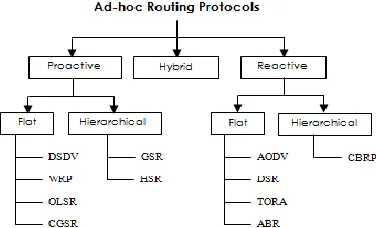
Classification of Ad hoc network protocols: According to the routing strategy, routing protocols can be categorized as Table-driven, On-demand driven and Hybrid (see Figure.2) while depending on the network structure they are classified as flat routing, hierarchical routing and geographic position assisted routing.
Figure 2 Classification of Routing protocols
Table-driven routing protocols (Proactive)
various existing proactive routing protocols. The areas in which they differ are the number of necessary routing tables and the methods by which changes in the network topology are broadcast. Example of proactive protocol is Destination-Sequenced Distance Vector (DSDV).
Destination Sequenced Distance Vector (DSDV) routing protocol is based on the Distributed Bellman-Ford algorithm with certain improvements. In DSDV, each route is tagged with a sequence number. The sequence numbers are generated by the destination. The sequence numbers indicates how old the route is. Each node manages its own sequence number. Every time each node assigns greater value to the sequence number than the old one. When a route update with a higher sequence number is received, the old route is replaced with the new route. In case of different routes with the same sequence number, the route with better metric is used. Either the full updates or incremental are transmitted periodically or immediately when any significant topology change is detected. To avoid fluctuations in route updates, DSDV employs a "settling time" data, which is used to predict the time when route becomes stable. In DSDV, broken link may be detected by the layer-2 protocol.
Cluster Gateway Switch Routing Protocol (CGSR) is a clustered multi hop wireless protocol based on code separation among clusters. The clusters are formed using different cluster head election algorithms. CGSR use Least Cluster Change (LCC) election algorithm for selecting the cluster head among a cluster. By using LCC cluster heads changes only when two clusters head comes into contact of each other or when a node moves out of contact of all cluster heads. The benefit of this scheme is that cluster head changes only when required. CGSR uses DSDV as an underlying scheme. Node is of three types in CGSR, first is cluster heads, second is cluster gateway and third is simple nodes in a cluster. A packet sent by a node in cluster is first sent to the cluster head of the cluster then to the gateway node which forwards it to another cluster head till the node reached to the destination node.
Figure3 CGSR routing example
In the Figure3 there are two clusters C1 and C2. In cluster C1 node A is cluster head and in C2 node C is cluster head. Node B represents the cluster gateway node. If any node in C1 wants to send packet to any node in C2 it first forwards the node to node A then node A forwards the packet to the node B which is cluster gateway, node B then forwards it to Node C cluster head of C2 which send the packet to destination node in its cluster. A token is used each time from every node which wants to send packet to another node.
neighbors of a node. RT contains up to date view of the network for all destinations. The LCT contains the cost of relaying message through each link. The MRL contains entry for every update message that is to be retransmitted and maintains a counter for each entry. When a node detects a link break it sends an update message to its neighbors with the link cost of the broken link set to infinity.
Optimized Link State Routing Protocol (OLSR) is a proactive protocol that is based on the concept of the link state algorithm. OLSR has been modified and optimized to efficiently operate MANET routing. The main concept is to adapt the changes of the network without creating control message overhead due to protocol flooding nature. So OLSR protocol consists only of subset of nodes named multipoint relays. These are responsible for broadcasting control messages and generating link state information. Secondly every MPR may chose to broadcast link state information only between itself and the nodes that have selected it as an MPR.
On-demand routing protocols (Reactive): A different approach from table-driven routing is on-demand routing. In this approach, a routing path is discovered only when the need arises. These are called reactive since it is not necessary to maintain routing information at the nodes if there is no communication. When a route to a destination is needed, a route discovery procedure is invoked. The discovery procedure ends either when a route has been found or no route available after examination of all the route permutations. The primary advantage of reactive routing is that the wireless medium is not subject to the routing overhead for the routes that may never be used.
Dynamic Source Routing Protocol (DSR) is one of the on-demand routing protocols that is based on the concept of source routing. It is designed to save the bandwidth consumed by periodic update messages required in table driven protocols. In source routing the sender node contains the complete list of the path of the destination node that the packet must travel. That is, every node in the path forwards the packet to its next hop specified in the header without checking its routing table as in table-driven routing protocols. DSR is a beaconless protocol so it does not requires periodic Hello packet. This saves a lot of network bandwidth.
Ad hoc On-demand Distance Vector Routing Protocol (AODV): To find routes, the AODV routing protocol uses a reactive approach and to identify the most recent path it uses a proactive approach. That is, it uses the route discovery process similar to DSR to find routes and to compute fresh routes it uses destination sequence numbers. The two phases of the AODV routing protocol are described below.
Route Discovery: In this phase, RREQ packets are transmitted by the source node in a way similar to DSR. The components of the RREQ packet include fields such as the source identifier (SId), the destination identifier (DId), the source sequence number (SSeq), the destination sequence number (DSeq), the broadcast identifier (BId), and TTL. When a RREQ packet is received by an intermediate node it checks availability of destination in its cache or forwards the RREQ packet. To avoid duplicate RREQ packets, the (SId, BId) pair is used. While forwarding the RREQ packet intermediate node adds the previous node’s address and Bid in packet header. A timer TTL is also maintained by the node for every entry in an order to delete an expired RREQ packet.
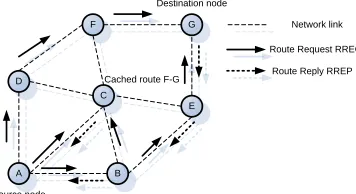
that node A wishes to forward a data packet to node G but it has not an available route in its cache. It then initiates a route discovery process by broadcasting a RREQ packet to all its neighboring nodes (B, C and D).
B C
E D
A
F G
Destination node
Source node
Network link Route Request RREQ
Route Reply RREP Cached route F-G
Figure4 Route discovery in AODV
All the SId, DId, SSeq, DSeq, BId, and TTL fields are inserted in the RREQ packet. When RREQ packet reaches to nodes B, C and D, these nodes immediately search their respective route caches for an existing route. In the case where no route is available, the intermediate node forwards the RREQ to their neighbor nodes only otherwise a comparison is made between the destination sequence number (DSeq) in the RREQ packet and the DSeq in its corresponding entry in the route cache. If the DSeq in the RREQ packet header is greater it replies to the source node with a RREP packet consisting of the route to the destination. In Figure 5, node C gets a route to G in its cache and its DSeq is greater when compared with that in the RREQ packet, it then sends a RREP back to the source node A. A RREP is also sent back by the destination node to the source. One possible route is A-B-E-G. The intermediate nodes on the path from source to destination make an update on their routing tables with the latest DSeq in the RREP packet.
Route Maintenance
The way that the route maintenance mechanism works is described below. Whenever a node finds out a link break, it broadcasts an RERR packet same as in DSR, to notify the source and the destination. This process is described in Figure5. If the link between nodes C and F breaks RERR packets will be sent by both nodes F and C to notify the source and the destination nodes. The main advantage of AODV is the avoidance of source routing to reduce the routing overload in a large network. Another good feature of AODV is its application of expanding-ring-search to control the flood of RREQ packets and expanding-ring-search for routes to unknown destinations. It also supplies destination sequence numbers, allowing the nodes to have more up-to-date routes. However, some notes have to be taken into consideration when using AODV. Firstly, it requires bidirectional links and periodic Hello messages to detect neighbors. Secondly, it needs to maintain routing tables for route maintenance which is not required in DSR.
B C
E D
A
F G
X
Destination node
Source node
X
Broken link Route from A to G
Route error RERR
Temporally-Ordered Routing Algorithm (TORA) is a self adaptive, efficient and scalable distributed routing protocol based concept of link reversal. It is mostly used for high speed and high dynamic wireless network. It is a source-initiated on demand routing protocol and find multiple routes to the destination from source node. The process consists of discovery, maintenance and deletion of routes. The unique feature of TORA is that the control messages are localized to a very small set of nodes near the occurrence of topological change. So each node maintains routing information about adjacent nodes. The route discovery is same as other protocols. During its initialization the ID of destination is set to 0. Then source node broadcast a QRY require including ID of the destination. The DAG (Direct Acyclic Graph) algorithm is applied. For creating new route when topology changes the new QRY require is broadcasted among the affected nodes. Due to this feature protocol reacts only when all the routes to the destination lost. The TORA deletes invalid routes by broadcasting a CLR require during routing deletion.
Associativity-Based Routing (ABR) is a distributed on-demand routing protocol based on the stability of wireless links. It is a beacon-based routing protocol. It is free from loops, packet duplicates and deadlocks. In ABR routes are selected based on associativity of nodes and temporal stability of wireless links connecting the nodes. The temporal stability is determined by counting the periodic beacon messages that a node receives from its neighbors. Each node in the network maintains the beacon count from its neighbors and classifies a link as a stable or unstable based on that beacon count. The link corresponding to a stable neighbor is termed as a stable link and to a unstable neighbor as a unstable link. The main objective to ABR is to find longer-lived routes for ad hoc networks. The three phases in ABR are: Route discovery, Route construction and Route deletion. A source node floods Route Request packet through the network, the packet carries the path it has traversed and the beacon count for the corresponding node in the path.
Hybrid routing protocols
Protocols belonging to this category combine the best features of the above two categories. Nodes within a certain distance from the node concerned, or with in a particular geographical region, are said to be in the routing zone of the given node. For routing in the zone, a table driven approach is used. For nodes that are beyond the zone, a demand driven approach is used. Main hybrid routing protocol is ZRP.
Zonal Routing Protocol (ZRP) combines the advantages of both reactive and pro-active protocols into a hybrid scheme, taking advantage of pro-active discovery within a node's local neighborhood, and using a reactive protocol for communication between these neighborhoods. The ZRP is not so much a distinct protocol as it provides a framework for other protocols. The separation of a nodes local neighborhood from the global topology of the entire network allows for applying different approaches - and thus taking advantage of each technique's features for a given situation. By dividing the network into overlapping, variable-size zones, the Zone Routing Protocol consists of several components, which only together provide the full routing benefit to ZRP.
route optimization through the removal of redundant routes and the shortening of routes if a route with fewer hops has been detected, as well as bypassing link-failures through multiple hops.
Inter zone Routing Protocol (IERP) takes advantage of the known local topology of a node's zone and, using a reactive approach enables communication with nodes in other zones.When there is request for a route, Route queries within the IERP are issued. The delay caused by the route discovery is minimized through the use of broadcasting, an approach in which the node does not submit the query to all local nodes, but only to it's peripheral nodes. A node does not send a query back to the nodes the request came from, even if they are peripheral nodes. It is necessary to disable pro-active updates for local routes to convert an existing reactive routing protocol for use as the IERP in the ZRP.
Conclusion
In this paper a modified DSR to define the occurrence of congestion by monitoring multiple resource utilization thresholds as QoS attribute to improve quality of service in MANET. DSR and AODV leave more space for data packets so have low variation and independent from number of connection in terms of packet delay variation. In routing overhead OLSR has different behavior from other two protocols and DSR ha low routing overhead than AODV. AODV showed less sending time than DSR however both protocols showed comparable performance in other parameters. Throughput and packet dropped rapidly increased when the packet size increased. DSR has shown better efficiency. The drawback of this evaluation was that they considered lesser number of nodes for simulation.
REFERENCES
[1]. Mobile Ad-hoc Networks (MANET).
URL:http://www.ietf.org/html.charters/manet-charter.html.(1998-11-29).
[2]. Martha Steenstrup, “Routing in communication networks”. New Jersey, Prentice Hall, ISBN 0-13-010752-2.
[3]. C.E. Perkins, E. Royer and S.R. Das. “Ad hoc on demand distance vector (AODV) routing", Internet Draft, March 2000.
[4]. C.-K. Toh. “Ad Hoc Mobile Wireless Networks: Protocols and Systems”, Prentice Hall
publishers, December 2001, ISBN 0130078174.
[5]. Sachin Dnyandeo Ubarhande, “Performance Evolution of AODV and DSR Routing Protocols In MANET using NS2”, International Journal of Scientific & Engineering Research Volume 3, Issue 5, May-2012.
[6]. Amit N. Thakare and Mrs. M.Y. Joshi, “Performance Analysis of AODV and DSR Routing Protocol in Mobile Ad hoc Networks”, IJCA Special Issue on “Mobile Ad-hoc Networks”MANETs, 2010, pp. 211-217.
[7]. DHOPTE S.V. and SAVANKAR R.S., “THE DYNAMIC SOURCE ROUTING PROTOCOL IN MANET TO AVOID DIFFERENT ATTACKS”, International Journal of Wireless Communication, Vol. 2, Issue 1, 2012, pp. 20-25.
[9]. Matulya Bansal and Gautam Barua, “Performance Comparison of Two On-Demand Routing Protocols for Mobile Ad hoc Networks”, ICPWC, 2002.
[10]. D B. Johnson, D A. Maltz, and Y. Hu. “The dynamic source routing protocol for mobile ad hoc networks", Internet-Draft, April 2003.
[11]. Mishra Amitabh, Nadkarni Ketan M., and Ilyas Mohammad. “Chapter 30: Security in wirelessad-hocnetworks,the handbook of Adhoc wirelessnetwork”,CRC PRESS Publisher, 2003. [12]. Morshed U. Chowdhury, Dharani Perera and Thao Pham,” A Performance Comparison of Three Wireless Multi hop Ad-hoc Network Routing Protocols when Streaming MPEG4 traffic”, in INMIC 2004.
[13]. Rajiv Mishra and C.R. Mandal,” Performance Comparison of AODV/DSR On-demand Routing Protocols for Ad Hoc Networks in Constrained Situation”, in ICPWC 2005.
![Figure 1 Overview of Mobile Ad-hoc Network [11]](https://thumb-us.123doks.com/thumbv2/123dok_us/1946001.1256026/2.612.278.395.138.202/figure-overview-mobile-ad-hoc-network.webp)