SC2000 Block Cipher
⋆Jiqiang Lu
D´epartement d’Informatique, ´Ecole Normale Sup´erieure, 45 Rue d’Ulm, Paris 75005, France
Abstract. The SC2000 block cipher has a 128-bit block size and a user key of 128, 192 or 256 bits, which employs a total of 6.5 rounds if a 128-bit user key is used. It is a CRYPTREC recommended e-government ci-pher. In this paper we describe two 4.75-round differential characteristics with probability 2−126of SC2000 and seventy-six 4.75-round differential characteristics with probability 2−127. Finally, we present a differential cryptanalysis attack on a 5-round reduced version of SC2000 when used with a 128-bit key; the attack requires 2125.68 chosen plaintexts and has a time complexity of 2125.755-round SC2000 encryptions. It suggests for the first time that the safety margin of SC2000 with a 128-bit key de-creases below one and a half rounds.
Key words: Cryptology, Block cipher, SC2000, Differential cryptanal-ysis
1
Introduction
SC2000 [2] is a 128-bit block cipher with a user key of 128, 192 or 256 bits, which employs a total of 6.5 rounds for a 128-bit user key, and a total of 7.5 rounds for a 192 or 256-bit key. It was designed to “have high performance on a wide range of platforms from the low-end processors used in smart cards and mobile phones to the high-end ones that will be available in the near future by suitably implementing it in each platform, and also to have high security” [3]. In 2002, SC2000 became a CRYPTREC recommended e-government cipher [4], after a thorough analysis of its security and performance. In the field of block cipher cryptanalysis, an exhaustive key search (i.e. brute force search) attack is usually assumed to be the best generic attack, and a cryptanalytic attack is commonly regarded as effective if it is faster (i.e. it has lower time complexity) than exhaustive key search. Below we consider the version of SC2000 that uses 128 key bits.
⋆ This work as well as the author was supported by the French ANR project SAPHIR
Table 1.Cryptanalytic results on SC2000
Attack T ype Rounds Data T ime Source
Boomerang attack 3.5 267ACPC 2116.74Encryptions† [7] Rectangle attack 3.5 284.6 CP 2116.74Encryptions† [7] Linear attack 4.5 2104.3 KP 2121.33Encryptions† [12] Differential attack 4.5 2111 CP 2118.33Encryptions† [6]
4.5 2104 CP 2121.33Encryptions† [12] 5 2125.68CP 2125.75Encryptions This paper
†: The complexity is for obtaining the user key by using Property 1 in Section 3 of this paper.
The SC2000 designers first analysed the security of SC2000 against differen-tial cryptanalysis [5] as well as certain other cryptanalytic techniques. In 2001, Raddum and Knudsen [6] presented a differential attack on 4.5-round SC2000, which is based on two 3.5-round differential characteristics with probabilities 2−106 and 2−107, respectively. In 2002, by exploiting a few short differentials with large probabilities, Biham et al. [7] presented boomerang [8, 9] and rect-angle [10] attacks on 3.5-round SC2000, following the work described in [11]. In the same year, Yanami et al. [12] described a 2-round iterative differential characteristic with probability 2−58, and obtained a 3.5-round differential char-acteristic with probability 2−101by concatenating the 2-round differential twice and then removing the first half round; finally they presented a differential tack on 4.5-round SC2000 with a time complexity smaller than that of the at-tack of Raddum and Knudsen. Yanami et al. also presented linear [13] atat-tacks on 4.5-round SC2000. The attacks on 4.5-round SC2000 are the best previously published cryptanalytic results on SC2000 in terms of the numbers of attacked rounds.
The remainder of this paper is organised as follows. In the next section, we give the notation, and describe the SC2000 block cipher and differential crypt-analysis. In Section 3, we discuss how to recover the user key from a few subkey bits of SC2000. In Section 4, we give the 4.75-round differential characteristics. In Section 5, we present our differential attack on 5-round SC2000. Section 6 concludes the paper.
2
Preliminaries
In this section we give the notation used throughout this paper, and then briefly describe the SC2000 block cipher and differential cryptanalysis.
2.1 Notation
In all descriptions we assume that the bits of an-bit value are numbered from 0 to
n−1 from left to right, the most significant bit is the 0-th bit, a number without a prefix expresses a decimal number, and a number with prefix 0xexpresses a hexadecimal number. We use the following notation.
⊕ bitwise logical exclusive OR (XOR) operation
∧ bitwise logical AND operation
addition modulo 232
subtraction modulo 232
multiplication modulo 232
≪ left rotation of a bit string
⌊x⌋ the largest integer that is less than or equal tox
◦ functional composition. When composing functions X and Y, X◦Y deno-tes the function obtained by first applying X and then applying Y
◃▹ exchange of the left and right halves of a bit string
X bitwise logical complement of a bit string X
2.2 The SC2000 Block Cipher
SC2000 takes as input a 128-bit plaintext. For simplicity, we describe the plain-textP as four 32-bit words (d, c, b, a). The following three elementary functions
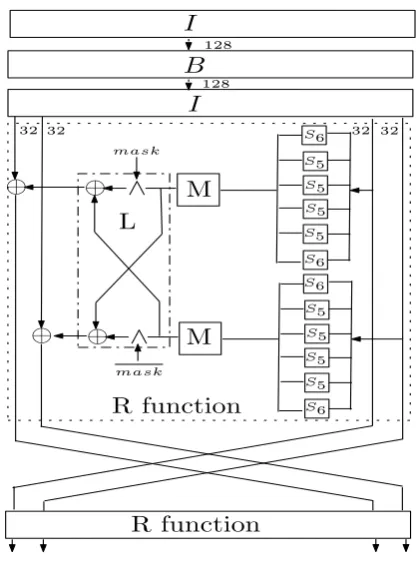
I, B and R are used to define the SC2000 round function; as shown in Fig. 1 the round function of SC2000 is made up of twoIfunctions, oneBfunction and twoR functions.
– TheIfunction: the bitwise logical XOR (⊕) operation of the 128-bit input with a 128-bit round subkey of four 32-bit words.
– TheB function: a non-linear substitution, which applies the same 4×4 S-boxS4 32 times in parallel to the input. For a 128-bit input (d′, c′, b′, a′), the output (d′′, c′′, b′′, a′′) is obtained in the following way: (d′′k, c′′k, b′′k, a′′k) =
⊕
⊕
∧
⊕
∧
B
S6
S6 S6
S6 S5 S5 S5
S5
S5
S5 S5
S5
32
32 32 32
M
M
⊕
L
mask
mask
R function
I
I
128128
R function
Fig. 1.The round function of SC2000
SC2000 (with a 128-bit key) uses a total of fourteen 128-bit subkeys Ki l,
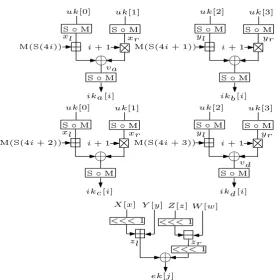
(0 ≤ i ≤ 6, l = 0,1), all derived from a user key of four 32-bit words long (uk[0], uk[1], uk[2], uk[3]). The key schedule is as follows; the intermediate-key generation function and the extended-key generation function are shown picto-rially in Fig. 2.
S◦M S◦M
⊕
S◦M
ika[i]
i+ 1 M(S(4i))
uk[0] uk[1]
S◦M S◦M
⊕
S◦M
ikb[i]
i+ 1 M(S(4i+ 1))
uk[2] uk[3]
S◦M S◦M
⊕
S◦M
ikc[i]
i+ 1 M(S(4i+ 2))
uk[0] uk[1]
S◦M S◦M
⊕
S◦M
ikd[i]
i+ 1 M(S(4i+ 3))
uk[2] uk[3]
⊕
ek[j]
X[x] Y[y] Z[z]W[w] <<< 1 <<< 1
zl zr
<<< 1
xl xr yl yr
xl xr yl yr
va
vd
Fig. 2.Intermediate-key and extended-key generation functions
1. Generate 12 intermediate keysika[i], ikb[i], ikc[i], ikd[i] by the
intermediate-key generation function, (i= 0,1,2):
ika[i] =M(S((M(S(uk[0]))M(S(4×i)))⊕(M(S(uk[1]))(i+ 1)))),
ikb[i] =M(S((M(S(uk[2]))M(S(4×i+ 1)))⊕(M(S(uk[3]))(i+ 1)))),
ikc[i] =M(S((M(S(uk[0]))M(S(4×i+ 2)))⊕(M(S(uk[1]))(i+ 1)))),
ikd[i] =M(S((M(S(uk[2]))M(S(4×i+ 3)))⊕(M(S(uk[3]))(i+ 1)))).
– s=jmod 9;
– t= (j+⌊36j ⌋) mod 12;
– X =Order[0][t], Y =Order[1][t], Z=Order[2][t], W =Order[3][t]; – x=Index[0][s], y=Index[1][s], z=Index[2][s], w=Index[3][s]; – ek[j] = ((X[x]≪1)Y[y])⊕(((Z[z]≪1)W[w])≪1), wheres, t, X, Y, Z, W, x, y, z, ware variables,
Order[4][12] =
ika ikb ikc ikdika ikb ikc ikd ika ikb ikc ikd
ikb ika ikdikc ikc ikdika ikb ikdikc ikb ika
ikc ikd ika ikb ikd ikc ikb ika ikb ikaikd ikc
ikd ikc ikb ika ikb ika ikd ikc ikc ikdika ikb ,
and
Index[4][9] =
0 1 2 0 1 2 0 1 2 0 1 2 1 2 0 2 0 1 0 1 2 0 1 2 0 1 2 0 1 2 1 2 0 2 0 1
.
3. Ki
l = (ek[8i+ 4l], ek[8i+ 4l+ 1], ek[8i+ 4l+ 2], ek[8i+ 4l+ 3]).
The full 6.5-round encryption procedure of SC2000 can be described as:IK0 0◦
B◦IK0
1◦R5◃▹ R5◦IK01◦B◦IK11◦R3◃▹ R3◦IK02◦B◦IK12◦R5◃▹ R5◦IK03◦B◦
IK3
1◦R3◃▹ R3◦IK04◦B◦IK14◦R5◃▹ R5◦IK05◦B◦IK15◦R3◃▹ R3◦IK06◦B◦IK16. Note that we refer to the first round as Round 0.
We writeKli for the subkey used in thel-thIfunction of Roundi, and write
Kl,ji for the j-th bit ofKli, where 0≤i≤6, l = 0,1,0≤j ≤127. We number the 32S4 S-boxes in aB function from 0 to 31 from left to right.
2.3 Differential Cryptanalysis
Differential cryptanalysis was introduced in 1990 by Biham and Shamir [14]; it was the first cryptanalytic method more effective than an exhaustive key search to be proposed for the full DES [15] block cipher [5]. A similar method was used a little earlier by Murphy [16] to analyse the FEAL block cipher [17].
Differential cryptanalysis takes advantage of how a specific difference in a pair of inputs of a cipher can affect a difference in the pair of outputs of the cipher, where the pair of outputs are obtained by encrypting the pair of inputs using the same key. The notion of difference can be defined in several ways; the most widely discussed is with respect to the XOR operation. The difference between the inputs is called the input difference, and the difference between the outputs of a function is called the output difference. The combination of the input difference and the output difference is called a differential. The probability of a differential is defined as follows.
Definition 1. SupposeE is an n-bit block cipher and K∈ {0,1}k is a key for E. If x and y are n-bit blocks, then the probability of the differential (x, y)for E, written ∆x→∆y, is defined to be
PrEk(∆x→∆y) = Pr
The following result follows trivially from Definition 1:
Proposition 1. If E is ann-bit block cipher, and K∈ {0,1}k is a key for E,
andxandy are n-bit blocks, then
PrEk(∆x→∆y) =|{P|Ek(P)⊕Ek(P⊕x) =y, P ∈ {0,1}
n}|
2n .
For a random function, the expected probability of a differential for any pair (x, y) is 2−n. Therefore, if Pr
Ek(∆x→∆y) is larger than 2−
n, we can use the
differential to distinguishEk from a random function, given a sufficient number
of chosen plaintext pairs.
Proposition 1 gives the accurate probability values of a differential from a theoretical point of view. However, it is usually hard to apply it to a block cipher with a large block size in reality, for example, n = 64 or 128 which is currently being widely used, and even harder when the differential operates on many rounds of the cipher. In practice, a multi-round differential is usually obtained by concatenating a few one-round differentials, and the probability of the multi-round differential is regarded as the product of the probabilities of the one-round differentials under the following Assumption 1.
Assumption 1 The round keys are independent and uniformly distributed.
Assumption 1 connotes that the involved rounds are treated as independent. Usually, the round keys are actually dependent, being generated from a global user key under the key schedule algorithm of the cipher. As mentioned in [18], this is “most often not exactly the case, but as often it is a good approximation”. In 2008, Sel¸cuk [20] formulated the success probability of a differential crypt-analysis attack, as follows.
Theorem 1 (from [20]). For a differential attack on m key bits that uses
a differential with probability p and N plaintext-ciphertext pairs and ranks the
correctm-bit key value among the toprout of the2mpossible key values, ifpris
the average probability that a given key value is suggested by a randomly chosen pair with the input difference, then under the assumption that the counters for
the 2m possible key values are independent and are identically distributed for all
wrong key values, the success probability of the attack, denoted byPS, is.
PS =Φ(
√
µ×SN√−Φ−1(1−2−v)
SN+ 1
),
whereµ=p×N,SN = pp
r,v=m−log r
2, andΦ(·)is the cumulative distribution
function of the standard normal distribution.
3
How to Recover the User Key from a Few Subkey Bits
of SC2000
In general, a successful differential attack can reveal a few subkey bits of the attacked cipher, and a step after that is to deduce the user key from the subkey bits obtained. This can be easily done by exhaustive search when the cipher has such a key schedule that its constituent operations are invertible, e.g., the DES [15] and AES [21] block ciphers, but nevertheless it is tough for SC2000 — We cannot invert the operations for computing a round subkey to get the corresponding user key. None of the previously published works has addressed this problem, and Raddum and Knudsen mentioned in [6]: “The strong key schedule in SC2000 prevents us from actually breaking 4.5 rounds by searching exhaustively for the remaining 96 bits in the first or last round key”.
We assume that the time complexity of a SC2000 encryption/decryption is evaluated by the numbers of B and S operations, and the time complexity of a computation of the key schedule is evaluated by the number of S operations. An optimised computation of the key schedule involves a minimum of 16S op-erations, and a one-round SC2000 encryption/decryption involves 1Boperation and 4 S operations. Thus, a computation of the key schedule is not negligible compared with an encryption/decryption, and from the designers’ performance evaluation in [2] we know that it takes more time than a full-round encryp-tion/decryption.
It looks like that every subkey bit of SC2000 depends on the entire 128 bits of the user key. The seemingly only solution is to try each of the 2128 possible values for the user key, and we check whether it can generate the obtained subkey bits by the key schedule of SC2000; if so, then we further test it with trial encryptions using one or more known plaintext-ciphertext pairs, and if it passes this test then the trial value is very likely to be the correct key value. This solution requires a negligible memory complexity and has a time complexity of 2128computations for the extened key(s) containing the concerned subkey bits. An alternative solution is to precompute and maintain a table of the concerned subkey bits for all the 2128possible values of the user key, and given the obtained subkey bits, we can find out the possible key values by looking up in the table; the correct key value can be further identified with a trial encryption. This solution requires a 2128128-bit memory, which is also very costly. However, we find that there exists a better way in certain circumstances, and our result is given as follows.
Property 1 For a q-round SC2000 with 128 key bits (1 ≤ q ≤ 6.5), if an
extended key ek[·] whose intermediate-key inputs X[·], Y[·] belong to the set
{ika[·], ikc[·]} or {ikb[·], ikd[·]} andhother subkey bits are known (h≥0), then
the correct value for (uk[0], uk[1], uk[2], uk[3]) can be obtained with an expected
time complexity of approximately(5×296+4×⌊296−h⌋)Soperations and⌊296−h⌋
q-round SC2000 encryptions (provided that a known plaintext-ciphertext pair is
available).
Proof.Without loss of generality, we assume thatek[51] andhbits ofek[50] are given, here 0≤h≤32. Observe that the intermediate-key inputs forek[51] are
{ika[·], ikc[·]}. Let us consider the following algorithm for obtaining the correct
value for (uk[0], uk[1], uk[2], uk[3]).
1. Define six 32-bit constantsc0, c1,· · ·, c5, six unknown 32-bit constantsxl, xr,
yl, yr, zl, zrand two 32-bit variables va, vd, (see Fig. 2).
c0=M(S(0)), c1=M(S(10)), c2=M(S(3)),
c3=M(S(9)), c4=M(S(2)), c5=M(S(11)),
xl=M(S(uk[0])), xr=M(S(uk[1])),
yl=M(S(uk[2])), yr=M(S(uk[3])),
zr= (ika[0]≪1)ikc[2], zl= (ikd[0]≪1)ikb[2].
2. Guess a value forzl, then computezr= (zl⊕ek[51])≪1, and perform the
following two sub-steps in parallel.
(a) Guess a value for ika[0], compute va = S−1(M−1(ika[0])), and do as
follows.
i. Guess a value forxl, and computexr= (xlc0)⊕va.
ii. Check whether (xl, xr) meets the following condition (1):
(ika[0]≪1)M(S((xlc1)⊕(xr3))) =zl. (1)
If not, repeat Step 2(a)-(i) with another guess for xl, (repeat the
above step if all the possible guesses are tested in a step).
(b) Guess a value for ikd[0], compute vd = S−1(M−1(ikd[0])), and do as
follows.
i. Guess a value foryl, and computeyr= (ylc2)⊕vd.
ii. Check whether (yl, yr) meets the following condition (2):
M(S((ylc3)⊕(yr3)))zr= (ikd[0]≪1). (2)
If not, repeat Step 2(b)-(i) with another guess for yl, (repeat the
above step if all the possible guesses are tested in a step).
3. For each value (xl, xr) passing Step 2(a)-(ii) and each value (yl, yr) passing
Step 2(b)-(ii), check whether the resulting value for (xl, xr, yl, yr) can
pro-duce a match with the givenhbits ofek[50]. If so, execute Step 4 with the value for (xl, xr, yl, yr); otherwise, repeat Step 2 with another guess.
4. For the value (xl, xr, yl, yr) passing Step 3, compute
uk[0] =S−1(M−1(xl)), uk[1] =S−1(M−1(xr)),
uk[2] =S−1(M−1(yl)), uk[3] =S−1(M−1(yr)),
The algorithm requires a negligible memory. For each guess of (zl, ika[0])
in Step 2(a), it is expected that there is only 1 = 232×2−32 value for (x
l, xr)
meeting condition (1); and for each guess of (zl, ikd[0]) in Step 2(b), it is expected
that there is only 1 = 232×2−32value for (y
l, yr) meeting condition (2). Thus, it
is expected that there are 232×232×232= 296 possible values for (x
l, xr, yl, yr)
in Step 3. On average, 296×2−h= 296−h possible values for (x
l, xr, yl, yr) will
pass Step 3. Step 2(a) has a computational complexity of approximately 232× 232×232 = 296 S operations, and so is Step 2(b). Step 3 has a computational complexity of approximately 232×232×232×4 = 298 S operations. Step 4 has a computational complexity of approximately 296−h×4 = 298−h S−1operations and 296−h trial encryptions. Since Steps 2(a) and 2(b) are executed in parallel, the algorithm has a total time complexity of approximately 296+ 298+ 298−h= (5 + 22−h)×296S operations and 296−h q-round SC2000 encryptions.
The result follows trivially when we observe that ifh >96 there is no need to do a trial encryption in Step 4.
Note that Property 1 is mainly due to the observation that the left two intermediate-key inputs for ek[·] are dependent on a different set of 64 user-key bits from the right two intermediate-key inputs.
We now apply Property 1 to some previously published cryptanalytic results on SC2000:
– Biham et al.’s boomerang and rectangle attacks on 3.5-round SC2000 [7] retrieved 10 bits for each of the eight extended keysek[0], ek[1], ek[2], ek[3], ek[28], ek[29], ek[30], ek[31]. After a simple analysis, we know that each of
ek[28], ek[29], ek[30], ek[31] meets the condition that the intermediate-key inputsX[·], Y[·] belong to the set {ika[·], ikc[·]} or {ikb[·], ikd[·]}. Thus, we
have 222possible values for each of the four extended keys andh= 70 in this attack, and it is expected to take approximately 5×296×222×1
4× 1 3 ≈2
116.74
3.5-round SC2000 encryptions to obtain the user key from the 80 subkey bits. – Raddum and Knudsen’s differential attack on 4.5-round SC2000 [6] retrieved 8 bits for each of the eight extended keysek[0], ek[1], ek[2], ek[3], ek[36], ek[37], ek[38], ek[39], a total of 64 subkey bits. Among the eight extended keys, only
ek[39] meets the condition that the intermediate-key inputsX[·], Y[·] belong to the set{ika[·], ikc[·]}or{ikb[·], ikd[·]}. Thus, there are 224possible values
forek[39] andh= 56 in this attack, so it is expected to take approximately 5×296×224×41×14 ≈2118.33 4.5-round SC2000 encryptions to obtain the user key from the 64 subkey bits.
– Yanami et al.’s differential attack on 4.5-round SC2000 [12] retrieved 5 bits for each of the eight extended keysek[0], ek[1], ek[2], ek[3], ek[36], ek[37], ek[38], ek[39], and their linear attacks on 4.5-round SC2000 retrieved 5 bits for each of the eight extended keysek[0], ek[1], ek[2], ek[3], ek[36], ek[37], ek[38], ek[39] or for each of the four extended keysek[36], ek[37], ek[38], ek[39]. Sim-ilarly, we learn that it is expected to take approximately 5×296×227×1
4
4.75-Round Differential Characteristics of SC2000
In this section we describe the 4.75-round differential characteristics.
⊕ ⊕ S M S M S S M M ⊕ ⊕ S M S M S S M M ⊕ S M S M ⊕ ⊕ S M S M S S M M ⊕ S M S M ⊕ S M S M
I◦B◦I
I◦B◦I
I◦B◦I
I◦B◦I
I◦B◦I
L3 L3 L3 L3 L3 L5 L5 L5 L5
(0x01124400,0)
(0x01124400,0,0,0)
(0x01124400,0x00020000,0,0x01124400) (0x01120000,0x01124400,0x01124400,0)
(0,0x01124400,0,0)
(0,0)
(0x01124400,0,0,0)
(0x01124400,0,0,0)
(0x01124400,0x00020000,0,0x01124400)
(0x01124400,0,0,0x01124400)
(0,0x01124400,0,0)
(0x01120000,0x01124400,0x01124400,0) 2−10
1
2−16
2−16
2−16
2−16
1
1
1
1 2−15
2−11
2−11
2−15
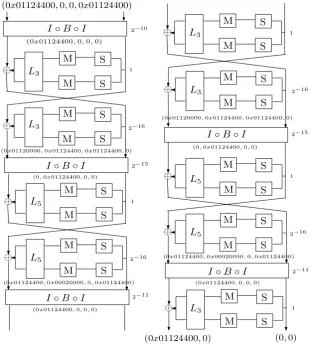
Fig. 3.A 4.75-round differential characteristic with probability 2−126
4.1 2-Round Iterative Differential Characteristic of Yanami et al.
In 2002, Yanami et al. [12] described the results of a search over all the possible two-round iterative differential characteristics with only one activeS function in every round for any two consecutive roundsI◦B◦I◦R5◃▹ R5◦I◦B◦I◦R3◃▹
(i.e. that with the highest probability) is (α, β, β,0) → (α, β, β,0) with prob-ability 2−58: (α, β, β,0) I◦B−→◦I/2−15 (0, β,0,0) R5◃▹R5/2−16
−→ (β, γ,0, β) I◦B◦I/2 −11
−→
(β,0,0,0)R3◃▹R3/2 −16
−→ (α, β, β,0), whereα= 0x01120000,β = 0x01124400 and
γ= 0x00020000.
4.2 The 4.75-Round Differential Characteristics
As a result, we can obtain a 4-round differential characteristic (α, β, β,0) → (α, β, β,0) with probability 2−116 by concatenating the above two-round iter-ative differential twice. It is essential to try to exploit an efficient (i.e. with a relatively high probability) differential operating over more than four rounds in order to break more rounds of SC2000. However, this 4-round differential cannot be extended to a differential characteristic operating over more than four rounds with a probability larger than 2−128, as appending even a half round R
3◃▹ R3 at the beginning will cost a probability of 2−16and appending aB function at the end will cost at least a probability of 2−13.
Nevertheless, observe that from the above two-round iterative differential characteristic it follows that two-round iterative differential characteristic (β, γ,0, β) → (β, γ,0, β) for any two consecutive rounds I ◦B ◦I ◦R3 ◃▹ R3 ◦I◦
B ◦I◦R5 ◃▹ R5 also holds with a probability of 2−58: (β, γ,0, β)
I◦B◦I/2−11
−→
(β,0,0,0) R3◃▹R3/2 −16
−→ (α, β, β,0)I◦B◦I/2 −15
−→ (0, β,0,0) R5◃▹R5/2 −16
−→ (β, γ,0, β). It might seem counter-intuitive at first, but there is a major difference between this and the previous iterative 2-round differential characteristic: we can ap-pend a 0.75-round differential characteristic (β, γ,0, β)I◦B◦I◦R3
→ (β,0,0,0) with a probability of 2−11 at the end of this differential characteristic! Therefore, we can obtain a 4.75-round differential characteristic (β, γ,0, β)→(β,0,0,0) with probability 2−127. Further, by changing the input difference to the difference (β,0,0, β) we can get a 4.75-round differential characteristic with probability 2−126: (β,0,0, β)→(β,0,0,0), and this 4.75-round differential characteristic is depicted in Fig. 3. Additionally, by changing the output difference of the last
B function of the 4.75-round differential characteristic with probability 2−126to (θ, ϕ,0,0), where θ = 0x01104400 and ϕ = 0x00020000, we get another 4.75-round differential characteristic with probability 2−126: (β,0,0, β)→(θ, ϕ,0,0). When we change the output difference for only one of the four active S-boxes (7,11,17,21) in the last B function of the two 4.75-round differential character-istics with probability 2−126 to a value in {0x4,0xC}, we get a total of six-teen 4.75-round differential characteristics with probability 2−127. We denote by Θ the set of the output differences of the two 4.75-round differential char-acteristics with probability 2−126 and the sixteen 4.75-round differential char-acteristics with probability 2−127. Note that when we change the input differ-ence for only one of the five active S4 S-boxes in the first B function of the two 4.75-round differential characteristics with probability 2−126 to a value in
S4 S-box is given in [12], and the differential distribution table of the S5 S-box is shown in Table 2 in Appendix A. (The characteristics do not make an active
S6 S-box, so we do not give its differential distribution table.)
In a natural way, we might try to find a better differential characteristic on greater than four rounds by first exploiting short differentials with similar structures and then concatenating them, for the above 4.75-round differential obtained from the two-round iterative differential is just a special case among these. Motivated by this idea, we perform a computer search over all the possi-ble differentials for such one roundR ◃▹ R◦I◦B◦I with only oneRfunction active and the right two bit input differences and one of the left two 32-bit input differences being zero; moreover, in order to ensure that the resulting differential is capable of being concatenated with itself, we also require that the right two 32-bit output words and one of the left two 32-bit output words have a zero difference. Surprisingly, we find that the differential characteristics
(β,0,0,0) R3◃▹R−→3◦I◦B◦I
(0, β,0,0) and (0, β,0,0) R5◃▹R−→5◦I◦B◦I
(β,0,0,0) in the above two-round iterative differential are the best (i.e. with the highest prob-abilities) among those with the same forms, respectively. Our search for other similar forms gives no better result.
5
Differential Attack on 5-Round SC2000
In this section, we present a differential cryptanalysis attack on the following 5 rounds of SC2000 when used with a 128-bit key: IK1
0 ◦B◦IK11 ◦R3 ◃▹ R3◦
IK2
0 ◦B ◦IK12 ◦R5 ◃▹ R5◦IK03 ◦B◦IK31 ◦R3 ◃▹ R3◦IK04 ◦B ◦IK14 ◦R5 ◃▹
R5◦IK5
0 ◦B◦IK15◦R3◃▹ R3◦IK06. 1
5.1 Preliminary Results
First observe that the output differences inΘ have a constant zero value in 54 bit positions of the left half and have a zero value in the 64 bit positions of the right half. Among the remaining 10 bit positions of the left half, there are a total of 18 possible values, corresponding to the 18 output differences inΘ; we denote byΓthe set of the 18 possible values. The left half of an output difference inΘ will become the right half of the output difference after the followingR3◦IK6 0 operation.
On the other hand, having known the 128-bit difference after theIK6
0 function for a ciphertext pair, we only need to guess the 64 subkey bits (K6
0,64,· · ·, K06,127) ofK6
0to check whether this pair could produce an expected difference just before the adjacentR3function. In our case, for a candidate difference whose right half is equal to the left half of one difference inΘ, we only need to guess at most the 40 subkey bits (K6
0,70,· · ·, K06,89, K06,102,· · ·, K06,121) corresponding to the eight
S5 S-boxes in the adjacentR3 function to determine whether a ciphertext pair with a candidate difference could produce one of the output differences of the eighteen 4.75-round differential characteristics.
1
5.2 Attack Procedure
By using the eighteen 4.75-round differential characteristics with input difference (β,0,0, β), we can mount a differential attack on the 5-round SC2000. The attack procedure is as follows.
1. Initialize 240 counters for the 240 possible values of the 40 subkey bits (K6
0,70,· · ·, K06,89, K06,102,· · ·, K06,121) in theIK6
0 function.
2. Choose 2124.68plaintext pairs with difference (β,0,0, β). In a chosen-plaintext attack scenario, obtain the corresponding ciphertexts for every plaintext pair, and do as follows.
(a) Check whether the ciphertext pair has a zero difference in the following 54 bit positions of the right half: (0, 1, · · ·, 6, 8,· · ·, 10, 12, 13, 15, 16, 18,· · ·, 20, 22,· · ·, 38, 40,· · ·, 42, 44, 45, 47, 48, 50,· · ·, 52, 54,· · ·, 63). If so, execute Step 2(b); otherwise, discard it.
(b) Check whether the ciphertext pair has a difference belonging toΓin the 10 bit positions (7, 11, 14, 17, 21, 39, 43, 46, 49, 53) of the right half. If so, execute Step 2(c); otherwise, discard it.
(c) For each possible value of the 40 subkey bits, partially decrypt the ci-phertext pair through theIK6
0 function and the eightS5 S-boxes in the adjacent R3 operation, compute the 64-bit difference just after the L3 operation in theR3 operation, then XOR it with the left 64-bit differ-ence of the ciphertext pair, and finally check whether the resultant 64-bit difference is zero. If so, increase 1 to the counter corresponding to the possible value for the 40 subkey bits.
3. For the values of (K06,70,· · ·, K06,89, K06,102,· · ·, K06,121) corresponding to the 2r counters with the top 2rnumbers, (a specific value ofrwill be given be-low), compute possible values forek[51], and apply the algorithm in Section 3 to find the correct user key.
5.3 Complexity Analysis
The attack requires 2125.68 chosen plaintexts, and requires about 240 bytes of memory, used for the 240 counters. It is expected that 2124.68×2−54 = 270.68 ciphertext pairs pass the condition in Step 2(a), and 270.68× 21810 ≈ 2
64.85
ci-phertext pairs pass the condition in Step 2(b). The time complexity of Step 2 is dominated by the partial decryptions in Step 2(c), which is approximately 2×264.85×240×1
2× 1 5 ≈2
102.53 5-round SC2000 encryptions.
The signal-to-noise ratio for the attack is 2×2−18126×+162−128×2−127 ≈21.15. In Step 2(b), there are 2124.68×(2×2−126+ 16×2−127)≈16 right ciphertext pairs for the correct key guess.
As mentioned in Section 3, the extended keyek[51] meets the condition that the intermediate-key inputsX[·], Y[·] belong to the set{ika[·], ikc[·]}. For each
possible value of (K6
0,102,· · ·, K06,121), there are 212 possible values for ek[51], because of 12 unknown bits (K6
When we set r = 15, there are at most 215 values for (K6
0,102, · · ·, K06,121) among the 215 values for (K6
0,70, · · ·, K06,89, K06,102, · · ·, K06,121) in Step 3. As a consequence, there are 215×212 = 227 possible values for ek[51], and there is a 20-bit filtering condition (i.e., 2120) in Step 2(c) of the algorithm given in Section 3. So by Property 1 we learn that Step 3 has an expected time complexity of approximately 227×[(5 ×296+ 4×296−20)× 1
4 × 1 5 + 2
96−20] ≈ 2121
5-round SC2000 encryptions. Therefore, the attack has a total time complexity of approximately 2125.68+ 2121 ≈ 2125.74 5-round SC2000 encryptions and has a
success probability ofΦ( √
16×21.15−Φ−1(1−2−(40−15)) √
21.15+1 )≈62% by Theorem 1. Lettingr = 30, we have at most 220 values for (K6
0,102,· · ·, K06,121) among the 230 values for (K6
0,70,· · ·, K06,89, K06,102,· · ·, K06,121); and for each of the 220 values of (K6
0,102,· · ·, K06,121), on average there are 210 values for (K06,70,· · ·,
K6
0,89). Thus, there are 232possible values forek[51], and there is a 10-bit filtering condition (i.e., 221020) in Step 2(c) of the algorithm given in Section 3. Hence, Step 3 has an expected time complexity of approximately 232×[(5×296+4×296−10)×
1 4×
1 5+ 2
96−10]≈2126 5-round SC2000 encryptions. Therefore, the attack has a
total time complexity of approximately 2125.68+ 2126≈2126.855-round SC2000 encryptions, with a success probability ofΦ(
√
16×21.15−Φ−1(1−2−(40−30)) √
21.15+1 )≈94.5%. Moreover, we can expect there are 215 possible values for (K6
0,70,· · ·, K06,89) and 215possible values for (K6
0,102,· · ·, K06,121), then there are 215×212= 227possible values for ek[51], and there is a 5-bit filtering condition (i.e., 215
220) in Step 2(c) of the algorithm in Section 3. Thus, Step 3 has an expected time complexity of approximately 227×[(5×296+ 4×296−5)×1
4 × 1 5 + 2
96−5]≈2121.21 5-round
SC2000 encryptions, and the attack has a total time complexity of approximately 2125.68+2121.21≈2125.755-round SC2000 encryptions, with a success probability of 94.5%.
6
Conclusions
SC2000 is one of the CRYPTREC e-Government Recommended Ciphers, which has a total of 6.5 rounds if a 128-bit key is used. In this paper we have described a few 4.75-round differential characteristics with a probability of larger than 2−128. Finally, we have presented a differential attack on 5-round SC2000 when used with 128 key bits. The presented attack is theoretical, like most cryptanalytic attacks on block ciphers; anyway, from a cryptanalytic view it suggests for the first time that the safety margin of SC2000 with a 128-bit key decreases within one and a half rounds.
Acknowledgments
References
1. Lu, J.: Differential attack on five rounds of the SC2000 block cipher. In Bao, F., Yung, M., Lin, D., Jing, J. (eds.), INSCRYPT 2009. LNCS, vol. 6151, pp. 50–59. Springer, Heidelberg (2010).
2. Shimoyama, T., Yanami, H., Yokoyama, K., Takenaka, M., Itoh, K., Yajima, J., Torii, N., Tanaka, H.: The block cipher SC2000. In: Matsui, M. (ed.) FSE 2001. LNCS, vol. 2355, pp. 312–327. Springer, Heidelberg (2002)
3. Fujitsu Laboratories,http://jp.fujitsu.com/group/labs/en/techinfo/techno te/crypto/sc2000.html
4. Cryptography Research and Evaluatin Committees — CRYPTREC Report 2002. Available athttp://www.ipa.go.jp/security/enc/CRYPTREC/index-e.html 5. Biham, E., Shamir, A.: Differential cryptanalysis of the Data Encryption Standard.
Springer-Verlag (1993).
6. Raddum, H., Knudsen, L.R.: A differential attack on reduced-round SC2000. In: Vaudenay, S., Youssef, A. (eds.) SAC 2001. LNCS, vol. 2259, pp. 190–198. Springer, Heidelberg (2001)
7. Biham, E., Dunkelman, O., Keller, N.: New results on boomerang and rectangle attacks. In: Daemen, J., Rijmen, V. (eds.) FSE 2002. LNCS, vol. 2365, pp. 1–16. Springer, Heidelberg (2002)
8. Wagner, D.: The boomerang attack. In: Knudsen, L.R. (ed.) FSE 1999. LNCS, vol. 1636, pp. 156–170. Springer, Heidelberg (1999)
9. Kelsey, J., Kohno, T., Schneier, B.: Amplified boomerang attacks against reduced-round MARS and Serpent. In: Schneier, B. (Ed.), FSE 2000. LNCS, vol. 1978, pp. 75–93. Springer, Heidelberg (2000)
10. Biham, E., Dunkelman, O., Keller, N.: The rectangle attack — rectangling the Serpent. In: Pfitzmann, B. (ed.) EUROCRYPT 2001. LNCS, vol. 2045, pp. 340– 357. Springer, Heidelberg (2001)
11. Dunkelman, O., Keller, N.: Boomerang and rectangle attacks on SC2000. In Pro-ceedings of the Second Open NESSIE Workshop, 2001.
12. Yanami, H., Shimoyama, T., Dunkelman, O.: Differential and linear cryptanalysis of a reduced-round SC2000. In: Daemen, J., Rijmen, V. (eds.) FSE 2002. LNCS, vol. 2365, pp. 34–48. Springer, Heidelberg (2002)
13. Matsui, M.: Linear cryptanalysis method for DES cipher. In: Helleseth, T. (ed.) EUROCRYPT 1993. LNCS, vol. 765, pp. 386–397. Springer, Heidelberg (1994) 14. Biham, E., Shamir, A.: Differential cryptanalysis of DES-like cryptosystems. In:
Menezes, A., Vanstone, S.A. (eds.) CRYPTO 1990. LNCS, vol. 537, pp. 2–21. Springer, Heidelberg (1990)
15. National Institute of Standards and Technology (NIST), Data Encryption Stan-dard (DES), FIPS-46 (1977)
16. Murphy, S.: The cryptanalysis of FEAL-4 with 20 chosen plaintexts. Journal of Cryptology, 2(3), 145–154 (1990)
17. Shimizu, A., Miyaguchi, S.: Fast data encipherment algorithm FEAL. In Chaum, D., Price, W.L. (eds.), EUROCRYPT 1987. LNCS, vol. 304, pp. 267–278. Springer, Heidelberg (1988)
18. Handschuh, H., Naccache, D.: SHACAL. In: Proceedings of the First Open NESSIE Workshop (2000)
20. Sel¸cuk, A.A.: On probability of success in linear and differential cryptanalysis. Journal of Cryptology 21(1), 131–147 (2008)
21. National Institute of Standards and Technology (NIST). Advanced Encryption Standard (AES), FIPS-197 (2001)
A
The Differential Distribution Table of the
S
5S-box
Table 2.The differential distribution table of theS5 S-box