STRATEGY IMPLEMENTATION PRACTICES ON PERFORMANCE OF HUDUMA CENTRES IN NAIROBI CITY COUNTY, KENYA
BETTY KARIITHI
A RESEARCH PROJECT SUBMITTED IN PARTIAL FULFILLMENT OF THE REQUIREMENTS FOR THE AWARD OF THE DEGREE OF MASTER OF BUSINESS ADMINISTRATION (STRATEGIC MANAGEMENT) SCHOOL
OF BUSINESS, KENYATTA UNIVERSITY
ii
DECLARATION
This research project is my original work and has not been presented for a degree in any other University. No part of this research project should be reproduced without authority from the author or/ and Kenyatta University
Signature__________________________________Date________________________
BETTY KARIITHI D53/EMB/PT/25582/14
I confirm that the work in this research project was done by the candidate under my supervision as the University Supervisor
Signature ___________________________________Date______________________ DR. MARY RAGUI
Lecturer
iii
DEDICATION
iv
ACKNOWLEDGEMENT
v
TABLE OF CONTENTS
DECLARATION ...ii
DEDICATION ... iii
ACKNOWLEDGEMENT ... iv
LIST OF TABLES...viii
LIST OF FIGURES ... ix
ABBREVIATIONS AND ACRONYMS ... x
OPERATIONAL DEFINITIONS OF TERMS ... xi
ABSTRACT ... xii
CHAPTER ONE: INTRODUCTION ... 1
1.1 Background of the Study ... 1
1.1.1 Strategy Implementation Practices ... 3
1.1.2 Organizational Performance ... 5
1.1.3 Service (Huduma) Centres in Kenya ... 6
1.2 Statement of the Problem ... 7
1.3 Objectives of the Study ... 9
1.3.1 General objective ... 9
1.3.2 Specific objectives ... 9
1.4 Research Questions... 10
1.5 Significance of the Study ... 10
1.6 Scope of the Study ... 11
1.7 Limitations of the Study... 11
1.8 Organization of the Study ... 11
CHAPTER TWO: LITERATURE REVIEW ... 13
2.1 Introduction ... 13
2.2. Theoretical Review ... 13
2.2.1 Resource Based-View Theory ... 13
2.2.2 Human Capital Theory ... 14
2.2.3 Ricky Griffin’s Model ... 15
2.2.4 Balanced Scorecard Model ... 19
2.3 Empirical Review ... 18
2.3.1 Employee Training and Organization Performance ... 18
2.3.2 Leadership and Organization Performance ... 23
vi
2.4 Summary of Literature Review ... 31
2.5 Research Gaps ... 32
2.6 Conceptual Framework ... 32
CHAPTER THREE: RESEARCH METHODOLOGY ... 34
3.1 Introduction ... 34
3.2 Research Design ... 34
3.3 Target Population ... 34
3.4 Sampling Technique and Sample Size ... 35
3.5 Data Collection ... 36
3.6 Pilot Study ... 37
3.6.1 Validity of the Instrument ... 37
3.6.2 Reliability of the Instrument ... 38
3.7 Data Analysis and Presentation ... 38
3.8 Ethical Considerations ... 39
CHAPTER FOUR ... 40
RESEARCH FINDINGS AND DISCUSSION ... 40
4.1 Introduction ... 40
4.2 Response Rates ... 40
4.3 Population Demographics ... 40
4.3.1 Age of Respondents ... 40
4.3.2: Gender of Respondents ... 41
4.3.3: Education Level of Respondents ... 42
4.3.4: Duration of Service ... 43
4.4 Strategy Implementation Practices ... 45
4.4.1 Employee Training ... 45
4.4.2 Leadership ... 47
4.4.3 Communication... 48
4.4.4 Organization Performance ... 50
4.5 Qualitative Data Analysis ... 58
4.5.1 Employee Training... 58
4.5.2 Leadership ... 58
4.5.3 Communication... 58
4.6 Inferential Statistics ... 59
vii
4.6.2 Correlation Analysis ... 57
4.6.3 Regression Analysis ... 58
CHAPTER FIVE: FINDINGS, CONCLUSION AND RECOMMENDATION ... 62
5.1 Introduction ... 62
5.2 Summary of Findings ... 62
5.2.1 Employee Training and Development ... 62
5.2.2 Leadership ... 62
5.3.3 Communication... 63
5.4 Recommendation ... 64
5.5 Suggestions for Further Research ... 65
REFERENCES ... 66
APPENDICES ... 71
Appendix 1: Introductory Letter ... 71
Appendix 2: Questionnaire ... 72
Appendix 3: List of Huduma Centres in Nairobi ... 77
Appendix 4: Kenyatta University Graduate School Data Collection Approval Letter .. 83
viii
LIST OF TABLES
Table 2.1: Summary of Knowledge Gaps... 29
Table 3.1: Target Population... 35
Table 3.2: Sample Size ... 36
Table 3.3: Reliability Results ... 42
Table 4.2: Employee Training and Development ... 45
Table 4.2: Leadership ... 47
Table 4.3: Communication ... 49
Table 4.4: Organization Performance... 50
Table 4.5: Normality Test ... 54
Table 4.6: Linearity Test... 55
Table 4.7: Homogeneity Test ... 56
Table 4.8: Multicollinearity Test... 56
Table 4.9: Correlations Results Analysis... 57
Table 4.10 : Regression Results Analysis... 59
ix
LIST OF FIGURES
Figure 2.1 Ricky Griffin's Model ... 17
Figure 2.2: Conceptual Framework ... 33
Figure 4.1: Age of Respondent ... 41
Figure 4.2: Gender of Respondent ... 42
Figure 4.3: Education Level of Respondents ... 43
x
ABBREVIATIONS AND ACRONYMS
CEO Chief Executive Officer
GoK Government of Kenya
GPO General Postal Office
ICT Information Communication Technology
KIPPRA Kenya Institute for Public Policy Research and Analysis SMART Specific, Measurable, Attainable, Realistic, and Time bound. SPSS Statistical Package of Social Sciences
UK United Kingdom
xi
OPERATIONAL DEFINITION OF TERMS
Communication Involves the ability of employees to exchange information and ideas during the implementation of strategic initiatives.
Employee Training Is a process of empowering workers with relevant skills and knowledge to perform their duties well. It entails long term investment in employee welfare to achieve organizational goals more efficiently and effectively. Huduma Centres Service Centers that are integrated to Government
databases.
Leadership It involves approaches adopted by managers to influence employee behaviors to achieve organizational objectives with minimal resistance.
Performance refers to the effectiveness of the organization in fulfilling its set goals.
Strategy implementation Practice refers to initiatives that can be put in place by organizational leaders to influence employees translate formulated policies/plans/decisions into action to achieve organizational goals
xii ABSTRACT
With the influence of internal and external factors, Huduma (Service) Centres operating in Kenya have continued to experience deteriorating performance due to issues of strategy implementation. Formulation of good strategies is not a reflection that implementation will take place. Effective implementations of strategy give organizations a competitive edge in the local and global business environments. Successful strategy implementation has been correlated with organizational performance. The aim of this study was to determine strategy implementation practices on the performance of Huduma (Service) Centres in Kenya. The objectives of the study were to: establish the effect of employee training, leadership and communication on performance of Huduma (Service) Centres in Kenya. The study adopted descriptive and exploratory research designs. Theories that were adopted to inform the study included resource based theory, human capital theory and Ricky Griffins theory. The study adopted a census approach during data collection where information was collected from all (130) employees working in 5 Huduma Centres operating in Nairobi City County, Kenya which included; GPO Huduma Centre, Makadara Huduma Centre, Kibera Huduma Centre, Eastleigh Huduma Centre and City Square Huduma Centre. Primary data was collected using questionnaires. Data collected was analyzed using descriptive and inferential statistics. Regression analysis was conducted at 95% confidence level and 5% significance level. Before conducting regression analysis diagnostic tests which include normality, linearity, homogeneity and multicollinearity were conducted to confirm fitness of the model. Data analysed was presented in form of tables and figures. The study revealed there exists a positive significant relationship between employee training, leadership, communication and performance of Huduma Centres despite a few challenges. The study concludes that unless Huduma Centres top management should review employee training policies, engage leaders with relevant knowledge improving performance would a challenging task. To improve communication, top leaders should adopt decentralized structures which facilitates top down and upward communication among workers. The study recommends that top management of Huduma Centres should seek to equip their employee with relevant training on strategy implementation, enhance a culture that promotes employees to leadership positions based on performance and replace centralized structures with decentralized structures to facilitate communication among all stakeholders during strategy implementation.
1
CHAPTER ONE: INTRODUCTION
1.1Background of the Study
Improving organizational performance in todays’ competitive business environment is thought to be a function of effective strategy implementation. Even though there exist differences from one organization to another on the link between strategy implementation practices and performance, Abdalkrim (2013) describes organizational performance as the ability of the organization to achieve its short term ad long term objectives more effectively and efficiently. With increased competition, change of consumer demands, influence of technology and globalization, organizations are rethinking on strategy implementation practices in order to improve performance (Efendioglu & Karabulut, 2010). Aldehayyat and Khattab (2013) suggest that effective strategy implementation is thought to be a function of organizational performance from context to context.
2
The concept of strategy implementation has continued to evolve in competitive organization (Daft, 2010). A number of factors that have been pointed out by acknowledged scholars like Thompson, Gamble and Strickland (2012) which determine strategy implementation in an organization are employee development, leadership and structure. Development of employee skills and knowledge through trainings can promote creativity and the flexibility of implementation new policies or plans formulated. Delegation and job appraisal among workers can enable the organization identify key competencies among workers that can lead to strategy implementation thus firm performance (Efendioglu & Karabulut, 2010).
3 1.1.1 Strategy Implementation Practices
Strategy implementation thought to be a practice of translating formulated policies or decisions into action (Kinyanjui & Juma, 2014). In the changing business environment, strategy formulation is not a challenge but implementation of strategies formulated (Daft, 2010). Implementing strategy means mobilizing employees and managers to put formulated strategies into action (Thompson, Peteraf, Gamble, & Strickland, 2012). Often considered to be the most difficult stage in strategic management, strategy implementation requires personal discipline, commitment, and sacrifice. Successful strategy implementation hinges upon managers’ ability to motivate employees, which is more an art than a science. Strategies formulated but not implemented serve no useful purpose (Kinyanjui & Juma, 2014).
Konzi (2012) suggests that strategy operationalization is one of the critical processes during strategy implementation in large and small organizations. Transforming formulated strategies to actual plans determines the success of strategy implementation process. Thompson et al. (2012) suggest that strategy institutionalization promotes synergy of implementing strategies formulated in the organization. Without strategy institutionalization, organizations will automatically face challenges during strategy implementation.
4
employees without adequate knowledge to actualize strategies formulated can be an uphill task due to environmental dynamics (Mulemi, 2014). Organizations with well trained workers are likely to execute strategies formulated with minimal difficult and resistance and vice versa. Untrained workers are likely to avoid responsibilities during strategy implementation compared to knowledgeable, skilled and experienced workers (Lehner, 2015).
Leadership is an art of influencing employees of an organization to achieve common goals with minimal resistance (Khan, 2011). Effective leaders should formulate policies or strategies and ensure that they create maximum awareness among the key (Efendioglu & Karabulut, 2010). Stakeholders for implementation to take place with minimal resistance Institutionalization and conceptualization of organizational vision and mission is determined by top leadership. Visionary leaders are always keen on the present and future direction of the organization (Hrebiniak, 2006).
5 1.1.2 Organizational Performance
Daft (2010) suggests that organizational performance is the ability of an organization to utilize its resources to achieve organizational goals in effective and efficient way. Performance is conceptualized as the extent to which an organization can utilize inputs to maximize outputs (Aldehayyat, & Al Khattab, 2013). Organization performance can be measured using financial metrics such as profits and costs while non-financial metrics can include employee satisfaction, customer satisfaction and innovations (Aldehayyat, 2011).
Norton and Kaplan (2010) assert that performance management is commonly used today to describe a range of managerial activities designed to monitor, measure and adjust aspects of individual and organizational performance through management controls of various types. Performance management integrates the management of organizational performance with the management of individual performance.
Organizational performance perspectives suggested by Norton and Kaplan (2010) include; financial perspective which entails measuring whether the organization is generating profits from its core businesses; customer perspective which entails customer satisfaction from goods and services; internal business processes which involves continuous improvement of services using modern technology and finally innovation and learning, that entails ability of organizations to develop new products and services thus team learning and co-partnerships in the industry.
6
priority. Selected indicators of measuring performance adopted by this study involves: customer satisfaction, change implementation, efficiency and effectiveness of service delivery.
1.1.3 Service (Huduma) Centres in Kenya
Huduma Kenya is a programme by the Government of Kenya that was established in 2013. The major objective of establishing the centers was to transform Public Service Delivery by providing citizens’ access to various Public Services and information from One Stop Shop citizen service centres called Huduma Centres and through integrated technology platforms. Huduma Centres Kenya provides Efficient Government Services at the Convenience of the citizen.
This means that Kenyans will be able to get birth certificates, national identity cards, passports, registration of business names, and applications for marriage certificates, drivers’ licences, police abstracts and many other services in one place. Others are introduction of m-Huduma platform to offer M-Government services to citizens from their mobile phones and a Huduma call centre to provide customer service using a single dialing prefix (GoK, 2016).
7
Both local and foreign investments have been hindered or slowed down by the cumbersome bureaucratic requirements from different government agencies before licenses or approvals were obtained. To many Kenyans, obtaining even some of the most basic and simple services such as national identification card or a trading license for a small business had become impossible and often led to frustrations (GoK, 2015). However, implementation of initiatives spelt out in the strategic plan of Huduma Centers has remained an uphill task due to challenges from internal and external business environment, despite the efforts of the Government to implement the initiatives.
1.2 Statement of the Problem
In the world of stiff competition, change of regulations and changing consumer needs and wants, performance of the majority of the organizations has become an issue of concern from various stakeholders such as shareholders, investors and organization managers (Aldehayyat & Khattab, 2013). Public organizations in Kenya and more specifically Huduma Centre are experiencing challenging of maintaining customer quality services (KPMG, 2016). Issues of delayed services, delivery of services using modern technologies, employee motivation and corporate governance are among the factors that have contributed to deteriorating performance of Huduma Centres thus the need of conducting this study.
8
that majority (79%) of the State owned Corporation were experiencing challenges of deteriorating performance due to issues of strategy implementation.
Extensive studies which have been conducted internationally and locally reveals that there is a correlation between strategy implementation practices and performance of organization (Abdalkrim, 2013; Efendioglu & Karabulut, 2010; Jehad, Aldehayyat & Naseem, 2012 & Konzi, 2012). Similarly, local studies conducted by (Mbaka & Mugambi, 2014; Odhiambo, 2006; Omboi & Mucai, 2011; Odongo, Owuor 2015 & Onyango (2012) also acknowledge that despite benefits associated to effective strategy implementation such as increased profits, customer satisfaction, diversification, employee morale, efficiency and effectiveness in service delivery, many organization public and private organizations are underperforming due to issues of strategy implementation practices.
9
Further, Mbaka and Mugambi (2014) examined factors affecting successful strategy implementation in the water sector in Kenya. Similarly, Odhiambo (2006) examined challenges of strategy implementation of non-governmental organizations observed that internal factors were the major hindrances of strategy implementation and Onyango (2012) studied factors influencing the implementation of the Kenya sugar industry strategic plan (2010-2014).
However, it is noted that there is discrepancies in the findings of previous empirical studies with regard to strategy implementation and performance of organizations. Some studies examined variables of this study partially or in isolation. Further, constraints of operationalization and contextualization of constructs of the theories are uncertain from context to context. Therefore, it is on this premise this study sought to investigate strategy implementation practices on the performance of Huduma (Service) Centres in Nairobi County, Kenya.
1.3 Objectives of the Study 1.3.1 General objective
The general objective of this study was to establish the influence of strategy implementation practices on the performance of Huduma Centres in Nairobi County, Kenya.
1.3.2 Specific Objectives
The research objectives of this study were:
(i) To determine the influence of employee training and development on performance of Huduma Centres in Nairobi County.
10
(iii) To establish the influence of communication on performance of Huduma Centres Nairobi County.
1.4 Research Questions
The research questions of this study were:
(i) What is the influence of employee training and development on performance of Huduma Centres in Nairobi County?
(ii) How does leadership influence performance of Huduma Centres in Naiorbi County?
(iii) What is the influence of communication on performance of Huduma Centres in Nairobi County?
1.5 Significance of the Study
The findings of this study would help various stakeholders ranging from employees, management the Government, customers Scholars and researchers. Firstly, the findings of the study would help employees identify new ways of implementing strategies formulated thus enhanced performance of Huduma Centres. Secondly, the findings would help the management to formulate new policies to address strategy implementation challenges. The information would provide guidance to the entire management hierarchy in making decisions that would lead to strategy implementation. The management will be proactive in dealing with the challenges that they face during strategy implementation process. This would enable them gain competitive advantage in service delivery.
11
management. Scholars in the field of strategic management would find this study to be of help in enriching their literature and inform the hypotheses of related studies.
1.6 Scope of the Study
The study focused on the strategy implementation practices on the performance of Huduma Centres in Nairobi City County, Kenya as shown in appendix (3). Nairobi City County was selected due to its strategic location and concentration of Huduma Centres. Employees of Huduma Centres in Nairobi County were the respondents of the Study. Unit of analysis were Huduma Centres and Unit of observation were employees of Huduma Centres. The independent variables of the study were employee training and development, leadership and communication. The dependent variable was performance of Huduma Centres in Nairobi County. The study collected information from the 5 Service Centres operating in Nairobi County.
1.7 Limitations of the Study
The limitation of non-cooperation from some of the respondents was overcome by presenting institutional letters authorizing the researcher to conduct the study and the objective of the study will be explained clearly to respondents that the information will be used solely for academic purposes only.
12
The limitation of inconsistencies of findings from previous studies caused by the kind of research designs adopted such as longitudinal, mixed and correlational, small sample size, instruments of data collection was overcome by the study adopting a descriptive research design that sought to test the association between variables and present data in a quantitative form. Further, multiple regression was adopted to test the statistical relationship between variables for objectivity purposes.
1.8 Organization of the Study
Chapter one outline the background of the study, the concept of organizational performance, overview of Huduma (Service) Centres, problem statement, research objectives, research question, significance of the study, scope of the study and limitations of the study.
Chapter two highlights the theoretical review, empirical review, summary of literature review and knowledge gaps and conceptual framework. Chapter three outlines the researcher’s scope of methodological procedures that are employed in the study. These include; research design, target population, data collection, validity and reliability of the instrument, data analysis and presentation techniques.
13
CHAPTER TWO: LITERATURE REVIEW
2.1 Introduction
Chapter two highlights the theoretical review, empirical review, summary of literature review and critique of literature, research gaps and conceptual framework.
2.2. Theoretical Review
The study was anchored on Resource Based-View Theory and supported by Human Capital Theory and Ricky Griffins theories.
2.2.1 Resource Based-View Theory
Resource Based View theory was established by Barney (1991). Resource based theory of the firm is one of the concepts applied by modern competitive firms in the dynamic business environment when formulating, implementing and monitoring strategies. The theory argues that analyzing and identifying a firm’s strategic advantages based on examining its distinct combination of assets, skills, capabilities and intangibles can give a firm a competitive edge. Sustainability of organizational competitiveness is based on unique resources of the organization that range from employee skills, technology, customer development and new product development.
14
This theory underpins this study based on the notion that employees of service centres in Kenya are strategic resources that would contribute to implementation of strategic plan initiatives. Ability of employees to adopt new technologies will enhance efficiency and effectiveness of the service centres. Training employees and investing in modern technologies are unique capabilities that will give service centres a competitive edge in the changing business environment.
2.2.2 Human Capital Theory
Human Capital Theory founded by Becker’s (1993) noted that the most valuable of all capital is that of investment in human being. The theory distinguishes firm-specific human capitals from general-purpose human capital. Examples of firm-specific human capital include expertise obtained through education and training in management information systems, accounting procedures, or other expertise specific to a particular firm. General-purpose human capital is knowledge gained through education and training in areas of value to a variety of firms such as generic skills in human resource development.
15
societal investment in human capital may in principle be calculated in an analogous way.
The theory postulates that human capital is generally understood to consist of the individual’s capabilities, knowledge, skills and experience of the company’s employees and managers, as they are relevant to the task at hand, as well as the capacity to add to this reservoir of knowledge, skills, and experience through individual learning. Despite the important role of human capital in modern societies, there are still many unknowns about the process of educational production as well as individual and collective decisions concerning how much and what kind of education to obtain.
The theory applicable in this study on the premise that employee skills and knowledge will lead to quality decisions formulation and implementation to promote organizational performance. Organizations should invest in employee trainings in order implement strategies formulated without difficult. Employee training will minimize change resistance and enhance strategic planning process.
2.2.3 Ricky Griffin’s Model
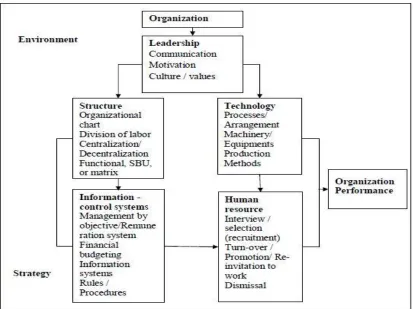
16
Sailing through organizational politics and implementing strategies successfully is dependent on leadership.
The theory postulates that organic structure that are decentralized enhance change implementation while mechanical structures that are centralized hinder effective change implementation of competitive firms. Decentralized structures enhance communication, transparence and accountability among leaders and employees in any organization. Organization objectives are achieved by dedicated team of employees who are influenced by leadership qualities.
The theory acknowledges that organizations with automated systems are likely to improve customer service delivery and minimize costs of operation. Technology enhances job design, control system which includes financial budgeting, procedures that influence organization strategy implementation. Recruitment of qualified personnel, promoting employees based on performance and job enrichment will enhance organization performance.
Moreover the theory advocates that organizations are likely to realize increased profitability, improved customer satisfaction, reduced costs of operation though automated systems of production, distribution, and marketing and human resource management. If organizations are intending to perform effectively in the dynamic business environment, leadership, structures, technology, information control and human resource systems should be aligned appropriately in the organizational context.
17
Visionary leaders with unique skills and knowledge will influence employee behaviors to perform effectively. Timely feedback provided by leaders will enhance strategy actualization in the long run in any competitive organization. Leaders without a vision and ability to anticipate the future are likely to fail during strategy implementation process thus poor organizational performance.
Figure 2.1 (Source) Ricky Griffin's Model (2007) 2.2.4 The Balanced Scorecard Model
18
Norton include; financial perspective, that entails measuring whether the organization is generating profits from its core businesses; Customer perspective, that entail customer satisfaction from goods and services; Internal business processes, that involves continuous improvement of services using modern technology and finally innovation and learning, that entails ability of organizations to develop new products and services thus team learning and co-partnerships in the industry.
Further, the theory ascertains that due to changing business environment, competitive organizations can adopt a number of strategic management practices such as strategic leadership, strategic human resource development and information and communication technology in order to enhance their performance. Strategic leadership is regarded as a multifunctional, involves managing through others, and helps organizations cope with change that seems to be increasing exponentially in today’s globalized business environment. Strategic leadership requires the ability to accommodate and integrate both the internal and external business environment of the organization, and to manage and engage in complex information processing. This theory is applicable in this study based on the premise that Huduma Centres are likely to performance effectively in terms of quality customer service delivery if they embrace strategy implementation practices such as employee training, leadership and communication.
2.3 Empirical Review
19
2.3.1 Employee Training and Organization Performance
Lewa, Mutuku and Mutuku (2009) studied the effect of strategic planning in the higher Education Sector of Kenya. The study adopted exploratory research design and stratified sampling technique to select 195 respondents. Data was collected using interview guides and questionnaires. Data was analyzed descriptively and findings revealed that training and development of employees’ skills can make them more productive or more effective in their jobs, directly contributing to the bottom line. The purpose of training and management development programs is to improve employee capabilities and organizational capabilities.
The study further pointed out that when the organization invests in improving the knowledge and skills of its employees, the investment is returned in the form of more productive and effective employees. The purpose of training and management development programs is to improve employee capabilities and organizational capabilities. When the organization invests in improving the knowledge and skills of its employees, the investment is returned in the form of more productive and effective employees. However, the study was confined to strategic planning in higher institutions of learning in Kenya but did not seek to examine the relationship between strategy implementation practices on performance of Huduma Centres in Kenya.
20
The study recommended that timely training and change management were key aspects to effective strategy implementation. Some of the limitations of this study were; too little sample used to generalize the total population, the study looked independent variables from a holistic perspective rather than independent view. The study was limited to challenges of strategy implementation in CMC Motors Group Ltd but not Huduma Centre.
Andalya (2008) studied impact of strategic planning on organizational performance: a case study of Equator Flower farm in Eldoret East District, Kenya. The study adopted descriptive research design and purposive sampling technique to select 146 respondents. Linear regression was used to analyze data and findings indicated that top management plays an ever increasing role to ensure that a knowledge-friendly culture is built in the organization. However, the study was confined to strategic planning in flower firms in Edoret, Kenya and examined variables of this study partially and in isolation.
21
Nduko (2008) studied strategic practices among foreign multinational corporations in Kenya. The study adopted descriptive research design and systematic sampling technique to select 167 respondents. Data was collected questionnaires. Multiple regression was used to analyzed data and findings found out that external factors like political, economic, social and technological to some extent they contributed strategic policies implementation. However, the study did not address the critical factors that determined on implementation of strategies. The recommendations of the study were not based on findings of the study. The study adopted a census that was complex to analyze all the multinational firms in Kenya.
22
Mbaka and Mugambi (2014) carried out a study on the factors that influence strategy implementation in the Kenyan water sector. The study adopted descriptive research design and convenience sampling technique to select 194 respondents. Secondary and primary data was collected. Data was analyzed using linear regression and findings indicated that the employees in the public sector lack the capabilities, skills, and enthusiasm to drive the process of implementation. There is also an information gap between the strategy formulators and the staff.
Omboi and Mucai (2011) on the factors affecting the implementation of strategic management plans in government tertiary institutions. The study adopted cross-sectional research design and exploratory research design. Quota sampling technique was adopted to select 341 respondents. Data was collected using questionnaires and findings revealed that managerial behavior, resource allocation practices, reward management and institutional management policies as main influences of implementation of strategic management plans. The study focused in government tertiary institutions and it sought to examine implementation of strategic management plans as a dependent variable.
23
organization should ensure that the vision and mission of the organization is aligned to organizational objectives.
Aosa (1991) contends that strategic management practices and performance of firms is correlated if the top management has a dedicated course. Activities performed with a view of long term outcomes and implications yield maximum outputs and vice versa. The study concluded that commercial banks should integrate technology to gain competitive edge in the market. However, the study did not focus on County Governments and the variables of the study were different from the variables of this study. The recommendations of study were too general and did not specifically address the problem under investigation.
2.3.2 Leadership and Organization Performance
Jehad Aldehayyat and Naseem (2012) studied strategic planning and corporate performance relationship in small business firms in the Middle East countries. The study adopted exploratory research design and random sampling technique to select 321 respondents. Data was collected using questionnaires and observation forms. Analysis of data was done using multiple regression and resulted indicated that strategic culture among competitive firms was determined by charismatic leaders who adopt a combination of management styles to influence employees to perform.
24
caution as this has an effect on subordinates and at the same time offer guidance and motivation to subordinates for better performance.
Musyoka (2011) established that resistance to change was a key challenge to strategy implementation. Further that study pointed out that leadership was correlated to performance of competitive firms. The research design adopted was longitudinal and regression data analysis method. The study was limited to challenges of strategy implementation at Jomo Kenyatta University of Agriculture and Technology.
Okumus and Roper (1999) studied strategy implementation in the UK manufacturing firms. Descriptive research design was adopted. Multiple stage sampling technique was used to select 443 respondents. Data was collected using electronic questionnaires. Data was analyzed using cross-tabulation method and findings indicated that multiple variables such as culture, training, skills, systems and strategy contributed to strategy implementation. Leadership styles adopted by managers contributed to effective strategy implementation. The best performing organizations are associated with visionary leaders who serve as role models.
25
Obonyo and Arasa (2012) argue that good leadership is likely to influence the behavior of employees thus resulting to minimal employee resistance to change, promote team work, enhance communication and promote participative decision making from employees of the organization. The study was limited to strategic planning among manufacturing firms in Kenya. Abok (2013) on the factors that influence the effective implementation of strategic plans in non-governmental organizations established that management styles affect the implementation of strategic plans in NGOs.
Moreover, the study found out that there was redundancy in as far as the implementation of policies is concerned although a significant percentage agreed that strategic plans were available, but they were not being implemented effectively. Employees also quoted conflict of interests and attitude as one of the reasons that derail strategy implementation. However, the limitations of the study were that instruments of data adopted were not appropriate. Observation method was characterized by subjective statements that were inaccurate when making recommendations. However, the study was confined to implementation of strategic plans among Public Benefit Organizations in Kenya.
26
Konzi (2012) studied the relationship between strategic plan implementation and performance of manufacturing firms in Tanzania. Cross-sectional research design was adopted. Snowball sampling technique was used to select 456 respondents. Data was collected using questionnaires. Stepwise regression method was used to analyze data and results indicated that implementation of strategic policies by large and small firms always experience internal and external challenges.
Further, the study identified that leadership, structure, culture, employees, style of management, employee skills were among the challenges identified that hindered effective strategic plan implementation. Limitations of the study was that is that it was carried out in Tanzania and cannot be applicable in Kenya, The study focused in the manufacturing sector and not Huduma Centres in Kenya. The study only did not focus on critical factors that influenced strategy implementation. The conclusions of the study were out of the context and generalized.
27
2.3.3 Communication and Organization Performance
Onyango (2012) on factors influencing the implementation of the Kenya sugar industry strategic plan (2010-2014). The study adopted a longitudinal research design and random sampling technique to select 78 respondents. Data was collected using questionnaires. Data analysis was conducted using descriptive and inferential statistics. Findings established that poor planning and structural challenges contributed to failure of implementing plans formulated due to poor communication. However, the study did not adopt longitudinal design to measure the changing trends in the dynamic business environment. The sample that was used was not adequate. The study focused on the sugar industry and did not focus on Huduma Centres in Kenya.
Koske (2003) on strategy implementation and its challenges in public corporations: the case of Telkom Kenya limited. The study adopted a case study research design. Random sampling technique was used to select 198 respondents. Data was collected using questionnaires. Analysis of data was conducted using liner regression method. The findings revealed that most organizations are unable to implement their strategies due to centralized structures and non-committal of top management to sensitize employees on new changes, inadequate resources, and untimely introduction of change. However, the study focused in in one corporation and ignored other public corporations. Multiple regression method adopted was not appropriate since the study was not intended to test hypothesis.
28
organization structure. Mechanistic structures contribute to failure of strategic plan implementation while organic structures promote strategy implementation. The study concluded that employee empowerment through training was the key driver of successful strategy implementation. However, the theories adopted in this study were not accurate as they were outdated and did not withstand the changing times, the study focused non-governmental institutions and not Huduma Centres in Kenya and the variables of the study were completely different from this study.
Aldehayyat and Khattab (2013) argue that there exist a correlation between compunction and performance even though systems have different structures that facilitate communications within functional areas. Odongo and Owuor (2015) assert that organizational communication plays an important role in training, knowledge dissemination and learning during the process of strategy implementation. Communication is pervasive in every aspect of strategy implementation, as it relates in a complex way to organizing processes, organizational context and implementation objectives which, in turn, have an effect on the process of implementation.
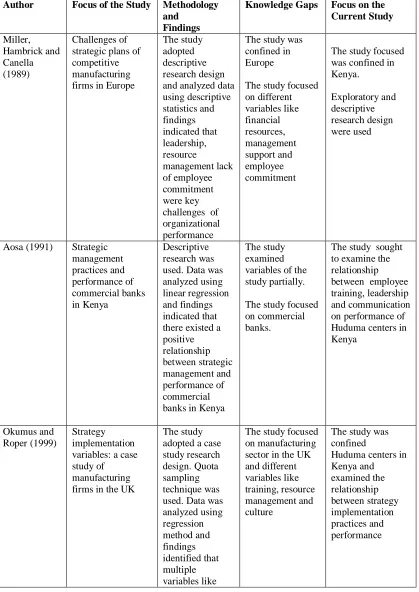
29 Table 2.1: Summary of Knowledge Gaps
Author Focus of the Study Methodology and
Findings
Knowledge Gaps Focus on the Current Study Miller, Hambrick and Canella (1989) Challenges of strategic plans of competitive manufacturing firms in Europe
The study adopted descriptive research design and analyzed data using descriptive statistics and findings indicated that leadership, resource management lack of employee commitment were key challenges of organizational performance
The study was confined in Europe
The study focused on different variables like financial resources, management support and employee commitment
The study focused was confined in Kenya. Exploratory and descriptive research design were used
Aosa (1991) Strategic management practices and performance of commercial banks in Kenya Descriptive research was used. Data was analyzed using linear regression and findings indicated that there existed a positive relationship between strategic management and performance of commercial banks in Kenya
The study examined variables of the study partially.
The study focused on commercial banks.
The study sought to examine the relationship between employee training, leadership and communication on performance of Huduma centers in Kenya
Okumus and Roper (1999)
Strategy implementation variables: a case study of manufacturing firms in the UK
The study adopted a case study research design. Quota sampling technique was used. Data was analyzed using regression method and findings identified that multiple variables like
The study focused on manufacturing sector in the UK and different variables like training, resource management and culture
The study was confined
30 culture, training, skills, systems and strategy contributed to strategy implementation. Konzi (2012) The relationship
between strategic plan
implementation and performance of manufacturing firms in Tanzania
Descriptive research design and simple random technique was used to select respondents. Revealed that implementation of strategic policies by large and small firms always experience internal and external challenges like; leadership, structure, culture, employees, style of management, employee skills
Variables of this study were examined partially and in isolation. The study was carried out Tanzania and focused on manufacturing sector
The study was conducted in Kenya and the relationship between employee training, leadership and communication was tested in relation to performance of Huduma centers in Kenya
Onyango (2012)
Factors influencing the implementation of the Kenya sugar industry strategic plan (2010-2014) The study adopted longitudinal research design. Data was analyzed using descriptive statistics and inferential statistics Established that poor planning contributed to failure of implementing plans formulated.
The study focused on sugar board of Kenya and different
methodology like longitudinal research
The study will focus
communication on performance of service centers in Kenya
Rajasekar (2014)
The factors that affect the
implementation of strategic plans in service industries in Yemen
The study used cross-sectional research design. Stratified sampling technique was used. Stepwise sampling technique was used to select respondents. It was established that leadership
The study was conducted in Yemen
The study focused on service industries variables like management knowledge and qualification
31
and
organizational structure were the main influences on the
implementation of strategic plans Abok (2013) Factors that
influence the effective
implementation of strategic plans in non-governmental organizations in Kenya Descriptive research design was used. Data was analyzed using regression method and it was established that management styles affect the implementation of strategic plans in NGOs.
The dependent variable of the study was
implementation of strategic plans. The study focused on NGO’s and different variables like management and leadership styles
The dependent variable of the study was performance of Huduma Centres in Kenya
Mbaka and Mugambi (2014)
The factors that influence strategy implementation in the Kenyan water sector.
The study adopted cross-sectional research design. Data was analyzed using descriptive and inferential statistics.
Findings revealed that there exists a correltion between employee skills, resource allocation and leadership on strategy implementation The dependent variable was strategy implementation
The study focused on water sector
The dependent variable of the study was performance of Huduma centers in Kenya
Source: (Literature Review, 2018) 2.4 Summary of Literature Review
32
Firstly, empirical studies conducted focused on different variables like culture, style, strategy and leadership but did not focus on the variables of this study. Secondly, the studies conducted focused on different sectors like manufacturing, education, financial and countries like Turkey, United States, Nigeria, Somalia and Uganda which cannot be compared with Kenya. Thirdly, some studies focused on different research methodologies like research designs, research philosophy, sampling designs, and research instruments and data analysis methods.
2.5 Research Gaps
The study identified this area as deserving attention since little has been done to address issues of strategy implementation practices on performance of Huduma (Service) Centres in Kenya. The Public service sector in Kenya has been given little attention in terms of establishing the practices that influence implementation of strategies formulated. The researcher identified a gap in evidence of approaches of using employee training, leadership and communication on performance of Huduma Centres in Kenya.
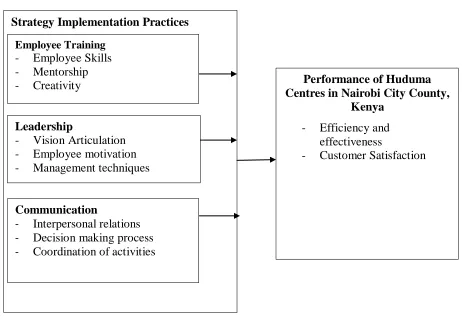
2.6 Conceptual Framework
33
Independent Variables Dependent Variable
Figure 2.2: (source) Conceptual Framework (Researcher, 2018)
As shown in Table 2.1 above, the study established that employee training facets such as information sharing, knowledge and creativity of individual workers influences performance of Huduma (Service) Centres in Kenya. Similarly, antecedents of leadership such as employee empowerment, planning and management influences performance and structural aspects that facilitates organizational performance are communication, team work and delegation. Further, it was revealed that performance of Huduma Centres was measured in terms of efficiency and effectiveness of service delivery, customer satisfaction and corporate image.
Performance of Huduma Centres in Nairobi City County,
Kenya - Efficiency and
effectiveness
- Customer Satisfaction Strategy Implementation Practices
Communication
- Interpersonal relations - Decision making process - Coordination of activities
Employee Training
- Employee Skills - Mentorship - Creativity
Leadership
34
CHAPTER THREE: RESEARCH METHODOLOGY
3.1 Introduction
This chapter discusses the research methodology that was adopted to analyze data collected. It includes the research design that was used, the population of the study and the data collection procedure. It finally illustrates the data analysis methods used.
3.2 Research Design
A research design is a plan or an approach that articulates principles of collecting, analysing and interpreting data (Guest 2010). The study adopted a descriptive and exploratory research designs to establish the influence of strategy implementation practices on performance of 5 Huduma (Service) Centres operating in Nairobi City County, Kenya. A descriptive and exploratory research designs were considered appropriate in this study based on the fact that the study sought to collect data from a sizeable population and aimed to method was appropriate because it explores and describes the relationship between variables in their natural setting without manipulating them.
3.3 Target Population
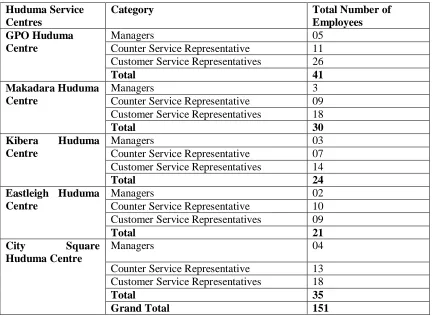
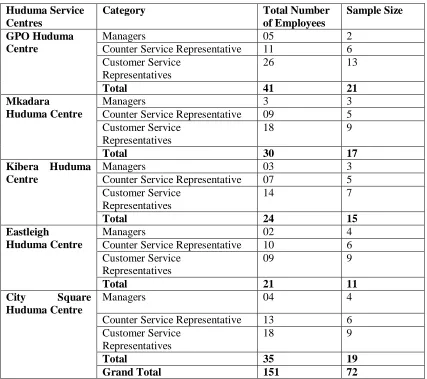
35 Table 3.1: Target Population
Huduma Service Centres
Category Total Number of Employees GPO Huduma
Centre
Managers 05
Counter Service Representative 11 Customer Service Representatives 26
Total 41
Makadara Huduma Centre
Managers 3
Counter Service Representative 09 Customer Service Representatives 18
Total 30
Kibera Huduma Centre
Managers 03
Counter Service Representative 07 Customer Service Representatives 14
Total 24
Eastleigh Huduma Centre
Managers 02
Counter Service Representative 10 Customer Service Representatives 09
Total 21
City Square Huduma Centre
Managers 04
Counter Service Representative 13 Customer Service Representatives 18
Total 35
Grand Total 151
Source: (Government of Kenya, 2018) 3.4 Sampling Technique and Sample Size
36 Table 3.2: Sample Size
Huduma Service Centres
Category Total Number of Employees
Sample Size
GPO Huduma Centre
Managers 05 2
Counter Service Representative 11 6 Customer Service
Representatives
26 13
Total 41 21
Mkadara Huduma Centre
Managers 3 3
Counter Service Representative 09 5 Customer Service
Representatives
18 9
Total 30 17
Kibera Huduma Centre
Managers 03 3
Counter Service Representative 07 5 Customer Service
Representatives
14 7
Total 24 15
Eastleigh Huduma Centre
Managers 02 4
Counter Service Representative 10 6 Customer Service
Representatives
09 9
Total 21 11
City Square Huduma Centre
Managers 04 4
Counter Service Representative 13 6 Customer Service
Representatives
18 9
Total 35 19
Grand Total 151 72
Source: (Government of Kenya, 2018)
3.5 Data Collection
37 3.6 Pilot Study
A pilot study is a research project that is conducted on a limited scale that allows researchers to get a clearer idea of what they want to know and how they can best find it out without the expense and effort of a full-fledged study (Black, 2010). To test validity, a pilot study was conducted in Nairobi City County using 3 customer service employees of Huduma Centres. Modification of the instrument was done if the instrument were inconsistent with what was intended to be measured before administration.
3.6.1 Validity of the Instrument
The face, content and criterion validity was determined by using industry strategic management experts and scholars at Kenyatta University. Black (2010) asserts that content validity measures the degree to which the test items represent the domain or universe of the trait or property being measured. Industry experts and Lecturers of Kenyatta University were used to identify the appropriateness the content of the instrument.
38 3.6.2 Reliability of the research Instrument
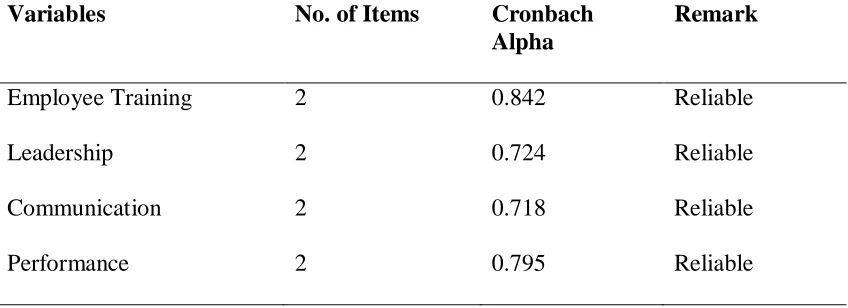
Reliability of the research instrument was enhanced through a pilot study that was done on 3 Customer Care employees of Huduma Centres in Nairobi City, County. Cronbach’s alpha method was used to test the reliability of the instrument and internal consistency of the instrument was measured using reliability coefficients. Cronbach’s alpha value is therefore widely used to verify the reliability of a construct. Collis and, Hussey (2014) note that acceptance value for Cronbach’s Alpha is between 0.7 and 0.9. Therefore, this study adopted a loading of 0.7 as the acceptable value.
Table 3.3: Reliability Results
Variables No. of Items Cronbach Alpha
Remark
Employee Training 2 0.842 Reliable
Leadership 2 0.724 Reliable
Communication 2 0.718 Reliable
Performance 2 0.795 Reliable
Source: Research data (2018)
As depicted in Table 3.3, reliability coefficients of all variables of the study were more than 0.07 indicating reliability of the study variables as recommended by Collis and Hussey (2014).
3.7 Data Analysis and Presentation
39
similarity and then tabulated. Descriptive, correlation and multiple regression methods were used to analyze data and explain the findings.
Multiple regression was conducted at 95% confidence level and 5% significance level. Before conducting multiple regression, normality, linearity, bomogeneity and multicollinearity were conducted to test conformity of data with statistical assumptions. Using a measuring scale of 1-5, items of the instruments were analyzed and descriptive statistics such as mean scores, standard deviation, frequency distributions and percentages were used to summarize and relate variables which were obtained from the study. The specific multiple regression model adopted was of the form.
Y = β0 + β1X1 + β2X2 + β3X3+ β+ ε, Where,
β0, β1, β2 and β3 are the regression co-efficient
Y – Performance of Huduma Centres in Kenya X1 – Employee Training
X2 – Leadership
X3 – Communication
ε,-Error Term
3.8 Ethical Considerations
40
CHAPTER FOUR: RESEARCH FINDINGS AND DISCUSSION
4.1 Introduction
This chapter presents the results and discussion of the study conducted to establish strategy implementation practices on the performance of Huduma (Service) Centres in Nairobi City County, Kenya. The chapter encompasses descriptive statistics and inferential statistics such as correlation and regression analysis. Further, the chapter discusses the research findings in relation to findings of previous studies on related issues to establish relationships of the results with those of previous studies.
4.2 Response Rates
The questionnaires were administered to a sample size of 72 respondents whom comprised of managers, counter service representative and customer service representatives selected from the five Huduma Centres operating in Nairobi City County. However, after questionnaire administration, only 53 questionnaires were returned duly filled. 19 questionnaires were incomplete and others were not returned. This contributed to 73% response rate. This response rate was adequate for data analysis and conforms to Black (2012) who posits that a response rate of more than 50% is adequate for analysis and reporting.
4.3 Population Demographics
This section presents age of the respondents, gender, education and duration of working at Huduma Centres as discussed and illustrated in the figures and tables. 4.3.1 Age of Respondents
41 Figure 4.1: Age of Respondent
Below 25 years 26-35 years 36-45 years 46 and above
13%
49%
33%
5%
Age of Respondent
Source: (Research Data, 2018)
As shown in Figure 4.1, it was established that majority (49%) of the respondents or employees who worked in Huduma Centres were aged between 26-35 years, some (33%) were aged between 36-45 years, 13% of them were aged below 25 years and 5% aged above 46 years. The findings implies that majority of the service centres were engaging youthful workers to achieve their goals. As a result the response rate was high as these respondents are keen to learn given their age
4.3.2: Gender of Respondents
42 Figure 4.2: Gender of Respondent
Male 41%
Female 59%
Gender
Source: (Research Data, 2018)
As illustrated in Figure 4.2, majority (59%) of the respondents of the study were female while 41% of them were male. The findings implies that majority of the Huduma Centre employees were female compared to their male counterparts because some service centres observe gender balance policies stipulated by the public service commission.
4.3.3: Education Level of Respondents
43 Figure 4.3: Education Level of Respondents
Source: (Research Data, 2018)
As illustrated in Figure 4.3, majority (58%) of the respondents indicated they had diploma, bachelors and postgraduate qualifications from private and public universities and 42% of them indicated that they had certificate qualifications attained from tertiary level colleges in Kenya. The findings implies that majority of the service centre preferred to engage degree holders compared to employees with certificate qualification in various positions due to competitive labour market forces.
4.3.4: Duration of Service
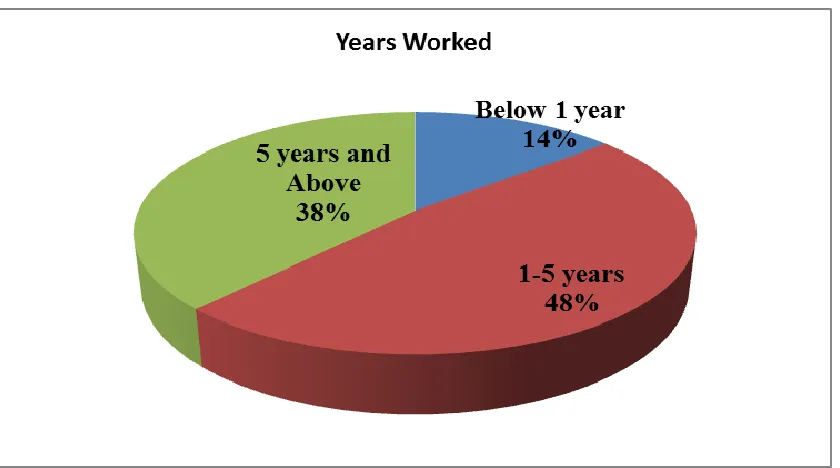
The study sought to establish the period respondents had worked for their Huduma Centers and the following findings were summarized as shown in Figure 4.4.
College 42%
University 58%
0% 0%
44 Figure 4.4: Duration of Service
Source: (Research Data, 2018)
45 4.4 Strategy Implementation Practices
Descriptive statistics such as mean scores, standard deviation and percentages were used to measure variables of the study which includes employee training, leadership and communication as depicted in Table 4.2, 4.3 and 4.4.
4.4.1 Employee Training and Development
The study sought to investigate the influence of employee training and development on performance of Huduma Centres in Kenya and the following were the findings as shown in Table 4.1
Table 4.2: Employee Training and Development
Statements N Mean S.D %
The organization conducts training needs assessment periodically to determine employee knowledge gaps
53 2.86 .665 41%
Employees have multiple skills to perform tasks 53 2.77 .654 40% The organization encourages employee creativity
during strategy implementation
53 3.45 .623 72%
Employee of the organization share information during and after strategy implementation
53 2.31 .584 37%
Learders always encourage employees to consult when implementing strategies
53 3.96 .486 61%
The organization allocates adequate budgets for training employees on how to implement strategic decisions
53 3.73 .421 61%
All employee of the organization have appropriate skills to implement strategic decisions
53 3.56 .374 59%
All employees have relevant knowledge to implement strategic decisions
53 3.42 .343 58%
Managers and supervisors delegate their responsibilities to lower level employees
46 I find trainings conducted to be of great value to organizational growth
53 2.73 .421 33%
Source: (Research Data, 2018)
As illustrated in Table 4.1, the mean scores for 5 of the 10 statements was less than 3.00 which means that majority (58%) and above agreed with the statement while the rest either disagreed or were neutral. The results imply that despite the fact that employee training and development influenced performance of Huduma Centres, to some a larger extent employee training and development practice was not embraced effectively to facilitate strategy implementation process.
It emerged that conducting periodical trainings needs assessments among workers was not embraced to a larger extent. On the other hand, it was noted that employees who worked at the services centres did not have multiple skills to implement strategies formulated. Information sharing, delegation and value of the trainings were practices which were not embraced to a larger extent to facilitate strategy implementation thus organization performance.
47
resource allocation and provision of feedback to workers were factors that determined the success of any strategy in the changing business environment.
4.4.2 Leadership
The study sought to investigate the influence of leadership on performance of Huduma Centres in Kenya and the following were the findings as shown in Table 4.2
Table 4.2: Leadership
Statements N Mean S.D %
Huduma Centres have strategic leaders with appropriate qualities to implement strategies formulated
53 3.21 .544 25%
Leaders develop policies that embrace the vision and mission
53 4.98 .487 73%
Leaders have put in place policies to minimize resistance from workers
53 3.33 .421 41%
Leaders have the drive to implement new strategies 53 3.26 .374 29% Leaders encourage employees to improve their skills
through training
53 4.42 .343 48%
Leaders encourage teamwork in the organization 53 4.67 .261 48% Leaders engage employees in key decision making 53 3.45 .623 42% Leaders motivate employees to implement strategies 53 3.31 .584 37% Leaders use a combination or leadership styles to
influence employees implement strategies
53 2.96 .486 31%
Source: (Research Data, 2018)
48
that employee training and development was attributed to performance of Huduma Centres, it emerged that little was done in engaging strategic leaders with appropriate qualities to implement strategies formulated. Further, it was noted that the drive of leaders in implementing new strategies was non-existent due to structural issues. In addition, involvement of employees in decision making process, issues of motivation and using a combination of leadership styles were practices which were given little attention thus deteriorating performance of the service centres in Kenya.
These findings corresponds with that of Aldehayyat (2011); Aldehayyat, Khattab, (2013); Efendioglu & Karabulut (2010); Jehad, Aldehayyat & Naseem (2012); Konzi, (2012) who acknowledge that organizational performance is determined by the practices that organizations put in place to ensure strategies formulated are implemented such as employee motivation, mentorship programs and involvement of key stakeholders such as workers in the decision making process. Further, their studies indicated that there was a positive correlation between participation, training, motivation and leadership styles and organization performance.
4.4.3 Communication
49 Table 4.3: Communication
Statements N Mean S.D %
My organization has decentralized structures that enhance and facilitate communication
53 2.91 .544 25%
The structure of my organization enable managers regularly communicate the progress of strategy implementation
53 2.88 .487 23%
There is high level of interpersonal relations in the organization
53 4.73 .421 61%
Leaders communicates appropriately when introducing new changes
53 4.56 .374 59%
Managers give employee feedback on their performance
53 4.42 .343 58%
There is effective coordination of activities during strategy implementation
53 2.73 .421 31%
Managers always create maximum awareness when implementing new policies
53 2.56 .374 39%
Employees have the spirit of working together 53 4.42 .343 68% The organization has open communication culture 53 2.42 .343 38%
Source: (Research Data, 2018)