The preimage security of double-block-length compression functions
Jooyoung Lee1, Martijn Stam2, and John Steinberger3∗ 1 Faculty of Mathematics and Statistics, Sejong University, Seoul, Korea,
Dept. of Computer Science, University of Bristol, United Kingdom,[email protected] 3 Institute of Theoretical Computer Science, Tsinghua University, Beijing, China,[email protected]
Abstract. We give improved bounds on the preimage security of the three “classical” block-length, double-call, blockcipher-based compression functions, these being Abreast-DM, Tandem-DM and Hirose’s scheme. For Hirose’s scheme, we show that an adversary must make at least22n−5blockcipher queries to achieve chance0.5
of inverting a randomly chosen point in the range. For Abreast-DM and Tandem-DM we show that at least22n−10 queries are necessary. These bounds improve upon the previous best bounds ofΩ(2n)queries, and are optimal up to a constant factor since the compression functions in question have range of size22n.
1
Introduction
Almost as soon as the idea of turning a blockcipher into a hash function appeared [13], it became evident that, for typical blockciphers and security expectations, the hash function needs to output a digest that is considerably larger than the blockcipher’s block size. Consequently, many proposals of double-block-length, or more generally multi-block-length, hash functions have appeared in the literature. In this article we focus on a subclass of double-block-length constructions, where a3n-bit to2n-bit compression function makes two calls to a blockcipher of2n-bit key andn-bit block.
Recently, for all three well-known members of this class—those being Tandem-DM [8], Abreast-DM [8] and Hirose’s construction [6]—collision resistance has been successfully resolved [4,6,9,10]: for Abreast-DM and Hirose’s scheme,Ω(2n) queries to the underlying blockcipher are needed to obtain a non-vanishing advantage in finding a
collision. For Tandem-DM,Ω(2n−logn)queries are needed, which is almost optimal ignoring log factors.
On the other hand, the corresponding situation for preimage resistance is far less satisfactory. Up to now, it has been an open problem to prove preimage resistance for values ofqhigher than2nfor either Abreast-DM, Tandem-DM or Hirose. This is not to say that no dedicated preimage security proofs have appeared in the literature. For instance, Lee, Stam and Steinberger [10] provide a preimage resistance bound for Tandem-DM that is a lot closer to2n than a straightforward implication [14] of their collision bound would give. However, a “natural barrier” occurs once2n queries are reached: namely, a blockcipher “loses randomness” after being queriedΩ(2n)times on the same key
(for example, when2n−1queries have been made to a blockcipher under a given key, the answer to the last query
under that key is deterministic). Going beyond the2n barrier seemed to require either a very technical probabilistic
analysis, or some brand new idea. In this paper, we show a new idea which delivers tight bounds in a quite pain-free and untechnical fashion.
OUR CONTRIBUTION. In this paper, we prove that various compression functions that turn a blockcipher of2n-bit key into a double-block-length hash function, have preimage resistance close to the optimal22nin the ideal cipher model.
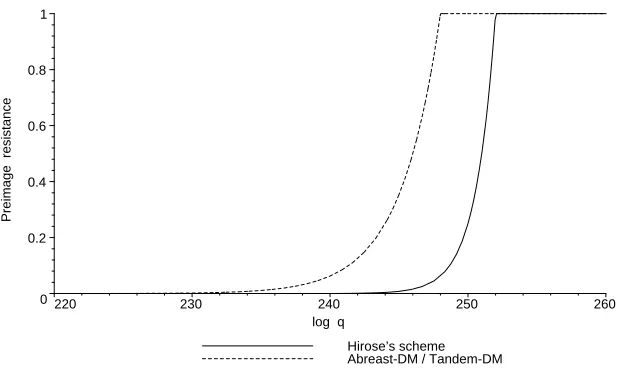
Our analysis covers many practically relevant proposals, such as Abreast-DM, Hirose-DM and Tandem-DM. Bounds for the casen = 128are depicted in Figure 1 (withα = q1/2/2for Abreast-DM and Tandem-DM). At the heart of our result are so-called “super queries”, a new technique to restrict the advantage of an adaptive preimage-finding adversary.
To build some intuition for our result, let us start with considering the much easier problem of constructing a3n-bit to2n-bit compression functionH based on two3n-bit ton-bit smaller underlying primitivesf andf′. An obvious approach is simply to concatenate the outputs off andf′, that is letH(B) =f(B)∥f′(B)forB∈ {0,1}3n. Iffand
∗Supported by the National Natural Science Foundation of China Grant 61033001, 61061130540, 61073174, by the National
Hirose’s scheme Abreast-DM / Tandem-DM 0
0.2 0.4 0.6 0.8 1
Preimage_resistance
220 230 240 250 260
log_q
Fig. 1: Preimage bounds for the classical constructions.
f′are modeled as independently sampled, ideally random functions, then it is not hard to see thatH behaves ideally as well. In particular, it is preimage resistant up to22nqueries (tof andf′).
When switching to a blockcipher-based scenario, it is natural to replacef andf′ in the construction above by
E, resp.E′, both run in Davies–Meyer mode. In other words, for blockciphersEandE′ both with2n-bit keys and operating onn-bit blocks, defineH(A∥B) = (EB(A)⊕A)∥(EB′ (A)⊕A)whereA ∈ {0,1}
nandB ∈ {0,1}2n.
While there is every reason to believe this construction maintains preimage resistance up to22nqueries, the standard proof technique against adaptive adversaries falls short significantly. Indeed, the usual argument goes that theith query an adversary makes toEusing keyKwill return an answer uniform from a set of size at least2n−(i−1)and thus the probability of hitting a prespecified value is at most1/(2n−(i−1))<1/(2n−q). Unfortunately, onceqapproaches
2n, the denominator tends to zero (rendering the bound useless). As a result, one cannot hope to prove anything beyond
2nqueries using this method. This restriction holds even for a “typical” bound of typeq/(2n−q)2.
When consideringnon-adaptiveadversaries only, the situation is far less grim. Such adversaries need to commit to all queries in advance, which allows bounding the probability of each individual query hitting a prespecified value by 2−n. While obviously there are dependencies (in the answers), these can safely be ignored when a union bound is later
used to combine the various individual queries. Since theqoffset has disappeared from the denominator, the typical boundq/(2n)2wouldgive the desired security.
Our solution, then, is to force an adaptive adversary to behave non-adaptively. As this might sound a bit cryptic, let us be more precise. Consider an adversary adaptively making queries to the blockcipher, using the same key throughout. As soon as the number of queriesto this keypasses a certain threshold, we give the remaining queries to the blockcipher using this very keyfor free. We will refer to this event as asuper query. Since these free queries are all asked in one go, they can be dealt with non-adaptively, preempting the problems that occur (in standard proofs) due to adaptive queries. Nonetheless, for every super query we need to hand out a very large number of free queries, which can aid the adversary. Thus we need to limit the amount of super queries an adversary can make by setting the threshold that triggers a super query sufficiently high. In fact, we set the threshold at exactly half4the total number of queries that can be made under a given key (i.e., it is set at2n/2queries). This effectively doubles the adversary’s query budget, since for every query the adversary makes it can get another one later “for free” (if it keeps on making queries under the same key), but such a doubling of the number of queries does not lead to an unacceptable deterioration of the security bound.
With this new technique in hand, we revisit the proofs of preimage resistance of the three main double-block-length, double-call constructions (Tandem-DM, Abreast-DM and Hirose). An additional technical problem is that
4
these compression functions each make two calls to the same blockcipher, as opposed to using two calls to independent blockciphers (we discuss the latter, somewhat easier scenario in Appendix A). Ideally, to get a good bound, one would like to query the two calls necessary for a single compression function evaluation in conjunction (this would allow using the randomness of both calls simultaneously, potentially leading to a denominator22n as desired for preimage
resistance). For instance, in the context of collision resistance for Hirose-DM and Abreast-DM corresponding queries are grouped in cycles (of length 2 and 6, respectively) and all queries in a cycle are made simultaneously: if the adversary makes one query in a cycle, the remaining queries are handed out for free. Care has to be taken that these free queries and the free queries due to super queries do not reinforce each other to untenable levels.
For Hirose’s scheme, there are no problems as the free queries introduced by a super query necessarily consist of full cycles only. The corresponding (upper) bound on the preimage finding advantage is 16q/22n which is as
desired, up to a small factor. For Abreast-DM, however, the cyclic nature can no longer be exploited: any super query introduces many partial cycles, yet freely completing these might well trigger a new super query, etc.! Luckily, the original preimage proof for Tandem-DM [10] (which does not involve cycles) provides a way out of this conundrum. The downside however is that our preimage bound for Abreast-DM and Tandem-DM is slightly less tight than that for Hirose’s scheme. Ignoring negligible terms, it grows roughly as16√q/2n. Although this is faster than one might wish for (as can be seen in Figure 1), it does imply thatΩ(22n)queries are required to find a preimage with constant probability. To compare numerical bounds forn= 128, Hirose’s scheme requires about2251blockcipher queries to achieve chance0.5of inverting a randomly chosen point in the range, while Abreast-DM and Tandem-DM require 2246queries.
RELATED WORK. The problem of preimage security for double-block-length compression functions beyond2n has previously been tackled by Krause, Armknecht and Fleischmann [7]. They discuss what can be regarded as variations of calling Davies–Meyer twice in parallel (using distinct blockciphers). For one such compression function, they prove aΩ(22n)preimage resistance bound.
Their original analysis predated our work, but was technically flawed, and we obtained our results after discovering these flaws. We emphasize, however, that the techniques we developed are entirely disjoint from those in their original preprint [7]. After we pointed out the technical problems to Krause et al.they (independently) found a second analysis using rather similar ideas to ours, which is contained in the new version of their preprint.
The analysis of Krause et al. contains a number of additional elements besides the super query idea, such as conditioning on the number of preimages present for a given key. In Appendix A we show that, to analyze the preimage security for a class encompassing that targeted by Krause et al., the use of super queries alone suffices. The proof thus obtained is significantly simpler, and the bound is slightly sharper, as well.
2
The model
A blockcipher is a functionE :{0,1}m× {0,1}n→ {0,1}nsuch thatE(K,·)is a permutation of{0,1}nfor each
K ∈ {0,1}m. We call mthe key sizeandnthe block lengthof the blockcipher. It is customary to writeE K(X)
instead ofE(K, X)forK∈ {0,1}m,X ∈ {0,1}n. The functionE−1
K (·)denotes the inverse ofEK(·)(asEK(·)is a
permutation). Henceforth, we will restrict to the casem= 2nand we defineN= 2n.
A compression functionH is blockcipher-based if, in its execution, it has access to a blockcipher. In this paper, we only discuss double-block-length, double-call constructions, meaning thatHis a function from3n-bits to2n-bits making two calls to some underlying blockcipherE. (This definition will become more concrete in the next sections.) As our preimage security notion for H, we adopt everywhere preimage resistance in the information theoretic setting [14]. In this preimage resistance experiment, a computationally unbounded adversaryAwith oracle access to a uniformly sampled blockcipherE : {0,1}2n × {0,1}n → {0,1}n selects and announces a pointC ∈ {0,1}2n, before making queries toE. We allowAto query bothEandE−1. Afterqqueries toE, thequery historyofAis the set of triplesQ={(Xi, Ki, Yi)}
q
i=1such thatEKi(Xi) =YiandA’si-th query is eitherEKi(Xi)orE
−1
Ki(Yi)for
1≤i≤q. We sayAsucceedsorfinds a preimageif its query historyQcontains the means of computing a preimage ofC, in the sense that there exist valuesB ∈ {0,1}3n,K
1, K2 ∈ {0,1}2nandX1, X2, Y1, Y2 ∈ {0,1}n such that both(X1, K1, Y1)and(X2, K2, Y2)are in the query historyQ,H(B) =Cand the two queries used to evaluateH(B) are preciselyEK1(X1)andEK2(X2). In this case, we also sayQcontains a preimageofC. We let
c A
S R
A⊕c⊕S A⊕R
M L
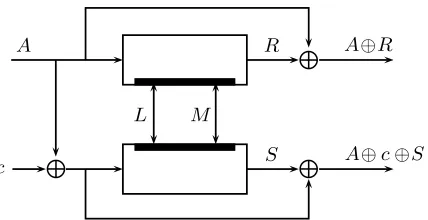
Fig. 2: Hirose’s compression function. All wires carryn-bit values. The top and bottom blockciphers, which are the same blockci-pher, have2n-bit key andn-bit input/output. The wiresA, L, Mare the inputs to the compression function. The bottom left-hand wire is not an input; it carries an arbitrary nonzero constantc.
be the predicate that is true if and only ifQcontains a preimage ofC, whereCis an elided-but-understood parameter of the predicate. We define
AdvepreH (q) = max
A Pr[Preim(Q)]
where the maximum is taken over all adversariesAmaking at mostqqueries, and where the probability is taken over the randomness ofEas well as over the adversary’s coins, if any.
For Tandem-DM, it turns out that the everywhere preimage resistance notion is slightly too strong, as there is one weak point (namely 02n) in the range, for which finding preimages is a bit easier. A simple adaptation of the
everywhere preimage resistance definition is to disallow the adversary to chooseC= 02nas the target point [10]; we
denote the corresponding advantage as
AdvepreH ̸=0(q).
(We will still use the same predicatePreim(Q)though.)
A standard assumption to make in ideal cipher proofs is that “the adversary never makes a query to which it already knows the answer”. By this it is meant, for example, that one can assume the adversary never makes a query
EK(X), obtaining an answerY, and then makes the query EK−1(Y)(which will necessarily be answered by X).
In the current context, where we consider adversaries making2n queries or more, this assumption should be more
precisely restated as “the adversary never makes a query that will result in a triple(X, K, Y)which is already present in the query history”. (This latter assumption can be made without loss of generality using the fact thatEK(·)is a
permutation.) Indeed, if an adversary has made2n−1queries under a keyK, the result of the last query under that
key is predetermined, and thus the adversary “already knows” the answer to this query. However, one should not forbid the adversary from making this query, since the query may be necessary to complete a preimage.
Our security proofs also use the notion of “free” queries. Formally, these can be modeled as queries which the adversary is “forced” to query (under certain conditions), but for which the adversary is not charged: they do not count towards the maximum ofqqueries which the adversary is allowed. However, these queries become part of the adversary’s query history, just like other queries. In particular, the adversary is not allowed, later, to remake these queries “on its own” (due to the previously discussed assumption that the adversary never makes a query which it already owns).
3
Preimage security results for Hirose’s scheme
Theorem 1. LetHir :{0,1}3n→ {0,1}2nbe the blockcipher-based compression function depicted in Figure 2. Then
AdvepreHir(q)≤8q/N2+ 8q/N(N−2).
In particular,AdvepreHir (q)is upper bounded by approximately16q/N2.
Proof. LetU∥V ∈ {0,1}2nbe the point to invert (chosen by the adversary before it makes any queries toE). We upper
bound the probability that, inqqueries, the adversary finds a pointA∥L∥M ∈ {0,1}3nsuch thatHir(A∥L∥M) =
U∥V.
When the adversary makes a forward queryEL∥M(A)we give it for free, also, the answer to the queryEL∥M(A⊕
c). Moreover when the adversary makes a backward queryEL−∥1M(R), resulting in an answerA=EL−∥1M(R), we give it for free the answer to the forward queryEL∥M(A⊕c). Also, we assume that the adversary never makes a query to
which it knows the answer (in the sense discussed in Section 2). Thus the elements of the adversary’s query historyQ can be paired into adjacent pairs of the form(A, L∥M, R),(A⊕c, L∥M, S). We call such a pair an “adjacent query pair”.
We now give further free queries to the adversary, in the fashion described next. After each adjacent query pair has been completed (namely, after the adversary has received the response to both its query and its associated free query, and after these have been placed in the query history), we check whether the key used for the latest query is such that the (current) query history contains exactlyN/2queries with this key. If so, we giveallremaining queries under this key for free to the adversary. There will be exactlyN/2such queries, which can be paired intoN/4adjacent query pairs. We insert theseN/2free queries into the query history pair-by-pair (to maintain, mostly for conceptual simplicity, the adjacent pair structure of the query history). We note that, after these free queries have been inserted into the query history, the adversary cannot make any more queries under this key, since the adversary is assumed never to make a query to which it knows the answer.
WhenN/2free queries are given to the adversary in the fashion just described, we say that asuper queryoccurs. We also use the term “super query” to denote thesetofN/2free queries thus returned to the adversary. Every adjacent query pair in the query history is either part of a super query, or not; in the latter case, we call the adjacent query pair a “normal” adjacent query pair; we also say a single query is “normal” to indicate it is not part of a super query.5
Moreover, we keep track, in the query history (e.g. by an additional bit of data attached to each query), of which queries are normal, and of which queries belong to a super query (with every query being one or the other and not both).
We say that an adjacent query pair(A, L∥M, R),(A⊕c, L∥M, S)is “winning”, or “successful”, ifA⊕R =U
andA⊕c⊕S =V, or ifA⊕R=V andA⊕c⊕S=U. Thus the adversary obtains a preimage ofU∥V precisely if it obtains a winning adjacent query pair. This can occur in one of two ways: either the winning query pair is part of a super query, or not. We letSuperQueryWin(Q)denote the event that the adversary obtains a winning query pair that is part of a super query, andNormalQueryWin(Q)the event that the adversary obtains a winning query pair of normal queries. It thus suffices to upper bound
Pr[SuperQueryWin(Q)] + Pr[NormalQueryWin(Q)].
Here probabilities are taken (as usual) over the adversary’s randomness (if any) and over the randomness of the ideal cipher.
We first upper boundPr[NormalQueryWin(Q)]. Note that when the adversary makes, say, a forward queryEL∥M(A),
at mostN/2−2queries (counting free queries) have been previously answered with the keyL∥M, since otherwise a super query for the keyL∥M would have occured. Thus the valueR=EL∥M(A)comes uniformly at random from a
set of size at leastN/2 + 2≥N/2, and there is chance at most2/(N/2) = 4/Nthat eitherA⊕R=UorA⊕R=V
(this is also true ifU =V). If, say,A⊕R=U, there is further chance at most1/(N/2) = 2/N that the free query
EL∥M(A⊕c)returnsA⊕c⊕V, since the answer to the free query comes uniformly at random from a set of size
at leastN/2 + 1 ≤ N/2. Other cases (e.g.whenA⊕R = V, and when the adversary makes a backward query
5
EL−∥1M(R)) are similarly analyzed, showing that the adversary’s chance of triggering the eventNormalQueryWin(Q) at any given query is at most(4/N)(2/N) = 8/N2. Since the adversary makesqqueries total, we therefore have
Pr[NormalQueryWin(Q)]≤8q/N2. (1)
We now boundPr[SuperQueryWin(Q)]. Say a super query is about to occur on keyL∥M, meaning that the value ofEL∥M(·)is already known on exactlyN/2points paired intoN/4query pairs. LetA, A⊕cbe in the domain of
the super query. (We say that a pointB∈ {0,1}nis “in the domain of the super query” ifEL∥M(B)is not yet know,
and will be queried as part of the super query; note that a pointA ∈ {0,1}n is in the domain of the super query if and only ifA⊕cis in the domain of the super query.) Then the probability thatEL∥M(A) =U is either 0 ifUis not
in the range of the super query (meaning there is a normal queryEL∥M(B) =U already present in the query history
when the super query is made), or else is exactly2/N, since the value ofEL∥M(A)returned by the super query is
uniform at random in a set of sizeN/2. Thus, by a similar argument onV, the probability thatEL∥M(A)∈ {U, V}
is at most4/N. Conditioning on the eventEL∥M(A) ∈ {U, V}, the probability that EL∥M(A⊕c) ∈ {U, V} is
at most1/(N/2−1), sinceEL∥M(A⊕c)is sampled uniformly at random from a set of sizeN/2−1, once the
valueEL∥M(A)is known. Thus the probability that the super query returns values such that the adjacent query pair
(A, L∥M,·),(A⊕c, L∥M,·)is winning is at most4/N(N/2−1). ButA, A⊕cwere two arbitrary paired domain points; taking a union bound over theN/4such pairs in the domain of the super query, we find that the probability of the super query producing a winning pair of adjacent queries is at most
(N/4)·(4/N(N/2−1)) = 1/(N/2−1).
We now observe that at mostq/(N/4)super queries can ever occur, since each super query requires a “setup” cost of
N/4queries. Thus
Pr[SuperQueryWin(Q)]≤4q/N(N/2−1). (2)
Summing (1) and (2) completes the proof. ⊓⊔
Corollary 1. We have
AdvepreHir (22n−5)≤1/2 +o(1)
where theo(1)term tends to 0 asn→ ∞.
Proof. By settingq=cN2for some0< c <1, the bound from Theorem 1 simplifies to
16c+ 16c 2
N−2.
Again, settingc= 1/32gives us the claimed result.
4
Preimage security results for Abreast-DM
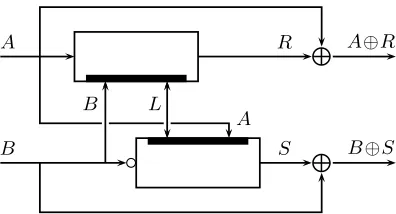
Abreast-DM, pictured in Figure 3, is one of the classical schemes for turning a2n-bit key blockcipher into a3n -bit to2n-bit compression function. It was proposed by Lai and Massey in the same paper as Tandem-DM [8]. The collision resistance of Abreast-DM was independently resolved by Fleischmann, Gorski and Lucks [4] and Lee and Kwon [9], who both showed birthday-type collision resistance for Abreast-DM. Previously, Hirose [5] had given a collision resistance analysis for a general class of compression functions that included Abreast-DM as a special case, but under the assumption that the top and bottom blockciphers of the diagram be distinct. This assumption considerably simplifies the analysis (see also the later generalization by ¨Ozen and Stam [12]).
A B
B
L
A R
S B⊕S
A⊕R
Fig. 3: The Abreast-DM compression function. The wiresA, B, Lare the inputs to the compression function. The empty circle at the left side of the bottom blockcipher denotes bit complementation.
Theorem 2. LetAbr :{0,1}3n→ {0,1}2nbe the blockcipher-based compression function depicted in Figure 3. Let
α >0be an integer. Then
AdvepreAbr(q)≤ 16α
N +
8q
N2(N−2)+ 2·
(
2eq αN
)α
+ 4q
αN.
Proof. LetU∥V be the point to invert, chosen by the adversary before any queries are made toE.
Unlike in the proof for Hirose’s scheme, we do not give the adversary a free query after each query it makes. However, we still give the adversary “super queries” for free. More precisely, whenever the adversary has madeN/2 queries under a given keyK∥L, and after the(N/2)-th such query has been answered and placed in the query history, we give the remainingN/2queries under the keyK∥Lfor free to the adversary, in any order. In this case, we say that a super query occurs; every query in the query history is either part of a super query, or not; in the latter case we call the query a “normal query”. (Thus, in this theorem, normal queries are exactly the non-free queries.) Unlike in the proof of Theorem 1, there is no notion of an adjacent query pair. However, like in the proof of Theorem 1, we alert the reader to the fact that a “super query” consists of a set ofN/2queries, whereas a “normal query” is a single query.
We define an eventLucky(Q)on the query history;Lucky(Q)occurs if
|{(X, K∥L, Y)∈ Q:X⊕Y =U}|>2α,
or if
|{(X, K∥L, Y)∈ Q:X⊕Y =V}|>2α.
The adversary obtains a preimage ofU∥V precisely if it obtains queries of the form(A, B∥L, R),(B, L∥A, S) such thatA⊕R = U andB⊕S = V, where B is bitwise complementation ofB. It is easy to check that these two queries must be distinct, otherwise one obtains the contradictionB =A=L =B. We call two such queries a “winning pair” of queries. Note, of course, that the queries in a winning pair need not be adjacent in the query history. We speak of the “first” and “second” query in a winning pair referring to the order in which they appear in the query history.
LetWinNormal(Q)be the event that the adversary obtains a winning pair in which the second query is a normal query. LetWinSuper1(Q)be the event that the adversary obtains a winning pair in which the second query is part of a super query and the first is either normal or part of a super query, but is not part of thesamesuper query as the second. Finally letWinSuper2(Q)be the event that the adversary obtains a winning pair in which both queries of the pair are part of the same super query. It is then clear that if the adversary wins, one of the events
WinNormal(Q),WinSuper1(Q) or WinSuper2(Q) occurs. In particular, thus, one of the four events
We start by upper boundingPr[Lucky(Q)]. For this we introduce two new events. LetQnbe the restriction ofQ to normal queries, and letQsbe the restriction ofQto queries that are part of super queries. LetLuckyn(Q)be the event that either
|{(X, K∥L, Y)∈ Qn:X⊕Y =U}|> α, or
|{(X, K∥L, Y)∈ Qn:X⊕Y =V}|> α.
The eventLuckys(Q)is likewise defined with respect toQs. Obviously,Lucky(Q) =⇒ Luckyn(Q)∨Luckys(Q), so it suffices to upper boundLuckyn(Q)andLuckys(Q)and to sum these upper bounds.
Since every answer to a normal query, forward or backward, comes at random from a set of size at leastN/2, and since at mostqnormal queries are made, we have that
Pr[Luckyn(Q)]≤2·
( q α
) (
2
N )α
≤2·
(
2eq αN
)α
.
To upper boundPr[Luckys(Q)], note that there occur at mostq/(N/2) = 2q/N super queries, since it costs N/2 queries to setup a super query for a given key. Since each super query containsN/2queries, we can define random variablesZi,j for1 ≤i≤ 2q/N and1 ≤j ≤N/2, whereZi,j = 1if and only ifX ⊕Y =U for thej-th query
(X, K∥L, Y)within thei-th super query. Then we have
Z=∑
i,j
Zi,j=|{(X, K∥L, Y)∈ Qs:X⊕Y =U}|.
SinceE(Zi,j) ≤ 2/N for eachi andj, we haveE(Z) ≤ (2q/N)(N/2)(2/N) = 2q/N. Therefore, by Markov’s
inequality, the probability that
|{(X, K∥L, Y)∈ Qs:X⊕Y =U}|> α
is at most2q/αN. Now by a union bound and a symmetric argument (forX⊕Y =V), we obtain thatPr[Luckys(Q)]≤ 4q/αN. Summing the upper bounds forPr[Luckyn(Q)]andPr[Luckys(Q)], we thus obtain that
Pr[Lucky(Q)]≤2·
(
2eq αN
)α
+ 4q
αN. (3)
We now upper boundPr[WinNormal(Q)∧ ¬Lucky(Q)]. For this we use a “wish list” argument similar to that of [10]. As the adversary makes queries, we maintain two sequencesWTandWBcalledwish lists. These are initially empty. For each query(X, K∥L, Y)added to the query history (whether normal or part of a super query) we update the wish lists as follows:
1. IfX⊕Y =Uthen(K, L∥X, K⊕V)is added toWB. 2. IfX⊕Y =V then(L, X∥K, L⊕U)is added toWT.
We emphasize thatWBandWTare sequences, not sets. The following properties are easy to check: (i) a query never “adds itself” to a wish list (namely, the queries inserted into the wish lists—if any—as a result of query(X, K∥L, Y) being added to the query history, are distinct from(X, K∥L, Y)itself); (ii) the elements ofWTare all distinct from one another, and the elements ofWB are all distinct from one another—namely, the same triple is never added twice to a wish list; (iii) the adversary obtains a winning pair precisely if a query is ever added to its query history that is already a member of one of its wish lists before the updating of the wish lists for that query (by property (i), however, we could equally well say “after the updating of the wish lists for that query”). Moreover, as long as¬Lucky(Q)holds, the wish lists never exceed length2α.
LetEK∥L(X)be a query made toE during the adversary’s attack (either a normal query, or as part of a super
query). If, at the moment when the query is being made, there is an element of the form(X, K∥L, Y)in (at least) one of the wish lists for someY ∈ {0,1}n, then we say this wish list element is being “wished for” when the query
EK∥L(X)is made. We similarly say the wish list element(X, K∥L, Y)is being “wished for” if the queryEK−1∥L(Y)is
by forward queries). We note, importantly, that any wish list element can only be wished for once, sinceEK∥L(·)is a
permutation.
Let NormalWishGrantedT,i be the event that a normal query (X, K∥L, Y), when added to the query list, is
equal to the i-th element ofWT (presuming WT has length at least i when the query is added). Likewise define NormalWishGrantedB,iwith respect to the listWB. Then by the above remarks
WinNormal(Q)∧ ¬Lucky(Q) =⇒ 2α
∨
i=1
NormalWishGrantedT,i∨
2α
∨
i=1
NormalWishGrantedB,i
so by a union bound
Pr[WinNormal(Q)∧ ¬Lucky(Q)]≤ 2α
∑
i=1
Pr[NormalWishGrantedT,i] +
2α
∑
i=1
Pr[NormalWishGrantedB,i].
Because each wish list element can only be wished for once and because a normal query is answered at random uniformly from a set of size at leastN/2, we have
Pr[NormalWishGrantedT,i]≤2/N, Pr[NormalWishGrantedB,i]≤2/N
and therefore
Pr[WinNormal(Q)∧ ¬Lucky(Q)]≤2·(4α/N) = 8α/N. (4)
We now upper boundPr[WinSuper1(Q)∧ ¬Lucky(Q)]. We keep the same definition of the wish listsWT,WBas above. We letSuperWishGranted1T,ibe the event that a query(X, K∥L, Y)that is part of a super query is equal to the
i-th element ofWT, whereWThas length≥ibefore any of the super queries under keyK∥Lhave been made. The eventSuperWishGranted1B,iis similarly defined. By the definition ofWinSuper1(Q)we have that
Pr[WinSuper1(Q)∧ ¬Lucky(Q)]≤ 2α
∑
i=1
Pr[SuperWishGranted1T,i] + 2α
∑
i=1
Pr[SuperWishGranted1B,i].
Assume, for a giveni, that thei-th element ofWT(say) is(X, K∥L, Y), and that a super query is about to be made for the keyK∥L, and thatXis in the domain of the super query. Then the probability thatEK∥L(X) =Y is at most
2/N(more precisely, it is exactly2/NunlessY is not in the super query’s range, in which case it is 0). Thus, arguing similarly for the listWB, we obtain that
Pr[SuperWishGranted1T,i]≤2/N, Pr[SuperWishGranted1B,i]≤2/N.
Therefore
Pr[WinSuper1(Q)∧ ¬Lucky(Q)]≤8α/N. (5) We finally boundPr[WinSuper2(Q)∧ ¬Lucky(Q)]. In fact we upper boundPr[WinSuper2(Q)], and we do not use a wish list argument. Note the eventWinSuper2(Q)can only occur when a super query is made on a key of the formL∥L, and then occurs only if bothLandLare in the domain of the super query and if EL∥L(L)⊕L = U,
EL∥L(L)⊕L=V. It is easy to see that probability (when the super query is made) that these latter equalities hold is
at most(2/N)·(1/(N/2−1)). Since at mostq/(N/2)super queries are made, we therefore have
Pr[WinSuper2(Q)∧ ¬Lucky(Q)]≤Pr[WinSuper2(Q)]≤4q/N2(N/2−1). (6)
Finally, we obtain the theorem by summing (3), (4), (5) and (6). ⊓⊔
Corollary 2. We have
AdvepreAbr(22n−10)≤1/2 +o(1)
B
B L
A R
R
S B⊕S
A⊕R
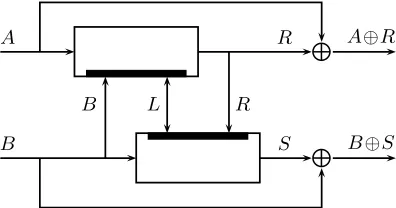
Fig. 4: The Tandem-DM compression function. The wiresA, B, Lare the inputs to the compression function.
Proof. By settingα=q1/2/2(note thatαis allowed to depend onq), the bound from Theorem 2 simplifies to
16q1/2
N +
8q
N2(N−2)+ 2·
(
4eq1/2
N
)q1/2/2
.
Suppose thatq= (cN)2for some0< c <1, then this bound can be rewritten as
16c+ 8c 2
N−2 + 2·(4ec)
cN/2
.
For4ec <1, this tends16c, so settingc= 1/32gives us the claimed result.
5
Preimage security results for Tandem-DM
The Tandem-DM compression function, proposed by Lai and Massey in 1992 [8], is a3n-bit to2n-bit compression function based on two applications of a blockcipher of2n-bit key andn-bit word length (Figure 4). The first (flawed) proof of collision security for Tandem-DM (by Fleischmann, Gorski and Lucks [3]) did not appear until 2009. Later, Lee, Stam and Steinberger [10] gave a correct collision resistance analysis of Tandem-DM showing that indeed it has birthday-type collision security in the ideal cipher model (necessitating at least2120.8queries to break when the output length is2n= 256bits). They also showed preimage resistance up to essentially2128queries (forn= 128), once0n∥0nis excluded as challenge digest. Our new bound is identical to the bound we gave for Abreast-DM, so in
particular22n−10queries are needed to obtain a preimage with probability∼0.5(Corollary 3).
Theorem 3. LetTan :{0,1}3n→ {0,1}2nbe the blockcipher-based compression function depicted in Figure 4. Let α >0be an integer. Then
AdvepreTan̸=0(q)≤16α
N +
8q
N2(N−2)+ 2·
(
2eq αN
)α
+ 4q
αN.
Proof. LetU∥V ̸= 0n∥0nbe the point to invert, chosen by the adversary before making any queries toE.
We manage free queries exactly as for Abreast-DM; more precisely, when N/2queries are made toE under a given key, we give the remainingN/2 queries under that key for free to the adversary, and this constitutes a “super query”. No other free queries are given.
In the case of Tandem-DM, the adversary obtains a preimage ofU∥V precisely if it obtains queries of the form (A, B∥L, R),(B, L∥R, S)such thatA⊕R = U,B⊕S =V. It is easy to see these two queries must be distinct, otherwise we would haveA = B = L = R = S and thereforeU∥V = 0n∥0n. We call two queries as above a
We define the eventsLucky(Q),WinNormal(Q),WinSuper1(Q)andWinSuper2(Q)as in the proof of Theorem 2 (but with respect, of course, to the new definition of “winning pair”). If the adversary wins, one of the events
Lucky(Q), WinNormal(Q)∧ ¬Lucky(Q), WinSuper1(Q)∧ ¬Lucky(Q),WinSuper2(Q)∧ ¬Lucky(Q) must occur. We upper bound the probability of each of these events separately.
As in the case of Theorem 2, we have
Pr[Lucky(Q)]≤2·
(
2eq αN
)α
+ 4q
αN. (7)
To upper boundPr[WinNormal(Q)∧ ¬Lucky(Q)], we again use wish lists. There are two wish lists,WTandWB, which are initially empty and which are updated after each new query(X, K∥L, Y)placed into the query history, according to the following rules:
1. IfX⊕Y =Uthen(K, L∥Y, K⊕V)is added toWB. 2. IfX⊕Y =V then(L⊕U, X∥K, L)is added toWT.
The same four properties from Theorem 2 are easy to check: (i) a query never “adds itself” to a wish list (this uses
U∥V ̸= 0n∥0n); (ii) the elements within each wish list are all distinct from one another; (iii) the adversary obtains a
winning pair precisely if it obtains a query that is already in one of its wish lists (at the moment of insertion of that query into the query history). And by definition ofLucky(Q), the wish lists never exceed length2αas long¬Lucky(Q) holds.
LetNormalWishGrantedT,i,NormalWishGrantedB,ibe defined as in (the proof of) Theorem 2. Then, using
ex-actly the same analysis as in the proof of Theorem 2, we have that
Pr[NormalWishGrantedT,i]≤2/N, Pr[NormalWishGrantedB,i]≤2/N
and that
Pr[WinNormal(Q)∧ ¬Lucky(Q)]≤8α/N. (8)
Then also arguing word for word as in the proof of Theorem 2, we find that
Pr[WinSuper1(Q)∧ ¬Lucky(Q)]≤8α/N. (9) We finally boundPr[WinSuper2(Q)∧ ¬Lucky(Q)]. Note the eventWinSuper2(Q)can only occur when a super query occurs for a key of the formL∥L, and when that super query results in the triples(U⊕L, L∥L, L),(L, L∥L, L⊕ V)being added to the query history. The probability thatEL∥L(U ⊕L) =Lis at most2/N, and, conditioned on the
event thatEL∥L(U⊕L) =L, the probability thatEL∥L(L) = L⊕V is at most1/(N/2−1). Since at most2q/N
super queries occur, we thus find that
Pr[WinSuper2(Q)∧ ¬Lucky(Q)]≤Pr[WinSuper2(Q)]≤4q/N2(N/2−1). (10)
The theorem follows by summing (7), (8), (9) and (10). ⊓⊔
As for Abreast-DM, we have the following corollary (with the same proof):
Corollary 3. We have
AdvepreTan(22n−10)≤1/2 +o(1)
References
1. Y. Dodis and J. Steinberger: Message Authentication Codes from Unpredictable Block Ciphers. Crypto 2009, LNCS 5677, pp. 267–285. Springer, Heidelberg (2010). Full version available at http://people.csail.mit.edu/dodis/ps/tight-mac.ps
2. E. Fleischmann, C. Forler, M. Gorski and S. Lucks: Collision Resistant Double-Length Hashing. ProvSec 2010, LNCS 6401, pp. 102–118. Springer, Heidelberg (2010)
3. E. Fleischmann, M. Gorski and S. Lucks: On the security of Tandem-DM. FSE 2009, LNCS 5665, pp. 84–103. Springer, Heidelberg (2009)
4. E. Fleischmann, M. Gorski and S. Lucks: Security of cyclic double block length hash functions. Cryptography and Coding, 12th IMA International Conference, Cirencester, UK, LNCS 5921 pp. 153–175. Springer, Heidelberg (2009)
5. S. Hirose: Provably secure double-block-length hash functions in a black-box model. ICISC 2004, LNCS 3506, pp. 330–342. Springer, Heidelberg (2005)
6. S. Hirose: Some plausible constructions of double-block-length hash functions. FSE 2006, LNCS 4047, pp. 210–225. Springer, Heidelberg (2006)
7. M. Krause, F. Armknecht and E. Fleischmann: Preimage resistance beyond the birthday bound: Double-length hashing revis-ited.http://eprint.iacr.org/2010/519.pdf
8. X. Lai and J. Massey: Hash function based on block ciphers. Eurocrypt 1992, LNCS 658, pp. 55–70. Springer, Heidelberg (1993)
9. J. Lee and D. Kwon: The security of Abreast-DM in the ideal cipher model. IEICE Transactions 94-A(1), pp. 104–109. (2011) Also available athttp://eprint.iacr.org/2009/225.pdf
10. J. Lee, M. Stam and J. Steinberger: The security of Tandem-DM in the ideal cipher model. http://eprint.iacr.org/2010/409.pdf
11. S. Lucks: A collision-resistant rate-1 double-block-length hash function. Symmetric Cryptography, Dagstuhl Seminar Proceed-ings 07021 (2007)
12. O. ¨Ozen and M. Stam: Another Glance at Double-Length Hashing. Cryptography and Coding, 12th IMA International Confer-ence, Cirencester, UK, LNCS 5921, pp. 94–115. Springer, Heidelberg (2009)
13. M. Rabin: Digitalized signatures. Foundations of Secure Computations, pages 155–166. Academic Press (1978)
14. P. Rogaway and T. Shrimpton: Cryptographic hash-function basics: definitions, implications, and separations for preimage resistance, second-preimage resistance, and collision-resistance. FSE 2004, LNCS 3017, pp. 371–388. Springer, Heidelberg (2004)
15. P. Rogaway and J. Steinberger: Constructing cryptographic hash functions from fixed-key blockciphers. Crypto 2008, LNCS 5157, pp. 433–450. Springer, Heidelberg (2008)
16. T. Shrimpton and M. Stam: Building a collision-resistant compression function from non-compressing primitives. ICALP 2008, Part II. LNCS 5126, pp. 643–654, Springer, 2008.
17. J. Steinberger: The collision intractability of MDC-2 in the ideal-cipher model, Eurocrypt 2007, LNCS 4515, pp. 34–51. Springer, Heidelberg (2007)
18. M. Stam: Beyond uniformity: better security/efficiency tradeoffs for compression functions, Crypto 2008, LNCS 5157, pp. 397–412. Springer, Heidelberg (2008)
19. M. Stam: Blockcipher-based hashing revisited, FSE 2009, LNCS 5665, pp. 67–83. Springer, Heidelberg (2009) 20. D. Wagner: Cryptanalysis of the Yi-Lam hash, Asiacrypt 2000, LNCS 1976, pp. 483–488. Springer, Heidelberg (2000) 21. X. Yi and K.-Y. Lam: A new hash function based on block cipher. ACISP 1997, Second Australasian Conference on Information
Security and Privacy, LNCS 1270, pp. 139–146. Springer, Heidelberg (1997)
A
Using two distinct blockciphers in parallel
In the main body we applied our new technique of super queries to the analysis of three well-known constructions that each call the same blockcipher twice. Often the situation where two distinct blockciphers are each called once is easier to analyze, and indeed it is this scenario that is addressed by Krause et al. [7] (albeit indirectly, by performing explicit domain separation for a single blockcipher). For comparison, we show how our technique applies to this scenario, where we adhere to the more general framework as introduced by ¨Ozen and Stam [12, 19] (with slighlty different notation though).
Given two blockciphersE, E′ : {0,1}m× {0,1}n → {0,1}n we define a parallel-call compression6 function H : {0,1}m+n → {0,1}2n by means of three helper functions F, F′ : {0,1}m+n → {0,1}m× {0,1}n and
6
G:{0,1}m+n× {0,1}n× {0,1}n→ {0,1}2n. IfB ∈ {0,1}m+nis the input to the compression function, the digest
C is computed as(K, X) ← F(B),(K′, X′) ← F′(B), followed byY ← EK(X), Y′ ← EK′ ′(X′)and finally
C=G(B, Y, Y′).
(Since two distinct blockciphersE andE′ are used to createY respectivelyY′, one obviously needs to use a slightly different definition of preimage resistance, where the adversary has access to both blockciphers and these are sampled independently from each other.)
Theorem 4. Let H be a parallel-call compression function using two distinct blockciphers and with the following structural properties:
P1 F and F′ are both bijections, thus defining a 1-1 correspondenceπ between inputs(K, X)and (K′, X′)(so
(K′, X′) =π(K1, X1)).
P2 G(B, Y, Y′)as a function from(Y, Y′)toCis bijective for allB.
P3a G(combined withF) is such thatK, Y andCuniquely determine a correspondingX. Namely for allX, Y˜ ′and
BsatisfyingG(B, Y, Y′) =Cand(K,X˜) =F(B)we haveX˜ =X.
P3b G(combined withF′) is such thatK′, Y′andCuniquely determine a correspondingX′.
P4 FandF′are key-consistent, that is there exists a permutationξsuch that if(K′, X′) =π(K, X)thenK′=ξ(K).
(Here we assumed propertyP1is already satisfied.)
Then
AdvpreH (q)≤8q/N2.
In particular, an adversary must ask at leastN2/16 = 22n−4queries to have chance0.5of obtaining a collision.
Proof. We largely follow the proof we gave for Hirose’s scheme (Theorem 1). LetCbe the point that the adversary
has chosen to invert (before gaining access to the blockciphers). On top of theqqueries the adversary wants to make, we give it several queries for free, as follows:
1. (Normal forward query) If the adversary queriesEK(X), we also give it for freeEK′ ′(X′)where(K′, X′) =
π(K, X)(and vice versa, given a queryEK′ ′(X′)the appropriateEK(X)query with(K, X) =π−1(K′, X′)is
added).
2. (Normal inverse query) Given inverse queryEK−1(Y)with answerX, the corresponding queryEK′ ′(X′)is given
for free (and vice versa, given an inverseE′query, the appropriateEquery is added).
3. (Super query) GivenN/2queries toEall using the same keyK, all the remaining queries using that keyKare given for free. Moreover, all remaining queries toE′ using the corresponding keyK′ =ξ(K)are given for free as well.
We note that, as a result of these additional queries, the elements(X, K, Y)Eand(X′, K′, Y′)E′with(K′, X′) =
π(K, X)are always added to the query history as a pair. (Here we use subscript notation in the query history to resolve ambiguity about the relevant primitive.) Moreover, thanks to propertyP1, any pair uniquely corresponds to someB
(for which(K, X) =F(B)and(K′, X′) =F′(B)) and we call it winning iffH(B) =C, i.e. iffC=G(B, Y, Y′). To find a preimage, an adversary needs to create a winning pair in its query history (composed of both the queries it asks explicitly and the free queries). We can distinguish between three types of winning pairs, depending on the free queries involved. LetNormalQueryWin(Q)denote the event that the adversary obtains a winning pair that is not part of a super query and whose first query was a forward query, letInverseQueryWin(Q)denote the event that the winning pair is not part of a super query whose first query was an inverse query, and finally letSuperQueryWin(Q)denote the event that the adversary obtains a winning pair that is part of a super query. Then the preimage-finding advantage is upper bounded by
Pr[SuperQueryWin(Q)] + Pr[NormalQueryWin(Q)] + Pr[InverseQueryWin(Q)].
(Here the probabilities are over the choice of bothEandE′, and over the adversary’s randomness, when present.) We will bound these three probabilities; a simple sum then leads to the theorem statement.
To bound Pr[NormalQueryWin(Q)], consider a single query pair(EK(X), EK′ ′(X′)). PropertyP2implies that
similarly, at mostN/2queries toE′ underK′, the probability of hitting this single value(Y1, Y2)is upper bounded by1/(N−N/2)2= 4/N2(here we also use thatEandE′are independent).
Bounding Pr[InverseQueryWin(Q)]goes along similar lines. Assume WLOG that the pair has been prompted by queryEK−1(Y). Then propertyP3aimplies that there exists a uniqueX that might lead to a preimage. Moreover (regardless of the actualX˜ obtained), there is a unique answerY′ toEK′ ′(X′)(where (K′, X′) = π(K,X˜)) that
combines withK, X, andY to complete the preimage. Since there have been at mostN/2 queries toE underK
and, similarly, at mostN/2queries toE′ underK′, the probability of hitting bothX andY′ is upper bounded by 1/(N −N/2)2 = 4/N2(again exploiting independence ofEandE′). The case that the pair was prompted by an (E′)−K1′(Y′)is analogous, based on propertyP3b.
Note that a query is either a forward or an inverse query (but not both), so by a union bound the (combined) total contribution of these two events to the adversary’s advantage is at most4q/N2.
All that is left is boundingPr[SuperQueryWin(Q)]. We first note that key consistency (propertyP4) ensures that only “regular” queries can count towards causing a super query. Since the threshold isN/2, this immediately implies that an adversary can only ever cause2q/N super queries. For any individual super query, we claim that the success probability is upper bounded by2/N, leading toPr[SuperQueryWin(Q)]≤4q/N2. A super query considers ofN/2 query pairs. For each pair, we can use the exact same derivation as we used forPr[NormalQueryWin(Q)]to argue that it succeeds with probability at most4/N2. A union bound over theN/2pairs constituting a super query gives the claimed2/Nbound.
B
Optimizing the bounds
In the previous analyses, we have set the threshold that triggers a super query at exactly half the total number of queries that can be made under a given key, that is,N/2. In general, we can allow a super query to occur right after an adversary makes(1/2 +θ)Nqueries for a given key, where−1/2< θ <1/2is a parameter to be optimized later.
Furthermore, eventLucky(Q)appearing in the security proof of Abreast-DM and Tandem-DM can be decomposed by using a certain parameter, leading to an improved bound on the probability ofLucky(Q). Note that eventLucky(Q) occurs if
|{(X, K∥L, Y)∈ Q:X⊕Y =U}|>2α,
or if
|{(X, K∥L, Y)∈ Q:X⊕Y =V}|>2α.
As before, letQnbe the restriction ofQto normal queries, and letQsbe the restriction ofQto queries that are part of super queries. For−1/2< δ <1/2, we defineLuckyn(Q)to be the event that either
|{(X, K∥L, Y)∈ Qn:X⊕Y =U}|>2
(
1 2 −δ
) α,
or
|{(X, K∥L, Y)∈ Qn:X⊕Y =V}|>2
(
1 2−δ
) α.
Similarly,Luckys(Q)is the event that either
|{(X, K∥L, Y)∈ Qs:X⊕Y =U}|>2
(
1 2 +δ
) α,
or
|{(X, K∥L, Y)∈ Qs:X⊕Y =V}|>2
(
1 2+δ
) α.
SinceLucky(Q) =⇒ Luckyn(Q)∨Luckys(Q), we can upper boundLuckyn(Q)andLuckys(Q)and sum these upper bounds. Using a similar argument to the original proof, we can show that
Pr[Lucky(Q)]≤2·
(
eq
2(12−δ) (12−θ)αN
)2(12−δ)α
+(1 q 2+δ
) (1
2+θ
)
Note that we obtain the original inequality by settingθ=δ= 0.
With the same definition of eventsWinNormal(Q),WinSuper1(Q)andWinSuper2(Q), we have the following parameterized bounds.
Pr[WinNormal(Q)∧ ¬Lucky(Q)]≤ (1 4α 2−θ′
)
N, (12)
Pr[WinSuper1(Q)∧ ¬Lucky(Q)]≤ (1 4α 2−θ′
)
N, (13)
Pr[WinSuper2(Q)]≤ (1 q 2−θ′
)
N((12−θ′)N−1) (12 +θ′)N. (14)
Here we are using a super query thresholdθ′, which is distinct from the parameterθused in the bound ofPr[Lucky(Q)]. To summarize, we obtain the following theorem.
Theorem 5. Let0< θ, θ′ <1, and letα,α1andα2be positive integers such thatα1+α2= 2α. Then for Abreast-DM
and Tandem-DM,
AdvepreAbr(q), AdvepreTan=0̸ (q)≤ (1 8α 2 −θ′
)
N +
q (1
2−θ′
)
N((12−θ′)N−1) (12 +θ′)N
+ 2·
(
eq
2(12−δ) (12−θ)αN )2(1
2−δ)α
+(1 q 2+δ
) (1
2+θ
) αN.
HIERARCHICAL OPTIMIZATION. Let
A= (1 8α 2−θ′
)
N, B =
q (1
2−θ′
)
N((12−θ′)N−1) (12+θ′)N,
C= 2·
(
eq
2(1 2−δ
) (1
2−θ
) αN
)2(1 2−δ)α
, D=(1 q
2+δ
) (1
2+θ
) αN.
We minimizeA+B+C+Dby the following steps.
1. BisO(q/N3), which is sufficiently small forq≈N2. Therefore, we minimizeAby takingθ′as small as possible. Settingθ′=−1/2 + 1/N, we have
A= 8α
N−1 and B=
q
(N−1)(N−2).
2. Consider the two factors(12−δ) (12 −θ)and(12+δ) (12+θ), each of which comes from the denominators of
CandD, respectively. For a fixed value of the first factor, the second factor is maximized by settingδ=θ. Then we have
C= 2·
(
eq
2(12−θ)2αN )2(1
2−θ)α
and D=( q
1 2+θ
)2
αN .
Here we ignore the exponent appearing inC, assuming it is sufficiently large.
3. For fixed values ofN,qandθ,A+Dis minimized whenA=D. By approximatingA= 8α/N, we have
α=
√q
2√2(12+θ).
Substituting this value intoC, we obtain
C= 2·
(
e√2(12+θ)√q (1
2−θ
)2
N )(1
2−θ)
√q √
4. Finally, we would like to maximizeθin order to minimizeAandD. As long as
e√2
(
1 2 +θ
)
√ q <
(
1 2 −θ
)2
N,
Cwould remain negligible. By solving this quadratic inequality, we can set
θ=θ(N, q) = N+ 4
√q−4√
N√q+q
2N .
To summarize, the adversarial advantagesAdvepreAbr(q)andAdvepreTan̸=0(q)are upper bounded by
4√2q (1
2+θ(N, q)
)
(N−1) +
q
(N−1)(N−2) + 2·
(
e√2(12+θ(N, q))√q (1
2−θ(N, q)
)2
N )(1
2−θ(N,q))√q
√
2(12+θ(N,q))
.
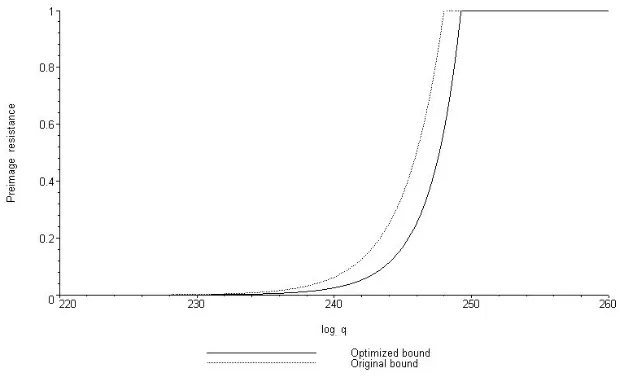
This optimized bound is compared to the original one in Fig. 5. Numerically, the optimized bound requires about 2247.6blockcipher queries to achieve chance0.5of inverting a randomly chosen point in the range for Abreast-DM and Tandem-DM. Thus we have1.6-bit gain over the original bound.