Constructing Variable-Length PRPs and SPRPs from
Fixed-Length PRPs
⋆Debra L. Cook1, Moti Yung2, Angelos Keromytis3 1
Alcatel-Lucent Bell Labs, New Providence, New Jersey, USA [email protected]
2
Google, Inc. and Columbia University, New York, NY USA [email protected] 3
Department of Computer Science, Columbia University, New York, NY, USA [email protected]
We create variable-length pseudorandom permutations (PRPs) and strong PRPs (SPRPs) accepting any input length chosen from the range ofbto2bbits from fixed-length,b-bit PRPs. We utilize the elastic network that underlies the recently introduced concrete design of elastic block ciphers, exploiting it as a network of PRPs. We prove that three and four-round elastic networks are variable-length PRPs and five-round elas-tic networks are variable-length SPRPs, accepting any input length that is fixed in the range ofbto2bbits, when the round functions are independently chosen fixed-length PRPs onbbits. We also prove that these are the minimum number of rounds required. Key words: (strong) pseudorandom permutations, block ciphers, variable-length PRPs
1
Introduction
We prove that the elastic network, the underlying structure of elastic block ciphers [2], allows for the creation of variable-length PRPs and SPRPs from fixed-length PRPs, meaning it provides a PRP or SPRP for every length individually within a range of in-put lengths. In the abstract sense, a block cipher should be a SPRP. Feistel networks were analyzed in this manner and proven to provide fixed-length PRPs and SPRPs un-der certain conditions by Luby and Rackoff [7], and by Naor and Reingold [8]. This approach has also been used to justify modes of encryption. For example, the CBC-Mask-CBC mode (CMC) of encryption was proven to provide a SPRP on multiples of the block length under certain conditions on the block cipher used within the mode [5]. In general, the implementation of a block cipher can be considered a black box to applications making function calls to the cipher. This is especially true in modern computers where block cipher hardware may be included, such as Intel’s plan to have AES in hardware as part of its future CPUs [4]. Understanding how to combine PRPs in theory to provide additional functionality translates into practical implementations by replacing the PRP with the black box that is the block cipher.
We consider the elastic network in an analogous manner. Elastic block ciphers are variable-length block ciphers created from existing block ciphers. The elastic version of a block cipher supports any actual block size between one and two times that of the original block size. The method consists of a substitution-permutation network, the
elastic network, that uses the round function from the existing fixed-length block cipher. We prove that three and four round elastic networks provide variable-length PRPs and five round elastic networks provides a variable-length SPRP for each input length in the range ofb to2b bits when the round functions are independently chosen fixed-length PRPs onb-bits.
Our results assist in proving the soundness of the elastic block cipher’s basic struc-ture. The security of elastic block ciphers against practical attacks was evaluated in [3]. By proving the elastic network forms variable-length PRPs and SPRPs on inputs ofb
to2bbits, under certain restrictions on the number of rounds and independence of the round functions as was done for Feistel networks [7, 8], our work provides further justi-fication for the elastic block cipher approach to creating variable-length block ciphers.
We consider analysis of the elastic block cipher approach to be of value because of how the approach differs from other approaches that reuse existing block ciphers when creating a variable-length block cipher in practice. Unlike other variable-length block cipher constructions that build upon existing fixed-length block ciphers, the elas-tic block cipher approach does not require multiple applications of the fixed-length block cipher to encrypt b+y bits, where 0 ≤ y ≤ b. By using the round function of the existing fixed-length block cipher as a black box within the elastic network the computational workload of an elastic block cipher is proportional to the block size. In contrast, other methods, such as [1, 9, 10], treat a fixed-length block cipher as a black box. When encryptingb+ybits, each of these methods apply a block cipher multiple times along with additional operations, resulting in a computational workload that is not proportional to the block size and which is less efficient than padding the data to two full blocks, regardless of the exact value ofy.
The remainder of this paper is organized as follows. Section 2 summarizes the def-initions of a PRP and SPRP, and the structure of elastic block ciphers. In Section 3, we show how to create variable-length PRPs from fixed-length PRPs with three and four round elastic networks. In Section 4, we prove that a five-round elastic network allows for the creation of a variable-length SPRP from fixed-length PRPs. In Section 5, counter-examples used to define the minimum number of rounds and independence of the round functions required for the proofs are presented. In Section 6, we summarize our results and briefly explain how the elastic network can be combined with CMC mode to extend the supported input length beyond2bbits.
2
Preliminaries and Strategy
2.1 PRP and SPRP Definitions
We informally remind the reader of the definitions of a PRP and a SPRP. Refer to [6] for formal definitions. Although we are discussing permutations (as opposed to practical block ciphers), we will use the terms ”plaintext” and ”ciphertext” to refer to the inputs and outputs of the permutation. We use the following terms in the definitions of a PRP and a SPRP.
– LetP be a permutation onbbits.P−1denotes its inverse.
P(x)is the output ofP
when given inputxof lengthbbits.
– Chosen plaintext query: An adversary chooses an input,pi, to a permutation,P,
and receives the output,ci=P(pi).
– Chosen ciphertext query: An adversary chooses an input,ci, to the inverse of a
permutation,P−1, and receives the output,p
i=P−1(ci).
– Chosen plaintext - chosen ciphertext queries: An adversary makes a series of queries to a permutation,P, and its inverse,P−1, and receives the outputs.
– Adaptive queries: When making chosen plaintext, chosen ciphertext or chosen plaintext - chosen ciphertext queries to a permutation (and/or its inverse), the queries are said to be adaptive if the adversary making the queries receives the output of theithquery before forming the(i+ 1)stquery and can use the previousiqueries
and their outputs when forming the(i+ 1)stquery.
The concepts of a PRP and a SPRP can be described by considering the probability with which an adversary can correctly determine whether or not a black box contains a specific permutation or a random permutation onbbits while using only polynomial (in
b) many resources. LetPbe a permutation onbbits. Given a black box that contains ei-therP(or its inverse) or a random permutation, an adversary makes polynomially many adaptive queries to the black box and receives the outputs of the permutation within the box. If the probability that the adversary correctly determines (using polynomial time and memory) the contents of the box is 12+efor negligiblee≥ 0, thenP is a PRP. In terms of block ciphers, this corresponds to the adversary being able to make either adaptive chosen plaintext queries or adaptive chosen ciphertext queries, but not both, to a black box which contains either the cipher or a random permutation.
Similarly, a permutation,P, onbbits is a SPRP if it is not possible to distinguish
P from a random permutation onb bits in polynomial (inb) time and memory when queries to both the permutation and its inverse are permitted. In terms of block ciphers, this corresponds to the adversary being able to make adaptive chosen plaintext -chosen ciphertext queries to a black box which contains either the cipher or a random permutation.
2.2 Elastic Network
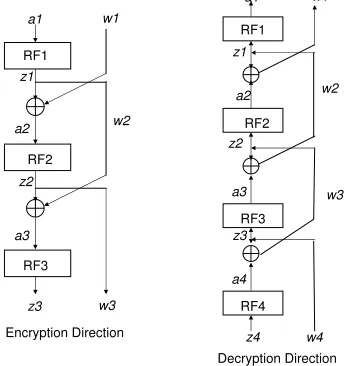
We provide a brief review of the elastic network, which provides the underlying struc-ture of elastic block ciphers. The elastic block cipher method was defined for creating variable-length block ciphers in practice [2]. The round function or cycle of an existing fixed-length,b−bit, block cipher is inserted into the elastic network, shown in Figure 1 and becomes the round function of the elastic version of the cipher. The input isb+y
bits, where0 ≤ y ≤ b. In each round the leftmostb bits are processed by the round function and the rightmosty bits are omitted from the round function. Afterwards, a ”swap step” is performed in which the rightmostybits are XORed with a subset of the leftmostbbits and the results swapped when forming the input to the next round.4
4Elastic block ciphers also include initial and end-of-round whitening, and initial and final
Fig. 1. Two Rounds of an Elastic Network
3
Variable-Length PRPs
As our first step, we prove that a three-round elastic network and the inverse of a four-round elastic network are variable-length PRPs when their four-round functions are inde-pendently chosen random permutations (RP). From these results, we can then prove that the same networks are variable-length PRPs when the round functions are indepen-dently chosen fixed-length PRPs. Figure 2 shows three-round and four-round elastic networks.
We prove that if a three-round elastic network,G′, with round functions that are
independently chosen random permutations onbbits can be distinguished from a ran-dom permutation onb+ybits, for some fixed value ofb+y, using polynomially many queries toG′then at least one of the round functions can be distinguished from a
ran-dom permutation onbbits, which is a contradiction. Therefore, we conclude thatG′is a
PRP. We use a black box,BG′, that contains eitherG′or a random permutation onb+y bits. We prove that if a distinguisher,D3, exists that can determine whether or notBG′ containsG′using polynomially many adaptive queries to the box thenD3can be used
to create a distinguisher for at least one of the round functions ofG′to distinguish the
round function from a random permutation onbbits. When we say a distinguisher for
G′exists, we mean that the distinguisher, using polynomially many adaptive queries in
one direction can predict or eliminate a possibility about an additional input/output pair value of the given permutation with greater certainty than that of a random guess. In contrast, with a random permutation, anything beyond the input/output pairs from the queries is known with the same probability as a random guess. We repeat the process for the inverse of a four-round elastic network.
We will refer to the components of the three and four-round networks as they are labelled in Figure 2. We use the following notation:
– b >0is an integer.
– yis an integer such that0≤y≤b.
– X⊕Y whereX is ab-bit string andY is ay-bit string, means the bits ofY are XORed withy specific bits ofX and the otherb−y bits ofX are treated as if they are XORed with 0’s. If the resulting string is stored in a variable containing onlyy bits instead ofbbits, the result consists only of they bits in the positions that involved bothX andY instead ofXand theb−y0’s. For example, consider XORing a 2-bit string with a 4-bit string such that the XOR involves the leftmost 2 bits of the 4-bit string. Letz1 anda2be 4-bit strings. Letw1 andw2 be 2-bit strings. Ifz1 =0110 andw1 =11,a2 =z1⊕w1 =1010.w2 =z1⊕w1 =10. – n > 0is an integer that generically represents the number of polynomially many
(in terms of the length of the input) queries made to a function. – |X|is the length, in bits, ofX.
– RF iis theithround function, fori= 1,2,3,4. Any restrictions placed on aRF i
will be specified as needed. Each round function is a permutation onb-bits. – aiis theb-bit input to theithround function fori= 1,2,3,4.
– ziis theb-bit output of theithround function fori= 1,2,3,4.
– wiis theybits left out of theithround function fori= 1,2,3,4. For any particular
elastic network,w2is formed from a fixed set of y-bit positions fromz1,w3 is formed from a fixed set ofy-bit positions ofz2, andw4is formed from a fixed set ofy-bit positions ofz3(i.e., the positions of the bits taken fromz1to formw1do not vary amongst the inputs to a specific three-round elastic network). Likewise, when formingw2,w3andw4.
– When referring to a specific value for anai, ziorwi, a subscript will be used. For example,a1j.
Theorem 1. A three-round elastic network,G′, onb+ybits in which the round
pseu-dorandom permutation onb+ybits in the encryption direction for any fixed value ofy where0≤y≤b. Three rounds are the mininum number of rounds required.
Proof. A two-round elastic network cannot be a PRP. Refer to Section 5 for the
counter-example. We define the following notation for use in proving the three round case: – BG′ is a black box that contains eitherG′or a random permutation onb+ybits. – (a1i, w1i)is an input toBG′.|a1i|=band|w1i|=yas defined previously. – (z3i, w3i)is the output ofBG′corresponding to the input(a1i, w1i).|z3i|=band
|w3i|=yas defined previously.
– D3is a distinguisher forG′, meaningD3can determine whether or notBG′ con-tainsG′ with probability1
2+αfor non-negligibleα,0< α≤ 1
2 when using only polynomially (inb+y) many resources. LetD3return a 1 if it thinksBG′contains
G′ and a 0 otherwise.D3 makesnadaptive chosen plaintext or adaptive chosen
ciphertext queries, but not both.
– S1 ={(a1i, w1i)}andS2 ={(z3i, w3i)}, fori= 1tonare the sets ofninputs
and outputsD3uses to distinguishG′from a random permutation. WhenD3works by making queries toBG′ in the encryption direction,S1contains the inputs and
S2contains the resulting outputs. WhenD3works by making queries toBG′in the decryption direction,S2contains the inputs andS1contains the resulting outputs. – BRF i is a black box that contains either theithround function,RF i, ofG′ or a
random permutation onbbits, fori= 1,2,3.
– BRF i(X)is the output ofBRF iwhen given inputX.
– B−1
RF i(X)is the inverse ofBRF i(X). i.e., the inverse of whatever permutation is in
BRF iis applied toX.
– DRF i is a distinguisher forRF i, meaningDRF i can determine whether or not
BRF icontainsRF iwith probability12+αfor non-negligibleα,0< α≤ 1 2 using polynomially (inb+y) resources.DRF i uses either adaptive chosen plaintext or
adaptive chosen ciphertext queries, but not both.
– ”plaintext query” refers to a query toG′in the encryption direction and ”ciphertext
query” refers to a query toG′in the decryption direction (a query toG′−1). We note that the bit positions used in the swap steps inG′ are not secret and this
information can be used by any distinguisher. We define the following functions corre-sponding to the swap steps for use by the distinguishers:
– LetF i(X, Y)be a function that takes ab-bit input,X, and ay-bit input,Y, and returns the pair(Z, W)whereZis ab-bit string andWis ay-bit string.F ireplaces theybits ofX with theybits ofY such that the bits inX which are replaced are in the same positions as the bits from the output of theithround function that are
involved in the swap step after theithround ofG′.F ireturns the updatedXvalue
inZ and returns a bit string,W, that contains theybits ofX that were removed fromX XORed with theybits inserted intoX.F i(X, Y)computes the inverse of theithswap step in the elastic network.
– LetF Y i(X)be a function that takes ab-bit inputX and returns theybits that are in the same bit positions used to createwifromz(i−1)inG′.
We now prove Theorem 1. IfD3, a distinguisher forG′in the encryption direction, exists,D3must fall into one of the following categories:
– Category I:D3does not use thez3portion of the output in its decision. The only part of the output used is thew3portion. This means that given theninput/output pairs inS1andS2,D3never uses thez3portion from any of the pairs inS2. – Category II:D3does not use thew3portion of the output in its decision. The only
part of the output used is thez3portion. This means that given theninput/output pairs inS1andS2,D3never uses thew3portion from any of the pairs inS2. – Category III:D3 uses both thez3andw3 portion of the outputs in its decision.
This means that givenninput/output pairs inS1andS2,D3uses thez3portion of the output from at least one of of the pairs inS2and uses thew3portion from at least one of the pairs inS2. Without using both portions,D3fails to distinguish the elastic network from a RP.
In each category, there are no restrictions on what portions of the inputs,{(a1i, w1i)},
are used. For each of the categories, we will show that the existence ofD3implies a distinguisher can be formed for either the second or third round function ofG′, which
contradicts the round functions being independently chosen random permutations. Category I: IfD3falls into Category I, a distinguisher,DRF2, can be defined for the second round function,RF2. Intuitively,D3 using only thew3portion of the output ofG′whenw3is from the output ofRF2whose inputs cannot be predicted with
non-negligible probability impliesD3 can distinguishRF2 from a random permutation. The inputs toRF2 are distinct except with negligible probability. Therefore, thew3 values are distributed as if they are taken from the outputs of distinct queries toRF2, except with negligible probability andD3cannot rely on being givenw3 values that were generated from identical inputs toRF2.
DefineDRF2as follows:
AskD3what its first query (input) would be if it was queryingBG′. PopulateS1
with this first input, so(a11, w11)has been chosen and is inS1.S1is known toDRF2. fori= 1ton{
Take(a1i, w1i)fromS1for use in subsequent steps.
Setz1i=O1(a1).
Setz2i=BRF2(z1i⊕w1i).
Setw3i=F Y3(z2i).
Givea1i, w1i, w3itoD3.
Add toS1the next inputD3would use when trying to distinguishD3, having seen the inputs and partial output of the firstiqueries. This is(a1i+1, w1i+1).
}
Letansbe the valueD3returns. Returnans.
ofS1and thew3ivalues ofS2whenD3is allowed to makenadaptive chosen plaintext queries toBG′.D3succeeds with non-negligible probability in determining whether or not it was given the input and partial output ofG′impliesD
RF2will succeed with non-negligible probability in determining if then(a2i, z2i)pairs correspond to the inputs
and outputs ofRF2. Therefore,DRF2can distinguish the contents ofBRF2using the
nqueries{O1(a1i)⊕w1i}.BRF2, contradicting the assumption that the second round function is an RP.
Category II: IfD3falls into Category II, a distinguisher,DRF3, can be defined for the third round function,RF3. Intuitively,D3using only thez3portion of the output ofG′ whenz3is from the output ofRF3whose inputs cannot be predicted with
non-negligible probability impliesD3can distinguishRF3from a random permutation. The inputs toRF3are distinct except with negligible probability. Therefore, thez3values are distributed as if they are the outputs ofndistinct queries toRF3, except with neg-ligible probability andD3cannot depend on being givenz3values that were generated from identical inputs to RF3. Therefore,D3 using only the input toG′ and thez3 portion of the output impliesD3can distinguishRF3from a random permutation.
DefineDRF3as follows:
AskD3what its first query (input) would be if it was queryingBG′. PopulateS1
with this first input, so(a11, w11)has been chosen and is inS1.S1is known toDRF3. fori= 1ton{
Take(a1i, w1i)fromS1for use in subsequent steps.
Setz1i=O1(a1i).
Setz2i=O2(z1i⊕w1i).
Setw2i=F Y2(z1i).
Setz3i=BRF3(z2i⊕w2i).
Givea1i, w1i, z3itoD3.
Add toS1the next inputD3would use when trying to distinguishD3, having seen the inputs and partial output of the firstiqueries. This is(a1i+1, w1i+1).
}
Letansbe the valueD3returns. Returnans.
The values given toD3are the input and leftmostbbits of the output of a three-round elastic network withRF1as the first round function,RF2as the second round func-tion and the contents of BRF3 as the third round function. The values given to D3 correspond to those ofS1and thez3ivalues fromS2whenD3is allowed to maken adaptive chosen plaintext queries toBG′.D3succeeds with non-negligible probability in determining it was given the input and partial output ofG′impliesD
RF3will suc-ceed with non-negligible probability in determining the contents ofBRF3by usingn queries,{O2(O1(a1i)⊕w1i)⊕F2(O1(a1i))}, contradicting the assumption that the
third round function is an RP.
G′ when z3is from the output ofRF3whose inputs cannot be predicted with
non-negligible probability, wherew3 is from the output of RF2whose inputs cannot be predicted with non-negligble probability and wherew3contributes to the formation of the input ofRF3(and thus contributes to the input to the permutation that produces
z3) impliesD3can distinguishRF3from random.D3cannot depend on being given
z3and/or w3 values that were generated by holding the inputs toRF2 and/orRF3 constant since this occurs with negligible probability. Therefore,D3can be viewed as using some relationship between partial information (i.e.,w3) used in forming the input toRF3and the output (ı.e.,z3) ofRF3to distinguish the third round function from a random permutation.
DRF3v2isDRF3with the modification thatw3iis given toD3along witha1i, w1i
andz3i. DefineDRF v2as follows:
AskD3what its first query (input) would be if it was queryingBG′. PopulateS1
with this first input, so(a11, w11)has been chosen and is inS1.S1is known toDRF3. fori= 1ton{
Take(a1i, w1i)fromS1for use in subsequent steps.
Setz1i=O1(a1).
Setz2i=O2(z1i⊕w1i).
Setw2i=F Y2(z1i).
Setz3i=BRF3(z2i⊕w2i).
Setw3i=F Y3(z2i).
Givea1i, w1i, z3i, w3itoD3.
Add toS1the next inputD3would use when trying to distinguishD3, having seen the inputs and output of the firstiqueries. This is(a1i+1, w1i+1).
}
Letansbe the valueD3returns. Returnans.
The values given toD3are the inputs and outputs of a three-round elastic network with
RF1 as the first round function,RF2as the second round function and the contents ofBRF3 as the third round function. The values given toD3 correspond to those of
S1andS2when D3 is allowed to makenadaptive chosen plaintext queries toBG′.
D3succeeds with non-negligible probability in determining it was given the input and output ofG′impliesD
RF3v2will succeed with non-negligible probability in determin-ing the contents ofBRF3by usingnqueries,{O2(O1(a1i)⊕w1i)⊕F2(O1(a1i))},
contradicting the assumption that the third round function is a random permutation. For each category, we have shown thatD3 cannot exist. Therefore, a three-round elastic network cannot be distinguished from a PRP by using polynomially many plain-text queries when the round functions are independently chosen random permutations. In the decryption direction, four rounds are required to create a PRP.
Theorem 2. The inverse of a four-round elastic network, (G′−1), on
Proof. Refer to Section 5 for an example showing why three rounds are insufficient.
The notation and terms are the same as in the proof to Theorem 1 unless otherwise stated. The black box,BG′, will containG′−1or a random permutation onb+ybits. The categories for the distinguisher are the same as in the three-round case. For two of the categories, three rounds are sufficient forG′−1to be a PRP. We prove these cases first. Then the proof for the third category, which requires four rounds, follows directly. The inputs are of the form(z3, w3)when using three rounds and(z4, w4)when using four rounds. The outputs are of the form(a1, w1).D3andD4will denote the distinguishers when three and four rounds are under consideration, respectively. When the number of rounds is not specified,Drwill be used to denote eitherD3orD4. If a distinguisher exists forG′−1
it must fall into one of the following three categories:
– Category I:Drdoes not use thea1portion of the output in its decision. The only
part of the output used is thew1portion. This means that given theninput/output pairs inS2andS1,Drnever uses thea1portion from any of the pairs inS1.
– Category II:Drdoes not use thew1portion of the output in its decision. The only
part of the output used is thea1portion. This means that given theninput/output pairs inS2andS1,Drnever uses thew1portion from any of the pairs inS1.
– Category III:Druses both thea1andw1portion of the outputs in its decision. This
means that givenninput/output pairs inS2andS1,Druses thea1portion of the
output from at least one of them and uses thew1portion from at least one of them. Without using both portions,Drfails to distinguish the elastic network from a RP.
In each category, there are no restrictions on what portions of the inputs,{(z3i, w3i)}or
{(z4i, w4i)}, are used. WhenDris restricted to Category II or III, only three rounds are
needed forG−1
to be a PRP. These two categories will be addressed before Category I. Similar to what was done with the encryption direction,Dr can be used to create
a distinguisher for one of the round functions. Since the round functions are random permutations, this results in a contradiction; therefore,Drcannot exist.
Category II: IfD3falls into Category II, a distinguisher,DRF1, can be defined for the inverse of the first round function ofG′ (the last round ofG′−1). Intuitively,
D3using only thea1portion of the output ofG′−1when
a1is from the output ofRF1−1whose inputs cannot be predicted with non-negligible probability impliesD3can distinguish
RF1−1 from a random permutation. The inputs to
RF1−1 are distinct except with negligible probability. Therefore, thea1values are distributed as if they are the outputs ofndistinct queries toRF1−1, except with negligible probability. Therefore,
D3using only the input to G′−1 and the
a1 portion of the output impliesD3 can distinguish
RF1−1from a random permutation. DefineDRF1as follows:
AskD3what its first query (input) would be if it was queryingBG′. PopulateS2
with this first input, so(z31, w31)has been chosen and is inS2.S2is known toDRF1. fori= 1ton{
Take(z3i, w3i)fromS2for use in subsequent steps.
Seta3i=O3−1(z3i).
Seta2i=O2−1(z2i).
Set(z1i, w1i) =F1(a2i, w2i).
Seta1i=BRF−11(z1i).
Givea1i, z3i, w3itoD3.
Add toS2the next inputD3would use when trying to distinguishD3, having seen the inputs and output of the firstiqueries. This is(z3i+1, w3i+1).
}
Letansbe the valueD3returns.
DRF3v2returnsans.
The values given toD3 are the inputs and outputs of the inverse of a three-round elastic network withRF3as the third round function,RF2as the second round func-tion and the contents ofBRF1as the first round function. These values correspond to the contents ofS2and thea1ivalues ofS1whenD3is allowed to makenadaptive chosen plaintext queries toBG′.D3succeeds with non-negligible probability in determining it was given the input and output ofG′ impliesD
RF1will succeed with non-negligible probability in determining the contents ofBRF1, contradicting the assumption that the first round function is a random permutation.
Category III: IfD3falls into Category III, a distinguisher,DRF3, can be defined for the inverse of the first round function,RF1−1. Intuitively,D
3can be viewed as using some relationship between partial information (i.e. w1) used in forming the input to
RF1−1
and the output (ı.e.a1) ofRF1−1
to distinguish the first round function from a random permutation.
DefineDRF1v2to beDRF1with the addition that thew1ivalues are also given to
D3.
AskD3what its first query (input) would be if it was queryingBG′in the decryption direction. PopulateS2with this first input, so(z31, w31)has been chosen and is inS2.
S2is known toDRF1v2. fori= 1ton{
Take(z3i, w3i)fromS2for use in subsequent steps.
Seta3i=O3−1(z3i).
Set(z2i, w2i) =F2(a3i, w3i).
Seta2i=O2−1(z2i).
Set(z1i, w1i) =F1(a2i, w2i).
Seta1i=B−
1
RF1(z1i).
Givea1i, w1i, z3i, w3itoD3.
Add toS2the next inputD3would use when trying to distinguish
D3, having seen the inputs and output of the firstiqueries. This is(z3i+1, w3i+1).
}
Letansbe the valueD3returns. Returnans.
func-tion and the contents ofBRF1as the first round function. These values correspond to those ofS1 andS2whenD3is allowed to makenadaptive chosen plaintext queries toBG′.D3 succeeds with non-negligible probability in determining it was given the input and output ofG′ impliesD
RF1v2 will succeed with non-negligible probability in determining the contents ofBRF1, contradicting the assumption that the first round function is a random permutation.
Category I: The result for this category follows directly from the results for Categories II and III. IfD4only uses thew1portion of the outputs, sincew1 =w2⊕a2, this im-pliesD4is using a combination ofa2andw2on which to base its decision. This implies
D4is a distinguisher for the first three rounds of the network in the decryption direction that falls into Category III because the leftmostb-bit portion (a2) and rightmosty-bit portion (w2) of the three round output is used. AssumeD4 exists for the four-round network.D4 is used to define a distinguisher,D3, for the three rounds consisting of
RF4−4to
RF2−2, taking inputs(
z4i, w4i)and producing outputs(a2i, w2i). In this
case,BG′ is a black box containing eitherG−1with four-rounds or a random permu-tation on b+y bits. LetB3 be a black box containing either the three-round elastic network formed from roundsRF4−4to
RF2−2or a random permutation on
b+ybits. DefineD3as follows:
AskD4what its first query (input) would be if it was queryingBG′in the decryption direction. PopulateS2with this first input, so(z41, w41)has been chosen and is inS2.
S2is known toD3. fori= 1ton{
Take(z4i, w4i)fromS2for use in subsequent steps.
Give(z4i, w4i)toB3and get back(a2i, w2i).
Setw1i=a2i⊕w2i.
Givew1i, z4i, w4itoD4.
Add toS2the next inputD4would use when trying to distinguishBG′, having
seen the inputs and output of the firstiqueries. This is(z4i+1, w4i+1).
}
Letansbe the valueD4returns.
D3returnsans.
The values given toD4are the inputs and rightmosty bits of the outputs of the inverse of a four-round elastic network. Theseybits are formed from both theb-bit and
y-bit portions of the output of three rounds. Therefore, by the assumptionD4exists,D3 will succeed with non-negligible probability in determining that the(a2i, w2i)values
were formed from the first three rounds of decryption. This contradicts the previous result from Category III.
For each of the three categories, we have shownDr cannot exist. Therefore, the
inverse of a four-round elastic network is a PRP when the round functions are indepen-dently chosen random permutations.
variable-length PRP when the round functions are independently chosen fixed-length PRPs.
Theorem 3. A three-round elastic network,G′, onb+ybits in which the round
func-tions are independently chosen PRPs onbbits is a variable-length PRP onb+ybits in the encryption direction for any fixed value ofywhere0≤y≤b. Three rounds are the mininum number of rounds required.
Proof. First, as noted in Theorem 1, a two-round elastic network cannot be a PRP. The
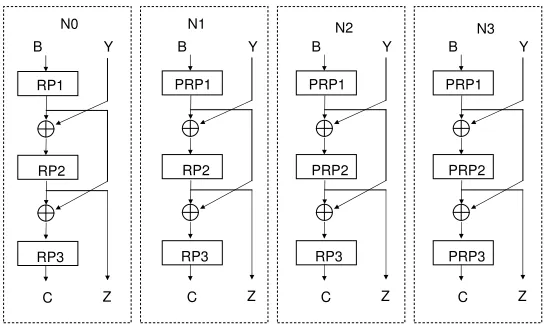
result for three rounds follows directly from Theorem 1 and the triangle inequality. We consider the relationships between four versions of a three-round elastic network that differ in regards to the number of their round functions that are PRPs and RPs. We consider the relationships between the four versions shown in Figure 3 of a three-round elastic network. In each version, the round functions are chosen independently of each other and map ab-bit input to ab-bit output.
Fig. 3. Three-Round Networks Consisting of RPs and PRPs
We define the following six permutations:
– LetP RP1, P RP2, P RP3be three independently chosen pseudorandom permu-tations.
– LetRP1, RP2, RP3be three independently chosen random permutations. LetN irefer to a three-round elastic network in the encryption direction in which the first i round functions are pseudorandom permutations and the remaining round functions are random permutations, fori= 0,1,2,3defined as follows:
– N0: Each round function is a RP. The round functions areRP1,RP2andRP3. – N1: The first round function is the PRP. The second and third round functions are
RPs. The round functions areP RP1,RP2andRP3.
– N3: Each round function is a PRP. The round functions areP RP1,P RP2and
P RP3.
As shown by Theorem 1,N0 is a PRP. Therefore, if Theorem 3 is not true it is possible to distinquishN3fromN0with probability≥ αfor some non-negligibleα
where0< α≤1. However, ifN3can be distinquished from random then at least one ofP RP1, P RP2andP RP3can be distinguished from random, which is a contradic-tion to the definicontradic-tion of a PRP and thus proves Theorem 3. LetD be a distinguisher that takes(b+y)-bit inputs and runs in polynomial time.Doutputs a 1 if it thinks the inputs are the outputs of a random permutation and outputs a 0 otherwise. LetP r(N i) be the probability thatDoutputs a 1 when given polynomially many outputs fromN i. IfN3can be distinguished from a random permutation, then|P r(N0)−P r(N3)| ≥α. However,
|P r(N0)−P r(N3)|=|P r(N0)−P r(N1) +P r(N1)−P r(N2) +P r(N2)− P r(N3)| ≤ |P r(N0)−P r(N1)|+|P r(N1)−P r(N2)|+|P r(N2)−P r(N3)|. Therefore,α≤ |P r(N0)−P r(N1)|+|P r(N1)−P r(N2)|+|P r(N2)−P r(N3)|. This implies at least one term on the right side of the inequality is≥ α
3. Therefore, it is possible to distinguish a three-round elastic network in the encryption direction that hasiround functions that are pseudorandom permutations and3−iround functions that are random permutations from a three-round elastic network that hasi−1round functions that are pseudorandom permutations and4−iround functions that are ran-dom permutations with non-negligible probability, whereiis at least one value from
{1,2,3}. Therefore, it is possible distinguish between a round function which is a ran-dom function and one that is a pseudoranran-dom function with non-negligible probability, contradicting the definition of pseudorandom.
Theorem 4. The inverse of a four-round elastic network,(G′−1), on
b+ybits in which the round functions are independently chosen PRPs onbbits is a variable-length pseu-dorandom permutation onb+ybits for any fixed value ofywhere0 ≤y ≤b. Four rounds are the minimum number of rounds required.
Proof. First, as noted in Theorem 2, the inverse of a three-round elastic network cannot
be a PRP. The proof uses the same method as in the proof to Theorem 3, with each network now having four rounds andN idefined fori= 0,1,2,3,4, with4−iround functions being RPs andiround functions being PRPs. In each version, the round func-tions are chosen independently of each other and map ab-bit input to ab-bit output.
We define the following eight permutations:
– LetP RP1, P RP2, P RP3, P RP4be four independently chosen pseudorandom permutations.
– LetRP1, RP2, RP3, RP4be four independently chosen random permutations. LetN irefer to the inverse of a four-round elastic network in which the firstiround functions are pseudorandom permutations and the remaining round functions are ran-dom permutations, fori= 0,1,2,3,4defined as follows:
– N0: Each round function is a RP. The round functions areRP1,RP2,RP3and
– N1: The first round function is the PRP. The second to fourth round functions are RPs. The round functions areP RP1,RP2,RP3andRP4.
– N2: The first two round functions are PRPs and the last two are RPs. The round functions areP RP1,P RP2,RP3andRP4.
– N3: The first three round functions are PRPs and the last one is a RP. The round functions areP RP1,P RP2,P RP3andRP4.
– N4: Each round function is a PRP. The round functions areP RP1,P RP2,P RP3 andP RP4.
As shown by Theorem 2,N0 is a PRP. Therefore, if Theorem 4 is not true it is possible to distinquishN4fromN0with probability≥ αfor some non-negligibleα
where0< α≤1. We will show that ifN4can be distinquished from random then at least one ofP RP1, P RP2,P RP3andP RP4can be distinguished from random in order to derive a contradiction and thus conclude Theorem 4 is true.
LetDbe a distinguisher that takes(b+y)-bit inputs and runs in polynomial time.D
outputs a 1 if it thinks the inputs are the outputs of a random permutation and outputs a 0 otherwise. LetP r(N i)be the probability thatDoutputs a 1 when given polynomially many outputs fromN i. IfN4can be distinguished from a random permutation, then
|P r(N0)−P r(N4)| ≥α. However,
|P r(N0)−P r(N4)|=|P r(N0)−P r(N1) +P r(N1)−P r(N2) +P r(N2)− P r(N3) +P r(N3)−P r(N4)|
≤ |P r(N0)−P r(N1)|+|P r(N1)−P r(N2)|+|P r(N2)−P r(N3)|+|P r(N3− P r(N4)|.
Therefore,α≤ |P r(N0)−P r(N1)|+|P r(N1)−P r(N2)|+|P r(N2)−P r(N3)|+
|P r(N3)−P r(N4)|.
This implies at least one term on the right side of the inequality is≥ α
4. Therefore, it is possible to distinguish a four-round elastic network in the decryption direction that hasiround functions which are pseudorandom permutations and4−iround functions that are random permutations from a four-round elastic network that hasi−1round functions that are pseudorandom permutations and5−iround functions that are random permutations with non-negligible probability, where i ∈ {1,2,3,4}. Therefore, it is possible distinguish between a round function which is a random function and one that is a pseudorandom function with non-negligible probability, contradicting the definition of pseudorandom.
4
Variable-Length SPRP from Fixed-Length PRPs
We now show how to construct variable-length SPRPs from fixed-length PRPs. First, we prove that a five-round elastic network in which the round functions are independently chosen fixed-length PRPs is a variable-length SPRP. This allows us to form SPRPs on
b+ybits fromb-bit PRPs, where0≤y≤b.
claim. LetRP1andRP2be two independently chosen random permutations, each on
mbits. LetP erm1(x) =RP2(RP1(x)), wherexis of lengthm.P erm1is a random permutation onmbits and is a SPRP. Now we consider what happens if we use a com-bination of pseudorandom permutations and permutations in place of RP1 and RP2. We define permutations,P1,P2,P RP1andP RP2to satisfy the following conditions:
– P1(x)andP2(x)are independently chosen permutations onmbits. P1 6= P2 except with negligible probability.P1is not pseudorandom in that a relationship between some subset of bits in its inputs and outputs that occurs with non-negligible probability is known, but the exact permutation is unknown. Specifically, when given a black box that contains eitherP1 or a random permutation onb bits, it is possible to determine the contents of the box in polynomially many queries. However, when usingP1in formingP Aas defined below, the exact permutation corresponding toP1is unknown in thatP1will involve applying a PRP to the first
bbits of its(b+y)-bit input. Likewise forP2, which is used to formP Bas defined below. The PRPs used inP1andP2are not the same PRP, except with negligible probability.
– P RP1(x)andP RP2(x)are pseudorandom permutations onmbits whose inde-pendence is defined by the indeinde-pendence ofP1andP2such that
P2(P RP2(P1(x))) =P RP1−1 (x). – P A(x) =P RP2(P1(x))
– P B(x) =P RP1(P2(x)). Therefore,P B=P A−1
– P erm2will refer to the permutation corresponding toP AandP B.P erm2 =P A
andP erm2−1=P B.
It is possible to defineP1, P2, P RP1andP RP2 that satisfy these constraints. For example, we will later show how a five-round elastic network can be viewed in this manner by definingP1 to be the first round,P2 to be the inverse of the last round,
P RP2to be the last four rounds andP RP1to be the inverse of the first four rounds.
P erm2is a pseudorandom permutation onmbits (this is justP RP2andP RP1with the inputs selected by choosingmbits then applying a permutation,P1orP2, to the input before giving it to the pseudorandom permutation).
Claim 1:P erm2is a SPRP.
Proof. In order forP erm2to be a SPRP it must not be possible to distinguishP erm2 from a random permutation on polynomially many (n) queries toP Aand its inverse,
P B. For simplicity, when we say an adversary is querying P erm1 orP erm2, we mean the adversary is able to issue queries to both the permutation and its inverse. The adversary does not have direct access toP1andP2, meaning the adversary is not able to queryP1and use the output as input toP RP2and/or queryP2and use the output as input toP RP1. The adversary can only give inputs toP AandP B.
– Let(pi, ci), fori= 1tonbe pairs ofmbit strings such thatci=P A(pi).
– Let<+, pi>denote a query toP Ausing inputpi.
– Let<−, ci>denote a query toP Busing inputci.
– Letti be the output of theith query.ti = ci when the query is< +, pi >and
– LetT = (t1, t2, ....tn)be the output ofndistinct queries toP A. If theithquery
is< +, pi >and the jthquery is<−, ci >,tj = pi if and only ifti =cj, for
i6=j. Without loss of generality we can assume that if an adversary queries with
<+, pi >that he will not later query with<−, ci >since he knows the answer
will bepiregardless of whether he is queryingP erm1orP erm2.
– LetU = (u1, u2, ....un)be the output ofndistinct queries made toP erm1.
We will refer toU andT as transcripts ofP erm1andP erm2, respectively. In order forP erm2 to be a SPRP, it must not be possible to distinguishT fromU with non-negligible probability. The probability ofui+1ocurring given(p1, c1),(p2, c2)...(pi, ci)
is 1
2m−i becauseP erm1is a random permutation. The probability of a specificU
oc-curing isP rR= Qn−1
i=0 1 2m−i.
SinceP Ais a pseudorandom permutation, it is not possible to distinguish the out-put,ti, of any single query from the output of a random permutation with non-negligible
probability. For any single query toP A, the output occurs with probability 1
2m +efor
some negligiblee. When given i queries to P A, the(i+ 1)st such query produces
an output that occurs with probability 1
2m−i+eAifor negligibleeAi. Likewise, when
giveniqueries toP B, the(i+ 1)stsuch query produces an output that occurs with
probability 2m1−i +eBi for negligibleeBi. Even thoughP AandP B are inverses of
each other, there is no non-negligible relationship between the outputs ofP AandP B
because these are the outputs ofP RP2andP RP1, respectively. A transcript ofn1 dis-tinct queries toP Awill occur with probability(Qn1−1
i=0 1
2m−i)+eAfor negligibleeA. A
transcript ofn2distinct queries toP Bwill occur with probability(Qn2−1
j=0 1
2m−j) +eB
for negligibleeB.
We consider the probability with which a transcript,TP A, of n1 queries to P A
occurs and with which a transcript,TP B, ofn2 queries toP B occurs. Suppose an
adversary makesn1queries toP Aand that between the queries, the adversary is given (pl, cl)pairs that correspond toP A(ı.e., the adversary is given extra pairs for which
he did not need to expend resources) such that overall, the adversary is givenn2such pairs. The adversary will not repeat any query or make a query for which he already been given the outcome. Letnaibe the number of(pl, cl)pairs the adversary has been
given prior to the(i+ 1)stquery toP A.na
i ≥nai−1for1 ≤ i≤ n1.TP A occurs
with probabilityP rA = (Qn
1−1
i=0 1 2m−i−na
i) +eP A for negligibleeP A. Suppose an
adversary makesn2queries are made toP Band that between the queries, the adversary is given(pl, cl)pairs that correspond toP B(ı.e., the adversary is given extra pairs for
which he did not need to expend resources) such that overall, the adversary is given
n1such pairs. The adversary will not repeat any query or make a query for which he already been given the outcome. Letnbj be the number of(pl, cl)pairs the adversary
has been given prior to the(j+1)
stquery toP B.nbj ≥nbj−1for1≤j ≤n2.TP B
occurs with probabilityP rB= (Qn
2−1
j=0 1
2m−j−nbj) +eP Bfor negligibleeP B.
Whenn=n1 +n2queries are made to Perm2 such thatn1queries are made toP A
andn2are made toP B(the queries can be in any order), the probability of the resulting transcript,T, from Perm2 can be written as the product ofP rAandP rB. LetqBi be
the number of queries made toP Bbetween theithand(i+ 1)st queries toP A. Let
qAjbe the number of queries made toP Abetween thejthand(j+1)stqueries toP B.
By settingnai=Pik=0qAkandnbj=
Pj
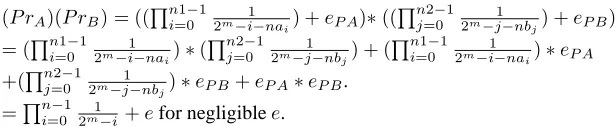
(P rA)(P rB) = ((Qn
1−1
i=0 1
2m−i−nai) +eP A)∗(( Qn2−1
j=0 1
2m−j−nbj) +eP B)
= (Qn1−1
i=0 1
2m−i−nai)∗( Qn2−1
j=0 1
2m−j−nbj) + ( Qn1−1
i=0 1
2m−i−nai)∗eP A
+(Qn2−1
j=0 1
2m−j−nbj)∗eP B+eP A∗eP B.
=Qn−1
i=0 1
2m−i +efor negligiblee.
Therefore, it is not possible to distinguishT fromUwith non-negligible probability. Theorem 5. A five-round elastic network onb+y bits in which each round function is an independently chosen PRP onbbits is a variable-length SPRP onb+ybits for any fixed value ofywhere0≤y≤b. Five rounds are the minimum number of rounds required.
Fig. 4. Five-Round Elastic Network as Two PRPs and Two Permutations
Proof. Refer to Section 5 for an example showing why four rounds are insufficient. G′ refers to a five-round elastic network onb+y bits with round functions that
are independently chosen PRPs on b bits. G′ can be defined in a format consistant
with the four permutations used in Claim 1:P1, P2, P RP1, P RP2. Figure 4 shows a five-round elastic network represented in this manner. In the figure, the RFi’s are independently chosen pseudorandom permutations.
– LetP1refer to the first round ofG′, including the swap step.
– LetP2 refer to the inverse of the last round ofG′, including the swap step that
precedes the round function. i.e.,P2is the first round inG′−1 .
– P1andP2 are independently chosen permutations, because eachRF iis a inde-pendently chosen pseudorandom permutations. The exact permutations used for
P1 andP2are unknown because they involve RF1 andRF4, respectively.P1 andP2are not pseudorandom because they can be distinguished from a random permutation by using queries where thebbit portion of input is held constant and they-bit portion is varied.
– LetP RP2refer to the last four rounds ofG′; i.e., all steps inG′afterP1.
– LetP RP1refer to the inverse of the first four rounds ofG′, excluding the swap
step after the third round.P RP1consists of all steps inG′−1after
P RP1andP RP2are PRPs onb+ybits by Theorems 4 and 3.P RP16=P RP2−1.
P1 and P2 are permutations onb+y bits. By setting P A = P RP2(P1(x))and
P B=P RP1(P2(x)),P B=P A−1. Therefore, by Claim 1,
G′is a SPRP.
In our analysis for the three, four and five round cases, we required the round func-tions be independently chosen random permutafunc-tions. It may be possible to relax the requirement that the round functions must independently chosen PRPs in a manner sim-ilar to what was done by Naor and Reingold in their analysis of Feistel networks [8]. While we have not determined to what extent the independence of the round functions can be relaxed, we know that at least two of the round functions must differ, except with negligible probability. Specifically, a three-round elastic network and the inverse of a four-round elastic network in which the round functions are identical are not PRPs. The proofs are provided in Section 5. These results indicate some independence is required of the round functions.
5
Counter-Examples
We provide a lower bound on the minimum number of rounds needed in an elastic net-work to create variable-length PRPs and variable-length SPRPs by providing examples of when fewer rounds are not PRPs and SPRPs. We also show that a certain level of independence is required between the round functions by considering cases when all of the round functions are identical. First, we show that at least three rounds are needed for an elastic network to be a PRP by proving that a two-round elastic network is not a PRP regardless of the round functions. Second, we show that a three-round elastic network is not a PRP when the round functions are identical. Third, we show that the inverse of a three-round elastic network is not a PRP regardless of the round functions. Fourth, we show that the inverse of a four-round elastic network is not a PRP when the round functions are identical. Fifth, we show that three and four-round elastic networks are not SPRPs, regardless of the round functions. When proving an elastic network is not a variable-length PRP or variable-length SPRP under specific conditions on the number of rounds and/or round functions, it is sufficient to provide an example for one block size. All of the counter-examples use a2b-bit block size (y=b). Each example will not hold with probability 1 wheny < b.
Claim 2:
An elastic network with exactly two rounds is not a PRP.
Proof. This claim holds regardless of the properties of the round functions. Consider
the case wherey=b. Given two2b-bit plaintexts of the formB||Y1andB||Y2(theb -bit portion is the same in each), let the ciphertexts be denoted byC1||Z1andC2||Z2, respectively.Z1 = Z2 with probability 1. If the two-round construction was a PRP onb+y bits, then for largeb, this equality would occur with probability2−b±efor
negligibleeinstead of with probability 1. Claim 3:
Fig. 5. Three-Round Elastic Network with Identical Round Functions
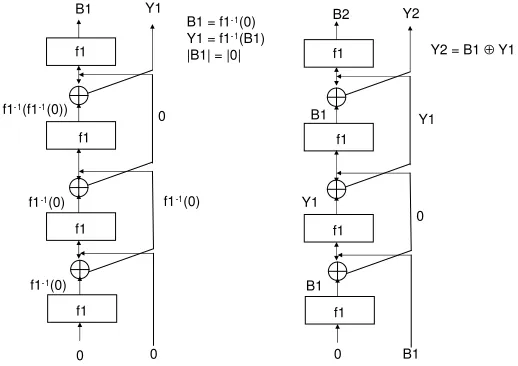
Proof. Consider the case shown in Figure 5 wheny = b. Let0 denote a string ofy
zeroes. EncryptB||0and letC1||Z1denote the resulting ciphertext.Z1 =f1(f1(B)).
C1 = f1(f1(f1(B))⊕f1(B)). Then encryptB||Z1 and letC2||Z2denote the ci-phertext.Z2 =C1with probability 1. If this three-round network was a PRP onb+y
bits, then for largeb, this equality would occur with probability2−b±efor negligible
einstead of with probability 1.
Fig. 6. Three-Round Elastic Network: Chosen Ciphertext Attack
Claim 4:
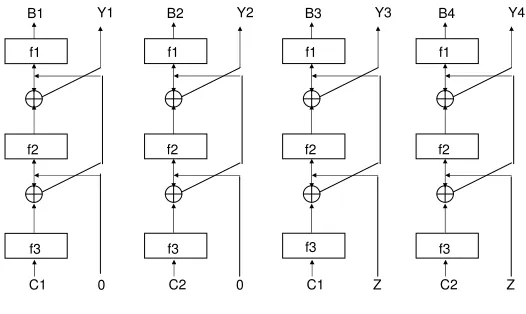
Proof. This is illustrated in Figure 6. The inputs to the round functions are defined in
the directions of the arrows in the figure and correspond to the direction of decryption. This claim holds regardless of the properties of the round functions and is due to the fact that, wheny = b, the input to the inverse of the second round function is known because it is the rightmostybits. In contrast, in the encryption direction, the XOR after the first round prevents the input to the second round function from being chosen. Let 0denote a string ofbzeroes. Wheny = b, create four2b-bit ciphertexts of the form
C1||0,C2||0,C1||Z andC2||Z whereC1 6= C2andZ 6= 0. Let the plaintexts be denoted byB1||Y1,B2||Y2,B3||Y3andB4||Y4. ThenY1 =f2−1(0)⊕f3−1(C1),
Y2 =f2−1(0)⊕f3−1(C2),Y3 =f2−1(Z)⊕Z⊕f3−1(C1)andY4 =f2−1(Z)⊕
Z⊕f3−1
(C2). As a result,Y1⊕Y2 =Y3⊕Y4with probability 1. If the three-round network was a PRP on2bbits in the decryption direction, then for largeb, this equality would occur with probability2−b±e for negligibleeinstead of with probability 1.
Wheny < b, the attack does not hold with probability 1 because the input to the second round of decryption containsb−ybits off4−4
(Ci). Theseb−ybits would have to be equal forf4−4
(C1)andf4−4 (C2).
Fig. 7. Four-Round Elastic Network with Identical Round Functions
Claim 5:
The inverse of a four-round elastic network in which the round functions are identi-cal is not a PRP.
Proof. Consider the case shown in Figure 7 wheny = b. Let0 denote a string ofb
zeroes. Decrypt0||0 and letB1||Y1 denote the resulting plaintext.B1 = f1−1(0).
Y1 =f1−1(
f1−1(0)) =
f1−1(
B1). Decrypt0||B1and letB2||Y2denote the result-ing plaintext.Y2 =f1−1(
B1)⊕f1−1(0) =
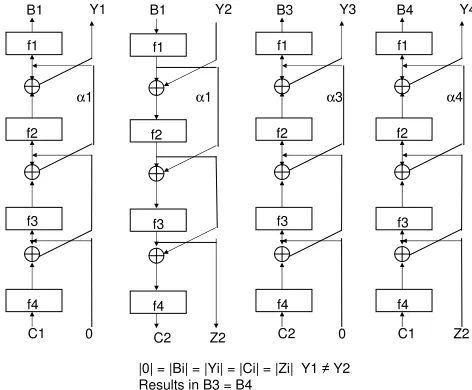
Neither a three-round nor a four-round elastic network is a SPRP. In both cases, this can be shown with an adaptive chosen plaintext - chosen ciphertext attack in which two chosen plaintexts are encrypted then two chosen plaintexts formed from the two resulting ciphertexts are decrypted. We include one four-round counter-example here.
Fig. 8. Four-Round Elastic Network: Chosen Plaintext - Chosen Ciphertext Attack
Claim 6:
A four-round elastic network is not a SPRP whenb=y.
Proof. This claim holds regardless of the properties of the round functions and is due
to the fact that a three-round elastic network in the decryption direction is not a PRP. In the three round case, using chosen ciphertexts only, a relationship can be pushed through the three rounds of decryption into the right half of the output with probability 1 wheny =b. In the four round case, the same approach is used in that the halves of two ciphertexts are switched to form to new ciphertexts and push a relationship into the rightmosty bits of the output of the third round. Wheny = b, this becomes the entire input to the round function in the fourth round of decryption. This time, one plaintext must be encrypted to assist in providing the values from which the ciphertexts are formed. The sequence of three decryptions and one encryption shown in Figure 8 can be used to distinguish the four-round elastic network from a SPRP wheny = b. Each plaintext and ciphertext is of length2b, ı.e.|B|=|Bi|=|Y i|=|Ci|=|Zi|=
b ∀i. Let0 denote a string of y zeroes. Decrypt a ciphertext of the formC1||0. Let
B1||Y1be the resulting plaintext. Encrypt a plaintext of the formB1||Y2withY26=
Y1. LetC2||Z2 be the resulting ciphertext. The output of the first round function,
α1, is identical in both the decryption and encryption. Form two ciphertexts,C2||0and
C1||Z2, and decrypt them. LetB3||Y3andB4||Y4denote the two resulting plaintexts.
B3 =B4with probability 1. Notice that:α1 =f4−1(
C1)⊕f3−1(0) =
Z2⊕f4−1(
C2)⊕f3−1(
α3 =f4−1(
C2)⊕f3−1(0)
α4 =Z2⊕f4−1(
C1)⊕f3−1(
Z2) By rearranging the equations forα1:
f4−1(
C2)⊕f3−1(0) =
Z2⊕f4−1(
C1)⊕f3−1(
Z2). Therefore, α3 =α4andB3 =B4.
6
Conclusions and Extensions
Our analysis validates the soundness of the underlying structure used in creating elastic block ciphers. We have proven that a three-round elastic network and the inverse of a four-round elastic network are variable-length PRPs and a five-round elastic network is a variable-length SPRP when the round functions are independently chosen PRPs. These results allow for the creation of(b+y)-bit PRPs and SPRPs fromb-bit PRPs, for each value ofywhere0≤y ≤b. We also proved that these are the minimum number of rounds required and that the results do not hold when all of the round functions are identical.
We can extend our PRP and SPRP constructions to cover a wider range of input sizes by using instances of CMC mode [5] as the round functions within the elastic network. CMC mode produces mb-bit SPRPs from a fixed-length b-bit PRP, where
m is an integer and 2 ≤ m ≤ α, for some integer upper bound of α. It involves encrypting data using a block cipher in CBC mode, applying a mask, then encrypting the resulting data in a reverse CBC mode. By using a b-bit PRP in CMC mode for each of the round functions in the elastic network (the PRPs are still independently chosen across each round), we are able to create variable-length SPRPs on a larger range of input lengths, in single bit increments, then when using the elastic network by itself. This combination for supporting variable-length inputs is unique from previous designs of variable-length block ciphers that worked on any input length [1, 9]. Those constructions work by creating an IV to use with the cipher in counter mode, then create a key stream to XOR with all but one block of the data. When dealing with input lengths beyond two blocks, the use of CMC mode and the elastic network provides an alternative approach to [1, 9] that does not apply a key stream, but rather creates a permutation that results in diffusion across all of the bits.
Acknowledgments
This work was partially supported by NSF Grants ITR CNS-04-26623 and CPA CCF-05-41093. Any opinions, findings, and conclusions or recommendations expressed in this material are those of the authors and do not necessarily reflect the views of the NSF or the U.S Government.
References
1. M. Bellare and P. Rogaway, On the Construction of Variable Length-Input Ciphers,
Pro-ceedings of Fast Software Encryption 1999, LNCS 1636, Springer-Verlag, pages 231-244,
2. D. Cook, M. Yung and A. Keromytis, Elastic Block Ciphers: The Basic Design, Proceedings
of ASIACCS, ACM, pages 350-355, 2007.
3. D. Cook, M. Yung, and A. Keromytis, The Security of Elastic Block Ciphers Against Key-Recovery Attacks. Proceedings of ISC, LNCS 4779, Springer-Verlag, pages 89-103, 2007. 4. S. Gueron, Advanced Encryption Standard (AES) Instructions Set.
http://softwarecommunity.intel.com/articles/eng/3788.htm, 2008.
5. S. Halevi and P. Rogaway, A Tweakable Enciphering Mode, Proceedings of Advances in
Cryptology - Crypto 2003, LNCS 2729, Springer-Verlag, 2003.
6. M. Luby, Pseudorandomness and Cryptographic Applications, Princeton University Press, 1996.
7. M. Luby and C. Rackoff, How to Construct Pseudorandom Permutations from Pseudoran-dom Functions, Siam Journal of Computing, vol. 17, no. 2, pages 373-386, April 1988. 8. M. Noar and O. Reingold, On the Construction of Pseudo-random Permutations:
Luby-Rackoff Revisited, Journal of Cryptology, vol. 12, pages 29-66, 1999.
9. S. Patel and Z. Ramzan and G. Sundaram, Efficient Constructions of Variable-Input-Length Block Ciphers, Proceedings of Selected Areas in Cryptography 2004, LNCS 3357, Springer-Verlag, 2004.
10. T. Ristenpart and P. Rogaway, How to Enrich the Message Space of a Cipher, Proceedings