Breaking An Identity-Based Encryption Scheme
based on DHIES
Martin R. Albrecht1 and Kenneth G. Paterson2? 1
INRIA, Paris-Rocquencourt Center, SALSA Project UPMC Univ Paris 06, UMR 7606, LIP6, F-75005, Paris, France CNRS, UMR 7606, LIP6, F-75005, Paris, France
2
Information Security Group, Royal Holloway, University of London.
Abstract. We present collusion attacks against a recently proposed IBE scheme of Chenet al.from ASIACCS 2010. The attacks recover the mas-ter secret key of the scheme and thereby invalidate the existing security analysis of this scheme. The attacks are flexible, allowing, for example, the amount of computation needed to be traded-off against the size of the collusion.
Keywords:identity-based encryption; cryptanalysis; Gr¨obner bases.
1
Introduction
The search for Identity-Based Encryption (IBE) schemes having efficient algo-rithms and proven security has resulted in many proposals for schemes. A recent proposal, due to Chenet al.[5], has very efficient encryption and decryption and claims to have security based on the security of the DHIES public key encryp-tion scheme. In this paper, we present collusion attacks against the scheme of [5] which recover the Trusted Authority’s master secret key. These attacks apply even in the weak IBE security model used in [5] and thus completely invalidate the security claims made in [5, Theorem 3.1], the main security result in that paper. We explain where the security analysis in [5] is deficient.
However, it seems that the authors of [5] were already aware of the possibility of collusion attacks against their scheme and set the scheme parameters with the intention of making such attacks inefficient (see Section 3.1 of [5]). We show that their setting of parameters is also flawed by exhibiting a family of efficient collusion attacks against the scheme which applies for their concrete choice of parameters. In fact, our attacks allow the various attack parameters to be traded off against one another – such as the number of private keys needed (the size of the collusion), and the amount of computation needed. For example, we exhibit a master key recovery attack against the concrete scheme of [5] that requires a collusion of 213 parties, 243.3evaluations of a hash function and 230field opera-tions.
?
In [10], Susilo and Baek also present an attack against the scheme of [5]. We stress that our work was done independently of and in parallel to [10]. The attack in [10] is an application of the observation in Section 3.1 of [5] using more precise complexity results than the authors of the original scheme. As with our attacks, this invalidates the security claims made in [5]. However, our attacks are considerably more flexible, much more efficient than the attack in [10] and exploit more structure of the particular construction proposed in [5]. Moreover, we provide concrete attack costs for the parameters proposed in [5] (something that was omitted in [10]), we highlight the flaw in the security proof given in [5], and we show that there is a design flaw in the construction of private keys in the scheme which enables attacks beyond straight-forward system solving. Finally, we note that [10] repeats some of the wrong claims made in [5] about the complexity of Gr¨obner basis algorithms and the relation of the XL algorithm to standard Gr¨obner basis algorithms. In order to correct these misunderstandings, which seem to be quite widely shared in the research community, we include in Section 3 a detailed account of the state-of-the-art for complexity results for polynomial system solving.
In summary, our attacks and the attacks from [10] show that the scheme of [5] cannot be rescued simply by increasing the parameter sizes, without having a serious effect on the efficiency of the scheme.
The remainder of this paper is organised as follows. In Section 2, we present the IBE scheme of [5]. In Section 3 we present some results on the complexity of polynomial system solving which we later use in our attacks on the underlying hard problem. Finally, Section 4 presents our dedicated attacks which highlight the flaw in the construction and discusses their application to the concrete pa-rameters selected in [5].
2
The IBE Scheme
Our description of the IBE scheme comes from [5, Section 3], with some minor changes to notation. In fact, we do not need to describe the encryption and decryption algorithms of the scheme, since our attacks do not rely on their details. Moreover, we omit some steps that are not needed to understand our attacks.
Setup: This algorithm has as input a security parameterkand a valuen(called
`in [5]).
1. Run a pairing parameter generatorGto generate a primeq, two groupsG1,
4. Let H0 be a hash function which takes as inputs elements of {0,1}∗ and outputs subsets of sizetof{0,1, . . . , n−1}. A specific method for definingH0 in terms of elementary hash functions is given in [5]. However, we note that this method is flawed because it does not guarantee to produce an output set of size exactlyt. For the concrete parameters selected in [5] (n= 512,t= 8), a reduced-size output set is quite likely. We ignore this flaw, assuming that the output set is always of sizet.
5. Select a pseudo-random number generator (PRNG) F having elements of {0,1}∗ as seeds and outputs in
Zq.
The master secret key of the scheme ismsk. The master public key of the scheme ismpk together with descriptions ofG1, G2, e, q, P, H0 andF.
KeyGen: Given an identityid∈ {0,1}∗, this algorithm proceeds as follows:
1. Produce{s0, . . . , st−1}:=H0(id).
2. Use F with seed id to produce vectors a = (a0, . . . , at−1)∈(Zq)t andb = (b00, . . . , bt−1,t−1)∈(Zq)(
t+1 2 ).
3. Output as the private key for identityidthe value:
xid= X
0≤i<t
aiusi+
X
0≤i≤j<t
bijusiusj ∈Zq.
Notice that the private key corresponding to the identityidis the evaluation of a quadratic functionfid overZq in ton the values u0, . . . , un−1 from msk. The specific quadratic function fid is determined by H0 and F and can be readily calculated using only the string id and public information. This observation forms the basis of all known attacks against the scheme in [5] including ours, the first of which follows immediately.
2.1 An Attack on the Underlying Hard Problem
Consider an attacker who has access to private keys xid for strings id of his choice. Such an attacker is standard in the usual security models for IBE, where the attacker has access to a private key extraction oracle. The attacker makes about n2 such queries for randomly chosen identities. Each query yields the value xid of a new quadratic function fid in the n unknown values ui. We set up a polynomial system in which variables xi take the place of the unknown valuesui in the quadratic polynomialP0≤i<taixsi+
P
0≤i≤j<tbijxsixsj −xid
corresponding tofid andxid. After roughly n2queries, the quadratic system so obtained can be linearised – replacing each monomialxixj by a new variableyij yields a full-rank linear system in n+12 +nvariables. The resulting linear system can be solved in timeO n6
This yields a polynomial-time-and-space attack (in parametern) for the scheme presented in [5]. In particular, it shows that the security proof of [5, Theorem 3.1], which is the main security result in the paper, cannot be correct. This is because our adversary can be converted into an IND-sID-CCA adversary that breaks the scheme without breaking the underlying DHIES scheme. Technically, since n as defined in [5] is a constant and not dependent on k, our attacker runs with a constant number of extraction queries and in constant time. For the specific parametersn= 512,t= 8 given in the paper, this attacker runs in time O 254, where our basic operation is a field operation over Zq. We note that this kind of attack is anticipated in [5, Section 3.1], which makes it all the more inconsistent that Theorem 3.1 is included in that paper.
One way in which the main result of [5] could be rescued would be to make
n super-polynomial in the security paramter k. However, this would impact adversely on the efficiency of the scheme. Another way would be to limit the number of key extraction queries allowed by the adversary. This latter fix is suggested in [5, Section 3.1], where it is claimed that the scheme will be secure against collusion attacks so long as the adversary is limited to making 0.1n2
key extraction queries (whereas the basic attack above requires roughlyn2such queries). As we shall see with our more sophisticated attacks below, limiting the adversary to 0.1n2 key extraction queries is insufficient to make the scheme secure.
2.2 Where the Proof Fails
It is instructive to examine where the proof of [5, Theorem 3.1] fails. The scheme makes use of a hash functionH1:{0,1}∗→G2 mapping identitiesidto group elements. This function is modelled as a random oracle in the proof, meaning that its outputs are treated as independent and uniformly distributed random elements of G2. However, it is shown in [5] that this hash function satisfies the equation:
H1(id) =gxid
where xid is the private key corresponding to id and g is a generator of G2. Then forH1to act as a random oracle, the valuesxid must also be independent and uniformly distributed. But they are clearly not, since they are quadratic functions of the master secret key components, a fact that is exploited in our attacks. ThusH1 cannot be properly modelled as a random oracle.
3
Gr¨
obner Basics
Since both [5] and [10] base their attacks on incorrect complexity results about polynomial system solving, we restate the relevant results in this section.
We denote by LM(f) the largest monomial in f and byLC(f) the coefficient corresponding toLM(f). We consider the ideal Ispanned byf0, . . . , fm−1.
Definition 1. Let f0, . . . , fm−1 be polynomials inP. Define the set
hf0, . . . , fm−1i= (m−1
X
i=0
hifi:h0, . . . , hm−1∈P )
.
This set I is an ideal and is called the ideal generated byf0, . . . , fm−1.
A Gr¨obner basisGfor some idealIis a basis such that for any leading monomial occuring in the ideal there is an element in the basis which has leading monomial dividing it.
Definition 2 (Gr¨obner Basis). Let I be an ideal of Zq[x0, . . . , xn−1] and fix
a monomial ordering. A finite subset G = {g0, . . . , gm−1} ⊂ I is said to be a Gr¨obner basis of I if for all f ∈ I there exists a gi ∈ G such that LM(gi) |
LM(f).
Definition 3 (Reduced Gr¨obner Basis [6]).LetIbe an ideal ofZq[x0, . . . , xn−1]
and fix a monomial ordering. A finite subset G={g0, . . . , gm−1} ⊂I is said to
be a reduced Gr¨obner basisof I if
– Gis a Gr¨obner basis,
– LC(gi) = 1 for allgi∈G, and
– for all gi ∈ G, no monomial of gi is divisible by some LM(gj) for gj ∈
G− {gi}.
The reduced Gr¨obner basisGof I is unique for a givenI for a fixed monomial ordering. From this, it is easy to see that the reduced Gr¨obner basis of an ideal
I = hf0, . . . , fm−1i with (u0, . . . , un−1) ∈ Znq the unique common root of all
f0, . . . , fm−1is (x0−u0, . . . , xn−1−un−1). Consequently, if a system of equations has exactly one solution, computing the Gr¨obner basis is equivalent to solving the system of equations.
Lazard showed in [9] that computing a Gr¨obner basis for a homogeneous sys-tem of polynomials spanning a zero-dimensional ideal can be reduced to linear algebra.
Definition 4. For the set ofmpolynomialsf0, . . . , fm−1we can define and
con-struct the Macaulay matrixMacaulayd,m of degreedas follows: list “horizontally” all the degree dmonomials from smallest to largest sorted by some fixed monomial ordering. The smallest monomial comes last. Multiply eachfi by all monomials
for the resulting system:
Macaulayd,m =
monomials of degreed
(t0,0, f0) (t0,1, f0) (t0,2, f0)
.. .
(t1,0, f1)
.. .
(tm−1,0, fm−1) (tm−1,1, fm−1)
.. .
Theorem 1 (Lazard’s Theorem [9]). Let F ={f0, . . . , fm−1} be set of
ho-mogeneous polynomials in P spanning a zero-dimensional ideal. There exists a positive integerDfor which Gaussian elimination on allMacaulayd,m for1≤d≤D
computes a Gr¨obner basis for the idealhFi.
To estimate the required value ofDfor computing a Gr¨obner basis the following definitions are useful:
Definition 5 (Degree of Regularity [3]). We define the degree of regularity of a zero dimensional ideal I=hf0, . . . , fm−1iform≥n by
Dreg = min
d≥0|dimZq({f ∈I,deg(f) =d}) =
n+d−1
d
.
Definition 6 (D-regular Sequences [3]).Letf0, . . . , fm−1⊂Zq[x0, . . . , xn−1]
be homogeneous polynomials of degrees d0, . . . , dm−1 respectively. This sequence
is regular of degree D if:
1. hf0, . . . , fm−1i 6=Zq[x0, . . . , xn−1].
2. For all0≤i < m andg∈Zq[x0, . . . , xn−1]:
deg(g·fi)< Dandg·fi∈ hf0, . . . , fi−1i ⇒g∈ hf0, . . . , fi−1i.
Definition 7. A Dreg-regular system is called semi-regular.
The value forDreg for semi-regular sequences can be computed as follows:
Lemma 1 (Degree of Semi-Regularity [3]). The degree of regularity Dreg
of a semi-regular sequencef0, . . . , fm−1of respective degreed0, . . . , dm−1is given
by the index of the first non-positive coefficient of:
X
k≥0
ckzk = Qm−1
i=0 (1−z di)
This notion can be extended to affine polynomials by considering their homoge-neous components of highest degree. It is conjectured that random systems of polynomials aresemi-regular systems [3].
TheF4[7] andF5[8] algorithms can be seen as applications of Lazard’s theorem1. They successively construct and reduce matrices until a Gr¨obner basis is found. Consequently, their complexity can be estimated using the degreeDreg.
Theorem 2 (F5 Complexity [3]). The complexity of computing a Gr¨obner
basis of a zero-dimensional system of m polynomials in n variables with the algorithmF5 is
O
n+D−1
D
ω
where D is the degree of regularity of the system and 2 ≤ ω < 3 is the linear algebra constant.
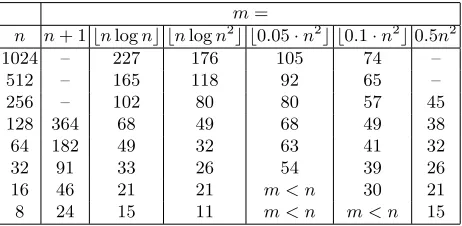
Using Theorem 2 and Lemma 1 we can estimate the complexity of solving a random system of equations in n unknowns and m equations. Below, we give concrete values for the log2 of the expected complexity of theF5 algorithm in finite field operations for a variety of cases relevant to this work. The table below assumesω= 3. We note, that assumingω= 3 is pessimistic, since if the system is dense then there exist practical faster algorithms for Gaussian elimination withω= log27 and if the system is sparse, we expectω= 2 +.
m=
n n+ 1bnlognc bnlogn2c b0.05·n2c b0.1·n2c0.5n2
1024 – 227 176 105 74 –
512 – 165 118 92 65 –
256 – 102 80 80 57 45
128 364 68 49 68 49 38
64 182 49 32 63 41 32
32 91 33 26 54 39 26
16 46 21 21 m < n 30 21 8 24 15 11 m < n m < n 15
Table 1. log2 of basic operations for solving a random system ofm equations in n
unknowns.
However, the systems considered in this work are not random since we have the guarantee that only a small fraction of the possible variables appear in a polynomial, that is the systems are sparse. However, we expect that the com-plexity bounds from Table 1 still apply. In particular, we expect sparse systems
1
to be easier to solve than truly random (dense) systems. Moreover, we do not expect the systems to be harder than random systems. Since the coefficients are chosen uniformly at random each new polynomial does indeed add new useful information to the system and is not a simple algebraic combination of other polynomials already in the system.
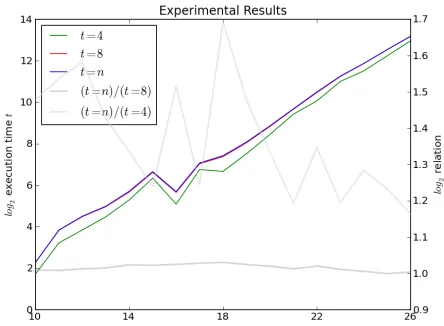
In order to verify this intuition, we give concrete running times in seconds on a 2.6 Ghz Opteron for small-scale random systems innunknowns andm=b0.1n2c equations and t unknowns per equation in Figure 1. The x-axis is n, the left-hand side y-axis is the log2 of the running time and the right-hand side y-axis is the log2 of the speed-up of t < n compared to t = n. We used Magma’s [4] implementation of the F4 algorithm and implemented the experiment using the Sage mathematics software [11]. We note that while the values fornare too small to observe the asymptotic behaviour, they show that settingt=cfor some constantc < n does not impact the complexity negatively.
Fig. 1.Experimental verification fort∈ {4,8, n}withm=b0.1n2c.
4
Refining the Basic Attack
We now extend the basic collusion attack shown in Section 2, exploiting the fact that the adversary can precompute the hash function H0 in an effort to find identities leading to simpler sets of equations in the n unknownsxi. Our main idea is to partition the set of unknowns into subsets of equal size, and then search for identities yielding systems of equations with unknowns restricted to these sets. Since the subsets are of smaller size than the whole, solving these systems should be easier than solving a single large system.
To this end, we writen= 2d, assuming this parameter is an integer power of 2 (as it is for the concrete parameters in [5]). For some values≥0 with 2d−s≥t, we partition the set{0, . . . , n−1} into 2s setsS
i each containing 2d−s integers by setting Si ={i2d−s, . . . ,(i+ 1)2d−s−1}. Next we present pseudo-code for our attack.
SetIDi:=∅, ci:= 0 for 0≤i <2s Setc:= 0 and c2s := 0.
repeat
c:=c+ 1
id←R{0,1}∗
if H0(id)⊂Si for some ithen
IDi=IDi∪id
ci :=ci+ 1 else
c2s :=c2s+ 1
end if
untilci ≥mfor 0≤i <2s
Obtainxidfor the firstmelements in each setIDiusing key extraction queries. for0≤i <2sdo
Using the m values xid for id ∈ IDi, generate and solve a system of m equations in the set of unknowns{xj :j∈Si}.
end for
The attack involves three main stages: a pre-computation to generate sets of identitiesIDisuitable for building systems of equations; making key extraction queries to obtain the required private keys; generating and solving 2s systems of equations, each containing m equations in 2d−s unknowns. Here s and m
are parameters of our attack. It is evident that our attack requires m2s key extraction queries, and that Table 1 can be used to estimate the running time of the equation solving stage for parameters of interest. We focus next on the running time of the first stage.
The first stage involves making sufficiently many queries to H0 so as to obtain at leastm identities idin each of the 2s setsID
to t-subsets of {0,1, . . . , n−1}. We make this assumption henceforth. Under this assumption, for a uniformly selectedid, the probability thatH0(id)⊂Si is equal top:= 2dt−s/ nt.
After c iterations of main loop in the algorithm, the vector (c0, . . . , c2s−1, c2s)
follows a multinomial distribution with parameters c and (p, . . . , p,1−2sp). It then follows from standard results on the multinomial distribution that, for each 0 ≤ i <2s, the random variable c
i follows a binomial distribution with mean
cp and variancecp(1−p). Moreover, the covariance betweenci and cj is equal to−cp2. Sincepis generally small for the parameters of interest, the covariance is very small and to a first approximation we may treat the first 2svaluesc
i as independent identically distributed random variables. We require each of these variables to be greater thanmfor the algorithm to terminate, and we estimate the probability that it does so after no more thanciterations as follows. Using known estimates for the tail of the binomial distribution (see for example [1, Theorem A.13]), we have, for any real numbera:
Pr[ci≥cp−a]>1−e−a 2/2pc
Under our assumption that theci may be treated as independent random vari-ables, we then have:
Pr[ ^ 0≤i<2s
ci≥cp−a]>(1−e−a 2/2pc
)2s.
Setting a=m andc= 2m/p, we then obtain:
Pr[ ^ 0≤i<2s
ci≥m]>(1−e−m/4p)2
s
≥1−2se−m/4p≥1−n
te
−m/4p.
It is then easy to see that with p= 2dt−s
/ nt
, the algorithm terminates with high probability provided the main loop is executedc= 2m/ptimes.
A concrete example: We taken= 512 (so d= 9) and t= 8, as in the concrete parameters suggested in [5]. We then select s = 4 and m = 0.5(2d−s)2 = 29 (corresponding to the last column in Table 1). For these parameters, we have
p= 2−33.3. Then our attack requires 2m/p= 243.3evaluations ofH0 andm2s= 213 key extraction queries to build 2s= 16 sets of 29 equations in 32 variables. From Table 1, the complexity of solving the 16 systems of equations is 16× 226= 230field operations. To summarise, we can break the scheme of [5] for the concrete parameters n = 512 andt = 8 using 243.3 evaluations of H
A second example (minimising key extractions): We take n = 512 (so d = 9) andt = 8, again as in the concrete parameters suggested in [5]. We then select
s= 6 andm= 9. Then our attack requires 260.8evaluations ofH
0, just 29.2key extraction queries and 227.2 field operations to recover the master secret key of the scheme.
A third example (doubling the parameters): Suppose the scheme parameters are doubled in an attempt to avoid our attack. So we take n = 1024 (so d = 10) and t= 16. We then select s= 3 andm = 213. Our attack then requires 264.1 evaluations ofH0, 216key extraction queries and 241 field operations.
Further refinements of the attacks: We have taken a simple approach to gener-ating sets of equations that are easier to solve than sets involving allnvariables. The reader can easily see that more sophisticated ways of generating and solving sets of equations can be developed. For example, once the values of some vari-ables are known, we can be less restrictive about how further sets of equations are generated. However, this seems unnecessary in order to conclude that the scheme of [5] is flawed in an essential way.
5
Conclusions
We have presented an analysis of a recently proposed IBE scheme of Chen et al. [5]. We have shown that the main security result in [5] does not hold, and that the authors’ assessment of their scheme’s resistance to collusion attacks is over-optimistic. We have shown how standard Gr¨obner basis techniques can be used to efficiently break the scheme for the parameters proposed in [5], using a collusion attack with a small number of key extraction queries. Our attack is still practical if all the scheme’s parameters are doubled.
We note that in order to achieve 80-bit security against the simple attack from Section 2 one needs at leastn= 214. In that case, solving the system of equations would cost n6 = 214·6 = 284 finite field operations. With such parameters the master public keympkwould have a size of 160·214/8 = 320kb. Note that this variant would still be vulnerable to the attacks in Section 4. For example, if we were to pick s= 4, we would need 252.04 evaluations of H
0, 223 key extraction queries and just 231field operations in the Gr¨obner basis step.
We conclude that the scheme of [5] does not offer an attractive trade-off between security and efficiency.
References
2. G. Ars, J.-C. Faug`ere, H. Imai, M. Kawazoe and M. Sugita. Comparison between XL and Gr¨obner basis algorithms. InAdvances in Cryptology - ASIACRYPT 2004, Volume 3329 of LNCS, pp. 338-353, Springer Verlag, 2004.
3. M. Bardet, J. Faug`ere and B. Salvy. On the complexity of Gr¨obner basis compu-tation of semi-regular overdetermined algebraic equations. In Proceedings of the International Conference on Polynomial System Solving, pp. 71-74, 2004.
4. W. Bosma, J. Cannon and C. Playoust, The MAGMA Algebra System I: The User Language. In Journal of Symbolic Computation, Vol. 24, pp. 235-265. Academic Press, 1997.
5. Y. Chen, M. Charlemagne, Z. Guan, J. Hu and Z. Chen. Identity-based encryption based on DHIES. In D. Feng, D.A. Basin and P. Liu Proceedings of the 5th ACM Symposium on Information, Computer and Communications Security, ASIACCS 2010, pp. 82-88, ACM, 2010.
6. D. Cox, J. Little and D. O’Shea.Ideals, Varieties, and Algorithms. 3rd Ed. Springer Verlag. Berlin, Heidelberg, New York, 2007.
7. J.-C. Faug`ere. A New Efficient Algorithm for Computing Gr¨obner Bases (F4). In
Journal of Pure and Applied Algebra, Vol. 139 (1-3), pp. 61-88, 1999.
8. J.-C. Faug`ere. A New Efficient Algorithm for Computing Gr¨obner Bases without Reduction to Zero (F5). In Proceedings of the 2002 International Symposium on Symbolic and Algebraic Computation, pp.75-83, ACM, 2002.
9. D. Lazard. Gr¨obner-Bases, Gaussian elimination and resolution of systems of alge-braic equations. In Proceedings of the European Computer Algebra Conference on Computer Algebra, Vol. 162 of LNCS, pp. 146-156, Springer Verlag, Berlin, 1983. 10. W. Susilo and J. Baek. On the Security of the Identity-based Encryption based
on DHIES from ASIACCS 2010 (short paper). In Proceedings of the 6th ACM Symposium on Information, Computer and Communications Security, ASIACCS 2011, ACM, 2011, to appear.