Cloning
of
the
Mutator Transposable Element MuA2, a Putative Regulator
of
Somatic Mutability
of
the
al-Mum2 Allele in Maize
Minmin Qin,**’ Donald
S.
Robertsont and
Albert
H. Ellingboe*’*
*Department of Genetics, University of Wisconsin, Madison, Wisconsin 53706, +Department of Genetics, Iowa State University, Ames, Iowa 5001 1, and tPlant Pathology, University of Wisconsin, Madison, Wisconsin 53706
Manuscript received April 6, 1 99 1 Accepted for publication July 15, 199 1
ABSTRACT
The identification of the autonomous or transposase-encoding element of the Mutator (Mu) transposable element system of maize is necessary to the characterization of the system. We reported previously that a transcript homologous to the internal region of the MuA element is associated with activity of the Mutator system. We describe here the cloning of another Mu element, designated MuA2, that cosegregates with Mutator activity as assayed by somatic instability of the al-Mum2 allele. The MuA2 element has features typical of the transposable elements of the Mutator family, including the 2 1 O-bp terminal inverted repeats. Several lines of evidence suggest that MuA2 is an autonomous or transposase-encoding element of the Mu family: (1) MuA2 cosegregates with a genetically defined element that regulates somatic mutability of the al-Mum2 allele; (2) MuA2 is hypomethylated while most other MuA2-hybridizing sequences in the genome are extensively methylated; (3) the increase of the copy number of MuA2 is concomitant with the increase of regulator elements; (4) MuA2-like elements are found in Mutator lines but not in non-Mutator inbreds. We propose that autonomous or transposase-encoding elements of the Mu family may be structurally conserved and MuA2-like.
T
RANSPOSABLE element systems in maize are usually composed of two components: the au- tonomous element and nonautonomous elements. An autonomous element encodes the functions necessary for its own transposition and can also act in trans to promote the transposition of nonautonomous ele- ments. In the Ac-Ds and Sprn (En) systems, the auton- omous element for each system is a single, structurally conserved element whereas nonautonmous elements are structurally heterogeneous. T h eDs
elements of the Ac-Ds system vary in structure, ranging from se- quences derived from Ac by deletions to those that are virtually unrelated to the Ac element, except for the terminal inverted repeats (TIRs). Defective Sprn(dSpm) elements of the Spm system are usually dele-
tion-derivatives of the Sprn element (reviewed by FEDOROFF 1989).
T h e Mutator (Mu) transposable element system of maize was discovered through its ability to induce mutations at an extremely high rate, usually 50-100- fold higher than spontaneous mutation rates (ROBERT- SON 1978). Many unstable mutations isolated from maize plants exhibiting the Mutator trait have been shown to be due to the insertion of one of several structurally related transposable Mu elements. Mu1 was the first member of the family cloned and was recovered from an unstable Adhl allele (BENNETZEN
Street, Albany, California 94710. Genetics 1 2 9 845-854 (November, 1991)
’
Present address: USDA Plant Gene Expression Center, 800 Buchananet al. 1984). It is approximately 1.4 kb and has TIRs of approximately 200 bp (BARKER et aE. 1984). Sub- sequently, Mul. 7 MU^), Mu3, rcy:Mu7 and Mu8 were also found inserted in Mu-induced mutations (TAYLOR and WALBOT 1987; OISHI and FREELINC 1988; SCHNABLE, PETERSON and SAEDLER 1989; FLEENOR et
al. 1990). T w o other
Mu
elements, Mu4 and Mu5, were cloned from non-Mutator stocks via their homol- ogy to the TIRs of the Mu1 element (TALBERT, PAT- TERSON and CHANDLER 1989). These Mu elements share the TIRs with Mu1 but the internal regions differ from Mu1 and from each other, except for Mul. 7 which is closely related to Mul.A fundamental difference between the Mutator sys- tem and the Ac-Ds and Spm systems has been the apparent non-Mendelian inheritance of Mutator activ- ity. Crosses between a Mutator plant and a non-Muta-
846 M. Qin, D. Robertson and A. H. Ellingboe
non-Mutator plants and that stable derivatives could be reactivated by crossing to plants exhibiting Mutator activity. However, the crosses in which the inactiva- tion or reactivation occurred did not produce ratios that would be expected if one or a few autonomous or transposase-encoding elements were segregating in a Mendelian fashion. It was not clear from these early studies if the Mutator system is a two-element system, like the Ac-Ds and Spm ( E n ) systems. Nor was it known which previously cloned Mu elements, if any, encode transposase activity required for Mu transposition.
T h e first reported genetic evidence that the Mutator system may be a two-element system came from recent genetic analysis of maize lines carrying Mu-induced mutable a1 alleles (ROBERTSON and STINARD 1989). These experiments demonstrated Mendelian segre- gation of elements or factors that regulate the excision of a nonautonomous Mu1 element inserted at the a1 locus. Some of these regulator elements have been
mapped to specific chromosomal locations (D. S. ROB-
ERTSON and P. STINARD, unpublished results).
T h e regulation of Mutator activity has been shown t o be correlated with the copy number, the transpo- sition, and/or the DNA modification of Mu elements. M u l , the most active element in the Mu family, is found in multiple copies in Mutator lines but not in non-Mutator lines (BENNETZEN 1984; ALLEMAN and FREELINC 1986). T h e active transposition of Mu ele- ments is usually correlated with Mutator activity (ALLEMAN and FREELINC 1986; BENNETZEN et al.
1987; WALBOT and WARREN 1988). T h e presence of the Mul-like elements alone, however, is not sufficient for Mutator mutagenic activity since Mu-loss lines (loss of Mutator mutagenic activity) derived from crosses between Mutator and non-Mutator lines still retain Mul-like elements (ALLEMAN and FREELINC 1986; BENNETZEN et al. 1987). Loss of Mutator activity was also reported from intercrossing of diverse Mutator lines (ROBERTSON 1986). This loss is correlated with an increased copy number of Mul-like elements and these Mu elements are usually hypermethylated (BEN-
NETZEN 1987). Similar observations between DNA
modification and loss of somatic Mutator activity have been reported (CHANDLER and WALBOT 1986). An- other intriguing observation is that transposition and excision of Mu elements might be under separate genetic controls. A high mutation rate (presumably due to the transposition of Mu elements) has been observed in a few lines that have lost somatic instability ofthe Mu-induced allele, and some lines exhibit a high somatic instability but have a low germinal Mutator activity (ROBERTSON et al. 1988).
We recently described the cloning of the MuA ele- ment from a maize line with a Mutator background via its homology to the TIRs of MuZ (QIN and EL-
LINGBOE 1990). MuA hybridized to a transcript that is
associated with Mutator activities. T h e molecular evi- dence presented was consistent with what would be expected for an autonomous or transposase-encoding element of the Mutator system. We propose that one or more elements of the MuA family encode transpos- ase activity. Other M u elements, including previously cloned elements and defective elements of the MuA family, would then be receptor elements. Since MuA was cloned from a maize line carrying no receptor alleles, we were unable to determine genetically if
MuA regulates Mu transposition, or cross-hybridizes with Mu elements that confer Mutator activity. We identified a DNA fragment in Southern blots that hybridized to an internal fragment of MuA. This fragment cosegregated with an element or gene that has been genetically identified to regulate the somatic excision of the Mu1 insertion of the al-Mum2 allele (ROBERTSON et al. 1985; O'REILLY 1985; ROBERTSON and STINARD 1989). In this study, we report the cloning of the MuA2 element and present evidence that MuA2 may be an autonomous or transposase- encoding element of the Mu family.
MATERIALS AND METHODS
Maize strains: Maize lines DR86-87-9849-7" X 8849-1 (DR1) and DR87-4192-4"X 5192-6 (DR6) (see ROBERTSON and STINARD (1989, Table 3) for the origin of these two
lines) contain the al-Mum2 allele and segregate 1: 1 for
somatic Mutator activity. Somatic Mutator activity refers to
the ability of an element or gene to support the mutable pattern of the al-Mum2 allele. Somatic mutability is classi-
fied into four categories (#l, #2, #3 and #4) ranging from fully stable (#l, colorless) to fully mutable (#4, spotted) according to ROBERTSON and STINARD (1 989). In this study, kernels with extremely high frequency of spots (approxi- mately over 90% of the aleurone covered with spots) are classified as #4+. Mutator lines are defined as lines from
which new mutants have been isolated. Non-Mutator lines
are standard inbreds. Sources of various Mutator stocks and non-Mutator inbreds were described (QIN and ELLINCBOE
1990). Two a1 sh2 tester lines, A632 and Oh43, were kindly provided by W. TRACY (University of Wisconsin-Madison).
DNA isolation and Southern blot analysis: Procedures
for plant DNA isolation and Southern hybridization analysis
were described previously (QIN and ELLINCBOE 1990). Probes used to identify MuA2 were the EcoRI-EcoRV frag- ment and/or the Hind111 fragment of MuA (Figure 1).
X cloning: Plant DNA was digested with SacI enzyme (Promega) and size-fractionated by gel electrophoresis (0.8% SeaKem GTG agrose, FMC). DNA from the region contain-
ing the 4.8-kb MuA-hybridizing SacI band was excised from the gel and purified with Geneclean (Bio 101). The purified
DNA was ligated to SacI-digested XZap arms (Stratagene)
and then packaged into phage particles. The library was
screened with the EcoRI-EcoRV fragment of MuA.
Inverse polymerase chain reaction (PCR) amplifica-
tions: DNA was prepared from pooled leaf tissues from
plants derived from spotted kernels and digested to comple-
tion with XhoI (Promega). The digested DNA was extracted with phenol:chloroform, ethanol-precipitated, and redis-
solved in 10 mM Tris (pH 8), 0.1 mM EDTA. The ligations
S S E h : x H E v R ' B
,
1 k b If l
MIA-
-
SaS S E W B X W H Ev H
x915
4 b1 c
El MI MZ E l
A M s A
DNA or size-selected Xhol fragments at a final concentration of 2 pg/ml D N A and 0.02 unit/ml T 4 D N A ligase (BRL) at 16" for over 16 hr. The following oligonucleotides were used for PCR amplification: (El) 5' AACGGTAAACGCCG- ACAGGA 3'; ( M I ) 5' GTAGCTAGATTGGCGGTGTC
3'; (M2) 5' CCAGTGGAGTGTTTGCACCA 3'. PCR re-
actions were performed according to SAIKI ( 1 990) except that BSA was used instead of gelatin. The cycling reactions were: 30 sec at 94"; 2 rnin at 5 5 " ; 5 min at 72" for 35 cycles, using an automated PCR machine (Perkin Elmer Cetus).
Plasmid cloning: PCR-amplified D N A products were gel- purified and digested with Xhol and SacI restriction en- zymes. After digestion, the D N A was repurified by pheno1:chloroform extractions and ethanol precipitation. D N A was then ligated into Xhol- and SacI-digested pBluescript D N A and transformed into Escherichia coli strain DH5a.
DNA sequencing: D N A sequencing reactions were per-
formed by the dideoxy method using the Sequenase enzyme ( U . S . Biochemical). The two ends of the SacI fragment of the phage clone and plasmid clones flanking the SacI frag- ment were sequenced on one strand using the M 13 universal sequencing primer (U. S. Biochemical). Two plasmid clones flanking the left end and three flanking the right end were sequenced. The clones for each flanking region were from
a single PCR. Sequence comparisons were made using the University of Wisconsin Genetics Computer Group software and documentation package.
RESULTS
Isolation of the MuA2 element: Repeated outcross- ing of maize lines carrying the al-Mum2 allele with non-Mutator a1 sh2 tester lines resulted i n lines that segregated for a single putative regulator element or gene (ROBERTSON and STINARD 1989). DRI and DR6 (see MATERIALS A N D METHODS) are two such lines. Somatic mutability in the two lines was shown to cosegregate with a MuA-hybridizing sequence (QIN a n d ELLINGROE 1990). DNA from 20 plants derived from ten mutable kernels and ten stable kernels from
A
EcoRl Xhol
mutable stable stable mutable
l ? 3 . 1 1 2 3 4 I ; ~ , l l i ' 4
""
B
EcoRl Xhol
""
mutable stable stable mutablc
I 1 3 4 I P l 4 I 7 1 4 1 7 3 ~
2.3
-
2.0
-
FIGURE 2.-Autor;tdiogl.am of Southern blots showing cosegre- gation of,!fu:\2 with somaticdltrtnforactivit~. Plnnts 1-3 are derived from DK6 and plant 4 from D R 1 . ( A ) The blot \vas probed with
BcoKI-broKV fragment of ,!4uA. (B) The same blot was reprobed with the Pstl-Xbal fragment flanking MuA2. Arrowheads indicate tile bands cosegrcgating with .\.Intator activity.
D R I or DR6 was digested with Sac1 (which does not cut within MuA), Southern-blotted, and hybridized with the EcoRI-EcoRV fragment of MuA. A fragment of approximately 4.8 kb was found to be present in the DNA from mutable kernels but not from stable ones. This fragment was cloned into the SacI site of XZap vector to yield X9 15. T h e restriction map and the DNA sequence of the two ends of the SacI insert of X9 15 revealed that the fragment appears to consist of the internal region and part of t h e T I R s of a MuA- like element (Figure 1). To obtain DNA extending beyound this fragment, inverse PCR was used to clone
the flanking sequences (OCHMAN, GERRER and HARTL
Genomic DNA from the same plants used in the cloning of the SacI fragment was digested with XhoI, which cuts once within the SacI insertion of X91 5 . T h e positions of the left and right flanking Xhol sites of the genomic DNA were determined by Southern blot analysis as approximately 4.8 kb and 2.9 kb from the internal XhoI site, respectively. This interpretation was based on the size of hybridizing bands that cose- gregated with mutability when probed with the EcoRI- EcoRV fragment (Figure 2A) or the Hind111 fragment (data not shown) of MuA. Two pairs of primers, E l / MI and M2/E1 (Figure I ) , were used to amplify the left and right flanking sequences, respectively. T h e predicted PCR products would be 2.5 kb for the left flanking region and 0.3 kb for the right flanking region. T h e amplified products were gel-purified, di- gested with both XhoI and SacI. and cloned into the pBluscript plasmid vector.
Although the internal region and the missing por- tions of the TIRs of this
Mu
element were cloned separately, several lines of evidence were obtained to indicate that they all were from the same element. Southern blot analvsis revealed that the cloned left end, designated MuLF, was contiguous to the element since both the internal EcoRI-EcoRV probe and the848 Qin, Robertson and A.
TABLE 1
Sequence similarities between the TI& of MuA2 and those of several other Mu elements
MuA Mu1 Mu2 Mu4 Mu5 Mu7 Mu8
M d P L R L R L R L R L R L R L R
L 89 84 82 78 82 82 79 79 80 83 84 83 88 85
R 88 87 8 1 77 81 81 81 80 81 84 85 84 90 84
L, left T I R ; R , right T I R . Sequence comparisons were made for
-”””
the first 200 bp.
flanking PstI-XbaI probe hybridized to the same XhoI fragment (Figure 2). A probe for the region flanking the other end of the element, designated MuRF, was not available because the flanking DNA had only three nucleotides. However, there were findings to suggest that the cloned right end was from the same Mu
element. First, the size of the Sad-XhoI fragment of the MuRF clones is 130 bp, close to the predicted 200 bp from Southern analysis (substraction of the 2.7-kb XhoI-Sac1 fragment of X91 5 from the 2.9-kb XhoI fragment identified on Southern blots with the Hind111 probe). Second, sequence comparison of the PCR-amplified regions of the TIRs (Figure 3, from the Sac1 site to the end of M u A 2 ) showed only one base pair difference. A sequence similarity of nearly 100% was less likely to happen if the two ends were from different elements. Finally, the right end was amplified from DNA that had been XhoI-digested and size-selected to enrich for the DNA of the expected
M u end. T h e Mu element, composed of three cloned fragments, was therefore designated MuA2.
The structure of MuA2: Comparison of MuA2 with
MuA by restriction analysis revealed that the linear structures of the two elements are similar, but differ- ences in several restriction sites were found (see Figure 1). Sequence similarities of the TIRs of MuA2 with those of MuA and several other M u elements are given in Table 1.
Sequences of the TIRs o f M u A 2 are shown in Figure 3. Approximately 97% similarity was observed for
2
10 bp. Only 1 bp was different in the first 189 bp. T h e sequences flanking MuA2 are shown below:C A m G T C G G g a g a t a a t t g
.
.
. . .
c a a t t a t c t c N Dots denote MuA2 and small letters denote the se- quences of the outmost 10-bp TIRs. T h e underlined letters show the first three nucleotides of the putative target site duplication. There were only 3 nucleotides flanking MuA2 in the MuRF clones. If the target sequence were to begin with “GAG,” as indicated at the right end, then the sequence of the left end would suggest that the target site sequence would have been of 8 bp. Due to a lack of the complete sequence data for the right target site duplication, this conclusion remains tentative.M u A 2 L :
M U A 2 R :
MuA2L:
MuAZR ;
MuA2L :
M u U R :
M u A 2 L :
MuA2R :
MuA2L :
MuA2R :
H. Ellingboe
L
GAGATAATTGCCATTATAGACGAAGAGCGGAAGGGATTCGACGAAATGGA
GAGATAATTGCCATTATAGACGAAGAGCGGAAGGGATTCGACGAAATGGA
GGCCATGGCGTTGGCTTCTATGATCTGGAGACGCAGAGGACAGCCAATCG 51
GGCCATGGCGTTGGCTTCTATGATCTGGAGACGCAGAGGACACCCAATCG
101
CCAAAACAGAAAGGTGACAGCGCTT AGCT TTAAACAGGTATTACTC l I l I l I I I I I I I I I l I I l l I I l I I l I I I I I I I I I I l I I I I I I I I I I I I I I I I I I I I I I I I I I I I I I I I I I I I I I I I I I I I I I I I I I I I I I I I I I I I I I I I
I I I l I l I I I I I I I I l l I l l I I I I I I l I I I I I I I I I I l I I I I l I I I I I I I
CCAAAACAGAAAGGTGACAGCGCTT 151
a
AGCT TTAAACAGGTATTACTCTCCTGTCGGCGTTTACCGTTCGCCCGCGCGCACACGCCGTCACTTGTACTCC I I I I I I I I I I I I I I I I I I I I I I I I I I I I I I I I I I I I I I I I I I I I I TCCTGTCGGCGTTTACCGTTCGCCCGCGCACACGCCGTCTGGCATACTCC
201 TCTTGTGACC
TCTTGTCACC I I I I I I I l l
FIGURE 3.-Nucleotide sequences of the T I R s of MuA2. L, left end; R, right end. Position 1 is either the left or right end of the T I R .
Cosegregation of MuA2 with somatic Mutator ac- tivity: T h e internal and flanking regions of MuA2
were identified and cloned based on their cosegrega- tion with somatic Mutator activity. We confirmed this cosegregation with Southern blot analysis using sev- eral enzymes that do not cut, or cut only once, within the MuA2 element. This would reduce the possibility that the cosegregation was due to the comigration of two or more cross-hybridizing DNA fragments. Dou- ble digestions with enzymes that cut twice within the element were performed to determine if the band cosegregating with mutability contains an element that has an internal structure similar to MuA2, and to detect any possible DNA rearrangements in the clon- ing process.
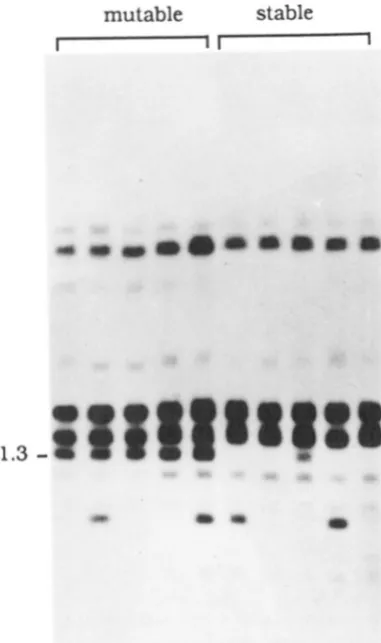
DNA was prepared from 28 plants derived from either mutable or stable kernels from DRl or DR6, both of which segregated for a single regulator ele- ment. DNA was digested with EcoRI which cuts once within MuA2. A representative of this Southern analy- sis is shown in Figure 2. A single EcoRI DNA fragment of approximately 7.5 kb (indicated by an arrowhead) cosegregated with somatic Mutator activity when probed with the EcoRI-EcoRV fragment of MuA (Fig- ure 2A). A separate EcoRI DNA fragment of approx- imately 3.5 kb was found to cosegregate with somatic
mutable
stable
"
F I G U R E 4,-A2utor;ldiogr;1m o f ;I Southern blot o f 1)NI\ from
plants derived from either mutable or stable kernels of D R I after
f h R I and Bamf-II digestion. T h e blot was probed with the EcoRl-
f,koR\' fragment o f . l I t ~ 4 .
with Mutator activity (Figure 4). A band of similar size present in plant number 3 from a stable kernel is probably due to cross-hybridization with a different
Mu element since the intensity of this band is lower than the one cosegregating with Mutator activity.
Comparison of DNA modification of MuA2 with MuA2-hybridizing sequences: Active AclDs and Spm
(En)
elements of maize are hypomethylated whereas other cross-hybridizing sequences in the same genome remain extensively methylated (SCHWARTZ and DEN-NIES 1986; CHOMET, WESSLER and DELLAPORTA 1987;
CONE, BURR and BURR 1986; FEDOROFF et al. 1988;
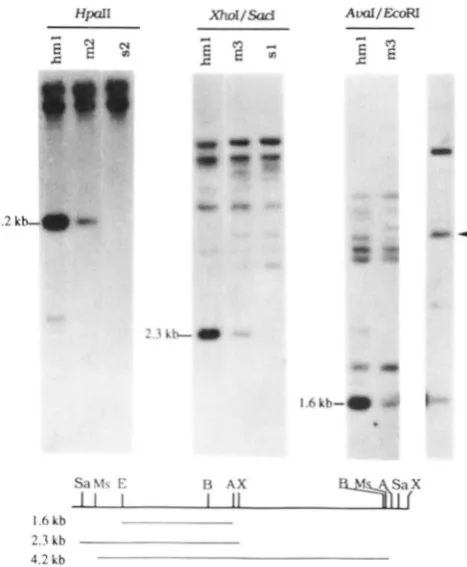
SCHIEFELREIN et al. 1988). We also found that MuA2 was completely cleaved by X h o l , a methvlation-sensi- tive enzyme that cuts once within MuA2, while most other MuA2-hybridizing sequences were poorly cleaved (Figure 2). Similar results were obtained with the methyl;ltion-sensitive enzyme HpaII, which cuts twice within MuA2 (Figure 7). T h e presence of other faint bands of low molecular weight in either XhoI or HpaII digestions may be due to incomplete methyla- tion of other MuA2-hybridizing elements or elements with less honlology with the MuA2 probe used. None of these bands was found to cosegregate w i t h Mutator activity.
of a slngle reglilator
e l w e n t ( T a b l e 1 )
r'l
stable
Tests f o r the nurrber of regulator elements present i n p l a n t s d e r l v e d f r o r r rrutable kernels (Table 2 )
FIGURE 5.-L.ine;tge relationships among plants used in the
analysis of the antplification o f the 'MuA2 element. A number next to each plant indicates the mutabilitv score.
Concomitant increase of MuA2 copy number and regulator elements: Genetic studies on Mu-induced al-Mum alleles showed the presence of a single puta- t i v e regulator in some lines, as evidenced from the
1: 1 segregation for somatic mutability. When plants from mutable kernels were testcrossed with a l sh2 tester lines, the segregation of mutable vs. stable ker- nels in the next generation occasionally became 3: 1 ,
7:l or 15:l (ROBERTSON and STINARD 1989; M . Q I N
and A. H. ELLINGROE, unpublished results). These ratios suggest the presence of two, three or four regulator elements, respectively, in these kernels. An explanation for this phenomenon was duplicative transposition of regulator elements. Experiments were performed to test whether MuA2 could amplify from one generation to the next and if such amplifi- cation would result in an increased number of regu- lator elements.
T h e lineage relationship among plants used in this analysis is given in Figure 5. Plants 90-101 1 and 90-
1023 were derived from two kernels, one mutable and one stable, respectively, from an ear of DRl (see
MATERIALS A N D METHODS) which segregated 1:l for somatic mutability. T h e data suggest t h e segregation of a single regulator element which was shown to
cosegregate with the cloned MuA2 element (Figure
2). Plant 90-101 1 was testcrossed with plant 90-123,
or an a1 sh2 tester, A632, or self-pollinated. T h e results of testcrosses are given in Table 2. T h e prog- eny ears segregated 1: 1 (or nearly 1: 1) and 3:l for mutability in testcrosses and a self-pollination, respec- tively. T h e data suggest the presence of a single reg- ulator in plant 90-101 1.
M . Q i n , D. Robertson A. H . Ellingboe
TABLE 2
Tests for the presence of a single regulator element in plant 90-101 1
\lut;ltllc." St;l-
hlr
- Expected
(:rev 90- 1 0 t t t4* tt.1 c? a:! -1otaI tt t ratio x' A X 90-102:1 9 60 22 0 91 120 1: I 3.99**
R 90-1023 x 10 14 124 22 170 I 9 0 1:1 1.1 1
C 90-1357' X 0 0 41 0 4 1 38 1 : 1 0.1 1
I) @' 14 95 2.5 0 134 40 3:l 0.40
1'l;untx 90- I O I I and 9 0 - 1 023 were derived from either a mutable o r 21 stable licrtlel, respectively, from an ear that segregated 1: 1 for
somatic .\.lufafor ac-tivity.
Mutable kernels were further classified into four categories according t o the frequency of purple spots. #4', highly mutable: #4. tnut:~ble: ~ 3 . intermediate; tt2, low mutable with a few spots.
* x? > x'(P = 0.05) = 3.84.
' A n a 1 sh2 tester. A632.
Self-pollination.
=:
ECORI sadi3
x
4
FIGURE 6,"Autoradiogram of Southern blot analysis showing the increase in copy numbers of MuA2. hm, highly mutable;
m.
mutable: s, stable. The number following each phenotype is thep l a n t number. hml = 91-13?; m l = 91-130: m2 = 91-12?; m3 =
91-125: S I = 91-122: s2 = 91-121. Arrowheads on the left side indicate either the novel BcoKI bands (first and fourth arrowheads from the top). or the original E m K I band (second), or the 4.8-kb
Sac1 band (third). T h e right most lane shows the single copy reconstruction (indicatecl by a n arrowhead). T h e blot was probed with the EroRI-EroR\' fragment of ,\,fu,4.
digested with EcoRI and/or SacI, Southern-blotted, and probed with the EcoRI-EcoRV fragment of MuA. T h e result is shown in Figure 6. Comparison of the GcoRI restriction patterns of several progeny plants with those of their parental generation (the restriction patterns of the parental generation were obtained
4.2 kb-
"-
2.3 lib0
I .6 kb" I
SaMs E B AX
I I I I II
I .6 kb
2.3 kb 4.2 kb
FIGURE 7.--Autoradiogram of a Southern blot, probed with the same probe as in Figure 6, showing that the amplified M u copies have an internal structure characteristic of MuA2. T h e phenotypes and plant number are given in Figure 6. D N A fragments expected forMuA2 with the cn7ymes used are indicated. T h e right most lane shows the single copy reconstruction (indicated by the arrowhead). T h e structure of M u A 2 and expected sizes of D N A fragments are shown in lower portion of the figure.
from a separate blot and not included) revealed two new bands (indicated by the first and fourth arrow- heads on the left) in one of the progeny plants (Figure 6, lane 1, hm 1 or plant 9 1-1 32). T h e SacI digestion of the same DNA resulted in a greater intensity of the 4.8-kb SacI fragment expected for MuA2 (Figure 6, lane 4), suggesting that the new
Mu
bands were prob- ably from the MuA2 transposition. To obtain addi- tional evidence that the new EcoRI bands were due to the newly transposed MuA2 elements, the same DNA was digested with various restriction enzymes, South- ern-blotted, and probed with the EcoRI-EcoRV frag- ment of MuA. T h e use of one methylation-sensitive enzyme in each digestion (HpaII, XhoI and AvaI) reduced the possibility of the digestion of other crypticTABLE 3
Segregation ratios and the putative numbers of regulator elements in progeny plants from cross B of Table I
O I ) \ C V \ C d ~
C V O d hf S -1- ratio\ clcments' x'
F.X~"'~I'"l so. 01
<ll-l25/9I-l22 71 5 X 129 I : l 1 1.31
91-127/91-122 5 5 49 104 1 : l 1 0 . 3 5
91-130/91-122 X 0 92 172 1 : l 1 0.84
91-131/91-121 1x2 3 0 212 3:l 2 1 5.30**"
7 : 1 :Jl 0..5 I
91-122/91-191 206 83 2x9 3 : l 2 2. I 5
9l-llO'/9l-l32 7 0 2 7 : l 7 2 3 ti.22" 31:l > 0.03
91-1:32/91-122 1 4 1 3 212 7:l 3 14.29**
J 1 : l ) 0.52
9 l - l 2 6 / 9 I - l 2 2 91 7 9 I t i . 1 1:1 I 1.9x
" I ' l a n t nun~l)ers can be found on ligurc .5.
' Espected number o f regulatory elemmts lx~srd on segregation ratio.
" *, ** <)l)served segregation ratio, rcspcrtivelv, significantly
(.?%I o r tligtlly significantly ( I %) different from the ispectrd ratio.
' A n a 1 sh2 tester. Oh.15.
5.1. n1ut;Ible;
s,
st;ll)le; I., t 0 t ; l l .an increased copy number of MuA2 (data not shown). Amplijcation of regulator elements: I f MuA2 is a reg- ulator element, plants with an increased copy number of MuA2 would be expected to have an increased number of mutable kernels in the next generation. Some of these plants were grown i n the greenhouse and testcrossed with sibling plants from stable kernels o r with an a 1 sh2 tester, Oh43. T h e data are sun1- marized in Table 3. T h e two plants, 91-131 and 91- 132, with an increased copy number of MuA2, as determined by Southern blot analysis, also showed an increased number of regulator elements in t h e prog- e n y tests whereas plants maintaining an apparent sin- gle copy of MuA2 still showed 1: 1 segregation for somatic mutability in their progeny plants (plants 91-
12.5, 91-126, 91-127 and 91-130). T h e difference between the three copies of MuA2 in plant 9 1-1 32 based on the EcoRI digestion (Figure 6, the two new EcoRI fragments plus the original copy indicated by the second arrowhead on the left) and the five copies of regulator elements based on the segregation ratios i n the progeny tests (Table 3, crosses 9 1
-
1 10/9 1-
1 32 and 9 1 - 1 32/9 1 - 1 22) can be explained by an underes- timation of new EcoRI fragments because of comigra- tion w i t h the parental MuA2-hybridizing bands. Southern blot analyses and progeny tests involving plant 9 1-1 3 1 indicated three copies of MuA2 and three regulator elements (Table 3, cross 9 1-
1 3 1 X 9 1-
1 2 1 ),respectively. The deficiency of mutable kernels in the "reciprocal" cross (Table 3, 9 1 - 122 X 9 1
-
13 1 ) is likely due to the reduced somatic mutability observed when lines with somatic instability are crossed as males to tester lines, as has been described before ID. S. Ron-A B
2 3 . 1
-
9.4 -
6.6
-
4.4
-
D
2.3
-
2.0-
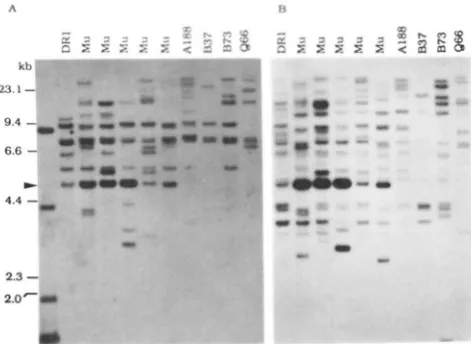
F ~ C ; ~ ' R C X.-A~rtor.;ldiogr~~~~~ of Southern blot analysis of D N A from ,\futator and n o ~ ~ - . \ f u t a t o r pl;~nts after Sur1 digestion. T11e Ixmd of ;tlq~rosinl;~tely 4.1 k b (the E f o K I - R a m H I fragment o f , t f u A ) of the first I ; I I I ~ is ;I t\\wcopy reconstruction, assunling 5. pg D N A were loaded i n e ; ~ c l ~ I ~ I W . D R I , ;I p l a n t from ;I mutable kernel from DKI
(also a s a singlc copy control). The blot w a s probed with the EmRI-
EroKV fragment of ,MuA (A) ;und reprobed with the Hind1 I I frag-
n l w t of .\lu.4 ( B ) . The ;irro\chc;d indicates the 4.8-kb Sac1 band es['cctcd for , \ ~ t 1 ; ~ 2 .
ERTSON (unpublished data, Maize Genetics News Letter 59: 10-1 1 , 1985) and WALROT (1 986)].
Southern blot analysis of Mutator lines and non-
Mutator inbreds: We have found that sequences ho- mologous to the internal regions of MuA are hetero- geneous and present i n multiple copies in both Mutator and non-Mutator maize lines. We reasoned that MuA- homologous elements in non-Mutator inbreds and most of elements in Mutator lines may be structurally different from transposase-encoding
Mu
elements. By comparing the internal structures of these MuA2- hybridizing sequences with enzymes that cut twice within the elements, we should be able to distinguish elements structurally similar to MuA2 from elements that have gross changes i n the internal structures. D N A from plants derived from five Mutator lines and four non-Mutator inbreds was digested with Sac1 and probed with the EcoRI-EcoRV fragment (Figure 8A) or the Hind111 fragment of MuA (Figure 8B). T h e 4.8-kb SacI fragment (indicated by an arrowhead) was detected i n all the plants from the Mutator lines with both probes but absent from t h e four inbreds. Other bands were either present i n both Mutator and non- Mutator plants or absent from some of the Mutator plants screened. Furthermore, different plants from different Mu lines had different copy numbers of the 4.8-kb SacI fragment, varying from one (Figure SA, lane 6 from the left) to approximately ten (Figure SA, lanes 3, 4 and 5 ) , based on densitometer scanning. Most of the variations may represent the copy number differences in different M u lines.DISCUSSION
We have described the cloning of ;I novel M U ele-
M. Qin, D. S. Robertson and A. H. Ellingboe
MuA2 has properties expected for a regulator or trans- posase-encoding element of the Mutator system.
We suspect that MuA2 may regulate somatic muta- bility of the al-Mum2 allele because it cosegregated with Mutator activity in more than 50 plants (approx- imately half from mutable kernels and half from stable kernels) from two lines that segregated 1 : 1 for a single putative regulator. Additional lines of evidence in support of, or consistent with, this conclusion came from the following observations. First, MuA2 was hy- pomethylated relative to the bulk of other MuA2- hybridizing sequences in the same genome. Second, the increase of MuA2 copy number was concomitant with an increased number of regulators. Third, al- though there were many copies of MuAZhybridizing sequences in all lines tested, intact MuA2 elements were found only in Mutator lines. Furthermore, be- cause of the cross-hybridization between MuA and MuA2, the MuA-hybridizing transcript that has been shown to be associated with Mutator activities (QIN and ELLINGBOE 1990) should also hybridize to MuA2. T h e transcript, in fact, could be produced from MuA2. Finally, the TIRs of MuA2 have high sequence simi- larity with those of other Mu elements, ranging from
77
to 90% (Table l ) , a characteristic similar to the Ac-Ds and Spm systems in which the autonomous Ac and Spm elements also share the TIRs with their nonau- tonomous elements. Together, the data are consistent with a concept that MuA2 may promote the transpo- sition of the Mu1 insertion at the al-Mum2 allele (or any nonautonomous Mu insertions in general) by pro- viding the transposase activity.
The data presented here suggest the transposition of the MuA2 element. Transposition events were de- tected by the appearance of new MuAShybridizing elements at different sites in two out of eight progeny plants tested (the molecular data for plant 9 1-1 32 is shown in Figure 6). An increased copy number of MuA2 in the same plant when the DNA was digested with SacI and several other enzymes (Figures 6 and
7)
supports the idea that the transposed elements were from MuA2. Since a plant with newly transposed MuA2 elements (Figure 6, indicated by the first and fourth arrowheads on the left) also retained the orig- inal copy of MuA2 (Figure 6, indicated by the second arrowhead on the left), MuA2 may transpose via a
replicative mechanism, similar to the Mu1 transposi- tion (ALLEMAN and FREELING 1986). T h e amplifica- tion of the MuA2 elements is also consistent with previous genetic studies on the behavior of regulator elements (ROBERTSON and STINARD 1989). It may also explain in part the appearant non-Mendilian inherit- ance of Mutator activity and Mu-induced mutations.
In outcrosses of plants with a single regulator, var- iation in mutability is frequently observed among mutable kernels from ears that segregate 1 : 1 for mut-
ability. Eight plants that we analyzed were grown from selected kernels with different mutability scores, six of which are given in Figure 5 . Two plants with increased copy number of MuA2 (Figure 6 and Table 3, 91-132 and 91-131) also had higher mutability
(#4+). Whether this reflects a dosage effect needs further examination.
Autonomous Ac and Spm transposable elements are both structurally conserved elements for each system. We have found that when DNA from diverse Mu lines and non-Mu inbreds was restricted with S a d , which cuts within the TIRs of the MuA2 element, the 4.8- kb band characteristic of MuA2 was found in
Mu
lines but not in non-Mu inbreds (Figure 8). Similar results were obtained with an EcoRI and BamHI double diges- tion (data not shown). T h e copy numbers of the 4.8-kb SacI fragment varied from one to approximately ten in plants from different Mu lines, this may reflect the copy number differences of MuA2-like elements. This is also in agreement with the non-Mendelian segregation of the Mutator trait. These data suggest that autonomous
Mu
elements may be structurally conserved and similar, if not identical, to MuA2. T h e final proof must await the determination of DNA sequences of MuA2 and other autonomous Mu ele- ments.T h e association of MuA2-like elements with ger- minal Mutator activity would also suggest that MuA2- like elements encode the functions required for ger- minal Mutator activity as well as somatic Mutator activ- ity. This is also in agreement with our previous North- ern blot analysis of maize lines with various Mutator activities in which the MuA-hybridizing transcript of similar size is associated with both germinal mutagenic activity and somatic mutability (QIN and ELLINGBOE
1990). T h e difference between germinal and somatic Mutator activities may be due to the copy number differences of active MuA2-like elements as well as actively transposing nonautonomous Mu elements. While a single copy of MuA2-like element may be sufficient to promote the somatic excision of a non- autonomous Mu insertion at a given locus, only lines with certain numbers of active
Mu
elements (autono- mous as well as nonautonomous) may exhibit detect- able germinal Mutator activity. Genetic studies have shown that most al-Mum2 and al-Mum3 stocks seg- regating for a single regulator have no detectable germinal Mutator activity (ROBERTSON and STINARD1989). T h e amount of the MuA-hybridizing transcript of two such lines was also found lower than that of germinally active lines (QIN and ELLINCBOE 1990).
From the limited data, an 8 bp target duplication was inferred. This is different from the 9-bp target dupli- cations found in all the M u insertions that have been analyzed thus far except MuA which was also found to be flanked by an 8-bp target duplication (QIN and ELLINGBOE 1990). Variations of target duplications have also been reported in bacterial insertion se- quences (GALAS and CHANDLER 1989). It is possible that the cleavage of the target occurred with a 9-bp spacing, but a base was subsequently removed from one or the other of the cleaved target ends by nuclease action. An alternative possibility is duplication of 9 and 8 bp reflects a variation in the spacing of the initial cleavage, possibly due to sequence variations in the T I R s and/or structural variations in the internal regions of different M u elements. More sequence data from the MuA family will be needed to determine if this one base pair difference is common to the MuA
family or represents one of the few exceptions. The cloning of the MuA2 element is an important step toward the understanding of M u regulation. For example, loss of Mutator activity by outcrossing and intercrossing have been proposed to be due to the segregation and the DNA modification of transposase- encoding elements, respectively. These hypotheses can now be tested with respect to the segregation and/ o r the DNA modification of MuAZlike elements. The
Mutator system has become increasingly interesting because of its high mutagenic activity. It may now be possible to introduce the Mutator system into other heterologous systems, similar to the work .done with the Ac-Ds and Spm systems (reviewed by HARING et al.
199 1).
We like to thank TOM SULLIVAN, OLIVER NELSON and JERRY
KERMICLE for useful discussions. We also thank TOM SULLIVAN and OLIVER NEWN for allowing us to use their PCR machine. We are grateful to CHENG KAO, TOM SULLIVAN, DAVID Ow, MARRY ALLE-
M A N and RON OKAGAKI for critically reading the mannuscript.
Thanks also to CAITILYN ALLEN for helping us with DNA sequenc- ing and WILLIAM TRACY for providing us with a l sh2 tester lines.
LITERATURE CITED
ALLEMAN, M., and M. FREELING, 1986 The Mu transposable elements of maize: Evidence for transposition and copy number regulation during development. Genetics 112: 107-1 19. BARKER, R. F., D. V. THOMPSON, D. R. TALBOT, J. SWANSON and
J. L. BENNETZEN, 1984 Nucleotide sequence of the maize transposable element Mul. Nucleic Acids Res. 12: 5955-5967. BENNETZEN, J. L., 1984 Transposable element Mu1 is found in multiple copies only in Robertson’s Mutator maize lines. J. Mol. Appl. Genet. 2: 519-524.
BENNETZEN, J. L., 1987 Covalent DNA modification and the regulation of Mutator transposable element transposition in maize. Mol. Gen. Genet. 208: 45-51.
BENNETZEN, J. L., J. SWANSON, W. C. TAYLOR and M. FREELING, 1984 DNA insertion in the first intron of maize Adhl affects message levels: cloning of progenitor and mutant Adhl alleles. Proc. Natl. Acad. Sci. USA 81: 4125-4128.
BENNETZEN, J. L., R. P. FRANCASSO, D. W. MORRIS, D. S. ROBERT-
SON and M. J. SKOKEN-HAGENSON, 1987 Concomitant regu- lation of Mu1 transposition and Mutator activity in maize. Mol. Gen. Genet. 208: 57-62.
CHANDLER, V. L., and V. WALBOT, 1986 DNA modification of a maize transposable element correlates with loss of activity. Proc. Natl. Acad. Sci. USA 83: 1767-1771.
CHOMET, P. S., S. WESSLER and S. DELLAPORTA, 1987 Inactivation of the maize transposable element Activator (Ac) is associated with its DNA modification. EMBO J. 6: 295-302.
CONE, K. C., F. BURR and B. BURR, 1986 Molecular analysis of the maize anthocyanin regulatory locus C l . Proc. Natl. Acad. Sci. USA 83: 9631-9635.
FEDOROFF, N., 1989 Maize transposable elements, pp. 377-411 in Mobile DNA, edited by D. BERG and M. HOWE. ASM Press, Washington D.C.
FEDOROFF, N . , P. MASSONJ. BANKS and J. KINGSBURG, 1988 Positive and negative regulation of the Suppressor-mu- tator elements, pp. 1-15 in Plant Transposable Elements, edited by 0. NELSON. Plenum press, New York.
FLEENOR, D., M. SPELL, D. S. ROBERTSON and S. R. WESSLER, 1990 Nucleotide sequence of the maize Mutator element, Mu8. Nucleic Acids Res. 18: 6725.
GALAS, D. J., and M. CHANDLER, 1989 Bacterial insertion se-
quences, pp. 109-162 in Mobile DNA, edited by D. BERG and M. HOWE. ASM Press, Washington D.C.
HARING, M. A., C . M. T. ROMMENS, H. J. J. NIJKAMP and J. HILLE, 1991 The use of transgenic plants to understand transposi- tion mechanisms and to develop transposon tagging strategies. Plant Mol. Biol. 16: 449-461.
OCHMAN, H., A. S. GERBER and D. L. HARTL, 1988 Genetic applications of an inverse polymerase chain reaction. Genetics
OISHI, K. K., and M. FREELING, 1988 A new Mu element from a Robertson’s Mutator line, pp. 289-291 in Plant Transposable Elements, edited by 0. NELSON. Plenum Press, New York.
O’REILLY, C., N. C. SHEPHERD, A. PEREIRA, 2. SCHWARZ-SOMMER, I. BERTRAM, D. S. ROBERTSON, P. A. PETERSON and H. SAE-
DLER, 1985 Molecular cloning of the a l locus of Zea mays using the transposable elements En and Mul. EMBO J. 4: 877- 882.
QIN, M., and A. H. ELLINGBOE, 1990 A transcript identified by MuA of maize is associated with Mutator activities. Mol. Gen. Genet. 2 2 4 357-363.
ROBERTSON, D. S., I978 Characterization of a mutator system in maize. Mutat. Res. 51: 21-28.
ROBERTSON, D. S., 1986 Genetic studies on the loss ofMu mutator activity in maize. Genetics 113: 765-773.
ROBERTSON, D. S., and P. STINARD, 1989 Genetic analyses of putative two-element systems regulating somatic mutability in Mutator-induced aleurone mutants of maize. Dev. Genet. 1 0
1 2 0 621-623.
482-506.
ROBERTSON, D. S., P. STINARD, J. G. WHEELER and D. W. MORRIS, 1985 Genetic and molecular studies on germinal and somatic instability in Mutator-induced aleurone mutants of maize, pp. 317-332 in Plant Genetics, edited by M. FREELING. Alan R. Liss, New York.
ROBERTSON, D. S., D. W. MORRIS, P. S. STINARD and B. A. ROTH, 1988 Germ line and somatic Mutator activity: are they func- tionally related? pp. 17-42 in Plant Transposable Elements, edited by 0. NELSON. Plenum Press, New York.
SAIKI, R. K . , 1990 Amplification of genomic DNA, pp. 13-20 in
PCR Protocals: A Guide to Methods and Applications, edited by M. A. INNIS, D. H. GELFAND, J. J. SNINSKY and T. J. WHITE. Academic Press, New York.
SCHIEFELBEIN, J., V. RAYBOY, H. Y . KIM and 0. E. NELSON, 1988 Molecular characterization of Suppressor-mutator (Spm)-
S. Robertson and Ellingboe
alleles, pp. 261-278 in Plant Transposable Elements, edited by 0. NELSON. Plenum Press, New York.
SCHNABLE, P. S., P. A . PETERSON and H. SAEDLER, 1989 T h e bz- rcy allel of the Cy transposable element system of Zea mays
contains a Mu-like element insertion. Mol. Gen. Genet. 217: 459-463.
SCHWARTZ, D., and E. DENNIES, 1986 Transposase activity of Ac
controlling element in maize is regulated by its degree of methylation. Mol. Gen. Genet. 2 0 5 476-482.
T A L B E R T , L. E., G. I. PATTERSON and V. L. CHANDLER, 1989 Mu
transposable elements are structurally diverse and distributed
throughout the genus Zea. J. Mol. Evol. 29: 28-39.
TAYLOR, L. P., and V. WALBOT, 1987 Isolation and characteriza- tion of a 1.7 kb transposable element from a Mutator line of maize. Genetics 117: 297-307.
WALBOT, V., 1986 Inheritance of mutator activity in Zea mays as assayed by somatic instability of the bz-mu1 allele. Genetics 114:
WALBOT, V., and C. WARREN, 1988 Regulation of M u copy number in maize lines with an active or inactive Mutator transposable system. Mol. Gen. Genet. 211: 27-34.
1293-1312.