Copyright 0 1996 by the Genetics Society of America
Excision Patterns of Activator (Ac)
and
Dissociation
(Ds)
Elements
in Zea
mays
L.:
Implications for the Regulation of Transposition
Manfred Heinlein
The Scripps Research Znstitute, La Jolla, Calqornia 92037 Manuscript received May 28, 1996
Accepted for publication September 4, 1996
ABSTRACT
The pattern of aleurone variegation of maize kernels carrying Ac and bz-m2(DI) as reporter allele for Ac activity depends on the dosage of both Ac and Ds. Alterations of Ac dosage can abolish Ds excision at certain times and allow it to occur at other times. wx-m7 and wx-m9 are different Ac insertions in the
Waxy gene which have different dosage effects on Ds excision. Kernels, heterozygous for the two Ac alleles and being either wx-m7/wx-m7/wx-m9 or wx-m9/wx-m9/wx-m7 exhibit characteristic patterns of predominantly late excisions; this is in strong contrast to the pattern of early excisions present on wx- m7/wx-m7/wx-m7 homozygotes. This observation supports the hypothesis that the Ac alleles express different amounts of transposase (TPase) during development and that above a certain level of TPase transposition is inhibited. Furthermore, experimental results suggest that the frequency of Ac-induced events is influenced by the dosage and composition of the transactivated Ds or Ac allele. Thus, transposi- tion frequency seems not to be exclusively determined in trans by the amount of active TPase, but also by specific cis-acting properties of the TPase substrate.
T
HE maize transposable elements Activator (Ac) andDissociation (Ds) were discovered by BARBARA MCCLINTOCK (1946,1947,1948). These elements trans- pose by a nonreplicative mechanism and create an 8- bp target duplication upon transposition (reviewed in FEDOROFF 1989). The Ac element is able to transpose autonomously and to mobilize nonautonomous Dissoci-
ation (Ds) elements in trans (MCCLINTOCK 1948; COUP-
LAND et al. 1988). Both Ds and Ac elements have been cloned (COURAGE-TEBBE et al. 1983; FEDOROFF et al. 1983; BEHRENS et al. 1984) and sequenced (DORING et
al. 1984; MULLER-NEUMANN et al. 1984; POHLMAN et al. 1984) and the gene structure of Ac has been deter- mined (KUNZE et al. 1987). The Ac element encodes a 3.5-kb mRNA (KUNZE et al. 1987; FINNEGAN et al. 1988) for a protein of 807 amino acids. Because expression of the corresponding cDNA is sufficient to trigger exci- sion of Ds in transgenic tobacco plants (COUPLAND et
al. 1988) as well as in Petunia protoplasts (HOUBA-HERIN
et al. 1990; BECKER et al. 1992; HEINLEIN et al. 1994), the Ac protein is referred to as the transposase (TPase) of the Ac/Ds system. This protein is a nuclear DNA- binding protein that recognizes AAACGG sequence motifs of which multiple copies are found within the subterminal portions of both Ac and Ds elements ( KUNZE and STARLINGER 1989). The DNA-binding prop- erties (FELDMAR and KUNZE 1991) as well as the observa- tion that certain mutant TPase derivatives act as trans-
Address fm correspmdmce: The Scripps Research Institute, Depart-
ment of Cell Biology-BCC206, 10555 N. Torrey Pines Rd., La Jolla,
CA 92037. E-mail: [email protected]
Genetics 144: 1851-1869 (December, 1996)
dominant inhibitors of transposition in vivo suggest that several TPase molecules participate in the formation of the transposition complex (KUNZE et al. 1993).
The Ac/Dssystem is sensitive to the copy number of Ac in the genome (MCCLINTOCK 1948, 1951). An in- crease in the number of Accopies in the genome usually results in a delay of Ds excisions, indicating that the number of early excision events is decreased whereas the number of late excision events is increased (MCCLINTOCK 1949). The dosage effect of Ac is depen- dent on expression of the TPase protein, since deletions destroying the TPase coding region mutate Ac into Ds elements, which do not contribute to the dosage effect (DOONER et al. 1986), and Ac elements whose transcrip- tion is inactivated by transient methylation do not con- tribute to the dosage effect (MCCLINTOCK 1964, 1965; SCHWARTZ and DENNIS 1986; KUNZE et al. 1988). There- fore, it appears that the dosage effect of Ac may be explained by the level of its transcription and/or trans- lation products in response to both Ac dosage and the development of the tissue under investigation, e.g., the endosperm.
1852 M. Heinlein the amount of TPase; however, above a certain concen-
tration of Ac TPase the Ds excision rate remains con- stant even if the amount of TPase is increased further (BECKER et al. 1992; KUNZE et al. 1993; HEINLEIN et aZ.
1994). This observation has been substantiated by the finding that the TPase tends to associate into large, rod-like aggregates. This suggests that aggregation may sequester active TPase, thereby keeping the transposi- tion rate low even in the presence of high levels of TPase (HEINLEIN et al. 1994). In addition, using transgenic tobacco plants, transposition inhibition was demonstrated above a threshold TPase concentration (SCOFIELD et al. 1993). Therefore, increasing Ac dosage in maize may result in a decrease in transposition fre- quency because two or three copies of Ac lead to pro- duction of TPase levels that are above an inhibitory threshold.
The Ac dosage effect is dependent on the particular Ac insertion used to cause the excision of a constant reporter
Ds
element, as is demonstrated by the wx-m7and wx-m9alleles of the Wx gene. Although these alleles are identical except for the insertion site of Ac within the Waxy gene (KLOSGEN et al. 1986), they are character- ized by virtually opposite dosage effects. The wx-m9 al- lele has a “normal” dosage effect with predominantly early excisions with one copy and predominantly late excisions with two or three copies (SCHWARTZ 1984; HEINLEIN and STARLINGER 1991). In contrast, the wx- m7 allele has an inverse effect with predominantly late excisions in the presence of one copy and predomi- nantly early excisions when two or three copies are pres- ent in the genome (MCCLINTOCK 1964; SCHWARTZ 1986; SCHWARTZ and DENNIS 1986; HEINLEIN and STAR-
LINGER 1991). The genetic background of the maize lines is not responsible for these differences between
wx-m7 and wx-m9, and it has been proposed that the dosage-specific trans-activities of wx-m7 and wx-m9 are determined by the Ac alleles themselves, presumably by expression of different amounts of TPase during development (HEINLEIN 1995).
I
report here on patterns of aleurone variegation that are displayed on kernels that carry different doses ofwx-m7 and wx-m9 and the bz-m2(DI) allele as reporter allele for Ac activity. The observed patterns provide fur- ther support for the hypothesis that the two specific Ac alleles differ in TPase expression during development and that above a critical threshold of TPase expression transposition activity is inhibited. In addition,
I
describe that Ds or Ac elements may differ in transactivation patterns in the presence of the same transacting TPase source. This suggests that TPase activity is not exclu- sively regulated in trans, but also in cis, at the site of the TPase substrate.MATERIALS AND METHODS
Maize stocks The particular Ac alleles used in this study were bz-m2, wx-m7 and wx-m9. bz-m2 is a mutable allele that
arose from an insertion of the 4.6kb Ac element into the second exon of Bz-McC (MCCLINTOCK 1955; FEDOROFF et al. 1984; DOONER et al. 1985; RALSTON et al. 1988). wx-m7 and wx-m9 are unstable Wx alleles that arose in bz-m2 and al-m4 stocks by transposition of the Ac element to the Wx-locus (MCCLINTOCK 1963, 1964). The Ac elements of both Wx al- leles are identical and inserted in reverse orientation relative to the host gene. wx-m7 carries Ac 46 bp upstream of the TATA box and wx-m9 carries the element in the tenth exon of the gene (KLOSGEN et al. 1986).
The alleles sh-m5933, bz-mZ(DI), wx-m9Ds and c2-m4490Ds carry Ds and were used as reporter alleles for Ac trans-activity. sh-m5933 is a mutable allele of the Sh locus that contains a “double Ds ” element, consisting of a 2-kb Ds element in- serted in opposite orientation into the center of a second, identical 2-kb element (COURAGE-TEBBE et al. 1983; DORING and STARLINGER 1984; DORING et al. 1989). Although somatic excision events have been reported (COURAGE-TEBBE et al. 1983; HEINLEIN and STARLINGER 1989), the element fre- quently induces chromosome breakage events at the site of insertion, probably in the course of aberrant transposition attempts involving the two transposon ends that are in direct orientation (DORING and STARLINGER 1984; DORING et al.
1989). In this study, the sh-m5933 is linked to the Cl-I allele of the aleurone color gene CI. This allele dominantly inhibits anthocyanin synthesis in maize kernels (CHEN and COE 1977; CONE et al. 1986; PAZ-ARES et al. 1990). In the presence of Ac, chromosome breakage at sh-m5933 leads to loss of the distally located chromosome fragment containing the C1-Iallele. Ker- nels carrying the wild-type C l gene on the homologous chro- mosome thus display colored areas on an uncolored back- ground. bz-mZ(DI) is a derivative of bz-m2 harboring a 3.3-kb
Ds element at the locus as a consequence of a deletion muta- tion of Ac to Ds (MCCLINTOCK 1962; DOONER et al. 1985, 1986). Similarly, wx-m9Ds derived from wx-m9 by a 194bp internal deletion from Ac (FEDOROFF et al. 1983). c2-m4490Ds is a mutable allele of the C2 gene that carries Ds in an un- known position (NEVERS et al. 1985). The C2 locus encodes chalcone synthase, which catalyzes an early step in the antho- cyanin biosynthesis pathway (DOONER 1983; WIENAND et al.
1986; FRANKEN et al. 1991).
In addition, maize lines were used that contain recessive alleles sh bz (MOITINGER 1973), WXB-7 (WESSLER and VARA-
GONA 1985) and c2 (MCCLINTOCK 1967; FRANKEN et al. 1991), respectively.
New lines in which the mentioned alleles were mutually combined were developed from recombinant kernels that were phenotypically selected from FP ears. All lines were p r o p agated by selfing and sibling crosses and appropriate genetic tests were carried out to verify the genetic constitution of the strains.
Phenotypic selection of kernels and quantitative analysis:
The following criteria were applied to select the kernels for comparison and quantitative evaluation of variegation pat- terns in the aleurone: the kernels represented the predomi- nant variegation phenotype present on the ear at hand and on other ears of the same cross; the variegation patterns on the kernels were homogeneous and, if possible, did not carry sectors indicative of “changes in state” of Ac or DS (MCCLIN-
Ac and Ds Activity in Maize 1853
wx-m7::
bz-m2(DI)
FIGURE 1.-Patterns of Ds excision from the bz-m2(DZ) allele in kernels carrying one, two or three copies of bz-m2(DZ) and one,
two or three copies of wx-m7. An increase in wxm7 dosage leads to earlier events. The small sectors on kernels with two and
three wx-m7 alleles resulted from early somatic transposition events during which one copy of Ac has been lost (see text for detailed discussion). The effect of altering the dosage of the bz-m2(DZ) allele is best seen on kernels carrying one copy of wx- m7. Ds excision frequency increases less than proportionally to an increase in bz-m2(DI) dosage from one to two copies but increases more than proportionally to an increase in the number of Ds alleles from two to three copies of the Ds allele. The phenotype of kernels in which bzm2(DZ) is transactivated by the action of two copies of wx-m7 and one copy of wx-m9 differs strongly from the phenotype of kernels which carry three doses of the wx-m7 allele. The phenotype of the heterozygous kernels indicates that the replacement of the sperm-derived wx-m7 allele by a wx-m9 allele causes strong suppression of early excision events. Therefore, Ac activity in the cell is specified not only by the dosage of Ac but also by the Ac allele.
Histochemical methods: P a n embedding and sec- tioning of maize kernels as well as iodine staining of the inner endosperm starch was performed as described (HEINLEIN et
al. 1994; HEINLEIN 1995).
Statistical analysis: &distribution statistics was used to esti- mate confidence intervals for mean values p of small samples. The t-statistics is defined as t = &(x - p)/s, where n is the number of samples, xis the sample average and s is the sample standard deviation. The confidence interval for p is from x
-
st/& to x+
st/& The value of t for a given sample size can be found in published statistical tables.RESULTS
Dosage effects of
zux-m7
and
m m 9 : The variegated aleurone phenotype of kernels carrying the bz-mZ(DI) allele consists of fully colored sectors on a bronzecol- ored background. Each revertant sector is caused by somatic excision of Ds, and the pattern of differentlysized sectors corresponds to the frequencies of excision events that occurred during the process of kernel devel- opment. Because transposition of Ds requires the pres- ence of active TPase expressed from Ac, the aleurone variegation pattern serves as a convenient read-out for TPase activity during development. In a previous study, the bz-m2(DI) variegation patterns that were displayed in the aleurone of kernels that carried one and two
doses of wx-w27 or wx-m9 were compared and evaluated by separately counting the numbers of sectors of each sector size class. The two Ac alleles were determined to M e r strongly in their dosage-specific truns-effects on Ds excision from bzm2(DI) (HEINLEIN and STARLINGER
1991). Because these differences appeared to be geneti- cally tightly linked to the corresponding Ac allele, the
1854 M. Heinlein
wx-m9
::
bz-m2(DI)
FIGURE 2.-Patterns of Ds excision from the bz-mZ(DI) allele in kernels carrying one, two and three copies of bz-mZ(DI) in the presence of either one, two or three wx-m9 alleles. An increase in wx-m9 dosage causes a reduction in the number of early events and thus leads to postponement of Ds excisions during kernel development. Upon an increase in the dosage of wxm9, the number of small sectors first increases (two doses) and then decreases (three doses). Heterozygous kernels carrying two wx-m9 alleles and one wxm7 allele display slightly more small sectors than the homozygous kernels with three copies of the wxm9 allele. The effects of altering the dosage of the Ds allele on the frequency of Ds excision are dependent on the dosage of the transactivating wx-m9 allele (Table 2).
ther test this hypothesis, wx-m7/wx-m7/wx-m9 and wx- m9/wx-m9/wx-m7 heterozygotes that contain both al- leles were generated and the transeffects on Ds excision were tested again by using bz-m2(DI) as reporter allele.
If
the two Ac alleles encode different amounts of TPase during development, the level of TPase made by both alleles should result in new variegation patterns that are distinguishable from the patterns of Ds excision inwxm7/ wx-m7/ wx-m7 and wx-m9/ wx-m9/ wx-m9 homozy- gotes. In contrast to the former study (HEINLEIN and
STARLINGER 1991), the present analysis was carried out with kernels harboring constant doses of the bz-m2(DI) reporter allele to monitor the dosage effects of wx-m7 and wx-m9 in isolation from Ds dosage effects (de- scribed below). The dosage-specific phenotypes of wx-
m7 and wx-m9 that were seen in this experiment are summarized in Figures 1 and
2,
respectively.As was described earlier (SCHWARTZ 1986; H E I N L E ~
and STARLINGER 1991) the phenotype of one copy of wx-m7 consists of a very high number of small sectors
and very rare large sectors and indicates high levels of TPase activity during late development. In contrast, kernels in which a second copy of wx-m7 is present carry predominantly large sectors indicative of early Ac activity. The large sectors on kernels with two doses of wx-m7 are of two kinds that need to be explained the first m e is represented by large colored sectors that indicate early Ds excision events; the second type is represented by large sectors that delineate areas of aleu- rone displaying a late spotting pattern similar to that found in the one dose wxm7phenotype. Similar to the onedose wx-m7 phenotype, the density of small spots increases with increasing dosage of the bz-m2(DI) re- porter allele. It seems likely that these areas displaying a late spotting pattern are caused by early events that,
Ac and Ds Activity in Maize 1855
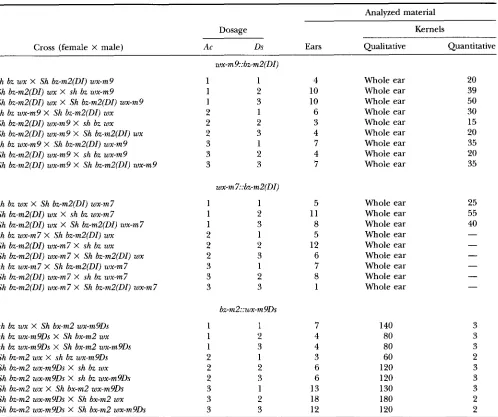
TABLE 1
Genetic crosses to generate kernels containing different doses of Ac and Ds
~~
Analyzed material
Dosage Kernels Cross (female x male) Ac Ds Ears Qualitative Quantitative
sh bz wx X Sh bz-m2(DI) wx-m9 Sh bz-m2(DI) wx X sh bz wx-m9 Sh bz-m2(DI) wx X Sh bz-m2(DI) wx-m9
sh bz wx-m9 X Sh bz-m2(DI) wx Sh bz-m2(DI) wx-m9 X sh bz wx
Sh bz-m2(DI) wx-m9 X Sh bz-m2(DI) wx sh bz wx-m9 X Sh bz-m2(DI) wx-m9
Sh bz-m2(DI) wx-m9 X sh bz wx-m9 Sh bz-m2(DI) wx-m9 X Sh bz-m2(DI) wx-m9
sh bz wx X Sh bz-m2(DI) wx-m7 Sh bz-m2(DI) wx X sh bz wx-m7 Sh bz-m2(DI) wx X Sh bz-m2(DI) wx-m7 sh bz wx-m7 X Sh bz-m2(DI) wx Sh bz-m2(DI) wx-m7 X sh bz wx Sh bz-m2(DI) wx-m7 X Sh bz-m2(DI) wx sh bz wx-m7 X Sh bz-m2(DI) wx-m7 Sh bz-m2(DI) wx-m7 X sh bz wx-m7 Sh bz-m2(DI) wx-m7 X Sh bz-m2(DI) wx-m7
sh bz wx X Sh bx-m2 wx-m9Ds sh bz wx-m9Ds X Sh bx-m2 wx sh bz wx-m9Ds X Sh bx-m2 wx-m9Ds Sh bz-m2 wx X sh bz wx-m9Ds Sh bz-m2 wx-m9Ds X sh bz wx Sh bz-m2 wx-m9Ds X sh bz wx-m9Ds Sh bz-m2 wx X Sh bx-m2 wx-m9Ds Sh bz-m2 wx-m9Ds X Sh bx-m2 wx Sh bz-m2 wx-m9Ds X Sh bx-m2 wx-m9Ds
wx-m9::bz-m2(DI) 1 1
1 2
1 3
2 1
2 2
2 3
3 1
3 2
3 3
wx-m7::bz-m2(DI) 1 1
1 2
1 3
2 1
2 2
2 3
3 1
3 2
3 3
bz-m2::wx-m9Ds
1 1
1 2
1 3
2 1
2 2
2 3
3 1
3 2
3 3
4 10 10
6 3
4 7 4 7
5 11 8 5 12
6 7
8
1
7 4 4 3
6 6
13 18 12
Whole ear Whole ear Whole ear Whole ear Whole ear Whole ear Whole ear Whole ear Whole ear
Whole ear Whole ear Whole ear Whole ear Whole ear Whole ear Whole ear Whole ear Whole ear
140 80 80 60 120 120 130 180 120
20 39 50 30 15 20 35 20 35
25 55 40 - -
-
--
-3
3
3 2 3 3 3
2 2 Genetic crosses, number of available ears and total number of kernels (qualitative analysis/quantitative analysis) analyzed to assess the effect of altering the dosage of Ac and Ds alleles on the frequency of Ds excision.
1948, 1949, 1951, 1955, 1956). The late spotting areas are contiguous with inner endosperm sectors that dis- play the typical one dose of wx-m7wx 4 Wx reversion
pattern (Figure
7,
data not shown) or which are fully Wx revertant (data not shown; see Figure 1A in HEIN-LEIN and STARLINGER 1991) and thus may be consistent with Ac transposition events during which one copy of AG was inactivated or lost (PETERSON 1987).
Homozygous wx-m7/ wx-m7/ wx-m7 kernels carry sev- eral large colored sectors indicating that upon increas- ing the dosage of wx-m7 from two to three doses early activity of Ac is maintained. However, in contrast to the kernels with two doses of the allele, the described large areas with late spotting patterns are absent. This is ex- pected, because simultaneous transposition of two Ac
copies that would lead to the formation of large sectors containing one dose of wx-m7 is an unlikely event ( HEINLEIN and STARLINGER 1991 )
.
In contrast to the phenotype of kernels with two or three doses of wx-m7, the phenotype of heterozygous
wx-m7/ wx-m7/ wx-m9 kernels in which one wx-m7 allele is replaced by one wx-m9 allele exclusively consists of a very low number of unicellular revertant sectors. Large sectors are completely absent. This strongly indicates that wx-m9 and wx-m7 exert unique and specific trans effects on
Ds
during development.1856 M. Heinlein
TABLE 2
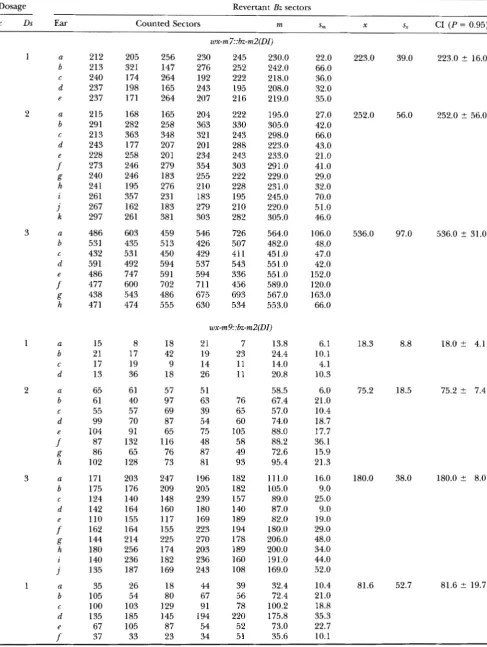
Number of Bz revertant sectors with increasing doses of bz-mZ(DZ)
Dosage Revertant Bz sectors
Ac Ds Ear Counted Sectors m S, X 5, CI ( P = 0.95)
a b d e a b d e c c
f
g h i k a b d e j Cf
g h a b d a b d e C Cf
g h a b d e Cf
g h i j a b d e f C 212 213 240 237 237 215 291 213 243 228 273 240 241 261 267 297 486 531 432 591 486 477 438 471 15 21 17 13 65 61 55 99 104 87 86 102 171 175 124 142 110 162 144 180 140 135 35 105 100 135 67 37 205 321 174 198 171 168 282 363 177 258 246 246 195 357 162 261 603 435 531 492 747 GOO 543 474 8 17 19 36 61 40 57 70 91 132 65 128 203 176 140 164 155 164 214 256 236 187 26 54 103 185 105 33 256 147 264 165 264 165 258 348 207 20 1 279 183 276 231 183 381 459 513 450 594 591 702 486 555 18 42 9 18 57 97 69 87 65 116 76 73 247 209 148 160 117 155 225 174 182 169 18 80 129 145 87 23 230 276 192 243 207 204 363 321 201 234 354 255 210 183 279 303 546 426 429 537 594 71 1675 630 245 252 222 195 216 222 330 243 288 243 303 222 228 195 210 282 726 507 41 1 543 336 456 693 534 230.0 242.0 218.0 208.0 219.0 195.0 305.0 298.0 223.0 233.0 291.0 229.0 231 .O 245.0 220.0 305.0 564.0 482.0 451.0 551 .O 551.0 589.0 567.0 553.0 21 19 14 26 51 63 39 54 75 48 87 81 196 205 239 180 169 223 270 203 236 243 44 67 91 194 54 34 7 23 11 11 76 65 60 105 58 49 93 182 182 157 140 189 194 178 189 160 108 39 56 78 220 52 51 13.8 24.4 14.0 20.8 58.5 67.4 57.0 74.0 88.0 88.2 72.6 95.4 111.0 105.0 89.0 87.0 82.0 180.0 206.0 200.0 191.0 169.0 32.4 72.4 100.2 175.8 73.0 35.6 22.0 66.0 36.0 32.0 35.0 27.0 42.0 66.0 43.0 21.0 41.0 29.0 32.0 70.0 51.0 46.0 106.0 48.0 47.0 42.0 152.0 120.0 163.0 66.0 6.1 10.1 4.1 10.3 6.0 21.0 10.4 18.7 17.7 36.1 15.9 21.3 16.0 9.0 25.0 9.0 19.0 29.0 48.0 34.0 44.0 52.0 10.4 21
.o
18.8 35.3 22.7 10.1 223.0 252.0 536.0 18.3 75.2 180.0 81.6 39.0 56.0 97.0 8.8 18.5 38.0 52.7223.0 2 16.0
252.0 ? 56.0
536.0 2 31.0
18.0 ? 4.1
75.2 ? 7.4
180.0 +. 8.0
Ac and Ds Activity in Maize 1857
TABLE 2
Continued
Dosage Revertant Bz sectors
Ac Ds Ear Counted Sectors m 5, x s, CI ( P = 0.95)
w~-m9::b~-m2(DI}
2
2 U 149b 108
C 108
2
3 U 265b 337
C 121
d 230
3 1 a 9
b 7
C 56
d 81
e 4
f
31g 16
3 2 a 185
b 166
C 76
d 324
3 3 a 171
b 155
C 155
d 144
e 196
f
198R 171
173 176 214 317 347 175 290 3 17 21 51 4 35 31 103 162 65 166
122
191 95 223 274 124 210 117 191 254 268 256 218 254 16 15 27 48 6 24 3 171 131 38 124 108 194 122 160 202 113 173 229 274 155 450 416 176 274 8 28 25 49 2 21 30 104 104 29 254 130 297 47 178 238 142 135 248 21 1 185 245 365 178 243 10 27 30 66 13 20 6 148 130 68 171 133 196 92 257 295 214 133183.0 55.0
192.0 60.0
183.0 56.0
309.0 83.0
344.0 58.0
174.0 35.0
258.0 24.0
9.2 4.6
18.8 8.8
31.8 13.9 59.0 14.3 5.8 4.3
26.2 6.5
17.2 13.1
142.0 38.0
139.0 26.0
55.2 20.5
115.0 80.0
133.0 23.0
207.0 53.0
102.0 40.0
192.0 47.0
241.0 44.0
158.0 45.0
164.0 32.0
186.0
271.0
24.0
136.0
171.0
53.0 186.0 t- 28.0
83.0 271.0 5 39.0
19.2 24.0 ? 6.6
71.0 136.0 2 33.0
58.0 171.0 ? 20.0
~
Number of revertant sectors seen in lAc, 2Ac, andd 3Ac aleurone of kernels carrying increasing doses of the bz-mZ(DZ) allele. Lower case letters designate individual ears generated by the same cross between different parental plants. The numbers behind each letter represent groups of total numbers of Bz sectors that were counted in the crown region of individual kernels taken from each ear as described in MATERIALS AND METHODS. m, group average (per ear); s,, standard deviation of group average (per ear); x sample average; s,, standard deviation of sample average. Confidence intervals (GI) for the “real mean” p (95%
probability) were calculated based on s, using the t distribution statistics.
development. The phenotypes shown in Figure
2
might give rise to the impression that the sectors are either small or large and thus consist of two distinct size classes; this, however, is deceptive, as was shown by the earlier study in which the numbers of differently sized sectors were separately determined (HEINLEIN and STARLINGER, 1991).Kernels carrying two copies of the wx-m9 allele are characterized by a lower number of large sectors and by a much higher number of small sectors.
A third copy of wx-m9 gives rise to exclusively small sectors. The sectors are lower in number and even ap- pear smaller in size compared with the already small sectors present on kernels with two doses of the allele. The phenotype of heterozygous wx-m9/ wx-m9/wx-m7 kernels (Figure 2) in which one copy of the wx-m9allele is replaced by one copy of the wx-m7 allele is similar to the phenotype of homozygous wx-m9/wx-m9/wx-m9
kernels. However, because of a slightly larger size of the sectors as well as a stochastic occurrence of large sectors (not shown) the phenotype of the heterozygotic kernels is also similar to the phenotype of kernels carrying two
doses of the wx-m9 allele.
Comparison of kernels with different doses of the
Ds
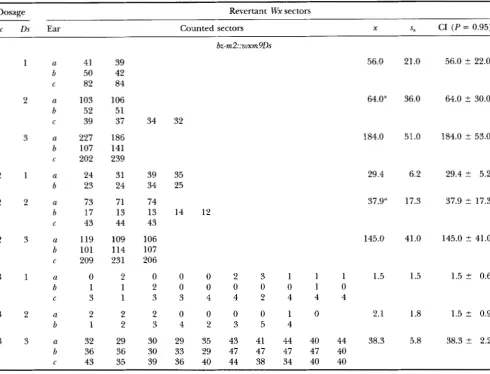
allele: The Ac allele- and Ac dosage-specific phenotypes displayed in Figures 1 and 2 carry either one, two or three genomic doses of the bz-m2(DZ) reporter allele. This material also was suitable to assess the effect of increasing the dosage of bz-m2(DI) on the frequency of bz-m2(DI) + Bz reversion events. Table 2 summarizes thenumbers of sectors that were present in the crown re- gion of individual kernels that carried one, two and three doses of the bz-m2(DZ) allele (Figures 1 and 2).
1 Ac 1 Ac ' 2Ac ' 3Ac
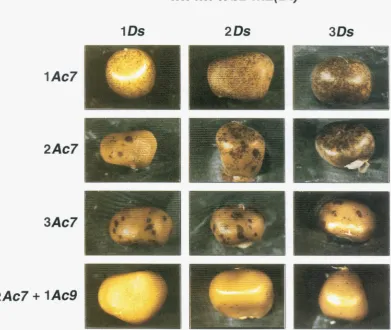
bz-m2::wx-m9Ds
1 Ds
I* 2Ds
W
3Ds1 Ac 2Ac 3Ac
tion. The numbers of total Bz sectors spread consider- ably between individual kernels of the same ear as well as between ears of the same cross and thus cause large standard deviations. Because no correlation can he drawn between the standard deviation and the size of the sample, the chance of improving the large error by increasing the number o f samples seems to he low. Rather, these data may suggest that the high variability in excision frequencies is an intrinsic feature of the system that might indicate the involvement of yet un- known modifiers in the regulation of transposition.
Due to this high variability, the mean average x of the whole sample provides only an estimate for the rpnl
mean. To know how precise this estimate is, klistribu- tion statistics (Student's distribution) was applied. On the basis of the known sample average, its (imprecise) standard deviation and the (limited) size of the sample this statistical method allows t o predict confidence in- t e n d s for the wnlmean value p . The confidence inter- vals for p (Table 2) for each of the corresponding Ac
and I l s dosage cornhinations were calculated on the basis of a 9.5% probability that the real mean value p, lies within the shown confidence i n t e n d . T h e confidence i n t e n d s of p, in this experiment are graphically dis- played in Figure 3 and can he cautiously described as follows.
In the presence of one copy of 7ttx-mf, the estimated total number of revertant sectors displayed in the crown re<gion of the kernels was in the range of 200-250 for one D.7 copy, in the range of 250-300 for two D.7 copies,
and in the range of 500-570 for three
Ds
copies. Thus, the number of sectors did not increase in proportion to the increase in the number of /n-m2(DI) alleles. The num- ber of sectors on kernels with nvo copies of the f)z-m2(r)l) allele was clearly less than two times larger than the num- ber of sectors counted on kernels with only one copv of the allele. The value for three doses of the reporter allele only approached the value expected from the number of sectors that was seen with one dose (cn. 600-720 ex-pected) and was (with some likelihood) higher than the expected 1.5 times the value of sectors seen with t w o doses (cn. 300-450 expected). Unfortunately, because of the inherent somatic instability of Ac dosage described above, it was not possible to gain reliable I l s dosage-spe- cific data with higher doses of 70x-rnf.
"hen the D.selement was transactivated by 7 1 ~ - m 9 , the effect of increasing the dosage of the h z - n ~ Z ( I ) I ) reportcr allele on the nttmhcr of bz-?nZ(DI)-t Bz revertant sectors was different. Even more surprisingly, the numbers of revertant sectors showed different 1 ) s dosage-specific in- crements when the reporter allelc was transactivatrd by different doses of 7ttx-m9 (Table 2, Figure 3). \.\'it11 one
7m-m9 allele, the reversion frequencies were in the ranges of 16-22 with one dose, of ( i i - 8 3 with two doses,
and of 170-190 with three doses of h n 2 ( D I ) . Thus, the reversion frequencies increased more strongly than was expected from the factor of increase in 11s tlosagc. The numl>er o f sectors increased
b y
a Factor o f three when &-?n2(111) dosage was only increased by a factor of two (from one to two copies) and increased by afactor of two (at least) when bz-wZ(I)I) dosage was in- creased by a factor o f only 1..5 (from two to three cop- ies). With hvo copies o f 7ux-m9, the frequencies were in the range of 60-100 with one close, of 150-220 with two doses, and of230-410 with three doses of Oz-m2(III). Thus, in this case the frequency of 11s excision appeared to he proportional to the number o f alleles. M'ith three
71)x-m9 copies, the bz-?nZ(DI) reversion frequencies were in the range of 1'7-31 with one dose, of 100- l i 0 with two doses, and of 150-190 with three doses of the 1)s
Ac and Ds Activity in Maize 1859 TABLE 3
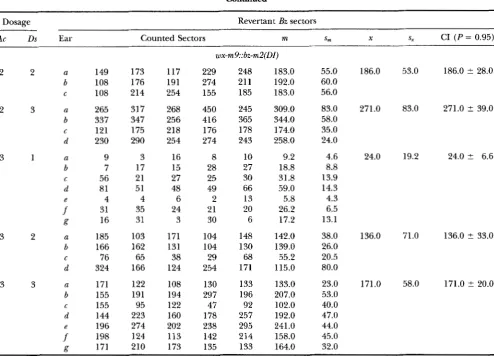
Number of revertant Wx sectors with increasing doses of mrn9Ds
Dosage Revertant Wx sectors
Ac Ds Ear Counted sectors X s, CI ( P = 0.95)
56.0 21.0 56.0 ? 22.0
1 1 a 41
b 50
c 82
1 2 a 103
b 52
C 39
1 3 a 227
b 107
c 202
2 1 U 24
b 23
2 2 U 73
b 17
C 43
2 3 a 119
b 101
c 209
3 1 U 0
b 1
c 3
3 2 a 2
b 1
3 3 a 32
b 36
c 43
39 42 84
106 51 37
186 141 239
31 24
71 13 44
109 114 231
2 1 1
2 2
29 36 35
36.0 64.0 2 30.0 64.0"
34 32
184.0 51 .O 184.0 ? 53.0
29.4 ? 5.2
37.9 ? 17.3 39
34
74 13 43
106 107 206
0 2 3
2 3
30 30 39
35 25
29.4 6.2
17.3 37.9"
14 12
145.0 41.0 145.0 ? 41.0
0 0 3
0 4
29 33 36
0 2 3
0 0 0
4 4 2
0 0 0
2 3 5
35 43 41
29 47 47
40 44 38
1 0 4
1 4
44 47 34
1 1 1.5
1 0
4 4
0 2.1
1.5 1.5 ? 0.6
1.8
5.8
1.5 2 0.9
38.3 ? 2.2 40 44 38.3
47 40 40 40
Number of revertant sectors seen in lAc, 2Ac, and 3Ac inner endosperm of kernels carrying increasing doses of wx-m9Ds. Lower case letters designate individual kernels. The numbers behind each letter represent the number of total Wx sectors counted in individual sectors made from the same kernel. Sample averages x were calculated on the bases of the whole sample, except in cases marked by a. Other details are described in the legend for Table 2. CI, confidence intervals for p.
'' Corresponding groups (of individual sections) varied in size and thus the sample average was calculated from group averages.
age and bz-m2(DI) reversion could be measured in the presence of two doses of wx-m9, considerable deviations from proportional values were found for one and three doses of the allele.
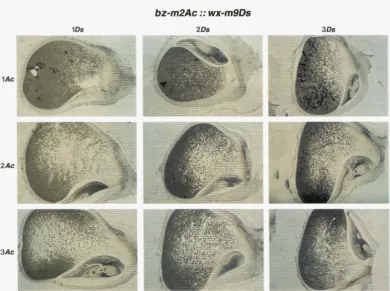
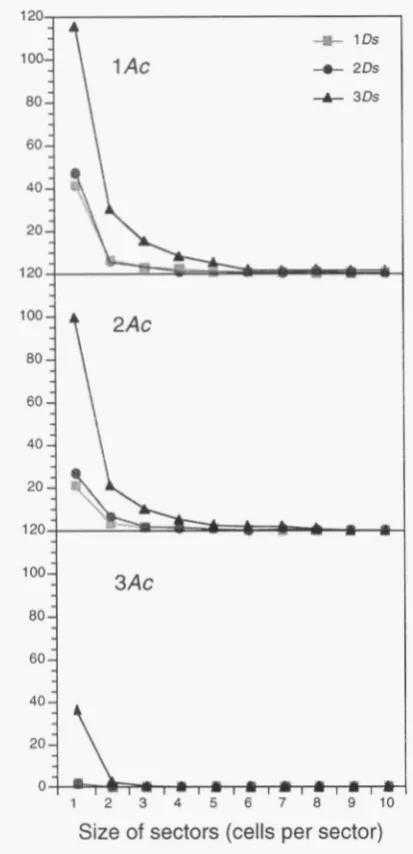
In another set of genetic experiments, the effect of Ds dosage on Ds excision frequency was analyzed by monitoring the variegated Waxy phenotypes of kernels that carried increasing doses of wx-m9Ds allele in the presence of constant doses of bz-m2 as the transactivat- ing allele. The revertant W x sectors were visualized at 30 DAP by staining endosperm sections with iodine. As is shown in Figure 4, the number of iodine-stained sec- tors increased only weakly when the number of wx-rn9Ds alleles was increased from two to three copies. In con- trast, a much stronger increase was seen when
Ds
dosage was increased from two to three copies. This remarkable behavior of Ds was seen with either one, two, or three1860 M. Heinlein
I
L
bz-m2Ac
::wx-rn9Ds
2Ds
FIGURE 4.-Dosage-specif1c mobilization of Ds from the wx-rn9Ds allele by one, two or three doses of bz-m2 harboring Ac. The number of Wx revertant sectors did not increase in proportion to the increase in the genomic dosage of the wxm9Ds allele. Sections of kernels were stained with iodine to visualize wild-type starch containing cell clones. The number of Wx revertant
sectors increased only slightly if the number of wx-m9Ds alleles was increased from one to two, but showed a dramatic increase if the dosage of this ⪙ w& Eurther increased to three copies.
Table 3 displays the total numbers of sectors that were counted in the paraffin sections. The confidence inter- vals for p calculated for one, two and three doses of
wx-m9Ds
in
kernels with one dose of Ac are in the ranges of 30-80, of 30-90, and of 130-230, respectively. The intervals with two doses of bz-m2 are -24-34, 20-55,and 100-180, and with three doses of Ac -1-2, 1-3,
and 36-40, respectively. These numbers confirm the phenotypic observation described above that at all Ac dosage levels, the number of wx-m9Ds + Wx reversion
events did not or only weakly increase by an increase
in
wxm9Ds dosage from one copy to two copies, but increased strongly when the dosage of the reporter al- lele was increased from two to three copies. With twodoses of Ds, the number of sectors was less than twice
as high as the number of sectors seen with one dose of the allele. In contrast, the number of iodine stained sectors in kernels with three
Ds
copies was more than proportional higher than in kernels with two Ds copies. With three copies, the number of sectors was even higher than the total number of sectors obtained with one and two copies.Comparison. of the activity of different mutable
al-
leles in the presence of the same V a s e source: It was shown earlier that two different elements usually are not mobilized simultaneously in the same cell (HEIN-
LEIN and STARLINGER 1991). One idea to explain this observation is to propose a low availability of trans- acting factors (including TPase), which manifests a low probability of setting up active transposition com- plexes. But, could the TPase substrates play a role by themselves? Could they differentially act in cis and differ in their responsiveness to specific TPase levels in the cells? As one approach to answer this question, the activity patterns of different TPase substrate ele- ments were compared. The kernel shown in Figure 6
has the genotype C sh bz-m2/C sh bz-m2/C-I sh-m5933 bz-m2. The TPase encoded by the Ac element in bz- m2 is required for excision of Ac itself as well as for transactivation of the “double-Ds” structure present in the sh-m5933 allele. In case of sh-m5933, Ac causes chromosome breakage at the site of the element re- sulting in the loss of the chromosome fragment car- rying the distally located C1-lallele. Sectors generated by this loss are colored since the wild-type C1 gene on the homologous chromosome is expressed (DORING
Ac and Ds Activity in Maize 1861
40
20
1 20
100-
3Ac
80
-
60
-
40
-
20
-
0 - " I * .I
- l - l - l = l l h - l m
I 2 3 4 5 6 7 8 9 1 0
Size of sectors (cells per sector)
FIGURE 5.-In the presence of the bz-m2 allele the number of Ds excisions from the wx-m9Ds allele did not increase in proportion to an increase in the number of Ds alleles. A small increase in the number of Ds excisions that was seen upon an increase in the dosage of Ds from one to two copies was followed by a dramatic increase upon further increase in Ds dosage to three copies. The number of revertant Wx sectors seen in iodine-stained kernel sections were counted for each sector size separately. The effect of increasing Ds dosage on Ds excision frequency was the same with all sector sizes and thus appears to be independent on the developmental state of the kernel. The effect was the same also regardless of whether one, two or three doses of the transactivating bz-m2
allele were present.
resulted in bronze-colored breakage sectors. The small size of the wild-type pigmented sectors shows that Ac excision occurred much later during develop- ment at a time when
Ds
transactivation must have ceased, because bronze-colored sectors of equal size are not present. This phenotype confirms that Ac-de- pendent events do not occur simultaneously in theFIGURE 6.-Different timing of mobilization of two differ- ent elements in the presence of the same TPase source. The genotype of the kernel is C sh bz-m2/ C sh bz-m2/ GI sh-m5933 bz-m2. The bzm2 allele contains Ac and the sh-m5933 allele harbors a composite double-Ds element. The kernel is color- less over most areas since the sh-m5933 allele is linked to the distally located Cl-I allele; this prevents aleurone color formation. The large bronze colored sectors originated from chromosome breakage events that were induced during early development at the site of insertion of the double-Ds element by the action of Ac. These events led to loss of the distally located inhibitory C1-Z allele and thus subsequently allowed the formation of pigments. Wild-type anthocyanin accumula- tion was precluded, however, as long as the Ac element resided in the Bronze gene. Wild-type sectors are consistently small indicating that excision of Ac from bz-m2 occurred much later during development than chromosome breakage at sh-m5933.
The early events at the sh-m5933 locus prove that during early development TPase was expressed. Apparently, this early activ- ity was not sufficient to induce excision of Ac from bz-m2. As
indicated by small wild-type colored sectors, excision of Ac ocurred much later during development at a time when chre mosome breakage no longer occured. Neither small bronze- colored nor small wild-typecolored sectors were seen on the kernels.
1862 M. Heinlein
1 Ac9 2Ac9 1Ac7 2Ac7
self
I
bz-mZ(DI)
G I
sh-m5933
llir
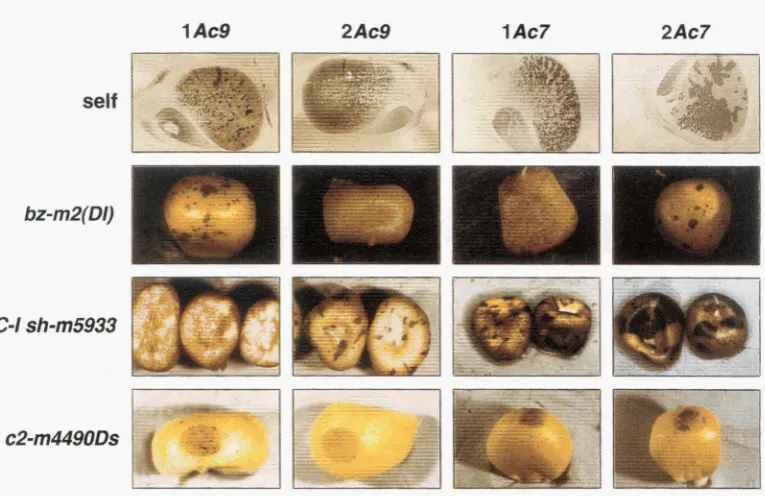
FIGURE 7.-Patterns of mobilization of Ac (“self”) and DS elements from different alleles in the presence of one or two doses of wx-m7 and wx-m9, respectively. Except for “self” phenotypes, crosses were performed between Ac strains and Ds strains. Accordingly, the “bz-m2(DI)”, the “ G I sh-m5933l” and the “c2-m4490Ds” kernels with one and two copies of Ac carried two and one copies of the Ds allele, respectively.
“self ’: Patterns of Ac excision from wx-m7 and wx-m9; self/lAc9: wx/wx/wx-m9; self/2Ac9: wx-m9/wx-m9/wx, self/lAc7 wx/ wx/wx-m? and self/2Ac7 wx-m7/wx-m7/wx. Pamflk-embedded kernels were sectioned and stained with iodine.
“bz-m2(DI)”: transactivation of Ds in the bz-m2(DI) allele; bz-m2(DI)/lAc9: bz-m2(DI) wx/bi-m2(DI) wx/bz wx-rn9: bz-m2(DI)/2Ac9: bz wx-m9/bz wx-m9/bz-m2(DI) wx, bz-m2(DI)/1Ac7 bz-m2(DI) wx/bz-m2(DI) wx/bz wx-m? and bz-m2(DI)/2Ac7: bz wx-m7/bz wx-m7/ bz-m2(DI) wx. When filed and stained with iodine, the kernels showed the Ac allele- and Ac dosage-specific wx + W x variegation
patterns (seen in line “self’) in the inner endosperm (data not shown). " CIsh-m5933": transinduction of chromosome breakage events at the site of the Ds insertion in sh-m5933 (see legend to Figure 6).
G I sh-m5933/ 1Ac9: Cl-I sh-m5933 Bz Wx/ C1-I sh-m5933 Bz Wx/ C sh bz wxm9: G I sh-m5933/2Ac9: C sh bz wx-m9/ C sh bz wx-m9/ C1-I sh-m5933 Bz Wx, G I sh-m5933/1Ac7: Cl-I sh-m5933 Bz Wx/Cl-I sh-m5933 Bz Wx/C sh bz wx-m7; and G I sh-m5933/2Ac7: C sh bz wx-m7/C sh bz wx-m7/Cl-I sh-m5933 Bz Wx. The red pigment present in the aleurone of kernels carrying one copy of wx-m9 was caused by a stable pallele segregating in the material. The colored/bronze twinned character of the larger sectors originated from the breakage-fusion-bridge cycle that was induced following the initial chromosome breakage event (MCCLINTOCK 1953, 1956; PETERSON 1987). Somatic changes in Ac dosage are responsible for larger colorless sectors on kernels with one dose of Ac as well as for areas displaying the one dose of Ac chromosome breakage pattern on kernels with two copies of Ac.
“c2-m4490Ds”: mobilization of Ds from the c2-m4490 allele. Kernels were filed and stained with iodine to expose the variegation patterns of wx-m9and wx-m7in the inner endosperm. These were the same as those seen in the stained kernel sections displayed in the upper row (“self”). The excision activity of the Ds element does not correlate with Ac excision activity. c2-m4490Ds/lAc9: c2-m4490Ds, wx/c2-m449ODs, wx/c2, wx-m.4: c2-m449ODs/2Ac9: c2, wx-m9/c2, wx-m9/c2-m4490Ds, wx, c2-m4490Ds/lAc7 c2-m4490Ds, wx/c2-m449ODs, wx/c2, wx-m? and c2-m4490Ds/2Ac7: c2, wx-m7/c2, wx-m7/c2-m4490Ds, wx.
time, as Ac transposition occurred. The absence of small bz sectors rather suggests that late breakage events did not occur during late development when the TPase was highly active.
Differences in transactivation patterns of Ds elements were also seen among bz-m2(DI), Cl-I sh-m5933 and c2- m449ODs in the presence of one or two doses of wx-m7 and wx-m9, respectively (Figure
7). Whereas the pat-
terns of excision of Ds from the bz-m2(DI) allele were quite similar to the self-excision patterns of Ac, devia- tions from the Ac dosage-specific phenotype were seen with G I shm5933 and cZrn4490Ds. The Ac dosage-spe- cific chromosome breakage patterns of sh-m5933 were reminiscent of the Ac dosage-specific excision patternsof bz-m2(DI). However, the number of early events in-
duced at sh-m5933 clearly exceeded the number of early events that occurred at bz-m2(DI); even much larger sec- tors were seen. While these differences might be due to the overall higher frequency of events at sh-m5933 that lead to a visible phenotype, these differences might
also suggest that during early development the double Ds element present in sh-m5933 is more efficiently trans- activated than the Ds element in bz-m2(DI).
Ac and Ds Activity in Maize 1863
staining of the inner endosperm of the kernels. To the contrary, marked differences in sizes between C2 and Wx sectors were visualized in these kernels. Moreover, unlike the other Ds reporter alleles, the c2-m4490Ds allele showed almost identical transactivation patterns regardless whether wx-m7 or wx-m9was the transactivat- ing allele. The nature of the unusual low frequency and late timing of reversion events of c2-m4490Ds is unknown. The lack of large sectors could be explained by a low frequency of Ds excision events that lead to restoration of a functional C2 allele. However, it seems remarkable that late during development, when the probability of reversions is increased by a higher cell number and revertant sectors are actually being formed, the number of c2-m4490Ds ”* C2 reversions
does not correspond to the rate of Ac activity at this time. On kernels with one dose of wx-m7, which is highly active during late development, the number of small C2 sectors is expected to be higher than on kernels with one dose of wx-m9, which has a low activity during late development. However, no such correlation be- tween Ac activity and Ds reversion frequency was ob- served.
DISCUSSION
This study investigated the variegation patterns on maize kernels to gain information about the trans and &acting determinants by which the Ac/Ds system is controlled.
While several independent transposable element sys- tems in Drosophila as well as in bacteria keep control of transposition by exploiting either two promoters, translational frameshifts, or a splicing anomaly to syn- thesize an inhibitory molecule along with the TPase from the same gene (SIMONS and QECKNER 1988; ROE
ERTSON and ENCELS 1989; SEKINE and OHTSUBO 1989; MISRA and RIO 1990; ESCOUBAS et al. 1991), the Ac/Ds system appears to use only one protein, which is the Ac- encoded TPase (KUNZE et al. 1987; COUPLAND et al. 1988; HOUBA-HERIN et al. 1990; FUSSWINKEL et al. 1991). Therefore, the Ac allele- and Ac dosage-specific trans effects of Ac are probably caused by specific levels of active TPase in the cells. However, my observations sug- gest that Ac or Ds elements may react in different ways in the presence of given TPase levels providing evidence for the possibility that transposition is not exclusively controlled by the availability of active transacting TPase molecules. Rather, I surmise that the transactivity of Ac in a cell is interpreted in cis at the site of the element to be excised, namely by effects, which in the presence of a given amount of active TPase, determine (or influ- ence) the capability of a particular Ac or Ds element to serve as an excision substrate.
w m 9 and m m 7 differ in trans-effects: A previous analysis showed that the different patterns of Ds
sion from the br-m2(DZ) allele that are seen in the pres- ence of wx-m7 and wx-m9 are caused by the presence of the Ac alleles themselves and not by the products of trans-acting modifier genes (HEINLEIN 1995). The specific variegation phenotypes that are displayed by heterozygous wx-m7/ wx-m7/ wx-m9 and wx-m9/ wx-m9/ wx-m7 kernels established that wx-m7 and wx-m9 indeed exert unique transeffects during development. I pro- pose that the Ac alleles express different amounts of active TPase during kernel development and that the phenotypes of the heterozygotes result from the total level of active TPase made by both Ac alleles. This hy- pothesis is depicted in the model shown in Figure 8, which describes one possibility of how Ac allele- and Ac dosage-specific TPase levels in the cells might deter- mine the specific TPase activities during development that are registered as specific patterns of large and small bz-m2(DI) + Bz aleurone sectors. Basically, this model
consists of three components: wx-m7 and wx-m9 express different TPase levels during development, the level of TPase produced in the cells is proportional to Ac dos- age, and high levels of TPase reduce TPase activity and inhibit transposition.
M. Heinlein
wx-m7
wx-m9
early late
early late
2 Ac7
1 Ac9
+
1
2 Ac7
1 Ac9
+
1
’
1 2 3 3
1 2 3 3
-
‘.
””-
1 2 3
3
wx-m7
2 Ac7-
+
1 Ac9
2 Ac9
1 Ac7
+
1
2 Ac9
1 Ac7
+
I
inhibition
low activity
1 .
high activityI
low a c t i v i t y
1 2 3
3
1 2 3
3
Ac dosage
1 2 3
-
3
Ac dosage
wx-m9
2 Ac9+
1 Ac7
FIWRE 8.-Model to explain the different i,z-m2(DI) variegation phenotypes seen with one, two and three doses of Ac alleles rox-m7 and rc~x-rn9. Consideration is confined to large and small sectors that are indicative of early and late excision even&, respectively. Very small sectors sectors indicating very late events are not considered. The generalized phenotypes of kernels with different doses of r w m 7 and wx-m9 and also of kernels that are heterozygous for the two alleles (“2Ac7
+
1Ac9” = 7ux-~ ~ / z I J x - ~ ~ / ~ I J x - ~ ~ “1Ac9
+
2Ac7” = rt~x-m9/rc~x-m9/rux-m7) are shown at the bottom of the figure (A). According to the occurrence of small- and large-sized sectors, these phenovpes are dissected into their component “early” and ‘‘late’’ phenotypes (B) which are separately considered further (C). The “early” and ‘‘late’’ Ac allele- and Ac dosage-specific variegation patterns are consistent with the following assumptions (with one exception-for rt~x-m9/rt~x-m9/rt~x-m7--see DISCVSSION): the amount of TPase expressed from Ac is positively correlated with Ac dosage; the level of TPase expressed from Ac changes during development; during development, the amount of TPase expressed from rox-rn7 does increase, whereas TPase expression from rux-m9 does decrease; and finally, transposition activity is inhibited at higher TPase expression levels; thus, with increasing levels of TPase expression the activity of the protein first increases and then decreases (as is illustrated by the gradient in the figure).carrying one r w m 7 allele suggest that
m”m7
expresses ment. Thus, the number of small sectors is expected toAc and Ds Activity in Maize 1865
In contrast to kernels carrying one dose of wx-m7, ker- nels carrying one copy of wx-m9 exhibit a higher num- ber of larger sectors and a lower number of small sec- tors, suggesting that during early development wx-m9
encodes a higher TPase activity than wx-m7, whereas during late development, the TPase activity provided by wx-m9 is lower than the TPase activity provided by
wx-m 7.
The exact in uivo levels of TPase mRNA and protein expressed by wx-m7 and wx-m9 are not known and still need to be determined. However, it has been shown that at 20 days after pollination the amount of Ac pro- tein present in the developing wx-m7 endosperm de- pends roughly proportionally on the Ac copy number (FUSSWINKEL et al. 1991). It is assumed in the model shown in Figure 8 that both Ac alleles produce specific TPase levels that linearly increase with increasing dos- age of the allele.
The variegation patterns are consistent with the hy- pothesis that high levels of TPase expression inhibit transposition as was suggested by SCOFIELD et al. (1993). The patterns indicate that at times when the activity of one copy of Ac is low, an increase in Ac dosage causes a positive effect on Ds excision frequency. At the times during development at which an Ac allele is highly ac- tive with one dose, however, an increase in Ac dosage has a negative effect on Ds excisions. For example, dur- ing early development when the TPase activity provided by one dose of wx-m7 is relatively low TPase activity is increased by increasing the dosage of the allele. In contrast, during late development, when the TPase ac- tivity expressed by one dose of wx-m7 is relatively high, an increase in the dosage of the allele leads to inhibi- tion of TPase activity. The model illustrates that during early development the TPase level remains below the inhibitory threshold even if two and three doses of the allele are present and TPase activity increases rather than decreases with higher dosage. During late develop- ment, however, an increase in the dosage of the allele leads to TPase levels above the threshold and transposi- tions are inhibited. The existence of an inhibition threshold is also supported by the bz-m2(DI) variegation patterns seen in the presence of wx-m9. During early development, when several Ds exision events occur with one dose, an increase in wx-m9 dosage leads to inhibi- tion of Ds excision events. This allele has a positive dosage effect during late development, however, when TPase activity of one dose of wx-m9is relatively low. The phenotype of the wx-m7/wx-m7/wx-m9 heterozygote provides further support. As described above, one copy of wx-m7 is not very active during early development and presumably expresses low TPase levels. Thus, TPase activity is increased with two copies of the allele and transpositions are not inhibited even in the presence of three doses of wx-m7. However, replacement of the third dose of wx-m7 with one dose of the more highly
active wx-m9 allele causes complete inhibition, presum- ably because a higher level of TPase produced by wx- m9 causes the total TPase level to exceed the critical threshold.
In summary, the model predicts that an increase in Ac dosage may lead either to an increase or to a decrease in excision frequency, dependent on whether the Ac all- ele- and Ac dosage-specific level of TPase expression remains below or exceeds the proposed inhibitory threshold. The model proposes that with increasing TPase concentrations the transposition activity goes through a maximum: a certain optimal TPase concen- tration causes the highest possible excision frequency whereas any other TPase concentration is suboptimal for transposition and causes a lower excision frequency. Several possible mechanisms have been suggested to explain negative dosage effects of Ac, including TPase titration by a limiting host factor (HEINLEIN and STAR-
LINGER 1991) and TPase aggregation (HEINLEIN et al. 1994). Positive effects of increasing Ac dosage may oc- cur with TPase concentrations remaining below the threshold at which the inhibitory mechanism becomes effective.
The model as shown in Figure 8, however, shows inconsistencies. For example, in the heterozygotic ker- nels as well as in kernels with three doses of the wx- m9 allele, late excision events occur even though the depicted level of TPase in the cells is above the critical threshold. This might be explained by an additional assumption that the inhibitory mechanism is leaky and only decreases the probability of transpositions. Thus, a low probability may prevent reversion events during early development when cell number is low but may result in the formation of revertant sectors during late development, when cell number is high. However, in the case of late sectors seen with three doses of wx-m9,