Study and Analysis of Discovering and
Exploring the Use of Evolutionary Approaches
in Computer Networks
Dr.M.Umamaheswari
1, S.S.Riaz Ahamed
2Professor, Depart ment of IT, RRase College of Engineering, Chennai, TN, India1
Sathak Institute of Technology, Ramanathapuram, TN, India2
ABSTRACT: Evolution says that you ought to dependably have some solutions to a problem, called population, and
then attempt to make that population better and better. Eventually you will discover a solution that is good enough for you, or you have effectively done loads of endeavors. At that stage determination of best individual solution, will end the solution. In this manner at every point in time, amid problem solving, a solution is accessible. This is known as the at whatever time conduct of an evolutionary algorithm. By and large the starting population with the beginning solutions is created aimlessly. An evolutionary algorithm usually soon gives pretty good solutions. Met heuristic methods broadly fall inside stochastic optimization methods. Transformative computation is a sub-field of the meta-heuristic methods that tail some regular wonders (Genetic legacy and Darwinian take a stab at survival) in search process. Evolutionary computation utilizes iterative progress for growth in a populace utilizing parallel processing to reach on ideal arrangement. Writing mirrors that artificial intelligence and delicate computing has contributed in a ton of exercises for development. One of such devices of soft computing is evolutionary algorithms. As comparative to other worldwide optimization techniques evolutionary approach gives some key elements like populace based aggregate learning process, self-adjustment, parallelism and power. Evolutionary algorithms space incorporates genetic algorithms, evolution strategies, evolutionary programming, and genetic programming. All these techniques share a typical theoretical base of reenacting the development of individual structures through processes of choice, hybrid and transformation. Contrasted with other worldwide optimization techniques, transformative calculations (EA) are anything but difficult to implement and all the time they give adequate solutions. The Internet is the biggest and most popular packet switched network. Bundle switched networks transfer information between indicated goals according to the need of client or an application. Steering of activity to coveted goal is most critical capacity performed by parcel switched networks. The topology design and steering assumes a noteworthy part in productive network design.
KEYWORDS: Dynamic Routing Protocol, Evolutionary Computation, Genetic Algorithms
I. INTRODUCTION
upon virtually every aspect of computing. Therefore, better and more reliable network configurations are needed to meet the fault tolerance and efficiency requirements of computer networks. A network that is designed with special attention to these efficiency factors will generally provide better throughput, is less costly, and is easier to manage. The Internet is the largest and most popular packet switched network. Packet switched networks transfer information between specified destinations as per the need of user or an application. Routing of traffic to desired destination is most important function performed by packet switched networks. The topology design and routing plays a major role in efficient network design.
II. TCP/IP PROTOCOL STACK ARCHITECTURE
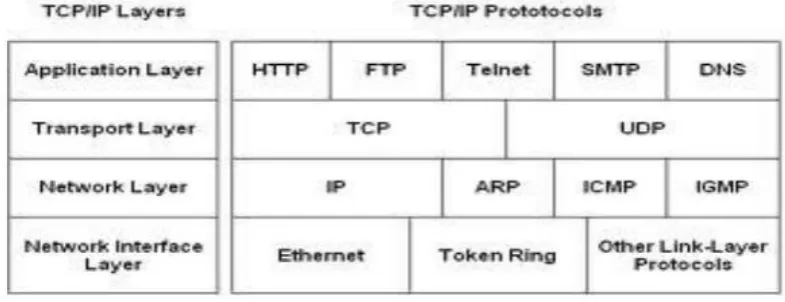
The IP architectural model can be classified into the following layers: the network interface, the IP layer, the transport layer, and the application layer. It can be easily observed that it does not exactly map into the seven-layer OSI reference model. Actual applications are considered on the top of the application layer, although the IP model does not strictly follow layering boundaries as in the OSI reference model. For example, it allows an application to be built without using a transport layer; ping is such an example. It is discussed earlier that IP includes both the destination and the source address – this is accomplished through a header part in the IP packet that also contains additional information. The IP model does not explicitly declare how the layer below the IP layer needs to be; this part is simply referred to as the network interface that can support IP. Figure 1.1 shows the major protocols of TCP/IP architecture.
Figure 1.1: Protocol Layering in IP Architecture
Dynamic Routing Protocols
A dynamic routing protocol is a set of processes, algorithms, and messages that are used to exchange routing information and populate the routing table with best paths chosen by the routing protocol. The purpose of a routing protocol includes (Rick and Allan 2007):
Discovering remote networks
Maintaining up-to-date routing information
Choosing the best path to destination networks
Having the ability to find a new best path if the current path is no longer available
There are basically three components that define a dynamic routing protocol:
i. Data structures: Some routing protocols use tables or databases for their operations. The date structure is kept in RAM for processing.
ii. Algorithm: It is a finite list of steps used to complete a task. Routing protocols use algorithms for processing routing information and for best-path determination.
To cope up the needs and maintain good performance the routing protocols need continuous optimization in terms of reducing the size of routing table and better routing algorithm.
Evolution of Dynamic Routing Protocols
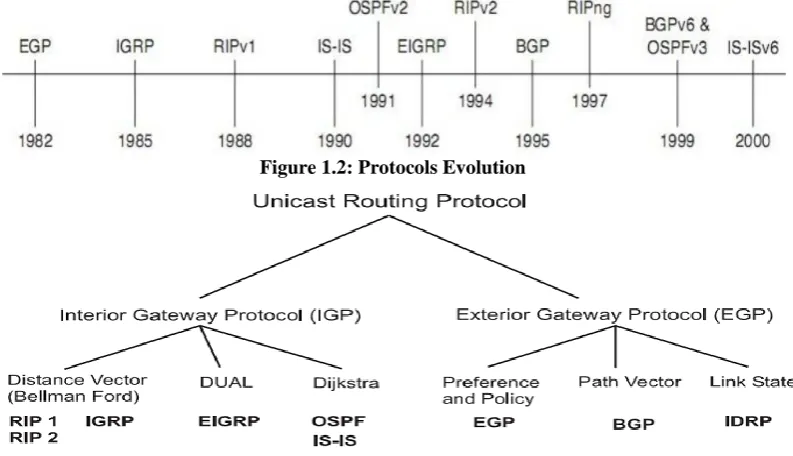
Dynamic routing protocols have been used in networks since the early 1980s. An overview of routing protocols evolution and IP routing strategies is given below in figure 1.2 and figure 1.3 respectively.
Figure 1.2: Protocols Evolution
Figure 1.3: Unicast Routing Protocols
The first version of Routing Information Protocol (RIP) was released in 1982, but some of the basic algorithms within the protocol were used on the ARPANET as early as 1969. As networks have evolved and become more complex, new routing protocols have emerged (Rick and Allan 2007).
Characteristics based Classification of Dynamic Routing Protocols
The classification is carried out on basis of the domain where protocol can be implemented, the algorithm it uses and the addressing scheme it uses to locate a host or entity in network. Table 1.1 shows the classification of routing protocols.
Interior Gateway Protocols (IGP) or Exterior Gateway Protocols (EGP)
Distance vector or Link-state
Classful or Classless
Classful and Classless Routing Protocols
All routing protocols can also be classified as either a) Classful routing protocols or
b) Classless routing protocols
a) Classful Routing Protocols: Classful routing protocols do not send subnet mask information in routing updates. The
first routing protocols, such as RIP, were classful. This was at a time when network addresses were allocated based on classes: Class A, B, or C. A routing protocol did not need to include the subnet mask in the routing update because the network mask could be determined based on the first octet of the network address. Classful routing protocols can still be used in some of today’s networks, but because they do not include the subnet mask, they cannot be used in all situations. Classful routing protocols cannot be used when a network is submitted using more than one subnet mask. In other words, classful routing protocols do not support variable-length subnet masks (VLSM). There are other limitations to classful routing protocols, including their inability to support discontinuous networks. Classful routing protocols include RIPv1 and IGRP.
b) Classless Routing Protocols: Classless routing protocols include the subnet mask with the network address in routing
updates. Today’s networks are no longer allocated based on classes, and the subnet mask cannot be determined by the value of the first octet. Classless routing protocols are required in most networks today because of their support for VLSM, discontinuous networks, and other features. Classless routing protocols are RIPv2, EIGRP, OSPF, IS-IS, and BGP.
All Intra-domain and Inter-domain protocols (Cisco 2011) are summarized as shown in table 1.2 and table 1.3:
Table 1.2: Characteristics of IP Routing Protocols
Operation of Dynamic Routing Protocol
The general strategy of all routing algorithms is same: to learn about remote networks and to quickly adapt whenever there is a change in the topology. To accomplish this, routing protocol depends upon its operational characteristics and the algorithm it uses. The operations of a dynamic routing protocol vary depending on the type of routing protocol and the specific operations of that routing protocol. In general, the operations of a dynamic routing protocol can be described as follows (Rick and Allan 2007):
The router sends and receives routing messages on its interfaces.
The router shares routing messages and routing information with other routers that are using the same routing
protocol.
Routers exchange routing information to learn about remote networks.
When a router detects a topology change, the routing protocol can advertise this change to other routers.
Evolutionary Computation (EC)
Metaheuristic methods broadly fall within stochastic optimization methods. Evolutionary computation is a sub-field of the meta-heuristic methods that follow some natural phenomena (Genetic inheritance and Darwinian strive for survival) in search process. Evolutionary computation (Wikipedia 2011) uses iterative progress for growth in a population using parallel processing to reach on optimum solution. Literature reflects that artificial intelligence and soft computing has contributed in a lot of activities for improvement. One of such tools of soft computing is evolutionary algorithms (Zelinka 2011). As comparative to other global optimization techniques evolutionary approach provides some key features like population-based collective learning process, self-adaptation, parallelism and robustness. Evolutionary algorithms domain includes genetic algorithms, evolution strategies, evolutionary programming, and genetic programming. All these techniques share a common conceptual base of simulating the evolution of individual structures via processes of selection, crossover and mutation. Compared to other global optimization techniques, evolutionary algorithms (EA) are easy to implement and very often they provide adequate solutions.
Evolutionary Computing
Evolution says that you should always have some solutions to a problem, called population, and then try to make that population better and better. At some point you will find a solution that is good enough for you, or you have already done lots of attempts. At that stage selection of best individual solution, will end the solution. Therefore at each point in time, during problem solving, a solution is available. This is called the anytime behavior of an evolutionary algorithm. Generally the starting population with the starting solutions is generated at random. An evolutionary algorithm usually soon gives pretty good solutions.
III. LITERATURE REVIEW
IV. ROUTING USING ADAPTIVE GENETIC ALGORITHMS
To identify the optimal route is a complex task in parcel switched network in light of the fact that optimization depends upon a number of parameters. This section demonstrates the utilization of Genetic Algorithm to find the optimal route. Genetic Algorithm begins with various arrangements where every arrangement is spoken to as chromosome utilizing the stage encoding plan. The achievement of Genetic Algorithm relies on the quantity of operators such as selection, mutation and hybrid. Obviously hybrid is generally imaginative. In this work hybrid operators proposed in particular 1-point, 2-1-point, and versatile, have been customized according to the need of computer network. The wellness of each solution is evaluated in terms of historical reliability component, hub achievement/disappointment and postponement. The execution of the proposed approach has been contrasted and Dijkstra Algorithm and improvement has been watched. Telecommunications networks technologies are growing faster and turning out to be more complex to handle distinctive sorts of physical traffic. Today computer networks have application in different spaces like business, instruction, look into, Industry, e-business and numerous others. Network based applications are turning out to be more famous and simple to use with the growth of Internet & development of new technologies and principles. In Data communication networks, for example, the Internet and the Mobile Ad-hoc Networks, routing is one of the most important regions that have a significant impact on congestion and network’s performance. Research of the routing strategy is turning into the key hypothetical theme of the new generation network architecture. The development of internet base applications’, for example, on line shopping, Video on request, video conferencing, on line managing an account, e-ticket booking, stock exchange and other genuine time applications has produced new requirements for coordinated and one-to-numerous dependable and time efficient communications. A perfect routing algorithm ought to endeavor to discover an optimum path for parcel transmission within a predetermined time in order to fulfill the Quality of Service. For Shortest path issue there are number of pursuit calculations, for example, Bellman–Ford calculation, the Dijkstra algorithm and so on to give some examples (Stalling 1998). A number of these algorithms locate the briefest way considering bounce tally/least cost measures. They exhibit unacceptably high computational complexity for communication involving quickly changing network topologies and involvement of other steering measurements like way unwavering quality, delay, data transmission and so forth for computation of optimal path from source to destination. The choice of courses in huge scale computer communication networks is amazingly complex network optimization problems. Such issues have a place with the class of nonlinear combinatorial optimization problems the majority of which are NP-hard. The problem can be detailed as finding an insignificant cost way with more prominent way wellness that contains the designated destination and source nodes. The Shortest and reliable Path routing problem is a Classical combinatorial optimization problem. Evolutionary algorithms, for example, genetic algorithms, neural networks, subterranean insect colony optimization and so forth guarantee the solution for such issues, as these have been utilized successful in numerous practical applications.
V. ROUTING TECHNIQUE USING PERSONALIZED GENETIC ALGORITHMS
destination. The network operator allocates the link weights. The lower the weight, the more noteworthy the possibility that movement will get steered on that connection. When one sends or gets information over the Internet, the information is partitioned into little pieces called bundles or datagram. Every parcel has a header, which contains the fundamental transmission information, for example, the goal Internet Protocol (IP) address. The information bundles are sent along connections between routers on Internet. Once an information bundle achieves a switch, the incoming datagram's are put away in a line for further processing. The router decides the best way to forward the bundle to achieve its final destination, by utilizing the IP destination address of the datagram header. Routing algorithms can be classified into two types:
Adaptive routing algorithm
Non-adaptive routing algorithm
Non-versatile algorithms perform steering without the impact of current network traffic and topology. In this routing algorithm, the routing decision happens when network opens. This sort of routing is additionally called as static routing. In adaptive routing calculation, the routing changes as indicated by topology and activity. Adaptive algorithms contrast by where they get information, when they make routing modification and what they use as a metric. This kind of routing algorithm is likewise called as dynamic routing. Different metrics are utilized by the routing algorithms to find the most suitable path. More than one metric can be utilized by complex routing algorithm and they can consolidate them for improving routing decision. The separation, security, time, bandwidth and communication cost can be utilized as different metrics in computer networks.
Distribution of stack on a few existing ways in communication network from the source to a goal is not appropriate in all circumstances. An investigation has uncovered that the enactment of the unequal distribution of the heap of quick uneven lines at the speediest line is bringing about postponements in administration going through the moderate line (Peter et al. 2010). At the point when attempting to gauge the unwavering quality in a computer network it is not sufficiently just to realize that a way exists between a given source destination pair, it is necessary to display the amount of the required movement can be exactly transferred from the source to the destination. The disappointment of a path between two hubs that have a heavier activity between them is too harmful for network performance.
VI. EXPERIMENTAL RESULTS
This section details the experimentation and performance evaluation of the MPGA technique. To illustrate the proposed work consider the example communication network with 15 nodes shown in figure. The maintenance management system of the distribution network maintains the reliability statistics, delay as well as the node failure status statistics for the analysis purpose. The technique uses assumed historical reliability factor, assumed node success/failure status and randomly generated delay.
Reliable and Optimum Path
The performance of the MPGA technique is evaluated in the static environment with the same source node and destination node and its fitness is analyzed using different crossover methods with the Dijkstra algorithm. Comparison is made using delay component in fitness function as well as without delay component in fitness function with different crossover methods. The MPGA technique is evaluated for dynamic environment by determining the path with dynamically varying reliability factors. Figure shows the optimum path.
Crossovers Fitness Comparisons
Performance Comparisons
Figure (a): Convergence Graph
Figure (b): Convergence Graph
VII. CONCLUSION
Evolutionary computation follows some natural phenomena (Genetic inheritance and Darwinian strive for survival) in search process. It uses iterative progress for growth in a population using parallel processing to reach on optimum solution. Evolutionary algorithms domain includes genetic algorithms, evolutionary programming, and genetic programming. All these techniques share a common conceptual base of simulating the evolution of individual structures via processes of selection, crossover and mutation. Compared to other global optimization techniques, evolutionary algorithms (EA) are easy to implement and very often they provide adequate solutions. Evolutionary Computation has many uses in the world of telecommunications i.e. locating antennas, networks designing, routing in data networks, and all kinds of other combinatorial optimization problems. Telecommunications is one of the most active application areas of Evolutionary computation.
REFERENCES
1. Hadi, R. 2011. Computer network optimization. John Wiley & Sons, Inc. WIREs Comp Stat 2011 3 34–46 DOI: 10.1002/wics.135, V o l u m e 3, January/February 2011,
2. David, H., Matthias, H., Michael, M. and Christian, S. 2010. Optimizing unique shortest paths for resilient routing and fast reroute in IP-based networks. IEEE, 12th IEEE/IF IP Network Operations and Management Symposium (NOMS2010), Osaka, Japan, pp. 309- 316.
3. Chitra, C. and Subbaraj, P. 2010. A Non-dominated sorting genetic algorithm for shortest path routing problem. International journal of computer science, 5(1):55-63.
4. Yousra, A.F. 2010. Routing using GA for large networks.Diyala journal of Engineering Sciences, 3(2):53 -70.
6. Chaudhary, A. and Pandey, N.K. 2011. Genetic algorithm for shortest path in packet switched networks. Journal of Theoretical and Applied Information Technology, 29(2):107-117.
7. Gihan, N. and Wahied G.A. 2010. Network routing protocol using genetic algorithms.International Journal of Electrical & Computer Sciences IJECS-IJENS, 10(2).
8. Kumar, R. and Kumar M. 2012. A novel routing technique for computer network using personalized GA, International Journal of Computer Information Systems, Vol.4, No. 3.
9. Ehab, R.M., Ibrahim, E.Z., Mahmoud, I.A., and Ibrahim, M.E. 2010. Performance evaluation of Genetic algorithm for solving routing problem in communication networks. (IJCSIS) International Journal of Computer Science and Information Security, 8(3):37-43.
10. Bhaskaran, K., Joan T. and Vinod M.V. 2011. Dynamic anycast routing and wavelength assignment in WDM networks using ant colony optimization (ACO), proceedings IEEE ICC 2011.
11. Anon. 2011. Network topology. [Available at: http://networking.layer-x.com/p020000- 1.html], [Viewed on 27 Dec. 2013] 12. William, B. 2000. Distributed systems and Networks. The McGraw-Hill companies, pp. 189.
13. Jean-Yves, Boudec, L., Duda, A., Toutain, L. and Thiran P. 2011. Introduction to computer networking.[Available at: http://icapeople.epfl.ch/thiran/CoursED/Ch1_Intro.pdf], [Retrieved on 17 Dec. 2013].
14. Martin W. M., Kok-Keong L., Payam M., Paolo B. and Karl W. 1999. IP Network Design Guide, IBM Redbook.
15. Medhi D. and Ramasamy, K. 2007. Network Routing: Algorithms, Protocols, and Architectures, Morgan Kaufmann Publishers.
16. Moiz H.H. 2011. Introduction to routing basics and protocols, [Available at: www.swatijaininst.com/etechno/Introduction_to_routing.pdf], [Retrieved on 17 Dec. 2013]
17. Rick, G. and Allan, J. 2007. Routing Protocols and Concepts, CCNA Exploration Companion Guide. Series: Companion Guide, 1st edition, Pages 640, ISBN-10: 1-58713- 206-0, ISBN-13: 978-1-58713-206-3, Cisco Press.
18. Cisco, 2011. Routing protocols basics. [Available at: http://www.cisco.com/networkers/nw00/pres/2204.pdf], [Retrieved on: 7 Dec. 2013]. 19. Kumar, R. and Kumar M. 2010b. Intra-domain routing optimization in IP networks & genetic algorithm methodology.National conference on
Emerging Trends in information technology & computing (ETIC 2010), organized by department of IT/MCA at GITM Gurgaon, Sponsored by CSI.
20. Andres R., 2011. Operation research and optimization. [Available at: http://www.doi.icai.upcomillas.es/simio/transpa/s_mod1_ar.pdf], [Retrieved on 20 Dec. 2013]
21. New Age Publishers. 2011. Classical optimization techniques. [Available at: http://www.newagepublishers.com/samplechapter/000253.pdf], [Viewed on 25 Dec.2013]
22. Peter, K. 2005. Evolutionary Computing in Telecommunications-A likely EC success story.PhD Thesis.
23. Somasundaram, P., Lakshmiramanan, R., and Kuppusamy, K. 2005. Hybrid algorithm based on EP and LP for security constrained economic dispatch problem, Electric Power Systems Research, 76(1–3):77–85.
24. Sivanandam, S.N., and Deepa, S.N. 2008. Introduction to Genetic Algorithms, Springer.
25. VijayLakshmi, K. and Radhakrishnan, S. 2007. Hybrid genetic algorithm for dynamic QoS Routing for Real Time Applications. Proceedings of International Conference on Intelligent Systems and Networks (IISN), pp. 203-209.
26. Cuihong, H. 1997. Route selection and capacity assignment in computer communication networks based on genetic algorithm.In Proc. 1997 IEEE Intl. Conf. On Intelligent Processing Systems, Beijing, China, pp. 548-552.
27. Steanputtanagul, W., Tanterdtid, S., and Benjapolakul, W. 1997a. Optimizing ATM network throughput based on virtual path concept by using genetic algorithm. In Proc. of 1997 IEEE Intl. Conf. on Intelligent Processing Systems, Beijing, China, 1634-1639.
28. Markaki, M. Vasilakos, A. and Kassotakis, I.. 1997. A hybrid genetic algorithm for the provision of isochronous service in high speed networks, Proc. 1997 IEEE Intl. Conf. on Evolutionary Computation (ICEC'97), Indianapolis, Indiana, USA, pp. 133-137.
29. Leung, Y., Li G., and Xu, Z.B. 1998. A genetic algorithm for the multiple destination routing problems. IEEE Trans. Evol. Comput., 2:50-161. 30. Ravikumar, C.P. and Bajpai, R. 1998. Source-based delay-bounded multicasting in multimedia networks. Computer Communications,