Temperature Control for Plastic Extrusion
Process
Prabhat Kumar Mahto
1, Rajendra Murmu
2P.G. Student, Department of Electrical Engineering, BIT Sindri, Dhanbad, Jharkhand, India1
Assistant Professor, Department of Electrical Engineering, BIT Sindri, Dhanbad, Jharkhand, India2
ABSTRACT: This paper develops an ANFIS controller design method for temperature control in plastic extrusion system at different set point changes as well as sudden input disturbances controlled with different control techniques. The temperature of the plastic extrusion system has a wide range of variation subject to various disturbances. The system is generally non linear and so controlling the temperature is a tedious process, as it has multiple stages and the system is coupled with each other. The Plastic extrusion process uses first order transfer function. The four control techniques are traditionally PI, PID and two intelligent controller FUZZY and ANFIS. The tuning synchronizes the controller to the controlled variable and make the process to work at its desired operating condition. All four control method is simulated using Matlab/simulink. It has been concluded that ANFIS controller gives better performance than other three controllers.
KEYWORDS: PI controller, PID controller, Fuzzy Logic Controller, ANFIS Controller, Plastic Extrusion system, Matlab/Simulink, Ziegler’s Nichols tuning rules, Takagi-sugeno model.
I. INTRODUCTION
Now a day’s use of polymer materials has greatly increased over last few decades due to their many attractive properties such as ease of forming into complex shapes, light weight with high tensile/impact/tear strengths, high temperature resistance, high chemical resistance, high clarity, re-process ability and low cost. This has resulted in new industrial applications for polymer materials while enabling products to be more cost effective, flexible, and efficient. The extrusion process is used for the production of commodities in diverse industrial sectors such as packaging, household, automotive, aerospace, marine, construction, electrical and electronic, and medical applications. Despite this success, it seems that effective thermal monitoring and control still remains an issue.
Plastic extrusion process
The Plastic Extrusion is well known process and widely used in polymerization industry. There are two basic types of polymer processing extruders known as continuous and batch extruders [14], of these, single screw continuous extruders are the most commonly used in the plastics industry [16]. The overall structure of the plastic extrusion system is shown in Figure 1. The basic components of a single screw extruder are shown in Figure2.The screw is the key component and has been divided into three main functional/geometrical zones (i.e. solids conveying, melting and metering) based on their primary operations. The polymer is fed into the hopper in solid pellet forms and it passes through the temperature zones where it is heated and melted. The melted polymer material is pushed forward by a Powerful screw and it passes through the moulding mechanism from the Die for getting desired shape.
Fig 1 overall structure of plastic extrusion system
Fig 2 Basic components of single screw extruder
Temperature zone of plant
The temperature control in plastic extrusion machine is an important factor to produce high quality products. The extrusion consists of large barrel divided into three temperature zones namely barrel, adapter and die zone respectively. The temperature zone uses more number of heaters in order to provide different temperature ranges. In the temperature response control rapid temperature rise and precise stable value instable state mode is required. The temperature system has non linearity, long delay time, and large time constant and undetermined system. Under poor thermal conditions, several Processing problems can occur, e.g. thermal degradation, output surging, poor mechanical properties, dimensional instability, poor surface finish and poor optical clarity [15]. Die melt temperature homogeneity depends on the selection of processing conditions, machine geometry and materials properties[1].The quality of extrudates depends on uniform temperature distribution, physical property of raw material, and so forth. High efficient plastic extrudates can be obtained only when temperature in all the zones is precisely controlled. The temperature section of PVC extrusion Plant is shown in Figure 3.
Fig 3 Temperature section of PVC plant
II. RELATED WORK (TEMPERATURE CONTROL MODEL)
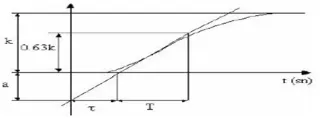
Step Response Method is based on transient response tests. Step input is applied to the transfer function of the system. A system with step response of the type is shown in the Fig.4 can be approximated by the transfer function as in (1).Where K is the static gain, is the apparent time delay and T is the apparent time constant. Transfer function of the system is given in G(s).
Fig 4 Unit step response of a typical industrial process
The plastic extrusion process control system uses first order transfer function. The plastic extrusion system transfer function is adopted from literature [8] and shown in (2). The plastic extrusion model uses the parameters K=0.92, T=144S, =10Seconds.
G(s) = 𝐾
1+𝑆𝑇𝑒
−𝑠 (1)
G(s) = 0.92
1+144 𝑆𝑒
−10𝑠 (2)
III. PI CONTROL
The PI control is designed to ensure the specifying desired nominal operating point for temperature control of plastic extrusion model, then regulating it so that it stays closer to the nominal operating point in the case of sudden disturbances, set point variations and noise. The PI control settings proportional gain (Kp) and integral time (Ti) are designed using Zeigler – Nichols tuning method [11]-[13] by applying the step test to “(2),” to obtain S – shaped curve of step response of temperature control model of plastic extrusion as shown in “Fig. 4” From the S-shaped curve of step response of temperature control model may be characterized by two constants, delay time L = 3s and time constant T = 6s. The delay time and time constant are determined by drawing a tangent line at the inflection point of the S-shaped curve and determining the intersections of the tangent line with the time axis and line output response c (t) as shown in “Fig. 5,” Ziegler and Nichols suggested to set the values of Kp = 1.8 and Ti =10s according to the Ziegler Nichols tuning rules shown in TABLE 1.
Table I Zeiglers-Nichols tuning rules
Type of Controller Kp Ti Td
P
T/L ∞ 0
PI
0.9T/L L/0.3 0
PID
Fig 5 S shaped curve response of a temperature control system
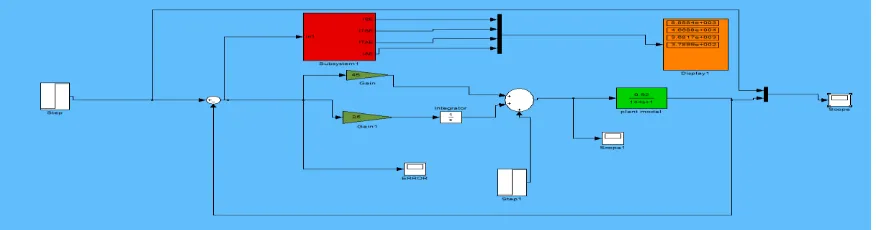
The optimal setting valuesKP,Ki,Ti obtained from the Zeigler Nicholas tuning rules and the values shown in Table 2. The simulink model of PI controller is shown in fig 6.
Figure 6 Matlab/ Simulink model for PI controller
Table 2 Minimum Setting Values ISE, ITSE, ITAE, IAE and optimal setting value KP,Ki,Ti
ISE ITSE ITAE IAE Kp Ki Ti(s)
2.4838e+000 1.3144e+001 6.1766e+001 6.3453e+000 45 25 45
IV. PID CONTROL
The PID control is designed to ensure the specifying desired nominal operating point for temperature control of plastic extrusion model. Tuning PID controllers make the system to eliminate the sudden disturbances, set point variations and noise. The PID control settings gain values and time constants are designed using Zeigler-Nicholas tuning method [7].By applying step test to equation (2) S-shaped curve of temperature control model of plastic extrusion obtained. From the S-shaped curve of step response, it is identified that the temperature control model characterized by two constants, as delay time L=5 seconds and time constant=10seconds.
Table 3 Minimum Setting Values ISE, ITSE, ITAE, IAE
ISE ITSE ITAE IAE
1.9819e+000 5.3806e+000 2.4132e+001 4.2681e+000
Table 4 the optimal setting values KP,Ki,Kd, Ti, Td
Kp K𝑖 Kd Ti Td
The delay time and time constant are determined by drawing a tangent line at the inflection point of the s-shaped curve. From Zeigler-Nichols tuning rules the suggested optimal set values obtained [2].
Figure 7 Matlab/Simulink model of PID controller
The PID control optimal setting values for temperature control of plastic extrusion model are obtained by finding the minimum values of ISE, ITSE, ITAE, and IAE as shown in Table 3. The optimal setting values KP,Ki, Kd, Ti, Td obtained from the Zeigler Nicholas tuning rules and the values shown in Table 4. The simulink model of PID controller is shown in fig 5.
V. FUZZY LOGIC CONTROL TECHNOLOGY
The plastic extrusion temperature controller uses two dimensional fuzzy logic controller models [10]. It has two input variables error 'e', change in error 'ce' and one output variable 'u'. For computations to be relatively simple, the research uses triangular shape membership function. The inputs to the fuzzy controller are error e (k) and the change in error e (k) are computed from the reference value r (k) where k denotes the discrete time. The fuzzy controller output u (k) based on error and error change. The fuzzy controllers have three basic steps in the order of fuzzification where the inputs are mapped from crisp value to a fuzzy value by membership functions [3-4].In the rules evaluation, the fuzzy control laws are formulated in the form of IF -THEN rules, which are based on dynamic performance of the process and the heater characteristics. The inferences engine is responsible for matching control rule and drawing conclusion based on the inputs [13].
Figure 8 Membership Functions of Input Fuzzy Variable Error
Figure 9 Membership Functions of Input Fuzzy Variable Change in Error
The input and change in input variable e and Ce are shown in Fig. 8 and Fig.9. The FLC output variable is shown in Fig.10.
Figure 10 Membership Functions of control output
Proposed control algorithm for fuzzy logic summarizes the 49 rules as shown in Table 5.
Table 5 Proposed Fuzzy Rules
Ce
E NB NM NS Z PS PM PB
NB PB PB PB PB PM PS ZO
NM PB PB PM PM PS ZO NS
NS PB PB PM PS ZO NM NM
Z PB PM PS ZO NS NM NB
PS PM PM ZO NS NM NB NB
PM PS ZO NS NM NM NB NB
PB ZO NS NM NB NB NB NB
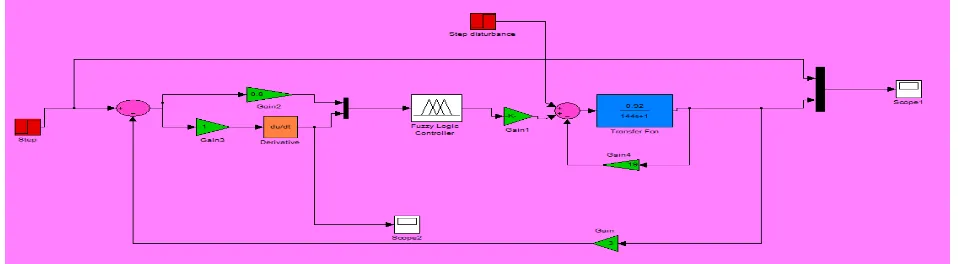
The defuzzification process after collecting all the singleton rules, it defuzzify the result so that a crisp value of the control signal is obtained the change of control signal is computed using centre of gravity method. The FLC matlab/simulink diagram is shown in Fig.11.
VI. ADAPTIVE NEURO FUZZY CONTOLLER
Fuzzy inference systems are also known as fuzzy rule based systems containing a number of fuzzy IF-THEN rules. ANFIS is used in the form of sugeno model to integrate the best features of fuzzy systems and neural networks [5]. ANFIS is also used in representation of prior knowledge into a set of constraints to reduce optimization search space obtained from fuzzy and adaptation of back propagation to structured network through neural network [13].
Table 6 Proposed Neuro Fuzzy Rules
Ce E
NB NS Z PS PB
NB MF1 MF2 MF3 MF4 MF5
NS MF6 MF7 MF8 MF9 MF10
Z MF11 MF12 MF13 MF14 MF15
PS MF16 MF17 MF18 MF19 MF20
PB MF21 MF22 MF23 MF24 MF25
The Neuro fuzzy system 25 rules base is shown in Table 6. The Neuro fuzzy system consists of the components of a conventional fuzzy system [17]. The output variable of fuzzy set u shown in Fig. 12.It has 25 membership functions and one controlled output.
Fig 12 the output variable of fuzzy set u.
Internal Layer of Neuro Fuzzy Model for Plastic Extrusion System is shown in Fig 13. Computations at each stage are performed by a hidden neurons and the neural network learning capacity is provided to enhance the system knowledge.
Figure 13 Internal Layer of Neuro Fuzzy Model for Plastic Extrusion System
Fig 14 MATLAB/Simulink Model of Neuro Fuzzy Controller
VII. RESULTS AND DISCUSSION
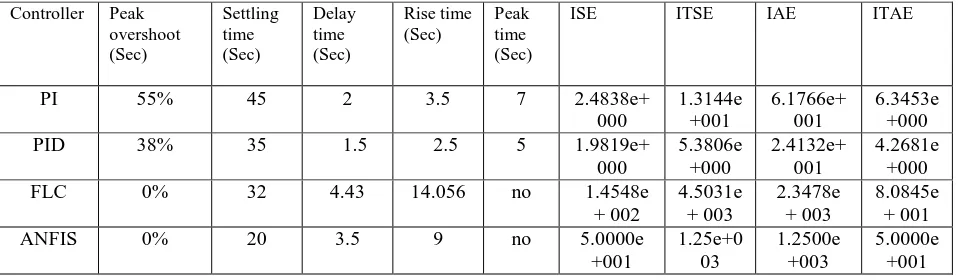
ANFIS controller for its unique characteristics can become a replacement for the Fuzzy, PID and PI controllers. The ANFIS has improved control quality. The aim of control of heated barrel is to bring the set points during start up as soon as possible to avoid large overshoots in order to maintain it at current temperature set value. The Table 7 gives various timing specification of all four controllers.
Table 7 Specification of all four controllers
Controller Peak
overshoot (Sec) Settling time (Sec) Delay time (Sec) Rise time (Sec) Peak time (Sec)
ISE ITSE IAE ITAE
PI 55% 45 2 3.5 7 2.4838e+
000 1.3144e +001 6.1766e+ 001 6.3453e +000
PID 38% 35 1.5 2.5 5 1.9819e+
000 5.3806e +000 2.4132e+ 001 4.2681e +000
FLC 0% 32 4.43 14.056 no 1.4548e
+ 002 4.5031e + 003 2.3478e + 003 8.0845e + 001
ANFIS 0% 20 3.5 9 no 5.0000e
+001 1.25e+0 03 1.2500e +003 5.0000e +001
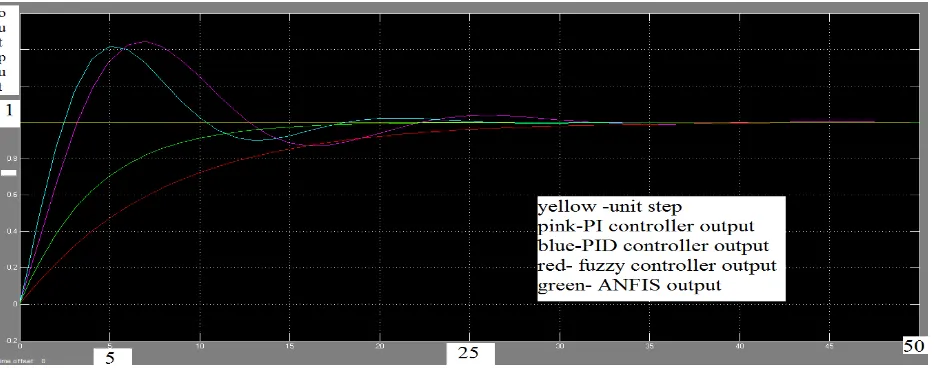
The feedback controller (PI controller) gives 55% peak overshoot and 45 sec settling time. The peak overshoot is in a higher side. To compensate the high peak overshoot, PID controller was designed gives 38% and 35 sec settling time. To compensate the high peak overshoot, FLC controller was designed gives 0% and 32 sec settling time. The controller reduces the peak overshoot to 0% and reduces the settling time to 32 sec. To further improve the response, ANFIS controller was designed. The ANFIS controller gives a peak overshoot of 0% (no overshoot) and reduces the settling time to 20 sec. From the table VII it is clear that the fuzzy based controller and adaptive neuro fuzzy controller gives a better control results as compared to feedback controller when a unit step input is applied and controller are evaluated in terms of peak overshoot and settling time.
VIII. CONCLUSION
IX. SIMULATION OUTPUT
Figure 15 Unit step response simulation output for PI
Figure 16 Unit step response simulation output for PID
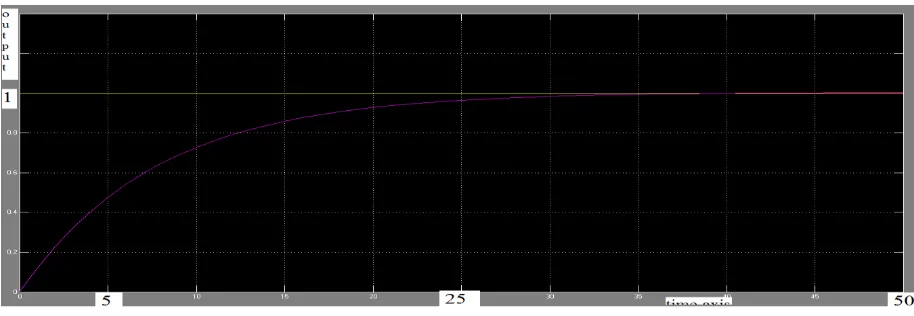
Fig 18 ANFIS Controller MATLAB/Simulink Output
ANFIS controller is without overshoot. This paper demonstrates the effectiveness of intelligent controller on non linear system particularly for temperature control in plastic extrusion system. ANFIS controller has improved 37.5% in settling time as compared to fuzzy logic controller.
Figure 19 Comparison of unit step response of the output for PI, PID, FLC and ANFIS
From the results the proposed ANFIS controller is suitable for set points changes and for stability with the aid of the supervisory technique. The proposed controller identifies the process variations quickly and provides good control for the set point changes and for sudden disturbances. The ANFIS controller will prove especially efficacious in the case temperature control in plastic extrusion system.
REFERENCES
[1] Brown, E. C., Kelly, A. L., Coates, P. D. “Melt temperature homogeneity in single screw extrusion: effect of material type and screw geometry”. SPE ANTEC Tech, pp183–187, 2004.
[2] C. Hwang, and J. H. Hwang, “Stabilization of first-order plus dead-time unstable processes using PID controllers ”, IEEE Proc.- Control Theory Appl., Vol. 151, No. 1, January 2004.
[3] Ching-Chih Tsai, Member, IEEE, and Chi-Huang Lu, "Multivariable Self-Tuning Temperature Control for Plastic Injection Molding Process," IEEE Transactions on Industry Applications, Vol. 34, No.2, March/April, 1998.
[5] Chia-Feng Juang, Shui-Tien Huang, "Mold temperature control of a rubber injection-molding machine by TSK- type recurrent neural fuzzy network," Elsevier journal of, Neuro computing 70, pp 559- 567, 2006.
[6] Dr. Mohammed Y. Hassan, Waleed F. Sharif, "Design of FPGA based PID-like Fuzzy Controller for Industrial Applications," IAENG International Journal of Computer Science, 34:2, IJCS_34_2_0,pp 631-638.
[7] Hongfu Zhou, "Simulation on Temperature Fuzzy Control in Injection Mould Machine by Simulink," Asian 1. Control, 5, pp. 176-186, 2003. [8] Huailin Shu, Youguo Pi, "Decoupled Temperature Control System Based on PID Neural Network," ACSE 05 Conference, Cairo, Egypt,
December 2005,.
[9] J.P. Keller, "Teaching PID and Fuzzy controllers with LabVIEW, "International 1. Engineering Ed. Vo1.l6, No.3, pp.202-21l, 2000. [10] K. J. Astrom, and T. Haagglund, “PID Controllers: Theory, Design and Tuning” Triangle Park, NC, USA, 2nd Edition,1995. [11] K., J. Astrom, B. Wittenmark, Adaptive Control Addison- Wesley Publishing Company , ISBN 0-201-55866-1 USA, 1995, ch. 8. [12] M. Zhuang, D. P. Atherton, “Automatic Tuning of Optimum PID Controllers”, IEEE Proceedings, Vol. 140, No. 3.
[13] P. P. Bhogle, B. M. Patre, L.M. Waghmare, V. M. Panchade, "Neuro Fuzzy Temperature Controller,"IEEE International Conference on Mechatronics and Automation, Harbin, China, August 5-8, 2007,.
[14] Rosato, D. V., “Extruding plastics - A practical processing handbook”. Springer - Verlag, ch. 1, 1998. [15] Rauwendaal, C., Polymer extrusion, 4th Edition. Hanser: Munich, ch. 2, 5, 7, 2001.
[16] Spalding, M. A.,Hyun, K. S.,.”Troubleshooting mixing problems in single-screw extruders. SPEANTEC Tech.pp,229–233, 2003.