Porter).
The purpose of this study was to examine the effects of proactive student-success
coaching, informed by predictive analytics, on student academic performance and
persistence. Specifically, semester GPA and semester-to-semester student persistence were the investigated outcomes. Uniquely, the community college focused the intervention on only
students predicted to be moderate-level academic performers instead of to all students or to students predicted to be low-level performers. Few studies have investigated interventions
like student-success coaching, and no research has addressed student-success coaching restricted to students with a particular predicted academic performance.
This study used inverse probability of treatment weighting to create appropriately
balanced samples of the proactively coached students and not proactively coached students in order to approximate a randomized control trial with observational data. Regression analyses
with weights and covariates estimated few statistically significant results in sample subgroup models and no statistically significant results for whole-samples. Generally, the results found in this study do not support the hypothesis that proactive student-success coaching initiated
by the predictive analytics of a student-monitoring system improves student outcomes. Nonetheless, this study contributes empirical results to the emerging literature regarding
by
Mark Monroe Hall
A dissertation submitted to the Graduate Faculty of North Carolina State University
in partial fulfillment of the requirements for the degree of
Doctor of Philosophy
Educational Research and Policy Analysis
Raleigh, North Carolina 2017
APPROVED BY:
_______________________________ _______________________________
Dr. Stephen Porter Dr. Paul Umbach
Committee Chair
_______________________________ _______________________________
DEDICATION
To my wife, to my children, and to my parents, thank you for the support and patience.
&
BIOGRAPHY
As a native and lifelong resident (so far) of North Carolina, Mark Hall has lived in
several cities and towns across the Old North State. He completed his Bachelor of Arts in Psychology at Appalachian State University, where he also worked as a behavioral
neuroscience research assistant. Following a few years and a few different career paths, he
returned to higher education and earned a Master of Arts in English and American Literature from North Carolina State University. After teaching English and humanities courses for
almost a decade in settings ranging from high schools to prisons to community-college campuses and after assuming various leadership roles, he decided to pursue a Doctor of Philosophy in Educational Research and Policy Analysis with a specialization in Higher
Education Administration at North Carolina State University. While a doctoral student, he entered full-time academic administration as a provost for Central Carolina Community
College.
Upon graduation, he plans on continuing to research emerging innovations in higher education and hopes to be found playing guitar with his family and kayaking with Team
ACKNOWLEDGMENTS
Without God’s provision, I could have accomplished little of what it takes to
persevere through a doctoral program, especially when the days were long and the nights were short.
Thanks go to my committee chair, Dr. Stephen Porter, for establishing high
expectations and for providing the tools to meet them. I appreciate your direct and efficient authenticity and leadership that sharpened my critical lens and analytical approach to
research and education. Thank you for insisting on rigorous methods and statistical analyses that account for the counterfactual. Finally, thank you for ensuring that I maintained progress in the doctoral program and that I did not stop short of the finish line. Cheers to you.
Thanks also go to my three dissertation committee members: Dr. Paul Umbach, Dr. Joy Gaston Gayles, and Dr. Bruce Mallette. I appreciate the time, effort, and patience you
have expended on this project. Thank you for your insightful questions early in the process that challenged me to articulate the treatment and analyses much more clearly than I could have without your perspectives. Moreover, thank you for your enthusiasm for the study and
its potential contribution to the literature.
Thanks go to all of the professors who have expanded my knowledge of research and
of you and learned much from all of you. Thank you for all that you do for your students, for the program, and for field of higher education.
Thanks go to my cohort members—Ashley Clayton, Ashley Grantham, Thomas Greene, Racheal Brooks, Becky Crandall, Mary Medina, and Shauna Morin—for keeping me sharp and for providing diverse perspectives. I appreciate the time we spent in and out of
class. A notable thanks go to Ashley Clayton for occasionally checking on my degree progress after she graduated and moved on to other opportunities—it is hard out there for
part-time doctoral students.
Thanks go to the too-many-to-list colleagues with whom I have worked over the years and who have kept track of my progress and continued to encourage my professional
and personal development.
Thanks go to Aviso for being willing to provide the dataset used in this study and for
working with me in the early stages of the project.
While many at NC State and many of my colleagues saw me through the doctoral program, there are several people in my personal life without whom I would not have been
able to succeed. My wife’s encouragement motivated me to continue each semester and fortified my resolve to finish, and her care for our family gave me the space and time to do
TABLE OF CONTENTS
LIST OF TABLES ………..… viii
LIST OF FIGURES ………... x
CHAPTER 1: INTRODUCTION………... 1
Background……….. 4
Student-monitoring and Alert Systems……….. 4
Analytics………7
Student-success Coaching……..……….……… 8
Intervention in Question……….……… 9
Student-success coaching at the community college selected for this study ….……….. 12
Purpose of Study and Research Questions.………. 13
Chapter 2: Literature Review.……….. 15
General Retention Practices.……….15
Student-success Monitoring Systems…...…..………..…..…..…..….…... 18
Learning and Predictive Analytics…..………. 23
Student-success Coaching………. 27
Synthesis and Application of the Literature………... 31
Chapter 3: Aviso System and Student-success coaching……… 32
Aviso Predictive Alerts……….. 32
Aviso-Generated Student Groups……… 42
Proactive Student-Success Coaching………... 48
Theory of Change for Proactive Student-Success Coaching………. 56
Chapter 4: Methodology………63
Research Design………. 63
Institutional Context and Population……….. 70
Participants………. 70
Assignment to groups……… 71
Variables………. 71
Treatment Variable………... 71
Matching Covariates……….. 72
Outcome Variables……….73
Data Collection………... 73
Propensity Score Analysis………. 74
Propensity Score Model and Calculations………... 74
Overlap………78
Weighting……… 83
Covariate Balancing within Simple Groups……… 84
Empirical Regression Models………... 92
Fall 2015 Semester GPA Model……….... 92
Chapter 5: Results………..94
Green-Yellow Sample Semester GPA……….. 96
Green-Yellow sample subgroup semester GPA analyses………... 97
Green-Yellow Sample Fall-to-Spring Persistence……….. 99
Green-Yellow sample Fall-to-spring persistence analyses………... 100
Yellow-Red Sample Semester GPA……… 102
Yellow-Red sample subgroup semester GPA analyses………. 103
Yellow-Red Sample Fall-to-Spring Persistence……….103
Yellow-Red sample Fall-to-spring persistence analyses………... 104
Summary of Results………. 105
Chapter 6: Discussion and Implications……….... 108
Discussion of Results……… 109
Implications of Semester GPA Analyses……… 109
Implications of Fall-to-Spring Persistence Analyses……… 112
Implications of Potential Inconsistency among Results………... 115
Implications of Analyses in the Context of Current Literature……….. 117
Possible Issues with the Analyses………... 121
Discussion of Predictive Analytics Ethics………. 125
Future Research……..……… 127
Limitations………... 129
References………. 132
Appendices……… 153
Appendix A: Green-Yellow Sample Full-model GPA Regression Results……….. 154
Appendix B: Green-Yellow Sample Subgroup GPA Regression Results…………. 157
Appendix C: Green-Yellow Sample Full-model Logit Results for Fall-to-Spring Persistence……..……… 167
Appendix D: Green-Yellow Sample Subgroup Fall-to-Spring Persistence Results.. 170
Appendix E: Yellow-Red Sample Full-model Regression Results for Semester GPA……… 180
Appendix F: Yellow-Red Sample Subgroup GPA Regression Results……… 183
Appendix G: Yellow-Red Sample Full-model Logit Results for Fall-to-Spring Retention……….. 193
LIST OF TABLES
Table 2.1 Student-success Monitoring System Differences………. 22
Table 3.1 List of Student-Level Variables Used in Aviso’s Predictive Analytics……… 33
Table 3.2 Predicted Course Performances, Numerical Course Grade Ranges, and
Course Flags………..…. 36
Table 3.3 Example Table of Predicted Course Grades Relationship to
Student Flags………... 39
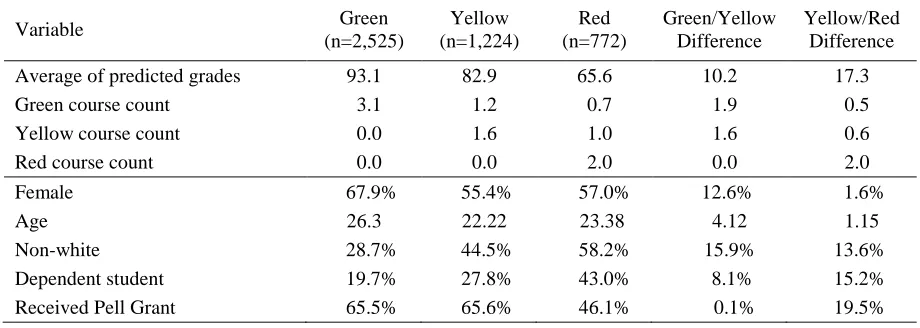
Table 3.4 Group Means for a Sample of Variables Used in
Aviso’s Predictive Analytics……… 42
Table 3.5 Percentages for Matches between Predicted- and Earned-Grades
by Student Category………. 47
Table 3.6 Timeline for Student-Success Coaching Activities……….. 49
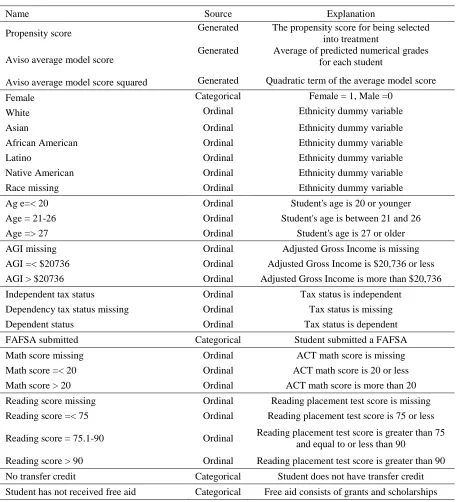
Table 4.1 Complete List of Variables Used in Propensity Score and
Regression Analyses……… 67
Table 4.2 Propensity Analysis Model for Green and Yellow Student Sample………… 75
Table 4.3 Propensity Analysis Model for Yellow and Red Student Sample……… 77
Table 4.4 Number of Students below, in, and above the Propensity-Score Overlap….. 83
Table 4.5 Balance Check for Green-Yellow sample Before and After Weighting…….. 85
Table 4.6 Balance Check for Yellow-red sample Before and After Weighting………… 89
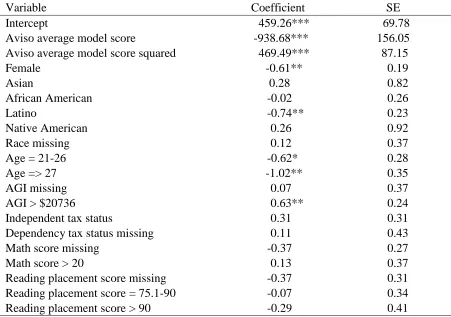
Table 5.1 Green-Yellow Sample GPA Regression Results……….. 97
Table 5.2 Green-Yellow Sample Subgroups Significant GPA Regression Results…….. 98
Table 5.3 Green-Yellow Sample Logit Results for Fall-to-Spring Persistence………... 99
Table 5.4 Green-Yellow Subgroups Fall-to-Spring Persistence Significant Results…. 100
Table 5.5 Yellow-Red Sample Semester GPA Regression Results………. 102
Table 5.7 Summary Results for All Sample and Subgroup Analyses………. 106
Table 6.1 List of Student-Success Coaching Implementation Features by
LIST OF FIGURES
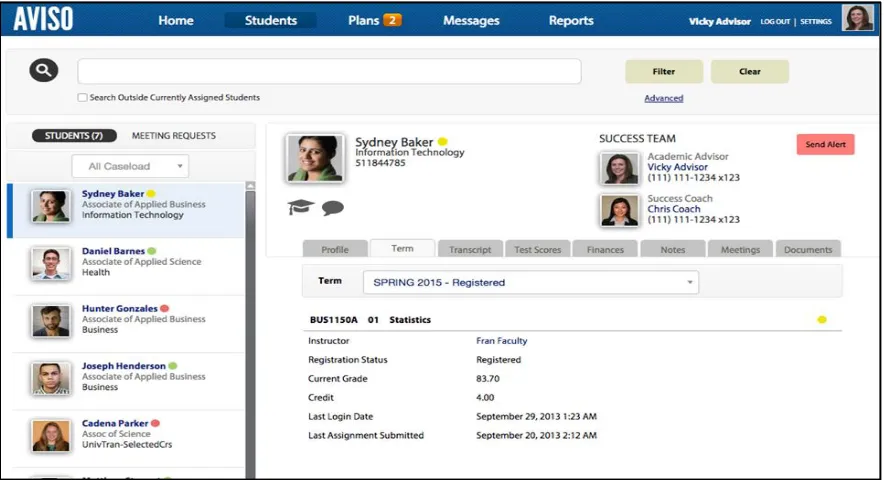
Figure 1 Screenshot of Aviso Student Profile……… 37
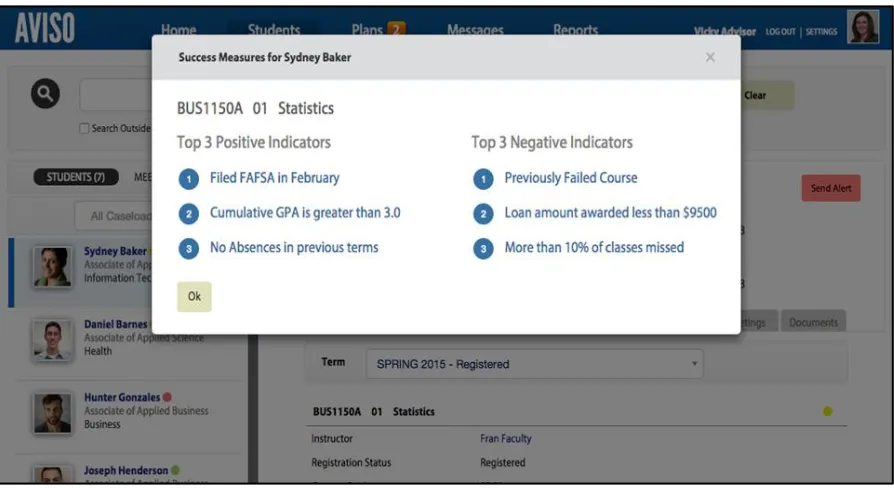
Figure 2 Screen shot of Aviso Success Measures……….. 51
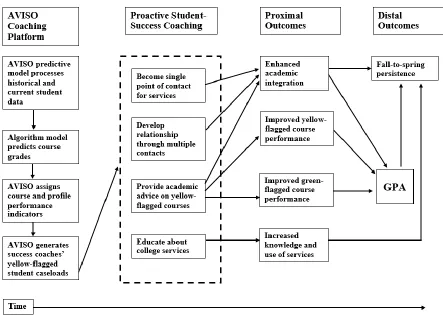
Figure 3 Theory of Change Model for Proactive Student-Success Coaching………… 57
Figure 4 Pre-trimming Green and Yellow Propensity Score Overlap………79
Figure 5 Post-trimming Green and Yellow Propensity Score Overlap………….…… 80
Figure 6 Pre-trimming Yellow and Red Propensity Score Overlap……….. 81
CHAPTER 1: INTRODUCTION
Student retention is a challenge for postsecondary education institutions. More than
four-year institutions, community colleges struggle to retain students. From the fall of 2012 to the fall of 2013, four-year institutions retained about 80% of their first-time college
students, but community colleges only retained 60% (Kena, Musu-Gillette, Robinson, Wang,
Rathbun, Wilkinson-Flicker, Barmer, & Velez, 2015). Of the retained community college students who started in the fall of 2012, only about 30% of them were likely to persist to
graduation within three years (Kena et al., 2015). The congruent goals of improving institutions’ retention of students and supporting students’ persistence to graduation have
produced ongoing research and innovative interventions.
Particular to this study, some educational institutions have started using analytics to predict student academic behaviors and outcomes. These institutions use the predictions to
inform and offer proactive interventions to students if needed (Campbell, DeBlois, & Oblinger, 2007; Clow, 2013; Jayaprakash, Moody, Lauria, Regan, & Baron, 2014; Phillips, & Horowitz, 2013; and Smith, Lange, & Huston, 2012). Although institutions have
increasingly employed predictive analytics to improve student success, the literature
concerning analytics predominantly addresses the data mining methods and the software used
to build the predictive models utilized by various organizations and institutions (Agudo-Peregrina, Iglesias-Pradas, Conde-Gonzalez, and Hernandez-Garcia, 2014; Campbell et al., 2007; Denley, 2014; Picciano, 2012; and Siemens, 2013). Generally, the literature lacks
estimate the effects of providing predictive-analytics-informed proactive interventions to students. This study did.
The use of analytics to anticipate individuals’ behaviors is more ubiquitous than many might realize (O’Neil, 2016; and Siegel, 2013). Many different types of organizations and
institutions use analytics to predict the likely actions and choices of any particular
service-users. These predictions are based on the data collected about specific individual users and on how that data compares to others like them. Google and Amazon are two commercial
examples of organizations that use predictive analytics as their recommendation mechanisms. These companies constantly analyze user data—the clicks, searches, purchases, locations, and visited websites of their users—to recommend products and services users are estimated
most likely to purchase based on their own historical data and on the data of other users similar to them.
In educational settings, analytics have been used for almost twenty years to develop predictive modeling for administrative functions like enrollment management (Campbell et al., 2007). When considering which applicants to accept, some institutions would estimate
the likelihood of their applicants to have successful educational outcomes, such as persistence to graduation, based on models developed from estimates of the likelihood of
their previous students to have successful outcomes. These estimations were mostly derived from preadmission demographic and academic preparation data correlated with outcomes. With the widespread use of learning management systems and student-monitoring and alert
than they could twenty years ago. More importantly, these systems can collect data about students’ actions (e.g., course attendance and course-site login frequency) and students’
outcomes (e.g., up-to-date course grades and cumulative GPA). Combined with student-records data, some institutions have used learning management systems’ historical student data to develop algorithmic models that estimate previous students’ odds for successful
academic outcomes. The models are then applied to current student data to estimate the odds of current students having successful academic outcomes. In short, institutions utilizing
analytics are able to make predictions about student outcomes and to use those predictions to identify students’ potential obstacles for success and to offer support to students as needed
and as indicated.
While retention and persistence have been thoroughly studied issues in education (Astin, 1993, 1999; Bean, 1980; Karp, Hughes, & O’Gara, 2010; Pascarella, & Terenzini,
2005; and Tinto, 1975, 1993, 2006), few researchers have analyzed the efficacy of exploiting analytics to predict student outcomes and to offer individualized and coordinated
interventions to improve those student outcomes. Research that adequately addresses
selection bias and/or uses quasi-experimental or experimental methods has not yet been conducted, save for Bettinger and Baker (2014). In this study, I examined the effects of a
proactive student-success-coaching intervention at a southeastern community college. The proactive student-success-coaching was offered to students for whom the predictive analytics of a student-monitoring and alert system estimated would likely achieve moderate academic
contribute to the broad literature about retention and to the developing literature about the use of analytics to offer proactive targeted and customized interventions in postsecondary
education.
Background
Much has been written about retention and persistence in higher education (Astin, 1993, 1999; Bean, 1980; Karp, Hughes, & O’Gara, 2010; Pascarella, & Terenzini, 2005; and
Tinto, 1975, 1993, 2006). This study expanded on the literature by addressing retention as it
relates to monitoring and alert systems, predictive analytics, and proactive student-success coaching. Currently, the literature contains little rigorous research on these three areas and no research on the synthesis of these retention tools and practices.
Student-Monitoring and Alert Systems
Many institutions use various forms of information technology systems to maintain
records for their students and monitor their current-semester performance. Systems that monitor students’ academic behaviors and outcomes during a semester are most often
referred to as early-alert or early-warning systems. The majority of these systems notify the
appropriate success stakeholders—students, faculty, advisors, and other student-support staff, like student-success coaches—after particular student-success indicators reach
or surpass certain preset limits. For example, if students' reported midterm grades fall below a C average (numerical grades less than 70 for most institutions), the student-monitoring systems generate alerts that notify stakeholders that the midterm grade is low. The alert
institutions can provide the appropriate interventions, such as tutoring services for the course in which the low midterm grade was reported. Since these alerts are sent only after an issue
arises, the alerts are reactive responses rather than proactive actions. In most cases, the alert-generated intervention serves to prevent a student’s academic performance from further
deterioration. Following the above example, tutoring could help the student earn a better
grade in the course, but being tutored after earning a low midterm grade seems to involve averting potential course failure more than achieving course expertise. In this way, most
student-monitoring systems are not really early-alert systems but reactive-response systems that mitigate academic problems rather than prevent them.
Although there are numerous vendors for student-monitoring and alert systems, like
AdvisorTrac, AvisoCoaching, Copley Retention, DropGuard, and Starfish Early Alert System (National Academic Advising Association, 2014), little empirical research exists
about these systems. Many publications associated with discussions of these systems concern responses to alerts. Especially common are discussions about reacting to reported low
midterm grades or absenteeism (Bruce, Bridgeland, Fox, & Balfanz, 2011; Faulconer,
Giessler, Majewski, & Trifilo, 2014; and Johnson, 2001). Other reports simply review the implementation of early-alert systems (Hanover Research, 2014; and O’Cummings &
Therriault, 2015). Furthermore, searching for studies on early-alert systems yields divergent concepts of such systems, ranging from orientation surveys that could be used to identify at-risk students (Beck & Davidson, 2001) to sophisticated software programs that collect
students, advisors, and faculty about issues correlated with student dropout or poor course performance (Agudo-Peregrina et al., 2014; Bettinger & Baker, 2014; Bruce, Bridgeland,
Fox, & Balfanz, 2011; and Pistlli & Arnold, 2010).
This study investigated the latter type of inter-networked student-monitoring and alert systems. The community college in this study used AvisoCoaching (so named during the time period from which this study’s data came; now named AvisoRetention). Distinctive to
this system was its incorporation of predictive analytics into its student-monitoring platform
starting in the fall 2015. Using predictive analytics, the system developed algorithmic models from the college’s historical student data and then applied those models to current student
data to predict the current students’ academic performances in each of the courses in which
they were enrolled. Proactively, student-success coaches used these estimations to offer interventions to students within the first few weeks of the fall semester; that is, academic
assistance was offered to students before predicted academic outcomes occurred. Explained in more detail in Chapter 3, these predicted performances were based on success measures (variables within the data) that allowed student-success coaches to provide individualized
interventions that were proactive instead of reactive. Whereas most student-monitoring systems are actually reactive-response systems, the system the community college used was
low grade weeks before the student had the chance to earn a low midterm grade. The use of predictive analytics provided the coaches the opportunity to support students proactively.
Analytics
Not unlike the literature about student-monitoring and alert systems, the literature on analytics in education has yet to coalesce around what is meant by analytics. In fact, for
several years researchers of analytics have refined their definitions and established sub-categories for analytics (bin Mat, Buniyamin, Arsad, & Kassim, 2013; Clow, 2013;
Macfadyen & Dawson, 2012; Picciano, 2012; and Siemens, 2013;). This literature begins with the use of quantitative metrics—that is, “Big Data: the quantity, range and scale of data that can be and is gathered” (Clow, 2013, p. 2)—especially after these metrics became much
more feasible and prevalent with improvements in computing technology. Simply stated, analytics is the application of statistical analysis and algorithm models to big data to reveal
patterns that can be used to estimate the likelihood of future outcomes. In education, these analytics have mostly been referred to as learning analytics.
Related to discussions of learning analytics are academic analytics, educational data
mining, predictive analytics, action analytics, and data-driven decision-making (Agudo-Peregrina et al., 2014). Most scholars consider predictive analytics in education to be a
sub-type of learning analytics. As the name indicates, predictive analytics are used to build statistical models that can predict, or rather estimate the likelihood of, student outcomes based on previous student data. Institutions can use these predictions to inform and offer
(Campbell et al., 2007; Clow, 2013; Bettinger & Baker, 2014; Picciano, 2012; and Siemens, 2013). However, the literature on analytics lacks studies that examine the implementation of
interventions based on predicted outcomes.
Student-success coaching
Despite the proliferation of student-success centers staffed with student-success
coaches (or similar positions with various names at those centers), empirical research concerning this kind of intervention is relatively scarce. In fact, at the time of this study searching “student success coach” and “student success center” through Google yielded over
500 thousand results, most of which were for institutional centers or advertised open success-coach positions at those centers. However, searching the same phrases through Google
Scholar produced only a little more than 700 results, only 40 of which included the exact phrase “student success coach” and almost all of which were corporate or non-profit
organizational marketing reports instead of scholarly research. A search through the
academic databases at a level-one research university returned even fewer results. Yet, some of the literature about retention and persistence implied that providing several coordinated
interventions to students, which is what student-success coaching does, should increase student engagement and integration into an educational institution (Astin, 1999; Dadgar, Nodine, Bracco, & Venezia, 2014; Karp, Hughes, & O’Gara, 2010; Tripp, 2008; and Wild, &
and provides the one-on-one support for which Astin (1999), Tripp (2008), and Wild and Ebber (2002) advocated.
In brief, most student-success coaching involves actively contacting students about potential challenges to academic success and coordinating the support services for them that might help them overcome those challenges. Success coaches also advise students in typical
and essential factors of persistence: time management, study skills, financial aid, extracurricular activities, faculty interaction, and intuitional knowledge. Furthermore,
contacted students are typically students identified by an institutional process or student-monitoring and alert system for the intervention (Bettinger & Baker, 2014; Richie and Hargrove, 2004; and Tripp, 2008).
Intervention in Question
Few programs resemble the proactive student-success coaching intervention that the
community college in this study implemented. According to Bettinger and Baker’s (2014) descriptions, InsideTrack provided coaching services that were the most similar to
AvisoCoaching. However, unlike InsideTrack, AvisoCoaching did not provide the
student-success coaching to students. Instead, for the community college in this study,
AvisoCoaching trained the college’s faculty, student-support staff, and student-success
coaches to use its online student-monitoring and advising platform, known to college employees simply as Aviso (heretofore also only referred to as Aviso). Until the start of the academic year in fall 2015, Aviso did not provide predictive analytics within its platform for
generated reactive alerts about student success indicators that had already surpassed preset thresholds, like too many absences or current course averages below 70. These alerts
typically started to occur about mid-semester and, thus, were not proactive. To generate these alerts, Aviso collected enrollment and attendance information from the college’s institutional
records and pulled current grades and login information from the college’s learning
management system, in which every course section at the college was required to have a course site for instructors to maintain up-to-date grades and provide course content.
Collecting all of the aggregated data accumulated over the several semesters the college had previously used the system, Aviso’s analytics team constructed and applied
predictive algorithms to every student enrolled in curriculum programs. For each course in
which a student was enrolled, Aviso predicted how successful each student was likely to be. Although successful course completion was defined as having a predicted numerical course
average of 70/C or above, the system distinguished among three predicted course
performance levels. Aviso and the college referred to these levels as high-risk (predicted grades of less than 70), moderate-risk (predicted grades between 70 and less than 86), and
low-risk (predicted grades 86 and greater). Aviso and the college considered “risk” to be the potential that a student would achieve poor academic outcomes in a given course. For
particular course were predicted to earn a final grade of a low B or C for the course but not a grade of D or F.
Since the language of “risk” used by Aviso and the College was obfuscated and was not aligned with educational literature’s typical use and meaning of the phrase, this study
substituted performance levels for Aviso’s “risk” levels. In the language of this study,
estimated high-performance in a course denoted the student was predicted to earn either an A or high B in a given course; moderate-performance signified the student was predicted to
earn a low B or C in the course; and, low-performance meant a student was predicted to earn either a D or an F in that course.
The course-level performance predictions were based on students’ background
characteristics (e.g., age, gender, ethnicity, and socio-economic status) and academic preparation information (e.g., placement test scores and previously earned GPA). Grade
predictions were made for each course in which a student was enrolled, which meant that students had a range of predicted grades across their course schedules. For example, a student could be predicted to be a high-performer in a literature course but also predicted to be a
moderate-performer in a science course. In addition to course-level performance predictions, Aviso classified each enrolled student at the student-level as either a high-, moderate-, or
low-performer. The student-level classification was based on students’ lowest predicted course grade. Discussed in more detail in Chapter 3, performing students had only high-performance course predictions; performing students had at least one
had at least one low-performance prediction but could have moderate- or high-performance predictions too.
The Aviso platform did not allow student-users to see these predictions, but college personnel had access to students’ predicted performances. Starting Fall 2015, the college’s
student-success coaches proactively contacted all students classified as moderate-performers
to coordinate support services and to provide one-on-one support from the beginning to the end of the semester, before predicted academic issues could occur. For various reasons, the
college offered targeted proactive student-success coaching to only moderate-performing students. Targeting the proactive student-success coaching intervention to students predicted to be moderate-performers merited determining whether or not the intervention did, in fact, have an effect on these students’ outcomes that were significantly different than the
outcomes of students otherwise classified. Furthermore, that research on this specific type of
proactively targeted intervention is lacking in the literature warranted this study.
Student-success coaching at the community college selected for this study. The implementation of student-success coaching and similar practices differ among institutions.
For example, as previously discussed, InsideTrack’s coaches were not employees of the institutions in which the students were enrolled, and its coaches interacted with students through email and phone conversations since they were not located on the students’
campuses. Student-success coaching at the community college selected for this study had similar goals, but the intervention was implemented by on-campus, college-employed
At the selected college, the coaching process started after students were enrolled in courses and after Aviso’s course-success predictions were generated at the start of the
semester. Using students’ Aviso student-level performance classifications, student-success
coaches generated caseloads of moderate-performers, whom they started contacting within the first couple of weeks of the semester. The process of contacting students was proactive
and, thus, intrusive in that the intervention relied on the assumption that students needed to be offered assistance before they realized they might need it and on the assumption that such
students might not seek assistance or be knowledgeable about support services. The coaches were required to initiate contact with moderate-performing students instead of waiting for the students to initiate contact or for reactive alerts to be generated later in the semester.
Purpose of Study and Research Questions
Current literature on retention and on analytics lacks sufficient empirical research
about the use of student-monitoring and alert systems, the use of predictive analytics in educational contexts, and the use of these tools injunction with each other. Very few studies specifically investigate student-success coaching (or its variants) as a way to improve student
outcomes. In particular to this study, the literature has yet to examine the potential effects of coordinated and analytics-informed interventions offered to students estimated to be
moderate-performers and, by extension, moderately at risk for premature departure from the college.
The purpose of this study was to examine the impact of offering proactive
student-monitoring and alert system, Aviso, using predictive analytics. Since the college offered the intervention to all moderate-performing students, this study could not
retroactively conduct a randomized controlled trial experiment to estimate the effects of the intervention. Fortunately, comprehensive data from Aviso were available for analysis in this study. With that data, this study used the inverse probability of treatment weighting method
to create comparable groups of students offered and not offered student-success coaching. These groups were analyzed to ascertain the possible, if any, causal associations between the intervention and student outcomes, specifically students’ fall semester GPAs and
fall-to-spring persistence. The overarching questions that guided this study were:
1. For students predicted to be moderate-performers, what was the estimated effect of
proactive coaching on academic performance, as measured by semester GPA? 2. For students predicted to be moderate-performers, what was the estimated effect of
CHAPTER 2: LITERATURE REVIEW
This study spanned several interrelated but diverse areas regarding student success in
higher education: general retention practices, early-alert and predictive-alert student-success monitoring systems, learning and predictive analytics, and student-success coaching.
Generally, the purpose of research in each of these areas is to ascertain and understand the
dynamics involved in student success and/or failure, so that educational practices can be grounded in empirical knowledge and not conjecture. While the literature about retention is
particularly extensive, the bodies of literature about student-monitoring systems, analytics, and student-success coaching are not. In fact, most of the material about student-monitoring systems is typically antidotal, as is the research on student-success coaching, and the
majority of the research in the field of educational analytics is technical. Moreover, research in these areas is often conflated, blurring the distinctions among them. In light of these
observations, the review of literature in the above areas discusses, in order, general retention practices, success monitoring systems, learning and predictive analytics, and student-success coaching.
General Retention Practices
Retention and persistence are different perspectives on the same process: students’
continual enrollment until graduation. Whereas the study of student persistence focuses on the students’ attitudes and behaviors as associated with their educational attainment, the
study of retention focuses on institutions’ environments and processes as associated with
et al., 1992; Pascarella & Terenzini, 2005; and Tinto, 1975, 1993, 2006). A thorough review of educational attainment research can be found in Pascarella and Terenzini (2005), which
consolidated much of what has been demonstrated about student and institutional variables associated with attainment and about the interventions designed to mitigate or enhance the impact of those variables on student persistence and institutional student retention.
In short, Pascarella and Terenzini (2005) found the literature to suggest that interventions addressing student issues with academic deficits, institutional bureaucratic
barriers, and interactions with faculty and support staff modestly influence improvements in student outcomes. Such interventions include practices like remedial education, supplemental instruction, tutoring, first-year seminars, early-alert systems (a type of student-monitoring
systems), advising and counseling programs, summer-bridge programs, academic-skill development programs and workshops, and experiential-learning courses and opportunities
(Bettinger & Baker, 2014; Dadgar et al., 2014; Karp et al., 2010; Singell & Waddell, 2010; and Wild & Ebbers, 2002). The problems with estimating the effects of any of these practices are that control groups are difficult to establish for the required interventions. For
example, remedial education is required for students whose placement test scores do not allow them to take higher level courses. Furthermore, selection bias is difficult to overcome
when analyzing interventions in which students choose to participate. For example,
enrollment in first-year seminars at most institutions is not required; therefore, students who choose to enroll in these courses are likely different in some way from students who choose
institutions seem to implement some form of programming for several, if not all, of these practices—confounding the empirical study of any one intervention.
Adding to the confounding effect of concurrently implementing several intervention programs, much of the research on retention interventions has relied on statistical analysis that does not adequately estimate the counterfactual outcomes as discussed by Khandker,
Koolwal, and Samad (2010). Estimating the counterfactual of an intervention is best accomplished through randomized controlled trials but is also achievable through
quasi-experimental methods such as propensity score matching and regression discontinuity. Using experimental or quasi-experimental methods provides stronger support that a particular intervention has a causal relationship with improved outcomes than research that does not
account for the counterfactual.
For example, while the multivariate regression models in Fike and Fike’s (2008)
study of developmental education courses and retention attended to relevant predictor variables, the results were only correlational and cannot be interpreted as causal since no attempts were made to create comparable control groups within the data set. The same could be stated about Singell and Waddell’s (2010) use of probit models in the discussion of
identifying and retaining at-risk students; Beck and Davidson’s (2010) analysis of orientation
A few other studies, however, relied on more rigorous research designs than did the above examples. Bettinger and Baker (2014) conducted a randomized controlled trial to
estimate the effects of student coaching on retention; Schnell and Doetkott (2002) used propensity score matching to evaluate the impact of first-year seminars on retention; and Munt and Merydith (2011) used the instrumental variable estimation to explore the
connections among personality traits, psychological characteristics, and retention. The latter set of the above studies resolved most concerns that might undermine
causal claims that the former set of studies did not. More importantly, all of the above studies reinforced the significance of Tinto’s (1975, 1993) institutional experiences and academic
integration segments of his Longitudinal Model of Institutional Departure to retention. That
is, as Tinto (1975) stated, “given individual characteristics, prior experiences, and
commitments, the model argues that it is the individual’s integration into the academic and
social systems of the college that most directly relate to his continuance in that college” (p. 96). The strong support from the literature that academic integration is foundational to students’ educational attainment seems to justify the use of tools, such as student-monitoring
systems, to implement interventions demonstrated to be successful in the retention literature.
Student-success Monitoring Systems
Generally, the literature only refers to student-success monitoring systems as either early-alert or early-warning systems. Although surveys cited in a Hanover Research (2014) report indicated that over 90% of postsecondary institutions use “early-alert systems,” it is
these systems only occur within course sites of learning management systems (Agudo-Pergrina et al., 2014) and others consisted of reacting to survey data attached to student IDs
(Beck & Davidson, 2001). However, the majority of systems involve the collection of student data from learning management systems and institutional records into the student-success monitoring systems to track student academic behaviors and performance and to provide
possible reactive interventions (Bruce et al., 2011; Faulconer et al., 2014; Hudson, 2006; Jayaprakash, 2014; and O’Cummings & Therriault, 2015); that is, most student-success
monitoring systems facilitate student-support interventions after issues have occurred. Even though clear distinctions are not found in the literature, this study differentiates between student-success monitoring systems that are reactive in design (early-alert systems) and those
systems that are both reactive and proactive in design (predictive-alert systems).
The early-alert systems relevant to this study are the software platforms that monitor
student-success indicators and notify students, faculty, and student-support staff when preset indicator limits are exceeded, such as alerts for low midterm grades. Students do not choose to participate in the alert portion of this intervention because institutions that adopt these
types of reactive early-alert systems typically enroll their entire student population into the system. Any students who exhibit academic behaviors and/or performance that trigger alerts
early-alert systems include all students, alerted students must opt into any suggested intervention. The same is true for most predictive-alert systems: students must opt-in.
Unfortunately, and despite the reported widespread use of these systems, there is a dearth of research that uses rigorous study designs to estimate the impact of student-success monitoring systems on outcomes, and non-empirical survey results suggested the impact is inconsistent (Hanover Research, 2014). As examples, a study of the University of Maine’s “Project 100: Early Alert/Early Intervention” program using mean comparisons and survey
responses suggested that the intervention had little effect on retention and GPA (Johnson, 2000), but other studies suggested some positive correlations between alerts and student success using different systems: Purdue University’s “Signals” (Campbell, 2007; and Pistilli
& Arnold, 2010), an Early Alert and Referral System at a large public university in the southwest (Tampke, 2012), and Rio Salado Community College’s combined S.T.A.R.S. and
RioPACE programs (Smith et al., 2012). These studies were limited to chi-square tests and descriptive statistics comparisons. Clearly, more research is needed about the effectiveness of student-success monitoring systems on student outcomes.
Important to note is that a few of the recently developed student-success monitoring systems mentioned in the literature now utilize predictive modeling to identify students’
probable course performances (Campbell et al., 2007; bin Mat, 2013; Pistilli & Arnold, 2010; and Smith et al., 2012). The interventions implemented by institutions operating these newer systems include proactively contacting students about potential challenges as well as
Therriault, 2015; and Smith et al. 2012). While only about five percent of institutions surveyed by Educause presently use systems employing predictive analytics (Vendituoli,
2014), the research on analytics suggests numerous institutions currently using less sophisticated systems are likely to start using such systems in the near future (Arnold & Pistilli, 2012; bin Mat et al., 2013; Gasevic et al., 2015; O’Cummings & Therriault, 2015;
and Vendituoli, 2014). In fact, a few recent articles and reports have documented how postsecondary institutions have lately used predictive analytics to encourage students to take
certain actions associated with successful student outcomes before and during enrollment (Ideas42, 2016; Frankfort, Salim, Carmean, & Haynie, 2012; and Wildavsky, 2013).
Since the literature often combines discussions of early-alert and predictive-alert
systems, noting the difference between the two types is important to this study. In short, early-alert student-success monitoring systems do not utilize predictive analytics and, thus,
do not facilitate preemptive interventions at the start of a semester. Although the rhetoric about early-alert systems suggests that interventions are indeed early, they are not actually early in the semester. In fact, early-alert systems can only react to events that have already
transpired. However, predictive-alert systems employ predictive analytics before semesters begin in addition to using all of the functions of typical early-alert systems during the
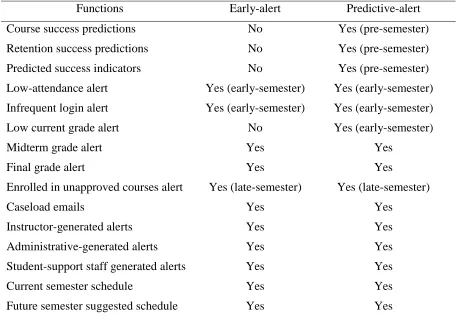
Table 2.1
Student-success Monitoring Systems Differences
Functions Early-alert Predictive-alert
Course success predictions No Yes (pre-semester)
Retention success predictions No Yes (pre-semester)
Predicted success indicators No Yes (pre-semester)
Low-attendance alert Yes (early-semester) Yes (early-semester)
Infrequent login alert Yes (early-semester) Yes (early-semester)
Low current grade alert No Yes (early-semester)
Midterm grade alert Yes Yes
Final grade alert Yes Yes
Enrolled in unapproved courses alert Yes (late-semester) Yes (late-semester)
Caseload emails Yes Yes
Instructor-generated alerts Yes Yes
Administrative-generated alerts Yes Yes
Student-support staff generated alerts Yes Yes
Current semester schedule Yes Yes
Future semester suggested schedule Yes Yes
Note. The table is not a comprehensive list of student-success monitoring system functions; instead, the table provides a list of functions associated with using the systems as tools to prompt
interventions with students. The parenthetical information regards the timing in which this function is first available. Early-semester is defined as within the first 4 weeks of the semester. These particular functions are used from the time indicated until the end of the semester.
While Table 2.1 does not provide all of the functions that most student-success
monitoring systems might have, such as information sections on placement test scores and finances, it does list the functions related to implementing interventions with students. As the table indicates, the two types of systems are very similar; however, systems using predictive
provide information about which student-level variables are estimated to influence a
student’s outcomes the most, and those variables are noted as predicted success indicators in
the table. Combined with course-success and retention predictions, these success indicators provide student-support staff and faculty with actionable information upon which to
personalize interventions. In essence, predictive analytics inform the possible preemptive and
personalized interventions offered to students.
Learning and Predictive Analytics
Initially, the study of analytics developed out of advances in computer science and the exploration of the potential uses for innovations like data mining, social network analysis, user modeling, cognitive modeling, computer-based instruction, adaptive hypermedia, and
online learning (Siemens, 2013). As an eclectic combination of several fields of study, analytics as a field unto itself has not yet been unified into a comprehensive discipline. In spite of still being in development, the definition of “learning analytics” most often cited in
the literature (Arnold & Pistilli, 2012; bin Mat, 2013; Clow, 2013; and Haythornthwaite, de Laat, & Dawson, 2013) comes from one of the founders of the Society for Social Learning Analytics Research, George Siemens: “Learning analytics is the measurement, collection,
analysis, and reporting of data about learners and their contexts, for the purposes of
understanding and optimizing learning and the environments in which it occurs” (Siemens,
2013).
Borrowing the business practice of using analytics on big data to understand the
applied analytics to their own big data to make decisions about processes and efficiencies—a practice first known in education as educational data mining (Campbell et al., 2007;
Jayaprakash et al., 2014; and Siemens, 2013). As institutions adopted the use of learning management systems, such as Blackboard and Moodle, some institutions began to apply analytics to the vast amount of data these systems can collect. This process was originally
referred to as academic analytics (Campbell, 2007). The results of this application of analytics range from the personalization of computerized and online learning software
programs to the development of user/student profiles and predictive modeling of student outcomes (Campbell, 2007; Campbell et al., 2007; Jayaprakash et al., 2014; and Siemens, 2013).
Typically considered a sub-type of learning analytics, predictive analytics in education involve the creation of the algorithmic models used to predict potential student
outcomes in order to identify students who might benefit from proactive intervention. These predictions prompt and inform interventions with the students as needed (Agudo-Peregrina et al., 2014; Arnold & Pistilli, 2012; Campbell et al., 2007; Jayaprakash et al., 2014; and
Siemens, 2013). While several institutions are noted for implementing programs using predictive analytics for areas like enrollment management, advising, career planning, and
student-success monitoring systems, the example most cited is Purdue University’s “Signals” system (Arnold & Pistilli, 2012; bin Mat et al., 2013; Campbell et al., 2007; Clow, 2013; and Jayaprakash et al., 2014). The Signals system predicts students’ probability to pass each
the online platform Aviso provided to the community college in this study greatly resembled that of Purdue University’s Signals system: by using predictive analytics, both systems
identified students based on the students’ predicted performance in the courses in which they
are enrolled. Each institution also provided interventions to students on the basis of how well they were predicted to perform. Interestingly, the effects of the interventions prompted by
these systems on student outcomes have not been examined using either experimental or quasi-experimental research designs.
The research on the impact of the Signals system was correlational and mostly focused on the accuracy of the model predictions (Campbell et al., 2007). With enrollment, transcript, and learning-management-system data, Campbell (2007) developed the predictive model used in Purdue University’s Signals system. Using correlational analysis, Campbell
(2007) developed and tested several predictive models using a logistic regression model that
estimated the odds of students successfully passing a course. In doing so, Campbell (2007) found that across the models academic preparation (standardized test scores), secondary and postsecondary GPA, learning-management-system use, and course level were variables
consistently correlated with successful course completion. Student demographics were found to be more associated with predictions among students who used the learning management system less often than students who accessed those systems most often. Campbell’s (2007) main model’s prediction for course success (earned grade of C or better) was found to be
In fact, like Campbell’s (2007) examination of the predictive precision of the model upon which the Signals system is based, the demonstration of model and method accuracy
constitutes most of the current predictive analytics literature (Aguiar et al., 2014; Davis & Burgher, 2013; Delen, 2011; Denley, 2014; and Smith et al., 2012). For example, Aguiar et al. (2014) used five data analysis techniques (Naïve Bayes, decision trees, logistic regression,
Hellinger distance decision trees, and random forests) to determine which approach provided the most accurate predictions of student retention within an engineering program at Notre
Dame. They found that all of the approaches provided retention predictions with accuracies from 80% to 95% across subsets of a dataset (just academic variables or just engagement variables) as well as for the complete dataset. In addition to demographic variables, their
dataset included academic preadmission factors, like standardized test scores, and
postadmission indicators, like first semester GPA. The engagement variables included login
frequency to the engineering learning management system and submission of work to that system. They found that using all of those variables yielded predictions that were 89% to 95% accurate across the different predictive methodologies.
Davis and Burgher (2013) found results similar to Aguiar et al. (2014) when they ran logit models on past enrollment and retention data. Independent variables such as high school
GPA and non-first-generation higher education student status were shown to have odds ratios greater than one (5.130 and 1.545, respectively) indicating that these variables were
correlated with increased fall-to-fall student retention, while variables such as late application
education were shown to have odds ratios less than one (.668 and .525, respectively) indicating that these variables were associated with increased student attrition (Davis &
Burgher, 2013). Relying on such variables, Davis and Burgher (2013) developed and tested a predictive model for student retention and found that their model predicted retention along several subgroups within less than one percentage point from actual retention. Findings like
these in the literature support the use and accuracy of similar variables in Aviso's predictive models.
Student-success Coaching
Collectively, the literature and theory about retention and persistence suggests that comprehensive intervention programing is needed to facilitate integration into the social and
academic systems of postsecondary institutions and to remove the barriers to student success. Most institutions already have numerous interventions in which students could participate,
but student-success coaching provides students with one point of contact to coordinate intuitional interventions that might best serve the individual student. In the case of my study, predictive analytics informed the coaches’ coordinated and individualized interventions. In
practice, student-success coaches can bridge the divide between students and multiple support services, like writing centers and mental-health counseling (Tripp, 2008), and they can “help students to prepare academically for their courses, to counsel students on how to
Almost no studies have been conducted on student-success coaching. Instead, research has investigated interventions ranging from the development of information
networks and faculty interaction (Karp et al., 2010) and summer-bridge programs (Lonn et al., 2015) to telephone interventions for absenteeism and poor grades (Richie & Hargrove, 2004) and conditional contract student programs requiring regular advising meetings
(Johnson, 2000). Collectively, the implications of this research suggest that some students require continual institutional support and contact to be successful. Additionally, most uses
of student-success monitoring systems involve some advising and “coaching” of students regarding the various indicators (like low grades, poor class attendance, and infrequent learning management system logins) that triggered the system notifications and alerts (Arnold & Pistilli, 2012; Davis & Burgher, 2013; Hanover Research, 2014; O’Cummings &
Therriault, 2015; and Smith et al., 2012). Important to note is that without student-success
coaches, the support these systems initiate is not always consolidated and consistent. Instead, a changing mix of instructors and advisors might or might not act on system-generated alerts. Moreover, the alerts are signals from the system that an issue has already developed; the
reactive alerts do not prompt proactive intervention that could change student behaviors prior to the development of academic problems. Student-success coaching coupled with
predictive-alert student-success monitoring systems provides the opportunity to offer such preemptive intervention.
Although little rigorous research can be found about student-success coaching, Richie
interventions to the student-success coaching program of this study. Moreover, these two studies are the only ones that adequately addressed selection bias with experimental designs.
As noted in earlier discussions, other research related to interventions similar to student-success coaching are at best correlational in design.
To examine the effect of a telephone intervention for excessive absences on student
outcomes, Richie and Hargrove (2004) randomly assigned 25 entry-level English sections to an intervention or to a control group. As the treatment, eligible students in intervention
sections were contacted about their absences and were advised about support services. The study’s results indicated that after two semesters the telephone interactions and follow-ups
increased average attendance by almost two days (p < .01), academic performance by 1 GPA point (p < .01), and fall-to-fall retention for students in the treatment group (77.5% retained compared to 62% retained in the control group) (Richie & Hargrove, 2004). While the
telephone intervention did not constitute a comprehensive student-success coaching program and was not proactive in its implementation, this type of intervention is one of among many responsibilities of student-success coaches (Bettinger & Baker, 2014; and Tripp, 2008). Furthermore, Richie and Hargrove’s (2004) study supports the claim that the offer of
treatment can have a positive effect on outcomes even if students do not accept the treatment.
Carmean, & Haynie, 2012; Milkman, Beshears, Choi, Laibson, & Madrian, 2011; and Thaler, & Sunstein, 2008).
Bettinger and Baker’s (2014) investigation of student-success coaching on retention
found that students assigned to receive coaching and who accepted the treatment persisted at higher rates than students not assigned to the intervention. According to Bettinger and Baker (2014), the coaching company, InsideTrack, created “balanced groups” by randomly
assigning 17 cohorts of students to balanced intervention and control groups for each
institution using its service. InsideTrack then allowed the institutions to choose which of the two groups would receive coaching. Nonetheless, to affirm “the randomization” (p. 8),
Bettinger and Baker (2014) took steps in their study to display that the groups were alike in their observable characteristics and “balanced” groups as needed. In addition to the
methodological approach of Bettinger and Baker (2014), of interest to my study was InsideTrack’s use of proactive and continual coaching as a treatment. The InsideTrack
coaches not only mentored students assigned to the treatment before the occurrence of problems that might have negative impacts on academic performance, persistence, and
retention, but the coaches also advised them through any problems that did arise.
The consistency of the coaching provided by InsideTrack that Bettinger and Baker
(2014) examined distinguished the study from previous research. Additionally, the proactive approach to coaching also differentiated InsideTrack’s intervention from the reactive
practices of other institutions. Bettinger and Baker (2014) found statistically significant gains
and Baker (2014) found that “In contrast to the uncoached persistence rate of 58%, the
retention rate among coached students was 63%” (p. 9). Their findings were relevant to my
study because the coaching methods of InsideTrack and the proactive student-success coaching intervention under examination in the current study were similar, differing primarily in that InsideTrack employed its own coaches and Aviso trained coaches at the institutions with which it partnered. InsideTrack coaches “help students prepare academically
for their courses, to counsel students on how to acquire better study skills, or to provide
advice on how to identify additional academic resources at their respective institutions” (Bettinger & Baker, 2014, p. 5). The student-success coaches at the community college site in my study had the same responsibilities, but they were employees of the community college and were physically located at the community college’s service-area sites.
Synthesis and Application of the Literature
The motif of the above review is that while much research has been conducted on retention and its associated theoretical models, little research has been conducted on student-success monitoring systems, predictive analytics, and student-student-success coaching despite their
proliferation at higher education institutions. Moreover, research has not been conducted on the synthesis of general retention practices, student-success monitoring systems, and
CHAPTER 3: AVISO SYSTEM AND STUDENT-SUCCESS COACHING
The Aviso system platform is a tool that student-success coaches use proactively to support students’ academic integration and performance. The proactive use of information
provided in the Aviso platform distinguishes it from other reactive-only early-alert student-monitoring systems. Most other student-student-monitoring systems alert appropriate institutional
areas about issues, such as low mid-term grades, after they have already occurred. However, Aviso’s predictive analytics allow student-success coaches to contact students before a
predicted need arises in a particular course. While most early-alert student-monitoring systems notify institutions to prompt reactive support, the Aviso system provides student-success coaches the opportunity to initiate proactive and individualized interventions.
Aviso Predictive Alerts
Aviso programmers connect the platform to an institution’s record keeping and online
learning management system, such as Blackboard or Moodle. Aviso merges the institution’s
historical data with data from other peer institutions to create a predictive model that is then applied to the institution’s current student information. Specifically for the community
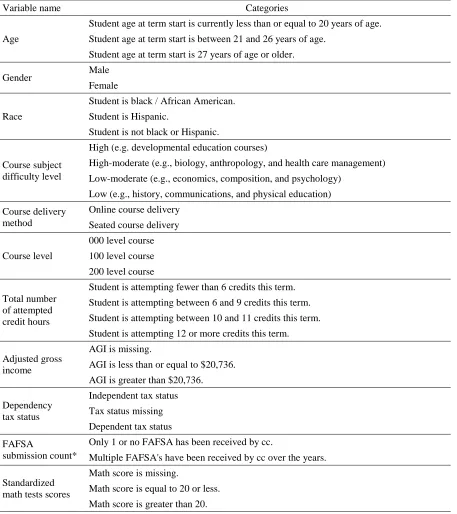
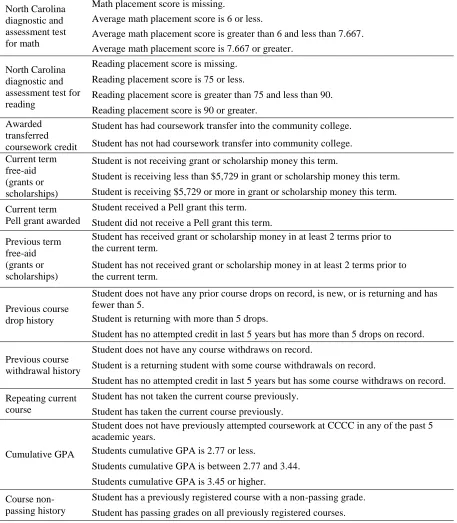
college in this study, Aviso uses 23 student-level variables to predict every currently enrolled student’s academic performance in each course for which students are registered. Table 3.1
Table 3.1
List of Student-Level Variables Used in Aviso’s Predictive Analytics
Variable name Categories
Age
Student age at term start is currently less than or equal to 20 years of age.
Student age at term start is between 21 and 26 years of age.
Student age at term start is 27 years of age or older.
Gender Male
Female
Race
Student is black / African American.
Student is Hispanic.
Student is not black or Hispanic.
Course subject difficulty level
High (e.g. developmental education courses)
High-moderate (e.g., biology, anthropology, and health care management)
Low-moderate (e.g., economics, composition, and psychology)
Low (e.g., history, communications, and physical education)
Course delivery method
Online course delivery
Seated course delivery
Course level
000 level course
100 level course
200 level course
Total number of attempted credit hours
Student is attempting fewer than 6 credits this term.
Student is attempting between 6 and 9 credits this term.
Student is attempting between 10 and 11 credits this term.
Student is attempting 12 or more credits this term.
Adjusted gross income
AGI is missing.
AGI is less than or equal to $20,736.
AGI is greater than $20,736.
Dependency tax status
Independent tax status
Tax status missing
Dependent tax status
FAFSA
submission count*
Only 1 or no FAFSA has been received by cc.
Multiple FAFSA's have been received by cc over the years.
Standardized math tests scores
Math score is missing.
Math score is equal to 20 or less.
Table 3.1 (continued) North Carolina
diagnostic and assessment test for math
Math placement score is missing.
Average math placement score is 6 or less.
Average math placement score is greater than 6 and less than 7.667.
Average math placement score is 7.667 or greater.
North Carolina diagnostic and assessment test for reading
Reading placement score is missing.
Reading placement score is 75 or less.
Reading placement score is greater than 75 and less than 90.
Reading placement score is 90 or greater. Awarded
transferred coursework credit
Student has had coursework transfer into the community college.
Student has not had coursework transfer into community college.
Current term free-aid (grants or scholarships)
Student is not receiving grant or scholarship money this term.
Student is receiving less than $5,729 in grant or scholarship money this term.
Student is receiving $5,729 or more in grant or scholarship money this term.
Current term Pell grant awarded
Student received a Pell grant this term.
Student did not receive a Pell grant this term.
Previous term free-aid (grants or scholarships)
Student has received grant or scholarship money in at least 2 terms prior to the current term.
Student has not received grant or scholarship money in at least 2 terms prior to the current term.
Previous course drop history
Student does not have any prior course drops on record, is new, or is returning and has fewer than 5.
Student is returning with more than 5 drops.
Student has no attempted credit in last 5 years but has more than 5 drops on record.
Previous course withdrawal history
Student does not have any course withdraws on record.
Student is a returning student with some course withdrawals on record.
Student has no attempted credit in last 5 years but has some course withdraws on record.
Repeating current course
Student has not taken the current course previously.
Student has taken the current course previously.
Cumulative GPA
Student does not have previously attempted coursework at CCCC in any of the past 5 academic years.
Students cumulative GPA is 2.77 or less.
Students cumulative GPA is between 2.77 and 3.44.
Students cumulative GPA is 3.45 or higher.
Course non-passing history
Student has a previously registered course with a non-passing grade.
Table 3.1 (continued) Current term
online course registration
Student is registered for an online course this term.
Student is not registered for an online course this term.
Note: *Due to collinearity with the dependency is missing variable, FAFSA submitted was excluded from the propensity score and later analyses. Aviso provided a list of variables used in its predictive analytics model. The above lists those variables and their categories, but the actual data set variable names were changed to be clearer for the reader. For example, Aviso’s name for the variable “crrtrmattcred_cat” was changed to “Total Number of Attempted Credit Hours.”
As shown in the table, variables include demographics (e.g., age, gender, race, and financial
need); academic history (e.g., placement test scores, cumulative GPA, and course
drop/withdrawal records); and current academic rigor (e.g., total hours attempted, course difficulty, delivery method, and course level). Using these variables and previous students’
comparable performances (obtained via the historical student data from the institution and its peer institutions), Aviso processes each current student data through an algorithm to estimate a student’s probability of passing each course successfully, defined as a final course grade
equal to or greater than 70%.
The probability for success that the algorithm produces is presented as a predicted
grade for each course in which a current student is enrolled. Predicted grades fall within three course performance levels: low, moderate, and high. Low performance corresponds to
predicted numerical grades of less than 70; moderate performance corresponds to predicted numerical grades equal to or greater than 70 but less than 86; high performance corresponds