18th International Conference on Structural Mechanics in Reactor Technology (SMiRT 18) Beijing, China, August 7-12, 2005 SMiRT18-S07-2
PLUTONIUM IN ATOMIC ENERGY (POINT OF VIEW OF THE
INDEPENDENT EXPERT)
G.V.Kiselev
State Scientific Centre of the Russian Federation
“Institute Theoretical and Experimental Physics” (ITEP)
e-mail: [email protected]
Report on International conference "Russia Power 2004", Moscow, March 11-13 2004
1. INTRODUCTION
As of [1] the inventory of plutonium in the world, including weapon-grade plutonium, on the end 2000 formed 1600 - 1700 t; to 2010 in spent uranium fuel of power reactors of the world by total power ~ 400 GWt in the absence of reprocessing and recycling ~ 3000 tons of plutonium, 140 t neptunium-237, ~120 t isotope of americium will be kept. The accumulation of power plutonium in Russia up to 2050 can form 500 t [2].
It’s appears the natural question - that to do with this amount of plutonium? There are two opposite approaches to problem of plutonium.
The first direction is connected with useful disposition of plutonium as nuclear fuel in power reactors for production of energy and reproduction of nuclear fuel. Specialists indicate to large power effect from use of plutonium as nuclear fuel. For instance, the potential of the use of 34 t surplus weapon-grade plutonium in fast reactors can be ~100 mln. kWth energy [3] that comparable with production of the electric power of all Russian NPP’s in 2002 (165 mln. kWth).
The second direction is motivated by representatives of ecological organisations, which consider the plutonium too dangerous for mankind, and so its does not follow to use in atomic power (AP), but it’s necessary to burial into the earth.
2 RADIATION PROPERTIES OF PLUTONIUM.
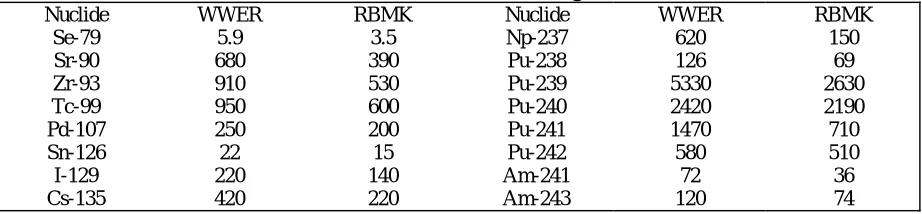
There is two kind of plutonium: weapon-grade and power, which are differed by isotope composition, that it’s necessary to distinguish. The weapon-grade plutonium was accumulated in industrial reactors for the manufacture of the nuclear weapon. The power plutonium is accumulated in fuel of NPP’s power reactors and differs from weapon-grade by raised content of isotopes plutonium-240 and 241. A part of power plutonium is extracted out spent nuclear fuel (SNF), however, more part is kept in SNF, which is found in storage. The data on the concentrations of long-lived FP's and MA’s (g/t) in SNF of Russian LWR WWER-1000 and uranium-graphite RBMK-1000 reactors after 0.5 year of cooling is presented in Table 1 [4].
Table 1. Concentrations of long-lived FP’s and actinides in SNF of WWER-1000
and RBMK-1000 reactors (g/t).
Nuclide WWER RBMK Nuclide WWER RBMK
Se-79 5.9 3.5 Np-237 620 150
Sr-90 680 390 Pu-238 126 69
Zr-93 910 530 Pu-239 5330 2630
Tc-99 950 600 Pu-240 2420 2190
Pd-107 250 200 Pu-241 1470 710
Sn-126 22 15 Pu-242 580 510
I-129 220 140 Am-241 72 36
Cs-137 1460 900 Cm-242 6.1 5.2
Sm-151 15 4.0 Cm-244 46 8.1
If using of plutonium as a fuel one has to keep in mind that its isotopic composition changes while storing. The information on changes of isotope content for power plutonium extracted from SNF of WWER reactors with burn-up of 40 kg of FP’s per 1 ton in dependence from time of storage is presented in Table 2 [4]. The data of the Table 2 allows to define the strategy of SNF radiochemical reprocessing in the event of closed nuclear fuel cycle (CNFC) and to use plutonium as nuclear fuel depending on time of its storage after unloading from reactor. If the plutonium after SNF reprocessing uses, which was in storage during 20 years and more, without its purification then plutonium will contain Np-237 and Am-241 in this case. This circumstance follows to take into account at calculation of mode on use of plutonium as nuclear fuel of power reactor or for transmutation .
Table 2. Masses of isotopes of plutonium and other nuclides per 1 t of SNF for
different storage duration.
Nuclide T1/2, y Freshly extracted Pu 20 y storage duration 50 y storage duration
SNF (g/t) % to Pu SNF (g/t) % to Pu SNF (g/t) % to Pu
Pu-238 87,74 130 1.3 111 1.21 87 1.0
Pu-239 2,4+4 5520 55.4 5520 60.5 5520 63.3
Pu-240 5,56+3 2420 24.3 2410 26.5 2410 27.6
Pu-241 14,4 1300 13.1 496 5.44 117 1.3
Pu-242 3,7+5 583 5.9 583 6.39 583 6.7
Total Pu 9950 100 9120 100 8710 100
Np-237 2,1+6 0 0 14.5 0.16 61.8 0.71
Am-241 432 0 0 788 8.64 1120 12.9
Uranium 0 0 27 0.30 62 0.72
The decay heat power of MA is very important data for definition of conditions on fuel manufacture, storage and burial. The total decay heat power of MA and the contributions of the most important actinides at storage of spent plutonium fuel during 100000 years are given in Table 3 [5].
Table 3. Decay heat power of actinides from SNF WWER-1000, W
T, year 1 10 100 1000 10000 100000
Pu-238 106 99.0 48.9 0.057 - -
Pu-239 20.1 20.1 20.1 19.6 15.5 1.19
Pu-240 55.0 55.3 55.4 50.4 19.4 0.0014
Pu-241 10.6 6.85 0.090 - - -
Pu-242 0.209 0.209 0.209 0.209 0.206 0.174
Am-241 96.5 225 407 96.9 0.076 -
Am-243 2.70 2.70 2.68 2.46 1.06 -
Cm-242 15.5 0.763 0.506 - - -
Cm-243 3.24 2.60 0.292 - - -
Cm-244 398 282 9.00 - - -
Cm-245 0.162 0.162 0.160 0.149 0.071 -
Total 708 694 544 170 36.5 1.66
The decay heat power, as well as the radiotoxicity, corresponds to the content of actinides in one ton of unloaded fuel. The decay heat power of MA of spent uranium-plutonium fuel in initial period of a storage is determined by a nuclide Cm-244 which creates 56 % of a power. The contribution of plutonium isotopes makes 27 %, Am-241 - 13 %. After 100 years of a storage total power of MA decreases 1.3 times. Am-241gives 75 % of main contribution, plutonium isotopes - 23 %, Cm-244 - 1.6 %. After 10000 years, power reduces 20 times, after 100000 years - 460 times.
given quantity of nuclide of kind i is the amount of water necessary for dilution of having quantity of nuclide to maximum permissible concentration:
RTi= Ai / PAi ,
where Ai - activity of radionuclide, PAi - their maximum permissible activity of radionuclide of kind i in air or
in water according to acting Standards of radiation safety.
The quantitative levels of the total radiotoxicity of MA’s by water and air and contributions of most important actinides in the total radiotoxicity at storage of WWER-1000 type reactor’s SNF during 100000 years are presented in Tables 4 and 5 [4].
Table 4. Radiotoxicity of
МА
from uranium-plutonium spent fuel by water, kg water
T, year 1 10 100 1000 10000 100000
Pu-238 1.98+14 1.84+14 9.10+13 1.06+11 - -
Pu-239 4.27+13 4.27+13 4.26+13 4.17+13 3.29+13 2.54+12
Pu-240 1.17+14 1.17+14 1.18+14 1.07+14 4.12+13 -
Pu-241 4.24+14 2.75+14 3.62+12 - - -
Pu-242 4.52+11 4.52+11 4.52+11 4.51+11 4.45+11 3.77+11
Am-241 1.54+14 3.59+14 6.50+14 1.55+14 1.22+11 -
Am-242m 1.32+12 1.27+12 8.44+11 - - -
Am-243 4.50+12 4.50+12 4.46+12 4.10+12 1.76+12 -
Cm-243 3.53+12 2.84+12 3.18+11 - - -
Cm-244 3.51+14 2.49+14 7.93+12 - - -
Total 1.30+15 1.24+15 9.19+14 3.09+14 7.67+13 3.11+12
Table 5. Radiotoxicity of
МА
from SNF by air, m
3air
T, year 1 10 100 1000 10000 100000
Pu-238 4.39+16 4.09+16 2.02+16 2.35+13 - -
Pu-239 9.57+15 9.57+15 9.55+15 9.34+15 7.38+15 5.68+14
Pu-240 2.62+16 2.63+16 2.63+16 2.40+16 9.23+15 -
Pu-241 8.78+16 5.69+16 7.49+14 1.19+12 - -
Pu-242 1.01+14 1.01+14 1.01+14 1.01+14 9.92+13 8.41+13
Am-241 3.67+16 8.54+16 1.55+17 3.69+16 2.90+13 -
Am-242m 2.93+14 2.81+14 1.87+14 3.08+12 - -
Am-243 1.03+15 1.03+15 1.03+15 9.42+14 4.05+14 -
Cm-243 8.21+14 6.59+14 7.39+13 - - -
Cm-244 9.15+16 6.48+16 2.07+15 - - -
Total 2.99+17 2.86+17 2.15+17 7.13+16 1.72+16 6.80+14
The amount of MA’s corresponded to their contents in 1 ton of SNF with burn-up of 40 kg of FP’s per 1 ton and subsequent cooling during 3 years. The fresh fuel was a mix of depleted uranium with addition of 3.5 % plutonium. The changes of relative radiotoxicity RТi depending on time of storage are presented in Table 6 (RТi
for Pu-239 is taken equal 1) [4].
Table 6. Changes of relative radiotoxicity of
МА
from SNF
WWER-1000 in dependence from duration of storage [13]
Nuclide i T1/2, year duration of storage, year
10 100 1000 10000
Pu-238 87,7 233 110 0,3 1,5
Pu-239 2,4+4 1 1 0,97 0,75
Pu-240 5,56+3 3,6 3,6 3,3, 1,3
Pu-241 14,4 45 56 13 0,02
Pu-242 3,7+5 0,05 0,05 0,05 0,05
Am-241 432 63 54 13 0,02
Am-243 737 3,3 3,3 3,1 1,8
Cm-244 18,1 600 20 3,3 1,3
Total 948.97 247.97 36.77 6.75
The data presented shows following. The radiotoxicity of MA’s in spent uranium-plutonium fuel by air in initial period of a storage is determined by nuclides Pu-238, Pu-241, Cm-244. Their contribution in beginning of storage is 75%. All isotopes of a plutonium give 56%, Cm-244 - 30%. In addition, Am-241 creates 12% of radiotoxicity. At storage there is the conversion Pu-241 into Am-241. After 100 years of storage, total radiotoxicity of MA’s decreases 1.4 times. The main contribution 72% gives. The contribution of plutonium isotopes makes 26%. The amount of Cm-244 decreases essentially because of decay. Their radiotoxicity falls 44 times and makes 1% of total radiotoxicity to the end of 100-year period of storage. After 1000 years of storage, radiotoxicity by air falls 4.2 times, after 10 000 years - 17 times, after 100000 years - 440 times.
3. THE CRITERIA FOR COMPARISON AND CHOICE OF THE SCENARIO OF THE MANAGEMENT WITH PLUTONIUM
Comparison and choice of the scenario on the management of plutonium is impossible without discussing and formulation of co-ordinated criteria. It’s expedient to formulate two interconnected main criteria. The first, ecological criterion pertains to influence on surrounding environment, including population, which will be defined by collective dose of the irradiation to populations. For its calculation it’s necessary to conduct the conceptual system comparison of proposed versions, to do the choice of the optimum variant, to execute the development of the project to get information on possible design level on releases of radioactive materials in environment, including plutonium. For present-day such system studies are not made and this information is incomplete or are absent. So on stage of the conceptual study it’s possible to use the level of radiotoxicity. The second criterion pertains to economic feature of the proposed versions on the management of plutonium, which are closely connected with taken by technical decisions. So specific cost to energy (economic competitive ability), produced on NPP’s, for each of variant and comparison with existing and perspective costs, can serve as main economic criterion at study of considered variants.
It’s useful also to define some local requirements. To it pertains: 1. Provision of nuclear safety on all stages of the management with plutonium; the quantitative criterion is a provision of the requirement for value of the effective factor multiplication Keff less 1 under any emergency conditions of the system with plutonium; 2. The
minimum losses of plutonium on all stages of the management; 3. Provision of the non-proliferation by means of organising and technical measures.
4. USE PLUTONIUM AS NUCLEAR FUEL IN AP
It’s necessary to note a several obvious facts, concerning to possible use of plutonium as nuclear fuel in AP: 1. The plutonium as NPP’s nuclear fuel is unclaimed that can be explained by low cost of uranium fuel and high cost of plutonium.
2. The raised radiation features of plutonium in contrast with uranium fuel that requires remote management at the fabrication of plutonium fuel for NPP’s.
3. The possibility of extended breeding with factor Kb more 1 in reactors on fast neutrons in contrast with
reactors on thermal neutrons with Kb less 1.
4. The possibility on realisation of two CNFC variants with use of plutonium as nuclear fuel in AP:
a) open СNFС, with one cycle of irradiation of fuel from available weapon-grade or power plutonium, without reprocessing;
b) closed nuclear fuel cycle (СNFС), with multirepeated use of regenerated uranium and plutonium fuel in power reactors, with reprocessing.
Management with plutonium in Russia is defined two main documents, prepared by Minatom: - A Concept on management with plutonium (1998);
- A Strategy on the development of atomic power in Russia, approved by the Russian Government at May 2000.
of closed NFC. However available data are indicative of that atomic industry in Russia not yet ready to execution of the program on disposition of 34 t weapon-grade plutonium.
As defined in [7], it’s necessary to execute the large volume of R&D on development of new technologies and substantiation of projects on construction of new plants and installations, including:
1. R&D and feasibility study for creation of demonstration and industrial installations for conversion of metallic weapon-grade plutonium in oxide, suitable MOX-fuel for fabrication of fuel assemblies.
2. R&D and feasibility study for creation of demonstration installations and plants for fabrication MOX-fuel for reactors WWER-1000 and BN-600.
3. R&D on substantiation of different variants of weapon-grade plutonium disposition in reactor on fast neutrons BN-600, including safety.
4. R&D on substantiation of different variants of weapon-grade plutonium disposition in reactor WWER-1000, including safety.
5. R&D on immobilization of plutonium.
In present time it’s follows to note that there is the experience of the plutonium fuel manufacture on
experimental installations of enterprise “Mayak” and Research Institute of Atomic Reactors in Dmitrovgrad. Schedule of the MOX-fuel loading in reactors on fast neutrons BOR-60, BN-600 and LWR WWER-1000 allows to irradiate 37 tons of WGPu till 2023 y.
The burn-up of MOX-fuel in existing power reactors will be approximately 16% and less of initial amount of loaded plutonium. In this connection appears the dilemma or the multirepeated irradiation of this fuel after reprocessing or burial of spent MOX-fuel without reprocessing.
The results of the weapon-grade plutonium disposition in reactor WWER-1000 are: 1. Transformation of metal plutonium in dioxide and MOX-fuel;
2. Destruction not more than 10-16% of initial weapon-grade plutonium for one cycle of irradiation; 3. Placement of remaining, inburnt amount of plutonium into the matrix of spent MOX-fuel for
subsequent cooling and reprocessing or burial.
4. The necessity of MOX-SNF: or a) reprocessing and multirepeated cycles of irradiation in power reactors in case of closed nuclear fuel cycle; or b) burial of MOX-SNF without reprocessing. In version a) it’s necessary to solve a non-proliferation problem.
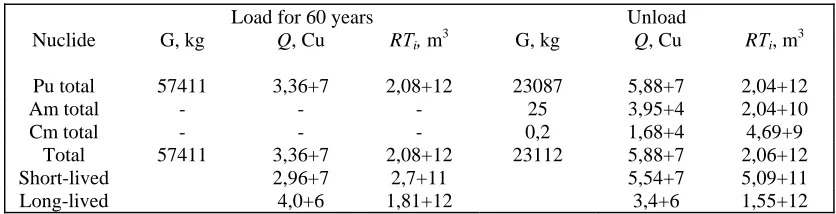
To define the changes of radiotoxicity the calculations of the change of activity Q and radiotoxicity RТi of MA
exposed in a heavy-water reactor (or ADS blanket) with neutron flux density of 1014, 1015, 1016 cm-2s-1 was done in the ITEP. A heavy-water core (or ADS blanket) of thermal capacity 1000 MWt, loaded by weapon-grade plutonium as a nuclear fuel and similar with the core of reactor Candu with some modifications. Different time of fuel storage before loading T1 and after unloading from reactor T2 are considered. The results of these
calculations are presented in Tables 8.
Table 8. Activity Q and radiotoxicity of weapon-grade plutonium by irradiation in a low-flux
heavy-water ADS for T
1and T
2equal to 30 years.
Load for 60 years Unload
Nuclide G, kg Q, Cu RТi, m3 G, kg Q, Cu RТi, m3
Pu total 57411 3,36+7 2,08+12 23087 5,88+7 2,04+12
Am total - - - 25 3,95+4 2,04+10
Cm total - - - 0,2 1,68+4 4,69+9
Total 57411 3,36+7 2,08+12 23112 5,88+7 2,06+12
Short-lived 2,96+7 2,7+11 5,54+7 5,09+11
Long-lived 4,0+6 1,81+12 3,4+6 1,55+12
this fundamental result. It means that the disposition of weapon-grade plutonium in reactors WWER-1000 is not ecological process. It's fundamental result too.
The total expenditures of the R&D work according to Russian program of the disposition of weapon-grade plutonium are the minimum 2.0 bln. dol., in contrast with 3.5 - 4.0 bln. dol. for utilisation on 34 t of American weapon-grade plutonium [7]. If the costs on R&D is 2 bln. dol., the increasing of the price of electric power from disposition of 34 t of weapon-grade plutonium, concerning to account the R&D only, will be 2.109 dol./ 1011 kWth = 2 cents/kWth, i.e. is increased approximately at 60% in contrast with existing tariff. Hereto it’s follows to add the operating expenses, to which will pertain the costs on purchasing of MOX-fuel, which as of [7] is since 900 till 1500 dol. per 1 kg of heavy metal and the cost on management of LLRW too. This means that operating expenses of NPP’s with MOX-fuel will greatly increase. If the cost of the natural uranium is 50$/kg and uranium fuel manufacture - 275 $/kg, the operating cost of electric power for NPP with plutonium fuel will increase in 4-5 times approximately. These estimations are indicative of unsatisfactory economic feature of CNFC with plutonium. However, world market plutonium is not exists so it’s impossible to exclude that the cost of plutonium will be more then 1500 $. It’s known that in USA in 1966 the power plutonium was purchased on the price 10000 $/kg, but was sold on the price 40000 $/kg.
There are following technical problems on realisation of closed CNFC: remote fabrication of plutonium fuel; the problem of safety in relationship with significant volume of plutonium, once loaded in reactor and multirepeated irradiation of plutonium fuel; new technologies of reprocessing and purification of plutonium and MA; vitrification of increased MA volume in contrast with uranium fuel; the non-proliferation in the event of reprocessing; the raised influence on surrounding environment in the event of emergency; the increased cost of the cycle in contrast with uranium fuel. So, in spite of existing positive estimations of CNFC different variants, executed by Russian experts, as well as experts of OECD and IAEA, before present-day time there is no united opinion amongst scientific public about economic competitive ability of AP with opened and closed CNFC and involvement of plutonium in AP. Hereto follows to note that the study of the changes of MOX-fuel radiotoxicity, as one of the criterion to ecological safety, are absent. This means that ecological element of process of the plutonium disposition as nuclear fuel is not studied. So, in the opinion of author, the main task of conducted system’ conceptual studies on management with plutonium is a determination of economic and ecological features of CNFC with provision for the other criterion and requirements, specified above. Only after this it’s possible to come to a conclusion about possibility of the realisation of CNFC and involvement of plutonium in AP.
5. TRANSMUTATION PLUTONIUM
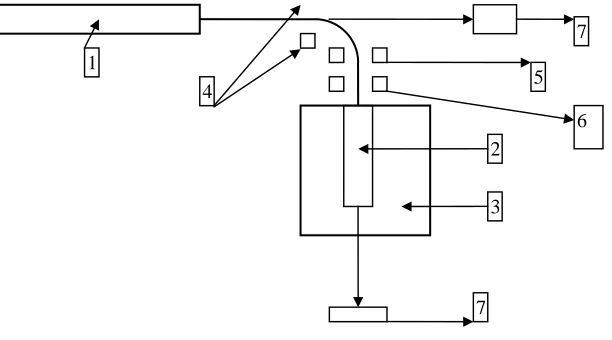
As a result of transmutation there is principle possibility of the practically full destruction of plutonium. This possibility reaches in special homogeneous burner-reactor or in Accelerator Driven System (ADS ) with homogeneous blanket and fluid fuel. Coming from considerations of safety and efficiency, the author considers that ADS is more preferred, than nuclear reactors with critical core for plutonium disposition. The scheme ADS is submitted for Fig.1, from which is seen that ADS consists of the following main elements: proton accelerator, neutron-producing target, subcritical blanket.
7
7
6 5 4
3 2 1
Linear accelerator (1), neutron-producing target (2), blanket (3), turning magnets (4), device to reduce energy release in the target (5), trap for metal vapour (in case of using a liquid target without separating diaphragm) (6), emergency proton beam trap (7)
The ITEP experts have considered the mode on transmutation of weapon-grade plutonium in heavy-water reactor (blanket) with thermal neutrons flux F = 1.14 1014, 1.14 1015 and 1.14 1016 cm-2s-1, for the time of subsequent cooling after unloading out reactor T = 0, 15 and 30 years [4].
In Table 10 the relative concentrations of weapon-grade plutonium isotopes are presented in multirepeated irradiation with flux density 1.14 1014 cm-2s-1 without subsequent cooling.
Table 10. Plutonium Isotope’s Concentrations (1.14·10
14cm
-2s
-1)
n Pu-239 Pu-240 Pu-241 Pu-242
0 0.955 0.045 - -
1 0.237 0.205 0.039 0.0076
2 0.059 0.176 0.050 0.025 3 0.015 0.122 0.043 0.041
4 0.0037 0.078 0.031 0.053
5 0.0009 0.047 0.021 0.060
6 0.0003 0.027 0.014 0.063
7 0.0001 0.015 0.0085 0.064
8 - 0.0084 0.0050 0.063
9 - 0.0045 0.0028 0.061
10 - 0.0025 0.0016 0.058
They are normalised by total initial plutonium concentration in the beginning of irradiation. Instead of the irradiation time there is the number n of lifetimes of 0.264 year each. The n is equal to 1; 2; 3; ... ; 10; and the irradiation time is 0.264; 2x0.264; 3x0.264; ... ; 10x0.264 year.
From Table 10 are seen that after 4 cycles of the irradiation contents plutonium becomes less 0.01 of initial amount.
In Table 12 the total radiotoxicity of all actinides is presented. It is normalised by initial radiotoxicity.
Table 12. Total Plutonium, Americium and Curium Radiotoxicity
F = 1.14·1014 cm-2s-1 F = 1.14·1015 cm-2s-1 F = 1.14·1016 cm-2s-1
n T, year T, year T, year
0 15 30 0 15 30 0 15 30 0 1 1 1 1 1 1 1 1 1
1 14.6 15.1 15.3 8.3 5.0 3.3 2.7 1.53 0.89
2 40.9 41.3 41.6 19.4 10.9 6.2 0.054 0.040 0.032
3 56.1 56.0 56.2 23.5 13.3 7.5 0.012 0.012 0.012
4 57.7 56.9 56.9 21.7 12.3 7.0 0.007 0.007 0.007
5 51.2 49.9 49.7 17.5 9.9 5.6 0.004 0.004 0.004
6 41.9 40.0 39.6 13.1 7.4 4.2 - - -
7 32.7 30.5 29.8 9.3 5.3 3.0 - - -
8 25.2 22.6 21.5 6.4 3.7 2.1 - - -
9 19.8 16.7 15.4 4.4 2.5 1.4 - - -
10 16.3 12.8 11.0 2.9 1.7 0.96 - - -
The data of Tables presented and our calculations show following.
1015 cm-2s-1 after 10 lifetimes all the plutonium and americium isotopes are burned out, the concentration of curium isotopes up to Cm-245 are decreased twice, and concentrations of more heavy isotopes reach a maximum. In flux of 1016 cm-2s-1 after the third lifetime of irradiation all the isotopes up to Cm-245 are burned out rather deeply, Cm-246 and Cm-247 concentrations are decreased 4 times, and Cm-248 reaches a maximum.
The total activity in flux of 1014 cm-2s-1 without subsequent cooling reaches a maximum to the end of third lifеtime. It’s 50 times greater then initial activity. After 10 lifetimes it’s 12 times greater than initial activity. In flux of 1015 cm-2s-1 the maximum activity is 18 times greater than initial one (also after 3 lifetimes), and after 10 lifetimes it is twice greater than initial activity. In flux of 1016 cm-2s-1 the maximum is reached to the middle of the first lifetime. After 2 lifetimes the activity is equal to 3 % of initial one.
The total radiotoxicity in flux of 1014 cm-2s-1 without subsequent cooling reaches a maximum to the end of fourth lifetime. It’s 58 times greater than initial value. After 10 lifetimes it’s 16 times greater than initial value. In flux of 1015 cm-2s-1 the maximum radiotoxicity is 23.5 times greater than initial one (after 3 lifetimes), and after 10 lifetimes it’s 3 times greater than initial value. In flux of 1016 cm-2s-1 the maximum is reached to the middle of the first lifetime. After 2 lifetimes the radiotoxicity is equal to 5 % of initial one. Cm-244 introduces the major contribution into activity and radiotoxicity. Dependence of activity and radiotoxicity on subsequent cooling time is slow. After 15-years cooling the activity and radiotoxicity is 1.3-1.8 times less, and after 30-years cooling they are 2-3 times less than without cooling.
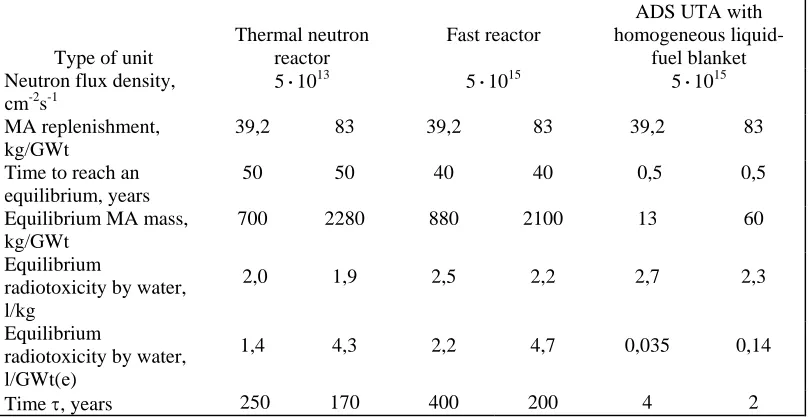
In addition, computer simulations were carried out in the ITEP and the MEPI under the ISTC project № 17 to compare the MA transmutation efficiency in different reactor units: the thermal reactor WWER-1000; fast reactor BN-800 and homogeneous heavy-water blanket ADS UTA. The 2 versions of MA replenishment for these facilities: 39.2 and 83 kg/GWt(e). The following characteristics are defined: time to reach an equilibrium when rates of MA accumulation and incineration are equal; inventory of MA and radiotoxicity in an equilibrium state, time t after which radiotoxicity accumulated in storage equals to radiotoxicity of MA in an equilibrium state. The results of this comparison are presented in Table 13. It can be seen from Table 13, that the time to reach the equilibrium state, where the transmutated MA radiotoxicity equals to the radiotoxicity of fresh MA, is 50, 40, and 0.5 years for the thermal reactor, fast reactor, and the UTA facility respectively.
Table 13. Transmutation performance of different nuclear power units.
Type of unit
Thermal neutron reactor
Fast reactor
ADS UTA with homogeneous
liquid-fuel blanket Neutron flux density,
сm-2s-1
5·1013 5·1015 5·1015
MA replenishment, kg/GWt
39,2 83 39,2 83 39,2 83
Time to reach an equilibrium, years
50 50 40 40 0,5 0,5
Equilibrium MA mass, kg/GWt
700 2280 880 2100 13 60
Equilibrium
radiotoxicity by water, l/kg
2,0 1,9 2,5 2,2 2,7 2,3
Equilibrium
radiotoxicity by water, l/GWt(е)
1,4 4,3 2,2 4,7 0,035 0,14
Time τ, years 250 170 400 200 4 2
Calculations performed allow us to make the following conclusions:
WWER-1000 load.
Presented in this section results are indicative of following:
1. Transmutation of plutonium in neutron flow is connected with forming the quite a number long-lived MA (Am and Cm) with high radiotoxicity. In this connection necessary to analyse the scheme an transmutation of all MA (since neptunium till curium and californium).
2. There is principle possibility of the destruction plutonium in thermal flux of the order of 1014 cm-2s-1 due to multirepeated cycles of the irradiation in reactor (or ADS blanket).
3. There is principle possibility of the efficient joint destruction plutonium and other MA in high flow thermal neutron (5.1015 sm-2s-1).
Thus, the problem of weapon-grade plutonium utilisation can be decided with neutron flux of the order of 1014 cm-2s-1 and the effective incineration of other minor actinides formed during process of plutonium transmutation requires an irradiation with flux of the order of 5 1015 cm-2s-1.
6. BURIAL PLUTONIUM INTO THE EARTH.
As defined in [5], in program of the work on management of plutonium R&D on immobilization of 1.5 t weapon-grade plutonium, being kept in radioactive pulp, must be to undertake. However, what follows from previous sections amount plutonium for immobilization can turn out to be more than 1.5 t. Technological cycle on plutonium burial can consist in plutonium vitrification or its compounds as obligatory requirement, initial its controlled surface storage and the following underground burial. There are following technical problems: remote management; the development to technology of plutonium vitrification; the motivation of radiation stability of the matrix for immobilization of plutonium; the choice of the place for controlled keeping and underground burial; the danger of the spreading plutonium as weapon-grade nuclear material and raised influence on surrounding ambience in the event of arising the emergency; the non-proliferation; the economy. The possible effect from burial plutonium is concluded in exception of the dangerous cycles of the fabrication nuclear fuel, irradiation of plutonium in energy reactor, reprocessing of SNF and management with fluid and solid nuclear waste, formed as a result reprocessing .
7. THE CONCLUSION
The analytical consideration allows to do following conclusion:
1. The amount of plutonium will constantly increase in existing AP scheme if plutonium will not be involved in CNFC. In this case it needs to provide a long-term safe storage.
2. At involvement plutonium in AP its amount can change as follows:
a) decreasing of plutonium quantity in the event of scenario on its disposition in power reactors on thermal neutrons only;
b) increasing of plutonium quantity in event of scenario on its disposition in power reactors on fast neutron with extended reproduction;
c) preservation of plutonium quantity at minimum-possible stationary level in the event of plutonium transmutation, depending on correlation between capacities of power reactors and transmutation installations. 4. It’s expedient to add the existing Concept of the management with plutonium by R&D activity on transmutation of plutonium in subcritical systems (ADS). It’s important to study the multirepeated irradiation of weapon-grade and power plutonium for all stages of its management. The problem of weapon-grade plutonium utilisation can be decided with neutron flux of the order of 1014 cm-2s-1 and the effective incineration of minor actinides formed during process of plutonium transmutation requires an irradiation with flux of the order of 5 1015 cm-2s-1. The ADS is more preferable for transmutation of plutonium and MA than power reactors. It’s not expedient to use the existing energy reactors for transmutation of plutonium and MA in connection with their low efficiency.
5. The existing information on disposition of plutonium is not enough for comparison and choice of the optimal variant for plutonium management. It’s necessary to continue the system studies with provision for already available result, and on base of the new conceptual study.