Studies on Extraction Behaviour of Reserpine
during Reverse Micellar Extraction from
Rauwolfia Vomitoria
D.Ranganath
1, M A Lourdu Antony Raj
2Associate Professor, Department of Chemical Engineering, R.V.College of Engineering, Bangalore, India1 Professor, Department of Chemical Engineering, R.V.College of Engineering, Bangalore, India2
ABSTRACT: Reserpine a well known phytochemical molecule found in the dried roots of plants such as Rauwolfia Serpentina and Rauwolfia Vomitoria. It is a hypertension drug molecule used in drug formulation. Reserpine ranks as one of the most complex natural product of its size and contains 21 skeletal atoms compactly arranged in five rings. The stereo chemical complexity and biological significance of Reserpine have made it a fascinating target for evaluation of new strategies that are conceived upon emergence of new methods for processing, since the conventional methods of extraction like HPLC, two phase extraction are not economical and efficient. Reverse micellar extraction, a novel method for separation of natural drug molecule has been explored for the purpose based on its success in isolating and separating other bio molecules like matrine and enzymes. Reverse micellar extraction adopts micro emulsions as a media of separation. The present work focuses on use of micro emulsions to enhance the rate of separation and extract Reserpine. The extraction behavior of Reserpine was investigated using reverse micellar extraction. It is found that during the forward extraction fractions of the Reserpine did not vary considerably with an increase in Aerosol OT concentration in the organic phase. However the backward extraction of Reserpine increased by 13% with increasing in concentration of cyclohexane in the stripping aqueous phase. The concentration of Reserpine obtained was analyzed in a UV-Vis spectrophotometer.
KEY WORDS: Reserpine, Reverse micelles, forward extraction, backward extraction, absorbance
I. INTRODUCTION
Natural products, including plants, animals and minerals have been the basis of treatment of human diseases. Nevertheless, ancient wisdom has been the basis of modern medicine and will remain as one important source of future medicine and therapeutics. History of medicine dates back practically to the existence of human civilization and majority of new drugs have been generated from natural products (secondary metabolites) and from compounds derived from natural products [1,2]. The process in natural product drug discovery usually required several separation circles and structure elucidation and was thus time consuming. New approaches to improve and accelerate the joint drug discovery and development process are expected to take place mainly from innovation in drug target elucidation and lead structure discovery. Powerful new technologies such as automated separation techniques, high throughput screening and combinatorial chemistry are revolutionizing drug discovery [3].
Fig. 1 Structure of Reserpine
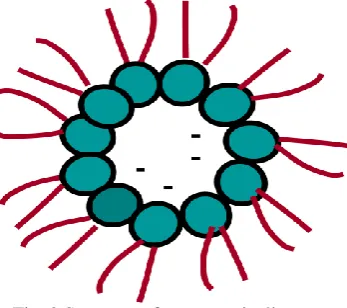
Reverse micelles are thermodynamically stable, optically transparent, submicroscopic (nano) aggregates of ssuurrffaaccttaanntt m
moolleeccuulleess in non-polar solvent. The surfactant molecules (aammpphhiipphihilleess)) form reverse micelles with their lilippoopphhiilliicc tails towards the solvent and hhyyddroropphhiilliicc head groups facing the core as shown in Fig. 2. During Reverse Micellar Extraction (RME) biomolecules are solubilized inside the ppoollaarr cocorree of surfactant shell that protects them from denaturation.
Fig. 2 Structure of reverse micelle
RME is an attractive Liquid Liquid Extraction (LLE) method for separation and purification of biological products including alkaloids, amino acids, proteins, enzymes, and nucleic acids [6]. These can be solubilised within and recovered from such solutions without loss of native function/activity. RME offer low interfacial tension, cost effectiveness, ease of scaling up and implementing a continuous process. The use of reverse micelles is thought to be among the most promising due to the high efficiency and selectivity being achieved in some systems. The process of RME has two phases: (i) Forward extraction and (ii) Back Extraction. Reverse micelles formed by ionic surfactants can only be employed for the extraction of biomolecules that are charged in the extraction system with the electrostatic interaction between surfactants and solutes as the driving force [7]
II. METHODOLOGY
Experimental work involves centrifuging aqueous and organic phases. Above a certain threshold limit known as critical micellar concentration, the surfactant molecules, which are amphiphilic in nature, bind small water pools in their core, via their hydrophilic ends, forming reverse micelles. These hydraulic cores contain the isolated Reserpine molecules. Thereafter, the surfactant-rich layer is decanted. This is followed by bringing it in contact with a new aqueous phase, containing an appropriate alcohol, which results in the transfer of the pure biomolecule into the new phase.
Micro emulsions were prepared with different concentrations of Aerosol OT (AOT)/water/cyclohexane. Study has been done on use of these micro emulsions to enhance the rate of separation and to extract Reserpine by analyzing formations of reverse micelles, Core size of the micro emulsions, forward extraction and backward extraction. The molar ratio ie., the number of moles of water to number moles of AOT and number of moles of cyclohexane to number of moles of AOT were varied to find out under what conditions the separation rate is maximum[5].
III. EXPERIMENTAL WORK
A. Pre treatment of raw material
A 5% solution (by weight) of Tartaric acid was prepared. The finely powdered raw material to the tune of 80 mesh was soaked in the acid solution. The raw material was then sun dried for 24 hours. This was done in order to weaken the lignocellulosic bonds between the alkaloids present in the raw material and the raw material itself. This would facilitate the extraction of Reserpine with relative ease.
B. Reverse micellar extraction
Preparation of aqueous Phase: Theinitial aqueous solution is prepared by dissolving 1 gm of raw material in suitable quantity of water and 1gm of Tartaric acid. A suitable quantity of ethanol is added to precipitate the interfering molecule (oil, fats etc.). The solution is filtered to obtain the natural molecule in the aqueous phase.
Preparation of Organic Phase: 20 gms of surfactant Aerosol OT is added to 100 ml of water for preparation of stable micro emulsions. And suitable quantity of cyclohexane is added to create a stable solution which will have influence on forward extraction process.
Forward Extraction: The organic phase containing reverse micelles is mixed with the aqueous phase and allowed to stand for 4 hours. The molecules in aqueous phase migrate towards the interface and attach themselves to the surfactant molecules and pass into the organic phase in the form of reverse micelles. The surfactant is chosen such that it selectively interacts with the molecule of interest. The pH of the water solution is also adjusted for the same.
Procedure Followed: Five different samples of aqueous phase were prepared by varying the weight of the raw material mixed with 25 ml of water. Five different samples of the organic extraction phase were prepared by mixing different volume of cyclohexane, surfactant and water. Different combination of the organic extraction phase and aqueous phase were tried to get the maximum absorbance which signifies maximum concentration of Reserpine extracted in the solution.
Backward extraction: The solution is allowed for settling and organic layer as well aqueous layer is separated through separating funnel after a thorough settling. The aqueous layer is treated with 2% ethanol to break the reverse micelles and to release the Reserpine into aqueous layer.
C. Analysis of the solutions
The concentration of the reverse micelles was determined by measuring the absorbance with the help of the UV-VIS spectrophotometer to determine the sample having optimum parameters for the further conduction of forward and back extractions.
IV. RESULTS AND DISCUSSION
indicates the formations of reverse micelles during forward extraction and transfer of same in the aqueous phase after backward extraction.
Table1: Absorbance of oil water Emulsion
As the absorbance had no direct correlation to the amount of oil, the emulsion properties were found to be independent of the amount of oil.
A. Absorbance of Reserpine with Cyclo-hexane, water, AOT and Rauwolfia Vomitoria bark powder
Different solutions with varying amounts of Cyclo-hexane, Water and AOT were prepared and 2gm of Rauwolfia Vomitoria bark powder was added into each sample and it was analysed for the forward extraction. The absorbance of reserpine in cyclohexane, water and AOT and Rauwolfia Vomitoria for the forward extraction was found in three trials
as shown in Fig.3, Fig.4
and Fig.5
AOT concentration
Fig. 3: Absorbance of reserpine with Cyclo-hexane, water, AOT and Rauwolfia Vomitoria bark powder
Sl.No Oil, ml Absorbance
1 1 0.299
2 2 0.224
3 3 0.090
4 4 0.096
5 5 0.0151
6 6 0.564
7 7 1.111
8 8 0.494
AOT concentration
3.1 3.15 3.2 3.25 3.3 3.35 3.4
0 1 2 3 4 5 6
AOT
concentrationFig.4: Absorbance of reserpine with Cyclo-hexane, water, AOT and Rauwolfia Vomitoria bark powder
Cyclohexane concentration
Fig .5 Absorbance of reserpine with Cyclo-hexane, water, AOT and Rauwolfia Vomitoria bark powder
B. Absorbance by using Cyclo-hexane, Water, AOT and Rauwolfia Vommotoria bark powder for forward and
Backward Extraction at Room Temperature:
Different solutions with varying amounts of Cyclo-hexane, Water and AOT were prepared and 2gm of Rauwolfia Vomitoria bark powder was added into each sample and it was analysed for the forward and backward extraction. The absorbance of Reserpine in cyclohexane, water and AOT and Rauwolfia Vomitoria for the forward extraction and
0 0.5 1 1.5 2 2.5
0 5 10 15 20 25 30
2.1 2.15 2.2 2.25 2.3 2.35 2.4
0 1 2 3 4 5 6
A
b
s
o
r
b
a
n
c
e
AOT Concentration
Fig.6 : Absorbance of reserpine with Cyclo-hexane, Water, AOT and Rauwolfia Vommotoria bark powder for forward and Backward Extraction at Room Temperature
AOT Concentration
Fig.7 : Absorbance of reserpine with Cyclo-hexane, Water, AOT and Rauwolfia Vommotoria bark powder for forward and Backward Extraction at Room Temperature
Cyclo hexane Concentration
Fig.8 : Absorbance of reserpine with Cyclo-hexane, Water, AOT and Rauwolfia Vommotoria bark powder for
0 0.5 1 1.5 2 2.5 3
0 1 2 3 4 5 6
Forward … 0 0.5 1 1.5 2 2.5 3
0 1 2 3 4 5 6
Forward … 0 0.5 1 1.5 2 2.5 3
0 5 10 15 20 25 30
V. CONCLUSION
The extraction behavior of Reserpine was investigated using the formed reverse micelles systems. The concentrations of ternary systems were varied for optimum results for both forward and backward extraction. Blank solutions were used to find the formation of reverse micelles at different formulations which are the indication for the use of this formulation for reverse micellar extraction of Reserpine.
The absorbance levels of system with raw material shows the presence of Reserpine in the core of reverse micelles and it was found that variation of Reserpine concentration in organic phase is not a function of surfactant concentration and average variation is 8% which can be ignored as functional parameter. However the variation of cyclohexane in backward extraction was of a considerably higher value which ranged between 10% to 27% change in the concentration of Reserpine in aqueous phase after backward extraction. The overall absorbance level for both primary and secondary surfactants indicates that the primary surfactant will not have any effect on reverse micelles formation where as secondary surfactant does have an effect on reverse micelles.
Further studies are recommended on variation of aqueous phase for both forward extraction and backward extraction for dependency study on surfactant concentrations. The results also indicates low solubility of reserpine in aqueous phase, hence a reagent enhances the solubility of reserpine in aqueous phase is recommended.
REFERENCES
{1} M. Lahlou, “The Success of Natural Products in Drug Discovery,” Pharmacology & Pharmacy, Vol. 4, pp17-31, 2013.
{2} Lahlou, “Screening of Natural Products for Drug Discovery,” Expert Opinion on Drug Discovery, Vol. 2, No. 5, pp. 697-705, 2007.
{3} Patwardhan, A. D. B. Vaidya and M. Chorghade, “Ayurveda and Natural Products Drug Discovery,” Current Science, Vol. 86, No. 6, pp. 789-799, 2004.
{4} Lichun Dong*; Wenping Li; Xiaohua Zhou; Qin Kang; Weifeng Shen “Liquid - liquid extraction of matrine using TRPO/cyclohexane reverse
micelles” Braz. J. Chem. Eng. vol.26, no.2, Apr./June 2009.
{5} Ranganath, Antonykunjacha,Gajendra Singh,Clyde D’Silva “Extraction of Reserpine from Raoulfia vommotoria” students project, RVCE, Bangalore, 2013.
{6} Sarika R Deshmukh, Dhanashree Ashrit and Bhausaheb A Patil “Extraction and evaluation of indole alkaloids from rauwolfia for their antimicrobial and ntiproliferative activities” International Journal of Pharmacy and Pharmaceutical Sciences, Vol 4, Suppl 5, 2012.
{7} Kai Lun LEE, ChingChiengChong “The use of Reverse Micelles in Downstream Processing of biotechnological Products” Department of Chemical Engineering and Chemical Technology, Imperial College London, March 2011.
{8} B. V. Kilikian et all, “Liquid-liquid extraction by reversed micelles in biotechnological processes”, Volume 17, 2000.
{9} Goklen, K. W ”Liquid-liquid extraction of biopolymers: selective solubilization of protein in reversed micelles” Ph.D. thesis, MIT, Cambridge, MA. USA. 1986.
{10}Kai Lun LEE, Ching Chieng Chong, “The use of Reverse Micelles in Downstream Processing of Biotechnological Products”, Department of Chemical Engineering and Chemical Technology, Imperial College London, March 2011.
{11} Laurier. L. Schramm, “Surfactants: Fundamentals and applications in petroleum industry”, 2000