ISSN(Online) : 2319 - 8753
ISSN (Print) : 2347 - 6710
I
nternational
J
ournal of
I
nnovative
R
esearch in
S
cience,
E
ngineering and
T
echnology
(An ISO 3297: 2007 Certified Organization)
Vol. 4, Issue 4, April 2015
Anti-forensic: Design and Implementation of
an Android Forensic Analyzer
Walter. T. Mambodza
1, Nagoor Meeran A.R
2PG Student, Information Security and Computer Forensics, SRM University, Chennai, India1 Assistant Professor, Information Security and Computer Forensics, SRM University, Chennai, India2
ABSTRACT
:
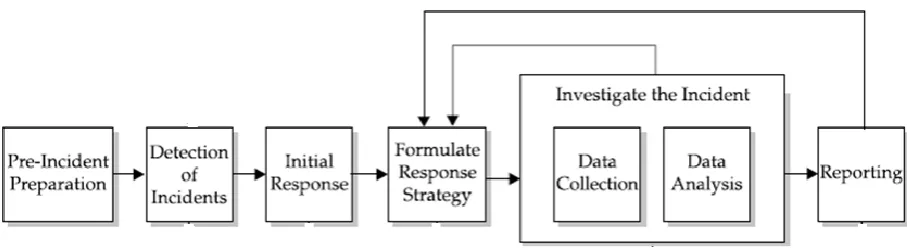
In incident response the Computer Emergency Response Team (CERT) or Computer Incident Response Team (CIRT) investigates an incidence in order to have a detailed description on how a crime was conducted, who was responsible and ways of making sure that the incident will not happen in future. In order for an investigation to commence there is need for someone to report the incident. The forensic expert or investigatorquarantines the crime scene, takes a photograph of the area and seizes the evidence in a forensically sound manner whilst preserving the integrity of data. The evidence media is taken to the forensic lab or workstation where an investigation is conducted. In most cases the investigator is qualified and skilled to perform the operation. The investigation process consists of two sub processes which are Data Collection and Data Analysis. Data collection is the process of acquiring the data that will assist in the investigation process for example through the use of Incident Response Toolkit. Data Analysis is the process of examining the collected data by using various forensic tools that follow the Association Chief of Police Officers (ACPO) principles in order to obtain results. The goals of information security are to protect the confidentiality, integrity and availability of data.Hackers compromise the information security and use anti- forensic techniques to make it difficult for investigators to detect and prove the existence and involvement in the crime. The aim of this paper is to design and implement an application that will provide a solution to some of the anti-forensic data hiding techniques.KEYWORDS: Incident, Anti-forensic, CERT, CIRT, Data collection, Data analysis, Evidence
I. INTRODUCTION
ISSN(Online) : 2319 - 8753
ISSN (Print) : 2347 - 6710
I
nternational
J
ournal of
I
nnovative
R
esearch in
S
cience,
E
ngineering and
T
echnology
(An ISO 3297: 2007 Certified Organization)
Vol. 4, Issue 4, April 2015
Fig 1.0 Incident Response Methodology diagram
II. RELEVANT WORK
Cellebrite is a mobile forensic product produced in 2007. The product is a Universal Forensic Extraction Device (UFED). It is a portable device that extracts mobile device data to a flash drive or SD card. The UFED can acquire hidden, deleted data, decipher and break codes. The UFED supports various cellular protocol and different operating systems like android, iOS, Symbian and Blackberry. The device can be used to collect both volatile and non-volatile data. [3]
XRY is a mobile and digital forensic product by Micro Systemation. It is used to recover, analyzer data on smartphones. Has a hardware and software component used for extraction. All the operations are conducted in a forensic manner. It allows both logical and physical examinations. It supports android, iOS and Blackberry devices. [4] EnCase is a multi-purpose forensic tool by Guidance Software. The software is designed for cyber security, forensics and security analytics. The evidence extracted using the software can be admissible in the court of law. It contains tools for data acquisition, data analysis and reporting. Forensic images of suspect media can be created. [5]
Oxygen Forensic Suite is proprietary software used for smartphones. The suite acquires data, parses data, imports device backups and images, recovers deleted data and performs data analytics. Supports various operating systemsuch as Android, iOS, Blackberry and Windows phone. [6]
SteganosPrivacy Suite is a package that includes 9 data protection mechanism such as the safe, the portable safe, the password manager, the internet trace destructor, the email encryption, the shredder, tha anti-theft protection, the private favorites and the steganography trick. [7]
MOBILedit forensic is a toolkit that analyzes phones via WIFI, Bluetooth or USB cable. It provides information of phone status, has a SIM Analyzer, SIM clone tool, Report generator. It performs physical extraction for Android phones. MOBILedit forensic supports Android, Symbian, iOS, Blackberry and Windows phone [8]
Joint Test Action Group (JTAG) forensics is a data acquisition method that test access ports on device by instructing processor. Used to extract physical image were normal tools fail. It is appropriate when device is damaged logically and on pattern locked android phones. They are various steps that are done for a JTAG forensic examination [9]
III. DESIGN
ISSN(Online) : 2319 - 8753
ISSN (Print) : 2347 - 6710
I
nternational
J
ournal of
I
nnovative
R
esearch in
S
cience,
E
ngineering and
T
echnology
(An ISO 3297: 2007 Certified Organization)
Vol. 4, Issue 4, April 2015
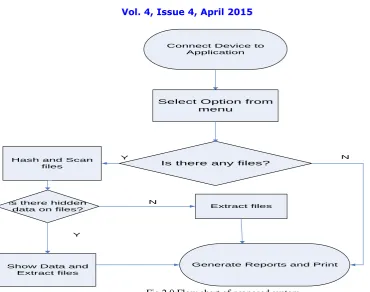
Connect Device to Application
Select Option from menu
Is there any files? Hash and Scan
files
Is there hidden
data on files?
Show Data and Extract files
Extract files
Generate Reports and Print N
Y
Y N
Fig 2.0 Flow chart of proposed system
User ( Investigator)
Connects Device
Selects Option
Scans
Extracts
Saves
Reports
Hash
ISSN(Online) : 2319 - 8753
ISSN (Print) : 2347 - 6710
I
nternational
J
ournal of
I
nnovative
R
esearch in
S
cience,
E
ngineering and
T
echnology
(An ISO 3297: 2007 Certified Organization)
Vol. 4, Issue 4, April 2015
MOBILE DEVICE APPLICATION
Investigator (User)
Connects using USB
Synchronises
Connected
Selects option from menu
Click [Hash]
Generates Hash Value
Click [Scan]
Analyzes
Results
Click [Extract]
Acquire files Saves
Fig 4.0 Sequence Diagram for Android Mobile Forensic Analyzer
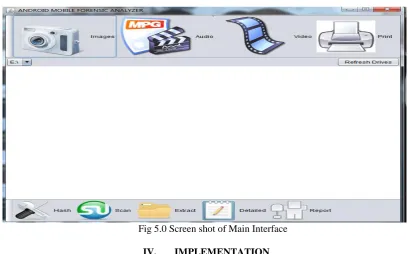
Fig 5.0 Screen shot of Main Interface
IV. IMPLEMENTATION
ISSN(Online) : 2319 - 8753
ISSN (Print) : 2347 - 6710
I
nternational
J
ournal of
I
nnovative
R
esearch in
S
cience,
E
ngineering and
T
echnology
(An ISO 3297: 2007 Certified Organization)
Vol. 4, Issue 4, April 2015
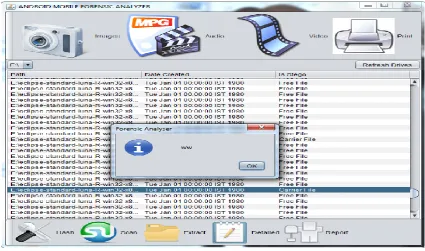
depending on the option selected and embedded data can be revealed. Fig 6 and fig 7 below show screenshots of the classification of the files i.e. free file or carrier file. Files can also be extracted to a flash disk or pen drive to create an evidence media.
Fig 6.0 Screenshot for Carrier file
ISSN(Online) : 2319 - 8753
ISSN (Print) : 2347 - 6710
I
nternational
J
ournal of
I
nnovative
R
esearch in
S
cience,
E
ngineering and
T
echnology
(An ISO 3297: 2007 Certified Organization)
Vol. 4, Issue 4, April 2015
V. RESULTS
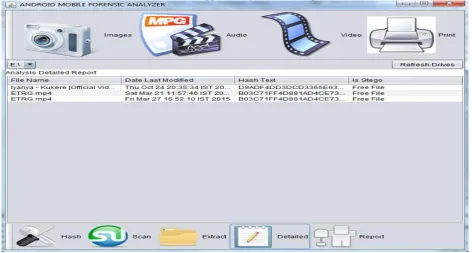
The application was able to perform all the functional requirements and this can be shown by the screenshot Fig 8.0. Test data was inserted to an android device and the application generated the reports with all the information
Fig 8.0 Screenshot for Analysis Detailed Report
The table below fig 9.0 shows a summary of the test cases or experiments that were conducted using the designed application
HASH SCAN EXTRACT REPORT
IMAGES Each file was hashed Analysis was
successfully done
Evidence media was created
Report generated
AUDIO Each file was hashed Analysis was
successfully done
Evidence media was created
Report generated
VIDEO Each file was hashed Analysis was
successfully done
Evidence media was created
Report generated
Fig 9.0 Table for Experiments done
VI. CONCLUSION
ISSN(Online) : 2319 - 8753
ISSN (Print) : 2347 - 6710
I
nternational
J
ournal of
I
nnovative
R
esearch in
S
cience,
E
ngineering and
T
echnology
(An ISO 3297: 2007 Certified Organization)
Vol. 4, Issue 4, April 2015
REFERENCES
[1] Karlsson, K.J., and Glisson, W.B., “Android Anti-forensics: Modifying Cyanogen Mod”, System Sciences (HICSS), 2014 [2] Jansen, W., and Scarfone, K., “Guidelines on Cell Phone Forensics”, National Institute of Standards and Technology (NIST) Special
Publication 800-101
[3] Cellebrite UFED- Mobile Forensics, www.cellebrite.com/mobile-forensics, accessed 18/01.2015 [4] XRY Mobile Forensic Tool, https://www.msab.com, accessed 18/01.2015
[5] Digital Forensic, https://www.guidancesoftware.com, accessed 18/01.2015 [6] Mobile Forensic Solutions, www.oxygen-forensic.com, accessed 18/01.2015 [7] Data Security and Privacy, https://www.steganos.com, accessed 18/01.2015 [8] MOBILedit Forensic, www.mobiledit.com/forensic, accessed 18/01.2015
[9] JTAG Forensic, www.binaryintel.com/services/jtag-chip-off-forensics/jtag-forensics, accessed 18/01.2015
[10] Chris Prosise.., and Kevin Mandia.., “Incident Response and Computer Forensics”, Second Edition, McGraw-Hill, 2003 [11] Gloe, T., Fischer, A., and Kirchner, M., “Forensic Analysis of Video File Formats”, Digital Investigation, 2014 [12] Quach, T.T., “Extracting Hidden Messages in Steganographic Images”, Digital Investigation, 2014
[13] Albano, P., Castiglione, A., Cattaneo, G., and De Santis, A., “A Novel Anti-Forensics Technique for the Android OS”, Broadband and Wireless Computing, Communication and Applications (BWCCA), 2011, pp. 380 – 385.