Human Face Recognition Using Image
Processing PCA and Neural Network
Yogesh B Sanap
1, Dr.Anilkumar N. Holambe
2PG Student, Department of Computer Science & Engineering, TPCT‟s College of Engineering, Osmanabad, Maharashtra, India1
HOD & P.G. Coordinator, Department of Computer Science & Engineering, TPCT‟s College of Engineering, Osmanabad, Maharashtra, India2
ABSTRACT: Security and authentication of a person is a vital part of any business. There are many techniques used for this purpose. One of technique is human face recognition. Human Face recognition is an effective means of authenticating a person. The benefit of this approach is that, it enables us to detect changes in the face pattern of an individual to substantial extent. The recognition system can tolerate local variations in the face expression of an individual. Hence Human face recognition can be used as a key factor in crime detection mainly to identify criminals. There are several approaches to Human face recognition of which Image Processing Principal Component Analysis (PCA) and Neural Networks have been included in our project. The system consists of a database of a set of facial patterns for each individual. The characteristic features called „eigenfaces‟ are extracted from the stored images using which the system is trained for subsequent recognition of new images.
KEYWORDS: Biometrics, Neural Networks (NN), Principal Component Analysis (PCA), Eigen Values, Eigen Vector, Image Processing
I. INTRODUCTION Face Recognition System
A face recognition system is a computer application for automatically identifying or verifying a person from a digital image or a video frame. One of the ways to do this is by comparing selected facial features from the image and a facial database. Security and authentication of a person is a crucial part of any industry. There are many techniques used for security and authentication one of them is face recognition. Face recognition is an effective means of authenticating a person the advantage of this approach is that, it enables us to detect changes in the face pattern of an individual to an appreciable extent the recognition system can tolerate local variations in the face expressions of an individual. Hence facial recognition can be used as a key factor in crime identification and detection, mainly to identify criminals there are several approaches to facial recognition of which Image processing principal component analysis (PCA) and neural networks (NN) have been incorporated in our project face recognition as many applicable areas. Moreover it can be categories into face recognition, face classification, one, or sex determination. The system consists of a database of a set of facial patterns for each individual. The characteristic features called „eigen faces‟ are extracted from the storage images using which the system is trained for subsequent recognition of new images.
It is typically used in security systems and can be compared to other biometrics such as fingerprint or eye iris recognition systems
returns the location and position of the image and extent of the each Human face. Pre-processing is done to remove the noise and reliance on the precise registration. The block diagram of a typical face recognition system can be shown with the help of Figure. The face detection and Human face extraction are carried out simultaneously. The complete process of face recognition can be shown in the Figure 1.
Face Detection
Feature
Extraction
Classification
Figure 1 Block diagram of a Face Recognition
There are various factors that makes the human face detection is a challenging task. Pose presence or absence of structural mechanism, Facial look and expression, Occclusion, Image direction. The facial feature detection is the process to detect the presence and location of features like eyebrow, nose, eyes, lips, nostrils, mouth, ears, etc. this is done with the assumptions that there is only a single human face in an image. In the Face recognition process the input image is compared with the stored database. The input image is also called as probe and the database is called as gallery. Then it gives a matching report and then the classification is done to identify the sub-population to which new observations belong
II. LITERATURE REVIEW
Techniques Used for Face Recognition
a. Traditional
There some facial recognition algorithms identify faces by extracting important features from an image of the subject's human face. For example, an algorithm may analyze the relative position, size, shape of the eyes, eyebrows, nose, cheekbones, and jaw. These features are then used to search for other images with matching features from stored database. Other algorithms normalize a gallery of face images and then compress the face data, only saving the data in the image that is useful for human face detection. A probe image is then compared with the face data. Popular recognition algorithms include Eigen-face, fisherface, the Hidden Markov model, and the neuronal motivated dynamic link matching.
b. 3D
A newly trend, claimed to achieve previously unseen accuracies, is three-dimensional face recognition. This technique uses 3D sensors to gather information about the shape of a face. This information is then used to identify unique features on the surface of a face, such as the contour of the eye sockets, nose, and chin. One advantage of 3D human face recognition is that it is not affected by changes in lighting like other techniques. It can also identify a human face from a range of viewing angles, including a profile view.
c. Skin texture analysis
III. PROBLEM STATEMENT
In face recognition system, the face detection and feature mapping is core concern to analyze the face. There is need of training for detection of faces from different perspective. The efficiency is the main concern for feature selection and multiple algorithm proposed for solve the accuracy problems. In the past techniques, there is need to provide the large test or training images to detect and assign the particular class means efficient image processing. Automatic recognition of human face is a challenging problem which has received much attention during recent years due to its many applications in different fields. Human Face recognition is one of those challenging problems and up to date, there is no technique that provides a robust solution to all situations.
EXISTING SYSTEM
Human Face recognition is the computer application technique to recognize a human face. When a person is registered in a face recognition system, a video camera takes a series of snapshots of the human face and then represents it by a unique code
When person has their face verified by the computer system, it captures their current appearance look and compares it with the facial unique codes already stored in the database system.
When human faces match, the person receives authorization for the system; otherwise, the person will not be authorized. The existing human face recognition system identifies only static face images that almost exactly match with one of the images stored in the image database.
When the current image captured almost exactly matches with one of the images which is stored in database then only the person is authorized and granted access.
When the current image of a person is considerably different, after comparing with image database say, in terms of facial expression then person will be denied
PROPOSED SYSTEM
The proposed human face recognition system overcomes certain pitfalls of the existing human face recognition system. It is based on extracting the important features of a set of human faces stored in the database and performing mathematical operations for the comparison on the values corresponding to them. Hence when a new image is fed into the system for recognition the important features are extracted and compute result to find the distance between the input image with the stored database images. Proposed system can tolerate some variation in the new face image. When the new image of a person varies from the images of that person stored in the database, the system will be able to recognize the new face and identify person. The proposed system is better mainly due to the use of facial features rather than the entire face. Advantages in terms of
Human Face recognition accuracy and better unfair power Computational cost because smaller images require less processing to train the image processing PCA.
The use of dominant features and hence can be used as an effective means of authentication
IV.IMPLEMENTATION
Face Recognition using Neural Network
We classify our project into two parts. These two stages are:- 1) Feature Extraction (Training)
2) Classification (Testing)
number of images are 165. So the total pixels processing is 72000 x 165. The processing of such a huge data is difficult and also time consuming. So we required to minimize the data first without interfering the image features and contents. So to reduce the number of pixels processed per image we use here the concept of image down sampling.
Training Faces
Step 1: Prepare the data
In this step, the faces constituting the training set (Γ) should be prepared for processing. Firstly we down sampled these images to 60 X 80 pixels i.e. the down sampling ratio is 0.25. So the number of pixels is reduced from 72000 to 4800 pixels. Due to that, the speed of operation of our project has increased.
Now from those images, we considered either all eleven images for training or depends on our choice, although we can say that eight images are used for training but it may be possible that subject came in front of system may having passion from that remaining three images. As the number of images for training is increased the result has also increased.
Down Sampling = |Xn / N|
Where, Xn- Image Pixel Values and N- Down Sampling Rate. Here we considered N=4. Figure bellow shows the Down sampling image.
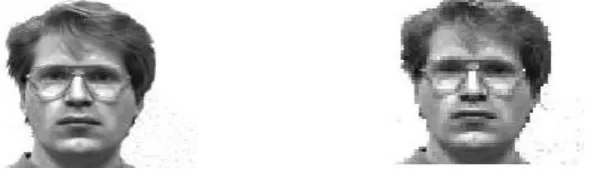
Figure 2 down sampling of Image
The Example of down sampled image is shown in figure bellow. The input image is of size 240 X 300 pixels and the down sampled image is of size 60 x 80 pixels.
Figure 3 Input image with 240 x 300 pixel Down sampled image with 60 x 80 pixels
We has arranged all the images in the in the row wise with each row size of 60 X 80 = 4800 pixels per row Image with pixel
value of 240X 320
Down Sampling Image with pixel value
Step 2: find the mean
The average matrix Ψ has to be calculated, then subtracted from the original faces (Γ) and the result stored in the variable ɸi
ᴪ =
1
𝑀
Γ
n1
𝑛−1
ɸ
i= Γ
i− ᴪ
Step 3: find the covariance matrix, Covariance C is calculated
𝐶 =
1𝑀
ɸ
𝑛ɸ
𝑁𝑇 𝑀
𝑁−1
We formed a matrix of size 4800 X 165 pixels. From that we had calculated variance and covariance. After covariance the new matrix is formed of size 4800 X 4800 pixels
The formula for variance and covariance is shown bellow
𝑉𝑎𝑟 𝑋 = 𝐸((𝑋 − 𝜇)
2)
--- Variance𝐶 =
1𝑀
ɸ
𝑛ɸ
𝑁𝑇 𝑀
𝑁−1 --- Covariance
Step 4: find the eigenvectors, Eigen-values of the covariance matrix in below step
Description of the correct algorithm for determination of eigenvectors and Eigen-values is absent here, as it belongs to the standard arsenal of most math programming libraries.
After that, we had calculated Eigen Values of matrix size 4800 X 4800 and Eigen vector of size 4800 X 1.
From these Eigen values and Eigen vector we drawn the Eigen face. The Eigen faces we calculate are 20 instead of 15 (as we use 15 persons) for our convenience and for result improvement
Step 5: find the principal components
M eigenvectors (Eigen-faces) ui, only M' should be chosen, which have the greatest Eigen-values. The greater the Eigen-value, the more characteristic features of a human face does the particular eigenvector describe. Eigen-faces with low Eigen-values can be retrieved, as they explain only a small part of characteristic features of the faces.
After M' Eigen-faces ui are determined, the “training” phase of the algorithm is finished.
We had calculated the 20 PCA values as we consider here 20 Eigenface. So for each Eigenface the PCA is being calculated. The size of that calculated PCA is 4800 X 20 for all images. Now, PCA value is 240 X 20 matrixes for every person i.e. for 11 posses of a person. PCA is well known statistical procedure that can be used to derive important features by reducing the dimensions of given input vector without losing information. The features of interest may not be available explicitly, and must be derived from the available attributes of individuals.
V.RESULT
Face recognition result
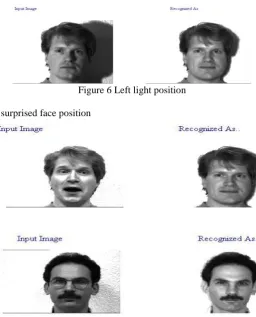
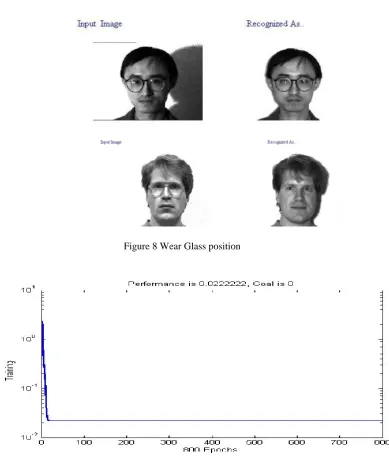
The input image was given to program for recognition. The input images have different positions. For this, whether the input image with different posses was matched or not was shown in figures bellow.
Face recognition result for wink face position
Figure 5 Wink face position
Face recogntition result for left ligt position
Figure 6 Left light position
Face recognition result for surprised face position
Face recognition result for wear glass position
Figure 8 Wear Glass position
Figure 5 Training performances for Epoch
VI. CONCLUSION
previous work, the face position must be center-light position; any lighting effect will affect the system. Similarly the eyes of person must be open and without glass. If such obstacles are on the face of person, the feature detection is complicated. Preliminary work in this era indicates that detecting profiles views of human faces is more difficult than detecting frontal views, because they have smaller amount of stable features and because the input window will contain more background pixels. When an image sequence is available, temporal coherence can focus attention on particular portions of the images. As a face moves about, its location in one frame is a strong predictor of its location in next frame. Standard tracking methods, as well as expectation-based methods, can be applied to focus the detector‟s attention. Other methods of improving system performance include obtaining more positive examples for training, or applying more sophisticated image preprocessing and Normalization techniques. The previous work required more complication in systems as well as the result of matching is not up to the satisfaction of any system. In our system special face features are not required for recognition process. The face features are detected using PCA. The feature face formed is Eigen face. Due to Eigen face, calculations in the specific face features are not required. So the overhead of the system is reduced as number of user of the system is going to increase.
The results we got here using Yale face database is up to the satisfaction of requirement of any system. As we were worked on more posses of the persons, so for our system, the center-light position is not required every time. For our algorithm, we say that as numbers of images for training are more and the epochs are more the result is increases. But the problem is that time require to complete the recognition is increases. As numbers of images are increases, time required to complete the recognition is increases.
REFERENCES
[1] A.S.Tolba, A.H.El-Baz, and A.A. El-Harby, “Face Recognition: A Literature Review”, World Academy of Science, Engineering and Technology, Vol:2 2008-07-21.
[2] B.K.Gunturk, A.U.Batur and Y.Altunbasak “Eigen-face-domain super-resolution for face recognition,” IEEE Transactions of Image Processing, Vol.12, no.5.pp. 597-606.
[3] Milo5 Oravec, Jarmila PavloviEov6, “Face Recognition Methods Based on Principal Component Analysis and Feed-forward Neural Networks”, IEEE paper number- 0-7803-83S9-1/04, ©2004 IEEE
[4] JawadNagi, Syed Khaleel Ahmed FarrukhNagi, “A MATLAB based Face Recognition System using Image Processing and Neural Networks”, 4th International Colloquium on Signal Processing and its Applications, March 7-9, 2008, Kuala Lumpur, Malaysia.
[5] Meng Joo Er, “High-Speed Face Recognition Based on Discrete Cosine Transform and RBF Neural Networks”, IEEE transactions on neural networks, vol. 16, No. 3, May 2005
[6] Ming-Hsuan Yang, D. Kriegman, and N.Ahuja, “Detecting Faces in Images: A Survey”, IEEE Trans On Pattern Analysis and Machine Intelligence, Vol.24, No.1, pp. 34-58, January 2002.
[7] Xiaofei He, Shuicheng Yan, Yuxiao Hu, ParthaNiyogi, and Hong-Jiang Zhang, “Face Recognition Using Laplacianfaces” IEEE Transactions on Pattern Analysisand Machine Intelligence, Vol. 27, NO. 3, March 2005.
[8] Abid, S. Fnaiech,F., and Najim, M., “A Fast Feed forward Training Algorithm Using A Modified Form Of The Standard Back-propagation Algorithm”, IEEE Transaction on Neural Networks, 12 (2001) 424–430
[9] T. Kathirvalava kumar and P. Thangavel, “A Modified Back-Propagation Training Algorithm for Feedforward Neural Networks”, Neural Processing Letters (2006) 23:111–119 © Springer 2006.