Mass Customization as Aided Value Tool in
New Product Development Process
Valentina Gecevska
1, Vanco Donev
1, Radmil Polenakovik
1Professor, Faculty of Mechanical Engineering, Ss. Cyril and Methodius University in Skopje, Skopje, Macedonia 1
Professor, Faculty of Mechanical Engineering, Ss. Cyril and Methodius University in Skopje, Skopje, Macedonia 1
Professor, Faculty of Mechanical Engineering, Ss. Cyril and Methodius University in Skopje, Skopje, Macedonia 1
ABSTRACT: Nowadays, intensive market competition brings new strategies of manufacturers and retailers as is mass customization, or the indvidualizing of standard products and services to meet the specific needs of each customer. Mass Customization (MC) is the result of a more self-aware type of customer who demands more choice and more involvment. Small and medium enterprices , through their flexibility advantages and closeness to customers, potentially can increase their sales volume in economic downtourns. Smaller firms and those producing made-to-order products were most likely to have realized increased sales volume. Small and medium enterprises competitiveness is based more on working closely with customer to produce fully customized products.
KEYWORDS:Mass Customization, Customized Products, Configurators, New Product Development.
I. INTRODUCTION
an overview of the mass customization concept is given, as well as explanation of the implementation of some aspects of mass customization strategy in small and medium enterprises, on the example of a furniture producer.
II. BACKGROUND-CONCEPTOFMASSCUSTOMIZATIONINSMALLANDMEDIUM
ENTERPRISES
Mass customization can be achieved through product line rationalization, modularity and part standardization, using internet catalogues and order entry, supply chain design; even lean manufacturing can be an entry in mass customization. In today’s world of business where the customer is most important and business products and services are more likely to be customized to fit the needs of the customers, it is highly critical that even small businesses learn to adapt and include customization in their offerings.
Small and medium enterprises, are already adopting variations of the mass customization concept. In order to analyse SMEs from the angle of mass customization we must determine the scope of these companies and what we mean when we say small or medium company. Many countries in Europe have their own definition. However there are recommendations from the European Commission used to determine the size of the company. By these recommendations [6] there is also a subcategory of small companies called micro enterprises consisting of 10 or less employees (Table 1). Enterprises qualify as micro, small and medium-sized enterprises (SMEs) if they fulfil the criteria laid down in the Recommendation which are summarized in the table below. In addition to the staff headcount ceiling, an enterprise qualifies as an SME if it meets either the turnover ceiling or the balance sheet ceiling, but not necessarily both. All enterprises whose headcount, turnover or balance sheet total exceed these numbers are referred to as large enterprises.
Table 1:Micro, small and medium enterprises as given in recommendations of EU Commission [6]
Enterprise category
Headcount Turnover Balance
sheet total
medium sized < 250 ≤ €50 million ≤ €43million
small < 50 ≤ €10 million ≤ €10million
micro < 10 ≤ €2 million ≤ €2million
Due to the highly competitive marketplace, small businesses may need to develop a niche strategy such as customization, which may become even more important in small and medium businesses than larger ones. Also, in many cases, the smaller businesses can more easily adapt and make changes to effectively implement the customization concept. The strategy of customization seems to offer small businesses a niche and a competitive edge in the marketplace. Even some larger companies are repositioning themselves as small business units so as to effectively benefit from the implementation of customization in their companies [7].
In today’s markets, small companies are better suited and more quickly able to implement customization to meet their many fickle-minded customers who possess increasing control and are looking for endless options. It is easier for the small and medium enterprises to contact with their customers and build a good relationship with them. Because of that, these enterprises can produce customized products including their customers as co -designers.
Table 2:Advantages and disadvantages of SMEs
SMEs
Advantages Disadvantages
Adaptability to trends Limited resources
Adaptability to change in demand Difficulties to develop specific competence for low to medium technology
Close customer interaction
Besides direct advantages in MC, SMEs also have their advantages in economic, social and environmental spheres of business like relationships with customers, cultural identity, aesthetic awareness, etc. SMEs are able to exploit local niches and maintain diversity in available products, understand local tastes that foster craftsmanship, create greater social equity that humanizes relationships in buying and selling (building community), provide culturally sensitive options that empower marginalized groups, and from the environmental aspect, having shorter transport distances, they reduce pollution, as well as human risk. Maybe some of these advantages will be the reason that SMEs will be the future of the Mass Customization. In today’s competitive business environment, where the customer is the most important, and products and services are more likely to be customized to fit the needs of the customers, it is highly critical that small and medium businesses learn to adapt and include customization in their offerings.
What do SMEs need to do if they want to become mass customize? Some of the next steps could be taken [9]:
1) Development of product configurator that can be a sales configurator or back end configurator, which is used with the mediation of an expert;
2) Increased automation – in the phases where it is purposeful;
3) Dealing with solution space – defining the production program that can be successfully produced with existing production equipment;
4) Increase in production volume - introducing new technologies in manufacturing and organization of production; 5) Replacing particular technology systems with CNC systems;
6) Introduction of IT systems for the successful management of data - PDM or PLM; 7) Developing of product platform and product families.
Aware of the existence of limited resources to implement MC, comparing to large enterprises, SMEs improve the three capabilities necessary for MC (solution space development, robust process design and choice navigation), by strategically focusing their resources on the capability where an investment would have the greatest effect on overall competitiveness, without trying to lift all three on the highest level. Capitalizing on economies of scope (the expansion of new business activities with current customers) instead of economies of scale (the expansion of current business activities in the marketplace) will allow a small organization to implement and benefit from mass customization [10].
III.PRSENTATIONOFTHEMAINCONTRIBUTIONOFTHERESEARCH
important for the manufacturing companies to make the decisions which market segment should be targeted and what products should be planned for the target market, namely, product family positioning.
IV.PROPOSEDMETHODOLOGYANDDISCUSSION
A.MEASURING CUSTOMER PREFERENCES
Measuring customer preferences means identifying a set of product attributes, А={аk |k=1,...,K}, which company
can produce it. Each attribute has a few levels, Ак*={akl*|l=1,...,Lk}, the product family is a combination of these
attribute levels, Z={ j|j=1,...J}. Each product is defined as a vector of specific attribute levels, j=[a*klj]K, where any
a*kl j represents an element of the set of attribute levels that can be assumed by the product, {a *
klj}K {A1 *
X A2*X ... X AK*} and any a*kl j= , represents that the product does not contain some of the attributes [15].
The product family which is positioned, A, is a set of a few selected product profiles, A={ | j=1,...J'},
Z
. Everyproduct is associated with certain engineering costs, denoted as {cj}J. The company has to make decisions about the
price of its offered products, {pj} J. The market today has multiple segments, S={ si |i=1,...,I}, each of them contains
homogeneous customers. Product demands of the market, {Рi j}ixj, are described by the products which the customers
choose, denoted as customer or segment-product pairs, {( si, )} i x j S X Z.
The modelling of the price is to treat price as a separate attribute that can be chosen from a limited number of values for
each product [16]. Adding price as one more attribute, the attribute set becomes A = {ak}K+1, where aK+l represents the
price possessing a few levels, A*K+l={a(K+l)l |l= 1..., ,LK+1}.
Measuring customer preferences helps companies to predict customer needs at different market segments. Next, is presented measuring customer preferences with example of a product family with its attributes and attribute levels.
B.DEFINITION OF THE CONFIGURABLE PRODUCT ATTRIBUTES
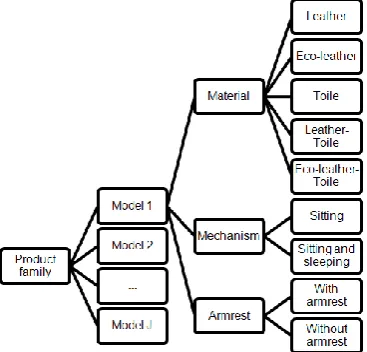
Considering that the company produces mainly sitting furniture, it is going to be the product family of the focus. At the beginning, it is necessary to define attributes and attribute levels, which are presented in Table 3 and include: material, mechanism, armrest, as well as price [11].
Table 3: List of product attributes and their levels
attribute (ак ) a kl code attribute level
material
a 11 А1-1 skin
a 12 А1-2 eco- skin
a 13 А1-3 toile
a 14 А1-4 combination skin-toile
a 15 А1-5 combination eco skin-toile
mechanism a 21 A2-1 sitting
a 22 A2-2 sitting and sleeping
armrest a 31 A3-1 whit armrest
a 32 A3-2 without armrest
price
a 41 A4-1 30 000-50 000 mkd
a 42 A4-2 50 000-70 000 mkd
a 43 A4-3 70 000-90 000 mkd
are the attribute levels, or the possible variants of the key attributes. In this way a configurator can be developed for the selected product family of this company. All the variants are offered to customers with proper visualization, which makes their communication with company more efficient. Graph theory can be used to support configurator development.
Figure 1:Generic structure for the selected product
C.MEASURING RESULTS
For exploring customer requirements, a survey was done with interviews of twenty customers in order to assess their requirement. Each of interviewed customers selected to act as the respondents is asked to evaluate all 20 profiles one by one with a requirement scale from 1 to 5 (1 means the least, 5 means the most).
Analysing these data, customer segments based on the similarity among customer preferences are found and two segments of customers are formed: s1, and s2. The first one (segment s1) represents home users (customers which buy furniture for their home) and the second segment (s2) represents business users (customers which buy furniture for their business needs). Product family positioning optimizes both a mix of products and the configurations of individual products in terms of specific attributes.
This research allows products to be configured directly from attribute levels and the analysis is used to quantify the customer preference. On the figure 2, there are represented the results for customer preferences to each of the 28 product profiles, as average for both segments of customers.
On the figure 3, there are given the differences in products’ assessing between two customer segments, home oriented s1, and business oriented s2. According to analyse done in this research and results from customer requirement assessment, it can be concluded which are the preferred products from market site and the company should oriented to produce in large volume. Defining customer requirements is the first step for implementing mass customization strategy in small and medium enterprises in order to include strategy that will introduce the competitive advantage and profit grooving.
Figure 3: Differences between the customer preferences in both market segments s1 and s2
V. EXPERIMENTALRESULTS
A.GRAPH THEORY IN PRODUCT CONFIGURATION
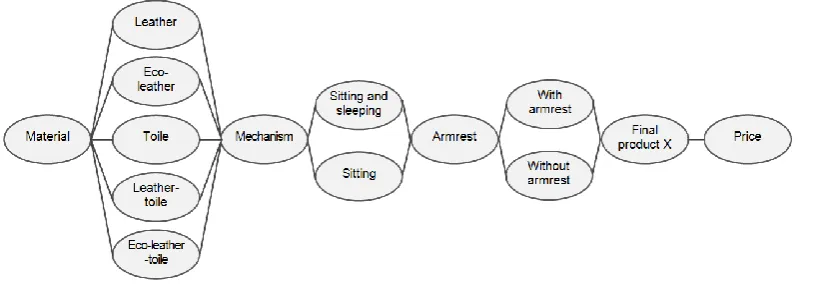
Graph theory is the study where mathematical structures are used to model relations between objects from a certain collection. Product configuration can be realized using the model based on graph theory. This model based on the graph theory is represented on the Figure 4, applied for making choice decisions for different product variants for furniture product analysed.
With the implementation of this model for product configuration, the simpler and more efficient communication with customers is enabled, that brings benefits to both sides, for customers and for company.
Considering that the configuration model for the product family is created, based on market research previously made, it is possible to represent examples of product variants that are chosen by the customers. The choice for the first product variant that is shown as the most preferred is given on the Figure 5.
This represents an oriented graph, which shows the path, or the customer’s choice of the variants offered. The path on the graph shows the chosen product variant with previously represented attributes. Configured product is described with the following path: material (leather) – mechanism (sitting) – armrest (with armrest) – final product 1 –price.
Figure 5:Configuration for the most preferred product (variant 1)
B.WEB-BASED CONFIGURATOR
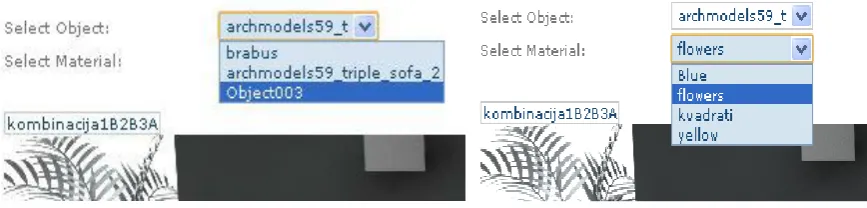
Configurators are information systems that support the specification of product individuals and the creation and management of configuration knowledge, therefore being prime examples of information systems supporting mass customization. The configurators have been used in different companies to help the customers to create the product they need.
One example of furniture product web based configurator is given on the Figure 6. Customers can make changes to the standard product only where the production process allows it. These changes are the potential product combinations which the configurator offers to the customers. Development of web-based configurator enables manufacturers to gather various information about customers. It shows the company which are the main customer needs.
VI. CONCLUSIONS
Mass customization as a future strategy is almost a feature that companies have to offer to keep their customers and
coming back for more.Due to the highly competitive marketplace, small and medium enterprises may need to develop
a concept such as mass customization, which may become even more important in small and medium enterprises than in larger ones. The main benefits of mass customization and the use of configurators are: higher profit, a rich source of new ideas, satisfied customers and growing product variety. Defining customer needs is essential for implementing mass customization strategy. To accomplish this, companies have to communicate with customers and make them their partners and co-designers of the final product solution. Considering that mass customization dramatically increases the
number of product variants, companies have to establish a modelto support product configuration.
Graph theory is represented in this paper as a basis of the model for configuring product variants in a product family. Furniture production is very convenient for implementation of mass customization concept, while there is a suitable production program that allows many combinations of product attributes on different levels. The policy makers responsible for SME development necessarily need a reliable mechanism for systematic follow up and assessment of
the condition of the sector. The implementation of some aspects of mass customization and the expertise in this area
help its SMEs to achieve adaptability to trends and change in demand, as well as close customer interaction, even though they are characterized with limited resources.
REFERENCES
[1] Forza, C. and Salvador, F., “Managing for Variety in the Order Acquisition and Fulfillment process”, International Journal of Production Economics, Vol. 76, pp. 87-98, 2002.
[2] Kumar, A. and Stecke, K. E., “Measuring the Effectiveness of a Mass Customization and Personalization Strategy: a Market and Organizational-capability based Index”, The International Journal of Flexible Manufacturing Systems, Vol. 19, No.4, pp. 548-570, 2007. [3] Silveira, G.D., Borenstein, D. and Fogliatto F.S., “Mass Customization: Literature Review and Research Direction”, International Journal of
Production Economics, Vol. 72, No.1, pp.1-13, 2011.
[4] Stojanova, T., Gecevska, V. and Anisic, Z., “Mass Customization – Tools for Growing Product Variety”, Proceedings of the 4th International Conference - Management of Technology Step to Sustainable Production (MOTSP), Zadar, Croatia, , ISBN 1848-5022, pp. 99-106, 2011. [5] Pine, B.J, Peppers, D. and Rogers, M., “Do you want to keep your customer forever?”, Harvard Business Review, Vol. 73, No.2, pp. 103-114,
1995.
[6] 96/280/EC: Commission Recommendation of 3 April 1996 concerning the definition of small and medium-sized enterprises. (1996), Official Journal L 107, P. 0004 – 0009.
[7] Selladurai, R., “Mass Customization Strategy in Management and its Applications to Small Business”, Indiana University, 2012.
[8] Suzic, N., Anisic, Z., Forza, C., “Preconditions for Implementation of Mass Customization Strategy in SMEs”, Proceedings of 5th International Conference for Entrepreneurship, Innovation and Regional Development,ICEIRD, ISBN 978-954-07-3346-3, pp. 830-837, 2012. [9] Peters, L. and Saidin, H., “IT and the mass customization of services: the challenge of implementation”, International Journal of Information
Management, Vol. 28, pp. 103-119, 2008.
[10] Meyer, M.H., Tertzakian, P. and Utterback, J.M., “Metrics for managing research and development in the context of the product family”, Management Science, Vol. 53, No.1, pp. 88-111, 2007.
[11] Jiao, J. and Tseng, M.M., “A pragmatic approach to product costing based on standard time estimation”. International Journal ofOperations & Production Management, Vol. 19, No.7, pp. 738-755, 1999.