International Journal of Advance Research In Science And Engineering http://www.ijarse.com
IJARSE, Vol. No.3, Issue No.11, November 2014 ISSN-2319-8354(E)
CLUSTERING BASED FEATURE SELECTION AND
IDENTIFICATION OF SUBSET FOR HIGH
DIMENSIONAL DATA
Neha V. Dharmale
1,Santosh N. Shelke
21,2
Department of Computer Engineering, Sinhgad Academy of Engineering, Pune, (India).
ABSTRACT
Feature selection is widely used in preparing high dimensional data for effective data mining. Increasingly popular social media data presents new challenges to feature selection. Social media data consists of traditional high-dimensional, attribute value data such as posts, tweets, comments, and images, and linked data that describes the relationships between social media users as well as who post the posts. The nature of social media also determines that its data is massive, noisy, and incomplete, which exacerbates the already challenging problem of feature selection. In this paper, using SVM Algorithm we illustrate the differences between attribute value data and social media data, investigate if linked data can be exploited in a new feature selection framework by taking advantage of social science theories, extensively evaluate the effects of user-user and user-post relationships manifested in linked data on feature selection.
Keywords:
Cluster, Feature selection, Linked Data, SVM
1. INTRODUCTION
The myriads of social media services are emerging in recent years that allow people to communicate and express
themselves conveniently and easily, e.g. Facebook and Twitter. The pervasive use of social media generates
massive data in an unprecedented rate. For example, users on Twitter are sending 200 million tweets per day, which
is about 200 percent growth in a year; more than 3,000 photos are uploaded to Flicker per minute and more than 153
million blogs are posted per year. The massive, high-dimensional social media data poses new challenges to data
mining tasks such as classification and clustering. One conventional approach to handling large-scale,
high-dimensional data is feature selection [1].
Feature selection aims to select relevant features from the high dimensional data for a compact and accurate data
representation. It can alleviate the curse of dimensionality, speed up the learning process, and improve the
generalization capability of a learning model [2]. The vast majority of existing feature selection algorithms work
with data containing uniform entities or attribute-value data points that are typically assumed to be independent and
identically distributed. However, social media data differs as its data points or instances are inherently connected to
Fig.1: System Framework
Fast algorithm employs the clustering-based method to choose features. General framework as shown in Fig. 1 in
which irrelevant features are removed first and then to remove redundant features minimum spanning tree is
constructed and then tree partitioning is used to obtain the selected features. Fast Algorithm can eliminate the
irrelevant features effectively but it is ineffective at removing redundant features which affect the speed and
accuracy of algorithm, thus it should be eliminated as well.
II LITERATURE SURVEY
For High Dimensional Data several researchers have done the Fast Clustering-Based Feature Subset Selection
Algorithm . Many new techniques are introduced by means of different performance and using different techniques
for this purpose.
To identify and to remove as many irrelevant and redundant features as possible Feature subset selection is used.
Because predictive accuracy is not contributed by irrelevant features and redundant features provides the
information which is already present in other features[3]. Some feature subset selection algorithms eliminate
irrelevant features efficiently but fail to handle redundant features and some of others can eliminate the irrelevant
features but fails to handle redundant features.
Many feature subset selection methods have studied which are divided into four broad categories: Embedded,
International Journal of Advance Research In Science And Engineering http://www.ijarse.com
IJARSE, Vol. No.3, Issue No.11, November 2014 ISSN-2319-8354(E)
based on distance-based criteria function according to its ability to discriminate instances under different targets[4].
In removing redundant features Relief is ineffective as two predictive but highly correlated features are likely both
to be highly weighted. Relief-F is the extension of Relief; it enables relief to work with noisy and incomplete data
sets and to deal with multi-class problems, but fails to identify redundant features[5]. CFS is achieved by the
hypothesis that a good feature subset is one that contains features highly correlated with the target, yet uncorrelated
with each other[6]. For retrieving high-dimensional data CFS is not efficient. FCBF is a fast filter method in which
without pairwise correlation analysis it can identify relevant features as well as redundancy among relevant
features[7]. CMIM picks the features iteratively which maximize their mutual information with the class to predict,
conditionally to the response of any feature already picked [8]. FAST algorithm employs the clustering-based
method to choose features [9].
III PROPOSED SYSTEM
Accuracy of the learning machines is severely affected by the redundant and irrelevant features. Thus
Feature subset selection should identify and remove the irrelevant and redundant features.
In this paper, we investigate issues of feature selection for social media data. Specifically, we perform feature
selection on posts (e.g., tweets, blogs, or images) in the context of social media with link information between user
and user or between user and posts. Since conventional feature selection methods cannot take
advantage of the
additional information in linked data. We proceed to study two fundamental problems for feature selection on social
media data:
Relation extraction - what are distinctive relations that can be extracted from linked data, and
Mathematical representation - how to represent these relations and integrate them in a state-of- the-art feature selection formulation.
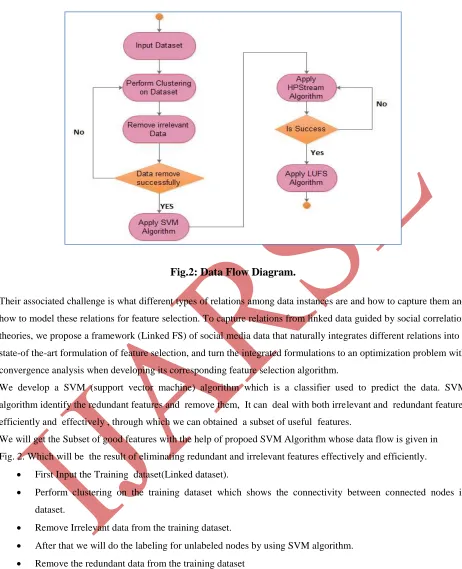
Fig.2: Data Flow Diagram.
Their associated challenge is what different types of relations among data instances are and how to capture them and
how to model these relations for feature selection. To capture relations from linked data guided by social correlation
theories, we propose a framework (Linked FS) of social media data that naturally integrates different relations into a
state-of the-art formulation of feature selection, and turn the integrated formulations to an optimization problem with
convergence analysis when developing its corresponding feature selection algorithm.
We develop a SVM (support vector machine) algorithm which is a classifier used to predict the data. SVM
algorithm identify the redundant features and remove them, It can deal with both irrelevant and redundant features
efficiently and effectively , through which we can obtained a subset of useful features.
We will get the Subset of good features with the help of propoed SVM Algorithm whose data flow is given in
Fig. 2. Which will be the result of eliminating redundant and irrelevant features effectively and efficiently.
First Input the Training dataset(Linked dataset).
Perform clustering on the training dataset which shows the connectivity between connected nodes in
dataset.
Remove Irrelevant data from the training dataset.
After that we will do the labeling for unlabeled nodes by using SVM algorithm. Remove the redundant data from the training dataset
Then we will do the projected stream clustering using the High-dimensional Projected Stream Clustering
(HPStream) algorithm.
International Journal of Advance Research In Science And Engineering http://www.ijarse.com
IJARSE, Vol. No.3, Issue No.11, November 2014 ISSN-2319-8354(E)
1. Identifying redundant features.
2. Searching for relevant features.
3. Improving the efficiency and effectiveness of data retrieval.
4. Using linked datasets as an input dataset.
IV CONCLUSION
We have presented feature subset selection algorithm for high dimensional social media data. In the proposed
algorithm, a cluster consists of features. In previous system generality of the selected features was limited and the
computational complexity was large. In proposed system each cluster is treated as a single feature and thus
dimensionality is drastically reduced and computational complexity is also reduced .It efficiently and effectively
deal with both irrelevant and redundant features and obtain a good feature subset. Good feature subsets contain
features highly correlated with the class, yet uncorrelated with each other.
REFERENCES
[1] M. Dash, and H. Liu, Feature Selection for Classification, Intelligent Data Analysis, 1(3),1997, 131-156. [2] P. Langley, “Selection of Relevant Features in Machine Learning,” Proc. AAAI Fall Symp. Relevance, pp. 1-5, 1994.
[3] G.H. John, R. Kohavi, and K. Pfleger, Irrelevant Features and the Subset Selection Problem, Proc. 11th Int’l
Conf. Machine Learning, 1994, 121-129.
[4] I. Kononenko, Estimating Attributes: Analysis and Extensions of RELIEF, Proc. European Conf. Machine Learning, 78(4), 1994, 171-182.
[5] S. Chikhi and S. Benhammada, ReliefMSS: A Variation on a Feature Ranking Relieff Algorithm, Int’l J.
Business Intelligence and Data Mining, vol. 4, nos. 3/4, pp. 375-390, 2009.
[6] M. Dash, H. Liu, and H. Motoda, Consistency Based Feature Selection, Knowledge Discovery and Data Mining,
18(5), 2000, 98-109.
[7] M.A. Hall, Correlation-Based Feature Subset Selection for Machine Learning, doctoral diss., Department of Computer Science, university of Waikato, 1999.
[8] F. Fleuret, Fast Binary Feature Selection with Conditional Mutual Information, Journal of Machine Learning Research, 5, 2004, 1531-1555,
[9] Q. Song, J. Ni and G. Wang, A Fast Clustering-Based Feature Subset Selection Algorithm for High Dimensional