A Privacy-Enhancing Framework for Internet of
Things Services
Lukas Malina1* , Gautam Srivastava2,3, Petr Dzurenda1, Jan Hajny1, and Sara
Ricci1
1
Department of Telecommunications, Brno University of Technology, Brno, Czech Republic; E-mail:{malina, dzurenda, hajny, ricci}@feec.vutbr.cz
2
Department of Mathematics and Computer Science, Brandon University, 270 18th Street, Brandon, Canada, R7A 6A9; [email protected]
3
Research Center for Interneural Computing, China Medical University, Taichung 40402, Taiwan, Republic of China
Keywords: Authentication; Cryptography; Evaluation; Identification; Internet of Things; Privacy; Privacy-Enhancing Technologies; Security; Safety.
Abstract
The world has seen an influx of connected devices through both smart devices and smart cities, paving the path forward for the Internet of Things (IoT). These emerging intelligent infrastructures and applications based on IoT can be beneficial to users only if essential private and secure features are assured. However, with constrained devices being the norm in IoT, security and privacy are often minimized. In this paper, we first categorize various existing enhancing technologies (PETs) and assessment of their suitability for privacy-requiring services within IoT. We also categorize potential privacy risks, threats, and leakages related to various IoT use cases. Furthermore, we propose a simple novel privacy-preserving framework based on a set of suitable privacy-enhancing technologies in order to maintain security and privacy within IoT services. Our study4 can serve as a baseline of privacy-by-design strategies applicable to IoT
based services, with a particular focus on smart things, such as safety equipment.
1
Introduction
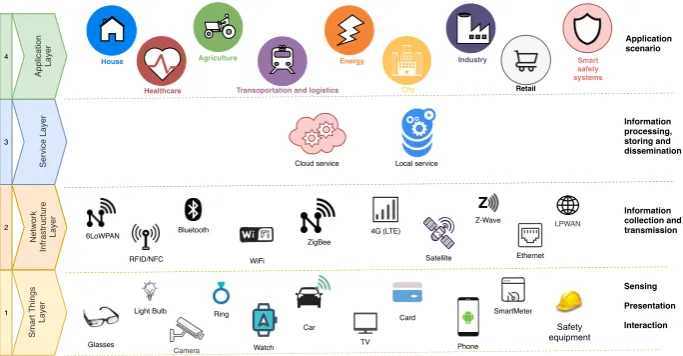
Emerging Intelligent Infrastructures (II) that interconnect various IoT applica-tions and services are meant to provide convenience to people, open new benefits to society, and benefit our environment. There are many IoT applications and use cases that are either already implemented or are in varying research stages heading towards potential implementation. The general overview of IoT envi-ronments and applicable scenarios are depicted in Figure 1.
4
Smart Things
Layer
Network
Infrastructure
Layer
Service Layer
Application
Layer
WiFi
Bluetooth 4G (LTE)
Ethernet Satellite
RFID/NFC
Watch
Card
Phone Car
Ring
Glasses
Cloud service Local service
Camera
TV
Light Bulb SmartMeter
1 2 3
4 House
Healthcare
Agriculture
Transoportation and logistics
Energy
City
Industry
Sensing Presentation Interaction Information collection and transmission Information processing, storing and dissemination Application scenario
Retail
6LoWPAN
ZigBee
Z
Z-Wave LPWAN
Safety equipment
Smart safety systems
Fig. 1.The IoT environment and application areas.
Nevertheless, connected objects, sensors and digital systems around peoples lives form a large intelligent network that can serve as a medium for the leak-age of personal data [61, 27, 63]. It is essential during the design and application stages of intelligent networks to include privacy protection into incoming in-frastructures and IoT applications. Engineers, practitioners, and researchers can develop various privacy protection principles, technologies or Privacy by Design (PbD) strategies.PbDis a term for a multifaceted concept which involves various technological and organizational components, implementing privacy, and data protection principles. In [18], Hoepman proposes eight privacy design strategies, divided into 2 categories, namely data-oriented (1-4) and process-oriented (5-8). The strategies are briefly described as follows:
1. Minimize: processed personal data should be constrained to the minimal amount.
2. Hide: personal data and their interrelationships (linkability) should be pro-tected or not public.
3. Separate: personal data should be processed in a distributed way.
4. Aggregate(Abstract): limit as much as possible the detail in which personal data is processed, aggregating data in the highest level.
5. Inform: data subjects should be informed whenever their personal data is processed.
6. Control: data subjects should be provided control over the processing of their personal data.
7. Enforce: processing personal data should be committed in a privacy-friendly way, and should be adequately enforced.
Many PbDstrategies can be solved by privacy protection techniques called Privacy-Enhancing Technologies (PETs).PETsare based on the principles of data minimization, anonymization, pseudonymization, and data protection that allow users to protect their privacy and their personally identifiable information (PII). The European Union Agency for Network and Information Security (ENISA) has been active in PETs for many years by collaborating closely with privacy experts from academia and industry. ENISA defines PETs as the broader range of technologies that are designed for supporting privacy and data protection.
TheENISA report given in [8] provides a fundamental inventory of the existing
approaches and privacy design strategies and the technical building blocks of various degree of maturity from research and development in general ICT. The report [8] distinguishes the following basic privacy techniques:
• Authentication(e.g. privacy features of authentication protocols);
• Attribute-based credentials;
• Secure private communications;
• Communications anonymity and pseudonymity;
• Privacy in databases:
◦ Respondent privacy: statistical disclosure control;
◦ Owner privacy: privacy-preserving data mining;
◦ User privacy: private information retrieval;
• Storage privacy;
• Privacy-preserving computations;
• Transparency-enhancing techniques;
• Intervenability-enhancing techniques.
In this paper, we focus on privacy-preserving techniques that can be deployed in IoT based services.
1.1 Privacy in Standards and Regulations
Privacy protection is already an important part of EU regulations and interna-tional standards. In 2011, the ISO organization released the ISO/IEC 29100:2011 Privacy Framework Standard that aims at the protection ofPIIfrom the begin-ning of data collection, data usage, data storage to final data destruction. The standard presents 11 principles:
1. consent and choice
2. purpose legitimacy and specification 3. collection limitation
4. data minimization
5. use, retention, and disclosure limitation 6. accuracy and quality
7. openness, transparency, and notice 8. individual participation and access 9. accountability
11. privacy compliance
The general data protection regulation (GDPR) replaced the Data Protection Directive 95/46/EC in 2018 [57]. TheGDPRcovers most basic data security and privacy principles by Article 5 that includes lawfulness, fairness, transparency, purpose limitation, data minimization, accuracy, storage limitation, integrity and confidentiality, and accountability. In addition, the GDPR is stricter in various privacy aspects such as consent, right to be forgotten and privacy (and data protection) by design and by default that is mentioned in Article 25. Hence, privacy-preserving IoT applications and services are required also by the above-mentioned regulations.
1.2 Privacy in IoT Applications and Communication Model
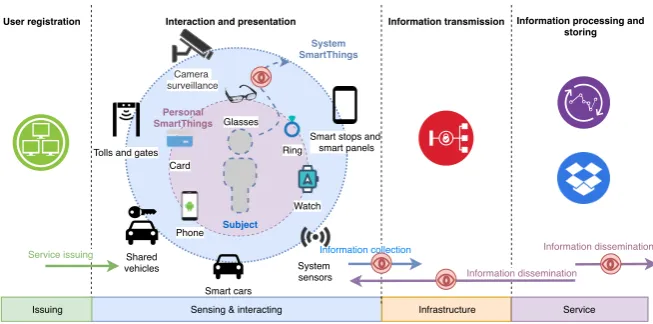
In general, a common IoT communication model consists of several entities such as users, service providers, and third parties. It is also defined by several pro-cesses, such as data sensing, interaction, collection, and presentation. Ziegeldorf
et al.present an IoT model with 4 different IoT entities [64]. Those entities are
smart things (IoT sensors, actuators), services (backends), subjects (humans who receive data and/or produce/send data), and infrastructures (including network sub-entities based communication technologies). They also introduce 5 different IoT data flows: interaction, presentation, collection, dissemination and process-ing.
Sensing & interacting Infrastructure Service
Issuing
Service issuing Information collection Information dissemination
Information dissemination
Information processing and storing Information transmission
User registration Interaction and presentation
Watch Card
Phone
Ring Glasses Personal SmartThings
Subject
System SmartThings
Smart stops and smart panels Tolls and gates
Camera surveillance
System sensors Shared
vehicles
Smart cars
Fig. 2.The IoT communication model and privacy breaches.
leakages that have to be mitigated. The list of privacy issues is presented in detail in Section 4.
In this paper, we aim at privacy-required IoT applications and privacy is-sues in IoT. We also provide an assessment of technical-based PETs in various IoT applications. Based on the results of our categorization and assessment, we propose a novel general framework that should address potential privacy leak-ages and threats within data processes in various IoT scenarios. Our framework enhances traditional privacy-preserving models (e.g. Hoepman’s eight privacy design strategies [18]) by concrete steps and privacy-preserving technical coun-termeasures suited for private and secure IoT services.
The rest of the paper is organized as follows. In Section 2 we describe the state-of-the-art. We follow this in Section 3 by exploring specific use cases of IoT where users have or may experience privacy issues. Section 4 presents privacy issues in IoT. Next, in Section 5 we deal with the categorization and assessment of PETs in IoT. Section 6 presents our proposal of a general privacy-preserving framework for IoT. Lastly, we give some concluding remarks in Section 7.
2
State of the Art
There are plenty of interesting studies and survey papers focusing on security and privacy in IoT [42, 48, 29, 41, 23]. Furthermore, there are surveys and study papers that focus solely on privacy in IoT. Some examples are given in [36, 25, 44, 6, 45, 22].
• Control Over Data
• Enforcement
• Anonymization or Pseudonymization – Personal Data Protection
• Anonymous Authorization
• Partial Data Disclosure
• Holistic Privacy Preservation
Furthermore, the authors conduct 15 privacy principles fromGDPRandISO/IEC
29100:2011, and link the principles withPETs papers and present some future
directions of advanced technologies. The classification of 120 privacy-oriented IoT papers shows that 28% of papers are dedicated to building and home au-tomation, 13% for e-healthcare, 13% for smart cities, 9% for wearables, 8% for automotive, 2% smart manufacturing and 27% are general oriented. In our study, we categorize and present concrete privacy-required IoT applications in Section 3.
The above noted surveys provide comprehensive literature reviews about the
PETsincluding several classifications but there are a lack of basic guidelines for a privacy-by-design implementation of privacy-requiring IoT applications and concretePETsrecommendations.
3
Privacy-Requiring IoT Applications and Use Cases
With the new conveniences promised by IoT comes new privacy and security vul-nerabilities. In an area where often times the devices involved are constrained and as such do not have the capabilities of running high powered security pro-tection, we see definitive vulnerabilities. In this section, we will explore some specific use cases of IoT where users have or may experience privacy issues in no particular order.
For smart home IoT, one well documented attack is the Fingerprint and Timing based Snooping (FATS) attack presented by Srinivasanet al.in [50]. The FATS attack involves activity detection, room classification, sensor classification, and activity recognition from Wi-Fi traffic metadata from a sensor network deployed in the home the precursor to todays smart home IoT devices. TheFATS
attack relies on wireless network traffic instead of observations from a last-mile Internet service provider or other adversary located on a Wide Area Network (WAN). The FATSattack demonstrates that traffic analysis attacks in the style of
FATSare as effective for the current generation of consumer IoT devices as they were for sensor networks ten years ago.
In another significant real-world attack, a recent article in Forbes magazine highlighted research by Noam Rotem and Ran Locar atvpnMentor, who exposed a Chinese company called Orvibo, which runs an IoT management platform. They showed that their database was easily accessible through direct connection to it, exposing openly user logs which contained 2 billion records including user passwords, account reset codes, payment information and even some “smart” camera recorded conversations. Below is a list of data that was available through this ground-breaking breach.
• Email addresses
• Passwords
• Account reset codes
• Precise Geolocation
• IP Address
• Username (ID)
• Family name
This specific breach pinpoints the type of data can be available through unsecured IoT devices or networks.
Consider another IoT use case involving assisted living, were we consider senior citizens who appreciate living independently as summarized in [16]. In this scenario, a number of unobtrusive sensors screen their vital signs and deliver information to the cloud for fast access by family members and third parties such as doctors, and health care providers. There are two levels of privacy issues here, one dealing with senior citizen medical information and the other with their personal data. Combining IoT devices for monitoring vitals and storage mechanisms like cloud storage can present a new domain of issues trying to integrate constrained devices (IoT) with the unconstrained (cloud storage).
great societal challenge for this, and for any service requiring user characteri-zation, is to assure users privacy and security. Thus, in order to achieve user consent, trust in, and acceptance of Smart Cities, integration of security and privacy preserving mechanisms must be a key concern of future research. The overall priority must be to establish user confidence in the upcoming technolo-gies, as otherwise users will hesitate to accept the services provided by Smart Cities.
In the near future autonomous vehicles will be commonplace [59, 21]. In the meantime, the development of Internet of Vehicles (IoV) is ongoing where a myriad of sensors, devices and controllers are attached to vehicles in an effort to allow for autonomous control. It is quite significant to design a privacy mecha-nism which ensures that collection of IoV Big Data is trusted and not tampered with. There is a huge risk of fraudulent messages injected by a malicious vehi-cle that could easily endanger the whole traffic system(s) or could potentially employ the entire network to pursue any dangerous activity for its own wicked benefits.
Finally, in [49], Solanaset al.discuss the notions of Smart Health (s-Health), as the synergy between mobile health and smart cities. Although s-Health might help to mitigate many health related issues, its ability to gather unprecedented amounts of information could endanger the privacy of citizens. In the context of s-Health, the information gathered is often rather personal. From the data, it would be possible to infer citizens habits, their social status, and even their religion. All these variables are very sensitive, and when they are combined with health information, the result is even more delicate. This s-Health scenarios are also very related to smart safety systems where protective equipment (such as helmets, glasses or hazmat suites) is being monitored and traced.
We summarize our findings listing areas of IoT, some concrete applications, and the privacy concerns in Table 1. The privacy concerns used match the list from [13], where Finnet al. identify 7 privacy concerns, defined as follows:
• Privacy of person: encompasses the right to keep body functions and body characteristics private.
• Privacy of behaviour and action: this concept includes sensitive issues such as sexual preferences and habits, political activities and religious prac-tices.
• Privacy of communication: aims to avoid the interception of communica-tions, including mail interception, the use of bugs, directional microphones, telephone or wireless communication interception or recording and access to e-mail messages.
• Privacy of data and image: includes concerns about making sure that individuals data is not automatically available.
• Privacy of thoughts and feelings. People have a right not to share their thoughts or feelings.
• Privacy of location and space: individuals have the right to move about in public or semi-public space without being identified.
Table 1.IoT Areas with the Example of Applications and Privacy Concerns [13]
IoT Area Application Privacy Concerns
Healthcare IoT Geniatech, Cycore Data, Person Internet of Underwater Things WFS Tech Communication
Smart Home Orvibo Data, Location
Smart Cities Cisco Communication, Location Data
IoT Blockchain Implementations Helium Personal, Data Internet of Vehicles RideLogic Action, Image
4
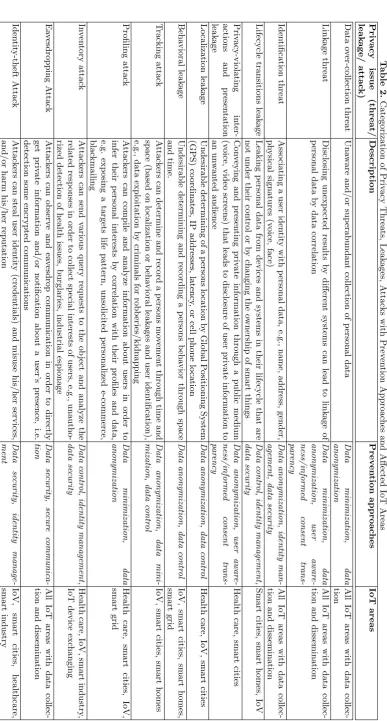
Categorization of Privacy Issues: Threats, Leakages
and Attacks in an IoT Environment
In this section, we categorize privacy issues and present brief descriptions, po-tential prevention approaches and compromised IoT areas. Security attacks and privacy threats in IoT have been analyzed in various studies [33, 64, 2, 6]. Lopez
et al.detect 3 IoT privacy problems: user privacy, content privacy and context
privacy [25]. Furthermore, there have been seven privacy threat categories for IoT given in [64, 6]. Our analysis presents 12 privacy issues divided into 3 classes:
• privacy threats: this class represents the weaknesses and flaws of IoT ser-vices and systems that could be misused by other system entities and/or lead to leakages and attacks,
• privacyleakages: this class represents more serious problems and flaws that can directly breach user privacy and/or can be misused by passive and active attackers,
• privacyattacks: this class represents issues that are intentionally performed by passive and active attackers in order to break user privacy and misuse the observed information for criminal activities.
We categorize general privacy protection and prevention approaches as fol-lows:
• Data minimization: limiting data collection to only necessary information.
• Data anonymization: encrypting, modifying or removing personal
informa-tion in such a way that the data can no longer be used to identify a natural person.
• Data security: the process of protecting data from unauthorized access and
data corruption.
• Data control: monitoring and controlling the data by defining policies.
• Identity management: policies and technologies for ensuring that the proper
users have access to technology resources.
• Secure communication: communication protocol that allow people sharing
• User awareness/informed consent transparency: users give their consents about data usage and they are aware which data are processed.
In Table 2, we describe privacy issues, general prevention approaches and link the issues with target IoT area and services. To be noted, that some more complex attacks can be performed by the combination of several privacy leakages and threats.
5
Categorization of Privacy-Enhancing Technologies for
Internet of Things
In this section, we present and categorize privacy-enhancing technologies. We focus onPETsthat can be
• implemented in devices,
• used as applications (user side),
• applied in networks,
• applied in data storage, cloud and back-end servers.
PETsmay provide these basic privacy features:
• (P1) anonymity: user is not identifiable as the source of data (user is
indis-tinguishable).
• (P2)pseudonymity: user is identifiable only to system parties (issuers), trades off between anonymity and accountability.
• (P3) unlinkability: actions of the same user cannot be linked together, and
all sessions are mutually unlinkable.
• (P4) untracebility: user’s credentials and/or actions cannot be tracked by
system parties (issuers).
• (P5) revocation: a dedicated system party is able to remove person or its
credential from the system.
• (P6) data privacy: stored and/or released information do not expose
unde-sired properties, e.g. identities, user’s vital data etc.
Further,PETs combine privacy features with common security features such as:
• (S1) data confidentiality: sensitive data are protected against eavesdropping
and exposing by encryption techniques.
• (S2) data authenticity and integrity: data are protected against their lost or
modification by the unauthorized entities.
• (S3) authentication: proof that a connection is established with an
authen-ticated entity or access to services is granted only to authenauthen-ticated entity .
• (S4) non-repudiation: proof that a data is signed by a certain entity (entity
cannot deny this action).
As above, privacy (P1 - P6) and security (S1 - S5) features are only basic and common. Table 3 presents PETscategorized into 6 processes (data authenticity, user authentication, communication, computation/data processing, data storing and data dissemination), and provides a brief description of PETs, their privacy and security features and standards and/or examples of references for existed IoT implementations or thePET’s consideration in IoT. Mentioned technologies may conduct and represent many various schemes that have different properties. Furthermore, this analysis for simplicity does not involve advanced and special features, e.g. malleability, no framing, transparency, and intervenability, which can be found in the special variants of PETschemes.
In addition, it is assumed that well-established techniques already provide principally native features such as soundness, correctness, unforgeability, com-pleteness etc. Suitable and maturedPETsfor IoT applications are integrated into our proposed framework in the following Section 6.
6
Privacy-Preserving Framework for Internet of Things
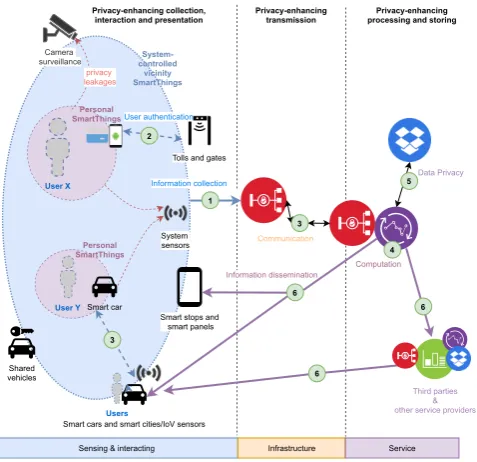
In this section, we propose a general privacy-preserving framework for an IoT communication model. Our proposed novel framework is mainly based on gen-eral security and privacy requirements of IoT applications and potential privacy issues in IoT based services. The general concept of the proposed framework is depicted in Figure 3. The framework contains 4 initial processes, 6 privacy-preserving data procedures, and 4 general post-processes. The privacy privacy-preserving data procedures are mainly focused on embedding thePETsin IoT services (e.g. access control in smart cities/smart buildings, IoV data exchanging etc.). These framework processes can be applied linearly in time. Furthermore, we recom-mend suitable types of PETs in order to solve concrete privacy-issues in each detected area and aspect in the general IoT model.
Before employing concretePETs into an IoT application, initial Privacy-by-Design strategies and procedures must be set and performed in order to be in line with privacy standards and principles, i.e., ISO/IEC 29100:2011, [57], [18].
Theinitial processes of the framework are defined as follows:
• System Definition: Define data flaws and data procedures for the concrete IoT application/system.
• Privacy Analysis: Analyze the privacy breaches and issues in the concrete IoT application/system.
• Data Definition: Define concrete datasets, user’s vital and sensitive data that should be protected and set limitation.
• Legal Definition: Set and ensure purpose legitimacy, consents and infor-mation strategies in according to regulations and laws.
Then, thetechnical processes should be set and ensured by employingPETs
in these 6 privacy-preserving data procedures:
Sensing & interacting Infrastructure Service Privacy-enhancing processing and storing Privacy-enhancing
transmission Privacy-enhancing collection,
interaction and presentation
Personal SmartThings
User X
System-controlled vicinity SmartThings
Smart stops and smart panels
Tolls and gates Camera
surveillance
System sensors
Shared vehicles
Smart cars and smart cities/IoV sensors
Information dissemination
4 3
User YSmart car 2
3
Information collection 5 1
User authentication
Communication
Data Privacy privacy
leakages
6
Computation
6
Third parties & other service providers
6 Personal
SmartThings
Users
Fig. 3.The proposed privacy-preserving framework for IoT environment.
should ensure user privacy and data authenticity. Employing anonymous/ pseudonymous digital signatures such as digital group signatures (GS) should provide data authenticity, non-repudiation and also hide users as sources of data in the group of members. This approach providesk-anonymity wherek
is the number of all members. The implementation of short (few KBs) group signatures (e.g. [10, 12, 31]) that need several asymmetric cryptographic op-erations could be feasible in IoT using small devices (i.e. mobiles, micro-controllers).
routing, MixNets or broadcasting in order to provide source privacy, i.e. hide source IP address. Recently, the paper [3] has utilized the Tor Network for IoT. Moreover, anonymous digital signatures and GScan be used to ensure data authenticity and integrity without leaking the identity of a sender. 4. Privacy-preserving Computation: The back-end servers of IoT services
or cloud infrastructures should perform privacy-preserving data processing. For privacy-preserving computation, there are many possible techniques and privacy-preserving options, such as HE, SW,ABE, MC, andPE&P. Using tech-niques such as homomorphic encryption is possible to perform some data analysis and keep data private for owners. Nonetheless, HEandSEmethods could be less applicable to performance-constrained client nodes (see results in [47]). Therefore, these heavy computation operations should be performed at powerful back-end servers or clouds. On the other hand, fine-grained ac-cess control on encrypted outsourced data can be realized by ABEschemes. The work [19] shows the results of ABE on small devices with promising efficiency in terms of processing time and energy consumption.
5. Privacy-preserving Data Storing: A service area should store only nec-essary data in a privacy-preserving way. There are several SDC techniques (microdata protection, etc.) that enable users to store data and protect their privacy. These approaches lead to data minimization. Also, the data should be secured by standard methods (e.g. storage encryption). The implementa-tion of SDCtechniques should not be problematic on most IoT platforms and storages but data minimization should be done in a reasonable way without losing the important data for an analysis.
6. Privacy-preserving Data Dissemination: The results of data processing that are disseminated and presented back to users or to third parties should not contain any vital and/or private information about concrete users. The combination of presentation rules and data minimization strategies should be employed in order to keep user privacy.
After embeddingPETsinto data procedures,post-processes for sustainability and general management must be followed:
• Evaluation: The final application/service should be evaluated whetherPETs
and technical processes mitigate privacy and security issues.
• Control: The functionality of concrete privacy-preserving data procedures should be constantly controlled.
• Monitoring: The data visibility and transparency in the system should be ensured.
• Compliance: The compliance with the current regulations and laws should be checked, and the system should be able to demonstrate this.
7
Conclusion
analyzed and categorized various privacy issues and privacy-enhancing technolo-gies from the perspective of IoT. Based on the analyzed privacy breaches in IoT and privacy-enhancing technologies divided into 6 categories, a general frame-work was proposed that consists of 8 general processes and 6 technical privacy-preserving procedures. The presented framework should serve as a guideline for establishing privacy-preserving IoT applications and systems in line with privacy-by-design concepts. The particular applications that will benefit from the framework the most are identification systems, access control systems, smart safety systems, smart-grids and health care.
Acknowledgment
This paper is supported by the Ministry of Industry and Trade grant # FV20354, the TACR project TL02000398 and European Union’s Horizon 2020 research and innovation programme under grant agreement No 830892, project SPARTA. For the research, infrastructure of the SIX Center supported by National Sustain-ability Program under grant LO1401 was used.
References
1. Alp´ar, G., Batina, L., Batten, L., Moonsamy, V., Krasnova, A., Guellier, A., Nat-gunanathan, I.: New directions in iot privacy using attribute-based authentication: Position paper (2016)
2. Atamli, A.W., Martin, A.: Threat-based security analysis for the internet of things. In: International Workshop on Secure Internet of Things. pp. 35–43. IEEE (2014) 3. Baumann, F.W., Odefey, U., Hudert, S., Falkenthal, M., Breitenb¨ucher, U.: Util-ising the tor network for iot addressing and connectivity. In: Proceedings of the 8th International Conference on Cloud Computing and Services Science (CLOSER 2018). pp. 27–34. SciTePress (Mar 2018)
4. Bernal Bernabe, J., Hernandez-Ramos, J.L., Skarmeta Gomez, A.F.: Holistic privacy-preserving identity management system for the internet of things. Mobile Information Systems 2017 (2017)
5. Camenisch, J., Drijvers, M., Dzurenda, P., Hajny, J.: Fast keyed-verification anony-mous credentials on standard smart cards. In: Dhillon, G., Karlsson, F., Hedstr¨om, K., Z´uquete, A. (eds.) ICT Systems Security and Privacy Protection. pp. 286–298. Springer International Publishing, Cham (2019)
6. Cha, S.C., Hsu, T.Y., Xiang, Y., Yeh, K.H.: Privacy enhancing technologies in the internet of things: Perspectives and challenges. IEEE Internet of Things Journal (2018)
7. Chatzigiannakis, I., Vitaletti, A., Pyrgelis, A.: A privacy-preserving smart parking system using an iot elliptic curve based security platform. Computer Communica-tions 89, 165–177 (2016)
8. Danezis, G., Domingo-Ferrer, J., Hansen, M., Hoepman, J.H., Metayer, D.L., Tirtea, R., Schiffner, S.: Privacy and data protection by design-from policy to engineering. arXiv preprint arXiv:1501.03726 (2015)
10. Derler, D., Slamanig, D.: Highly-efficient fully-anonymous dynamic group signa-tures. In: Proceedings of the 2018 on Asia Conference on Computer and Commu-nications Security. pp. 551–565. ACM (2018)
11. Dwivedi, A.D., Srivastava, G., Dhar, S., Singh, R.: A decentralized privacy-preserving healthcare blockchain for iot. Sensors 19(2), 326 (2019)
12. Emura, K., Hayashi, T.: A light-weight group signature scheme with time-token dependent linking. In: Lightweight Cryptography for Security and Privacy. pp. 37–57. Springer (2015)
13. Finn, R.L., Wright, D., Friedewald, M.: Seven types of privacy. In: European data protection: coming of age, pp. 3–32. Springer (2013)
14. Hajny, J., Dzurenda, P., Malina, L.: Attribute-based credentials with cryptographic collusion prevention. Security and Communication Networks 8(18), 3836–3846 (2015)
15. He, D., Chen, C., Bu, J., Chan, S., Zhang, Y., Guizani, M.: Secure service provi-sion in smart grid communications. IEEE Communications Magazine 50(8), 53–61 (2012)
16. Henze, M., Hermerschmidt, L., Kerpen, D., H¨außling, R., Rumpe, B., Wehrle, K.: User-driven privacy enforcement for cloud-based services in the internet of things. In: 2014 International Conference on Future Internet of Things and Cloud. pp. 191–196. IEEE (2014)
17. Hoang, N.P., Pishva, D.: A tor-based anonymous communication approach to se-cure smart home appliances. In: 2015 17th International Conference on Advanced Communication Technology (ICACT). pp. 517–525. IEEE (2015)
18. Hoepman, J.H.: Privacy design strategies. In: IFIP International Information Se-curity Conference. pp. 446–459. Springer (2014)
19. Jahan, M., Seneviratne, S., Chu, B., Seneviratne, A., Jha, S.: Privacy preserving data access scheme for iot devices. In: 2017 IEEE 16th International Symposium on Network Computing and Applications (NCA). pp. 1–10. IEEE (2017)
20. Kelarev, A.V., Yi, X., Cui, H., Rylands, L.J., Jelinek, H.F.: A survey of state-of-the-art methods for securing medical databases. AIMS Medical Science 5(1), 1–22 (2018)
21. Kong, Q., Lu, R., Ma, M., Bao, H.: A privacy-preserving sensory data sharing scheme in internet of vehicles. Future Generation Computer Systems 92, 644–655 (2019)
22. Li, C., Palanisamy, B.: Privacy in internet of things: From principles to technolo-gies. IEEE Internet of Things Journal 6(1), 488–505 (Feb 2019)
23. Lin, J., Yu, W., Zhang, N., Yang, X., Zhang, H., Zhao, W.: A survey on internet of things: Architecture, enabling technologies, security and privacy, and applications. IEEE Internet of Things Journal 4(5), 1125–1142 (2017)
24. Liu, F., Li, T.: A clustering-anonymity privacy-preserving method for wearable iot devices. Security and Communication Networks 2018 (2018)
25. Lopez, J., Rios, R., Bao, F., Wang, G.: Evolving privacy: From sensors to the internet of things. Future Generation Computer Systems 75, 46–57 (2017) 26. Ma, M., He, D., Kumar, N., Choo, K.K.R., Chen, J.: Certificateless searchable
public key encryption scheme for industrial internet of things. IEEE Transactions on Industrial Informatics 14(2), 759–767 (2017)
28. Mai, V., Khalil, I.: Design and implementation of a secure cloud-based billing model for smart meters as an internet of things using homomorphic cryptography. Future Generation Computer Systems 72, 327–338 (2017)
29. Malina, L., Hajny, J., Fujdiak, R., Hosek, J.: On perspective of security and privacy-preserving solutions in the internet of things. Computer Networks 102, 83–95 (2016) 30. Malina, L., Srivastava, G., Dzurenda, P., Hajny, J., Fujdiak, R.: A secure pub-lish/subscribe protocol for internet of things. In: Proceedings of the ARES 2019. ACM (2019)
31. Malina, L., Vives-Guasch, A., Castell`a-Roca, J., Viejo, A., Hajny, J.: Efficient group signatures for privacy-preserving vehicular networks. Telecommunication Systems 58(4), 293–311 (2015)
32. von Maltitz, M., Carle, G.: Leveraging secure multiparty computation in the in-ternet of things. arXiv preprint arXiv:1806.02144 (2018)
33. Medaglia, C.M., Serbanati, A.: An overview of privacy and security issues in the internet of things. In: The internet of things, pp. 389–395. Springer (2010) 34. Nieto, A., Rios, R., Lopez, J.: Digital witness and privacy in iot: Anonymous
witnessing approach. In: 2017 IEEE Trustcom/BigDataSE/ICESS. pp. 642–649. IEEE (2017)
35. Patton, M., Gross, E., Chinn, R., Forbis, S., Walker, L., Chen, H.: Uninvited connections: a study of vulnerable devices on the internet of things (iot). In: IEEE Joint Intelligence and Security Informatics Conference. pp. 232–235. IEEE (2014) 36. Porambage, P., Ylianttila, M., Schmitt, C., Kumar, P., Gurtov, A., Vasilakos, A.V.: The quest for privacy in the internet of things. IEEE Cloud Computing 3(2), 36–45 (2016)
37. Put, A., De Decker, B.: Attribute-based privacy-friendly access control with con-text. In: International Conference on E-Business and Telecommunications. pp. 291– 315. Springer (2016)
38. Ramos, J.L.H., Bernab´e, J.B., Skarmeta, A.F.: Towards privacy-preserving data sharing in smart environments. In: Eighth International Conference on Innovative Mobile and Internet Services in Ubiquitous Computing. pp. 334–339. IEEE (2014) 39. Raza, S., Trabalza, D., Voigt, T.: 6lowpan compressed dtls for coap. In: 2012 IEEE 8th International Conference on Distributed Computing in Sensor Systems. pp. 287–289. IEEE (2012)
40. Rodr´ıguez, C.R.G., et al.: Using differential privacy for the internet of things. In: IFIP International Summer School on Privacy and Identity Management. pp. 201– 211. Springer (2016)
41. Rodriguez, J.D.P., Schreckling, D., Posegga, J.: Addressing data-centric security requirements for iot-based systems. In: 2016 International Workshop on Secure Internet of Things (SIoT). pp. 1–10. IEEE (2016)
42. Roman, R., Zhou, J., Lopez, J.: On the features and challenges of security and privacy in distributed internet of things. Computer Networks 57(10), 2266–2279 (2013)
43. Rothenpieler, P., Altakrouri, B., Kleine, O., Ruge, L.: Distributed crowd-sensing infrastructure for personalized dynamic iot spaces. In: Proceedings of the First International Conference on IoT in Urban Space. pp. 90–92. ICST (Institute for Computer Sciences, Social-Informatics and (2014)
44. Seliem, M., Elgazzar, K., Khalil, K.: Towards privacy preserving iot environments: A survey. Wireless Communications and Mobile Computing 2018 (2018)
46. Sene, I., Ciss, A.A., Niang, O.: I2pa: An efficient abc for iot. Cryptography 3(2), 16 (2019)
47. Shafagh, H., Hithnawi, A., Droescher, A., Duquennoy, S., Hu, W.: Talos: Encrypted query processing for the internet of things. In: Proceedings of the 13th ACM con-ference on embedded networked sensor systems. pp. 197–210. ACM (2015) 48. Sicari, S., Rizzardi, A., Grieco, L.A., Coen-Porisini, A.: Security, privacy and trust
in internet of things: The road ahead. Computer networks 76, 146–164 (2015) 49. Solanas, A., Patsakis, C., Conti, M., Vlachos, I.S., Ramos, V., Falcone, F.,
Posto-lache, O., P´erez-Mart´ınez, P.A., Di Pietro, R., Perrea, D.N., et al.: Smart health: a context-aware health paradigm within smart cities. IEEE Communications Maga-zine 52(8), 74–81 (2014)
50. Srinivasan, V., Stankovic, J., Whitehouse, K.: Protecting your daily in-home ac-tivity information from a wireless snooping attack. In: Proceedings of the 10th international conference on Ubiquitous computing. pp. 202–211. ACM (2008) 51. Staudemeyer, R.C., P¨ohls, H.C., W´ojcik, M.: The road to privacy in iot: beyond
encryption and signatures, towards unobservable communication. In: 2018 IEEE 19th International Symposium on” A World of Wireless, Mobile and Multimedia Networks”(WoWMoM). pp. 14–20. IEEE (2018)
52. Tso, R., Alelaiwi, A., Rahman, S.M.M., Wu, M.E., Hossain, M.S.: Privacy-preserving data communication through secure multi-party computation in health-care sensor cloud. Journal of Signal Processing Systems 89(1), 51–59 (2017) 53. Ullah, I., Shah, M.A., Wahid, A., Mehmood, A., Song, H.: Esot: a new privacy
model for preserving location privacy in internet of things. Telecommunication Systems 67(4), 553–575 (2018)
54. Vance, N., Zhang, D.Y., Zhang, Y., Wang, D.: Privacy-aware edge computing in social sensing applications using ring signatures. In: IEEE 24th International Con-ference on Parallel and Distributed Systems (ICPADS). pp. 755–762. IEEE (2018) 55. Vasilomanolakis, E., Daubert, J., Luthra, M., Gazis, V., Wiesmaier, A., Kikiras, P.: On the security and privacy of internet of things architectures and systems. In: Proceedings of SIoT. pp. 49–57. IEEE (2015)
56. Verheul, E.R., Jacobs, B., Meijer, C., Hildebrandt, M., de Ruiter, J.: Polymorphic encryption and pseudonymisation for personalised healthcare. IACR Cryptology ePrint Archive 2016, 411 (2016)
57. Voigt, P., Von dem Bussche, A.: The eu general data protection regulation (gdpr). A Practical Guide, 1st Ed., Cham: Springer International Publishing (2017) 58. Wang, X., Jiang, J., Zhao, S., Bai, L.: A fair blind signature scheme to revoke
malicious vehicles in vanets. Computers, Materials & Continua 58(1), 249–262 (2019)
59. Xu, W., Zhou, H., Cheng, N., Lyu, F., Shi, W., Chen, J., Shen, X.: Internet of vehicles in big data era. IEEE/CAA Journal of Automatica Sinica 5(1), 19–35 (2017)
60. Yang, Y., Wu, L., Yin, G., Li, L., Zhao, H.: A survey on security and privacy issues in internet-of-things. IEEE Internet of Things Journal 4(5), 1250–1258 (2017) 61. Yao, Z., Ge, J., Wu, Y., Jian, L.: A privacy preserved and credible network protocol.
Journal of Parallel and Distributed Computing (2019)
63. Zhou, R., Zhang, X., Wang, X., Yang, G., Wang, H., Wu, Y.: Privacy-preserving data search with fine-grained dynamic search right management in fog-assisted internet of things. Information Sciences 491, 251–264 (2019)
![Table 1. IoT Areas with the Example of Applications and Privacy Concerns [13]](https://thumb-us.123doks.com/thumbv2/123dok_us/7989223.1325911/9.595.123.483.137.218/table-iot-areas-example-applications-privacy-concerns.webp)