Traceability Improvements of a New RFID Protocol Based On
EPC C1 G2
Seyed Salman Sajjadi GhaemMaghami1, Afrooz Haghbin2, Mahtab Mirmohseni3
1 Department of Computer Engineering, Science and Research branch, Islamic Azad University,
Tehran, Iran
2 Department of Computer Engineering, Science and Research branch, Islamic Azad University,
Tehran, Iran [email protected]
3 Department of Electrical Engineering, Sharif University of Technology, Tehran, Iran [email protected]
Abstract
Radio Frequency Identification (RFID) applications have spread all over the world and, in order to provide their security and pri-vacy, researchers proposed different kind of protocols. In this pa-per, we analyzes the privacy of a new protocol, proposed by Yu-Jehn in 2015 which is based on Electronic Product Code Class1 Generation 2 (EPC C1 G2) standard. By applying the Ouafi-Phan privacy model, we show that the Yu-Jehnprotocol is vulnerable against traceability attack and forward traceability attack and it does not provide the privacy of RFID users. Then, to enhance the privacy of the analyzed protocol, an improved version of the pro-tocol is proposed which eliminates the existing weaknesses of Yu-Jehnprotocol.
Keywords: RFID authentication protocols, Yu-Jehnprotocol, Privacy, Traceability Attack, Forward Traceability Attack.
1. Introduction
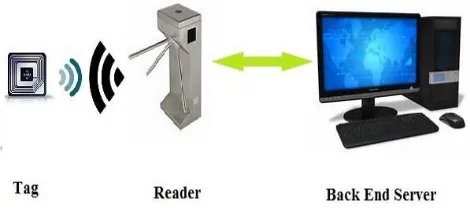
Radio Frequency Identification (RFID) technology is a pio-neer of great change in social life which has been started in recent decades and is developing increasingly in different kinds of services all around the world [1, 2, 3]. Transporta-tion, healthcare, medical applications, trading, human or an-imal identification, security services are some examples which improve their facilities by using the RFID technolo-gies. RFID systems consist of three main parts as shown in Fig. 1: Tag, Reader and Back end server. The identification data for interaction with the Reader are stored in the Tag. The Back-end server contains a complete database of iden-tification information of all the Tags and the Readers and the Reader is placed between the Tag and the Back-end server. Depending on the protocol of any RFID system, Readers are permitted to change or add some input to the received data from the Tag (Back-end server) and forward it to the Back-end server (Tag). The connection between the
Tag and the Reader is insecure while the connection be-tween the Reader and the Back-end server is mostly secure. However, in some applications, Reader is merged with the Back-end server and the new structure consist of two main parts, the Tag and the Back-end server.
Depending on the power of RFID tags, they are falling in one of the three categories: active, passive and semi-passive [4]. The active Tag has an inner battery which enables it to start a new conversation with the Reader or the Back-end server. On the other hand, the passive tag does not have any battery and obtains its required energy for calculations and responding by using the Reader’s electrical field. The semi-passive tag has a battery, but it uses this battery just for the internal processing while for wireless communications it is like the passive Tag.
In the last few years, researchers have proposed different RFID authentication protocols to provide security and pri-vacy requirements of RFID end-users. According to the structure of the protocols and deployed cryptographic func-tions in them, these protocols can be classified into four main groups [5]. The first class, called full-fledged, contains the protocols that apply ordinary cryptographic functions,
such as one-way hash functions, public or private key cryp-tography systems, and so forth [6]. The second class con-tains the protocols that use Random Number Generators (RNG) and one-way hash functions [7]. Lightweight is the name of the third class that is relevant to those protocols which apply RNG and Cyclic Redundancy Code (CRC) checksum [8]. And the last class are the Ultra Lightweight protocols which are only allowed to use simple bitwise op-erators such as XOR, AND, OR and it means that they are not even permitted for using RNG in the Tag’s side [1, 9]. In the last few years, due to ubiquitously deployment of RFID systems in some sensitive applications, studying the security and the privacy of RFID end-users has got more attention by researchers [2, 10-14]. Electronic Product Code Class 1 Generation 2 (EPC C1 G2) [15]is the most popular standard which has been proposed for RFID passive tags. Recently, due to popularity and implementing of RFID EPC-based tags in wide range of identification and authen-tication applications, designing authenauthen-tication protocols un-der EPC C1 G2 standard has become a primary research ar-eas for researchers in RFID protocols [16-19].
In 2007, Chien and Chen[20]proposed an improved mu-tual authentication protocol for RFID systems that is related to the standard of EPC C1 G2. Peris-Lopez et al. in [21] show that Chien and Chen’s scheme cannot resist against the tracking, forged-server, DoS, forged-tag, and forward secrecy attacks. In 2012, Yu-Jehn [1] studied Chien and Chen’s protocol and proposed a new mutual authentication protocol for EPC C1 G2 RFID tags. This protocol uses only ultra-lightweight operations, such as RNG, PRNG and XOR. In [1], the security and the privacy of the protocol are analyzed and it is claimed that the protocol is immune against existing security and privacy attacks.
In this paper, we study the privacy of Yu-Jehnprotocol [1] and show that their protocol still suffers from some weak-nesses and cannot provide private communication for RFID users. One of the main points in designing an RFID protocol is defining a new and randomized quantity as the secret val-ues, which will be impossible for the attacker to guess them even by eavesdropping the protocol, moreover there must be the least likeliness between the transmitted messages and the updating procedure to prevent an adversary from under-standing the next ID or secret values. But Yu-Jehn [1] miss these note in scheming of their proposed protocol, so it makes the attacker to trace the position of the Tag which is in contravention of the Privacy Performance in the protocol design. In this paper we mention to these weakness by per-forming two different traceability attacks and a forward traceability attack against theirprotocol. Moreover, in order to enhance the privacy of Yu-Jehn protocol, by paying at-tention to the stated notes, an improved version of their pro-tocol is proposed.
The structure of paper is organized as follows: privacy model of Ouafi and Phan is described in section 2. Section
3 introduces the Yu-Jehn protocol. In section 4, Yu-Jehn protocol is analyzed from the privacy point of view. In sec-tion 5, we apply some changes to Yu-Jehn protocol and pro-pose an improved version of it. Moreover, the privacy of our proposed protocol is analyzed in this section, and it is shown that the weaknesses of Yu-Jehn protocol are fixed. Finally, we conclude the paper in section 6.
2. Ouafi and Phan Privacy model
The researchers have proposed a number of privacy models to evaluate the privacy of the RFID protocols. Here, we briefly describe Ouafi and Phanprivacy model [22] since we analyze the privacy of Yu-Jehn protocol using this model. In this model, the adversary 𝒜 is able to both eaves-drop the communication channel between Tags and Readers, and change the protocol’s flows actively or passively. Ac-tually the adversary 𝒜 can run the following queries:
∎Execute query (R, T, i): This query models passive at-tacks. Its output involves the messages that were exchanged between Reader R and Tag T during a truthful execution of the protocol in the session i.
∎Send query (𝑼, 𝑽, 𝒎, 𝒊): In this query, an adversary 𝒜 is able to perform an active attack. In the other words, the at-tacker impersonate an entity such as 𝑈 ∈ 𝑇 in the 𝑖th ses-sion of the protocol by sending a message (m) to an entity
𝑉 ∈ 𝑅.
∎Corrupt query (𝑻, 𝑲): In corrupt query, the adversary 𝒜 has physical access to the Tag T, so it becomes as a stronger query than send. With this query, the adversary 𝒜 learns the stored secret 𝐾0 of 𝑇, and sets it to K. This query is used to capture the notion of forward and backward traceability and the extent of the damage caused by compromising tag’s stored secret.
∎Test query (𝑻𝟎, 𝑻𝟏,𝒊): When this query is executed in the particular session 𝑖, after completing 𝑖th session, a random number bit 𝑏 𝜖
{
0,
1}
is generated by challenger and𝑇𝑏
𝜖 {
𝑇0,
𝑇1}
is delivered to the attacker. Adversary wins if it can truly guess the bit 𝑏.Untraceability (UPriv): The adversary plays the game 𝐺 and gathers R and T instances by implementing the men-tioned queries in the following phases:
∷ Learning phase: The adversary 𝒜can drive the Execute, Send, and Corrupt queries to any random 𝑇0 and 𝑇1 tags.
∷ Challenge phase: The attacker 𝒜 selects two fresh tags
𝑇0 and 𝑇1, and forwards a Test query (𝑇0, 𝑇1, 𝑖) to the chal-lenger. After that, the challenger selects 𝑏 𝜖 {0,1} randomly and the attacker𝒜 expresses a tag 𝑇𝑏 ∈ {𝑇0, 𝑇1} using Exe-cute and Send queries.
The success of the attacker 𝒜 in playing 𝐺 is equal to its success of breaking untraceability notion which is equal to the probability of recognizing whether attacker 𝒜 received
𝑇0 or 𝑇1. It can be denoted by 𝐴𝑑𝑣𝐴𝑈𝑃𝑖𝑣(𝐾), where 𝑘 is the security parameter:
𝐴𝑑𝑣𝐴𝑈𝑃𝑖𝑣(𝑘) = |pr(𝒜 𝑤𝑖𝑛𝑠) − pr(𝑟𝑎𝑛𝑑𝑜𝑚 𝑐𝑜𝑖𝑛 𝑓𝑙𝑖𝑝)|
= |pr(𝑏′ = 𝑏) −12| (1)
where0 ≤𝐴𝑑𝑣𝐴𝑈𝑃𝑖𝑣(𝑘)≤21. If 𝐴𝑑𝑣𝐴𝑈𝑃𝑖𝑣(𝑘) <(𝑘), the pro-tocol is traceable with negligible probability.
3. The Yu-Jehn Protocol
In [1], Yu-Jehn proposed a new mutual authentication pro-tocol for EPC C1 G2 RFID tags. EPC is the new Electronic Product Code that replaces the older UPC (Universal Prod-uct Code) found on many item labels and is a set of num-bers plus a bar code. The structure of Yu-Jehn protocol is illustrated in Fig. 2. The notation that are used in Yu-Jehn protocol are listed below:
𝑬𝑷𝑪𝒊: Electronic Product Code of the ith Tag
𝑲𝒊: Authentication key
𝑷𝑰𝑫𝒊: The pseudonym identification code of the ith Tag
𝑹𝑰𝑫𝑗: The pseudonym identification code of the jth Reader
𝑹𝒊: A random number 𝒉(. ): Hash function
𝑷: Pseudo Random Number Generator ∥: Concatenation operation
𝐀 ⊕ 𝐁: Message A is XORed with message B
4. Privacy Analyzes of Yu-Jehn Protocol
4.1 Traceability Attack
This subsection aims to show that Yu-Jehn protocol is vul-nerable against two different kinds of traceability attacks where an adversary can trace a specific tag as follows, Learning phase: In the session (𝑖) and (𝑖 + 1), the adver-sary 𝒜 sends an 𝐸𝑥𝑒𝑐𝑢𝑡𝑒 𝑞𝑢𝑒𝑟𝑦 (𝑅, 𝑇0, 𝑖) and
𝐸𝑥𝑒𝑐𝑢𝑡𝑒 𝑞𝑢𝑒𝑟𝑦 (𝑅, 𝑇0, 𝑖 + 1) and gets 𝑀1,𝑖𝑇0= 𝑁𝑖𝑇0⊕ 𝑟2,𝑖,
𝑃𝐼𝐷𝑖+1𝑇0 , 𝑀
1,𝑖+1 𝑇0
. Then he/she calculates 𝜆 = 𝑃(𝑀1,𝑖𝑇0) =
𝑃(𝑁𝑖𝑇0⊕ 𝑟2,𝑖) and 𝛾 = 𝑀1,𝑖+1𝑇0 ⊕ 𝜆.
Challenge phase: The adversary 𝒜 selects two fresh tags
𝑇0 and 𝑇1 for test, and sends a 𝑇𝑒𝑠𝑡 𝑞𝑢𝑒𝑟𝑦(𝑇0, 𝑇1, 𝑖 + 2). According to the randomly chosen bit 𝑏 𝜖 {0, 1}, the adver-sary is given a tag 𝑇𝑏 𝜖 {𝑇0, 𝑇1}. Afterwards, the adversary
𝒜 sends an 𝐸𝑥𝑒𝑐𝑢𝑡𝑒 𝑞𝑢𝑒𝑟𝑦(𝑅, 𝑇𝑏, 𝑖 + 2), and obtains
Back-end Server
Reader
Tag
(𝑁𝑜𝑙𝑑, 𝑁𝑛𝑒𝑤, 𝐾𝑜𝑙𝑑, 𝐾𝑛𝑒𝑤, 𝑃𝐼𝐷𝑜𝑙𝑑, 𝑃𝐼𝐷𝑛𝑒𝑤, 𝐸𝑃𝐶𝑖) (𝑅𝐼𝐷𝑗) (𝑁𝑖, 𝐾𝑖, 𝐸𝑃𝐶𝑖, 𝑃𝐼𝐷𝑖)
4.1 𝑉𝑅 ? =ℎ(𝑅𝐼𝐷𝑗⊕ 𝑟1)
4.2 Search 𝑃𝐼𝐷𝑖 in the database to find out (𝐸𝑃𝐶𝑖, 𝑁𝑖𝑜𝑙𝑑, 𝐾𝑖𝑜𝑙𝑑, 𝑃𝐼𝐷𝑖𝑜𝑙𝑑, 𝑁𝑖𝑛𝑒𝑤, 𝐾𝑖𝑛𝑒𝑤, 𝑃𝐼𝐷𝑖𝑛𝑒𝑤)
4.3 𝑟2= 𝑀1⊕ 𝑁𝑖𝑜𝑙𝑑 or 𝑟2= 𝑀1⊕ 𝑁𝑖𝑛𝑒𝑤
4.4 𝑀2 ? =𝑃(𝐸𝑃𝐶𝑖∥ 𝑟1∥ 𝑟2∥ 𝐾𝑖𝑜𝑙𝑑 or 𝐾𝑖𝑛𝑒𝑤)
4.5 𝑥 = 𝑜𝑙𝑑 or 𝑛𝑒𝑤
4.6 𝑀3= 𝑃(𝐸𝑃𝐶𝑖∥ 𝑟2∥ 𝑁𝑖𝑥∥ 𝐾𝑖𝑥)
4.7 𝑀→ 3
4.8 If (x = new)
𝑁𝑖𝑜𝑙𝑑= 𝑁𝑖𝑛𝑒𝑤, 𝑁𝑖𝑛𝑒𝑤= 𝑃(𝑁𝑖𝑛𝑒𝑤⊕ 𝑟2)
𝐾𝑖𝑜𝑙𝑑 = 𝐾𝑖𝑛𝑒𝑤, 𝐾𝑖𝑛𝑒𝑤= 𝑃(𝐾𝑖𝑛𝑒𝑤⊕ 𝑟2)
𝑃𝐼𝐷𝑖𝑜𝑙𝑑= 𝑃𝐼𝐷𝑖𝑛𝑒𝑤, 𝑃𝐼𝐷𝑖𝑛𝑒𝑤= 𝑃(𝑃𝐼𝐷𝑖𝑛𝑒𝑤⊕ 𝑟2)
END If
1.1 Generates 𝑟1
1.2 𝑉𝑅= ℎ(𝑅𝐼𝐷𝑗⊕ 𝑟1)
1.3 𝑟 → 1
3 (𝑀← 1,𝑀2,𝑃𝐼𝐷𝑖,𝑟1,𝑉𝑅 )
5 𝑀→ 3
2.1 Generates 𝑟2 Randomly
2.2 𝑀1= 𝑁𝑖⊕ 𝑟2
2.3 𝑀2= 𝑃(𝐸𝑃𝐶𝑖∥ 𝑟1∥ 𝑟2∥ 𝐾𝑖)
2.4 (𝑀← 1,𝑀2,𝑃𝐼𝐷𝑖 )
6.1 𝑀3 ? =𝑃(𝐸𝑃𝐶𝑖∥ 𝑟2∥ 𝑁𝑖 ∥ 𝐾𝑖 )
6.2 𝑁𝑖 = 𝑃(𝑁𝑖 ⊕ 𝑟2)
6.3 𝐾𝑖 = 𝑃(𝐾𝑖 ⊕ 𝑟2)
6.4 𝑃𝐼𝐷𝑖 = 𝑃(𝑃𝐼𝐷𝑖 ⊕ 𝑟2)
Fig. 2 The Yu-Jehn Protocol [1].
𝑃𝐼𝐷𝑖+2𝑇𝑏
.
Guess phase: The adversary 𝒜 stops the game G, and out-puts a bit 𝑏′ 𝜖 {0, 1}as a guess of bit 𝑏 as follows.
𝑏′= {0 𝑖𝑓 𝑃𝐼𝐷𝑖+2𝑇𝑏 = 𝑃𝑅𝑁𝐺( 𝑃𝐼𝐷𝑖+1𝑇0 ⊕ 𝛾)
1 𝑜𝑡ℎ𝑒𝑟𝑤𝑖𝑠𝑒 (2)
As a result, we have:
𝐴𝑑𝑣𝐴𝑢𝑝𝑟𝑖𝑣(𝑘) = |𝑝𝑟(𝑏′= 𝑏) − 𝑝𝑟(𝑟𝑎𝑛𝑑𝑜𝑚 𝑐𝑜𝑖𝑛 𝑓𝑙𝑖𝑝)|
= |𝑝𝑟(𝑏′= 𝑏) −1
2| = |1 − 1 2| =
1
2 ≫ 𝜀 (3)
Proof: According to the Fig. 2 we can write,
𝐼𝑓 𝑇𝑏= 𝑇0 :
𝑃( 𝑃𝐼𝐷𝑖+1𝑇0 ⊕ 𝛾) = 𝑃( 𝑃𝐼𝐷
𝑖+1 𝑇0
⊕ 𝑀1,𝑖+1𝑇0 ⊕ 𝜆)
= 𝑃 ( 𝑃𝐼𝐷𝑖+1𝑇0 ⊕ 𝑀1,𝑖+1𝑇0 ⊕ 𝑃(𝑁𝑖𝑇0⊕ 𝑟2,𝑖))
= 𝑃( 𝑃𝐼𝐷𝑖+1𝑇0 ⊕ 𝑀
1,𝑖+1𝑇0 ⊕ 𝑁𝑖+1𝑇0 )
= 𝑃( 𝑃𝐼𝐷𝑖+1𝑇𝑏 ⊕ 𝑀
1,𝑖+1𝑇𝑏 ⊕ 𝑁𝑖+1 𝑇b
) = 𝑃( 𝑃𝐼𝐷𝑖+1𝑇𝑏 ⊕ 𝑟
2,𝑖+1) = 𝑃𝐼𝐷𝑖+2 𝑇𝑏
(4) Hence, 𝐴𝑑𝑣𝐴𝑢𝑝𝑟𝑖𝑣(𝑘) =1
2≫ 𝜀 and the Tag is traceable. Note that the notion 𝐴𝑑𝑣𝐴𝑢𝑝𝑟𝑖𝑣 is defined in [22].
Moreover, the Yu-Jehn protocol is again vulnerable against traceability attack too. According to the structure of Yu-Jehn protocol, it can be seen that the 𝑃𝐼𝐷𝑖 will not be up-dated till session (5) of the protocol. So an adversary can perform traceability attack by preventing the 𝑃𝐼𝐷𝑖 update in the Tag using one time interception of protocol. This attack can be performed as follows:
Learning phase: In session (i), the attacker 𝒜 sends an
𝐸𝑥𝑒𝑐𝑢𝑡𝑒 𝑞𝑢𝑒𝑟𝑦(𝑅, 𝑇0, 𝑖) to the Tag by sending a random number, 𝑟1′, and obtains 𝑀1′, 𝑀2′, 𝑃𝐼𝐷𝑖′.
Challenge phase: The attacker 𝒜 selects two fresh tags
𝑇0and 𝑇1 for the test, and sends a 𝑇𝑒𝑠𝑡 𝑞𝑢𝑒𝑟𝑦(𝑇0, 𝑇1, 𝑖 +
1). According to the randomly chosen bit 𝑏 𝜖 {0, 1}, the at-tacker is given a tag 𝑇𝑏 𝜖 {𝑇0, 𝑇1}. After that, the attacker 𝒜 sends an 𝐸𝑥𝑒𝑐𝑢𝑡𝑒 𝑞𝑢𝑒𝑟𝑦(𝑅, 𝑇𝑏, 𝑖 + 1) by sending 𝑟1′′, and obtains 𝑀1′′, 𝑀2′′, 𝑃𝐼𝐷𝑖′′.
Guess phase: The attacker 𝒜 stops the game G, and outputs a bit 𝑏′ 𝜖 {0, 1} as a guess of bit b as follows,
𝑏′= {0 𝑖𝑓 𝑃𝐼𝐷𝑖′= 𝑃𝐼𝐷𝑖′′
1 𝑜𝑡ℎ𝑒𝑟𝑤𝑖𝑠𝑒 (5)
As a result, we get:
𝐴𝑑𝑣𝐴𝑢𝑝𝑟𝑖𝑣(𝑘) = |𝑝𝑟(𝑏′= 𝑏) − 𝑝𝑟(𝑟𝑎𝑛𝑑𝑜𝑚 𝑐𝑜𝑖𝑛 𝑓𝑙𝑖𝑝)|
= |𝑝𝑟(𝑏′= 𝑏) −1
2| = |1 − 1 2| =
1
2 ≫ 𝜀 (6)
Proof: After an unsuccessful challenge between the attacker and the tag, the tag does not update 𝑃𝐼𝐷𝑖. Hence, the tag uses the same value in the next session.
4.2 Forward traceability Attack
In addition to the mentioned privacy disquiets, it can be shown that Yu-Jehn protocol does not assure forward traceability. According to the structure of Yu-Jehn protocol, the 𝐸𝑃𝐶 is fixed in all sessions. Because of this weakness, an adversary can track a target tag as follows:
Learning phase: In the 𝑖th session, the adversary 𝒜 sends a 𝐶𝑜𝑟𝑟𝑢𝑝𝑡 𝑞𝑢𝑒𝑟𝑦(𝑇0, 𝐾′) and obtains (𝐾𝑖𝑇0, 𝑁𝑖𝑇0, 𝐸𝑃𝐶𝑖𝑇0) from Tag 𝑇0. It also sends an 𝐸𝑥𝑒𝑐𝑢𝑡𝑒 𝑞𝑢𝑒𝑟𝑦(𝑅, 𝑇0, 𝑖) and obtains (𝑟1,𝑖, 𝑀1,𝑖𝑇0). Now, simply the adversary computes
𝑟2,𝑖 as 𝑟2,𝑖= 𝑀1,𝑖 𝑇0
⊕ 𝑁𝑖𝑇0. Afterward using the obtained 𝑟
2,𝑖, the adversary computes 𝛢 and 𝛣 as follows:
𝛢 = 𝑃(𝑁𝑖𝑇0⊕ 𝑟
2,𝑖), 𝛣 = 𝑃(𝐾𝑖𝑇0⊕ 𝑟2,𝑖) (7) Challenge phase: The adversary 𝒜 selects two fresh tags
𝑇0 and 𝑇1 for the test, and sends a 𝑇𝑒𝑠𝑡 𝑞𝑢𝑒𝑟𝑦( 𝑇0, 𝑇1, 𝑖 +
1).According to the randomly chosen bit 𝑏 𝜖 {0, 1}, the ad-versary is given a tag 𝑇𝑏 𝜖 {𝑇0, 𝑇1}. Now in session
(𝑖 + 1) th, the adversary 𝒜 sends an
𝐸𝑥𝑒𝑐𝑢𝑡𝑒 𝑞𝑢𝑒𝑟𝑦(𝑅, 𝑇𝑏, 𝑖 + 1) by sending 𝑟1,𝑖 (i.e., the same value as for session 𝑖) and obtains (𝑀1,𝑖+1𝑇𝑏 , 𝑀2,𝑖+1𝑇𝑏 ). Now the adversary computes 𝑟2,𝑖+1 as 𝑟2,𝑖+1= 𝑀1,𝑖+1
𝑇𝑏
⊕ 𝛢. Guess phase: The adversary 𝒜 stops the game 𝐺, and out-puts a bit 𝑏′ 𝜖 {0, 1}as a guess of bit 𝑏 using the following rule:
𝑏′= {0 𝑖𝑓 𝑀2,𝑖+1 𝑇𝑏
= 𝑃(𝐸𝑃𝐶𝑖𝑇0 ∥ 𝑟
1,𝑖∥ 𝑟2,𝑖+1∥ 𝛣)
1 𝑜𝑡ℎ𝑒𝑟𝑤𝑖𝑠𝑒 (8)
As a result, it can be written that,
𝐴𝑑𝑣𝐴𝑢𝑝𝑟𝑖𝑣(𝑘) = |𝑝𝑟(𝑏′= 𝑏) − 𝑝𝑟(𝑟𝑎𝑛𝑑𝑜𝑚 𝑐𝑜𝑖𝑛 𝑓𝑙𝑖𝑝)|
= |𝑝𝑟(𝑏′= 𝑏) −1
2| = |1 − 1 2| =
1
2 ≫ 𝜀 (9)
Proof: As the value of 𝐸𝑃𝐶 is fixed in all sessions, we have 𝐸𝑃𝐶𝑖𝑇0= 𝐸𝑃𝐶𝑖+1𝑇0 . Using this fact, the following equa-tions is obtained:
(1) 𝐼𝑓 𝑇𝑏 = 𝑇0∶ 𝑁𝑖+1 𝑇b
= 𝑃(𝑁𝑖𝑇b⊕ 𝑟
2,𝑖) = 𝑃(𝑁𝑖𝑇0⊕ 𝑟2,𝑖) = 𝛢
(2) 𝐼𝑓 𝑇𝑏 = 𝑇0∶ 𝐾𝑖+1 𝑇b
= 𝑃(𝐾𝑖𝑇b⊕ 𝑟
2,𝑖) = 𝑃(𝐾𝑖𝑇0⊕ 𝑟2,𝑖) = 𝛣
(1), (2) => 𝑀2,𝑖+1𝑇𝑏 = 𝑃(𝐸𝑃𝐶
𝑖 𝑇b
∥ 𝑟1,𝑖∥ 𝑟2,𝑖+1∥ 𝐾𝑖+1 𝑇b
= 𝑃(𝐸𝑃𝐶𝑖𝑇0 ∥ 𝑟
1,𝑖∥ 𝑟2,𝑖+1∥ 𝐾𝑖+1𝑇0 )
= 𝑃(𝐸𝑃𝐶𝑖𝑇0 ∥ 𝑟
1,𝑖∥ 𝑟2,𝑖+1∥ 𝛣) (10)
5. Improved Version of Yu-Jehn Protocol
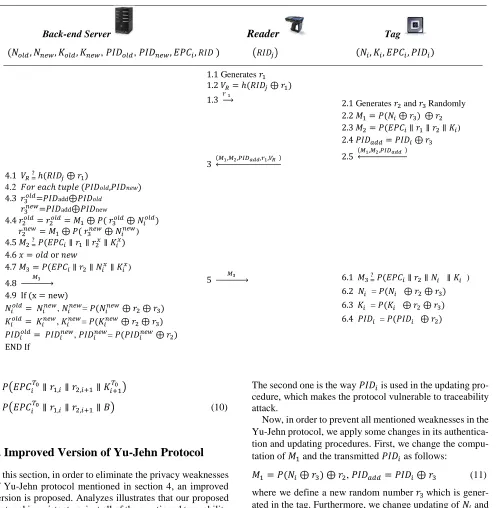
In this section, in order to eliminate the privacy weaknesses of Yu-Jehn protocol mentioned in section 4, an improved version is proposed. Analyzes illustrates that our proposed protocol is resistant against all of the mentioned traceability attacks. Yu-Jehn protocol has two main weaknesses that make it vulnerable to traceability attacks. The first one is the structure of generating 𝑀1= 𝑁𝑖⊕ 𝑟2. Because, using this way of generation, if the adversary obtains 𝑁𝑖, upon eavesdropping 𝑀1, he/she can calculate the random number
𝑟2 and perform traceability and forward traceability attacks.
The second one is the way 𝑃𝐼𝐷𝑖 is used in the updating pro-cedure, which makes the protocol vulnerable to traceability attack.
Now, in order to prevent all mentioned weaknesses in the Yu-Jehn protocol, we apply some changes in its authentica-tion and updating procedures. First, we change the compu-tation of 𝑀1 and the transmitted 𝑃𝐼𝐷𝑖 as follows:
𝑀1= 𝑃(𝑁𝑖⊕ 𝑟3) ⊕ 𝑟2, 𝑃𝐼𝐷𝑎𝑑𝑑= 𝑃𝐼𝐷𝑖⊕ 𝑟3 (11) where we define a new random number 𝑟3which is gener-ated in the tag. Furthermore, we change updating of 𝑁𝑖 and
𝐾𝑖 as follows,
𝑁𝑖+1= 𝑃(𝑁𝑖⨁𝑟2⨁𝑟3), 𝐾𝑖+1= 𝑃(𝐾𝑖⨁𝑟2⨁𝑟3) (12) The improved protocol is shown in Fig. 3 in details. In the improved protocol, to avoid traceability attack, we prevent sending 𝑃𝐼𝐷𝑖 explicitly and change it with 𝑃𝐼𝐷𝑎𝑑𝑑 which
Back-end Server
Reader
Tag
(𝑁𝑜𝑙𝑑, 𝑁𝑛𝑒𝑤, 𝐾𝑜𝑙𝑑, 𝐾𝑛𝑒𝑤, 𝑃𝐼𝐷𝑜𝑙𝑑, 𝑃𝐼𝐷𝑛𝑒𝑤, 𝐸𝑃𝐶𝑖,𝑅𝐼𝐷 ) (𝑅𝐼𝐷𝑗) (𝑁𝑖, 𝐾𝑖, 𝐸𝑃𝐶𝑖, 𝑃𝐼𝐷𝑖)
4.1 𝑉𝑅 ? =ℎ(𝑅𝐼𝐷𝑗⊕ 𝑟1)
4.2 𝐹𝑜𝑟 𝑒𝑎𝑐ℎ 𝑡𝑢𝑝𝑙𝑒 (𝑃𝐼𝐷𝑜𝑙𝑑,𝑃𝐼𝐷𝑛𝑒𝑤)
4.3 𝑟3𝑜𝑙𝑑=𝑃𝐼𝐷add⊕𝑃𝐼𝐷𝑜𝑙𝑑
𝑟3𝑛𝑒𝑤=𝑃𝐼𝐷add⊕𝑃𝐼𝐷new
4.4 𝑟2𝑜𝑙𝑑= 𝑟2𝑜𝑙𝑑= 𝑀1⊕ 𝑃( 𝑟3𝑜𝑙𝑑⊕ 𝑁𝑖𝑜𝑙𝑑)
𝑟2𝑛𝑒𝑤= 𝑀1⊕ 𝑃( 𝑟3𝑛𝑒𝑤⊕ 𝑁𝑖𝑛𝑒𝑤)
4.5 𝑀2 ? =𝑃(𝐸𝑃𝐶𝑖∥ 𝑟1∥ 𝑟2𝑥∥ 𝐾𝑖𝑥)
4.6 𝑥 = 𝑜𝑙𝑑 or 𝑛𝑒𝑤
4.7 𝑀3= 𝑃(𝐸𝑃𝐶𝑖∥ 𝑟2∥ 𝑁𝑖𝑥∥ 𝐾𝑖𝑥)
4.8 𝑀→ 3 4.9 If (x = new)
𝑁𝑖𝑜𝑙𝑑= 𝑁𝑖𝑛𝑒𝑤, 𝑁𝑖𝑛𝑒𝑤= 𝑃(𝑁𝑖𝑛𝑒𝑤⊕ 𝑟2⊕ 𝑟3)
𝐾𝑖𝑜𝑙𝑑 = 𝐾𝑖𝑛𝑒𝑤, 𝐾𝑖𝑛𝑒𝑤= 𝑃(𝐾𝑖𝑛𝑒𝑤⊕ 𝑟2⊕ 𝑟3)
𝑃𝐼𝐷𝑖𝑜𝑙𝑑= 𝑃𝐼𝐷𝑖𝑛𝑒𝑤, 𝑃𝐼𝐷𝑖𝑛𝑒𝑤= 𝑃(𝑃𝐼𝐷𝑖𝑛𝑒𝑤⊕ 𝑟2)
END If
1.1 Generates 𝑟1
1.2 𝑉𝑅= ℎ(𝑅𝐼𝐷𝑗⊕ 𝑟1)
1.3 𝑟 → 1
3 (𝑀← 1,𝑀2,𝑃𝐼𝐷𝑎𝑑𝑑,𝑟1,𝑉𝑅 )
5 𝑀→ 3
2.1 Generates 𝑟2 and 𝑟3Randomly 2.2 𝑀1= 𝑃(𝑁𝑖⊕ 𝑟3) ⊕ 𝑟2
2.3 𝑀2= 𝑃(𝐸𝑃𝐶𝑖∥ 𝑟1∥ 𝑟2∥ 𝐾𝑖)
2.4 𝑃𝐼𝐷𝑎𝑑𝑑= 𝑃𝐼𝐷𝑖⊕ 𝑟3
2.5 (𝑀← 1,𝑀2,𝑃𝐼𝐷𝑎𝑑𝑑 )
6.1 𝑀3 ? =𝑃(𝐸𝑃𝐶𝑖∥ 𝑟2∥ 𝑁𝑖 ∥ 𝐾𝑖 )
6.2 𝑁𝑖 = 𝑃(𝑁𝑖 ⊕ 𝑟2⊕ 𝑟3)
6.3 𝐾𝑖 = 𝑃(𝐾𝑖 ⊕ 𝑟2⊕ 𝑟3)
6.4 𝑃𝐼𝐷𝑖 = 𝑃(𝑃𝐼𝐷𝑖 ⊕ 𝑟2)
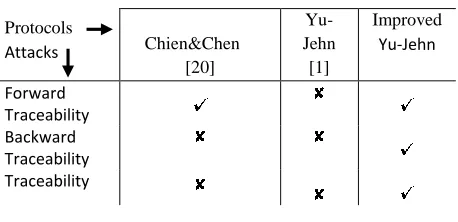
Table 1. COMPARISON OF PRIVACY ANALYZES
Protocols
Attacks Chien&Chen
[20]
Yu-Jehn
[1]
Improved Yu-Jehn
Forward Traceability Backward Traceability Traceability
: Secure : Insecure
the amount of computation in the Back-end server side, but the presence of powerful processor in Back-end server will make this issue ignorable [4-5]. In the rest of this subsection, the privacy of improved Yu-Jehn protocol is analyzed against different privacy attacks. It is shown that how our modification on the Yu-Jehn protocol can fix all mentioned weaknesses and increase its privacy.
Traceability Attack: In Section 4.1, it is shown that the ad-versary can trace the tag via two different methods. In our proposed protocol, in order to prevent these two, we make two changes in the exchanged messages between the Tag and the Reader. First, we change transmitted 𝑃𝐼𝐷𝑖 from the Tag to the Reader with 𝑃𝐼𝐷𝑎𝑑𝑑= 𝑃𝐼𝐷𝑖⨁𝑟3, where 𝑟3 is a random number that is generated by the tag in each session. Therefore, since in each session the value of 𝑃𝐼𝐷𝑎𝑑𝑑 changes, even if the adversary intercepts the protocol, he/she cannot trace the tag using 𝑃𝐼𝐷𝑖. Also in order to pre-vent the second attack, we change generating 𝑀1= 𝑁𝑖⨁𝑟2 into 𝑀1= 𝑃𝑅𝑁𝐺(𝑁𝑖⨁𝑟3)⨁𝑟2. As a result, the adversary cannot obtain 𝑁𝑖 and 𝑟2 and consequently he/she cannot calculate the value of 𝑃𝐼𝐷𝑖+1 to trace the tag.
Backward and Forward Traceability Attacks: In the pro-posed protocol, in order to prevent backward traceability and forward traceability attacks, we change updating proce-dure of 𝑁𝑖+1= 𝑃(𝑁𝑖⨁𝑟2) into 𝑁𝑖+1= 𝑃(𝑁𝑖⨁𝑟2⨁𝑟3) and
𝐾𝑖+1= 𝑃(𝐾𝑖⨁𝑟2) into𝐾𝑖+1= 𝑃(𝐾𝑖⨁𝑟2⨁𝑟3). Since the values of 𝑟2 and 𝑟3 are generated in each session, thus the adversary cannot trace the target tag even if he/she corrupts the tag and obtains the secret key 𝐾𝑖, 𝑁𝑖, and 𝐸𝑃𝐶𝑖. The privacy of our proposed protocol is compared with the analyzed protocol and Chien and Chen’s protocol in Table 2. As it can be seen, our proposed protocols can provide user privacy.
6. Conclusion
In this paper, we analyzed the privacy of a recently pro-posed RFID authentication protocol under the standard of EPC C1G2 by Yu-Jehn in 2015. We showed that Yu-Jehn protocol does not provide privacy immunity and it is sus-ceptible to different traceability attacks such as forward
traceability attack and traceability attack. Then, in order to improve the performance of the analyzed protocol, an im-proved version is proposed that eliminates the mentioned attacks.
References
[1] Yu-C. Huang, and Jehn-R. Jiang, "Ultralightweight RFID Reader-Tag Mutual Authentication Revisted," in Proc. of IEEE Mobile Services Conference (IEEE MS 2015), 2015.
[2] D. He, Sh. Zeadally, "An Analysis of RFID Authentication Schemes for Internet of Things in Healthcare Environment Using Elliptic Curve Cryptography," IEEE Internet of Things Journal, vol. 2, pp. 72-83, 2015.
[3] A. Juels, "RFID security and privacy: a research survey," IEEE Journal on Selected Areas in Communications, vol. 24, pp. 381 - 394, 2006.
[4] G. Avoine, "Cryptography in Radio Frequency Identification and Fair Exchange Protocols," PHD thesis, Swiss Federal Institute of Technology, Switzerland, 2005.
[5] H.-Y. Chien, "SASI: a newultralightweight RFID authentication protocol providing strong authentication and strong integrity," IEEE Transactions on Dependable and Secure Computing, vol. 4, pp. 337– 340, 2007.
[6] B. Abdolmaleki, K. Baghery, B. Akhbari, and M. R. Aref, "Attacks and improvements on two new-found RFID authentication protocols," in 7th International Symposium on Telecommunications (IST), Tehran, 2014.
[7] S. M. Alavi, B. Abdolmaleki, and K. Baghery, "Vulnerabilities and improvements on HRAP+, a hash-based RFID authentication protocol," Advances in Computer Science: an International Journal, vol. 3, pp. 51-56, 2014.
[8] Z. Shi, Y. Xia, Y. Zhang, Y. Wang, and J. Dai, "A CRC-based lightweight authentication protocol for EPCglobal Class-1 Gen-2 tags," in 14th International Conference on Algorithms and Architectures for Parallel Processing (ICA3PP), 2014.
[9] Y. C. Lee, "Two Ultralightweight Authentication Protocols for Low-Cost RFID Tags," Applied Mathematics & Information Sciences, pp. 425-431, 2012.
[10]S. Abdolmaleky, S. Atapoor, M. Hajighasemlou and H. Sharini, "A Strengthened Version of a Hash-based RFID Server-less Security Scheme," Advances in Computer Science: an International Journal, vol. 4, pp. 18-23, 2015.
C-1 G-2 standard," Journal of Advances in Computer Science (ACSIJ), vol. 3, pp. 10-16, 2014.
[12]S.M. Alavi, K. Baghery, B. Abdolmaleki, and M. R. Aref, "Traceability analysis of recent RFID authentication protocols," Wireless Personal Communications, pp. 1-20, 2015.
[13]M. Safkhani, N. Bagheri, P. Peris-Lopez, A. Mitrokotsa, J. C Hernandez-Castro, "Weaknesses in another Gen2-based RFID authentication protocol," in IEEE International Conference on RFID-Technologies and Applications (RFID-TA), 2012.
[14]U. Mujahid, M. Islam, M. A. Shami, "RCIA: A New Ultralightweight RFID Authentication Protocol Using Recursive Hash," International Journal of Distributed Sensor Networks, vol. Volume 2015, Article ID 642180, 8 pages, 2015.
[15]"EPCglobal Inc.," [Online]. Available: http://www.epcglobalinc.org. [Accessed 02 01 2014]. [16]K. Baghery, B. Abdolmaleki, B. Akhbari, M.R. Aref,
"Untraceable RFID authentication protocols for EPC compliant tags," in 23rd Iranian Conference on Electrical Engineering (ICEE), pp. 426-431, 2015. [17]N. Bagheri, M. Safkhani and M. Naderi, "Cryptanalysis
of a new EPC class-1 generation-2 standard compliant RFID protocol," Neural Computing and Applications, vol. 24, pp. 799-805, 2014.
[18]H. Martin, E. Millan, P. Peris-Lopez, and J. E. Tapiador, "Efficient ASIC implementation and analysis of two EPC-C1G2 RFID authentication protocols," Sensors Journal, IEEE, vol. 13, pp. 3537-3547, 2013. [19]F. Xiao, Y. Zhou, J. Zhou, H. Zhu, and X. Niu,
"Security protocol for RFID system conforming to EPC-C1G2 standard," Journal of Computers, vol. 8, pp. 605-612, 2013.
[20]H. Y. Chien, and C. H. Chen, "Mutual authentication protocol for RFID confirming to EPC Class 1 Generation 2 standards," Computer Standards & Interfaces, vol. 29, pp. 254-259, 2007.
[21]P. Peris-Lopez, J. C. Hernandez-Castro, J. M. Estevez-Tapiador, A. Ribagorda, "Cryptanalysis of a novel authentication protocol conforming to EPC-C1G2 standard," Computer Standards & Interfaces, vol. 31, pp. 372-380, 2009.
![Fig. 2 The Yu-Jehn Protocol [1].](https://thumb-us.123doks.com/thumbv2/123dok_us/7926201.1316035/3.612.59.559.92.493/fig-jehn-protocol-random-number-hash-function.webp)