© 2016, IJCSMC All Rights Reserved 118 Available Online atwww.ijcsmc.com
International Journal of Computer Science and Mobile Computing
A Monthly Journal of Computer Science and Information Technology
ISSN 2320–088X
IMPACT FACTOR: 5.258
IJCSMC, Vol. 5, Issue. 7, July 2016, pg.118 – 122
ACO Based Multi-Featured Analysis Method
for Route Optimization in WSN
Nishant Jakhar
Asstt. Prof., CSE Dept Indus Degree College
Abstract— The restricted resource based sensor network, can be optimized at different level. The route optimization is one of the methods to improve the resource utilization and effective network communication. In this paper, a multi-featured route optimization is provided using ACO approach. At the earlier stage of this work, random ANT agents are distributed over the network with coverage constraints. Each ANT analyzed the sensor devices under energy, distance and direction parameters. Based on these parameters, the effective node in each ANT regions will be identified. In the final stage, the backward ANT is processed to generate the optimized path.
Keywords : ANT, Route Optimization, Energy, Mutli-Featured
I. INTRODUCTION
© 2016, IJCSMC All Rights Reserved 119
Figure 1 : Routing in WSN
The common phenomenon here divides in two main approaches called source specific or the destination specific routing. As the name suggest, the destination specific routing start from destination node start exploring the neighbors towards the source. This kind of routing is performed at level based and identified the neighbors with each communication. In sensor network, with each communication, some energy consumption occurs. It can also affect the data delivery and increases the communication fault, because of this, there is requirement of route formation with each communication. To improve the communication effectiveness, the number of hop count can also be reduced so that the effective data delivery between the source and sink will be performed[6][7][8][9][10]. While estimating the neighbor different measures can be applied to identify the cost at neighbor level. This measure includes communication cost analysis, energy stock analysis, sensing rage analysis and the error rate analysis. These measures can be applied collectively to generate the adaptive network path. The evaluation of the routing effect and to generate the comparative between the methods, protocols and the routing constraints[11][12][13][14]. In this research a more adaptive and intelligent routing method is provided for sensor network which is explained in later section of this paper.
A) ACO
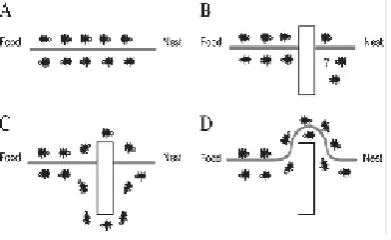
ACO (Ant Colony Optimization) is the approach that generates a primary network and relative communication through ants. Each ant is here recognized by some chemical called pheromones. The ant communication is here provided to trail these pheromones. Other ants can sense the position of the ants by this pheromone. The concentration path formation and the following path generation can be done using the pheromones. The ant behavior is here divided in two main stages. In first stage, the forward ant is processed to generate the path by sensing the pheromones of ants. The pheromone over the path is evaporated with time. Till this pheromone exists, other ants can track the ants. The ant processing is shown here in figure 2.
Figure 2 : Basic ANT behaviour
© 2016, IJCSMC All Rights Reserved 120
In this paper, an ACO improved route optimization method is provided to improve the communication throughput. The method used the distributed ANTs as the network agent to provide the zone specific analysis. The multi-featured analysis is performed to identify the effective node and later on applied adaptive communication route over it. In this section, the concept of sensor network optimization and route formation is provided. In section II, the work defined by earlier researchers is provided. In section III, the proposed work model is defined with relative process stages. In section IV, the conclusion of work is provided.
II. RELATED WORK
In this section, the work provided by some of the earlier researchers is presented. The work is done for different routing method and QoS optimization in the network. Different issues raised by different researchers are discussed in this section. Author has
proposed directed diffusion routing strategy in[6] is based on attribute-value querying and when queried, nodes establish gradients to the query initiator and send the attribute-value pair to the query initiating node. In [7], author proposes a refinement to the directed diffusion algorithm proposed in [7], named Rumor routing. Rumor routing is applicable in areas where nodes do not have a coordinate system. In this, the query generated is sent on randomly until it finds nodes which are on the path to the event destination. Servetto et al. recently proposed in [8], a routing algorithm (Servettos’ algorithm) It basically the congestion avoidance and the load distribution approach over the center nodes. Such kind of problem occur in case of some grid ndetwork or the hierarchical networks where some central nodes get the extra load on it and in such case a load distribution scheme is required to avoid the extra load over that node. The author has taken the grid network to present the work. In a grid network the routing is performed from the static routes either diagonal based or the horizontal or the vertical route identification schemes. In each case, the load over some specific node increases and the requirement of the load distribution or the load prevention is expected. In another paper [9] provide the solution to avoid the network faults and to provide the reliable communication in a fault oriented network. They split the data packet into multiple segments in such a way that the original data can be constructed from subset of all the segments. They route these multiple segments on multiple paths and at the destination construct the original message from the messages received. Author [10], proposed in this paper describe a Two-Tier Data Dissemination scheme to improve the data transmission in case of multicast communication. The author has presented a reliable and efficient communication to enable the continuous and flow less reliable communication over the network. Author[11] proposed a zig-zag routing to generate the optimal communication path in case of congested network as well as in a network having the fault over the nodes.. Author[12] proposed an unreliable wireless sensor grid-network with n nodes placed in a square of unit area. The author has defined the active communication without any coverage specification. The presented work was the probabilistic work in which routing will be generating by performing the analysis on next neighbor as well as to preserve the connectivity over the network.
The major issue in a sensor network is the energy consumption while performing the different events so that some energy savin g approach is required. Many of the authors performed work in this direction respective to different network problems. These energy saving approaches are categorized as the Greedy approach in which a greedy factor is included with each routing or the clustering algorithm. The major objective of such kind of work was to improve the network life and to improve the network QOS. The authors have defined the effective work in these energy effective algorithmic approaches.
Most of these energy effective approaches require the intelligent analysis over the network to process on to improve the QOS[6]. In order to reduce and control the energy consumption on each node as well as over the network different approaches are suggested by the authors. These all approaches include the redundancy avoided routing, network sensing approaches etc. Based on this phenomenon different greedy approaches are suggested. Some authors also use the fuzzy and other soft computing approaches to generate the energy effective routing path over the network. Each of these approaches is effective in terms of energy consumption, memory requirement, and the bandwidth utilization.
III. RESEARCH METHODOLOGY
© 2016, IJCSMC All Rights Reserved 121
relative to zone priority analysis. The zone specific backward trail is accomplished. As the zones covered in the path are identified, the next work is to capture the zone node information from the relative controller. The flow of work under the ant adaptive path formation is shown here in figure 2.
In each zone, the ant provided the information about the priority node present within the zone. The effectiveness of node is here identified in terms of node degree, energy and the direction towards the sink. The process is repeated in parallel for each inclusive zones and later on the connectivity path is formed by selecting these adaptive zone nodes. The process is repeated till the complete network path is not formulated. The parameter specific evaluation is here defined to generate the more optimized and reliable communication path. The method is able to improve the network life and to optimize the communication over the network.
Figure 2 : Flow of Work Establish the sensor network with N sensor
devices in the fixed region
Set the source and sink nodes to provide the adaptive communication
Set the random ants over the network with relative coverage and life constraints
Track the sensor nodes within zone with relative energy and coverage constraints
Apply the ANT adaptive node tracking under energy, direction and node degree parameters and
relatively assign the node priority within the ant zone
Repeat the process till the sink node not identified by the ant
Perform the backward ant with pheromone trail and identify the covered zone between the source
and sink nodes
{Zone specific trailing as the earlier stage without parameter evaluation}
Identify the adaptive node in each zone to generate the optimized communication path
© 2016, IJCSMC All Rights Reserved 122
Here figure 2 is showing the flow of work to generate the optimized communication path over the network. The work model is here defined to provide the optimized network communication. The ant based parametric analysis is here defined to elect the adaptive zones in first stage and later on the reliable nodes in each zone is identified to formed the optimized communication.
IV. CONCLUSION
In this present work, ACO optimized route formation is provided for sensor network. The proposed work model is here defined to provide the agent adaptive communication to improve the communication reliability. The proposed work model first used the parameter specific forward ant to identify the feasible effective nodes in each coverage zone and later on applied the backward ant to form the path. The work is to optimize the network communication and life.
R
EFERENCES
[1] Lewis, F.L., “Wireless Sensor Networks Smart Environments: Technologies, Protocols, and Applications”, New York: ed. D.J. Cook and S.K. Das, John Wiley, 2004, pp.1-18.
[2] Ian F. Akyildiz, Weilian Su, Yogesh Sankarasubramaniam, and Erdal Cayirci, “A Survey On Sensor Networks”, in Proc. of the IEEE Communications Magazine, vol.40, Issue: 8, pp. 102-114, August 2002
[3] Qiangfeng Jiang and D. Manivannan, “Routing Protocols for Sensor Networks”, in Proc. of the IEEE Conference, 2004, pp. 93-98.
[4] C. L. Barett, S. J. Eidenbenz, L. Kroc, M. Marathe, and J. P. Smith, “Parametric Probabilistic Sensor Network Routing,” Proceedings of the 2nd ACM international conference on Wireless sensor networks and applications, pp. 122–131, San Diego, California, September 2003.
[5] B. Krishnamachari, D. Estrin, and S. Wicker, “Modelling Data-Centric Routing in Wireless Sensor Networks,” Proceedings of the 2002 IEEE INFOCOM,New York, NY, June 2002.
[6] C. Intanagonwiwat, R. Govindan, and D. Estrin, “Directed diffusion: a scalable and robust communication paradigm for sensor networks,” Proceedings of the 6th57 annual international conference on Mobile computing and networking, pp. 56–67, Boston, Massachusetts, August 2000.
[7] D. Braginsky, and D. Estrin, “Rumor Routing Algorithm for Sensor Networks,”Proceedings of the 1st ACM international workshop on Wireless sensor networks and applications, pp.22–31, Atlanta, Georgia, 2002.
[8] S. D. Servetto, and G. Barrenechea, “Constrained Random Walks on Random Graphs: Routing Algorithms for Large Scale Wireless Sensor Networks,” Proceedings of the 1st ACM international workshop on Wireless sensor networks andapplications, pp. 12–21, Atlanta, Georgia, September 2002
[9] S. Dulman, T. Nieberg, J. Wu, and P. Havinga, “Trade-Off between Traffic Overhead and Reliability in Multipath Routing for Wireless Sensor Networks,” WCNC Workshop, vol. 3, pp. 1918- 1922, New Orleans, March 2003.
[10] C. Intanagonwiwat, R. Govindan, and D. Estrin, ”Directed diffusion: a scalable and robust communication paradigm for sensor networks,” Proc. of ACM MobiCom ’00, Boston, MA, 2000, pp. 56-67.
[11] C.Han, R.K. Rengaswamy, R. Shea, E. Kohler, and M. Srivastava. SOS: A dynamic operating system for sensor networks. In MobiSys ’05,2005.
[12] D. E. Goldberg, Genetic algorithms in search, optimization, and machine l earning, Addison Wesley.
[13] Demirkol I, Ersoy C, Alagoz F, (2006) “MAC Protocols for Wireless Sensor Networks: aSurvey”, IEEE Communications Magazine.