Fixing Efficiency Values by Unfixing Compressor
Speed: Dynamic Test Method for Heat Pumps
Carsten Palkowski1,†, Andreas Zottl2, Ivan Malenkovic3and Anne Simo1,*
1 BAM Bundesanstalt für Materialforschung und -prüfung; [email protected]
2 AIT Austrian Institute of Technology GmbH; [email protected]
3 Fraunhofer Institute for Solar Energy Systems ISE; [email protected]
* Correspondence: [email protected]; Tel.: +49-30-8104-4552 † Current address: Unter den Eichen 87, 12205 Berlin, Germany
1
2
3
4
5
6
7
8
9
10
11
12
13
Abstract: The growing market penetration of heat pumps indicates the need for a performance test method which better reflects the dynamic behavior of heat pumps. In this contribution, we developed
and implemented a dynamic test method for the evaluation of the seasonal performance of heat
pumps by means of laboratory testing. Current standards force the heat pump control inactive by
fixing the compressor speed. In contrast, during dynamic testing, the compressor runs unfixed while
the heat pump is subjected to a temperature profile. The profile consists of the different outdoor
temperatures of a typical heating season based on the average European climate and also includes temperature changes to reflect the dynamic behavior of the heat pump. The seasonal performance
can be directly obtained from the measured heating energy and electricity consumption making
subsequent data interpolation and recalculation with correction factors obsolete. The method delivers
results with high precision and high reproducibility and could be an appropriate method for a fair rating of heat pumps.
Keywords: heat pump; dynamic test method; seasonal performance factor; variable frequency drive; field approximation; energy label; air source heat pump; ground source heat pump
14
1. Introduction 15
Improving energy efficiency in buildings is a major objective of energy policy makers and energy 16
researchers in recent years [1]. Space and water heating are of particular interest as their energy
17
consumption already accounted for 31 % of the total European final energy use in 2015 [2] and is
18
predicted to further increase over the next decades [3]. For efficient and environmentally friendly
19
coverage of future space heating demands, heat pumps (HPs) have been identified as a promising 20
technology in various studies. Connolly et al. [4] for example, presented a comprehensive scenario
21
in which HPs take on a key role in renewable energy systems. Mathiesen et al. [5] highlighted the
22
fact that HPs increase the flexibility of energy systems. Improving the energy efficiency of HPs is of 23
particular importance as the energy consumption during operation accounts for the vast majority 24
of the total carbon dioxide equivalent emissions based on the life cycle climate performance. In the 25
case of air/air HPs, more than 70 % of the total carbon dioxide emission equivalents are caused 26
during usage [6]. Throughout a heating season most of the time the heat demand is lower than the
27
rated capacity of the HP. In order to improve the seasonal efficiency, inverter - driven HPs have been 28
launched on the market and steadily became more popular in the past years. These types of HPs can 29
adjust their heating capacity to the heat load by continously regulating their compressor speed by 30
means of pulse width modulation (PWM) and pulse amplitude modulation (PAM) via the inverter. 31
Shao [7] showed that the proper modulation of the capacity to the heat demand significantly reduces
32
the power consumption of the HP; thus the compressor operating speed is essentially affecting the 33
performance of the HP [8]. Several studies confirmed the influence of the compressor speed on the
34
capacity and thus control strategies via frequency adjustment of the compressor have been developed 35
[9–12]. 36
37
To determine the energy efficiency of HPs by means of laboratory tests, various standards exist, 38
such as (DIN) EN 14825 , AS/NZS 3823 (AS/NZS, 2014) and ANSI/AHRI Standard 201/240 (AHRI, 39
2008), ASHRAE 116-2010 (ASHRAE 2010), and JIS C9612 (JIS 2013) [13–17]. According to these
40
standards, a seasonal performance is determined from tests under one full load and various part 41
load conditions to represent different heat demands during a heating season. In order to achieve 42
steady - state conditions required by these standards, the HP control is forced inactive by fixing the 43
compressor speed. Thus, the control unit of the HP is not considered during the entire test. In addition, 44
to prevent the HP from operating in ON/OFF - mode, the supply temperature is increased by an 45
individual amount corresponding to the test specimen. As a result, the heating capacities are usually 46
much higher than the prescribed heat demand and require a correction calculation with prescribed 47
corrector factors. For different HPs, the determined seasonal performance may not be comparable due 48
to the different supply temperatures. 49
50
Therefore, new approaches for the evaluation of the seasonal performance of HPs, including the 51
dynamic behavior and the control of the unit, are crucial to make results more representative and 52
more comparable. There is only few literature that describes methods or approaches for the dynamic 53
testing of HP systems by laboratory means. But various studies exist which reproduced the seasonal 54
performance of HPs via simulations [18,19], also considering operating parameters of the units control
55
like the compressor frequency [20]. Menegon et al. [21] and also Haller et al. [22] developed dynamic
56
laboratory tests for the characterization of heating systems. Riederer et al. [23] developed a dynamic
57
test specifically for ground source heat pumps (GSHPs) considering dynamic weather conditions, 58
occupancy profiles and a reference building. Huchtemann et al. [24] followed another approach
59
and developed a dynamic test on a Hardware-in-the-Loop (HiL) test bench which can be applied 60
for GSHPs and also air source heat pumps (ASHPs). He observed deviations between measured 61
performance and the manufacturer declared performance, which were determined with standard tests. 62
Mavuri [25] obtained similar deviations testing air/air HPs under steady-state conditions with unfixed
63
compressor speed, thus considering the modulation control unit of the HP. He determined the seasonal 64
performance from the BIN method, which is well known for the evaluation of seasonal behavior [16].
65
He calculated the seasonal performance from the interpolation of results measured under certain 66
part load conditions and did not consider temperature changes. However, to adequately predict 67
the seasonal performance of HPs by means of laboratory performance tests, the whole temperature 68
operating range during a heating season should be considered, which would be from−10◦C to 15◦C
69
for the average European climate, for example. 70
71
In this study, we propose a new test method using a dynamic approach to determine the seasonal 72
performance of HPs. The method is in line with the state of the art of HP technology, considering 73
the HP’s dynamic control behavior. Thus, this method could help to distinguish between HPs with 74
efficient and less efficient control systems and would give manufacturers the impetus to optimize their 75
control systems. 76
This article is structured as follows: Section 2 gives a comprehensive background of the test setup. 77
Section 3.1 provides the main background information on the method of the dynamic test. Section 78
3.2 shows the results of two HPs tested with the dynamic method. In particular, the feasibility 79
and reproducibility of the dynamic tests are examined. In section 4, the results are discussed and 80
the advantages and disadvantages of the dynamic method compared to the standard method are 81
elaborated, recommendations for further investigations are given. Section 5 gives a short conclusion of 82
2. Materials and Methods 84
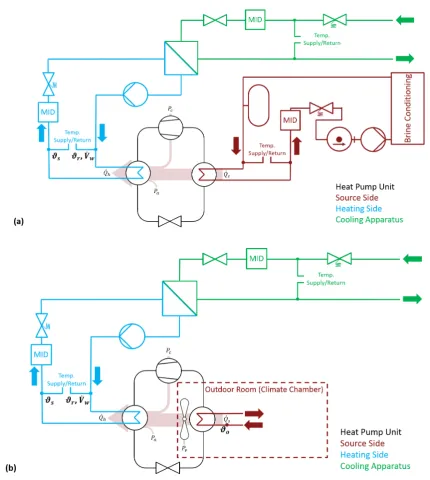
The dynamic test can be performed with a conventional HP - test bench that is used for testing 85
according to EN 14825. A scheme of the test setup is shown in the Appendix in FigureA1. For
86
both, ASHP and GSHP, the test bench consists of a cooling apparatus, a source and a heating side. 87
The design of the cooling apparatus of the test bench and the heating side are independent of the 88
type of test specimen. The cooling unit represents the heating demand of the reference building by 89
extracting a variable amount of heat from the heating circuit depending on the corresponding test 90
conditions. The heating circuit can thus be flexibly adapted to the required conditions, the required 91
compensation load can be applied to the HP condenser to remove the required heat amount from the 92
HP. The compensation load is controlled and adjusted by varying the volume flow ˙Vwon the heating
93
side. Both the supply temperatureϑsand the temperature difference between the supply and the
94
returnϑs−ϑr, however, remain constant as long as the set outdoor temperature remains unchanged.
95
The heating capacity ˙Qhis determined according to Equation (1).
96
˙
Qh=V˙w·cp,w·(ϑs−ϑr) (1)
For the specific heat capacity cp,w we assumed a constant value of 4.182 kJ kg−1K−1 for all
97
operating conditions [26].
98
The test setup on the source side differs depending on whether we are testing GSHPs or ASHPs. In 99
the case that an ASHP is tested, the outdoor unit of the test specimen is located in a climate chamber 100
and subjected to the outdoor air temperature. The required outdoor air temperature and the relative 101
humidity are provided directly by the conditioning system of the climate chamber. In the following, 102
the term outdoor temperatureϑorefers to the outdoor air temperature. If a GSHP is tested, the required
103
heat and temperature on the source side are provided by a system that treats the brine or water 104
according to the desired conditions. The supply temperature on the source side is 0◦C at any time
105
during the test, regardless of the given outdoor temperatureϑo.
106
The voltageUand electric current I are measured by a potentiometer and ammeter at the power
107
connection of the HP. From this, the total electric power consumption of the HPPelis finally determined
108
as the product of voltage and current. It includes the compressor powerPc, the power for the auxiliary
109
system of the HPPa(control unit, liquid pumps, lights, etc.) and the fan power of the outdoor unitPv
110
(for ASHPs only) according to Equation (2): 111
Pel=
∑
Px=Pc+Pa+Pv (2)For the calculation of the seasonal performance, the heating energyQhprovided by the HP and
112
the required electric energy consumptionEelduring the entire test period are put in proportion. The
113
heating energy is given by Equation (3) as the integral of the measured heating capacity curve; the 114
electric energy consumption is given by Equation (4) as the integral of the measured electric power 115
curve: 116
Qh= Z
˙
Qhdτ (3)
Eel= Z
Peldτ (4)
The seasonal coefficient of performance (SCOP) for the dynamic test is defined as the ratio of 117
heating energy measured to the amount of electricity consumed over the entire measurement period 118
as described by Equation (5): 119
SCOPdyn= Qh
The seasonal space heating energy efficiencyηsreflects the SCOP in relation to the primary energy 120
consumption and is calculated from Equation (6): 121
ηs =
SCOPdyn
CC ·100 %−
∑
F(i) (6)For the consideration of the primary energy consumption, the conversion coefficient CC1is used.
122
According to the Commission Delegated Regulation (EU) No 811/2013 [27], the correction factor
123
∑F(i)is used for further contributions accounting for temperature controls and, in case of GSHPs, the
124
electricity consumption of the ground water pump(s).∑F(i)is 8 % for GSHPs and 3 % for ASHPs [13].
125
126
The COP is calculated from the average values of heating capacity ˙Qh and electric power
127
consumptionPelof the examined sequence:
128
COP= Q˙h
Pel (7)
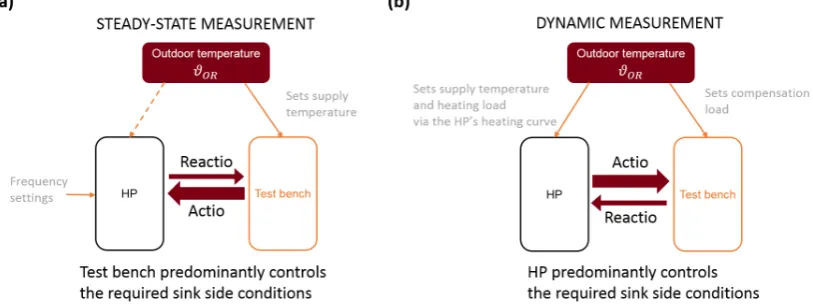
Figure1shows the methodological differences between the dynamic test and the steady - state
129
test according to EN 14825. For the steady - state test (Figure1a), the test bench provides the required
130
conditions on both, sink side and source side. The HP control is forced inactive by fixing the 131
compressor speed. This enables steady - state conditions for the heating capacity and the electric 132
power consumption at all times. For the dynamic test (Figure1b), the HP drives unfixed via its heating
133
curve and its capacity modulation (VFD or ON/OFF operation). It actively regulates the required sink 134
side conditions in dependency on the given outdoor temperature. The test bench supportively reacts 135
by providing the required conditions for compensation load and return temperature on the sink side 136
and the outdoor temperature/brine temperature on the source side. 137
Figure 1.Methodology of(a)the steady - state test according to EN 14825 and(b)the dynamic test.
3. Results 138
3.1. Concept of the dynamic method 139
The dynamic method is based on several individual compensation measurements at different 140
source temperatures (outdoor temperaturesϑo). The individual temperature sequences of the outdoor
141
temperature are combined to form a temperature profile which represents the average (temperate) 142
1 Conversion coefficient (CC) means a coefficient reflecting the estimated 40 % average EU generation efficiency referred to in
climate in Europe according to the EN 14825 [13]. During dynamic testing the control of the HP 143
(variable frequency drive (VFD) or ON/OFF operation) is active during the whole measurement. The 144
heating capacity is controlled via a compensation load given by the test bench on the sink side. The 145
seasonal performance can be obtained directly via an energy balance. 146
147
To determine the seasonal performance according to the dynamic method, the HP is subjected 148
to various conditions on the source side and the sink side. Based on the test conditions given in EN 149
14825, the conditions on the sink side, the part load ratio (PLR) and the supply temperatureϑs, are a
150
function of the outside temperature. The Equations (8) - (10), used for our measurements, are based on 151
the linear correlations described in EN 14825. The PLR is defined as the ratio of the heating capacity 152
˙
Qh,PLR at outdoor temperatures higher than -10◦C to the nominal heating capacity ˙Qh,100%at the 153
specific outdoor temperature of -10◦C. Further, it is a function of the outdoor temperature according to
154
Equation (8): 155
PLR= Q˙h,PLR ˙ Qh,100%
=0.614−0.039·ϑo (8)
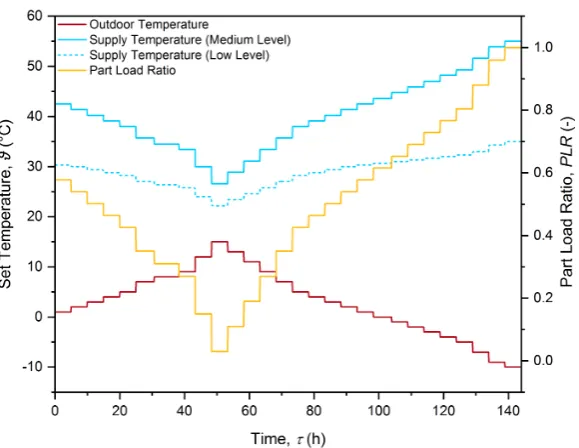
The supply temperature for medium temperature level correlates with the outdoor temperature 156
as follows: 157
ϑs, medium =
−ϑo+45◦C ifϑo ≤ −7◦C
−1.11ϑo+44.22◦C if −7◦C<ϑo ≤1◦C −1.20ϑo+44.40◦C if 1◦C<ϑo
(9)
The supply temperatures for low temperature level are determined according to Equation (10): 158
ϑs, low=
−0.67ϑo+28.33◦C ifϑo≤ −7◦C
−0.33ϑo+30.67◦C if −7◦C<ϑo≤1◦C −0.60ϑo+31.20◦C if 1◦C<ϑo
(10)
The main criteria for a well - designed test method are representativeness, comparability among 159
different appliances, costs of the measurement and reproducibility [28]. The outdoor temperature
160
profile for the dynamic test was developed with regard to these criteria as follows: 161
1. The outdoor temperature profile shall represent the average European climate according to the
162
mean occurence of each temperature from the EN 14825. Therefore, the temperature range of the 163
profile is between−10◦C and 15◦C and the duration of each individual outdoor temperature
164
corresponds to the weighting from the BIN distribution. 165
2. The test duration per temperature sequence shall be chosen to maintain high reproducibility, in
166
particular, for certain operating conditions such as defrost cycles. 167
3. The total test period and the expenses of the dynamic test should be at least equal or less compared
168
to current standard tests. 169
4. The profile should take into account both an increase and a decrease of outdoor temperature and
170
thus reflect the behavior of the HP during changes of the day temperature. 171
For this study, we chose the duration of each temperature sequence to be at least five hours which 172
results in total test period of six days (144 hours). Figure2shows the outdoor temperature profile over
173
the entire test period of six days as well as the supply temperatures and PLRs, the latter both set as a 174
Figure 2.Profiles of the outdoor temperature (red line), supply temperature at medium (blue solid line) and low level (blue dashed line) and the corresponding part load ratio (yellow line).
3.2. Experimental data 176
In this study, we show the results of two HPs tested according to the dynamic method in two 177
different accredited test laboratories (lab1 and lab2) over the period October 2018 to January 2019. We 178
have tested two different methods to provide the outside temperature to the heat pump. For the first 179
method (lab1), the heat pump determines the outdoor temperature directly via its temperature sensor, 180
which is installed in a climate box running the outdoor temperature profile shown (see Figure2). For
181
the second method (lab2), the measurement sensors of the heat pump are bypassed by setting the 182
outside temperature by means of a variable electrical resistance. The two methods will be examined 183
in section 3.2.3 with regard to their impact on the HP’s behavior and on the test results. In order 184
to demonstrate the feasibility of the dynamic method for all types of HPs, we performed tests on 185
both, GSHPs and ASHPs. Table1gives detailed information about the two test specimen. Both HPs
186
were subjected to the outdoor temperature profile shown in Figure2. The seasonal performance was
187
calculated according to Equations (5) and (6). 188
Table 1.Detailed Information of the HPs tested with the dynamic test method.
HP# HP type Rated heating capacity (kW) Declaredηs(%) Temperature level (◦C)
1 GSHP 8.2 144 55
2 ASHP 9.2 156 35
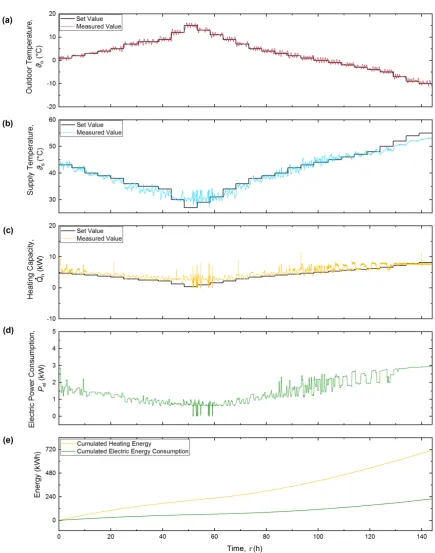
During the test, the outdoor temperature, the supply temperature, the heating capacity and 189
the electrical power consumption were recorded with a measurement every ten seconds. Figure3
190
exemplarily shows the measurement results of the dynamic test with the climate box for HP#1. For 191
a comparison between measured values and set values, the latter are also shown in Figure3. On
192
the source side, the measured outdoor temperature (Figure3a) followed the setpoint values during
193
the entire test period. On the sink side, the supply temperature (Figure3b) reacted to the variation
194
of the outdoor temperature via the HP’s control according to the correlations which are given in 195
Equation (9) and depicted in Figure2. The supply temperature was close to the setpoint values for
196
most of the time. However, it does not reach the set points at both particularly high and particularly 197
low outdoor temperatures, i.e. at low and at high PLRs. The measured heating capacity (Figure3c)
Figure 3.Results of the dynamic test for HP#1 (GSHP) using the climate box:(a)outdoor temperature
ϑo; (b) supply temperature ϑs; (c)heating capacity ˙Qh; (d) electrical power consumptionPel; (e)
generally follows the given heating curve, but is on average slightly higher than the setpoint values, 199
with the exception of the last sequences where PLRs get close to 1. The average heating capacity partly 200
deviates from the set values, especially with particularly low PLRs. The electric power consumptionPel
201
(Figure3d) increases with increasing heating capacity and vice versa as the HP adjusts the compressor
202
speed to the heating demand continously via VFD or via ON/OFF operation. Figure3e shows the
203
cumulated heating energy and the cumulated electric energy consumption. At the end of testing, HP#1 204
in total provided an amount of heating energyQhof 711.79 kWh with an electricity consumptionEelof
205
218.69 kWh. The energy balance results in aSCOPdynof 3.25 or rather a seasonal space heating energy
206
efficiencyηsof 122 % according to Equations (5) and (6).
207
3.2.1. Tests with GSHP 208
In the following, the behavior under full load conditions (PLR = 1) and part load conditions 209
(PLR = 0.15) is shown for the tested GSHP (HP#1). Figure4a shows the total of six hours of measurement
210
data acquisition of outdoor temperature, supply temperature, heating capacity and electric power 211
consumption for HP#1 at set outdoor temperatures of -9◦C and -10◦C.
212
Figure 4.Measurement of a GSHP at(a)rated capacity (PLR = 1) and(b)part load (PLR = 0.15) using the climate box.
The measured average outdoor temperature corresponds to the required setpoint temperature at 213
any time. The supply temperature likewise follows the given setpoint temperature, but does not reach 214
the required values as it is slightly lower on average than the setpoint temperature. For an outdoor 215
temperature of -9◦C, the average heating capacity is at the set values, but for -10◦C, the average
216
heating capacity is again slightly lower than required. 217
The control behavior of HP#1 at an outdoor temperature of 12◦C (PLR = 0.15) can be deduced from the
218
measurement data curves shown in Figure4b. Both the average outdoor temperature and the average
219
supply temperature meet the required set points. In addition, the temperature curves are continuous 220
and are not subject to any fluctuations. The measured heating capacity approaches the required heating 221
heating capacity for the rest of the temperature sequences. Both the heating capacity and the electric 223
power consumption show a continuous development. Only temporarily the HP adjusted the heating 224
capacity to approach the set values. 225
3.2.2. Tests with ASHP 226
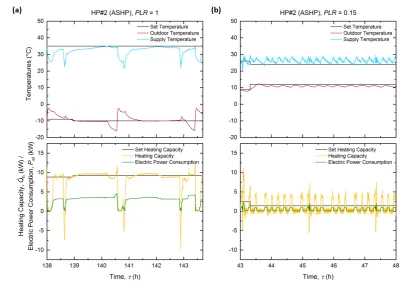
As described in section 3.2.1 the same six hours of data acquisition at PLRs of 1 and 0.15 are 227
shown for HP#2 (ASHP) in Figure5. Significant differences in comparison to the data curves of HP#1
228
(GSHP) shown in Figure4can be observed.
229
Figure 5.Measurement of an ASHP at(a)rated capacity (PLR = 1) and(b)part load (PLR = 0.15) using the climate box.
At full load (Figure5a) a cyclic behavior, caused by defrosting processes at the evaporator, is
230
observed for all measured parameters. The average outdoor temperature provided by the test bench 231
matches the required values. It fluctuates at cyclic intervals as a result of the defrosting phases caused 232
by the HP’s control behavior. The average supply temperature is achieved at some measuring points 233
but is slightly lower on average. The required heating capacity is achieved and provided by HP#2, but 234
the defrosting cycles lead to temporary negative heat flows. As a result, the average heating capacity 235
is also lower than the set values. The regulation of the compressor can also be observed by the course 236
of the electric power consumption, especially during defrost cycles. 237
The measurement data curves of the ASHP (HP#2) in Figure5b again show considerable differences
238
compared to the measurement data of the GSHP (HP#1) in Figure4b, since a cyclic behavior is observed
239
for all parameters. The average values of the measured temperatures are higher (supply temperature) 240
or lower (outdoor temperature) than the set temperatures. However, the minima and maxima of the 241
temperature cycles are close to the set values, respectively. The heating capacity fluctuates considerably 242
around the given set value and reaches amplitudes of approximately 5 - 7.5 kW (±200 %). The average
243
heating capacity however corresponds to the set heating capacity, since the phases with excessively 244
high heating capacity are compensated by phases with no or even negative flow of heating energy. For 245
3.2.3. Precision of the dynamic test method 247
The criteria chosen for the design of the dynamic test method were representativeness, 248
comparability among different appliances, costs of the measurement and reproducibility (see section 249
3.1). The latter is discussed more in detail in this section with particular focus on the use of the climate 250
box and the electrical resistance. We repeated the dynamic tests for HP#1 and HP#2 in different 251
laboratories. For HP#2 we performed the dynamic test using the climate box twice in the same 252
laboratory (lab 1) to conclude for repeatability. Figure6a shows the results of these tests, more precisely
253
the determined cumulative heating energies and cumulative electric energy consumptions. 254
Figure 6.Cumulated heating energy and cumlated electric energy consumption of(a)HP#2 measured two times in the same laboratory and(b)HP#1 measured in different laboratories, Lab1 and Lab2, respectively.
The set heating energy represents the ideal case that the heating capacity provided by the HP 255
meets the exact heating demand at all times. HP#2 apparently covers the heating demand almost 256
ideally for both tests, i.e. it neither generates too little nor too much heat. The tests resulted in 257
cumulative heating energies of 650.58 kWh (lab1) and 646.96 kWh (lab1), respectively. The cumulated 258
electric energy consumption differs only slightly for both measurements, with values of 192.39 kWh 259
and 188.95 kWh, respectively. According to Equations (5) and (6), the cumulated energies result 260
in the seasonal space heating energy efficienciesηs of 132.28 % and 133.96 %, corresponding to an
261
intra - laboratory precision (repeatability) of 0.63 %. 262
For HP#1 we performed the dynamic test once in two different laboratories to conclude for 263
reproducibility (lab 1 using the climate box and lab 2 using the electrical resistance). Figure6b shows
264
the results of these tests. In both laboratories, the determined electric energy consumptions are similar, 265
with values of 218.69 kWh (lab 1) and 198.00 kWh (lab 2), respectively. In contrast, the amount of 266
heating energy produced by HP#1 differs between the two laboratories. As HP#1 strictly follows 267
the heating demand (set heating energy) in laboratory 2, it produces excess heat during the tests in 268
laboratory 1. According to Equations (5) and (6), the cumulated energies result in the seasonal space 269
heating energy efficiencies of HP#1 to 122.20 % (lab 1) and 109.96 % (lab 2), which corresponds to an 270
inter - laboratory precision (reproducibility) of 5.01 %. 271
4. Discussion 273
The dynamic method achieves high repeatability and the inter - laboratory deviation 274
(reproducibility) is at an adequate level. The deviations of the heating energies between laboratory 1 275
and 2 in Figure6b could be explained by the fact that the set outdoor temperature was assigned to the
276
HP in different ways. In laboratory 1, the HP detected the temperature directly via its temperature 277
sensor using the climate box, whereas in laboratory 2 the temperature was given to the HP via an 278
electrical resistance. The test with the electrical resistance implicates that we obtain results which are 279
independent from the quality of the temperature sensor and thus possible sources of uncertainties are 280
reduced. Testing using the climate box with the temperature sensor being active, however, enables to 281
record the control quality of the HP in its entirety. This would be closer to field conditions compared 282
to when using an electrical resistance. In the case of HP#1, for example, Figures3b and3c show the
283
hysteresis that occurs by comparing setpoint and actual values of the sink side parameters at low and 284
high outdoor temperatures (low and high PLRs). This could occur because the outdoor temperature 285
detected by the HP differs from the actual outdoor temperature. Most likely the reproducibility can 286
be further improved using the same methods to provide the outdoor temperatures (via electrical 287
resistance or via climatic box). Furthermore, from the test results a coninous behavior, even during 288
ON/OFF - operation was observed (see Figure5b) and thus the test duration could be sigificantly
289
shortened without losing precision. 290
291
The comparability of various HPs could be a significant advantage of the dynamic method in 292
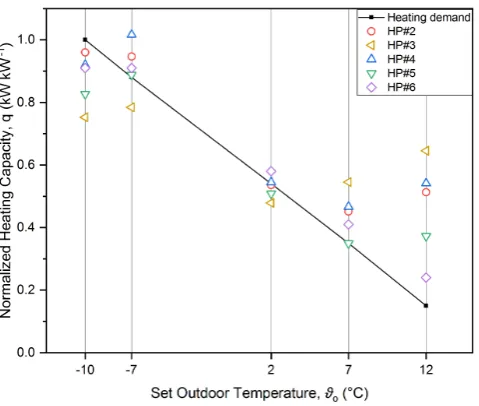
comparison to current standards like EN 14825. Figure7shows the heating capacity of five HPs,
293
determined according to EN 14825, and the demanded heating load (set value) required for the 294
respective outdoor temperatures. 295
Figure 7.Average heating capacity determined according to EN 14825 (fixed compressor speed) of several HPs, including HP#2.
Although these HPs were all tested at fixed compressor speeds according to the manufacturers’ 296
instructions, they could not meet the required heating capacity for most of the tested operating points. 297
At low outside temperatures, HP#3 and HP#5 could not achieve the required heating capacity within 298
the permissible deviations according to EN 14825 (±10 %). This is due to the HPs’ specification of the 299
bivalence temperature. Below this particular temperature, the HPs cannot provide the amount of 300
demanded heating capacity by themselves and thus would need additional support by an electric 301
heater in the field. In our case, we observed bivalence temperatures at 2◦C (HP#3) and−7◦C (HP#5).
302
deviations at outdoor temperatures of 7◦C and 12◦C can be directly attributed to the methodology 304
of EN 14825. According to the EN 14825, the supply temperature is increased whenever ON/OFF 305
operation would occur thus circumventing OFF - sequences. This consequently results in an increase 306
of heating capacity. If the heating capacity is more than 10 % higher than demanded, the EN 14825 307
requires to adjust the coefficient of performance (COP) with prescribed correction factors2.
308
309
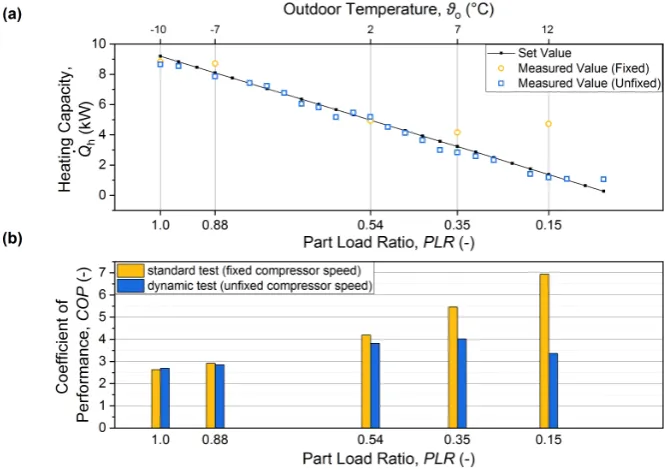
Figure 8a shows the comparison of the heating capacities of HP#2 for different outdoor
310
temperatures, determined with the dynamic method (unfixed compressor speed) and with the standard 311
method EN 14825 (fixed compressor speed). 312
Figure 8. (a)Average heating capacity and(b)COP results of HP#2 for different PLRs determined with the dynamic method (unfixed compressor speed: VFD or ON/OFF operation) and according to EN 14825 (fixed compressor speed).
At PLRs higher than 0.54 the HP operated with variable compressor speed during the dynamic 313
test. For PLRs lower than 0.54 we observed ON/OFF operation. The heating capacities of the dynamic 314
method are the average values of the entire respective temperature sequence, including the periods of 315
OFF operation and the stabilization phase at the beginning of each sequence. The consideration of 316
the stabilization phase is permissible as the small fluctuations during the stabilization phase can be 317
neglected. It is shown that the heating capacities determined with the dynamic method are close to the 318
demanded heating load, whereas in the standard test an excessive heat can be observed at low PLRs 319
due to the aformentioned methodology of EN 14825. Figure8b shows the corresponding COPs for
320
the dynamic method and for the standard method EN 14825 (after applying the correction factors). 321
The COP3determined with EN 14825 increases continously with decreasing PLR, whereas the COP
322
determined with the dynamic method also increases initially with decreasing PLR, but decreases again 323
2 According to EN 14825 the prescribed correction factors areCRandCd. CRis the ratio of measured heating capacity and required heating capacity. The degredation coefficientCdis determined via the formula 1−POFF/PPLRfor each PLR, respectively.POFFis the electric power consumption meausered during 5 min after the compressor has been switched off for 10 minutes andPPLRis the electric power consumption during operation at a particular PLR.Cdgenerally achieves values of between 0.9 and 1.
as soon as ON/OFF operation occurs. The high deviations of COPs between standard test and dynamic 324
test at low PLRs might indicate that the efficiency losses due to ON/OFF operation are not adequately 325
taken into account by the correction factors. Thus, the methodology of the EN 14825 could lead to an 326
overestimation of the COP at low PLRs. In addition, the standard test loses comparability between 327
different HPs because the adjustment of the supply temperature is individual for each HP, respectively 328
(see Figure7). In contrast, the dynamic method provides both, the consideration of efficiency losses
329
during ON/OFF operation and a comparability for various HPs without the need for correction factors. 330
331
The performed tests showed that the dynamic method can be applied to both HP types, GSHPs 332
and ASHPs, with common modifications to the test bench (see section 2). 333
The control of an HP is its individual strategy to reach the requirements on the sink side via its heating 334
curve and is taken into account by applying the dynamic test method. It was observed that the HPs 335
were usually unable to meet the heating set points for PLRs close to 1 and 0. However, particularly in 336
these cases, the dynamic method enables a clear differentiation between the control behaviors of tested 337
HPs in case of using the climate box. For PLR = 1, for example, HP#1 does not provide a sufficient 338
amount of heat, but for PLR = 0.15 in contrast, it generates a slight excess of heat. HP#2, on the other 339
hand, is able to meet the required heating capacity precisely. The dynamic method, however, provides 340
a fair comparison of HPs with different control strategies. It should be put up for discussion if tested 341
HPs should in any case achieve the setup values on the sink side for reasons of comparability. In this 342
context, the two methods climate box and electrical resistance should be further examined. 343
344
5. Conclusions 345
The growing market penetration of HPs indicates the need for a performance test method which 346
better reflects their capacity modulation. Currently, energy efficiency testing for HPs is only executed 347
in particular test modes, that fix the compressor speed and do not reflect the real use behavior of HPs. 348
This study proposes a test method with dynamic profiles based on climate data and designed for 349
outside temperature, supply temperature and the heating capacity. The dynamic test method has the 350
following advantages: 351
• It considers the real control behavior of HPs.
352
• It can be conducted independently from manufacturer support and makes special test modes
353
obsolete. 354
• It considers the whole temperature range of a heating season (from−10◦C to 15◦C for average
355
European climate) directly by measurement, specifically those sequences which are commonly 356
linearly interpolated in current standards. 357
• It makes linear interpolation and the prescription of invariables obsolete and hence gives a closer
358
approximation of the field performance of HPs and could reduce the need for field tests. 359
• It has the potential to achieve a high degree of automation and could be easily modified to new
360
technologies. 361
Furthermore, on the basis of these findings, we propose that the following should be subject to 362
further research: 363
• The optimum values for the permitted deviations and tolerances are to be defined.
364
• The temperature sequences can be further shortened. Therefore, the influence of the stabilization
365
phase on the average results should be investigated for all temperature sequences. 366
• The feasibility for testing fixed - speed HPs should be investigated.
367
• The use of climate box and electrical resistance should be examined.
368
Author Contributions:conceptualization, C.P.; methodology, C.P. and A.Z.; software, A.Z. and I.M.; validation, 369
writing–original draft preparation, C.P.; writing–review and editing, A.Z., I.M. and A.S; visualization, C.P.; 371
supervision, A.S.; project administration, A.S. 372
Acknowledgments:This project is financed as a part of the National Action Plan on Energy Efficiency (NAPE) of 373
the German Federal Ministry for Economic Affairs and Energy. 374
Conflicts of Interest:The authors declare no conflict of interest. 375
Abbreviations 376
The following abbreviations are used in this manuscript: 377
378
ASHP air source heat pump GSHP ground source heat pump COP coefficient of performance HiL Hardware-in-the-Loop HP heat pump
PLR part load ratio
SCOP seasonal coefficient of performance VFD variable frequency drive
Appendix A 380
Figure A1.Experimental Setup for (a) GSHP and (b) ASHP applications.
References 381
1. Chua, KJ. et al. Achieving better energy - efficient air conditioning - A review of technologies and strategies. 382
Appl Energ2013,104, 87–104. 383
2. Heat Roadmap Europe 2050. Heating and cooling facts and figures - the transformation towards a 384
low - carbon heating & cooling sector.2017. 385
3. Berardi, U. A cross - country comparison of the building energy consumptions and their trends. Resour 386
Conserv Recy2017,123, 230–241. 387
4. Connolly, D. et al. Smart energy Europe: The technical and economic impact of one potential 100 % renewable 388
energy scenario for the European Union.Renew Sust Energ Rev2016,60, 1634–1653. 389
5. Mathiesen, BV. et al. 100 % renewable energy systems, climate mitigation and economic growth.Appl Energ 390
6. Li, G. et al. Investigations of life cycle climate performance and material life cycle assessment of packaged 392
air conditioners for residential application.Sust Energ Tech Assess2015,11, 114–125. 393
7. Shao, S. et al. Performance representation of variable - speed compressor for inverter air conditioners based 394
on experimental data.Int J Refrig2004,27, 805–815. 395
8. Tu, Q. et al. Control strategy of compressor and sub-cooler in variable refrigerant flow air conditioning 396
system for high EER and comfortable indoor environment.Appl Therm Eng2018,141, 215–225. 397
9. Choi, JM.; Kim, YC. Capacity modulation of an inverter - driven multi - air conditioner using electronic 398
expansion valves.Energy2003,28, 141–155. 399
10. Jeong, K.; Choi, JM. Capacity modulation of a cascade heat pump with the variation of compressor speed 400
and electronic expansion valve opening.Renew Sust Energ2014,6, 1–9. 401
11. Park, YC. et al. Performance analysis on a multi - type inverter air conditioner.Energ Convers Manage2000, 402
42, 1607–1621. 403
12. Wu, C. et al. Development of control method and dynamic model for multi evaporator air conditioners 404
(MEAC).Energ Convers Manage2005,46, 451–465. 405
13. DIN Normenausschuss Kältetechnik (FNKä). DIN EN 14825:2016 Air conditioners, liquid chilling packages 406
and heat pumps, with electrically driven compressors, for space heating and cooling - Testing and rating at 407
part load conditions and calculation of seasonal performance. Berlin, Germany,2016. 408
14. Standards Australia and New Zealand Standards. AS/NZS 3823:2014 Performance of electrical appliances -409
Air conditioners and heat pumps. Sydney, Australia / Wellington, New Zealand,2014. 410
15. Air Conditioning, Heating and Refrigeration Institute. ANSI/AHRI 210/240:2008. Standard for Performance 411
Rating of Unitary Air-Conditioning & Air - Source Heat Pump Equipment. Arlington, USA,2008. 412
16. American Society of Heating, Refrigerating and Air-Conditioning Engineers Inc. ASHRAE, ANSI/ASHRAE 413
Standard 116-2010 Methods of Testing for Rating Seasonal Efficiency of Unitary Air Conditioners and Heat 414
Pumps. Atlanta, USA,2010. 415
17. Japanese Industrial Standards Committee. JIS C9612: 2013 Room Air Conditioners. Tokyo, Japan,2013. 416
18. Gomes, A. et al. A physically - based model for simulating inverter type air conditioners/heat pumps.Energy 417
2013,50, 110–119. 418
19. Cuevas, C.; Lebrun, J. Testing and modelling of a variable speed scroll compressor.Appl Therm Eng2009,29, 419
469–478. 420
20. Lee, SH. et al. Simulation-based optimization of heating and cooling seasonal performances of an air - to - air 421
heat pump considering operating and design parameters using genetic algorithm.Appl Therm Eng2018,144, 422
362–370. 423
21. Menegon, D. et al. Development of a new dynamic test procedure for the laboratory characterization of a 424
whole heating and cooling system.Appl Energ2017,205, 976–990. 425
22. Haller, MY. Dynamic whole system testing of combined renewable heating systems - The current state of the 426
art.Energ Buildings2013,66, 667–677. 427
23. Riederer, P. et al. Dynamic test method for the determination of the global seasonal performance factor of 428
heat pumps used for heating cooling and domestic hot water preparation.Proceedings of the 11th International 429
IBPSA Conference, Glasgow, Scotland2009,11. 430
24. Huchtemann, K. et al. Testing method for evaluation of a realistic seasonal performance of heat pump 431
heating systems: Determination of typical days.12th REHVA World Congress: volume 3, Aalborg, Denmark 432
2016,12. 433
25. Mavuri, S. Field behaviour of inverter air conditioners effect on seasonal performance.IJAIEM2015,4, 18–25. 434
26. Grote, KH.; Feldhusen, J. Thermodynamik. InDubbel - Taschenbuch fuer den Maschinenbau; Springer: 435
Berlin/Heidelberg/New York, Germany/USA, 2005; p. D45. 436
27. European Commission. Commission Delegated Regulation (EU) No 811/2013.Official Journal of the European 437
Union2013,L289: 136–161. 438