© 2014, IJCSMC All Rights Reserved 6
Available Online atwww.ijcsmc.com
International Journal of Computer Science and Mobile Computing
A Monthly Journal of Computer Science and Information Technology
ISSN 2320–088X
IJCSMC, Vol. 3, Issue. 7, July 2014, pg.6 – 12
RESEARCH ARTICLE
Automatic Number Plate
Recognition System
Rajshree Dhruw, Dharmendra Roy
Department of Computer Science & Engineering, RCET, Bhilai, India
[email protected] 1, [email protected] 2
Abstract— Automatic Number Plate Recognition (ANPR) is a mass surveillance system that captures the image of vehicles and recognizes their license number. The objective is to design an efficient automatic authorized vehicle identification system by using the Indian vehicle number plate. In this paper we discus different methodology for number plate localization, character segmentation & recognition of the number plate. The system is mainly applicable for non standard Indian number plates by recognizing single & double line number plates under different varying illumination condition and works on multilingual, multicolour number plates according to Indian condition.
Keywords— ANPR, Localization, Segmentation, Artificial Neural Network, Optical Character Recognition
I. INTRODUCTION
A. Automatic Number Plate Recognition (ANPR)
The Automatic number plate recognition (ANPR) [1] is a real time embedded system that uses optical character recognition on images to read the license plates on vehicles. They can use existing closed-circuit television or road-rule enforcement cameras, or ones specifically designed for the task. They are used by various police forces and as a method of electronic toll collection on pay-per-use roads and monitoring traffic activity.
License plate standards vary from country to country. Therefore, current ANPR systems being employed are country specific, in that they use specific features found on their number plates such as, background and foreground colour, boundary of number plate, number plate size, etc. for localizing the number plates.
B. Scope of this paper
© 2014, IJCSMC All Rights Reserved 7 methods. The paper concludes with the discussion of what is existing problems and how can resolve those problems in our proposed methodology.
II. EXISTING SYSTEM
In India, number plate standards, though they exist, are rarely practiced. As a result, wide variations are found in the number plates in terms of font type, character size and location of the number plate. Also, in certain cases, many unwanted characters are present on the number plate. In India [2],[3] we have various kinds of number plates. Old number plates following 1939 series as well as the vehicles following new number system. The new format license plates can be of lengths 8,9,10. For example
The figure shows the Indian licence plate that have: 1. Country Code, 2. State Code, 3. District Code, 4. Type of Vehicle, 5. Registration number.
Figure1.Indian Number Plate Format
III. STEPS FOR ANPR SYSTEM
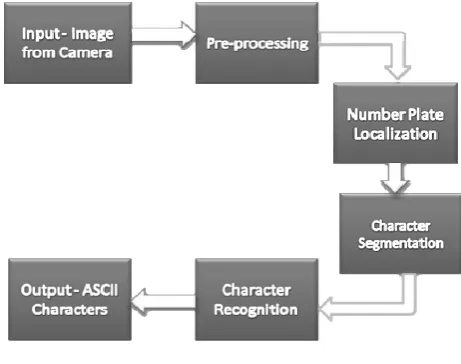
The Algorithm of ANPR system consists of following steps:
Step 1: Capturing the image of car, extracting the image of number plate, extracting character from the plate
image, recognize the number plate character & retrieve the vehicle number. A image of vehicle is captured and processed using various algorithms.
Step 2:This plate localization algorithm is based on combining textural characteristics of license plate
and morphological operation sensitive to specific shapes in the input image with a good threshold value by which the license plate is located. A fine percentage of localization of License plates is achieved by this algorithm.
Figure 2: Software flow of the system
Step 3: The segmentation of license plate characters is done after license plate location and binarization. The
character segmentation process act a as a bridge between the license plate localization and optical character recognition modules. Its main function is to segment the characters in the selected candidate region such that each character can be sent to the optical character recognition modules individually for recognition
.
© 2014, IJCSMC All Rights Reserved 8
Step 4:: Character recognition helps in identifying and converting image text into editable text. As most
of the number plate recognition algorithms use single method for character recognition. In this section, each method is explained.
IV. PROBLEM IDENTIFICATION
In India, number plates standards are rarely followed Wide variations are found in terms of font types, script, size, placement and color of the number plates. In few cases, other unwanted decorations are present on the number plate. Also, unlike other countries, no special features are available on Indian number plates to ease their recognition process. Hence, currently only manual recording systems are used and ANPR has not been commercially implemented in India. Main aim of this project is to implement a method efficient in recognizing license plates in Indian conditions. Our work is not restricted to car (in which size of license plate is small), transport vehicles which carry extra stylized characters and soiled license plate.
V. IMAGE ACQUISITION
Image acquisition is the process of obtaining an image from the camera. This is the first step of any vision based systems. The remaining stages of the system works in offline mode. Grayscale image: After acquiring the image, the very next step is to derive the gray scale image. Pseudo code to convert an image to a grayscale:
Step 1 : Load the image.
Step 2 : Retrieve the properties of image like width, height. Step 3 : Display the image after converting to grayscale
VI. PRE-PROCESSING
For pre-processing, the input gray-scale image (fig.3) is adaptively converted into binary image using Otsu‟s
method. This method is better suited for our application compared to other adaptive binarization methods like
the Niblack‟s method [4].
Fig.3: Output of Otsu‟s algorithm Fig.4: Output of Niblack‟s Following steps are pre-processing and number plate localization. :
Step 1: The first step for preprocessing is to convert the gray scale image into binary image using Otsu‟s algorithm by calculating thresholding.
Step 2: After binarization remove all the objects containing fewer than 30 pixel. Median filter to remove the noise.
Step 3: Calculating connected components of an image by scanning the image, pixel by pixel (from top to bottom and left to right) in order to identify connected pixel regions.
© 2014, IJCSMC All Rights Reserved 9 Step 5: Resize each character from the previous step to the standard height and width in order to be used in the recognition process.
Fig 5: Identified Character Components
Step 6: Measure properties of image regions by plotting bounding box to get the separate character and numbers for recognition process.
VII.NUMBER PLATE LOCALIZATION
A number of algorithms are suggested for number plate localization such as: multiple interlacing algorithm, Fourier domain filtering, and colour image processing. These algorithms however do not satisfactorily work for Indian number plates. Hence, we designed and implemented „Feature-based number plate localization‟ method well suited for Indian conditions.
To localize vehicle number plate following factors should be considered: (1). Plate size: a plate can be of different size in a vehicle image.
(2). Plate location: a plate can be located anywhere in the vehicle.
(3). Plate background: A plate can have different background colours based on vehicle type. For example a government vehicle number plate might have different background than other public vehicles.
(4). Screw: A plate may have screw and that could be considered as a character.
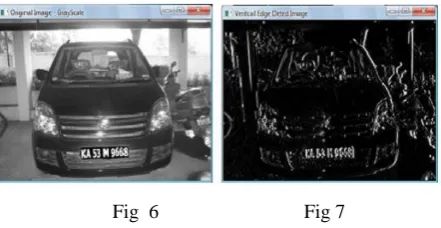
A. Median Filtering
A statistical Median filter is used to remove salt and pepper noise from the image inn gray scale before binarizing. We have used a 3 *3 masking sub window for this purpose.
Fig 6 Fig 7
B. Connected Components
© 2014, IJCSMC All Rights Reserved 10 plate of the vehicle involved, we need to recognize the number plate into a standard form. The vehicular number plates may be of Non-standard forms and may vary in their fonts.
Fig 8: License Plate after Localization
4 connected pixels are the neighbors of every pixel that touches on one of their edges. These pixels are connected both horizontally and vertically. Were as 8 connected pixels can be connected horizontally vertically and diagonally.
VIII. CHARACTER SEGMENTATION
The character segmentation process acts as a bridge between the license plate localization and optical character recognition modules. Its main function is to segment the characters in the selected candidate region (extracted license plate) such that each character can be sent to the optical character recognition module individually for recognition.
Once the license plate is localized we proceed to obtain the individual characters. A license plate as described above has high intensity variation regions. This forms the basis for character segmentation. Sometimes it observed that along with the license numbers, various texts may be present which have to be removed. By various observations we observed that for the license plate regions the amount of white on black or vice versa, is specific for the number regions and fall within a certain range. We ignore those regions which are out of range to isolate the number regions.
A. Bounding Box
The minimum or the smallest bounding box for any point set in N dimension is the box with smallest measure within which all point lies. In the other words it has the minimum height and width that cover all the pixels present in a particular connected component or region.
Fig 9: After applying bounding box
B. Selecting the best Bounding Box
1 contrast present in the bounding box : As the license plate consist of dark colored numbers to the lighter background or vice versa. The center row of the box can be scanned and the total sudden contrast can be recorded, if the image is binarized.
2. Aspect Ratio : Is the ratio of the width of the image to its height. The inverse of the aspect ratio should be less than 1 for any license plate. Hence all the regions which do not satisfy this property can be rejected.
3. Width of the license plate : After analyzing various dataset we have use the threshold limit to five time the height of the license plate so :
Width<(5*Height)
C. Cropping the Bounding Box
After identifying the best possible bounding box candidate for the license plate the coordinates of the bounding
box are noted and the box is cropped from the image and sent to character segmentation module for further
© 2014, IJCSMC All Rights Reserved 11
IX. CHARACTER RECOGNITION
Template matching is useful for recognition of Indian characters. It can be also used for detection of objects generally in face detection and medical image processing. It is further divided in two parts: feature based matching and template based matching. Feature based approach is useful when template image has strong features otherwise template based approach can be useful. In statistical feature extraction method is applied for achieving 85% of character recognition rate. A template based approach is proposed in . The authors used low-resolution template matching method to work with lower resolution image such as 4 X 8. The authors used similarity function to measure similarity between patterns
.
The image obtained after segmentation is Grayscale. Follow the preprocessing steps used for the training of the characters. Calculate the score for each of the characters: We calculate the matching score of the segmented character from the templates of the character stored by the following algorithm. We compare the pixel values of the matrix of segmented character and the template matrix, and for every match we add 1 to the matching score and for every miss-match we decrement 1. This is done for all 225 pixels. The match score is generated for every template and the one which gives the highest score is taken to be the recognized character. Character sets used for training the OCR: This is contained in the directory named “OCR Training Data”.
X. RESULT & DISCUSSION
In this proposed model pre-processing and number plate localization is performed by using “Otsu‟s methods” and “feature based localization methods” respectively. It provides satisfactory results for a wide variation in selected for binarization. In Character segmentation a new “Image Scissoring” algorithm is used. It gives reliability and time optimization. Finally the character reorganization performs using the “Template Matching”. We have also address the issue of multilingual number plate, multiscriptual number plate according to Indian condition. The algorithm has been found to be 80% accurate overall.
XI. ACKNOWLEDGEMENT
We would like to thank Prof. Dharmendra Roy of the Department of Computer Science & Engineering, Rungta group of college, Bhilai, C.G, India for his valuable suggestions and discussions regarding various aspects of this research work, particularly in the building of the recognition module.
REFERENCES
[1] Prathamesh Kulkarni, Ashish Khatri, Prateek Banga, and Kushal Shah, "Automatic Number Plate Recognition (ANPR)," in RADIOELEKTRONIKA. 19th International Conference, 2009.
[2] A Roy and D.P Ghoshal, "Number Plate Recognition for use in different countries using an improved segmentation," in 2nd National Conference on Emerging Trends and Applications in Computer Science(NCETACS), 2011, pp. 1-5.
[3] Ch.Jaya Lakshmi, Dr.A.Jhansi Rani, Dr.K.Sri Ramakrishna, and M. KantiKiran, "A Nove Approach for Indian License Recognition System," International Journal of Advanced Engineering Sciences and Technologies, vol. 6, no. 1, pp. 10-14, 2011.
[4] H. Erdinc Kocer and K. Kursat Cevik, "Artificial neural netwokrs based vehicle license plate recognition,"
Procedia Computer Science, vol. 3, pp. 1033-1037, 2011..
[5] Ying Wen et al., "An Algorithm for License Plate recognition Applied to Intelligent Transportation System," IEEE Transactions of Intelligent Transportation Systems, pp. 1-16, 2011
[6] Chirag Patel, Dipti Shah, Atul Patel, “Automatic Number Plate Recognition System”, IJOCA may 2013.
© 2014, IJCSMC All Rights Reserved 12 [8] Jianbin Jiao, Qixiang Ye, and Qingming Huang, "A configurabe method for multi-style license plate
recognition," Pattern Recognition, vol. 42, no. 3, pp. 358-369, 2009.
[9] K.V. Suresh, G. Mahesh Kumar, and A.N. Rajagopalan, "Superresolution of license plates in real traffic videos," IEEE Trans. Intell. Transp. Syst, vol. 8, no. 2, pp. 321-331, 2007
[10] Hui Wu and Bing Li, "License Plate Recognition System," in International Conference on Multimedia Technology (ICMT), 2011,pp.5425-5427
[11] Christos Nikolaos E. Anagnostopoulos, Ioannis E. Anagnostopoulos, Vassili Loumos, and Eleftherios Kayafas, "A License Plate-Recognition Algorithm for Intelligent Transportation System Applications," pp. 377-392, 2006
[12] Christos Nikolaos E. Anagnostopoulos, Ioannis E. Anagnostopoulos, Ioannis D. Psoroulas, Vassili Loumos, and Eleftherios Kayafas, License Plate Recognition From Still Images and Video Sequences: A Survey, vol. 9, no. 3, pp. 377-391,2008.
[13] Kaushik Deb, Ibrahim Kahn, Anik Saha, and Kang-Hyun Jo, "An Efficeint Method of Vehicle License Plate Recognition Based on Sliding Concentric Windows and Artificial Neural Network," Procedia Technology, vol. 4, pp. 812-819, 2012
[14] Vladimir Shapiro and Georgi Gluhchev Dimo Dimov, "Towards a Multinational Car License Plate Recognition system," Machine Vision and Appplcations, Springer-Verlag, pp.173-183,2006.
[15] Mei-Sen Pan, Jun-Biao Yan, and Zheng-Hong Xiao, "Vehicle license plate character segmentation ,"
Intenational Journal of Automation and Computing,pp.425-432,2008.
[16] Fikriye Öztürk and Figen Özen, "A New License Plate Recognition System Based on Probabilistic Neural Networks," Procedia Technology,vol.1,pp.124-128,2012.
[17] Jianbin Jiao, Qixiang Ye, and Qingming Huang, "A configurabe method for multi-style license plate recognition," Pattern Recognition, vol. 42, no. 3, pp. 358-369, 2009.
[18] E.N Vesnin and V.A Tsarev, "Segmentation of images of license plates," Pattern Recogniton and Image Analysis, pp. 108-110, 2006
[19] Ying Wen et al., "An Algorithm for License Plate recognition Applied to Intelligent Transportation System," IEEE Transactions of Intelligent Transportation Systems, pp. 1-16, 2011
[20] Zhen-Xue Chen, Cheng-Yun Liu, Fa-Liang Chang, and Guo-You Wang, "Automatic License-Plate Location and Recognition Based on Feature Saliance," IEEE Transactions on Vehicular Technology, vol. 58, no. 7, pp. 3781-3785, 2009.
[21] Yuntao Cui and Qian Huang, "Extracting character of license pltes from video sApplicationsequences,"