© 2015, IJCSMC All Rights Reserved
835
Available Online atwww.ijcsmc.com
International Journal of Computer Science and Mobile Computing
A Monthly Journal of Computer Science and Information Technology
ISSN 2320–088X
IJCSMC, Vol. 4, Issue. 4, April 2015, pg.835 – 841
RESEARCH ARTICLE
Prediction of Sensor Lifetime by
Using Clustering-Fuzzy Logic in
Wireless Sensor Networks
Sharath Kumara Y
1, Geetha N B
2, Mohamed Rafi
31Department of, Computer Science, UBDTCE (VTU), India
2Assistant Professor, UBDTCE, Department of Computer Science, UBDTCE (VTU), India
3Professor, UBDTCE, Department of Computer Science, UBDTCE (VTU), India
1
[email protected], 2 [email protected], 3 [email protected]
Abstract -
Wireless sensor network is composed of a set of nodes whose energy is limited in terms of computing, storage and communication power. In this network, a few nodes become cluster head which causes the energetic heterogeneity of the network, therefore the behavior of the sensor network becomes very unstable as soon as the life of the first node is elapsed. BDCP (LEACH) and Clustering-FL has proposed the extension of time to network stability before the death of the first node and the reduction of unstable time before the death of the last node. This protocol is based on the election of cluster head by the balance of the probabilities of the remaining energy for each node. In this paper, we propose to improve Clustering techniques by Clustering -fuzzy logic (Clustering-FL). In this work, we propose a fuzzy-based simulation system for WSNs, in order to calculate the lifetime of sensor by considering the remaining battery power , sleep time rate and transmission time rate. We evaluated the system by NetBeans IDE simulations and show that it has a good behavior for measuring sensor lifetime.
Keywords: WSN ,Clustering , Fuzzy logic ,Lifetime of sensor , sleep time rate, transmission rate, Remaining battery power
1.
INTRODUCTION
© 2015, IJCSMC All Rights Reserved
836
using the wireless transmission technique. Wireless sensor networks have been pervasive in various applications including health care system, battlefield surveillance system, environment monitoring system, and so on. Power saving is one of the most important features for the sensor nodes to extend their lifetime in wireless sensor networks. A sensor node consumes mostly its energy in transmitting and receiving packets. In wireless sensor networks, the main power supply of the sensor node is battery. However, in most application scenarios, users are usually difficult to reach the location of sensor nodes. Due to a large number of sensor nodes, the replacement of batteries might be impossible. However, the battery energy is finite in a sensor node and a sensor node draining of its battery may make sensing area uncovered. Hence, the energy conservation becomes a critical concern in wireless sensor networks. In order to increase energy efficiency and extend the network lifetime, new and efficient power saving algorithms must be developed. So many cluster-based protocol is exist by using a distributed clustering formation algorithm, the large number of sensor nodes will be divided into several clusters. For each cluster, a sensor node is selected as a cluster head. Selection of CH is the main task in cluster based sensor network, there are so many techniques are found to select CH by using different parameters like LEACH, PSO, HEEP.., etc. Below Fig shows the cluster based sensor network with Cluster Head and Cluster nodes and a Base station.
Fig: Cluster Based Wireless Sensor Nodes
The selection of cluster head nodes is based on a predetermined probability. Other non-cluster head nodes choose the nearest cluster to join by receiving the strength of the advertisement message from the cluster head nodes. A non-cluster head node can only monitor the environment and send data to its cluster head node. The cluster head node is responsible for collecting the information of non-cluster head nodes in the cluster. Then, it processes data and sends data to the BS. As a non-cluster head node cannot send data directly to the BS, the data transmission distance of the sensor node is shrunk. Therefore, the energy consumption is reduced in the wireless sensor networks.
© 2015, IJCSMC All Rights Reserved
837
2.
LITERATURE SURVEY
Several clustering methods such as weighted clustering, hierarchal clustering and dynamic clustering algorithms have been proposed to organize nodes as a cluster. Most algorithms elect CHs based on certain weights or iteratively optimize a cost function or use heuristic to generate minimum number of clusters.
The Distributed Clustering Algorithm (DCA) assumes quasi-stationary nodes with real-valued weights. The Weighted Clustering Algorithm elects a node based on the number of neighbors, transmission power and so on. The Max-Min d-Clustering Algorithm generates d-hop clusters with a run time of O(d) rounds. This algorithm does not minimize the communicating complexity of sending information to the information center.
The hierarchical clustering scheme uses spanning tree based approach to produce cluster with certain properties. However, energy efficiency is not addressed in this work. In Emergent algorithm , the authors have proposed an emergent algorithm that iteratively tries to achieve high packing efficiency, however negotiation among nodes to be CH and join cluster based on degree and proximity leads to high amount of communication overhead, thus wastage energy.
In LEACH(BDCP-Blender Decomposition),a single-hop CH to sink connection and adopt the randomized rotation of CHs to ensure balanced energy consumption .It results in Cluster that are on average of the same size throughout the entire network.
In WCNC, the authors propose a self-reconfiguring protocol for Wireless Personal Area Networks (WPAN) using an unsupervised clustering method. A fuzzy logic system is used to select the master/controller for each cluster. In our previous work, we had shown by simulation results that the selection surface of our system was better than the system in WCNC. But, we found that for CH selection the number of neighbor nodes is very important. For this reason, we proposed and implemented a CH system using FL and number of neighbor nodes.
3.
SYSTEM DESIGN
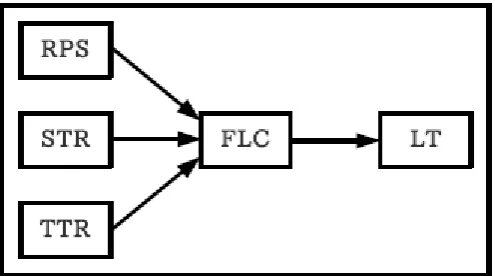
The structure of the proposed system is shown in Fig. 2. The FLC is the main part of FLTP and its basic elements are shown below.
Fig 2: Proposed Simulation System
A. Description of FLC
© 2015, IJCSMC All Rights Reserved
838
These parameters are described in the following: • Remaining Battery Power of Sensor (RPS);
• Sleep Time Rate (STR); • Transmission Time Rate (TTR);
The term sets for each input linguistic parameter are defined respectively as:
T(RPS) = {Low(Lo), Middle(Mi), High(Hg)}; T(STR) = {Short(Sh), Moderate(Md), Long(Lg)}; T(TTR) = {Few(Fe) ,Medium(Me), Many(Mn)}.
The output linguistic parameter is the Lifetime(LT) of sensor. We define the term set of LT as:
{ Very Short (V S), Short (S), Little Short (LS), Medium (MD), Little Long (LL), Long (L), Very Long (V L)}.
PARAMETER TERM SET
1. RPS 2. STR 3. TTR
Low, Middle , High Short , Moderate ,Long
Few , Medium , Many
Life Time (LT)
Very Short, Short, Little Short, Medium, Little Long, Long, Very Long
TABLE OF PARAMETERS AND THEIR TERM SETS.
B. Proposed Fuzzy Inference System (FIS)
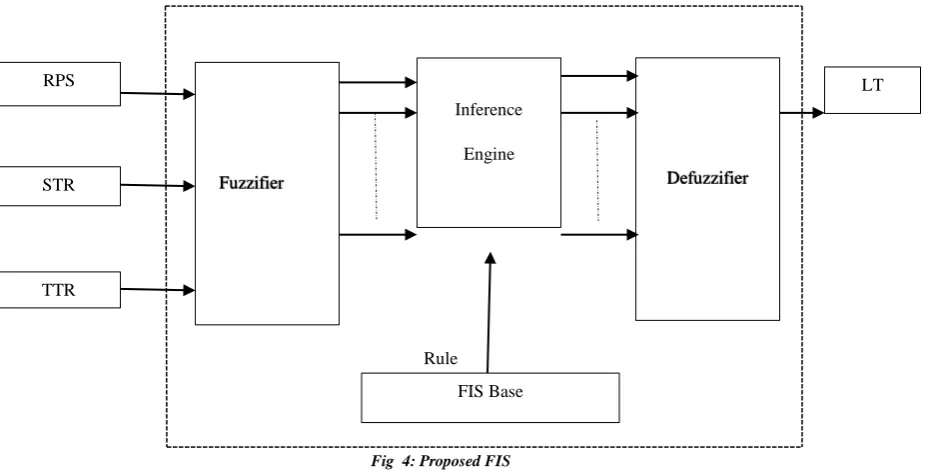
The architecture of FIS (Fuzzy Inference System) consists of three modules as fuzzifier, inference engine and CFRD defuzzifier. Proposed work introduced fuzzy logic control for deciding eligible candidates for CHs selection process as shown in Fig.4]. For each node, FIS (fuzzy inference system) compute the LT using three input parameters as RPS, STR and TTR. The FIS‟s output contain a set of those nodes which have sufficient energy to run a round successfully.
Rule
Fig 4: Proposed FIS RPS
STR
TTR
Fuzzifier
Inference
Engine
Defuzzifier
LT
© 2015, IJCSMC All Rights Reserved
839
FIS (Fuzzy Inference System) include 27 rules, mentioned in Table II decide the lifetime for each node to be a CH by using three input parameters as Remaining Battery Power of Sensor (RPS), Sleep Time Rate (STR) and Transmission Time Rate (TTR). After that a set of eligible candidates is available from which CHs will selected randomly using BDCP(LEACH) threshold value with some modification. The rule-base used in proposed algorithm is given in Table II.
TABLE II
4.
RESULTS
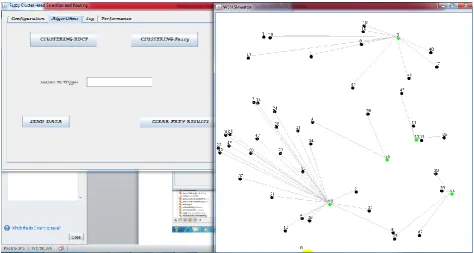
A Framework of Network has been created. In this results we are going perform the following 3 operation with respect to experimental parameter
1. Creation of Network: Network should contain Number of Nodes, Number of Cluster Head and range of network.
© 2015, IJCSMC All Rights Reserved
840
Finally we will plot performance graph with respect to number of nodes and energy consumption.
Fig:1 Creation of Network : CH ,„n‟ Number Nodes.
© 2015, IJCSMC All Rights Reserved
841
5.
CONCLUSION
In this paper, we proposed a simulation system based on Clustering-FL(Fuzzy Logic) for prediction of sensor lifetime in WSNs. Implemented our system with one FLC(FIS) and evaluated the performance by simulation and Comparing with the other clustering techniques like LEACH(BDCP).
From simulation results, we conclude as follows,
1. The effect of STR is directly proportional to lifetime. If a sensor has a high sleep rate, it will not spend a lot of energy, so its lifetime will be longer and vice-versa.
2. A sensor with higher RPS will have a longer lifetime.
3. As the TTR increases, LT decreases because the sensor will spend more energy.
REFERENCES
[1].K. Mikhaylov and J. Tervonen, “Energy-efficient routing in wireless sensor networks using power-source type identification,” International Journal of Space-Based and Situated Computing, vol. 2, no. 4, pp. 253–366, 2012.
[2] P. M. L. Chan, R. E. Sheriff, Y. Hu, P. Conforto, and C. Tocci, “Mobility management incorporating fuzzy logic for a heterogeneous ip environment,” IEEE Communications Magazine, vol. 39, no. 12, pp. 42–51, 2001.
[3] L. Barolli, A. Koyama, T. Suganuma, and N. Shiratori, “Gaman: a ga based qos routing method for mobile adhoc networks,” Journal of Interconnection Networks (JOIN), vol. 4, no. 3, pp. 251–270, 2003.
[4] M. Chatterjee, S. K. Das, and D. Turgut, “Wca: a weighted clustering algorithm for mobile ad hoc networks,” Journal of Cluster Computing, vol. 5, no. 2, pp. 193–204, April 2002.
[5] S. Banerjee and S. Khuller, “A clustering scheme for hierarchical control in multi-hop wireless networks,” Proc. of IEEE INFOCOM-2001, pp. 1028–1037, 2001.
[6] W. P. Chen, J. C. How, and L. Sha, “Dynamic clustering for acoustic target tracking in wireless sensor networks,” IEEE Trans. on Mobile Computing, vol. 3, no. 3, pp. 258–271, July- September 2004.
[7] S. Basagni, “Distributed clustering for ad hoc networks,” International Symposium of Parallel Architectures, Algorithms and Networks (I-SPAN‟99), pp. 310–315, 1999.
[8] A. D. Amis, R. Prakash, T. H. P. Vuong, and D. T. Huynh,Max-min d-cluster formation in wireless ad hoc networks,” Proc. of IEEE INFOCOM-2000, pp. 32–41, 2000.
[9] H. Chan and A. Perrig, “Ace: An emergent algorithm for highly uniform cluster formation,” Proc. of European Workshop on Wireless Sensor Networks (EWSN-2004), pp. 154–171, 2004.
[10] Q. Liang, “A design methodology for wireless personal area networks with power efficiency,” Proc. of the Wireless Communications and Networking (WCNC), vol. 3, pp. 1475–1480,2003.
[11] J. Anno, L. Barolli, F. Xhafa, and A. Durresi, “A cluster head selection method for wireless sensor networks based on fuzzy logic,” Proc. of IEEE TENCON-2007, pp. CD–ROM, 4 pages,2007.