Available Online atwww.ijcsmc.com
International Journal of Computer Science and Mobile Computing
A Monthly Journal of Computer Science and Information Technology
ISSN 2320–088X
IMPACT FACTOR: 5.258IJCSMC, Vol. 5, Issue. 4, April 2016, pg.503 – 510
Energy Efficient Clustering and Data
Uploading Using Polling Point in
Wireless Sensor Network
Ms.Aishwarya.A
1, Dr. SaravanaSelvam.N
2, Mr. Keerthi Vivek
3¹PG Scholar, Department of CSE, SECE, Coimbatore & Anna University, India ²HOD, Department of CSE, SECE, Coimbatore& Anna University, India
³System Engineer, Infosys Ltd, Chennai, India
1
[email protected]; 2 [email protected]; [email protected]
Abstract—In Wireless sensor network consisting of a huge number of sensor nodes is effective for assembly data in a variety of environment. Given that the sensors operate on battery of limited power, it is a challenging task to design an efficient routing scheme which can minimize the delay while offering high energy efficiency and long network lifetime. Multiple cluster heads within a cluster cooperate with each other to perform energy saving intercluster connections. Through intercluster transmissions, cluster head information is forwarded to SenCar for its moving trajectory planning. We proposed Energy Efficiency Clustering and Data aggregation for sensor Network. There are four phases: cluster head, cluster head selection, data aggregation and maintenance. Important issued in wireless sensor network is minimize the total energy consumption requires to collect data. Protocol provides improved network time period since the energy level of the nodes are considered while choosing the cluster head.
Keywords— Wireless sensor networks (WSNs), data collection, Cluster Head(CH),mobility control.
I. INTRODUCTION
WSN is a collection of sensor nodes which is used to sense the surrounding environment. Each sensor node contain the limited number of resources such as energy, storage, and computational capacity then each node can communicate with one another within a small distance. Energy (sending and receiving) is a driving constraint. Minimum Energy consumption and traffic load is an important issue in WSNs. Clustering is a standard approach for reducing energy consumption and traffic load. Group of similar sensor nodes are organized into a cluster. Each cluster has a CH which is used to collect the information from respective sensor nodes and forward to the base station.
When sensors around the data sink deplete their energy, network connectivity and coverage may not be guaranteed. Due to these constraints, it is crucial to design an energy-efficient data collection scheme that consumes energy uniformly across the sensing field to achieve long network lifetime. The sensors into clusters and allows cluster heads to take the responsibility for forwarding data to the data sink. The main objectives of clustering hierarchy is to efficiently maintain the energy consumption of sensor nodes by involving them in ad-hoc communication within a particular cluster and by performing data aggregation and fusion in order to decrease the number of transmitted message to the base station. Cluster formation is typically based on the reserve of sensors and sensors’ proximity to the cluster head.
Hierarchical routing protocols are critical for the wireless sensor networks (WSN) to maximize its lifetime, but the existing protocols are prone to lead nodes in clusters to die early due to ignoring the state of
neighbours
in the cluster headdecision. The
lifetime of sensor can be increased by optimized the applications, operating systems, and communication protocols. In clustering, the network is randomly divided into several clusters, where each cluster is managed by a cluster head (CH).II. RELATEDWORK
Clustering algorithm for sensor networks, known as Low-Energy Adaptive Clustering Hierarchy (LEACH). LEACH is a cluster-based protocol that applies randomized rotation of the cluster heads to distribute the energy load evenly among the sensor nodes in the network. The operation of LEACH is organized in rounds, each consisting of a set-up phase and a steady-state phase. During the set-up phase, the network is separated into clusters, each with a randomly selected cluster head from nodes in a cluster. During the steady-state phase, the cluster heads gather data from nodes within their clusters respectively. In LEACH, the nodes organize themselves into local clusters, with one node acting as the cluster head. All non-cluster head nodes transmit their data to the cluster head, while the cluster head node receives data from all the cluster members, performs signal processing functions on the data (e.g., data aggregation), and transmits data to the remote BS. Therefore, being a cluster head node is much more energy intensive than being a non cluster head node.
The operation of Energy Efficiency based Clustering and Data Aggregation is divided into round and every round consists set-up phase and Steady state phase. The network is divided into rectangular region and it’s called swim lanes, then each swim lane partitioned into smaller region is called grids. The grids further away from BS are bigger and have more nodes participated in Cluster Heads. Swim lane is partitioned into several rectangular grids along Y- axis. Grid of each swim lane is assigned a level of bottom grid is 1. Both numbers of grids and length of each grid in a swim lane are related with the distance from the swim lane to BS. For different swim lanes, the further swim lane is away from BS. For same swim lane, the grid further away from BS has longer length.
Cluster Formation Algorithm
Once the nodes have elected themselves to be cluster heads the cluster head nodes must let all the other nodes in the network know that they have chosen this role for the current round.
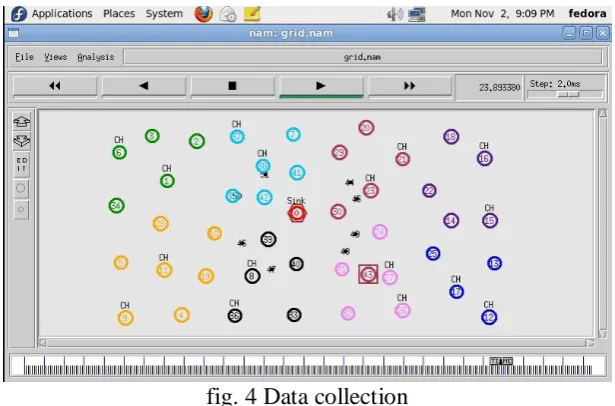
The actuator starts from the sink, travels through the entire network and collects the data from nearby sensor nodes while in motion, before inveterate to forward its collected data to the sink. In ultimate circumstances, the actuator’s moving distance is not limited. It is able to visit all of the sensor nodes in the network inorder, communicating with the sensor nodes by single-hop relay, thus minimizing energy consumption during communication. However, in practical applications, strict restrictions are placed on the data gathering delay. Thus, the key issue of using actuators in wireless sensor networks is planning reasonable paths for the actuator and optimizing the data exchange mechanisms with the sensor nodes.
to maximize the network lifetime of a wireless sensor network. The data gathering tree problem turns out to be NP-complete and hard to solve exactly. A polynomial time algorithm, which is provably close to optimal to extend our solution to the construction of a data gathering forest. This results in a better approximation ratio for extending the network lifetime and in decreasing the load on the central base station. Simulations show that both our schemes successfully balance the load and significantly extend the network lifetime. Further, our schemes have a low computational burden, which is important for on-line implementation.
Fig.2 Cluster Formation
Fig.3 Cluster Head Selection
III. MOBILEDATACOLLECTION
Compared with data collection via a static sink, introducing mobility for data collection enjoys the benefits of balancing energy consumptions in the network and connecting disconnected regions. Investigated mobility under random walk where the mobile collector picks up data from nearby sensors, buffers and finally offloads data to the wired access point. However, random trajectory cannot guarantee latency bounds which is required in many applications. proposed to control data mules to traverse the sensing field along parallel straight lines and collect data from nearby sensors with multichip transmissions. This scheme works well in a uniformly distributed sensor network.
They alternatively proposed a single-hop data gathering scheme to pursue the perfect uniformity of energy con-assumption among sensors where a mobile collector called SenCar is optimized to stop at some locations to gather data from sensors in the proximity via single hop transmission. Data generated from the sources in the region are often redundant and highly correlated. Accordingly, gathering and aggregating data from the region in the sensor networks is important and necessary to save the energy and wireless resources of sensor nodes. the concept of a local sink to address this issue in geographic routing. The local sink is a sensor node in the region, in which the sensor node is temporarily selected by a global sink for gathering and aggregating data from sources in the region and delivering the aggregated data to the global sink. a Single Local Sink Model for determining optimal location of single local sink. Because the buffer size of a local sink is limited and the deadline of data is constrained, single local sink is capable of carrying out many sources in a large scale local and adjacent region. the Single Local Sink Model to a Multiple Local Sinks Model. a data gathering mechanism that gathers data in the region through the local sink and delivers the aggregated data to the global sink to avoid individual data dissemination of source nodes in a local and adjacent region The Local Sink, which locally gathers data of source nodes in the region and disseminates the aggregated data to a Global Sink.
fig. 4 Data collection
The work was further extended in to optimize the data gathering tour by exploring the trade off between the shortest moving tour of SenCar and the full utilization of concurrent data uploading among sensors. Furthermore, proposed an algorithm to study the scheduling of mobile elements such that there is no data loss due to buffer overflow. Although these works consider utilizing mobile collectors, latency may be increased due to data transmission and mobile collector’s travelling time.
3.1 INTER-CLUSTER COMMUNICATIONS
Next, we discuss how cluster heads in a CHG collaborate for energy efficient inter-cluster communication. We treat cluster heads in a CHG as multiple antennas both in the transmitting and receiving sides such that an equivalent MIMO system can be constructed. The self-driven cluster head in a CHG can either coordinate the local information sharing at the transmitting side or act as the destination for the cooperative reception at the receiving side. Each collaborative cluster head as the transmitter encodes the trans-mission sequence according to a specified space-time block code (STBC) to achieve spatial diversity.
Compared to the single-input single-output system, it has been shown in that a MIMO system with spatial diversity leads to higher reliability given the same power budget. An alternative view is that for the same receive sensitivity, MIMO systems require less transmission energy than SISO systems for the same transmission distance. Therefore, given two connected clusters, compared with the single-head structure, in which the inter-cluster transmission is equivalent to a SISO syst
em, the
multi-head structure can save energy for inter-cluster communication received information. When a sensor node becomes a cluster head, other sensor nodes in that cluster forwards their data to the cluster head. Cluster heads aggregate data and send them to the base station. If the cluster head is far from the base station, it requires more energy to transmit data. Therefore, it is important to try to select a sensor node as cluster head with minimum possible distance to the base station. It is desirable that the sensor nodes closer to the base station become cluster head while the other ones remains as ordinary sensor nodes. In other words, smaller number of sensor nodes wants to become cluster head. In this model, cluster heads transmit data to the base station directly without getting help from other sensor nodes.3.2 IMPACT OF MAXIMUM NUMBER OF CLUSTER HEADS IN EACH CLUSTER
In this section, we evaluate the impact of the maximum number of cluster heads in each cluster, M, on energy consumptions, latency and number of clusters. We plot the performance of mobile MIMO with different M when l varies from 50 to 400 m and n ¼ 200. We fix the interval distance t between a polling point and its adjacent neighbors in horizontal and vertical directions at about 20 m, which means that np varies from 16 to 441
with different settings of l.
When M increases, there are more cluster heads in a cluster to share the workload. Fig. 8b shows the maximum energy consumption in the network. Since more cluster heads can directly upload their data to SenCar without any relay, the case with a larger M results in a slightly less energy consumptions. For example, when l ¼ 300 m, maximum energy consumption with M ¼ 6 is 15 percent less than the case with M ¼ 2.
It is demonstrated that a larger M also leads to longer data latency. The reason is that more selected polling points need to be visited, which leads to a longer moving trajectory. For instance, when l ¼ 400 m, the data latency in the case of M ¼ 6 and M ¼ 4 is 14 and 7 percent longer than the case of M ¼ 2, respectively. Fig. 8d shows the number of clusters formed with different M.
3.3 COMPARISON OF ENERGY CONSUMPTIONS AND LATENCY
First, we compare the average energy consumption for each sensor and the maximum energy consumption in the net-work. We set l ¼ 250 m, np ¼ 400, and M ¼ 2 (at most two cluster heads for each cluster) and vary n
from 50 to 500. Note that when n ¼ 50, network connectivity cannot be guaranteed all the time for multihop transmission with a static sink. The results here are only the average of the connected networks in the experiments. However, the mobile schemes can work well not only in connected networks but also in disconnected networks, since the mobile collector acts as virtual links to connect the separated sub networks.
We can see that our mobile MIMO scheme[8] results in the least energy consumption on sensor nodes, whereas the methods that transmit messages through multihop relay to the static data sink result in at least twice more energy on each node. Further presents the maximum energy consumption in the network. The network lifetime usually lasts until the first node depletes its energy.
It is intuitive that schemes with lower maximum energy consumption would have longer network lifetime. It shows that mobile MIMO has the least maximum energy consumptions and curves for the schemes that utilize multihop relaying to the static data sink (Relay Routing, Collection Tree and Clustered SISO/MIMO) climb much faster and higher than mobile MIMO scheme. When we increase the size of the network, network lifetime of these schemes would deteriorate because more relayed traffic needs to traverse the congested region near the data sink.
Here, we define data latency as the time duration for the data sink to gather all the sensing data in the field. For mobile schemes, data latency is equivalent to the time duration of a data col-lection tour which comprises of the moving time and data transmission time. The lower latency is achieved with clustered SISO/MIMO compared to Relay Routing or Collection Tree methods. This is because that nodes are organized into clusters and routing burden is decomposed into smaller tasks by different clusters. Relay routing has the highest latency because choosing node with the highest energy as the next hop may not lead to the shortest path. On the other hand, mobile SISO/MIMO has a little higher latency than clustered SISO/MIMO and Collection Tree methods due to SenCar’s moving time.
Fig.5 Energy Consumption
The cluster head is selected using the High Energy First clustering method which selects the node with highest energy as the cluster head. This increases the network lifetime. Initially the source and the destination nodes for data transmission are chosen and are set for the data transmission. The other nodes are held at the sleep mode which avoids the unwanted energy wastage.
IV. CONCLUSION
In this paper, we have studied the problem of energy efficiency data transmission in wireless sensor network and cluster based data aggregation methods. Four phases are consisting in the data aggregation method. Energy Efficiency based Clustering and Data Aggregation is divided network into a grid with unequal size, the grid further away from BS has bigger size and more nodes. Supporting this framework, a protocol victimization harmony search algorithmic rule (HSA), a music primarily based meta heuristic improvement methodology, is meant and enforced in real time for the WSNs. It is expected to attenuate the intra cluster distances between the cluster members and their cluster heads (CHs) and to optimize the energy distribution of the WSN and to match the performance of each existing and planned protocols.
V. ACKNOWLEDGEMENT
I am thankful to Dr.N.SaravanaSelvam Head Of The Department for his guidance, support and supervision. And also for providing the information and ready to help any time in completion of this paper.
REFERENCES
[1] E. Lee, S. Park, F. Yu, and S.-H. Kim, ―Data gathering mechanism with local sink in geographic routing for wireless sensor networks,‖ IEEE Trans. Consum. Electron., vol. 56, no. 3, pp. 1433– 1441, Aug. 2010.
[2] M. Zhao, M. Ma, and Y. Yang, ―Mobile data gathering with space-division multiple access in wireless sensor networks,‖ in Proc. IEEE Conf. Comput. Commun., 2008, pp. 1283–1291.
[4] A. Somasundara, A. Ramamoorthy, and M. B. Srivastava,, ―Mobile element scheduling for efficient data collection in wire-less sensor networks with dynamic deadlines,‖ in Proc. 25th IEEE Int. Real-Time Syst. Symp., Dec. 2004, pp. 296–305
[5] S. Cui, A. J. Goldsmith, and A. Bahai, ―Energy-efficiency of MIMO and cooperative MIMO techniques in sensor networks,‖ IEEE J. Sel. Areas Commun., vol. 22, no. 6, pp. 1089–1098, Aug. 2004.
[6] M. Younis, M. Youssef, and K. Arisha, ―Energy-aware management for cluster-based sensor networks,‖
Computer networks, vol. 43, pp. 649– 668, 2003.
[7] C. Liu, K. Wu, and J. Pei, ―An energy-efficient data collection framework for wireless sensor networks by exploiting spatiotem-poral correlation,‖ IEEE Trans. Parallel Distrib. Syst., vol. 18, no. 7, 1010–1023, Jul. 2007.
[8] Miao zhao, Member, IEEE, Yuanyuan Yang,Fellow,IEEE,and Cong Wang, ―Mobile Data Gathering with Load Balanced Clustering and Dual Data Uploading in Wireless Sensor Networks,‖ IEEE Trans. Mobile Comput., vol. 14, no. 4, pp. 770-785, Apr. 2015.
[9] Z. Zhang and F. Yu, ―Performance analysis of cluster-based and treebased routing protocols for wireless sensor networks,‖ in Proc. Int. Conf. Commun. Mobile Comput. (CMC), vol. 1, Shenzhen, China, Apr. 2010, pp. 418–422
[10] K. Xu, H. Hassanein, G. Takahara, and Q. Wang, ―Relay node deployment strategies in heterogeneous wireless sensor networks,‖ IEEE Trans. Mobile Comput., vol. 9, no. 2, pp. 145–159, Feb. 2014.
[11] E. Lee, S. Park, F. Yu, and S.-H. Kim, ―Data gathering mechanism with local sink in geographic routing for wireless sensor networks,‖ IEEE Trans. Consum. Electron., vol. 56, no. 3, pp. 1433– 1441, Aug. 2013.
[12] Jigui Sun, Jie Liu and Lianyu Zhao, ―Research on Clustering‖ Journal of Software ,2008
[13] L. Qing, Q. Zhu, and M. Wang, ―Design of a distributed energy-efficient clustering algorithm for heterogeneous wireless sensor networks,‖ Computer Communication, vol. 29, pp. 2230–2237, 2006
[14] W. R. Heinzelman, A. Chandrakasan, and H. Balakrishnan, ―An application-specific protocol architecture for wireless microsensor networks,‖ IEEE Trans. Wireless Commun., vol. 1, no. 4, pp. 660– 660, Oct. 2002.
[15] M. Ye, C. Li, G. Chen, and J. Wu, ―EECS: An energy efficient clustering scheme in wireless sensor networks,‖ in IPCCC, April 2005, pp. 535– 540.
[16] B. Gong, L. Li, S. Wang, and X. Zhou, ―Multihop routing protocol with unequal clustering for wireless sensor networks,‖ in CCCM, 2008, pp. 552–556.