IJEDR1503124
International Journal of Engineering Development and Research (www.ijedr.org)1
Effect of Soil-Structure Interaction in Seismic
Analysis of Framed Structures using Ansys
1Aarlin K Mathew,2 Sat Kumar Tomer,3Lovely K M 1P. G. Student,2 Research Scholar,3Professor
1Department of Civil Engineering,MBITS, Ernakulam,Kerala,India
2 Department of Civil Engineering, Indian Institute of Science, Bangalore
________________________________________________________________________________________________________
Abstract - The interaction of a building, its foundation and the under lying soils may have important effects on the behavior of each of these components as well as on the overall system behavior. The soil- structure interaction effect considerably influence the design of multi- storey buildings subjected to lateral seismic load. An investigation of the effects of Soil Structure Interaction on the stresses and displacements in the structure and the soil of a model six-storied frame structure resting on isolated column footings and supported by deformable soil. The finite element modeling and analysis is carried out using ANSYS software under normal loads as well as under seismic loads. Various load combinations are considered as per IS-1893 (Part-1):2002. The frame and soil mass both are considered to behave in linear elastic manner. It is observed that the Soil-Structure Interaction effect significantly alters the axial forces and moments in the footings due to the differential settlement. Analyses are carried out in layered soil mass. Compare the differences in the settlement of footing in different load cases.
Index Terms– Soil-Structure Interaction, ANSYS, Space Frame, Linear Interaction Analysis, Non-Interaction Analysis,
Differential Settlement, Isolated Column Footings, Seismic Forces.
________________________________________________________________________________________________________
I.INTRODUCTION
The conventional structural analysis of a RC space frame is carried out assuming foundation resting on unyielding supports. The analysis is carried out by considering bottom end of the columns fixed and neglecting the effect of soil deformations. In reality, any building frame rests on deformable soil resulting in redistribution of forces and moments due to soil-structure interaction. Thus, conventional analysis is unrealistic and may be unsafe. The interaction effect is more pronounced in case of multi-storied buildings due to heavy loads and may become further aggravated when such buildings are subjected to seismic loads.
In the present study, 3-D soil- structure interaction analysis has been carried out for a six storey RC framed building with isolated footings under normal as well as seismic loads using finite element software ANSYS. The analysis has been carried out considering space frame resting on four layers of deformable soil . In four layers of deformable soil, the soil consist of clay, silt soil, gravel with sand and gravel. Various combinations of dead, live and seismic loads are considered as per IS-1893 (Part-1): 2002. The model is easily extendable to any configuration of space frame as full 3-D space frame is considered for analysis. The results of conventional i.e. non interaction analysis (NIA) as well as linear interaction analysis (LIA) are compared for the space frame resting on four layers of deformable soil to investigate the effect of total settlements and differential settlement on axial forces and moments in the footings. The results show that there is considerable redistribution of forces and moments in the space frame due to the interaction effect.
Soil-Structure Interaction: Most of the civil engineering structures involve some type of structural element with direct contact with ground. When the external forces, such as earthquakes, act on these systems, neither the structural displacements nor the ground displacements, are independent of each other. The process in which the response of the soil influences the motion of the structure and the motion of the structure influences the response of the soil is termed as soil-structure interaction (SSI).Conventional structural design methods neglect the SSI effects. Neglecting SSI is reasonable for light structures in relatively stiff soil such as low rise buildings and simple rigid retaining walls. The effect of SSI, however, becomes prominent for heavy structures resting on relatively soft soils for example nuclear power plants, high-rise buildings and elevated-highways on soft soil.
II.LITERATURE SURVEY
IJEDR1503124
International Journal of Engineering Development and Research (www.ijedr.org)2
variation in natural period, bending moment s and deflections of structure by incorporating soil flexibility as compared to structures with conventional fixed base. The findings indicate that the seismic response of the building during severe shaking may be different than that predicted during the design process, and that the expected structural demands may not be as high as predicted because of the effects of soil structure interaction and basements. This study does underscore that there is scope for rationalization in the IS codal provisions.Ayman Ismail[3] examined the Effect of soil flexibility on seismic performance of 3-D frames. Abstract: In most of the designs of rigid structural frames, the analysis is carried out by assuming fixity at base, which means that the building is idealized to rest on hard rock. This paper discusses the importance of considering the effect of soil stiffness on the seismic performance of rigid structural frame system resting on it. Flexibility of soil causes lengthening of lateral natural period of the structural system due to overall decrease in lateral stiffness. Such lengthening of lateral natural period may considerably alter the seismic response of the building frames resting on isolated footings. Hence, focus of this paper is to bring out the effect of flexible foundation soil on the performance of 2D and 3D frame-foundation systems and their overall dynamic behavior from pushover analysis, a static non-linear analysis. Gazetas [1] model is used for representing stiffness of soil and the foundation resting on it as a spring. For analysis, design and pushover analysis of frame SAP2000 v15 [2] software is used. It is observed that modulus of soil has considerable effect on natural period of system and overall performance of structural system, indicating that idealization of fixity at the base may be seriously erroneous.
Mahesh Suresh Kumawat and L.G.Kalurkar[4] conducted a Static and dynamic analysis of multistory building using composite structure. Steel concrete composite construction means the concrete slab is connected to the steel beam with the help of shear connectors so that they act as a single unit. In the present work steel concrete composite with RCC options are considered for comparative study of G+15 story commercial building which is situated in earthquake zone-III and for earthquake loading, the provisions of IS: 1893(Part1)-2002 is considered. A three dimensional modeling and analysis of the structure are carried out with the help of SAP 2000 software. Equivalent Static Method of Analysis and Response spectrum analysis method are used for the analysis of both Composite and R.C.C. structures. The results are compared and found that composite structure more economical.
R. R. Chaudhari and Dr K. N. Kadam[5] presented an Effect of piled raft design on high-rise building considering soil structure interaction. Piled-raft foundations for important high-rise buildings have proved to be a valuable alternative to conventional pile foundations or mat foundations. The concept of using piled raft foundation is that the combined foundation is able to support the applied axial loading with an appropriate factor of safety and that the settlement of the combined foundation at working load is tolerable. Pile raft foundation behavior is evaluated with many researches and the effect of pile length; pile distance, pile arrangement and cap thickness are determined under vertical or horizontal static and dynamic loading. In the present paper the influence of pile length configurations on behavior of multi-storied are evaluated under vertical loading. In practice, the foundation loads from structural analysis are obtained without allowance for soil settlements and the foundation settlements are estimated assuming a perfectly flexible structure. However, the stiffness of the structure can restrain the displacements of the foundations and even tiny differential settlements of the foundations will also alter forces of the structural members. Hence, the interaction among structures, their foundations and the soil medium below the foundations alter the actual behaviour of the structure considerably than what is obtained from the consideration of the structure alone. In this work, analysis of pile soil structure interaction has been studied by finite element software ANSYS 11. The soil structure interact ion has been found to be significantly affecting the performance of structure and it is discussed in this paper.
III.PROBLEM FOR INVESTIGATION
IJEDR1503124
International Journal of Engineering Development and Research (www.ijedr.org)3
Table 1 Material Properties of ConcreteProperty Value
Grade of concrete for all structural elements M25 Modulus of elasticity of concrete (N/mm2) Ec = 5000√fck
Poisson’s ratio of concrete 0.15
Density of concrete 2500 N/m3
Table 2 Material Properties of Soil
Soil Type Modulus of Elasticity
(N/mm2)
Poisson’s Ratio
Clay 13.788 0.42
Silt soil 25.278 0.35
Gravel with sand soil 56.68 0.30
Gravel 68.94 0.25
Table 3 Geometric Parameters
Parameter Value
Number of storeys 6
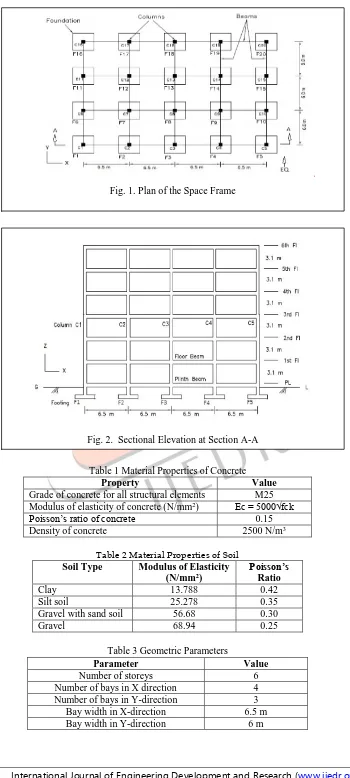
Number of bays in X direction 4
Number of bays in Y-direction 3
Bay width in X-direction 6.5 m
Bay width in Y-direction 6 m
Fig. 1. Plan of the Space Frame
IJEDR1503124
International Journal of Engineering Development and Research (www.ijedr.org)4
for analyzing and designing. The most popular and the easiest to learn is ANSYS software. It is a general purpose finite element modeling package for numerically solving a wide variety of mechanical problems. All users, from designers to advanced experts, can benefit from ANSYS structural analysis software. The fidelity of the results is achieved through the wide variety of material models available, the quality of the elements library, the robustness of the solution algorithms and the ability to model every product from single parts to very complex assemblies with hundreds of components interacting through contacts or relative motions. ANSYS FEA tools also offer unparalleled ease of use to help product developers focus on the most important part of the simulation process, understanding the results and the impact of design variations on the model.Finite Element Modelling
The finite element modelling and analysis of the problem is achieved using ANSYS software which has wide variety of elements and material models suited for the problem under consideration. ANSYS requires creation of model geometry, selection of appropriate element types, defining real constant sets in terms of cross sectional details for various elements, defining material properties, assigning these element types, real constants and material properties to various components of the interaction system and finite element mesh discretization in its pre-processing module. Boundary conditions, analysis type and loads are defined in its solution module.
V.METHODOLGY
Specimen Geometry
For soil mass, simulation element SOLID45 was chosen from the ANSYS element library. SOLID45 has plasticity, creep, swelling, stress stiffening, large deflection, and large strain capabilities. A reduced integration option with hourglass control is available. For footing , simulation element SOLID65, it is used for the three-dimensional modeling of solids with or without reinforcing bars (rebars). For beam and column element BEAM4 and for slabs SHELL63 elements are used. Surface to surface contact is established between foundation bottom area and soil using ANSYS surface to surface contact elements CONTA174 and TARGE170.
Boundary Conditions
The vertical displacement (Uz) is restrained on soil bottom as bed rock is assumed to be encountered at this location. The side boundaries of soil are considered to be restrained laterally i.e. horizontal displacement (Ux) is restrained on boundaries perpendicular to X-direction and horizontal displacement (Uy) is restrained on boundaries perpendicular to Y-direction.
Meshing
IJEDR1503124
International Journal of Engineering Development and Research (www.ijedr.org)5
VI.LOADING
The building is considered to be an institutional building. The live loads are considered as per IS 875 (Part 2):1987. The live loads of 4 kN/ m2 on floors and 1.5 kN/ m2 on roof are considered. The brick masonry wall on outer periphery of the building and parapet wall on roof are also considered. The details of various loads considered are given in Table 4. These are in addition to the self-weight of the structure. For seismic load calculations, equivalent static lateral force method is used as per IS 1893 (Part 1): 2002. The parameters used for seismic load calculations are given in Table 5.
Table 4 Dead Load And Live Load
Description Value
Dead load of floor finish 1 kN/m2
Dead load of finishing and water proofing on roof 2.5 kN/m2
Live load on floors 4 kN/m2
Live load on roof 1.5 kN/m2
Brick walls (only on plinth/floor periphery) 11.362 kN/m
Parapet wall on roof periphery 4.37 kN/m
Seismic Load Calculations
Calculation of lumped masses to various floor levels
The earthquake loads are calculated for full dead load plus the percentage of imposed load as given Table-8 of IS 1893 (Part 1): 2002. Accordingly 50% of live load on floors and 25% of live load on roof is considered. The lumped mass of each floor is worked out by adding mass of slab, mass of reduced live load on slabs, mass of beams in longitudinal as well as transverse directions at that floor, mass of column for half column height above and below floor, mass of wall for half height above and below beams (wall is considered only on outer periphery), mass of parapet wall on outer periphery beams on roof.
Seismic weight of floor = lumped masses of floors x g g = gravitational acceleration
W= Seismic weight of building (sum of seismic weights of all floors)
Determination of fundamental natural period of the space frame
The approximate fundamental natural period of vibration (Ta) of the space frame-shear wall structure is estimated as per the empirical expression given in the clause 7.6.1 of IS 1893 (Part 1): 2002:
Ta = 0.075 h0.75 (1)
Where h = height of building, in m.
Table 5 Seismic Load Parameters
Parameter Value
Earthquake zone V
Zone factor ‘Z’
(Table 2 of IS 1893 (Part 1): 2002)
0.36 Importance factor ‘I’
(Table 6 of IS 1893 (Part 1): 2002)
1.5 Response reduction factor ‘R’
(Table-7 of IS 1893 (Part 1): 2002)
5 Approximate fundamental natural period
of vibration (Ta)
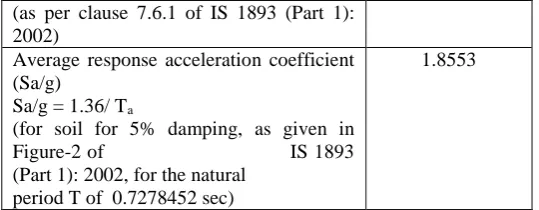
Ta = 0.075 h0.75 = 0.075 (20.9)0.75= 0.733
IJEDR1503124
International Journal of Engineering Development and Research (www.ijedr.org)6
Ah = Design horizontal acceleration spectrum coefficient, as per clause 6.4.2 of IS 1893 (Part 1): 2002.W = Seismic weight of the building
Ah = (Z/2)x(I/R)x(Sa/g) (3)
Z = Zone factor [Table 2 of IS 1893 (Part 1): 2002]. I = Importance factor [Table 6 of IS 1893 (Part 1): 2002].
R = Response reduction factor, depending on the perceived seismic damage performance of the building [Table 7 of IS 1893 (Part 1): 2002].
Sa/g = Average response acceleration coefficient for soil for 5% damping [Figure-2 of IS 1893 (Part 1): 2002] for the natural period as worked out above.
Determination of vertical distribution of base shear to different floor levels
The design seismic base shear, VB is distributed to different floor levels along the height of the building as per the clause 7.7.1 of IS 1893 (Part 1): 2002;
𝑄𝑖= 𝑉𝑏
𝑊𝑖ℎ𝑖2
∑𝑛𝑖=1𝑊𝑖ℎ𝑖2
(4)
Where
Qi = Design lateral force at floor ‘i’ Wi = Seismic weight of floor ‘i’
hi = Height of floor i measured from base, and
n = Number of storeys in the building is the number of levels at which masses are located.
(v) Distribution of design lateral force at floor level to different frames of the structure
The design lateral force at floor level is distributed amongst the frames in the direction considered for seismic load (i.e. Y-direction in present analysis) in proportion to their stiffness [clause 7.7.2.1 of IS 1893 (Part 1): 2002].
VII.LINEAR INTERACTION ANALYSIS
The linear interaction analyses of the space frame-soil system is carried out assuming the structure and soil to act as a single compatible structural unit and to behave in linear elastic manner.
Case-1: The conventional i.e. non-interaction analysis of the space frame l (NIA) considering columns fixed at their bases.
Case-2: The linear interaction analysis of the space frame-soil System without shear wall (LIA) considering the columns supported on isolated footings resting on deformable soil.
For each of the these analyses, the following combinations of dead load (DL), live load (LL) and seismic load (EL) are considered as per Clause 6.3.1.2 of IS 1893 (Part 1): 2002.
Table 6 Load Combinations
Load Case no. Designation Load Combination
1 LC1 1.5( DL+LL)
2 LC2 1.2(DL+LL+EL)
3 LC3 1.2(DL+LL-EL)
4 LC4 1.5(DL+EL)
5 LC5 1.5(DL-EL)
6 LC6 0.9DL+1.5EL
7 LC7 0.9DL-1.5EL
VIII.RESULTS AND DISCUSSIONS
IJEDR1503124
International Journal of Engineering Development and Research (www.ijedr.org)7
results are tabulated taking advantage of symmetry and only quarter portion of the problem is considered. Thus, axial forces and bending moments are tabulated for th footings F1, F2, F3, F6, F7 and F8.Due to interaction effect, differential settlements take place in the footings, which results in redistribution of axial forces and moments in the footings. Figures 4 to 7 show the settlements in the footings for LIA systems, under vertical and seismic loads.
Axial Forces In Footings
Table 7 shows Axial Force (Fz) in the footings for NIA and LIA systems. It is found that vertical loads (load case LC1), causes decrease in axial forces in inner footings and increase of axial forces in outer footings due to interaction effect. Under all combinations of seismic loads, the interaction effect causes decrease in axial forces in the inner footings and increase is found in the corner footings.
Table 7 Axial Forces in the footings for NIA and LIA systems under various load cases
S. No. Footing Coordinates (m) Analys
is type
Axial force in footings
(KN)
X Y Z LC1 LC2 LC3 LC4 LC5 LC6 LC7
1 F1 0.0 0.0 0.0
NIA 1070.10 2505.90 1625.10 1187.10 1734.70 498.08 1425.40 LIA 1478.5 4143.60 1947.80 1478.50 2101.80 333.54 1567
2 F2 6.5 0.0 0.0
NIA 1857 603.90 2366.50 1290.84 2333.10 362.96 1840.30 LIA 2010.40 810.77 2400.80 2010.40 2300.90 217.31 1774.30
3 F3 13.0 0.0 0.0
NIA 1841.30 593.98 2351.40 1255.64 2322.40 3641.30 1832.60 LIA 2124.9 891.58 2503.70 2124.90 2289.10 192.95 1825.50 NIA 1818.50 1523.80 1386.80 1283.40 1112.10 804.52 633.27 Fig. 4. Settlements in the Footing of LIA System under LC1
Fig. 5. Settlements in the Footing of LIA System under LC2
IJEDR1503124
International Journal of Engineering Development and Research (www.ijedr.org)8
Table 8 Bending Moment (Mx) in the footings for NIA and LIA systems under various load casesS. No. Footing Coordinates (m) Analysi
s type
Bending moment Mx (KN-m)
X Y Z LC1 LC2 LC3 LC4 LC5 LC6 LC7
1 F1 0.0 0.0 0.0
NIA 14.82 -315.98 336.79 -398.12 419.78 -400.82 417.05 LIA 135.16 -365.71 607.84 -493.53 748.95 -510.89 709.79
2 F2 6.5 0.0 0.0
NIA 9.89 -331.87 345.64 -416.94 431.56 -422.26 431.05 LIA 216.23 -297.58 669.52 -421.52 787.61 -478.40 727.91
3 F3 13.0 0.0 0.0
NIA 9.12 -331.62 345.69 -412.95 434.09 -422.78 431.26 LIA 237.68 -289.88 684.46 -405.89 795.77 -470.25 730.33
4 F6 0.0 6.0 0.0
NIA 1.89 -360.35 359.91 -448.91 457.11 -456.95 456.97 LIA 12.65 -395.17 412.81 -496.92 517.90 -512.88 523.43
5 F7 6.5 6.0 0.0
NIA 6.34 -371.98 382.70 -473.90 480.09 -473.38 498.42 LIA 23.46 -360.58 399.80 -459.03 495.60 -481.20 499.58
6 F8 13.0 6.0 0.0
NIA 6.94 -372.19 382.97 -470.27 480.44 -473.83 478.79 LIA 27.13 -353.08 396.61 -449.95 490.22 -473.14 494.05
Bending Moment My In Footings
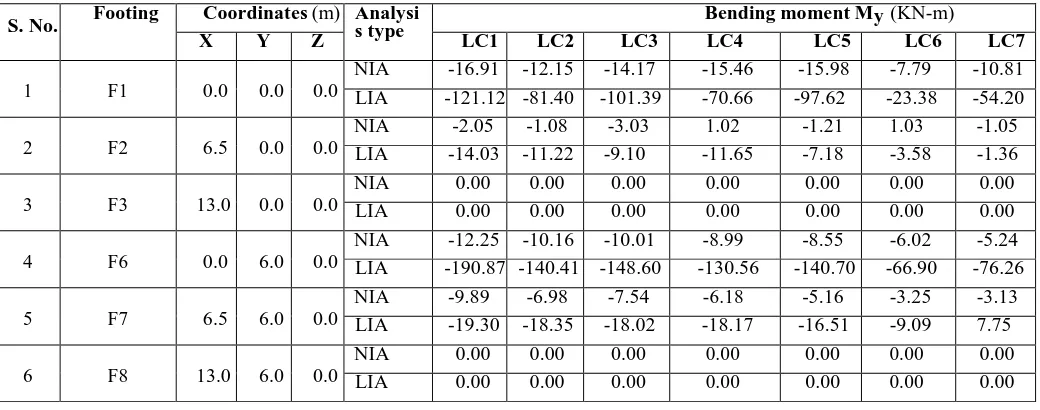
Table 9 shows Bending Moment(My) in the footings of NIA and LIA systems. The interaction effect causes significant increase in values of My in the footings. The reversal in the sign is found in some of the footings for certain load cases.
Table 9 Bending Moment (My) in the footings for NIA and LIA systems under various load cases
S. No. Footing Coordinates (m) Analysis type Bending moment My (KN-m)
X Y Z LC1 LC2 LC3 LC4 LC5 LC6 LC7
1 F1 0.0 0.0 0.0
NIA -16.91 -12.15 -14.17 -15.46 -15.98 -7.79 -10.81 LIA -121.12 -81.40 -101.39 -70.66 -97.62 -23.38 -54.20
2 F2 6.5 0.0 0.0
NIA -2.05 -1.08 -3.03 1.02 -1.21 1.03 -1.05
LIA -14.03 -11.22 -9.10 -11.65 -7.18 -3.58 -1.36
3 F3 13.0 0.0 0.0
NIA 0.00 0.00 0.00 0.00 0.00 0.00 0.00
LIA 0.00 0.00 0.00 0.00 0.00 0.00 0.00
4 F6 0.0 6.0 0.0
NIA -12.25 -10.16 -10.01 -8.99 -8.55 -6.02 -5.24 LIA -190.87 -140.41 -148.60 -130.56 -140.70 -66.90 -76.26
5 F7 6.5 6.0 0.0
NIA -9.89 -6.98 -7.54 -6.18 -5.16 -3.25 -3.13
LIA -19.30 -18.35 -18.02 -18.17 -16.51 -9.09 7.75
6 F8 13.0 6.0 0.0
NIA 0.00 0.00 0.00 0.00 0.00 0.00 0.00
IJEDR1503124
International Journal of Engineering Development and Research (www.ijedr.org)9
IX.CONCLUSIONS
Structure was modeled in ANSYS. Load calculations were done as per IS codes. The differential settlement of footings causes significant redistribution of forces and moments in the footings of space frame-soil and space frame-soil systems. The seismic forces cause compression/tensions in the footings and reversal in the nature of forces is found when direction of seismic forces is reversed. Interaction effect reduces this effect and provides more stability to the structure. Shear walls further add to the stability of the structure. The interaction effect causes significant increase in axial force in the outer footings and significant decrease in the inner footings under vertical load. The interaction effect significantly increases the value of bending moments (Mx) in all footings of space frame-soil system in most of the load cases.The proposed methodology can be effectively used to evaluate the settlements and forces in the superstructure and foundation for multi-story space framel-soil system for better and efficient building design.
X.ACKNOWLEDGMENT
I am very thankful to my project guides Prof. Dr. K M Lovely and Dr. Sat Kumar Tomer for their continuous support and encouragement in completing this work.
REFERENCES
[1] Gaikwad M.V., Ghogare R.B and Vageesha S. Mathada (2015) “ Finite element analysis of frame with soil structure interaction” IJRET: International
Journal of Research in Engineering and Technology, Volume: 04 Issue: 1 | Jan-2015pg 91-95
[2] Nithya Chandran J., Abhilash Rajan and Soni Syed (2014) “Seismic analysis of building with underground stories considering Soil Structure Interaction”
International Journal of Emerging Technology and Advanced Engineering Volume 4, Issue 11, November 2014, pg 112-117
[3] Ayman Ismail (2014) “Effect of soil flexibility on seismic performance of 3-D frames” IOSR Journal of Mechanical and Civil Engineering (IOSR-JMCE)
Volume 11, Issue 4 Ver. II (Jul- Aug. 2014), Pg 135-143.
[4] Mahesh Suresh Kumawat and L.G.Kalurkar (2014) “ Static and dynamic analysis of multistory building using composite structure” IJRET: International
Journal of Research in Engineering and Technology Volume: 03 Special Issue: 07 | May-2014, pg 638-647
[5] Sushma Pulikanti and Pradeep Kumar Ramancharla “SSI Analysis of Framed Structure Supported on Pile Foundations -With and Without Interface
Elements” Frontiers in Geotechnical Engineering (FGE) Volume 3 Issue 1, March 2014, pg 10-16
[6] R. R. Chaudhari and Dr K. N. Kadam (2013) “ Effect of piled raft design on high-rise building considering soil structure interaction” INTERNATIONAL
JOURNAL OF SCIENTIFIC & TECHNOLOGY RESEARCH VOLUME 2, ISSUE 6, JUNE 2013, pg 72-79
[7] Jing Ji, Wenfu Zhang, Wenyan Zhao, Chaoqing Yuan and Yingchun Liu “Research of Seismic Testing and Dynamic Character of High-rise Building
Structure Based on ANSYS” International Journal of Digital Content Technology and its Applications(JDCTA) volume6,number8,may 2012,pg 63-71
[8] Garg Vivek and Hora M.S. 2012. “Interaction effect of space frame-strap footing-soil system on forces in superstructure”. ARPN Journal of Engineering
and Applied Sciences. 7(11): 1402-1415.
[9] Shakib H. and Atefatdoost G.R. 2011. “Effect of soil-structure interaction on torsional response of asymmetrical wall type systems”. Elsevier, Procedia Engineering. 14: 1729-1736.
[10] Agrawal R. and Hora M.S. 2010. “Effect of differential settlements on nonlinear interaction behaviour of plane frame-soil system”. ARPN Journal of Engineering and Applied Sciences. 5(7): 75-87.
[11] Bishop A.W. and Henkel D. J. 1962. The measurement of soil properties in the tri-axial test. Edward Arnold (Publishers) Ltd., London, 2nd
Edition.
[12] Shah H. J. and Jain Sudhir K., Document No. :: IITK-GSDMA-EQ26-V3.0, Final Report :: A - Earthquake Codes, IITK-GSDMA Project on Building
Codes: Design example of a six storey building.
[13] Pankaj Agrawal and Manish Shrikhande. Earthquake Resistant Design of Structure. 1st edition 2006 (Reprint 2013), PHI Learning Pvt. Ltd.
[14] IS 1893 (Part 1): 2002. Criteria for Earthquake Resistant Design of Structures. (Part 1: General Provisions and Buildings) (5th Revision).
[15] IS 875 (Part 2):1987 (Reaffirmed 1997). Indian Standard code of practice for design loads (other than earthquake) for buildin gs and structures, part 2, imposed loads (2ndRevision).