DEVELOPMENT OF A PROCESS OF
SUPPLY CHAIN STRATEGY FORMULATION:
ACTION RESEARCH IN FOOD PROCESSING
AND HEAVY FABRICATION INDUSTRIES
IAN SADLER
AMRIK SOHAL
DEVELOPMENT OF A PROCESS OF SUPPLY CHAIN STRATEGY FORMULATION: ACTION RESEARCH IN FOOD PROCESSING AND HEAVY FABRICATION INDUSTRIES
Ian Sadler
Victoria University
Amrik Sohal
Monash University
ABSTRACT
Strategic operations planning can assist companies to improve their competitiveness but the process of planning for manufacturing operations and supply chains requires further improvement. This paper describes our development of a method of strategic operations planning called Strategic Operations and Logistics Planning (SOLP). SOLP requires a team of managers to undertake a series of workshops during which they determine the order-winning criteria to satisfy end product groups and formulate the forward policy settings needed to efficiently satisfy the corporate goals of companies and their supply chain partners. SOLP has been applied eight times in manufacturing industry. Action research is used to learn about process application in a business situation and iteratively improve the model’s ability and breadth. The applications show that managers are always able to construct a strategic plan, although the extent that it addresses the tasks required to follow the desired strategy is variable. Successful business outcomes are found in two thirds of the cases, predicated on the degree to which the participating managers have the ability, will and opportunity to implement them.
INTRODUCTION
Companies in private industry are currently beset by several step changes in the level of competition, availability of electronic data communications, fast product change driven by customer requirements and new technologies available. A major strategic tool to cope with, and make progress in spite of these changes, is strategic operations planning conjointly across the entire supply chain of interlocking
organisations. Platts first published a comprehensive process for planning single manufacturing companies (Platts & Gregory 1990).
There is strong evidence that strategic operations plans can assist companies to improve their
competitiveness and provide better returns and conditions for stakeholders from their resources (Skinner 1992; Hamel, Prahalad et al. 1998). We support the argument of Stevens (1989, p.4) that a strategic perspective is required for the supply chain that both develops objectives for the chain as a whole and specifies its shape and organisational structure to achieve a competitive package.
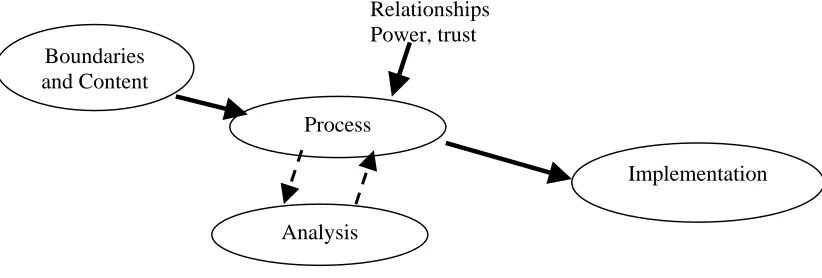
Preliminary steps in Australia involved formation from the Manufacturing Audit Approach (Platts & Gregory 1992) and initial testing at Trico, a company manufacturing windscreen- wiper assemblies. The process was also tested in a service factory involving engineering workshops for an emergency service. These tests enabled us to understand how SOLP worked and to make alterations for Australian conditions. Figure 2 shows the process stages at the end of process development.
This paper summarises eight applications of SOLP in manufacturing industry. Some applications have multiple supply chain echelons represented in the SOLP team and some address the need for several replications of the process for team member ‘managers’ to embed it in their means of management.
LITERATURE REVIEW
The supply network comprises the focal manufacturer flanked by an inward ‘bell’ of two tiers of suppliers and an outward ‘bell’ of two tiers of distribution to end consumers. Within this network, a supply chain is a ‘slice’ of the supply network defined by the focal company, which manufactures products and services required by customers using their products. ‘Slice’ refers to those suppliers, manufacturing functions and distributors required to service one group of products. Cooper, Ellram, Gardner and Hanks (1997) define a focal company which works with the same tiers of suppliers and customers. They state:
The (focal company) is an approach where one party, a channel leader, plays the key role in steering the overall strategy for the channel and in getting channel members involved in and committed to the channel strategy. ( 1997, p. 72).
The content which the process manipulates comprises the policy decisions required to manage a supply chain. (Refer to Sadler and Hines (2002) for a full discussion). In essence the decisions comprise a range of process and infrastructure choices. Amongst infrastructure, or soft systems, decisions, supply chains are highly dependent upon the information which flows between supply chain partners to plan and effect the flows of materials and products (Lewis & Talalayevsky 1997). They state that information distribution is so important to chains that it should have its own structure, linking all producers, intermediaries and retailers, in order to optimise information flows serving these partners.
It is valuable to examine planning processes for the operations of entire supply chains because business competition demands coherent strategies from such chains (Jouffrey & Tarondeau 1992; Porter 1985; Hines
Boundaries and Content
Process
Relationships Power, trust
Analysis
Implementation
et al. 1999). Fabbe-Costes and Colin’s study (1994), a very developed chain planning concept, recommends that logistics management should ‘imagine and develop’ strategic logistic actions made possible by strong logistics competencies. They see logistics as ‘a cross functional and deliberately
open-ended management domain in the firm’, which enables the firm to achieve differentiation from its
competitors. From applying their ideas in thirty firms, they propose a number of analysis grids which document ways in which firms could evolve through a series of strategic moves.
Hill (1989) stated his concept of order winning criteria: those requirements which customers use to choose between those potential suppliers who are qualified to provide the goods required. Hill also developed an outline process which requires planners to determine the business objectives and marketing strategy of a manufacturing company. They then assess the current and future order winners and use them as the goals for deciding which operations processes and soft systems should be put in place.
Platts and Gregory (1990) further developed the strategic planning process with their Manufacturing Audit Approach (MAA) which requires a multi-disciplinary team from a manufacturing company to complete a series of seven worksheets which document the intuitive mental processes they undertake. Platts and Gregory introduced a workshop in which senior managers would fill in the worksheets and divide the
company’s range into a number of product groups, which are planned separately. In terms of the underlying concept, Platts pictured the process as a bicycle drive, the small wheel comprising the competitive criteria linked by a driving chain to the big wheel, comprising the policy areas on which strategic decisions must be made to ‘drive the bicycle’ towards its goal.
Given the foregoing knowledge and our preliminary work, the research questions addressed in this paper are:
• Is SOLP a robust method of enabling and supporting a team of chain managers to formulate a business strategy for a whole supply chain?
• What inputs and senior management help are required to enable strategy formulation?
• How does one judge the efficacy of the action plans which result from a strategic chain planning process?
• What capabilities are required in team members for successful plan formation and what is the minimum level of such capabilities for success?
RESEARCH DESIGN
Action research is the method used to study the evolution of the process after eight cases. Action research takes an initial model of the process, learns about its efficacy in a business application, consolidates the learning into the process and iterates until a robust process application is believed to have evolved.
We aim to design a process which supports middle and senior managers in this planning. We do not believe that suggested actions should be externally provided: it is pivotal that managers are responsible for the strategic actions they intend to take to reach their future goals. We see analysis as an optional extra to the planning process.
A fuller discussion of the methodology is conducted in Sadler and Sohal (2005).
METHOD OF DATA COLLECTION
This paper summarises eight applications of SOLP in manufacturing industry comprising six applications in red meat processing and two in heavy earthmoving equipment manufacture. Four of the applications involve an attempt to plan for the whole of the supply chain, including related organisations. The applications show successful action plan construction, with one exception, and they involve limited overt analysis. They investigate the conditions we believe to be necessary for successful SOLP formulation:
• Team formation
• Action research
• External facilitation
• Senior management support
• Ability of team members (educational and experiential)
• Democratic behaviour in team
• Separation of workshops over 6-15 weeks.
The first two cases took place at two privately owned domestic beef and lamb abattoirs in Victoria. Three sequential cases took place at a meat processing plant, which converted pork meats into a range of cured products, and was part of an international food group. One case involved a similar meat processor, though much smaller and owned privately. The other two cases were carried out at a factory fabricating
earthmovers, the local arm of a major American company.
RESULTS
The results of eight applications of the SOLP process are shown in Tables 1 and 2. Each row represents one application. Table 1 gives inputs, documenting details about the company and the team that carried out the strategic planning. Indicators of the average level of experience and education of team members are given. The researchers also estimate the extent of commitment that the team applied to the task.
Table 2 supplies information about the planning process and the results that were obtained. Indicators of the extent that team members trusted each other and felt empowered to formulate strategies are given for each process. Measures of how good the plans were on paper and how successful they were in practice are also provided. Only limited reliance can be placed on these indicators since they are estimates by the researchers involved in the planning process.
CONCLUSIONS AND FUTURE DIRECTIONS
Implementation was achieved in five out of seven plans which were allowed to run their course. This suggests that SOLP is a feasible and robust process to form supply chain strategy, in which the results depend upon the commitment shown by team members and the extent that members were given the power to make strategic operations plans.
Referring to Tables 1 and 2, comparison of ‘team commitment’ with ‘success obtained’ for each process shows an increase, as one would expect. The lowest values for both these indicators occur at Wilson abattoir whilst the highest values for both occur at Bradley meat processing, in the first planning process. Comparison of ‘members empowered’ with ‘how good plans’ shows an increase of one indicator with the other. This confirms a correlation which one would expect to find. The lowest value for both indicators occurs at the Wilson abattoir whilst the highest values occur at the first and second processes at Bradley meat processing.
Very successful outcomes are found in five of the cases but frequently the resultant action plans are only partially implemented. We initially considered that responsible managers should be left alone in
implementation, but this leads us to think that careful assistance is probably required for most firms to achieve the best possible plan implementation. Our future work will attempt to test these process and implementation factors across increasing spans of supply chain partners in food processing and other industries.
REFERENCES
Cooper, M.C. Ellram, L.M. Gardner, J.T. & Hanks, A.M. 1997, “Meshing Multiple Alliances”, Journal of
Business Logistics, vol. 18, no. 1, pp. 67- 88.
Fabbe-Costes, N. & Colin, J. 1994, “Formulating Logistics Strategy”, in Logistics and Distribution Planning, ed J. Cooper, Kogan Page, London, pp. 36-50.
Hill, T. 1989, Manufacturing Strategy: Text and Cases, Irwin, Homewood, Il.
Hamel, G. Prahalad, C.K. Thomas, H. & O’Neal, D. 1998, Strategic Flexibility, J. Wiley, New York.
Platts, K.W. & Gregory, M.J. 1992, ‘A Manufacturing Audit Approach to strategy formulation’, in
Manufacturing Strategy; Process and Content, ed. C..A. Voss, Chapman & Hall, London, pp. 29-55.
Sadler, I. & Hines, P. 2002, ‘Strategic operations planning process for manufacturers with a supply chain focus: concepts and a meat processing application’, Supply Chain Management: An International Journal, vol.7, no. 4, pp. 225-241.
Sadler, I. & Sohal, A.S. 2005, ‘A Process for an Integrated Operations and Logistics Strategy’, International
Journal of Business Performance Management, vol. 7, no.1, pp. 71- 86.
Skinner, W. 1992, ‘Missing the links in manufacturing strategy’, in Manufacturing Strategy; Process and
1.Set Supply Chain Objectives Business’s Objectives 2. Partition product- family-channels 3./4. Decide Competitive Criteria, Output & Link 5. Audit current policies 6. Assess opportunities & threats 7./8. Formulate required strategies, Chain & Link
9./10. Determine Action Plans, Chain & Link
Product range & channel options End consumer needs Current policy status Signals in industry STEPS: Order Winning criteria Alternative feasible strategies Chosen strategies, Action Plans & Vision INPUTS: OUTPUTS:
INPUTS
CASE Industry Size
$ Aust. Ownership Company Ability Evolution
Level of
Access Size of Team
Team Exper-ience
Team
Education SChain Extent S Mgt. support Ext. Facil. Team Com-mitt. Flock Meat abattoir $95M Private
company 2.5 MD 7 70% 40% 1 High 2 65%
Wilson Meat abattoir $17M Private
company 1 Directors 8 35% 25% 1 High 2 50% Bradley 1 Meat
processing $110M Subsidiary 3 Opera-tions Manager
12 65% 65% 2 Quite
High 1 80%
Bradley 2 ditto ditto ditto ditto ditto 12 65% 65% 2 Quite
high 1 75%
Bradley 3 ditto ditto ditto ditto General
Manager 10 65% 65% 2 Mixed 1 70% Bidders Meat
processing $15M Private company 2 MD 6 66% 50% 1 Quite high 2 60% Butterfly
1 Earthmover fabrication $20M Subsidiary 3.5 Produc-tion Director
12 75% 85% 3 High 1 60%
Butterfly
2 ditto ditto ditto ditto ditto 9 85% 90% 1 Moderate 2 75%
Table 1 Input variables in SOLP process
Meaning of headings:
Company ability evolution: Estimated ability of the company to carry out operations strategy using the Hayes and Wheelwright method (1985) Team experience: proportion of team members who have many years of involvement in relevant industry at present level and type.
Team education: proportion of team members who have education to the level required for their present job.
PROCESS RESULTS
CASE Length
wks. No. of Meetings Customer input Power/ trust Plans No. of Members empowered How good plans? How Implemented? How successful?
Flock 18 7 1 60% 4 90% 75% Substantially 80%
Wilson 16 7 Poor 70% 4 30% 40% Limited extent 40%
Bradley 1 7 7 1 55% 4 90% 80% 3 plans
completely 90% Bradley 2 11 7 Many 65% 4 90% 80% Success in 2
out of 4 85% Bradley 3 22 11 No 65% 3 40% 50% Overtaken by
takeover Not applicable Bidders 8 7 No 40% 2 50% 40% Limited extent Not known
Butterfly 1 26 7 1 65% 2 50% 70% Half
implemented 55% Butterfly 2 6 7 Conference
phone 75% 1(3) 60% 75% Half implemented 60%
Table 2 Process and Results of SOLP process
Meaning of headings: