Department of Education, Science and Training
Changing Research Practices in
the Digital Information and
Communication Environment
John W. Houghton
With
Colin Steele & Margaret Henty
August 2003
© Commonwealth of Australia 2003 ISBN 0 642 77387 4
ISBN 0 642 77388 2 (Internet copy)
This work is copyright. It may be reproduced in whole or in part for study or training purposes subject to the inclusion of an acknowledgment of the source and no commercial usage or sale. Reproduction for purposes other than those indicated above, requires the prior written permission from the Commonwealth available from the Department of Communications, Information Technology and the Arts. Requests and inquiries concerning reproduction and rights should be addressed to Commonwealth Copyright Administration, GPO Box 2154, Canberra ACT 2601 or email [email protected].
Department of Education, Science and Training. This report is funded under the Research Evaluation Programme of the Department of Education, Science and Training.
Contents
1. Introduction... 1
1.1 Overview of the study... 1
1.2 Outline of the report... 2
2. The production of knowledge... 3
2.1 Models of knowledge production... 3
2.1.1 Systems of Innovation... 3
2.1.2 New Knowledge Production... 4
2.1.3 Triple Helix... 6
2.1.4 Post-academic science ... 7
2.1.5 Knowledge production and research practice ... 8
2.2 Changing nature of research... 11
2.2.1 Level of expenditure and source of funds... 11
2.2.2 Location of research activity (expenditure)... 13
2.2.3 Source of funding by sector of expenditure ... 14
2.2.4 Type of research activity (basic or applied) ... 16
2.2.5 Objectives of research activity... 18
2.2.6 Human resources devoted to research ... 19
2.2.7 Fields of research ... 24
2.2.8 Research fields by sector of performance ... 27
2.2.9 Publication and citation ... 32
2.2.10 Patenting... 36
2.3 What do these data show? ... 39
3. Changing research practices ... 41
3.1 The impact of ICTs ... 41
3.2 Communication and collaboration... 43
3.3 Information search and access ... 46
3.3.1 Library and information user studies ... 46
3.3.2 Information access and research practices ... 52
3.3.3 Use of research databases ... 53
3.4 Dissemination and publication ... 56
3.4.1 Scholarly publishing in transition ... 57
3.4.2 Publication motives and mechanisms ... 62
4. Research practices in Australia... 66
4.1 Characteristics and context...66
4.1.1 Position and experience ...67
4.1.2 Research fields and disciplines ...70
4.1.3 Funding sources and issues ...71
4.2 Communication and collaboration...76
4.2.1 Collaboration on research projects...76
4.2.2 Wider networks of scholarship...81
4.2.3 The impact of ICTs on research collaboration ...82
4.3 Information search and access...84
4.3.1 Information sources and search practices ...84
4.3.2 Print versus electronic...91
4.3.3 Choosing sources...92
4.3.4 Personal subscriptions and collections ...95
4.3.5 Research databases ...98
4.3.6 The impact of ICTs on search and access...101
4.4 Dissemination and publication ... 102
4.4.1 Publication practices ...102
4.4.2 Preferred publication medium and format ...104
4.4.3 Reasons for publishing...107
4.4.4 Barriers to publishing ...109
4.4.5 Factors in choosing a publishing outlet ...111
4.4.6 Informal dissemination...113
4.4.7 The impact of ICTs on dissemination and publication...116
4.5 Summary of findings... 117
5. Discussion and conclusions... 125
5.1 Approach ... 125
5.2 Key findings... 126
5.3 Issues arising... 128
5.4 Research information infrastructure... 136
5.5 The challenge ... 144
Figures and tables
Figures
Figure 2.1 R&D expenditure by source of funding, 1968-69 to 2000-01 ...12
Figure 2.2 R&D expenditure by source of funding, 1968-69 and 2000-02 ...12
Figure 2.3 R&D expenditure by sector of performance, 1968-69 to 2000-01 ...13
Figure 2.4 R&D expenditure by sector of performance, 1968-69 and 2000-01 ...14
Figure 2.5 R&D expenditure by type of activity, 1992-93 to 2000-01 ...16
Figure 2.6 Type of R&D activity by sector of performance, 2000-01 ...17
Figure 2.7 Trends in R&D expenditure by socio-economic objective to 2000-01 ..19
Figure 2.8 Human resources devoted to R&D by sector to 2000-01 ...20
Figure 2.9 Human resources devoted to R&D by sector, 1968-69 and 2000-01 ....21
Figure 2.10 Researchers devoted to R&D by sector, 1968-69 to 2000-01 ...22
Figure 2.11 Share of researchers (RSE) devoted to R&D by sector ...22
Figure 2.12 Post-graduate and academic researchers in higher education to 2001 ...23
Figure 2.13 Researchers by sector, 2000-01 ...24
Figure 2.14 R&D expenditure by field of research, 1986-87 to 2000-01 ...25
Figure 2.15 R&D expenditure by field of research, 1996-97 and 2000-01 ...26
Figure 2.16 Public sector R&D expenditure by field of research ...26
Figure 2.17 R&D expenditure by field of research and by sector of performance ...27
Figure 2.18 R&D expenditure shares by field of research, government sector ...29
Figure 2.19 R&D expenditure shares by field of research, higher education ...30
Figure 2.20 Higher education staff by function, 1992 to 2002 ...31
Figure 2.21 Levels of collaboration in Australian publication, 1981 and 1999...34
Figure 2.22 Patent applications received by IPAustralia, 1990-91 to 1999-2000 ...36
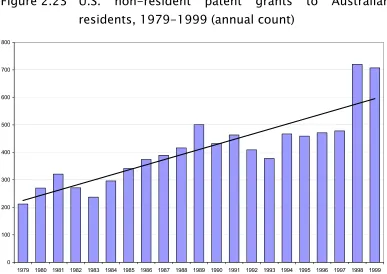
Figure 2.23 U.S. non-resident patent grants to Australian residents, 1979-1999 ...37
Figure 2.24 Sector of Australian papers cited in U.S. patents, 1988-97...38
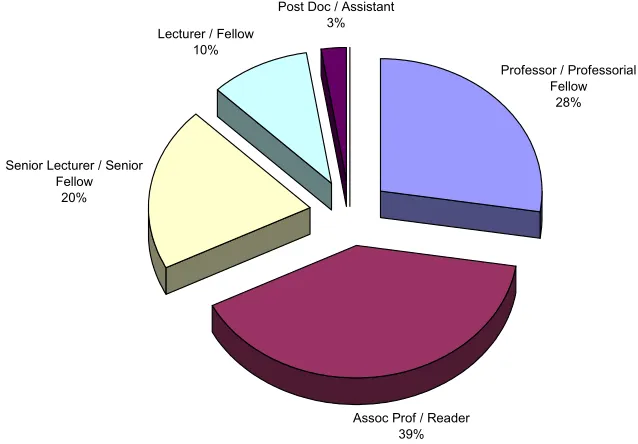
Figure 4.1 Characteristics of the interview sample: position of respondents ...68
Figure 4.2 Characteristics of the interview sample: institutional setting ...69
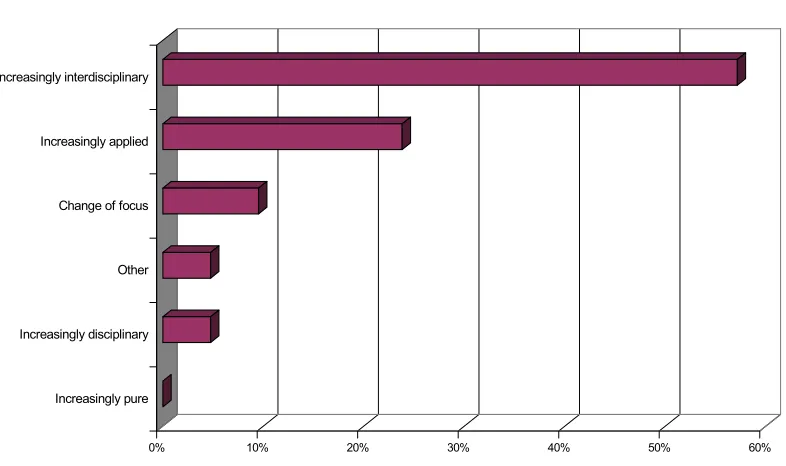
Figure 4.4 Changes in the nature of research over the last 5 years? ...71
Figure 4.5 Changes in sources of funding over last 5 years? ...72
Figure 4.6 Do you work primarily alone, or as part of a research or project team?.77 Figure 4.7 How has your team working changed over the last 5 years? ...77
Figure 4.8 How often do you communicate with team members?...79
Figure 4.9 How do team members keep in touch? ...80
Figure 4.10 How important is this broader network to your work?...81
Figure 4.11 How do members of this broader network keep in touch? ...82
Figure 4.12 How would you rate print and physical sources in your work?...85
Figure 4.13 Print and physical sources: sciences and medical ...86
Figure 4.14 Print and physical sources: social sciences, humanities and arts ...86
Figure 4.15 How would you rate electronic and online sources in your work? ...87
Figure 4.16 Electronic and online sources: science and medical...89
Figure 4.17 Electronic and online sources: social sciences, humanities and arts...89
Figure 4.18 What factors influence your choice of information sources? ...93
Figure 4.19 What factors influence choice: science and medical ...94
Figure 4.20 What factors influence choice: social sciences, humanities and arts...94
Figure 4.21 Do you have any personal subscriptions? ...96
Figure 4.22 How important is your personal library or collection? ...97
Figure 4.23 Change in use of primary sources? ...99
Figure 4.24 How many do you publish per year (Average Number)?... 103
Figure 4.25 Are your publications typically sole or joint authored?... 104
Figure 4.26 Preferred medium for publication?... 105
Figure 4.27 Preferred medium for publication: by field of research... 106
Figure 4.28 What are the main reasons for your publishing? ... 108
Figure 4.29 What are the main barriers you face when publishing? ... 110
Figure 4.30 When choosing between publishing outlets what factors?... 111
Figure 4.31 Do you circulate drafts or completed works informally? ... 113
Figure 4.32 Circulation practices: by field of research... 114
Figure 4.33 How do you circulate drafts?... 115
Figure 5.1 Australian Research Libraries, 1986-2001 ... 129
Tables
Acknowledgements
Executive summary
In the context of the emerging knowledge-based economy, innovation and the capacity of the national innovation system to create and disseminate scientific and scholarly information are increasingly fundamental determinants of national prosperity. In their foundational work on National Innovation Systems, the OECD observed that prosperity in a knowledge economy depends as much, if not more, on the knowledge distribution power of the system than it does on its knowledge production power (OECD 1997, p43). This makes the infrastructure supporting research communication and collaboration, information search and access, and dissemination and publication a key element of the national innovation system. It is essential, therefore, to provide cost-effective access to, and dissemination of scientific and scholarly information in support of research and its economic, social and environmental applications.
This study examines evolving research practices, focusing on how practices are changing and what the implications of those changes are for scholarly communication and the future development of the research infrastructure. It outlines a coherent agenda for the evolutionary development of a sustainable research information and scholarly communication infrastructure.
Approach
Wide-ranging statistical and literature reviews provide a framework for analysis. Interviews were conducted with a structured sample of senior researchers in a range of research fields and institutional settings. Findings were confirmed and extended in a series of workshops. Both interviews and workshops targeted the leading edge of research in order to shed light on the direction of development and future needs. They focused on why researchers do what they do, rather than simply on what they do, because it is only by understanding the evolving needs of leading researchers that we can effectively resource research activities in the future.
Analysis focuses on three key areas of research activity: communication and collaboration, information search and access, and dissemination and publication. The key questions posed are:
• How do researchers conduct their research, and how is that changing?
• What are their major information sources, and how are those sources changing?
• How do researchers access, use and manage information, and how is that changing?
• How do researchers communicate with colleagues and publish their findings, and how are scholarly communication activities changing?
• How do researchers use technology, especially Information and
Communication Technologies (ICTs), and how is it changing their activities?
• What are the implications of evolving research practices for those tasked with resourcing research and providing the necessary research information resources and communication infrastructures?
Key findings
We find that there is a new mode of knowledge production emerging, changing research practices and bringing new information access and dissemination needs. Adjustments will be required to the existing research information and scholarly communication system to accommodate these changes, but new opportunities are emerging for more cost-effective and sustainable information access and dissemination. To fully realise these opportunities, however, it will be necessary to take a more holistic approach to the development of the research information infrastructure and scholarly communication system.
A new mode of knowledge production is emerging
A new mode of knowledge production has emerged over recent years, characterised by Gibbons et al. (1994) as Mode 2. With the emergence of Mode 2 research there is: increasing diversity in the location of research activities; an increasing focus on interdisciplinary, multidisciplinary and transdisciplinary research; an increasing focus on problems, rather than techniques; greater emphasis on collaborative work and communication; and greater emphasis on more diverse and informal modes of communication.
The existing research information infrastructure has evolved over many years, during which traditional disciplinary Mode 1 research has been the dominant mode of knowledge production. Consequently, the existing infrastructure is better suited to the traditional than the new mode of knowledge production. The key to developing research infrastructure for the future is to think through the implications of the changes in research practices implied by the emergence of Mode 2 research and the development of e-science.
There are new information access and dissemination needs
As the U.S. National Research Council noted:
The rapidly expanding availability of primary sources of data in digital form may be shifting the balance of research away from working with secondary sources such as scholarly publications. Researchers today struggle to extract meaning from these masses of data, because our techniques of searching, analyzing, interpreting, and certifying information remain primitive. New automated systems, and perhaps new intermediary institutions for searching and authenticating information, will develop to provide these services, much as libraries and scholarly publications served these roles in the past. (National Research Council 2001, p5).
New digital object access management systems will be required, and there will be increasing demand for collaborative research support applications and research support systems that enable researchers to bring together the increasingly disparate digital objects used in research in such a way as to facilitate enhanced integrated analysis.
The system for the creation, production and distribution of scientific and scholarly knowledge must be viewed holistically
Many factors have influenced the development of the present research infrastructure and scholarly communication system. Its elements have evolved and are often considered separately. As a result, developments have been somewhat piecemeal and there are sometimes conflicting forces at work.
It will be essential to take an holistic approach to ‘re-engineering’ the system, which treats the creation, production and distribution of scientific and scholarly information, the management of information rights and access, systems of evaluation and the underlying infrastructure as parts of a single research information infrastructure and scholarly communication system.
Research practices are directly shaped by systems of evaluation, changing funding patterns and priorities. Existing evaluation and reward structures tend to lead to conflicting incentives in relation to scientific and scholarly communication. Establishing a coherent structure of incentives that operates system-wide is an essential step towards providing more cost-effective access and dissemination in support of both research and its economic, social and environmental applications.
Emerging dissemination and publication pathways offer new opportunities
Scientific and scholarly publishing is now evolving along two distinct paths – one in which large multinational commercial publishers are increasing their dominance in such areas as ‘branded’ journal titles and access to scientific publication, and the other in which there are a variety of open access initiatives.
The challenge
The process of knowledge production is cumulative, with knowledge applied to knowledge, such that knowledge is both an output and an input. How researchers source that knowledge input, how they communicate with each other and how they communicate and disseminate findings are crucial, not only for the progress of knowledge but also for the capacity of the national innovation system to underpin prosperity in the global knowledge economy. As the traditional systems of knowledge production and dissemination are disrupted and alternative modes of knowledge production emerge the future development of research infrastructure and the provision of information resources becomes more challenging – perhaps even more challenging than many have yet realised.
There are many challenges to be met. There is a need to:
• Establish a mechanism for the identification of research information infrastructure priorities that is representative of all stakeholders and able to gain support for identified initiatives;
• Stimulate informed debate about research infrastructure and scholarly communication issues, collaborating internationally where appropriate;
• Stimulate innovation through reforms to incentive systems – including, inter alia, research evaluation, intellectual property rights, grant allocation and peer review mechanisms;
• Encourage institutional leadership to facilitate access to, and management of digital repositories; and
• Support ongoing research into evolving research practices, research infrastructure and scholarly communication needs.
The way ahead
To meet these challenges and develop a sustainable research information infrastructure and scholarly communication system it will be necessary to take an holistic approach and pursue a coherent agenda. That agenda should focus on:
• Creating a coherent structure of incentives based on an holistic approach to the system for the creation, production and distribution of research information;
• Providing the infrastructure and tools to support collaborative research activities in both traditional and new modes of knowledge production;
• Enabling access to necessary information access mechanisms and resources, and equipping users with appropriate information skills to enable their use; and
Mechanisms and processes
There is a need to put in place mechanisms and processes that engage all stakeholders and enable consensual outcomes based on an holistic approach to research information infrastructure development. We call on stakeholders to:
• Support the development of an holistic approach to research infrastructure and scholarly communication issues;
• Establish a mechanism for the identification of systemic priorities, which represents all stakeholders and is able to gain support for identified initiatives;
• Pursue initiatives that seek to reduce the bureaucratisation of research activities – such as, for example, the development and implementation of best practice standards, standard contracts and the development of common compliance and reporting systems across funding sources; and
• Support an advocacy program to inform and engage, which focuses on:
o researchers’ awareness of, and access to collaborative support systems and the development of collaborative project management skills;
o raising awareness and equipping researchers with the skills necessary to maximise the benefits of emerging information access and dissemination possibilities; and
o encouraging researchers to license publishers rather than giving away copyright.
The incentive structure
There is a need to stimulate innovation through reforms to incentive systems – including, inter alia, research evaluation, intellectual property rights, grant allocation and peer review mechanisms.
Research evaluation
In respect to research evaluation there is a need to:
• Adjust performance measurement and research evaluation systems to take account of both traditional and emerging modes of knowledge production by, for example, giving greater recognition to:
o a wider range of activities and outputs;
o team-based work and collaborative activities;
o scientific, social, economic and environmental outcomes; and
o wider and more diverse communication and dissemination, linking to performance and practice as well as further research; and
from a ‘procurement model’ towards a system that is based on investment in people.
Incentives
In respect to incentives there is a need to:
• Examine whether current intellectual property rights practices provide sufficient incentives for the application and commercialisation of research outcomes – focusing on practices relating to the distribution of both property rights and licensing revenues between research institutions, centres/departments and individuals;
• Encourage the use of non-exclusive, but royalty bearing licensing, so as to minimise potential tensions between publication and commercialisation;
• Expand the focus of intellectual property rights management to include copyright, as well as patents and licensing; and
• Provide greater support to researchers in contract negotiation and through the promulgation of standard contracts and conditions.
Peer review
In respect to peer review of both grant applications and publications there is a need to:
• Explore ways to encourage reforms to peer review, which seek to introduce greater care and transparency while retaining the benefits of the system – such as, for example, open review (where the reviewers are named), published review (where reviews are published with the paper), increased payment for reviews, and increased recognition of review activities in performance assessment and evaluation; and
• Examine the need for further reforms to research council proposal review and assessment processes – such as, for example, expanding international reviewer possibilities through reciprocal arrangements at the national level.
Research infrastructure
It is necessary to provide the infrastructure and tools to support collaborative research activities in both traditional disciplinary and new modes of knowledge production, and to enhance access to necessary information resources. We call on stakeholders to:
• Support the development of high bandwidth research networks and grid applications (eg. through AREN and GrangeNet) with encouragements for researchers to push application development across all disciplines and fields of research;
• Investigate the possibility of developing and implementing research support systems that enable researchers to bring together the increasingly disparate digital objects used in research in such a way as to facilitate enhanced integrated analysis;
• Pay greater attention to non-disciplinary modes of search and access – such as generic front-end searching, and problem oriented rather than disciplinary portals and gateways; and
• Facilitate access to research databases, related software and analytical objects, with identified priorities feeding into action as soon as a research needs assessment has been completed.
Open access
We must encourage the development of a system of scholarly communication and research dissemination built on the principle of open access. To that end there is a need to:
• Establish an integrated open access digital repositories initiative based on Australia’s higher education and research institutions, which recognises and accommodates the needs of both traditional and emerging modes of knowledge production, and is built on clear strategies for digital rights management, metadata management and access management;
• Encourage the population of repositories through initiatives that seek to:
o promote awareness of their purpose and potential;
o encourage retention of copyright and standardised licensing to publishers;
o provide the necessary support to enable use; and
o provide incentives that reward researchers for adopting the systems; and
1.
Introduction
There are a number of inter-related factors driving changes in the ways in which researchers create, access and communicate information. Among the more significant of these are increasing demands for the commercialisation of research outcomes and for measurable research performance, and the impact of information and communication technologies (ICTs). It is only by understanding both the evolving needs of researchers and the emerging mechanisms for meeting them that we can effectively resource their activities at the individual, institutional and national levels.
This project examines evolving research practices, focusing on how practices are changing and what the implications of those changes are for scholarly communication and the future development of the research information infrastructure. It was supported by the Australian Commonwealth Department of Education, Science and Training’s Research Evaluation Programme, and is intended to provide an input into the Government’s thinking on the future development of Australia’s research infrastructure.
1.1
Overview of the study
A review of the international literature and Australian research activities provides a framework for analysis. It explores various conceptualisations of emerging modes of knowledge production, long-term trends in R&D in Australia and a range of international studies of research practices in the digital information and communication environment. The major part of the study is a survey of evolving research practices. Data were collected at two levels, in-depth interviews and workshops. Interviews were conducted with a small structured sample of senior researchers in a range of research fields and organizational settings. Findings were validated and extended using workshops, in order to ensure that they did indeed reflected typical practices and how researchers themselves see evolving research infrastructure and resourcing issues.
The key questions posed in this study are:
• How do researchers conduct their research, and how is that changing?
• What are their major information sources, and how are those sources changing?
• How do researchers access, use and manage information, and how is that changing?
• How do researchers communicate with colleagues and publish their findings, and how are scholarly communication activities changing?
• How do researchers use technology, especially Information and
Communication Technologies (ICTs), and how is it changing their activities?
• What are the implications of evolving research practices for those tasked with resourcing research and providing the necessary information and communication infrastructures?
1.2
Outline of the report
Drawing on an international literature review and an analysis of R&D activities in Australia, Chapter 2 examines evolving modes of knowledge production and the changing nature of research. It begins with a brief review of the most widely used conceptual models of the evolution of knowledge production that have informed debate on science and technology policy in recent years. Using this review as a basis for analysis, it then examines long-term trends in research in Australia – looking at changes in the patterns of funding, R&D activity, collaboration, publishing and patenting.
Drawing on an international literature review, Chapter 3 explores the impacts of information and communication technology (ICT) and the digital information and communication environment on researchers and research practices. Beginning with a brief review of the ‘big picture’ impacts of ICTs on research activities, it then focuses on the three key areas of communication and collaboration, information search and access, and dissemination and publication. This sets the scene for our analysis of research activities in Australia.
2.
The production of knowledge
This chapter draws on an international literature review and Australian examples to examine evolving modes of knowledge production and the changing nature of research. It begins with a brief review of the most widely used conceptual models informing debate on science and technology policy in recent years. Using this review as a basis for analysis, it examines long-term trends in research in Australia – looking at changing patterns of funding, R&D activity, collaboration, publication and patenting. It seeks to reveal the extent to which the changes described in conceptual analyses of knowledge production are reflected in research practices in Australia.
2.1
Models of knowledge production
There are various models which seek to explore the nature and context of knowledge production. Perhaps most prominent among recent models are:
• The Systems of Innovation approach, which encompasses a wide range of work focusing on the system(s) within which knowledge is produced, communicated and applied;
• The New Production of Knowledge, which is based on comparing and contrasting ‘ideal type’ conceptualisations of traditional disciplinary research (Mode 1) with an emerging transdisciplinary, problem oriented mode of knowledge production (Mode 2);
• The Triple Helix, which seeks to describe the emerging inter-relationship between universities, industry and the state; and
• Post-academic science, which seeks to describe the emerging era of science and contrast it with traditional ‘academic science’.
A useful starting point is to briefly explore each of these models, focusing on what they tell us about how the practice of research is evolving and how changes impact on the ways in which researchers source, communicate and disseminate information and produce knowledge.
2.1.1
Systems of Innovation
and institutional structures within which research takes place. The SI approach defines organizations and institutions as the main components of the system, and explores both market and non-market relations between them. Its focus is on the functions of the system (ie. to create, diffuse and use innovations).
Various authors have put forward lists of the major functions of an innovation system. That of Liu and White (2001) is indicative of the kinds of functions mentioned. They include:
• Research (basic, development, engineering);
• Implementation (manufacturing);
• End-use (bringing together complementary knowledge); and
• Education.
Such lists invariably include research and education, and commonly also include skills supply and competencies. They make clear the importance of research in the higher education sector, where research training forms such an important part of research practices.
In the SI approach “there is no one-to-one relationship between functions and organizations. For example, research or the creation of new knowledge can be carried out by research institutes, universities or research oriented firms.” (Edquist 2001, p12). Comparative studies have shown significant variation in mixes of organizations and functions and of organizations and institutions within different systems of innovation – most notably between different national systems, but also between different regional and sectoral systems.
The SI approach has a particular perspective on the nature of knowledge production. Edquist (2001) noted that in the SI approach innovations are normally seen as based on learning that is ‘interactive’ – innovations do not happen in isolation. Hence knowledge is often of two sorts:
• ‘scientific’ knowledge generated through ‘pure’ research, which is often seen as an input to the innovation process; and
• knowledge generated through ‘learning’, which is often seen as an outcome of interaction in a problem oriented context.
The SI approach sees the sources of knowledge or learning as: R&D, learning-by-doing, learning-by-using, and learning-by-interacting. Hence, knowledge is not simply an input derived from basic research. It is also generated throughout the innovation process, and throughout the innovation system, as learning. The ways in which different forms of knowledge are produced, communicated and diffused vary significantly.
2.1.2
New Knowledge Production
‘science’.1 It is referred to as Mode 2, and contrasted with the traditional Mode 1
knowledge production. As Gibbons (2001) put it:
Mode 1 refers to a form of knowledge production – a complex of ideas, methods, values, norms – that has grown up to control the diffusion of the Newtonian model to more and more fields of enquiry and ensure its compliance with what is considered sound scientific practice. Mode 1 is meant to summarise in a single phrase the cognitive and social norms which must be followed in the production, legitimation and diffusion of knowledge of this kind. For many, Mode 1 is identical with what is meant by science. Its cognitive and social norms determine what shall count as significant problems, who shall be allowed to practice science and what constitutes good science. Forms of practice which adhere to these rules are by definition ‘scientific’ while those that violate them are not.
…in Mode 1 problems are set and solved in a context governed by the, largely academic, interests of a specific community. By contrast, Mode 2 knowledge [production] is carried out in a context of application. Mode 1 is disciplinary while Mode 2 is transdisciplinary. Mode 1 is characterised by homogeneity, Mode 2 by heterogeneity. Organisationally, Mode 1 is hierarchical and tends to preserve its form, while Mode 2 is more heterarchical and transient. Each employs a different type of quality control. In comparison with Mode 1, Mode 2 is more socially accountable and reflexive. It includes a wider, more temporary and heterogeneous set of practitioners, collaborating on a problem defined in a specific and localized context (Gibbons 2001).
Among the many characteristics of this New Mode of Knowledge Production (Mode 2) are:
• Increasing diversity in the location of research activities – with a greater range of organizations involved in research (eg. universities, research institutes, hospitals, firms, industry associations, etc.);
• Increasing focus on interdisciplinary and, more particularly,
transdisciplinary research – with teams of researchers coming together to work on common problems that cannot be tackled adequately within a single disciplinary framework (eg. environmental or health problems);
• Increasing focus on problems, rather than techniques – with solutions being sought from a range of disciplinary ‘toolboxes’ and valued for their contribution to the solution, rather than to the toolbox;
• Increasing blurring of organizational borders and greater emphasis on collaborative work and communication – with a more flexible team approach in which teams form around problems, and then break up and move on to form different teams around different problems; and
• Changes in the modes of communication – including some increase in commercial guarding of intellectual property, less emphasis on publication in refereed journals and more on informal communication through networks of researchers.
1 It should be noted that the reference here is not to ‘science’ as conventionally understood – rather, it
Again there are differences between modes in terms of the way in which knowledge is created, communicated and diffused.
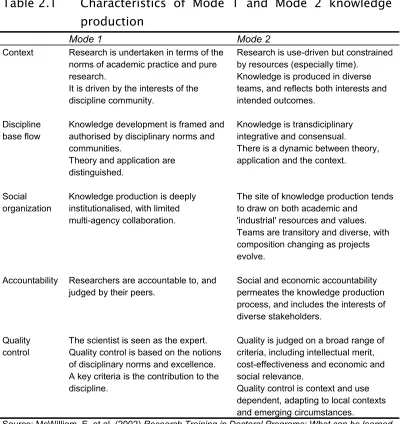
Table 2.1 Characteristics of Mode 1 and Mode 2 knowledge production
Mode 1 Mode 2
Context Research is undertaken in terms of the norms of academic practice and pure research.
It is driven by the interests of the discipline community.
Research is use-driven but constrained by resources (especially time). Knowledge is produced in diverse teams, and reflects both interests and intended outcomes.
Discipline base flow
Knowledge development is framed and authorised by disciplinary norms and communities.
Theory and application are distinguished.
Knowledge is transdiciplinary integrative and consensual. There is a dynamic between theory, application and the context.
Social organization
Knowledge production is deeply institutionalised, with limited multi-agency collaboration.
The site of knowledge production tends to draw on both academic and
'industrial' resources and values. Teams are transitory and diverse, with composition changing as projects evolve.
Accountability Researchers are accountable to, and judged by their peers.
Social and economic accountability permeates the knowledge production process, and includes the interests of diverse stakeholders.
Quality control
The scientist is seen as the expert. Quality control is based on the notions of disciplinary norms and excellence. A key criteria is the contribution to the discipline.
Quality is judged on a broad range of criteria, including intellectual merit, cost-effectiveness and economic and social relevance.
Quality control is context and use dependent, adapting to local contexts and emerging circumstances.
Source: McWilliam, E. et al. (2002) Research Training in Doctoral Programs: What can be learned
from professional doctorates? DEST, Canberra, p41.
2.1.3
Triple Helix
Etzkowitz (2002) suggested that in the United States:
It has been noted that the triple helix model has identified four processes related to major changes in the production, exchange and use of knowledge (Min-Wei Lin 2001):
• There is an internal transformation in each of the helices (eg. companies are developing ties through strategic alliances, while universities are becoming more ‘entrepreneurial’);
• The institutional spheres increasingly bring about transformation in another sphere (eg. government revising rules of intellectual properties rights);
• A new overlay of trilateral linkages, networks, and organizations among the three helices has been created to institutionalise the interfaces and stimulate organizational creativity and regional cohesiveness (eg. Cooperative Research Centres encouraging interaction among members in the three spheres); and
• The inter-institutional networks have a recursive effect on the originating spheres as well as the larger society (eg. universities are being transformed from a closed universe of scholars talking to scholars, to increasingly permeable organizations operating interactively with industrial and social communities) (Steven 2002).
Again there are new communication and information patterns implied by this permeability, and in the support of deepening linkages between spheres.
2.1.4
Post-academic science
In Real Science, Ziman (2000) characterised modern science as ‘post-academic’, suggesting that:
Post-academic research is marked by an increasing degree of collectivization as a response to the growing complexity of research problems, [and] the increasing costs of scientific equipment, but also the growing potential for research collaboration that is offered by information technology. Another important explanation of the collectivization process is that research areas today normally consist of amalgamations of areas and specialties, while older disciplinary demarcations are becoming obsolete. Scientific problems are defined by large groups and constellations of researchers and other actors within and beyond the academic system rather than by single researchers. Thus, research is no longer a self-governing isolate. Contemporary research in medicine, technology and the sciences (but also in other areas) is centered around the research group. The groups consist of a mixture of students, assistants, graduate students and professors, where colleagues, funding agencies, companies, and scientific networks influence the organization and direction of research (Nilsson 2001).
modes of knowledge production. Some established disciplines are declining, while new research areas are emerging.
2.1.5
Knowledge production and research practice
There are many facets to these recent models of knowledge production and how the practice of research is changing, other models that deserve mention, and numerous critiques of all of them. Nevertheless, they have important and obvious elements in common that point to some key dimensions of change in the ways in which research is conducted and knowledge produced.
There are cultural and institutional changes. Foray (1997, pp73-74) noted that there is a shift from the traditional Baconian system of ‘open science’ to more restricted access regimes, as the commercialisation of research findings and blurring of organisational boundaries occurs. This tension is played out most noticeably in universities, where there is a clash between traditional, disciplinary, ‘pure’ research oriented to undirected inquiry and free publication in refereed journals; and increasing interactions between universities, industry and government, increasing access restrictions (eg. patenting), publication restrictions and commercial influence in the choice of topic and direction of research. There is, in essence, a clash between Mode 1 and Mode 2 research.
There is increasing awareness that the organisational forms chosen for the funding and conduct of research effect how knowledge is produced and how researchers interact internally and with their environment (Vaughan 1999; Wilts 2000). Nilsson (2001) suggested that to understand the future development of research, we need to look into the organizational setting of research. Collaboration between disciplines and organizational settings plays an increasingly important role in the structuring of research work, and is a central part in the reconfiguration of knowledge production toward more permeable forms. This is not merely a policy trend, but also an increasingly important aspect of how knowledge is produced.
In The Enterprise University, Marginson and Considine (2000) discussed changes in the structure and governance of Australian universities in the latter part of the 1990s, and the impact these changes have had on the management structures, institutional systems and frameworks within which research is managed. They noted a trend towards the commercialisation of research and the increasingly competitive nature of funding, and identified the results of these as being: a tendency to reduce risk, the manipulation of publication in order to maximise funding impact, an emphasis on quantity rather than quality; and a focus on the short-term.
The mix of traditional and new modes of knowledge production varies between both fields of research and between loci of research. Gibbons (2001) noted that:
Research carried out in the context of application might be said to characterise a number of disciplines in the applied sciences and engineering – eg. chemical engineering, aeronautical engineering or… computer science. Historically these sciences became established in universities but, strictly speaking, they cannot be called applied sciences, because it was precisely the lack of the relevant science that called them into being. They were genuinely new forms of knowledge though not necessarily of knowledge production because, they too, soon became the sites of disciplinary-based knowledge production in the style of Mode 1. These applied disciplines share with Mode 2 some aspects of the attribute of knowledge produced in the context of application. But, in Mode 2 the context is more complex. It is shaped by a more diverse set of intellectual and social demands than was the case in many applied sciences… While it may give rise to genuine basic research… it is increasingly in computer, materials, bio-medical and environmental sciences that theories are developed in the context of application and… these continue to fertilise lines of intellectual advance that lie outside disciplinary frameworks (Gibbons 2001). Others have noted the relative mixes of Mode 1 and Mode 2 research in various fields, and how some have pursued ‘scientisation’ (eg. economics) while others have pursued mixed modes (eg. management) (Van Aken 2001).
The OECD recently noted that industry-science relationships are undergoing fundamental changes, prompted by globalisation and other factors, as part of an overall trend towards accelerated development of a market for knowledge. The most visible transformations are the emergence of broad alliances between universities and firms, and growing activity in the realm of commercialisation of results through licensing of intellectual property and spin-off companies (OECD 2002, p7). This echoes and reinforces the points made by Etzkowitz and Leydesforff (1997) in relation to the emergence of a triple helix, suggesting that it is an OECD-wide, if not worldwide phenomenon.
Different loci of research also vary as to their share of modes. Universities are often portrayed as the last bastion of disciplinary research, and some have foreseen the marginalisation and decline of universities as loci of research. Godin and Gingras (2000) suggested instead that universities will in fact remain the centre of the knowledge production system, and that other sectors, such as hospitals, private industry and government laboratories will remain closely linked. The pre-eminence of the university system is reiterated in the work of Guena (1999) who is one of the many writers to examine the move to commercialisation and its impact on research. He provided a detailed analysis of funding models for knowledge production in universities in the European Union, including the United Kingdom, and concluded that increasing competition for research funding has led to the polarisation of universities into two groups: a small group of research-focused universities and a larger group with a lesser focus. The roles of different sorts of universities in pursuit of predominantly Mode 1 versus Mode 2 research has also been noted in Australia (Ronayne 1997). There are also wide differences between the mixes and modes of research in government research institutes in various countries (Meyer-Krahmer 1997).
and quality control, and for education, training and accreditation. Mode 2, on the other hand, tends to rely more on informal modes of communication and dissemination. Hicks et al. (1997) noted that the pattern of publications in the natural sciences shows a move by researchers towards publishing in interdisciplinary or transdisciplinary journals. Gibbons (2001) noted that, because of the interdisciplinary, interactive and dispersed nature of Mode 2 research, Mode 2 is critically dependent on emerging computer and communication technologies. Gibbons also noted that communication among scientists is influenced by two factors: one is their mobility, while the second relates to how they set priorities and select problems. He suggested that interdisciplinarity has been facilitated through the availability of improved means of communication (Meyer-Krahmer 1997, p309). Turpin et al. (1996) noted that, in Australia, there is strong evidence to suggest that [knowledge] transfers between academic research and industry are led by the movement of people and the establishment of broad-ranging personal networks. Again emphasising the importance of informal mechanisms of communication and dissemination.
It is important to note that most analysts see Mode 1 and Mode 2 research operating in parallel, with the new mode of knowledge production supplementing rather than replacing traditional ‘science’. Indeed, as ideal types, Modes 1 and 2 present in mixes. Foray (1997, p81), a proponent of the Systems of Innovation approach, noted a “splitting behaviour and the survival of knowledge openness through a complentarity relationship.” Similarly, Gibbons (2001) suggested that:
Although Mode 1 and Mode 2 are distinct modes of production, they interact with one another. Specialists trained in the disciplinary sciences do enter Mode 2 knowledge production. While some may return to their original disciplinary base others will choose to follow a trail of complex solving [of] problems that are set by a sequence of application contexts. Conversely, some outputs of transdisciplinary knowledge production, particularly new instruments may enter into and fertilise any number of disciplinary science (Gibbons 2001).
Mode 2 knowledge will not supplant the traditional disciplinary structure of Mode 1 knowledge, but supplement it and interact with it (Ang 1999). As McWilliams et al. (2002) noted, they are complementary and contemporary rather than competing and exclusive modes of knowledge production. There are, then, many inter-dependencies, which suggest that both Mode 1 and Mode 2 research will continue to exist in parallel, and enough fundamental difference to suggest that the absorption of either one by the other will be difficult.
When the traditional system of research scholarly communication is disrupted and alternative parallel systems emerge, and there is a need for communication between the parallel modes and for cross-fertilization, the development of research information infrastructure and provision of information resources becomes much more challenging – perhaps even more challenging than many have yet realised.
2.2
Changing nature of research
The remainder of this chapter presents a brief review of quantitative indicators of change in research activities in Australia. It reveals that many of the changes noted in the literature on the changing nature of knowledge production can be observed in the long-term trends in research in Australia. Readers willing to take our word on that may wish to skip to chapter 3.
2.2.1
Level of expenditure and source of funds
As in other countries, there is increasing recognition of the value of R&D activities and their contribution to economic and social development. This is driven, in part, by increased awareness of the emerging global knowledge-based economy and the realisation that future prosperity is likely to be increasingly tied to the production and application of knowledge. In Australia, annual national expenditure on R&D increased from AUD 364 million in 1968-69 to AUD 10 251 million in 2000-01, or by 11% per annum over the last 32 years.2
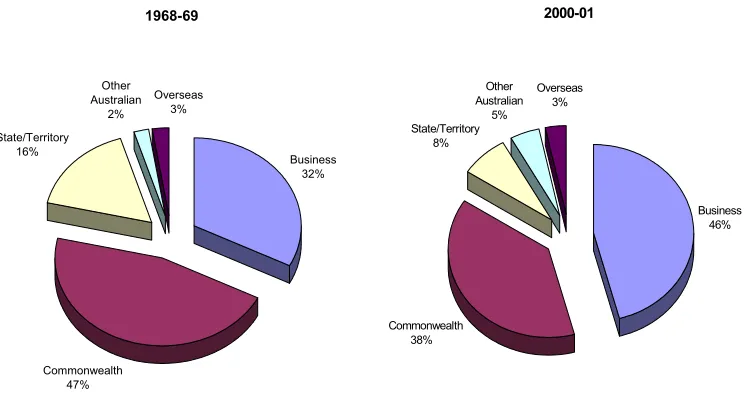
Within that overall increase there have been some significant changes in the sources of funding. The business sector has increased its proportional contribution, while governments have reduced theirs. From AUD 118 million in 1968-69, the business sector’s annual funding of R&D increased to AUD 4 702 million in 2000-01 – by 12% per annum. Commonwealth government funding of R&D increased by 10% per annum, from AUD 169 million in 1968-69 to AUD 3 923 million. Over the same period, state government funding of R&D increased by 8.5% per annum, from AUD 60 million to AUD 804 million. As a result, the business sector increased its share of total R&D funding from 32% to 46%, while government’s share declined from 63% to 46%.
Reflecting the globalisation of research activities, overseas sources increased their funding of R&D in Australia by almost 12% per annum, from AUD 9 million in 1968-69 to AUD 336 million in 2000-01. This, while still relatively small, suggests that Australian research is increasingly linked into international R&D activity. These data on the sources of research funding suggest that there are increasing linkages between business and research, with quite substantial shifts in funding from sector to sector.3
2 All expenditure data are presented in current values.
3 Funding is a less than perfect indicator of linkages between research and business for a variety of
Figure 2.1 R&D expenditure by source of funding, 1968-69 to 2000-01 (AUD m)
Source: ABS: compiled from various sources. Analysis conducted for Houghton, J.W. et al. (2003)
Changing Research Practices in the Digital Information and Communication Environment, DEST,
Canberra.
Figure 2.2 R&D expenditure by source of funding, 1968-69 and 2000-02 (%)
Source: ABS: compiled from various sources. Analysis conducted for Houghton, J.W. et al. (2003)
Changing Research Practices in the Digital Information and Communication Environment, DEST,
Canberra. 1968-69 Business 32% Commonwealth 47% State/Territory 16% Other Australian 2% Overseas 3% 2000-01 Business 46% Commonwealth 38% State/Territory 8% Overseas 3% Other Australian 5% 0 2,000 4,000 6,000 8,000 10,000 12,000
68-6969-7 0 70-7 1 71-7 2 72-7 3 73-7 4 74-7 5 75-7 6 76-7 7 77-7 8 78-7 9 79-8 0 80-8 1
81-8282-8 3 83-8 4 84-8 5 85-8 6 86-8 7 87-8 8 88-8 9
89-9090-9 1 91-9 2 92-9 3 93-9 4 94-9 5 95-9 6 96-9 7
97-9898-9 9
99-0 0
00-0 1
2.2.2
Location of research activity (expenditure)
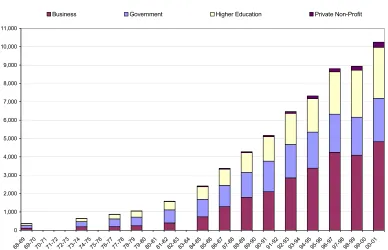
Over the last 32 years, expenditure on R&D by private non-profit organizations has increased most rapidly, but at just 2.8% of total expenditure it remains very small. Annual business sector expenditure on R&D has increased from AUD 119 million in 1968-69 to AUD 4 825 million in 2000-01 (by 12% per annum) and higher education expenditure has increased from AUD 86 million to AUD 2 775 million (by 11% per annum). Government expenditure has grown more slowly. Commonwealth government expenditure on R&D increased from AUD 117 million in 1968-69 to AUD 1 425 million in 2000-01 (by 8% per annum), while state, territory and local government expenditure increased from AUD 40 million to AUD 944 million (by 10% per annum).
Figure 2.3 R&D expenditure by sector of performance, 1968-69 to 2000-01 (AUD m)
Source ABS: compiled from various sources. Analysis conducted for Houghton, J.W. et al. (2003)
Changing Research Practices in the Digital Information and Communication Environment, DEST,
Canberra.
As a result, the business and higher education sectors have increased their share of R&D expenditure in Australia, while government’s share has fallen. The business sector increased its share of total R&D expenditure from 33% in 1968-69 to 47% in 2000-01, the higher education sector increased its share from 24% to 27% and the private non-profit sector increased its share from 0.7% to 2.8%. Over the same period, the share R&D expenditure within Commonwealth Government declined from 32% of total to just 14%, while state governments’ share fell from 11% to 9%. Thus the increase in the influence of the business sector both as a source of funding and as a location for the performance of research is clearly evident.
0 1,000 2,000 3,000 4,000 5,000 6,000 7,000 8,000 9,000 10,000 11,000 68-6 9 69-7 0 70-7 1 71-7 2 72-7 3
73-7474-7 5 75-7 6 76-7 7 77-7 8 78-7 9 79-8 0 80-8 1 81-8 2 82-8 3 83-8 4 84-8 5 85-8 6 86-8 7 87-8 8 88-8 9 89-9 0 90-9 1 91-9 2
92-9393-9 4 94-9 5 95-9 6 96-9 7 97-9 8 98-9 9 99-0 0 00-01
Figure 2.4 R&D expenditure by sector of performance, 1968-69 and 2000-01 (%)
Source: ABS: compiled from various sources. Analysis conducted for Houghton, J.W. et al. (2003)
Changing Research Practices in the Digital Information and Communication Environment, DEST,
Canberra.
It is notable that the higher education sector plays a more significant role in R&D activity in Australia than is often the case elsewhere. For example, ‘academic’ R&D is reported to have accounted for around 12% of R&D expenditure in the United States during 1999, 18% in France, 17% in Germany, 15% in Japan and 20% in the United Kingdom – compared with 29% in Australia (National Science Board 2002, p5-10).
2.2.3
Source of funding by sector of expenditure
Looking at the source of funding by sector of expenditure reveals something of the extent and pattern of linkages and interactions between the various organizations and sectors involved in funding and performing research. It reveals a number of interesting points.
Looking at column shares of R&D funding during 2000-01 (Table 2.2 below):
• 94% of business sector R&D funding goes to the business sector, and 3% goes to higher education – suggesting still somewhat limited private sector support for higher education research;
• 81% of state government R&D funding goes to state institutions and 11% to higher education – suggesting limited engagement between state governments and the business sector (although it should be noted that these data do not fully reflect significant expenditures by state governments on economically and socially oriented consultancies);
1968-69
Business 33%
Government 42% Higher Education
24%
Private Non-Profit 1%
2000-01
Business 47%
Government 23% Higher Education
27%
• 62% of overseas funding goes to the business sector, 18% to higher education and 10% to Commonwealth Government organizations – probably reflecting the mix of organizations from which it is sourced, more than their cross-funding support for each other; and
• 61% of Commonwealth Government funding goes to higher education, 31% to Commonwealth organizations and just 4.4% to the business sector (although it should be noted that this understates government support for industry R&D through the R&D tax concession and a variety of sectoral research levies).
Table 2.2 R&D expenditure by source of funds and sector of expenditure, 2000-01 (%)
Source of funds
Sector of expenditure Comm’ State Business Other Overseas Total
Business 4.4 1.0 93.9 4.7 61.7 47.1
Commonwealth 30.9 3.4 1.6 15.0 10.2 13.9
State/Territory 1.8 80.9 1.2 32.9 2.3 9.2
Higher Education 61.1 10.9 2.9 19.4 18.0 27.1
Private - Non-Profit 1.8 3.7 0.4 28.0 7.8 2.8
Total 100.0 100.0 100.0 100.0 100.0 100.0
Business 3.5 0.2 91.5 0.5 4.3 100.0
Commonwealth 85.1 1.9 5.4 5.1 2.4 100.0
State/Territory 7.6 68.9 5.8 16.9 0.8 100.0
Higher Education 86.3 3.2 4.9 3.4 2.2 100.0
Private - Non-Profit 25.6 10.5 6.5 48.1 9.3 100.0
Total 38.3 7.8 45.9 4.7 3.3 100.0
Source: ABS: compiled from various sources. Analysis conducted for Houghton, J.W. et al. (2003)
Changing Research Practices in the Digital Information and Communication Environment, DEST,
Canberra.
Looking at row shares of R&D funding during 2000-01:
• 92% of business spending on R&D is funded by the business sector, 4.3% is funded from overseas (reflecting the activities of multinational corporations in Australia) and 3.5% is funded by the Commonwealth Government (again, this number is somewhat understated);
• 86% of higher education R&D spending is funded by the Commonwealth Government and 5% is funded by business – suggesting increasing, but still somewhat limited private sector support for university research;
• 85% of Commonwealth spending is funded by the Commonwealth
Government; and
• almost 70% of state and territory government R&D spending is funded by state and territory governments.
However, as noted later, the level of scientific collaboration, and of patent citation of public science would suggest that cross-fertilisation and commercialisation are much more significant than these direct funding linkages reveal.
2.2.4
Type of research activity (basic or applied)
There is increasing emphasis on applied research, which increased from AUD 2.1 billion to AUD 3.7 billion over the period, or by 7.1% per annum. Expenditure on experimental development increased by 5.8% per annum, from AUD 2.5 billion to AUD 3.5 billion, while expenditure on basic research has grown more slowly – strategic basic research by 5.3% per annum and pure basic research by 3.9% per annum.4
Figure 2.5 R&D expenditure by type of activity, 1992-93 to 2000-01 (AUD m)
Source: ABS: compiled from various sources. Analysis conducted for Houghton, J.W. et al. (2003)
Changing Research Practices in the Digital Information and Communication Environment, DEST,
Canberra.
In 1992-93, experimental development accounted for 38% of R&D expenditure in Australia, applied research for 33%, strategic basic research for 16% and pure basic research for 12%. By 2000-01, applied research had increased its share of total R&D expenditure to 36%, while experimental development accounted for a steady
4 While it is widely recognised that the traditional distinction between pure and applied research is
breaking down, as ‘pure’ research increasingly leads quite directly to commercial outcomes and applied research increasingly feeds back into discovery, it remains a useful framework within which to explore long-term trends of funding and focus.
786 955 1,067
1,049 1,308
1,586 2,148
3,077
3,707 2,487
3,465
3,891
0 2,000 4,000 6,000 8,000 10,000 12,000
1992-93 1996-97 2000-01
38%. Both pure basic research, down to 10%, and strategic basic, down to 15.5%, lost share. So there has been a shift in emphasis away from pure research towards applied and developmental activities, which likely reflects the increased influence of the business sector and, perhaps, a shift in the mix of research activity from traditional disciplinary science to more applied, interdisciplinary activities (eg. environmental sciences, biotechnology, etc.).
In 2000-01, 79% of pure basic research was conducted within higher education. Conversely, no less than 86% of expenditure on experimental development took place in the business sector. The majority of commonwealth and state government activity is in the strategic basic to applied areas – with commonwealth activity favouring strategic basic research and state activity favouring applied research. These patterns are as one would expect. However, looking more closely at growth rates in various types of R&D expenditure reveals some interesting developments.
Figure 2.6 Type of R&D activity by sector of performance, 2000-01 (%)
Source: ABS: compiled from various sources. Analysis conducted for Houghton, J.W. et al. (2003)
Changing Research Practices in the Digital Information and Communication Environment, DEST,
Canberra.
Discounting the private non-profit sector, which is very small and growing rapidly from a low base, the fastest growth in experimental development and applied research expenditures occurred in higher education – at 9.5% and 9.3% per annum over the period 1992-93 to 2000-01, respectively. The higher education sector recorded the slowest growth of all sectors in pure basic research expenditure, at 2.9% per annum. Conversely, strategic basic and pure basic research expenditure in the business sector increased by 8.3% and 7% per annum, respectively; while applied research and experimental development expenditure increased more slowly
4
17
32
86
7
26
20
5
3
7 79
42
28
5
7 8 2
3
17
0% 10% 20% 30% 40% 50% 60% 70% 80% 90% 100%
Pure Basic Strategic Basic Applied Experimental Development
– by 6.8% and 6.6% per annum, respectively. Commonwealth Government organizations, such as the CSIRO, increased their pure basic research expenditure by 9.1% per annum over the period 1992-93 to 2000-01, while experiencing a decline in experimental development expenditure of 3.2% per annum.
Table 2.3 Annual change in R&D expenditure by sector and activity, 1992-93 to 2000-01 (%)
Pure Basic
Strategic Basic
Applied Experimental Development
Total
Business 7.0 8.3 6.8 6.6 6.8
Government 7.3 2.0 5.1 -2.2 3.4
- Commonwealth 9.1 2.3 4.9 -3.2 2.7
- State/Territory 4.3 1.0 5.5 0.0 4.4
Higher Education 2.9 6.5 9.3 9.5 5.6
Private Non-Profit 13.8 10.9 19.0 19.5 13.7
Total 3.9 5.3 7.1 5.8 5.9
Source: ABS: compiled from various sources. Analysis conducted for Houghton, J.W. et al. (2003)
Changing Research Practices in the Digital Information and Communication Environment, DEST,
Canberra.
It is still overwhelmingly the case that higher education R&D activity is focused on pure/basic research, while business sector R&D activity is focused on experimental development. However, these growth trends reflect a restructuring of research activities, and some diversification of the locus of research. Both the business sector and government appear to be increasing their involvement in basic research, while there is an increasing emphasis in higher education institutions on applied research and experimental development. While still small, these shifts could have a significant impact on researcher perceptions and on their research practices (National Science Board 2002, p5-36). These trends reflect the kinds of changes, convergences and cross-overs widely noted in the literature on changing modes of knowledge production, and reveal the dynamics and modalities of change with Australian research.
2.2.5
Objectives of research activity
Looking at R&D activities according to their socio-economic objective gives another perspective on the changing emphases of research activities, particularly in regard to shifts towards problem oriented (Mode 2) research. Over the period 1986-87 to 2000-01, expenditure on R&D by socio-economic objective (SEO) increased by 6% per annum. Society and health (10% per annum) and economic development (6% per annum) were the fastest growing areas, while expenditure on non-oriented research (broadly speaking, pure/basic research) increased by just 1.3% per annum.
but declined in other sectors – eg. by 8% per annum in government, driven by a 9.5% per annum decline in commonwealth government institutes.
Figure 2.7 Trends in R&D expenditure by socio-economic objective, 1986-87 to 2000-01
Source: ABS: compiled from various sources. Analysis conducted for Houghton, J.W. et al. (2003)
Changing Research Practices in the Digital Information and Communication Environment, DEST,
Canberra.
These trends, which see declines in non-oriented research expenditure, reflect a shift towards research activities that are less disciplinary and more problem oriented (eg. environment, society and health) – a shift from Mode 1 towards Mode 2 research.
2.2.6
Human resources devoted to research
The number of people engaged in research has also grown, but not as fast as has expenditure on research. In 1968-69, there were 41 000 people employed in research (ie. person years devoted to R&D). By 2000-01, this had increased to more than 95 250. Hence, research employment has grown 2.7% per annum over the last 32 years, compared with an 11% per annum increase in expenditure. Discounting inflation, these trends are consistent with both increased capital intensity of research and increased labour productivity in research.
In 2000-01, 46 287 or approximately 50% of all Australian research workers were employed in the higher education sector, making it the largest employer of researchers. Some 27 839 or 30% were employed in the business sector, and a further 2 721 or less than 3% were employed by private non-profit organizations.
361 2,940
6,494 543
1,998 666 612
733
352 0%
10% 20% 30% 40% 50% 60% 70% 80% 90% 100%
1986-87 2000-01
The remaining 18 408 (20%) were employed in government organizations – 9 711 (10%) by commonwealth government and 8 697 (9%) by state, territory and local governments.
Figure 2.8 Human resources devoted to R&D by sector,
1968-69 to 2000-01 (number)
Source: ABS: compiled from various sources. Analysis conducted for Houghton, J.W. et al. (2003)
Changing Research Practices in the Digital Information and Communication Environment, DEST,
Canberra.
Higher education, and private non-profit organizations, have experienced higher rates of increase in research employment over the last 32 years than other sectors. Private non-profit institutions increased their research employment from 438 in 1968-69 to 2 721 in 2000-01, or by almost 6% per annum. Higher education, the largest sector, increased research employment from 9 580 to 46 287, or by just over 5% per annum. Research employment in the business sector increased by less than 3% per annum over the period. Government research employment has declined over the last 32 years – from 19 648 in 1968-69 to 18 408 in 2000-01, or by 0.2% per annum. The loss has been in commonwealth government organizations, down from 14 671 to just 9 711 (by 1.3% per annum). State and territory governments’ research employment has increased over the period, by 1.8% per annum.
In percentage terms, higher education has been the sector with the largest gain in research employment over the last 32 years – accounting for 23% of total national research employment in 1968-69, compared with 49% in 2000-01. Conversely, the Commonwealth Government has experienced the biggest declines – accounting for 36% in 1968-69, compared with just 10% in 2000-01. Other sectors, including the business sector and state and territory governments account for much the same share of research employment now as they did 30 years ago.
0 10,000 20,000 30,000 40,000 50,000 60,000 70,000 80,000 90,000 100,000 68-6 9 69-7 0 70-7 1 71-7 2 72-7 3
73-7474-7 5 75-7 6 76-7 7 77-7 8
Figure 2.9 Human resources devoted to R&D by sector, 1968-69 and 2000-01 (%)
Source: ABS: compiled from various sources. Analysis conducted for Houghton, J.W. et al. (2003)
Changing Research Practices in the Digital Information and Communication Environment, DEST,
Canberra.
Scientists and engineers
Not all of those employed in research are scientists and engineers (ie. researchers). R&D surveys also count research management and administration personnel. In 2000-01, 19 485 or 69% of the person years employed on research in Australia were classified as researchers, with the remainder being classified as technical and support staff.
The number of researchers employed in Australia increased from 17 734 in 1968-69 to 65 805 in 2000-01. Higher education is the largest employer of researchers, with 39 507 or 60% of the total in 2000-01. The business sector employed a further 15 830 (24%), and governments a further 8 972 (14%) – 4 524 in Commonwealth Government organizations and 4 448 in state and territory government institutions. The higher education sector experienced the largest growth in research employment – from 7 132 in 1968-69 to 39 507 in 2000-01 and increasing 5.5% per annum. Private non-profit organization also experienced a relatively high rate of growth in research employment, but numbers remain low (less than 1 500 people in 2000-01). The employment of researchers in the business sector increased by 4.2% per annum, from 4 222 in 1968-69 to 15 830. Employment of researchers by government has grown much more slowly (1.2% per annum). In 1968-69, the Commonwealth Government employed 4 215 researchers, rising to 4 524 in 2000-01 – an increase of just 0.2% per annum. Over the same period, state and territory governments increased their employment of researchers from 1 957 to 4 448 – an increase of 2.6% per annum.
1968-69
Business 28% Higher Education
23%
Private Non-Profit 1%
Commonwealth 36% State/Territory
12%
2000-01
Business 29%
Higher Education 49%
Private Non-Profit 3%
State/Territory 9%