University of South Carolina
Scholar Commons
Theses and Dissertations
6-30-2016
Re-contacting Cancer Genetic Counseling
Patients: Expectations of Patients and Physicians
Zoe Elizabeth SiegelUniversity of South Carolina
Follow this and additional works at:https://scholarcommons.sc.edu/etd
Part of theGenetics Commons, and theMedicine and Health Sciences Commons
This Open Access Thesis is brought to you by Scholar Commons. It has been accepted for inclusion in Theses and Dissertations by an authorized administrator of Scholar Commons. For more information, please [email protected].
Recommended Citation
Re-contacting Cancer Genetic Counseling Patients: Expectations of Patients and Physicians
by
Zoe Elizabeth Siegel
Bachelor of Science Wagner College, 2012
Submitted in Partial Fulfillment of the Requirements
For the Degree of Master of Science in
Genetic Counseling
School of Medicine
University of South Carolina
2016
Accepted by:
Whitney Dobek, Director of Thesis
Kara Bui, Reader
Leah McClimans, Reader
Acknowledgements
I would like to thank the following individuals for their assistance and patience
throughout the thesis process: Whitney Dobek, Kara Bui, and Leah McClimans for their
guidance and willingness to act as thesis committee members; and Peggy Walker and the
genetic counselors at Greenville Health System for so graciously agreeing to assist me
with this study. I would also like to thank Janice Edwards, the University of South
Carolina Genetic Counseling Masters Program faculty, and the graduating class of 2016
Abstract
The landscape of cancer genetic counseling and testing is rapidly evolving. Genetic
testing technology is improving, management guidelines are evolving, and genetic testing
options are expanding. These frequent updates to the components of cancer genetics have
increased the complexity of managing patient care over time. In particular, this raises
questions on the duty to re-contact patients as new information becomes available. This
study explored healthcare providers’ duty to re-contact through the interests and
expectations of patients, including which circumstances warrant re-contacting, which
healthcare provideris responsible for re-contacting the patient, and the preferred method
of re-contacting. Physicians’ opinions on whether or not patients should be updated as
well as the person responsible for updating were also explored. To answer the questions
set forth in this study, we surveyed patients undergoing genetic counseling for a
hereditary cancer condition and physicians who work with cancer genetic counselors. The
study was limited by low response rate from patients, so no statistically significant results
could be confirmed. However, both groups indicated re-contacting patients with updates
was desirable and assigned a high level of responsibility to providers for delivering these
updates to patients. The majority of patient participants believed the duty to keep patients
informed fell primarily on the genetic counselor and preferred the geneticcounselor to
initiate contact. In contrast, physician participants indicated genetic counselors, referring
physician, and a shared responsibility between these two providers most frequently as the
Table of Contents
Acknowledgements...iii
Abstract...iv
List of Tables...vii
Chapter 1: Background...1
1.1 Hereditary Cancer Syndromes...1
1.2 Management...5
1.3 Evolution of Genetic Testing Technology...8
1.4 Clinical Genetic Testing Timeline...11
1.5 Duty to Re-contact...14
Chapter 2: Manuscript: Re-contacting Cancer Genetic Counseling Patients: Expectations of Patients and Physicians...20
2.1 Abstract...20
2.2 Introduction...21
2.3 Materials and Methods...25
2.4 Results...29
2.5 Discussion...32
2.6 Conclusions...42
Chapter 3: Conclusions...49
Appendix A- Participant Introductory Letter...56
Appendix B- Patient Questionnaire...58
List of Tables
Table 2.1 Patient Demographics...43
Table 2.2 Patients’ Level of Agreement with Reasons for Re-contacting...44
Table 2.3 Physician Demographics...45
Table 2.4 Physicians’ Opinions on Re-contacting...45
Chapter 1: Background
1.1Hereditary Cancer Syndromes
After age, a positive family history of cancer is the most significant risk factor for
developing the disease (Armstrong, Eisen, & Weber, 2000). It is estimated that up to 10%
of all cancers are hereditary, meaning there is a germline mutation in a cancer
susceptibility gene that confers an elevated cancer risk (van der Groep, van der Wall, &
van Diest, 2011). Oftentimes germline mutations in these genes result in a predictable
phenotype allowing clinicians to assess an individual’s likelihood for developing specific
cancers. Genetic testing can be performed to identify and diagnose individuals with
hereditary cancer syndromes, and personalized management can be implemented to
reduce the lifetime cancer risk and cancer-related mortality (Feliubadaló et al., 2013).
Since genetic testing for hereditary cancer syndromes first became commercially
available, our understanding and knowledge of hereditary cancers has grown. As of 1996,
around a dozen cancer predisposing genes had been identified (Nelson, 1996).To date,
germline mutations in over 49 genes have been associated with an increased cancer risk
(Hall, Forman, Pilarski, Wiesner, & Giri, 2014). Each of these genes predisposes
individuals to particular malignancies when a pathogenic mutation is present. In each
case, the likelihood for developing cancer varies, with some mutations conferring up to
an 80% or higher lifetime risk for developing the disease.
The majority of genetic testing for hereditary cancer syndromes relates to breast
genes. The first major gene associated with the development of breast cancer was
BRCA1,which was linked to a region on chromosome 17 through linkage analysis studies
in 1990 and subsequently sequenced in 1994 (Hall et al., 1990). A second gene, named
BRCA2, was linked to chromosome 13 in 1994 using the same technique, then later
sequenced in 1995 (van der Groep et al., 2011). Mutations in either of the BRCA genes
are responsible for a condition known as BRCA-Related Breast and Ovarian Cancer
syndrome (NCCN, 2016), or formerly as Hereditary Breast and Ovarian Cancer
syndrome (HBOC), which predisposes carriers to breast, ovarian, prostate, and pancreatic
cancers. Inherited mutations in these genes confer up to a 50-85% lifetime risk of breast
cancer in females and an 8% lifetime risk of breast cancer in males. The lifetime risk of
developing ovarian cancer in females can be as high as 40%, while the likelihood of
developing prostate cancer in males is also increased (Shiovitz & Korde, 2015).
Additionally, the probability of developing pancreatic cancer is elevated in both sexes,
especially with mutations in BRCA2.
Along with BRCA1 and BRCA2, pathogenic mutations in four other genes (TP53,
PTEN, STK11, and CDH1) confer a high risk for breast cancer (Shiovitz & Korde, 2015;
Weischer, Bojesen, Tybjoerg-Hansen, Axelsson, & Nordestgaard, 2007). Similar to the
BRCA genes, each of these is part of a distinct clinical syndrome.
Mutations in the TP53 gene are causative for Li-Fraumeni syndrome (LFS). This
condition predisposes individuals to breast cancer, soft-tissue sarcomas, bone cancer,
brain tumors, leukemia, adrenocortical carcinomas, and other forms of cancer (Nelson,
1996). Childhood cancers are also a common feature and occur in around 44% of carriers
females with this syndrome is around 80%, and the chance of developing a soft tissue
sarcoma is around 30% in both sexes (Bougeard et al., 2015). There is also a 40% chance
of multiple primary tumors in individuals with LFS, which has been partly attributed to
the individual’s sensitivity to chemotherapy and radiation used to treat the first tumor
(Bougeard et al., 2015).
PTEN Hamartoma Tumor syndrome (PHTS), also known as Cowden syndrome,
is a condition associated with a higher incidence of breast, follicular thyroid, endometrial,
and renal cancers, with the lifetime risks being as high as 80%, 35%, 28%, and 33%,
respectively. There is an additional risk for colorectal cancers (9%) and melanoma (6%),
and the risk of gastrointestinal hamartomas is increased (Tan et al., 2012; Ngeow,
Sesock, & Eng, 2015). Peutz-Jeghers syndrome (PJS) is caused by a germline mutation in
the STK11 gene. Individuals with this condition are at an increased risk for developing a
variety of gastrointestinal tumors, and females have a 50% chance of developing breast
cancer (Hearle et al., 2006; van der Groep et al., 2011). Mutations in the CDH1 gene
cause a condition called Hereditary Diffuse Gastric Cancer syndrome (HDGC). Women
with this condition have up to a 50% chance of developing breast cancer while the risk of
gastric cancer is as high as 70% in males and 56% in females (Hansford et al., 2015;
Stuckey & Onstad, 2015).
In addition to these high-risk gene mutations, moderate risk genes have recently
been introduced into clinical cancer genetic testing. These genes, ATM, BRIP1, PALB2,
and CHEK2,each confer an estimated two-fold increase in female breast cancer risk and
are considered to have moderate penetrance (Shiovitz & Korde, 2015). Together with the
hereditary breast cancer cases in which a genetic cause can be identified (Shiovitz &
Korde, 2015).
Lynch syndrome, formerly known as Hereditary Non-Polyposis Colorectal
Cancer syndrome (HNPCC), is one of the more common hereditary colon cancer
syndromes. Individuals with Lynch syndrome are more susceptible to colorectal,
endometrial, ovarian, stomach, and other cancers. This condition is caused by mutations
in MLH1, MSH2, MSH6, PMS2, or EPCAM. Depending upon the gene in which the
mutation is found, individuals with Lynch syndrome have anywhere from a 10-80%
lifetime risk of developing colon cancer, a 15-60% lifetime risk of endometrial cancer, a
1-13% lifetime risk of stomach cancer, a 1-25% lifetime risk of ovarian cancer, and an
elevated risk for hepatobiliary tract, urinary tract, small bowel, brain, sebaceous
neoplasms, and pancreatic cancers (Barrow et al., 2009; NCCN, 2015).
An elevated colon cancer risk is a feature of hereditary polyposis syndromes as
well. Familial Adenomatous Polyposis syndrome (FAP) carries close to a 100% lifetime
risk for colon cancer and an increased risk for duodenal, pancreatic, and papillary thyroid
cancers. There is an additional risk for hepatoblastomas and medulloblastomas during
childhood (Hampel, Bennett, Buchanan, Pearlman, & Wiesner, 2015). FAP is caused by
mutations in the APC gene. Juvenile Polyposis syndrome (JPS) is another hereditary
polyposis syndrome with a 40% to 50% lifetime risk for colon cancer. This condition,
which is caused by mutations in the SMAD4 and BMPR1A gene, also raises the risk for
stomach cancer up to 21% and notably increases the risk for other gastrointestinal cancers
Other genes, beyond those mentioned above, have been linked to hereditary
cancer. The features and associated cancer risks for some of these conditions are
well-defined, while the implications of other pathogenic mutations are less appreciated.
However, research on the genetics of inherited cancer is ongoing, and clinical
understanding of hereditary cancer is emergent. The future of hereditary cancer genetics
will look different than the current landscape described.
1.2Management
For many of the currently well-characterized hereditary cancer syndromes,
guidelines are in place for mutation-based cancer screening and management purposes.
These recommendations are often based on the consensus statements of the National
Comprehensive Cancer Network (NCCN), which has established guidelines on many of
the well-defined hereditary cancer syndromes such as BRCA-Related Breast and Ovarian
Cancer syndrome, LFS, PHTS, PJS, HDGC, Lynch, FAP, and JPS (NCCN, 2015). In
accordance with our expanding knowledge of cancer genetics, NCCN has also started to
develop guidelines defining which moderate risk genes warrant further consideration
regarding protocols for high-risk breast screening and/or risk-reducing surgeries (NCCN,
2016).
The results of genetic testing can significantly impact patient care. For example,
in women with a mutation in either BRCA1 or BRCA2, NCCN (2015) recommends
beginning breast surveillance at an earlier age. In the general population within the
United States, women are screened for breast cancer by annual mammograms beginning
at 40 years of age. Comparatively, NCCN recommends women with a BRCA1 or BRCA2
25-29 years (2015). Screening is further increased in female mutation carriers who are 30
years of age or older to include alternating between mammograms and breast MRIs every
six months. NCCN also recognizes that for some women with a mutation, the more
appropriate choice may be to opt for a prophylactic bilateral mastectomy.
Surveillance for ovarian cancer in women with a mutation in BRCA1 or BRCA2
can be performed by transvaginal ultrasounds or serum CA-125. However, these
screening options are poor tools for the detection of ovarian cancer. The most recent
NCCN guidelines recommend against screening for ovarian cancer in favor of a
risk-reducing bilateral salpingo-oophorectomy (BSO), typically performed between 35 and 40
years of age or upon completion of child bearing (NCCN, 2016). An additional benefit of
a BSO is that it reduces the risk of breast cancer by 50% in women with this condition if
performed prior to menopause (NCCN, 2016).
Lynch syndrome is another example of a hereditary cancer syndrome in which
well-established management guidelines have been developed. NCCN (2015)
recommends individuals with this condition begin colonoscopy screenings at the age of
20-25 years. These should be repeated every one to two years to screen for colorectal
cancer. Additionally, a prophylactic hysterectomy and BSO is a risk-reducing option that
should be discussed with women with Lynch syndrome who have completed childbearing
(NCCN, 2015).
NCCN guidelines have not established testing criteria and/or management
recommendations for every cancer predisposing gene, and it is less clear how to manage
pathogenic mutations in some of the moderate risk genes. This does not nullify or
may still be clinically actionable (Desmond et al., 2015). One specific example of this
includes the BRIP1 gene. As recently as March 2016, NCCNhas come out with new
recommendations for the consideration of risk-reducing BSO in women who carry a
mutation in this gene. However, there is currently no defined criteria for BRIP1 testing
(NCCN, 2016) which is currently offered as part of a multigene panel test.
Evidence-based guidelines are an important aspect of genetic testing and are meant to characterize
genes in which mutations are clinically actionable. Therefore, these guidelines can
support the need for genetic testing, especially to health insurance companies (Domchek,
2015).
Additionally, family history can impact cancer risk assessment and
recommendations for clinical care. When there is a known familial mutation, family
history-based recommendations might not be appropriate or necessary for all family
members. Similarly, it is important to recognize the significance of identifying
individuals with negative testing results in whom recommendations may be impacted
based on family history alone.
In conjunction with consensus statements from NCCN, guidelines from other
professional societies, such as the American Cancer Society (ACS) and the American
College of Obstetricians and Gynecologists (ACOG), can be used to determine a
high-risk breast screening protocol or the frequency of colon screening for example (Smith et
al., 2016; Printz, 2016; Smith et al., 2015). Some differences exist between the
recommendations from different societies. For example, there are minor variations in the
however, recommendations are generally consistent. Most importantly, guidelines are
updated on a regular basis to keep pace with the ever-changing clinical environment.
1.3Evolution of Genetic Testing Technology
Genetic testing was first introduced into clinical practices in the mid-1990s. The
earlier approaches involved sequence analysis (Lynch, Snyder, Shaw, Heinen, &
Hitchins, 2015) by Sanger sequencing to detect deleterious point mutations, small
deletions, and small insertions within one to two single genes. Sanger sequencing has
long been considered the gold standard for genetic testing and has been the traditional
technology used for the detection of DNA-based mutations. However, since genetic
testing for hereditary cancer syndromes first became commercially available, there has
been exponential growth in both the methodology with which we test for gene mutations
and our knowledge about their implications.
Although Sanger sequencing still has a prominent role in the laboratory, other
techniques have since been developed to detect a wider array of deleterious gene
mutations. Two such techniques, called quantitative multiplex PCR of short fluorescent
fragments (QMPSF) and multiplex ligation-dependent probe amplification (MLPA) have
been applied to identify large genomic deletions and duplications within the BRCA1
gene. Using QMPSF, Casilli et al. (2002) identified two previously unreported mutations.
The first novel mutation was a large deletion of exons 1-22. This individual had a
personal history of breast and ovarian cancer and two affected first-degree relatives: one
with breast cancer, the other with ovarian cancer. The other novel mutation, a deletion of
exons 15-16, was detected in an individual with a family history of breast and ovarian
in this study. Another study by Hogervorst et al. (2003) analyzed 805 families with a
history of breast and/or ovarian cancers and found pathogenic BRCA1 mutations in 144
families using Sanger sequencing. The remaining 661 families with no identified
mutations were then analyzed for large deletions using MLPA, and mutations in five
additional families were detected.
Genomic rearrangements were originally believed to comprise a small percentage
of the total number of cancer-predisposing mutations. Studies such as the ones by Puget
et al. (1999) and Montagna et al. (2003) aimed to address the mutational spectrum and
frequencies of the BRCA1 gene, and these studies had variable results. In the study by
Montagna et al. (2003), large genomic rearrangements accounted for more than 30% of
the BRCA1 mutations in an Italian cohort, while the Puget et al. (1999) study observed
the proportion of large genomic rearrangements accounted for 8% of BRCA1 mutations in
a cohort of American families. From these and other similar studies, it is concluded that
the proportion of genomic rearrangements responsible for any given hereditary cancer
syndrome is dependent upon the gene and population in question, and there can be
significant genetic variation from one population to the next.
The strategies for the detection of pathogenic mutations have continued to evolve.
The latest technology currently being integrated into commercial genetic testing is next
generation sequencing (NGS). NGS has the ability to potentially detect variants missed
by traditional methods (D’Argenio et al., 2015), is more cost effective, and has a quicker
turn-around time. Unlike traditional molecular testing methods, NGS is capable of
analyzing multiple genes at one time, which has enabled genetic testing to evolve into
implicated in hereditary cancer syndromes, and additional cancer susceptibility genes
with overlapping phenotypes are emerging. In fact, breast cancer is an overlapping
feature of multiple hereditary cancer syndromes as discussed earlier (Doherty, Bonadies,
& Matloff, 2015).
Risk assessment and management may be significantly impacted when newer
technology and additional genes are incorporated into genetic testing. For example, in a
study by Walsh and colleagues (2006), breast cancer families with prior negative BRCA1
and BRCA2 test results were analyzed for large genomic arrangements in the BRCA
genes, as well as for mutations in three other genes related to hereditary breast cancer:
CHEK2, TP53, and PTEN. Researchers observed that 17% of participants with no
previously detected mutations in either BRCA1 or BRCA2 actually had a pathogenic
mutation in one of the analyzed genes, including 12% with large genomic rearrangements
in a BRCA gene. The remaining 5% had a mutation in CHEK2, TP53, or PTEN.
The study by Walsh et al. (2006) demonstrates the limitation of single gene
analysis by Sanger sequencing alone and supports including deletion and duplication
testing with single gene analysis. It also provides evidence for the utility of a multigene
panel during risk assessment and genetic counseling. This testing approach is consistent
with the National Society of Genetic Counselors (NSGC) practice guidelines (Berliner,
Fay, Cummings, Burnett, & Tillmanns, 2013), which recommend that risk assessment
and genetic counseling for individuals with a personal and/or family history of breast
cancer should include the consideration of other hereditary cancer syndromes and genes
in which breast cancer is a component. In fact, multigene panel testing that includes
yield of risk-associated mutations compared to BRCA1/2 testing alone” when
BRCA-Related Breast and Ovarian Cancer syndrome is suspected (Desmond et al., 2015, p.
949). Furthermore, multigene panel testing results are “likely to change clinical
management” in a substantial amount of individuals, making the results of testing
clinically actionable (Desmond et al., 2015, p. 943). Individuals with strong family
histories of cancer who underwent genetic testing while it was in its early stages and
found no causative genetic mutation may benefit from a multigene panel.
1.4Clinical Genetic Testing Timeline
The availability of genetic testing for hereditary cancer syndromes over the years
warrants further consideration when reviewing the changing landscape of cancer genetics
in the clinical setting. The evolutionary trajectory of testing has been influenced by both
the scientific achievements mentioned above and political disputes, with the latter
proving to be a limiting factor on the advancement and accessibility of testing. This is
mainly attributed to Supreme Court rulings in the early to mid-1990s, which granted a
series of patents covering human genes to various companies. This most significantly
relates to patents that were granted over the BRCA1 and BRCA2 genes to a company
called Myriad Genetics Inc., which gave them exclusive rights over the BRCA genes,
mutations in these genes, and the diagnostic tests in which these mutations could be
identified (Gold & Carbone, 2010).
Historically, genetic testing for hereditary cancer syndromes focused heavily on
breast cancer because of its high prevalence in the general population and availability of
families for research protocols. Myriad’s patents allowed them to become the first
In late 1996, the company introduced three principal diagnostic tests: 1) Comprehensive
BRACAnalysis, which sequenced the entire BRCA1 and BRCA2 genes, 2) Single Site
BRACAnalysis, used for detecting a specific familial mutation, and 3) Multisite three
BRACAnalysis, which was designed to detect three specific mutations which have been
observed at a higher frequency in the Ashkenazi Jewish population (Gold & Carbone,
2010).
Myriad’s initial tests were not able to identify all mutations in the BRCA1 and
BRCA2 genes, specifically large genomic rearrangements (Gold & Carbone, 2010). To
keep up with technological advancements, the company came out with a newer version of
their Comprehensive BRACAnalysistest in 2002, which incorporated the five most
common large rearrangements in the BRCA1 gene(Myriad Genetics, 2002). This test was
later replaced by Myriad’s BRACAnalysisLarge Rearrangement Test (BART) in 2006,
which can detect large genomic rearrangements in both BRCA1 and BRCA2.
As research and technology progressed, the implication of other genes beyond
BRCA1 and BRCA2 in the development of hereditary cancer began to receive more
attention. Testing approaches began to shift from single gene testing to the simultaneous
analysis of multiple genes with the development of NGS. The first widely available
multigene panel test for hereditary breast cancer was introduced in 2012 by Ambry
Genetic Laboratories (Lundy, Forman, Valverde, & Kessler, 2014), enabling the
possibility of analyzing multiple genes at once for the first time. However, at this time
Myriad still held exclusive rights over BRCA1 and BRCA2 genetic testing and as a result,
multigene panel tests offered by other laboratories could not include these genes on their
Opinions surrounding the ethics of gene patenting had been circulating since the
patents were first issued. Societies such as the American College of Medical Genetics
(ACMG) expressed concerns that gene patents “limited the accessibility of competitively
priced genetic testing services and hinder[ed] test-specific development of national
programs for quality assurance” (ACMG, 1999, p. 237). These concerns were not
unwarranted. One leading example of this relates to the availability of comprehensive
testing for the BRCA genes. Deletion and duplication analysis was not routinely included
in all BRCA testing until 2013 despite the introduction of BART in 2006 (Myriad
Genetics, n.d.). BART had to be ordered separately and was not typically covered by
insurance (Shannon et al., 2011). At this time other commercial laboratories were
standardly offering deletion and duplication analysis for all genes that were sequenced.
However, due to the gene patents, patients seeking BRCA testing did not have a choice in
laboratory.
Following a few years of turmoil and controversy, the Supreme Court overturned
its ruling on gene patents in 2013, stating that patents could not be obtained on DNA
segments because they are a product of nature (Cook-Deegan & Niehaus, 2014). This has
enabled other laboratories to perform BRCA1 and BRCA2 testing and to include these
genes on their hereditary cancer panels. This, along with the advent of NGS, has led to a
decrease in the cost of genetic testing. Furthermore, it is suspected that the cost of testing
has an impact on guideline stringency. A decrease of cost could have a trickle down
affect allowing more people to have access to genetic testing (Meldrum, Doyle, &
Tothill, 2011). Therefore, someone who did not meet genetic testing criteria based on
1.5Duty to Re-contact
The above scenarios illustrate the ever-changing landscape of what genetic testing
can accomplish. However, in some situations these advancements in testing also raise
ethical, legal, and practical concerns. In particular, this raises questions on the duty to
re-contact patients as new information becomes available. The duty to re-re-contact is defined
in the genetics arena as the “ethical and/or legal obligation to re-contact former patients
about new genetic information” (Otten et al., 2015). In cancer genetics, situations in
which the duty to re-contact patients may become a concern include but are not limited to
1) when a hereditary predisposition had been suspected, but no diagnosis had been made
using previous testing techniques, and a new diagnostic test has become available
(Fitzpatrick, Hahn, Costa, & Huggins, 1999); 2) when a change in cancer screening and
management guidelines occurs; and 3) when insurance guidelines change to allow for
additional genetic testing.
The only policy statement addressing the duty to re-contact genetics patients was
issued by ACMG in 1999 (ACMG, 1999). According to the statement, the referring
physician, primary care provider, and patient should receive a written summary of the
appointment from the genetics provider, which should include the recommendation to
inquire about updates in the future. Additionally, it states the primary care provider is
responsible for encouraging the patient to inquire about updates and re-contact genetics
when needed. Therefore, the patient needs to be aware of his or her duty to re-contact. No
other policy statements on the matter have been made by the ACMG or any other
In many situations, it is not practical to re-contact all former patients. Barriers
such as the amount of staff time required to re-contact every single patient ever seen at
that particular clinic and tracking down patients who have changed address or telephone
number are often cited as limitations. Furthermore, in the genetics arena the service
provider often acts as a consultant, and the relationship between provider and patient is
not intended to be longitudinal (Fitzpatrick et al., 1999).
Previous research on this topic has found that patients with colon cancer who
underwent genetic counseling desired highly personalized updates (Griffin et al., 2007).
The vast majority, 90% of those surveyed, indicated that it was the healthcare provider’s
responsibility to keep patients informed. The provider that was most frequently expected
to keep patients updated was the genetics provider (65%), followed by the primary care
physician and gastroenterologist. When asked how often patients should be re-contacted,
participants were evenly divided among three categories: “only when new discoveries are
made that pertain directly to the re-contacted patient,” “when any new discoveries are
made,” and “regularly, even if no new discoveries are made.”
Although, as previously discussed, statements and research on the duty to
re-contact exists, there has been no attempt to refine these statements and add to the research
following the Supreme Court ruling on gene patents. Since this time, the prices of testing
have dropped. NGS has emerged as the prominent technology, and large panel tests are
becoming routine in hereditary cancer clinics. For these reasons, it is worthwhile to
readdress the duty to re-contact former genetics patients, especially from a hereditary
1.5.1 Ethical Perspective. In hereditary cancer genetic counseling, it is not currently a
standard of care to re-contact patients when there is new and relevant information or
when newer diagnostic testing options become available. Many arguments from different
ethical viewpoints, both in favor of and against re-contacting, have been made in the
literature. The arguments focus mainly around three principles in healthcare: respect for
patient autonomy, beneficence (do good), and nonmaleficence (do no harm) (Otten et al.,
2015).
It has been argued that providing information to patients promotes autonomy by
allowing these individuals to make informed decisions about their healthcare. By this
argument, re-contacting patients when new and relevant information becomes available is
indicated. In fact, many genetics providers believe that although it is not practical,
re-contacting is desirable since it provides patients with the best care (Fitzpatrick et al.,
1999), which falls under the principle of beneficence. However, respect of autonomy also
includes the patient’s right to remain uniformed (Hunter, Sharpe, Mullen, & Meschino,
2001). In some scenarios re-contacting may actually have the potential to cause harm to
patients, which goes against the principle of nonmaleficence. For example, the decision
about whether or not to undergo genetic testing for a hereditary cancer syndrome is made
based on information provided at the time of the patient’s appointment, and he or she
may not desire to readdress the topic at a later point. In this situation, re-contacting a
patient several years following an appointment may cause renewed anxiety for an issue
that had already been laid to rest (Hunter, 2001).
Overall, there is a general consensus that there are both potential benefits and
of information being provided and the timing of such information likely influence the
benefit or harm (Otten et al., 2015). Because of the potential emotional and psychological
impact re-contacting may have, this is an avenue that would benefit from further
exploration.
1.5.2 Legal Perspective. When examining the duty to re-contact former patients from a
legal perspective, liability is a major concern. One argument supporting the practice of
re-contacting former patients is that providers cannot be held liable for negligence for not
providing updated information that may be medically relevant or actionable (Otten et al.,
2015). In the past, providers have been held liable for failure to disclose subsequently
discovered information about risks and side effects of medications and medical devices to
former patients. However, there is currently no legal precedent requiring a complete
disclosure of future knowledge pertaining to genetics (Hunter et al., 2001). Other
arguments regarding the legal obligation to re-contact former patients state liability as a
concern. In this argument, genetics service providers would be vulnerable to malpractice
lawsuits if this duty was not fulfilled. Therefore, this obligation might not be in the best
interests of the service providers (Otten et al., 2015). Furthermore, re-contacting may also
go against a patient’s desire or right to remain uniformed.
1.5.3 Current Landscape of Re-contacting. There is currently no consensus among
professionals about whether or not patients should be re-contacted and, if so, how this
should be accomplished. The only published guideline to date is the ACMG policy
statement referenced previously (ACMG, 1999). A recent study aimed to address whether
or not re-contacting was occurring and how it was being implemented in a population of
participants in this study indicated they had experience with re-contacting but did not do
so on a regular basis. They also did not routinely obtain consent from patients prior to
re-contacting. The participating genetic service providers were most likely to re-contact
patients if the information was viewed as clinically actionable. This included the
availability of new diagnostic tests, new management guidelines, and reclassification of
previous test results. Although the majority indicated they had updated patients with new
information at some point, few stated their clinics had developed a system for
re-contacting. Additionally, some participants stated they contacted the primary care
provider with updated information while others contacted the patient directly.
No consensus exists between providers regarding which person is responsible for
keeping patients informed (Otten et al., 2015). Cancer genetic evaluations typically
involve one to three visits with a genetic counselor within a short period of time and
include a risk assessment prior to testing (Riley et al., 2012). Long-term follow-up
appointments are unusual, and no long-term patient-provider relationship is expected.
This is different than other specialties where patients may get re-evaluated for the same
condition on a regular basis. Especially in cancer genetics, it is unclear when a
re-assessment needs to be made and by whom. Current healthcare practices are moving in
the direction of interdisciplinary teams working together to provide patient care. This has
further led to the question of whom, if anyone, bears the responsibility to re-contact
patients. Is it the primary care physician who has an ongoing relationship with the
patient; the referring physician who may only be working as a temporary specialist in the
the patient’s responsibility for maintaining the patient-provider relationship and actively
inquiring about updates that affect medical management?
Many questions remain unanswered pertaining to the duty to re-contact patients
regarding new genetic information, services, or insurance coverage. These questions are
practical, legal, and ethical in nature. The purpose of the current study is to explore some
of these questions surrounding the duty to re-contact, particularly through the interests
and expectations of patients receiving genetic counseling and testing for hereditary
cancer syndromes and the attitudes of physicians involved in their care. The intention is
to elicit patient opinions on which circumstances warrant re-contacting, which healthcare
provider should re-contact the patient, and the preferred method of re-contacting. An
additional goal is to determine if there are common themes among patient and physician
perspectives. To achieve this goal, this study will also survey physicians on their
Chapter 2: Manuscript
Re-contacting Cancer Genetic Counseling Patients: Expectations of Patients and Physicians1
2.1 Abstract
The landscape of cancer genetic counseling and testing is rapidly evolving. Genetic
testing technology is improving, management guidelines are evolving, and genetic testing
options are expanding. These frequent updates to the components of cancer genetics have
increased the complexity of managing patient care over time. In particular, this raises
questions on the duty to re-contact patients as new information becomes available. This
study explored healthcare providers’ duty to re-contact through the interests and
expectations of patients, including which circumstances warrant re-contacting, which
healthcare provider is responsible for re-contacting the patient, and the preferred method
of re-contacting. Physicians’ opinions on whether or not patients should be updated as
well as the person responsible for updating were also explored. To answer the questions
set forth in this study, we surveyed patients undergoing genetic counseling for a
hereditary cancer condition and physicians who work with cancer genetic counselors. The
study was limited by low response rate from patients so no statistically significant results
could be confirmed. However, both groups indicated re-contacting patients with updates
was desirable and assigned a high level of responsibility to providers for delivering these
updates to patients. The majority of patient participants believed the duty to keep patients
informed fell primarily on the genetic counselor and preferred the genetic counselor to
initiate contact. In contrasts, physician participants indicated genetic counselors, referring
physician, and a shared responsibility between these two providers most frequently as the
responsible parties.
2.2 Introduction
The most significant risk factor for developing cancer excluding age is a positive
family history of the disease. It is estimated up to 10% of all cancers are hereditary,
meaning there is a germline mutation in a gene that confers an elevated cancer risk (van
der Groep et al., 2011). In certain cases, the likelihood of developing cancer is greater
than 80%. Genetic testing can have a significant impact on mutation carriers since
management recommendations can be personalized to reduce cancer risk and
cancer-related mortality (Feliubadaló et al., 2013). Mutation-based recommendations for
screening and management purposes are made according to consensus guidelines
developed by professional societies such as the National Comprehensive Cancer Network
(NCCN), which formulate these guidelines based on current literature and professional
opinions, and the guidelines are updated on an annual basis. However, the landscape of
cancer genetics is rapidly evolving. The last few decades have seen an exponential
growth in our understanding and knowledge of hereditary cancers, and an increasing
number of cancer susceptibility genes are emerging. Furthermore, advancements in
genetic testing technology have improved the sensitivity and reliability of these
care, frequent updates to the components of cancer genetics increases the complexity of
caring for patients over time.
Genetic testing for mutations in cancer susceptibility genes was first incorporated
into clinical practices around 1995 (Nelson, 1996). Testing at this time primarily focused
on hereditary breast cancer and employed a single gene analysis strategy. Current genetic
testing trends have evolved to include a broader approach when attempting to identify
mutations in cancer susceptibility genes. Next Generation Sequencing (NGS) is the latest
technology being widely integrated into clinical practices due to its ability to analyze
multiple genes simultaneously and its improved detection rate. NGS has allowed the
introduction of multigene panel tests, which is significant, as an increasing number of
genes are being implicated in hereditary cancer syndromes, and additional cancer
susceptibility genes with overlapping phenotypes are emerging.
Multigene panel tests were introduced into the clinical setting in 2012 (Lundy et
al., 2014). At the time panel tests were introduced, laboratories were limited by which
genes could legally be included on their cancer panels. This was a direct result of gene
patents that were granted to various laboratories in the early to mid-1990s (Gold &
Carbone, 2010). While these patents were upheld, patients who desired genetic testing for
certain hereditary cancer conditions were required to go through the laboratory that
owned the patents. In 2013, patents on human genes were overturned by the Supreme
Court (Cook-Deegan et al., 2014). This has enabled other laboratories to include
previously patented genes on their hereditary cancer panels, meaning patients and their
genetics healthcare providers now have more choices on laboratory when ordering testing
Now that genetic testing technologies have improved and testing options have
expanded and become more affordable, individuals with strong family histories of cancer
who underwent genetic testing while it was in its early stages and found no causative
genetic mutation may benefit from further testing. Genetic testing that examines a greater
number of genes with a higher detection rate is beneficial for providing more
personalized care since it has the potential to significantly impact risk assessment and
management (Desmond et al., 2015). However, in some situations updates to the
components of cancer genetic testing also raise ethical, legal, and practical concerns.
With continued advancements in genetic technology, the duty to re-contact
patients as new information becomes available has been a major question plaguing
clinicians. The duty to re-contact is defined in the genetics arena as the “ethical and/or
legal obligation to re-contact former patients about new genetic information” (Otten et
al., 2015). In cancer genetics, situations in which the duty to re-contact patients may
become a concern include but are not limited to 1) when a hereditary predisposition had
been suspected, but not discovered using previous testing techniques, and a new
diagnostic test has become available (Fitzpatrick et al., 1999), 2) when a change in cancer
screening and management guidelines occurs, and 3) when insurance guidelines change
to allow additional genetic testing. Because of the potential emotional and psychological
impact re-contacting may have, this is an avenue that would benefit from further
exploration.
Additionally, current healthcare practices are moving in the direction of
interdisciplinary teams working together to provide patient care. This has led to the
primary care physician, who has an ongoing relationship with the patient; the referring
physician, who may only be working as a temporary specialist in the patient’s care; or the
genetic counselor, who may be acting only as a consultant? Or is it the patient’s
responsibility for maintaining the patient-provider relationship and actively inquiring
about updates that affect medical management?
Previous research on this topic has attempted to address these and other questions.
Overall, re-contacting patients with updated knowledge is deemed desirable by genetic
service providers (Fitzpatrick et al., 1999) and is something that is currently being
practiced, albeit on an irregular basis (Carrieri et al., 2016). Genetic service providers
have indicated the responsibility of staying informed about advancements in genetics is
shared between the patient and the genetic service provider as well as other healthcare
professionals (Fitzpatrick et al., 1999). In a policy statement published by the ACMG, the
primary care provider was indicated as the main liaison between patient and genetics
provider due to the ongoing nature of their relationship, although the primary care
provider was also to encourage the patient to independently inquire about updates as
needed (ACMG, 1999). However, in a study which surveyed patients with colon cancer,
participants indicated that it was the healthcare provider’s responsibility to keep patients
informed. These patients also indicated that they desired highly personalized updates
(Griffin et al., 2007).
The purpose of this study was to explore the duty to re-contact, particularly
through the interests and expectations of patients receiving genetic counseling and testing
for hereditary cancer syndromes, and the attitudes of physicians involved in their care.
re-contacting, which healthcare provider should primarily be responsible for re-contacting
the patient, and the preferred method of re-contacting. An additional goal was to
determine if there were common themes among patient and physician perspectives.
2.3 Materials and Methods
2.3.1 Participants. The study was targeted at adults who had undergone genetic
counseling for a hereditary cancer condition and physicians who work with genetic
counselors as either referring physicians or as part of tumor boards.
Individuals were referred to a genetic counselor for a suspicious personal and/or
family history of a hereditary cancer condition. Any patient who met with a cancer
genetic counselor at the University of South Carolina between November 2015 and
February 2016 and at the Greenville Hospital System between January 2016 and
February 2016, either for an initial visit or for a follow-up results appointment, were
invited to participate in the study if they met the inclusion criteria. The inclusion criteria
for participation included patients who were 18 years of age or older, English speaking,
and individuals with recognized competence to read and understand the written material.
Undergoing genetic testing was not a requirement for participation.
Physicians associated with Palmetto Health Richland Hospital and Palmetto
Health Baptist Hospital, both in Columbia, SC, were invited to participate in the study.
The following physician specialties were targeted: oncology, surgery,
obstetrics/gynecology (OB/Gyn), and primary care. These specialties were chosen since
they are common referral sources to cancer genetic counseling.
2.3.2 Study Methods. Participation in this study entailed completing a questionnaire.
Patients who were eligible to participate were informed of the study at the end of
their genetic counseling session and were given an invitational letter (See Appendix A)
by their genetic counselor. At that time, participants were also given a print copy of the
questionnaire (See Appendix B) to be taken home and returned to our center via a
self-addressed postage-paid envelope.
The patient questionnaire consisted of nineteen questions designed to assess
participants’ opinions regarding re-contacting. A section of Likert scale questions was
used to assess patients’ responses on which circumstances warrant re-contacting.
Scenarios for re-contacting included the availability of newer diagnostic test options,
when new research indicated a change in lifetime risk for developing cancer, when
updates to testing results occurred, and following changes or updates to medical
management or insurance guidelines. These Likert scale questions used a 1 to 4 scale of
Strongly Disagree to Strongly Agree. Multiple choice questions were used to elicit
opinions on which healthcare provider is primarily responsible for re-contacting the
patient, the desired frequency and time period of re-contacting, and the preferred method
of being updated. Basic demographic information was collected regarding the
participants’ age range, sex, reasons for being referred to cancer genetic counseling,
whether or not they had had genetic testing, and which provider referred them to genetic
counseling.
Print copies of the physician questionnaire were handed to every person that
attended two breast and one gastric tumor boards. Tumor boards are multidisciplinary
conferences where ongoing cancer cases are presented to establish and confirm treatment
handed to all members at an obstetrical case conference, which are similarly attended by
physician and non-physician specialists. Questionnaires at all meetings were completed
and returned on site.
The physician questionnaire (See Appendix C) consisted of five multiple choice
questions designed to assess the opinions of physicians regarding which circumstances, if
any, warrant re-contacting and which healthcare provider is primarily responsible for
updating patients with new information. Demographic information was collected
regarding the participants’ specialty, whether or not they had ever referred patients to a
cancer genetic counselor, and whether or not they had ever personally updated patients
with new information.
No personal identifying information was collected for either group of participants.
Approval for this research study was obtained through the Institutional Review Board,
Office of Research Compliance, of the University of South Carolina, Columbia, SC, in
November,2015 and through the Institutional Review Board, Office of Research
Compliance, of the Greenville Health System, Greenville, SC, in January,2016.
2.3.3 Data Analysis. Descriptive statistics including response frequencies and
percentages were analyzed for both groups using SPSS, Version 23.0.0.2.
2.3.3.1 Patients. Demographic questions collected information from the patients
regarding their sex, age range, whether or not genetic testing had been performed, referral
process to genetic counseling, and personal and/or family history of cancer.
Descriptive statistical analyses were performed to provide data on demographic
questions and response frequencies to the section of Likert scale questions inquiring
were also calculated for multiple choice questions pertaining to how often and for what
length of time participants indicated a desire to be re-contacted, the provider responsible
for updating patients, and their preferred method of re-contacting. Additional
comparisons were made between participants with a personal history of cancer with those
who were unaffected to evaluate for any differences between the two groups with respect
to participants’ desired frequency of re-contacting and the time period in which they
desired updates. Tables and charts were created to illustrate response frequencies and
percentages to various questions.
2.3.3.2 Physicians. Demographic information regarding physician specialty, referral
history to cancer genetic counseling, and previous experience with updating patients with
new and relevant genetic information was collected from the physicians.
Response frequencies and percentages were provided for demographic
information and multiple choice questions regarding physician opinions on 1) whether or
not patients should be re-contacted; and 2) which provider was primarily thought to be
responsible for re-contacting patients.
2.3.3.3 Patient and Physician Comparisons. A chi-square analysis was performed
between patient and physician responses to the question regarding which provider is
primarily responsible for updating patients to assess for statistically significant
differences between the two groups. The response from each participant was assigned to
one of five categories: genetic counselor, physician, a shared responsibility, patient, or
unsure. Response frequencies for each of the five categories were recorded and
2.4 Results
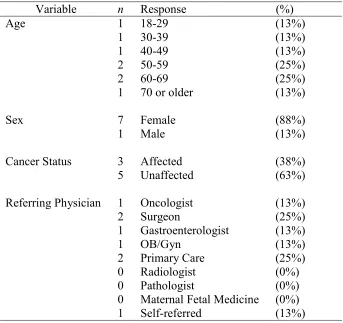
2.4.1 Patients. A total of 73 patients were invited to participate in the study. Eight
participants completed and returned the questionnaire, yielding an 11% response rate.
The majority of participants were female. Ages ranged from the 18-29 group to 70 years
or older. Patients were referred to cancer genetic counseling for a personal and/or a
family history of cancer, and referral sources came from a variety medical specialists, as
well as one self-referral. For specific information on demographics, refer to Table 2.1.
All eight participants reported a desire to be contacted in the future regarding
updates to the components of genetic testing and counseling discussed during their
genetic counseling appointment. Patients were asked how frequently and for how many
years following their initial appointment they desired to be updated with relevant
information. When asked about the preferred frequency, 38% (n = 3) of patients indicated
a desire to be update every six months and 63% (n = 5) stated a desire to be updated once
a year. For the most part, they were similarly divided about the time period in which they
desired updates, with 50% (n = 4) stating they desired to be kept updated for one year
following their initial appointment and 38% (n = 3) indicating they desired updates for
ten years. The remaining participant (n = 1) indicated a desire to be updated for five years
following her initial appointment with a genetic counselor.
Responses to these questions were also compared between patients with a
personal history of cancer (n = 3) and those who had never been diagnosed (n = 5). The
small sample size limited exploration through chi-square analysis, but descriptive
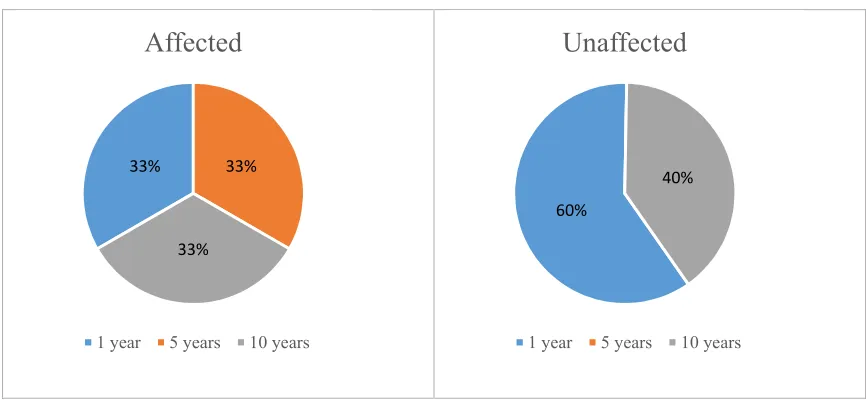
statistics are provided. The affected group was evenly divided between a desire to be
appointment. In the unaffected group, 60% (n = 3) said they desired contact for one year
following their initial appointment while 40% (n = 2) said they desired updates for a
period of ten years. When asked about the desired frequency, 33% (n = 1) of the affected
patients and 40% (n = 2) of unaffected patients indicated an update frequency of every
six months. Among those who stated a desire for updates once a year, 67% (n = 2) were
affected and 60% (n = 3) were unaffected. See Figure 2.1 and Figure 2.2.
Seven of eight patient participants, or 88%, believed the duty to keep patients
informed fell primarily on the genetic counselor. The participant that did not select the
genetic counselor as the responsible provider stated any knowledgeable person was an
acceptable source of new information. When asked about maintaining the
patient-provider relationship, all participants stated they preferred the healthcare patient-provider to
initiate contact with updates, instead of the patients contacting the provider themselves to
inquire about new information. The preferred methods of notification by participants
included phone call (n = 4), letter (n = 3), and email (n = 1). None of the participants
indicated they desired to be updated by follow-up genetic counseling appointments or
during appointments at high-risk clinics.
Seven of eight patient participants, or 88%, indicated they either agreed or
strongly agreed with being updated when a newer diagnostic test becomes available, and
when changes in cancer risk, test result status, or management guidelines occur. One
participant selected strongly disagree to all of these questions. For the statements on
updates to insurance guidelines and consenting at the initial appointment to future
updates, 75% (n = 6) of participants either agreed or strongly agreed. The question
provide updates on personal and/or family history. Thirty-eight percent (n = 3) of
participants indicated they disagreed or strongly disagreed with this question while 63%
(n = 5) either agreed or strongly agreed. Participants’ responses to all of these questions
are shown in Table 2.2.
2.4.2 Physicians. A total of 44 physician questionnaires were completed and returned.
Of these questionnaires, two were omitted because they were completed by someone
other than a physician, leaving a total of 42 physicians who participated in the study. The
majority of physicians specialized in either OB/Gyn or surgery. Table 2.3provides the
physician demographics for the participants enrolled in the study.
Of the physicians surveyed in this study, 83% (n = 37) indicated they had referred
patients to cancer genetic counseling at some point. The 17% (n = 7) of physicians who
indicated they had never referred to genetic counseling included two pathologists, two
out of the three radiologists, and one each from surgery, primary care, and OB/Gyn.
Physicians were asked whether or not patients who were previously seen for
genetic counseling should be re-contacted when new and relevant genetic information
becomes available, as well as whose primary responsibility it was to update patients.
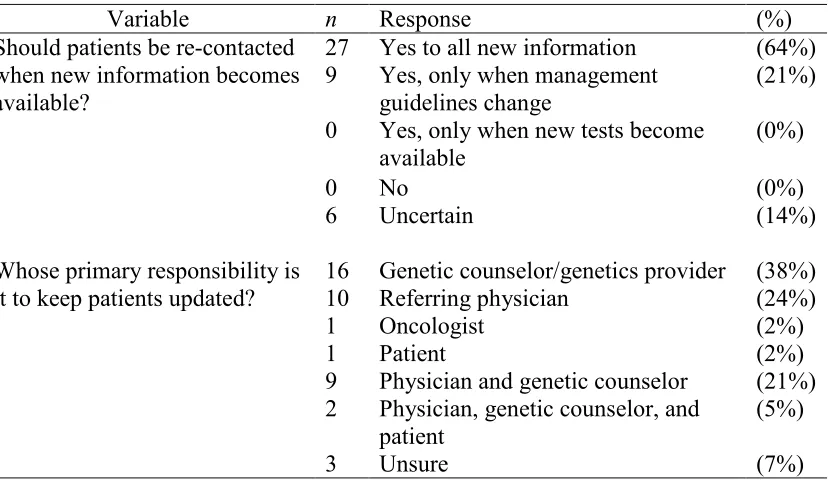
Eighty-six percent (n = 36) stated that patients should be re-contacted with updates,
although the indications for re-contacting varied. The remaining 14% of participants (n =
6) who did not explicitly agree with re-contacting patients stated they were uncertain
about whether or not re-contacting should occur. None of the participants indicated that
patients should not be re-contacted when new information becomes available. The most
frequent responses to whose primary responsibility it is to keep patients updated were
between these two providers (n = 9). See Table 2.4 below for specific information on
physicians’ responses to these questions.
Physician participants were asked whether or not they had ever updated patients
with new information, and 67% (n = 28) indicated they had while 33% (n = 14)
participants had not. Among those who had never re-contacted patients were three
surgeons, two pathologists, two radiologists, six OB/Gyns, and one family medicine
physician.
2.4.3 Patient and Physician Comparisons. Both the patient and physician groups
were asked which provider was responsible for re-contacting patients with updated
information. Patient and physician responses to this question are shown in Figure 2.1.
While 88% (n = 7) of patient participants reported they expected updates to come from
the genetic counselor, only 38% (n = 16) of physicians indicated the genetic counselor as
the provider primarily responsible for re-contacting. Using chi-square analysis,
comparison of patient responses to physician responses did not appear to be statistically
significant, p = .139, but we cannot confirm this due to low patient sample size.
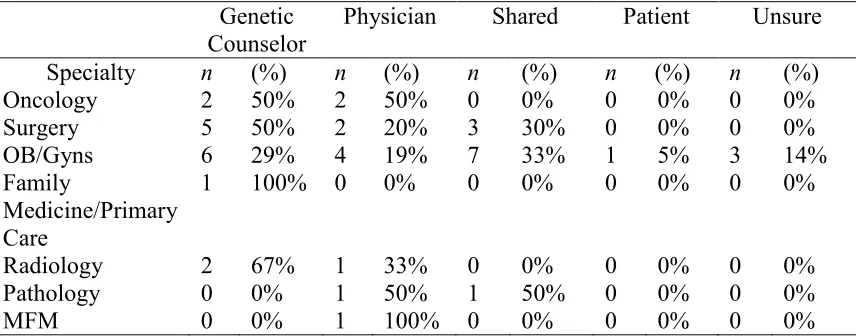
Physician responses regarding whose primary responsibility it is to update
patients with new information were further categorized by specialty. Physicians in the
following specialties more frequently indicated genetic counselors as the sole responsible
provider: oncologists, surgeons, family medicine/primary care physicians, and
radiologists. See Table 2.5 for more details.
2.5 Discussion
In this study we explored patient and physician opinions on which circumstances
information as it becomes available. We also explored the method of re-contacting
preferred by patients.
2.5.1 Patient Responses. The patient group had a low response rate, despite the fact
patients seemed interested when informed of the study. It is possible some patients
intended to complete the questionnaire but did not get around to it. Additionally, it is
possible that patients who answered “no” to the first question decided not to return the
survey. The first question asked if they would like to be contacted in the future regarding
updates to the components of genetic testing and counseling that were discussed. If they
selected “no,” they were asked to stop the survey. It is possible these patients did not
return the questionnaire because they believed their answer made them ineligible to
participate.
All eight patients who participated in the study stated they wished to be
re-contacted in the future regarding updates to the components of genetic testing and
counseling that were discussed at their appointment. The majority (n = 6) indicated they
would be open to discussing their preference for future contact with the provider at their
initial session. However, attaining consent for future, long-term contact is not a current
standard of practice. A recent study which surveyed genetics providers in the United
Kingdom found the majority did not routinely acquire permission to re-contact, citing a
lack of resources to offer this service and concerns about raising the expectations of
patients (Carrieri et al., 2016). While re-contact by a genetics provider seems to be
preferred by patients, it is not currently widely done and may not be a practical task. One
based in an electronic medical record, to overcome these barriers traditionally associated
with re-contacting patients.
The majority of participants in this study either agreed or strongly agreed with
being updated for all the circumstances provided on the questionnaire. The circumstances
participants responded to most favorably included being re-contacted with updates
pertaining to the availability of newer diagnostic tests, changes in lifetime cancer risk
based on new research, updates to test results, and changes in management guidelines
such as how often to be screened and surgery recommendations. These circumstances
were also listed among the most common reasons for re-contacting by genetics providers
since these reasons were viewed as clinically actionable (Carrieri et al., 2016). It is likely
that our patients also felt re-contact is best served by items that may have immediate
effect on their medical management which was likely thoroughly discussed as part of the
genetic counseling they received.
The question participants most strongly disagreed with pertained to the desire to
be re-contacted on a regular basis to update providers to any changes in their own or their
family’s health. Interestingly, 75% (n = 6) of participants stated they desired to be
re-contacted if insurance changed in a way that would allow for additional testing options
that were unavailable at the time of their initial appointment. Even if guidelines for
insurance do not change, updating the clinic with additional information on family
members’ medical histories or on newly diagnosed cancers is one way to potentially
qualify for additional testing. It is possible that patients might not realize the importance
of informing providers of such information. The National Society of Genetic Counselors
Health History] allows for risk assessment and can aid in diagnosis, decisions about
health care, screening, genetic and other test selection, and interpretation of test results, in
addition to the identification of at-risk relatives” (NSGC, n.d.) Patients need to be aware
that changes in personal and family history can be a clinically actionable item. Perhaps,
there is a role for genetic counselors and other health professionals in calling attention to
this important fact. Another explanation could be that patients perceive updates to history
as only potentially leading to a clinically actionable conclusion. Together, these results
suggest patients desire highly personalized updates that are clinically actionable at the
time of the update and are less interested in re-contact for other reasons.
Although all participants stated a desire for future updates, one participant
strongly disagreed to being contacted for all the circumstances provided on the
questionnaire. One possible explanation for this may have been the situations in which
she would have desired re-contacting were not included on the questionnaire. It is also
possible that she agreed with the notion of re-contacting patients in a general sense but
did feel not this was relevant in her particular circumstance. This patient was between the
age of 50-59 years and was referred to genetic counseling by her primary care physician
based on her family history of breast cancer. An opportunity for an open-ended response
might have provided more insight into her preferences.
Participants in this study indicated a desire to be re-contacted for a time period
ranging from one to ten years following their initial genetic counseling appointment. The
time period in which patients wish to be followed may be influenced by personal history.
We found participants who were unaffected were less likely to indicate a desire for
sample size limited exploration of this question, and we cannot claim any statistically
significant results. Unfortunately, this study was unable to weigh the impact of a positive
or negative test result on desired time period for future contact. This might be an area for
future study.
A frequency of updates once every six months or one year was most appropriate
according to participants. No one desired less frequent contact such as once every five or
ten years. Two of the three participants in this study who stated they wanted updates as
often as every six months were unaffected. A qualitative study surrounding why they
wanted updates so frequently would be an informative supplement to our study. For
unaffected patients, frequency of contact may be associated with closeness to an affected
relative. For affected patients, the amount of time since cancer diagnosis may
significantly influence the frequency with which they desire updates. For example,
patients in the middle of treatment may desire more frequent updates due to perceived or
actual relevance to their treatment and ongoing care.
Participants had a strong preference against in-person updates compared to
updates via phone, email, or letter. No one indicated a desire to be updated during a
follow-up genetic counseling appointment or during a high-risk cancer surveillance
appointment. Perhaps participants did not want to be updated at a future genetic
counseling appointment because it is inconvenient to schedule another appointment
amongst busy lives. It is less clear as to why patients would not desire updates during
regular high-risk cancer surveillance appointments. It is possible patients prefer to receive