IJEDR1504081
International Journal of Engineering Development and Research (www.ijedr.org)501
A Review of Research on an Interactive Augmented
Reality System for Enhancing Spatial Visualization
Skills in Education
1Amit B. Waghmare, 2Prof. S.D. Jondhale 1PG Student, 2Associate Professor 1Department of Computer Engineering 1Pravara Rural Engineering College, Loni, India
________________________________________________________________________________________________________ Abstract - The improvement of the visualization capabilities of students is important for their development of design skill in various areas in Education. Technological innovation throughout education can certainly influence college students to learn effectively and can persuade them, leading to an effective strategy of understanding. Prior research has recognized the issue that innovation in technologies will make an inactive learning procedure if the technology used does not encourage for critical decision making, awareness and understanding of one’s own thought processes. Due to the fact the benefits, augmented reality has been shown to have great potential in making the learning process more dynamic, successful, and productive as well as meaningful. Augmented Reality uses computer vision, various image processing methods and computer generated graphics to bind 2D or 3D virtual objects into the real world. It provides real-time interaction between the user, real world data and virtual objects. Moreover, the particular combining of augmented reality with education has fascinated research interest because it permits students to learn in an interactive environment. Therefore, this paper reviews the exploration that has been led on augmented reality. The survey depicts the utilization of augmented reality in various fields of learning including Engineering, Geography, Mathematics, Medical, Science, Astronomy, Biology and many more. This paper additionally examines the benefits of augmented reality contrasted with conventional technology (e.g. Conventional books). This review of the outcomes from the research demonstrates that, generally, augmented reality advancements have a positive potential and favorable circumstance that can be adjusted in education.
Index Terms – Augmented Reality, Technology, Education, Visualization
________________________________________________________________________________________________________
I. INTRODUCTION
In recent years, technology enable learning exploration has progressively focus on various trending technologies like augmented reality, mobile learning, E-learning, learning analytics intended for improving the particular fulfilment as well as activities on the users in improved learning environments. Most of these experiments take advantages of advancements in equipment or devices as well as software for portable devices and their trend among people as well as significance improvement of various stages of student’s learning process. Lessons that are upheld by technology will result in additional impressive kinds of educating and learning [1]. This is because the utilization of technology includes real world difficulties, sources of information recreations of ideas and discussion with experts in the field. Furthermore, embedding technology to the learning provides interactive learning mechanism as compare to conventional learning and teaching [4].
The coordination of innovation in technology tool into the education is turning out to be a piece of good teaching [8]. Lecturers definitely not simply devote a great deal of individual time for using the services on computer and also needs a higher level of creativity as well as self-assurance to utilize the modern technologies that are inlayed in modern education. The incorporation of technology additionally gives a way to upgrade student learning experiences and engagement in education. Consequently, current studies have targeted to higher understand the applications used through lectures from the point of view of students, including animation, computer generated graphics, simulation software [2].
Augmented reality is another innovation that has risen with benefits for application in education and learning. The Augmented reality system enables integrating real world data with virtual objects as well as new information that put over the existing information. As a result, virtual data appear to exist together in the same space with real world data. However, Augmented reality is not limited to the feeling of sight, it can be connected to all senses like hearing and touch. Augmented reality is differing from the “Virtual reality” where the user is fully engaged with the virtual environment.
IJEDR1504081
International Journal of Engineering Development and Research (www.ijedr.org)502
II. BACKGROUND OF PROBLEMConventional chalk and talk techniques and the use of printed textbooks are not sufficient to explain any concept and also resulting in inadequate understanding benefits in students. According to student’s point of view it is exhausting to simply hear the teacher talking before them [10]. The students thought that the embedding technologies could assist them in their learning practice. In this way, lecturer have started to look for technologies that can possibly be embedded in training so as to offer students some assistance with learning effectively and to enhance their understanding in various subjects. The following sub-sections focus on the problems that have emerged in traditional learning and teaching process and the way through which technology like augmented reality used to target these concerns.
A. Diminishing The Total Number Of Students Interested In Science Related Subjects
The investigation of Science is an complex procedure that incorporates recognizing an issue, researching the issue, making theories, arranging the information gathering technique, testing the speculations, gathering the information and making the conclusion and results [6]. Participating in these procedures assists the student to understand each process clearly that helps to achieve best results. Because of the well-known observation among students that Science subjects are very difficult to understand, fewer students are interested to taking their degree in the Science subjects.
According to observation, The Indian government introducing various schemes that can attract students to take admission in science subjects, but the target still has not been reached. Numerous studies have been led with the plan to gain from students about how to make them more intrigued to study Science. One proposal made by students that a specialist ought to be available in the classroom to give them the pertinent guidance for the subject and make the classroom exercises more enjoyable and exciting [13]. Students choose to find out with interactive methods that help them to understand the concepts rather than the conventional teaching methods.
B. Students’ Problems In Visualizing Abstract Concepts
Visualisation is term that is used to communicate with the data. This means which the data should come from something which can be abstract or not quickly visible. The most essential criteria are that the visualization must give an approach to learn something about the information. Any change of non-trivial information into a picture will leave out data, however there must be in any event some significant parts of the information that can be perused. Confusion among students must be considered because it meddles with students’ learning approach [5]. Thus, the appropriate teaching technique play important role in avoiding or reducing the students’ confusion. It is found that is possible to enhance student’s visualization skill simply by representing various conceptual visual images and permitting the students to manipulate and investigate the images [11].
Illustrations of visualization technologies which have been analysed inside preceding analysis include computer animation, virtual environment and computer based simulation. Animation along with useful information engaging moderator helps the students to understand the results of an investigation of data. These visualization technologies can be utilized to address the issue of misconception and offer students to understand the concept in better ways.
Examination has demonstrated the advantageous utilization of technology as a method for visualizing unique ideas. Visualization technologies give a way to making noticeable wonders that are too little, huge, quick or moderate to see with the unaided eye [9]. Wu et al. (2001), produced a great animation to aid students to understanding the theoretical ideas in Chemistry [16]. As indicated by them, this sort of innovation permits students to visualize the collaborations among particles and to comprehend the related synthetic ideas. Stith (2004) creates animation using software for teaching biology [22].
These days, one of the technologies that show incredible potential in educating particularly in imagining abstract ideas is Augmented Reality. Augmented Reality is another innovation that is liable to affect training [12]. This specific state is usually backed by the Horizon Reviews by 2004 to 2010 which depict Augmented Reality as an innovation that conveys the Computer world to the human world. AR is not quite the same as virtual reality on the grounds that AR mixes real environment with the computer generated artworks, while virtual reality engaged user with the computer generated graphics. AR displays various objects and ideas in different ways and from distinct observing angles which offers the students to better understanding the subjects [15].
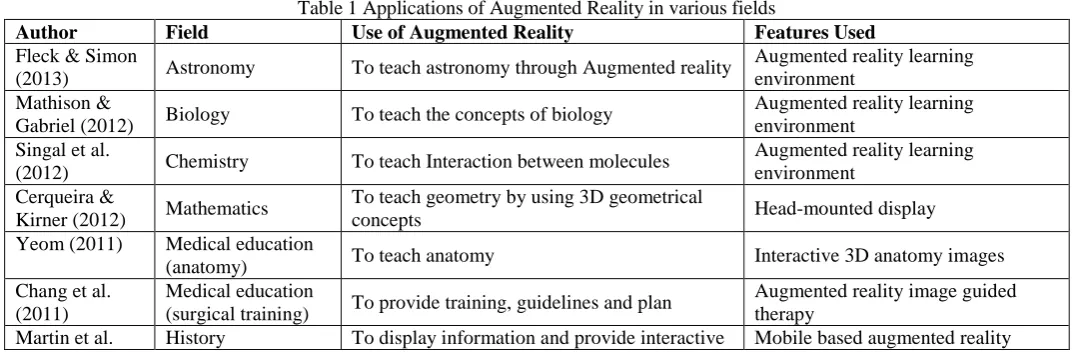
III. APPLICATION OF AUGMENTED REALITY IN VARIOUS FIELDS
Table 1 Applications of Augmented Reality in various fields
Author Field Use of Augmented Reality Features Used Fleck & Simon
(2013) Astronomy To teach astronomy through Augmented reality
Augmented reality learning environment
Mathison &
Gabriel (2012) Biology To teach the concepts of biology
Augmented reality learning environment
Singal et al.
(2012) Chemistry To teach Interaction between molecules
Augmented reality learning environment
Cerqueira &
Kirner (2012) Mathematics
To teach geometry by using 3D geometrical
concepts Head-mounted display
Yeom (2011) Medical education
(anatomy) To teach anatomy Interactive 3D anatomy images
Chang et al. (2011)
Medical education
(surgical training) To provide training, guidelines and plan
Augmented reality image guided therapy
IJEDR1504081
International Journal of Engineering Development and Research (www.ijedr.org)503
(2011) way to achieve best experience in exhibition
hall and archaeological sites. Coffin et al.
(2008) Physics
To display graphics on the top of physical things that help student to visualize speed, velocity, pressure, acceleration those are invisible to the human eyes.
Augmented Video
Hedegaard et
al. (2007) Medical Education
To increase visualization skills in medical student in connection to particular myocardial infections by enabling student to interact with patient’s heart’s 3D representation.
3D tracking
IV. LIMITATIONS OF AUGMENTED REALITY
There are numerous parts of Augmented reality that should be investigated and numerous future research examinations stay to be led in this generally new area. Several limitations can be found in this technology. Numerous users in an AR learning activity concurred that the AR tools are great but most users did not consider the tools to be as successful as reading textbooks [21]. They found that utilizing AR tools to get information was difficult. Although AR tools itself is simple to work, but the procedure of sending the text image, understanding the text and then getting the meaning of the text is very slow. This is because it requires 3G network for connecting to the Internet and for fast response. Students get frustrated when using augmented reality application outdoors and asking their teacher for assistance [14].
In many countries use of Augmented Reality in education growing rapidly. However, the use of Augmented reality in Education is growing very slowly in India. Therefore, more scientists in the education field ought to examine the capability of AR to enhance teaching techniques in the Indian education system and to enhance effectiveness of the teaching and learning process. The above stated limitations mostly focus on the difficulties related to technical features of using AR in education system. These technical issues must be enhanced in the future that AR can be widely used in education. There should be improvement in the internet facilities that user can access AR system quickly and easily. If proper internet facilities are available, the students can use AR via a smartphone [17].
V. PROPOSED SYSTEM
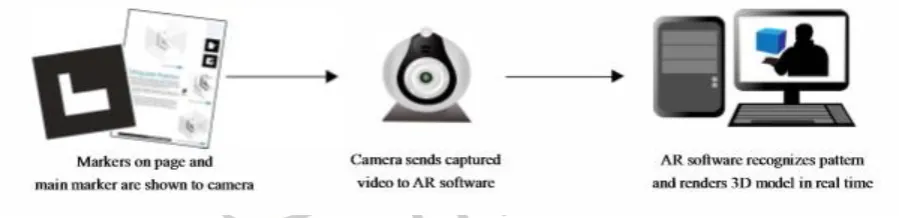
We proposed desktop based Augmented reality system, that helps student to easily understand the concept using computer graphics. As so far discuss earlier, the one of the limitation is that augmented reality system requires fast Internet connection, here we present Desktop based system that does not require any internet connection. We present the Augmented reality system which is cost effective and very easy to implement. (Fig. 1)
Figure 1. Augmented Reality system
We proposed the printed material incorporating augmented reality marker to the contents. In addition this, only a computer with the proper augmented reality software installed and a web camera is necessary. In order to access 3D content, web camera should be pointed at the particular area of the printed material. These areas contain chain of square patterns, called markers (Fig. 2), which are automatically identified by the Augmented reality system. These markers are embedded within the page and they have attached to specific 3D models.
Figure 2. Augmented reality Markers
IJEDR1504081
International Journal of Engineering Development and Research (www.ijedr.org)504
VI. CONCLUSIONThis survey of the research led in a various fields in education demonstrates that AR technology can be further enhanced in education. This is because the AR characteristics help students to improve their spatial visualization skills. These features also help to teacher to teach concept in interactive way and students can easily understand what teacher have teach to them. The Augmented reality system has also received positive comments and feedback from students who have demonstrated their enthusiasm for utilizing AR as a part of their learning processes. These good responses are important simply because they indicate the readiness of students to effectively take part in their studies through AR tools. Augmented Reality is still new in education, there are still a some drawbacks that should be take into account. Such drawbacks can be overcome in future as research on the incorporation of AR in education is replicated and moved forward. We also have proposed simple and cost effective augmented reality based system that used printed material incorporating augmented reality marker to the contents and web camera to access corresponding 3D models. This system will also overcome the problem of 3G network to access internet, that this system does not requires any internet connection.
REFERENCES
[1] Shapley, K., Sheehan, D., Maloney, C., & Caranikas-Walker, F. Effects of technology Immersion on Middle School Students’ Learning Opportunities and Achievement. The Journal Educational Research, 104, 299-315.
[2] Neumann, D.L., Neumann, M. M., & Hood, M.. Evaluating computer-based simulations, multimedia and animations that help integrate blended learning with lectures in first year statistics. Australasian Journal of Educational Technology, 27(2), 274-289. 2011
[3] Fleck, S., & Simon, G. An Augmented Reality Environment for Astronomy Learning in Elementary Grades. An Exploratory Study. 2013
[4] Yasak, Z., Yamhari, S., & Esa, A. Penggunaan Teknologi dalam Mengajar Sains di Sekolah Rendah. 2010
[5] Palmer, D. Students Alternative Conceptions and Scientifically Acceptable Conceptions about Gravity, International Journal of Science Education, 23(7), 691-706. 2001
[6] Meerah, T. S. Dampak Penyelidikan Pembelajaran Sains Terhadap Perubahan Kurikulum. UKM Bangi, Selangor: Penerbit Universiti Kebangsaan Malaysia. 1998
[7] Singhal, S., Bagga, S., Goyal, P., & Saxena, V. Augmented Chemistry: Interactive Education System. International Journal of Computer Applications.2012
[8] Pierson, M. E. Technology Integration Practice as a Function of Pedagogical Expertise. Journal of Research on Computing in Education, 33(4). 2001
[9] Cook, M. P. Visual Representations in Science Education: The influence of prior knowledge and Cognitive Load Theory on Instructional Design Principles. Sci. Ed., 90, 1073-1109. 2006
[10] Teoh, B. S., & Neo, T. Interactive Multimedia Learning: Student’s attitudes and learning impact in an animation course. The Turkish Online Journal of Educational Technology–TOJET October 2007 ISSN: 1303-6521 Volume 6 Issue 4 Article 3. 2007
[11] Kozhevnikov, M., & Thornton, R. Real-Time Data Display, Spatial Visualization Ability, and Learning Force and Motion Concepts. Journal of Science Education and Technology, 15, 1. 2006
[12] Martin, S., Diaz, G., Sancristobal, E., Gil, R., Castro, M., & Peire, J. New technology trends in education: Seven years of forecasts and convergence. Computer & Education, 57, 1893-1906. 2011
[13] Bevins, S., Brodie, M., & Brodie, E. A study of UK secondary school students’ perceptions of science and engineering. In European Educational Research Association Annual Conference, Dublin, 7-10 September 2005.
[14] Folkestad, J., & O’Shea, P. An Analysis of Engagement in a Combination Indoor/Outdoor Augmented Reality Educational Game. 2011
[15] Cerqueira, C. S., & Kirner, C. Developing Educational Applications with a Non-Programming Augmented Reality Authoring Tool. Proceedings of World Conference on Educational Multimedia, Hypermedia and Telecommunications (pp. 2816-2825). 2012
[16] Wu, H.-K., Krajcik, J. S., & Soloway, E. Promoting Understanding of Chemical Representations. Journal of Research in Science Teaching, 38(7), 821-842. 2001
[17] Lamounier, E., Bucioli, A., Cardoso, A., Andrade, A., & Soares, A. On the use of Augmented Reality techniques in learning and interpretation of caridiologic data. Annual International Conference of the IEEE, 2010 (Vol. 1, pp. 2451-2454). 2010 [18] Mathison, C., & Gabriel, K. Designing Augmented Reality Experiences in Authentic Learning Environments. Presentation
Proposal for the Society for Information Technology & Teacher Education.
[19] Yeom, S.-J. (2011). Augmented Reality for Learning Anatomy. Proceedings ascilite 2011 Hobart: Concise Paper (pp. 1377-1384). 2012
[20] Chang, G., Morreale, P., & Medicherla, P. Applications of Augmented Reality Systems in Education. Proceedings of Society for Information Technology & Teacher Education International Conference 2010, 1380-1385. 2011
[21] Hsu, J.-L., & Huang, Y.-H. The Advent of Augmented-Learning: A Combination of Augmented Reality and Cloud Computing. 2011
[22] Stith, B. J. (2004). Use of Animation in Teaching Cell Biology. Cell Biology Education, 3, 181-188. 2004 [23] Hedegaard, H., Dahl, M. R., & Grinbaek, K. EKGAR: Interactive ECG-Learning with Augmented Reality. 2007
IJEDR1504081
International Journal of Engineering Development and Research (www.ijedr.org)505
[25] I. Radu and B. MacIntyre, “Using children’s developmental psychology to guide augmented-reality design and usability,” inProc. IEEE Int. Symp. Mixed Augmented Reality, pp. 227–236. Nov. 2012
[26] W. Farr, N. Yuill, and S. Hinske, “An augmented toy and social interaction in children with autism,” Int. J. Arts Technol., vol. 5, no. 2, pp. 104–125, 2012.