IJEDR1604042
International Journal of Engineering Development and Research (www.ijedr.org)259
PAPR Reduction Using Hybrid method of Linear
Predictive Coding and VLM transform
1Manita Sharma, 2Devarshi Shukla 1E.C.E student, 2Head of department Department of electronics communication engineering LR College of engineering and technology, Solan, (H.P), India.
________________________________________________________________________________________________________
Abstract - Communication is one of the important aspects of life. With the advancement in age and its growing demands, there has been rapid growth in the field of communications. In this paper we have focused on learning the basics of an OFDM System and have under taken various methods to reduce the PAPR in the system so that this system can be used more commonly and effectively. A new hybrid method for PAPR reduction using Linear Predictive Coding and (Vandermonde-Like Matrix) VLM based precoding has been implemented and results are presented in order to prove the efficacy of the proposed method.
Keywords - OFDM, IDFT, ISI,ICI,PAPR
_______________________________________________________________________________________________________
I.INTRODUCTION
Since the very genesis of man, communication has been one of the main aspects in human life. Previously various methods like sign languages were implemented for this purpose. Wireless communication which was initially implemented analog domain for transfer has is now-a-days mostly done in digital domain. Instead of a single carrier in the system multiple sub-carriers are implemented to make the process easier. Electronics communication system has revolutionized the face of the world. Communication with some on emerge century back was only possible by physical mode. Butnowthatcanbedonejustbyclickingaswitchonthetelephonepadorbyjusta click of the mouse. Even live television report, live games telecast could not be possible without wireless communication.
With the ever growing demand of this generation need for high speed communication has become an most priority. Various multicarrier modulation techniques have evolved in order to meet these demands, few notable among them being Code Division Multiple Access (CDMA)and Orthogonal Frequency Division Multiplexing(OFDM).Orthogonal Frequency Division Multiplexing is a frequency–division multiplexing(FDM)scheme utilized as a digital multi–carrier modulation method. A large number of closely spaced orthogonal sub–carriers is used to carry data. The data is divided into several parallel streams of channels, one for each sub–carriers. Each sub–carrier is modulated with a conventional modulation scheme (such as QPSK)at a low symbol rate, maintaining total data rates similar to the conventional single carrier modulation schemes in the same bandwidth. Most of the transmission channels are frequency selective. Thus, the frequency components from the input signal affected differently by the channel. it means that the channel’s transfer function H(f) is not flat over the bandwidth. Due to which Inter-Symbol interference (ISI) will introduces and it can be seen as a time-domain manifestation of the frequency selectivity. OFDM is exceptionally robust to IIS. OFDM is Well suited to all the dispersive channels, and especially to the wireless channel. One of the main reason to use OFDM is to increase robustness against frequency-selective fading or narrowband interference. OFDM is a modulation scheme that is especially suited for high-data-rate transmission in delay-dispersive environments. OFDM is one of the many multicarrier modulation techniques, which provides high spectral efficiency, low implementation complexity, less vulner ability to echoes and non-linear distortion .Due to these advantages of the OFDM system, it is vastly used in variouscommunicationsystems.Butthemajorproblemonefaceswhileimplementing this system is the high peak–to–average power ratio of this system. A large PAPR increasesthecomplexityoftheanalog–to–digitalanddigital–to–analogconverter and reduces the efficiency of the radio – frequency (RF) power amplifier [3,6]. Regulatory and application constraints can be implemented to reduce the peak transmittedpowerwhichinturnreducestherangeofmulticarriertransmission.This leads to the prevention of spectral growth and the transmitter power amplifier is no longer confined to linear region in which it should operate. This has a harmful effect on the battery lifetime. Thus in communication system ,it is observed that all the potential benefits of multi carrier transmission can be out- weighed by a high PAPR value [3].
A. PAPR Reduction techniques
PAPR reduction techniques vary according to the needs of the system and are dependent on various factors. PAPR reduction capacity, increase in power in transmit signal, loss in data rate, complexity of computation and increase in the bit-error rate at the receiver end are various factors which are taken into account before adopting a PAPR reduction technique of the system. The PAPR reduction techniques on which we would work upon and compare in our later stages are as follows:
IJEDR1604042
International Journal of Engineering Development and Research (www.ijedr.org)260
Transmitting only part of data of varying sub-carrier which covers all the information to be sent in the signal as a whole is called Partial Transmit Sequence Technique.II.RELATED WORK
J.Armstrong[2] in this paper, frequency domain filter has been designed to remove the out-of-band discrete frequency components. Filtering results in peak regrowth. Additionally, PAPR reduction may be attained by repeated clipping and filtering operations. The distortion of the in-band signal results in shrinking of the overall signal constellation and an added noise-like effect. R. O‟Neil[3] This paper presents an investigation into the effects of clipping of both baseband and band pass multicarrier signals. The amount of in band distortion and out of band emissions can be traded off directly against reductions in the crest factor of the clipped signal. In this paper, Novel clipping techniques has been proposed that provides more control over the various trade-offs R.W.Baumi[4]A new method for the reduction of peak{to{average transmit power ratio of multicarrier modulation systems, called selected mapping, is presented, which is appropriate for a wide range of applications. Significant gains can be achieved by selected mapping whereas complexity remains quite moderate. S.H.Han [5]this paper explains significant PAPR reduction techniques for multicarrier transmission including amplitude clipping and filtering, coding, partial transmit sequence, selected mapping, interleaving, tone reservation, tone injection, and active constellation extension. S.H.Han[6] In the PTS technique, the data block to be transmitted is partitioned into disjoint sub-blocks and the sub-blocks are combined using phase factors to minimize PAPR. In the proposed technique, a gradient descent search is performed to find the phase factors. It is shown that the proposed technique achieves significant reduction in search complexity with little performance degradation.
III.PROPOSED METHODOLOGY
OFDM signals are generated by an N-point Inverse Fast Fourier Transform (IFFT), and the fast Fourier transform (FFT) is used at
the receiver to restore the signal. Suppose a block of N symbols XN={Xk, k = 0, 1,...,N - 1} is formed with each symbol
modulating the corresponding subcarrier from a set of orthogonal subcarriers, where Xk is the symbol carried by the kth
sub-carrier. Hence, the complex OFDM symbol in discrete-time can be written as
PAPR is the ratio between the maximum power and the average power of the complex signal. The PAPR defined as
.
The aim here is to reduce the PAPR value which helps in reducing the power requirement for the transmitter.
Fig.1 Block diagram of the system
The block diagram of the VLM (Vandermonde Like Matrix) precoded SLM-OFDM transmitter and receiver system is shown
in the Fig. 1. The SLM scrambles the OFDMsignal while the VLM transform reduces the autocorrelation of the input
IJEDR1604042
International Journal of Engineering Development and Research (www.ijedr.org)261
Either of the transforms (V1 orV2) can be used to transform the input symbols so as to reduce the PAPR value.
Transformations like VLM, are a rotation of phase of the signal vector in N-dimensional space. Therefore, the transformed signals will be very less likely aligned in-phase, which will reduce the high peak-power of the subcarriers.
The proposed approach may implement prediction based coding technique in order to reduce the effective PAPR.
Fig. 2. Linear Predictor
Prediction based transform or coding is an attempt to de-correlate the signals by subtracting the best possible linear prediction from the input signal while preserving other aspects of the signal, leaving a whitened residual signal which will be shown to have a very less PAPR, the basic idea of linear prediction is to transmit the prediction error signal instead of the original signal. the nth sample of a discrete-time sequence x(n) can be represented by a linear combination of the previous M samples.
Given this assumption, we define the predicted sequence x̃(n) in terms of M coefficients c(n) by the expression:
The PAPR is expected be reduced further and hence the technique is tentatively assumed to be suitable for the ongoing application.
IV.RESULTS
The results for the proposed method and simulation are shown below.
x e x dddd
Noise
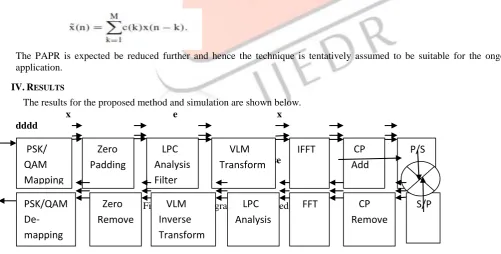
Fig.4.1 Block Diagram for Proposed Method
Graph plotted
PSK/
QAM
Mapping
PSK/QAM
De-mapping
Zero
Padding
LPC
Analysis
Filter
VLM
Transform
IFFT
CP
Add
P/S
Zero
Remove
VLM
Inverse
Transform
LPC
Analysis
FFT
CP
Remove
IJEDR1604042
International Journal of Engineering Development and Research (www.ijedr.org)262
Fig.1 Scatterplot for Proposed OFDM scheme. CCDF (Complementary Cumulative Distribution Function)
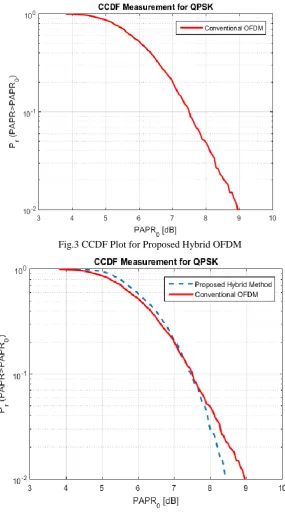
In order to see the performance of PAPR reduction, the CCDF curve is plotted for Conventional Selected mapping method. The figures show the effectiveness of the method to reduce the PAPR of the OFDM signal.
IJEDR1604042
International Journal of Engineering Development and Research (www.ijedr.org)263
Fig.3 CCDF Plot for Proposed Hybrid OFDMFig 4 CCDF Plot for Comparison of PAPR in OFDM
Comparison table ‒
Proposed Value Conventional Value 6.784645126 7.248438835 7.265237237 7.350603061 6.440352007 7.587335548 7.271044299 7.538332291 5.196800599 6.512662371 6.895518331 7.548231966 5.302274954 4.501870225 6.072697598 6.060710495 6.623677007 5.872437617 6.605705559 7.254353105 5.337132906 6.819640055
IJEDR1604042
International Journal of Engineering Development and Research (www.ijedr.org)264
whereas, VLM and High Order LPC (HLPC) do not affect the data. From the comparison curve of the VLM and HLPC techniques, we could infer that PTS is more effective in PAPR reduction. However, no specific PAPR reduction technique is the best solution for the OFDM system. Various parameters like loss in data rate, transmit signal power increase, BER increase, computational complexity increase should be taken into consideration before choosing the appropriate PAPR technique.VI.REFERENCES
[1] H.Taub,D.L.Schilling,G.Saha,“Taub’sPrinciplesofCommunicationSystems”:Tata McGraw Hill, 2008.
[2] J.Armstrong,“Peak–to–AveragePowerReductionforOFDMbyRepeatedClipping and Frequency Domain Filtering” ,Elect. Lett. ,Vol. 38, No. 8, February 2002.
[3]R. O‟Neil, L. B. Lopes, “Envelope Variations and Spectral Splatter in Clipped Multicarrier Signals”,Proc. IEEEPIMRC’95,Toronto, Canada, September1995.
[4]W.Baumi,R.F.H.Fisher,J.B.Huber,“ReducingthePeak–to–AveragePower Ratio of Multicarrier Modulation by Selected Mapping”,Elect.Lett.,Vol.32,No.22, October1996.
[5]S.H.Han,J.H.Lee,“AnOverviewofPeak–to–AveragePowerRatioReduction Techniques for Multicarrier Transmission” ,IEEE Transaction on Wireless Communication,April2005.
[6] S.H.Han,J.H.Lee,“PAPRReductionofOFDMSignalsUsingaReducedComplexity PTS Technique” ,IEEE Signal Processing Letters, Vol. 11, No. 11, November 2004.
[7]S.Y.L.Goff,B.K.Khoo,C.C.Tsimenidis,B.S.Sharif,“ANovelSelectedMapping Technique for PAPR Reduction in OFDM Systems” ,IEEE Transactions on Communication, Vol. 56, No. 11, November 2008.
[8] S.Y.L.Goff,S.S.Al–Samahi,B.K.Khoo,C.C.Tsimenidis,B.S.Sharif,“Selected Mapping Without Side Information for PAPR Reduction in OFDM”,IEEE Transactions on Wireless Communications, Vol. 8,No. 7, July 2009.
[9] S. H. Muller, J. B. Huber, “A Comparison of Peak Power Reduction Schemes for OFDM”, Proc. IEEEGLOBECOM ’97,Phoenix, AZ, November 1997.
[10] S.Mohapatra,S.Das,“AnewApproach for Performance Improvement of OFDM System using Pulse Shaping”, Electrical Dept., NIT Rourkela,November 2009.
[11] T. S. Rappaport, “Wireless Communication: Principles and Practice”: 2nd Edition, Prentice Hall, 2002.