858
THE EFFECTS OF GLOBALIZATION ON FIRM PERFORMANCE IN
EMERGING MARKETS: EVIDENCE FROM EMERGING-7 COUNTRIES
Ece C. KARADAGLI
1ABSTRACT
Although there exists a wide array of literature regarding almost every aspect of globalization at
macro level, surprisingly, the micro level of the subject area seems to be a little ignored and
consequently, almost nothing is known about the impact of globalization on firm
performance/value. In an attempt to contribute to fulfilling this gap, this research focuses on the
impact of the overall globalization level of a country and its single dimensions, specifically her
economic, her political and her social globalization levels on firm performance which is measured
by the stock market index returns for “Emerging-7 (E7)” countries, specifically Brazil, China,
India, Indonesia, Mexico, Russia and Turkey, for the period 1998-2009 by using panel data
estimation. The findings suggest that the overall level of globalization significantly improves firm
performance. Besides, the single dimensions of globalization are also found to have value
enhancing effects though the result for economic globalization is insignificant at conventional
levels. Additionally, the political globalization seems to be the most promising dimension of
globalization with regard to performance enhancing prospects for firms.
Keywords:
Globalization, Firm Performance, Emerging Countries, Panel Data
JEL Classification:
F6, G3, C33
INTRODUCTION
The massive trade liberalization and financial integration accompanied with growing political,
socio-cultural and military interdependence as well as the excessive technological progresses has
led the term “globalization” to become one of the hottest topics of our era. Although the term
„globalization‟ is used to refer to a single phenomenon, it is not a single, unified process (Ardıç,
2009), but a catch-all concept to describe a wide range of forces (Archibugi and Iammarino, 2002).
This process has effects on the environment, on culture, on political systems, on economic
development and prosperity, and on human physical well-being in societies around the World
(Kefela, 2011). Consequently, there is no unified definition of globalization as well
2. In fact, it is
1
Department of Banking and Finance, Cankaya University, Ankara, 06810, Turkey
2 Despite the fact that the definition of globalization has been attempted by hundreds of authors and distinguished speakers
on the topic, the word continues to mean very different things to different people (Kefela, 2011). According to International Forum on Globalization, it stands for the present worldwide drive toward a globalized economic system dominated by supranational corporate trade and banking institutions that are not accountable to democratic processes or national governments (http://www.ifg.org/analysis.htm). World Health Organization underlines two interrelated elements in defining globalization: the opening of borders to increasingly fast flows of goods, services, finance, people and ideas across international borders; and the changes in institutional and policy regimes at the international and national levels that facilitate or promote such flows (http://www.who.int/trade/glossary/story043/en/index.html). According to Oxford English Dictionary, globalization is the process by which businesses or other organizations develop international influence or start operating on an international scale (http://oxforddictionaries.com/definition/english/globalization). Szeman (2003) defines globalization as the moment of mass migration, multiculturalism, and cosmopolitanism and Giddens (1990) defines
Asian Economic and Financial Review
859
observed that the definition of globalization depends on the aim and the scope of the debate.
Accordingly, the effects of globalization have been argued from a wide spectrum as well. Just to
mention a few, for example, some authors concentrate on economic factors (such as Dreher, 2006;
Jamison, Jamison and Hanushek, 2007; Pehnelt, 2007; Leitao, 2011; Rao, Tamazian and
Vadlamannati, 2011; Rao and Vadlamannati 2011), while some others address political issues
(such as Bezemer and Jong-A-Pin, 2008; Dreher, Sturm and Ursprung, 2008; Dreher, Sturm and
Vreeland, 2009; Bjornskov and Potrafke, 2011; Chang and Berdiev, 2011) or raise social notions
(such as Lee and Vivarelli 2006; Dreher and Gaston, 2007). Further, there are still many others
who investigate many other various aspects such as human development (for ex., De and Pal,
2011), human welfare (for ex., Tsai, 2007) and life satisfaction (for ex., Bjornskov, Dreher and
Fischer, 2008), entrepreneurial activity (for ex., Vinig and Kluijver, 2007), willingness to help
immigrants as well as sick and disabled (for ex., Koster, 2007), environmental standards (for ex.,
Gassebner, Gaston and Lamla, 2008), water pollution (for ex., Lamla, 2009), military interstate
disputes (for ex., Choi, 2010), etc. Hence, clearly there exists a wide array of literature regarding
almost every aspect of globalization at macro level such as the dimensions of globalization and
their impacts on nations including the national economy, politics, social and cultural aspects etc.,
but, surprisingly, the micro level of the subject area seems to be a little ignored.
Although „Globalization‟ is a well known and widely used term for a long time and continues to
affect businesses in all aspects, there are only a few researches that address the impact of
globalization on firm performance. Among these, Acheampong et al. (2000) examined whether
increasing globalization equalizes speeds of profitability adjustment of global firms in the beverage
and tobacco industry and the food and consumer products industry and their findings report no
significant country effect in the beverage and tobacco industry while in the food and consumer
products industry, speeds of profitability adjustment was found to vary across countries. In another
study, Peltonen et al. (2008) analyzed the impact of import penetration on firm‟s profitability in 15
manufacturing industries in 10 euro area countries during 1955-2004 and their results indicate that
import competition from emerging market economies has had an overall negative impact on
company profitability in the euro area manufacturing sector. However, contrary to the findings of
Peltonen et al. (2008), Georgiou (2011) report a positive impact of globalization (as measured by
total trade to GDP) on company profitability (as measured by net return on equity) for Europe and
the findings of Akinola (2012) suggest that the performance of Nigerian Banks as measured by
profit before tax increases with globalization. Nevertheless, it is obvious that there exists a limited
body of knowledge about the impact of globalization on the firm performance/value and further
research is crucially needed.
This research is hoped to contribute to fulfilling this gap through focusing on the impact of the
degree of overall globalization level of a country as well as its single dimensions, specifically the
economic, the political and the social dimensions by using KOF Index of Globalization on the firm
performance/value as measured by the stock market index returns
3. For this purpose, this research
concentrates on “Emerging-7 (E7)” countries, referring to a group of seven emerging countries,
namely Brazil, China, India, Indonesia, Mexico, Russia and Turkey. E7 countries provide an
interesting sample set as they constitute the major emerging economies in the World. These
countries have been recorded substantial developments within the last few decades and are
predicted to have larger economies than G7 countries, specifically Canada, France, Germany, Italy,
Japan, United Kingdom, and United States, within the next couple of decades. According to the
globalization as the intensification of world-wide social relations which link distant localities in such a way that local happenings are shaped by events occurring many miles away and vice versa.
3
860
projections of PricewaterhouseCoopers
the E7 emerging economies will be around 50% larger than
the G7 economies by 2050 (Hawksworth and Cookson, 2008)
4.
Although emerging economies are more globalized than others (Naghshpour and Marie, 2008) very
little is known about the impact of globalization on firm performance. Besides, the effect of
different dimensions of globalization, especially at the micro level, is again somewhat neglected.
So, this paper not only addresses a crucial empirical question through focusing on the impact of
globalization on firm performance/value but is also hoped to provide insights on the effects of
different dimensions of globalization on firm performance/value as well. Within the scope of this
study, following De and Pal (2011), globalization can be defined as the process of opening up of
economies to the outside world to facilitate trade, reduction in physical and other barriers to
increase mobility of goods and factors of production as well as labor force: that is, it is a process of
integration of economies through economic, social and political processes.
The research undertaken in this study deviates from the majority of the previous work in some
important aspects. First of all, although not at a firm level, it concentrates on the effect of
globalization on firm performance by using stock market index returns as a proxy. Considering that
the limited previous research mainly employed accounting based performance measures such as
gross operating rate, return on equity etc., using a market performance measure also provide an
important additional contribution. Besides, it not only examines the impact of a country‟s overall
globalization level on firm performance but also investigates the effects of the economic, the
political and the social globalization levels of a country on firm performance. In this respect, it is
hoped to provide important additional insights to assess the relative importance of different
dimensions of globalization on firm performance/value as well.
DATA AND METHODOLOGY
This study aims to investigate the impact of globalization and its single dimensions on stock market
index returns for E7 countries with panel data estimation. The research is undertaken for the period
of 1998-2009 by using annual data.
The data on both the level of overall globalization and on its single dimensions, specifically the
levels of economic, political and social globalization, for the sample countries are obtained from
KOF Index of Globalization 2012 which is developed by Dreher (2006), updated by Dreher,
Gaston and Martens (2008) and provided by Swiss Federal Institute of Technology, Zurich. KOF
Index of economic globalization is characterized as long distance flows of goods, capital and
services as well as information and perceptions that accompany market exchanges. It consists of
both the actual flows and the restrictions. Actual flows cover the variables trade, foreign direct
investment, portfolio investment and income payments to foreign nationals where all the variables
are expressed as a percentage of GDP and restrictions cover hidden import barriers, mean tariff
rate, taxes on international trade as a percentage of current revenue and capital account restrictions.
The political globalization is characterized by a diffusion of government policies and the sub-index
covers the variables: the number of embassies in a country, the number of memberships in
international organizations, the number of UN peace missions she participated in and the number of
treaties she signed with other nations. The social globalization through combining the data on
personal contacts, on information flows and on cultural proximity, is expressed as the spread of
ideas, information, images and people. Personal contacts data include the international telecom
traffic measured in minutes per person, the degree of international tourism both incoming and
outgoing, the percentage of foreign population as a percent of total population, the number of
4
861
international letters sent and received as well as government and workers‟ transfers received and
paid as a percentage of GDP. The data on information flows consist of the share of internet users,
the fraction of households who have a television and the international newspapers traded which is
measured as a percentage of GDP. Finally, Cultural Proximity represents the number of
McDonald‟s restaurants per capita, the number of IKEA in a country per capita and the value of
imported and exported books as a percentage of GDP. Then, these three sub-indices, specifically
the economic, the social and the political globalization indices are combined into a single overall
globalization index
5.
The stock market indices of the countries, which are obtained from Bloomberg, are used as a proxy
for firm performance and the GDP growth rate which is sourced from IMF database
6, is used as a
control variable in the model. To test the impact of the overall globalization level of a country and
the effects of her economic, her political and her social globalization levels on firm performance,
two separate models are used:
Model 1:
Rm
i,t= β
0+ β
1GlobalizationLevel
i,t+ β
2GDPGrowthRate
i,t+ ε
Model 2:
Rm
i,t= β
0+ β
1EconomicGlobLev
i,t+ β
2PoliticalGlobLev
i,t+ β
3SocialGlobLev
i,t+ β
4GDPGrRate
i,t+ ε
In conducting the panel data estimation of the above models, first Hausman Test is applied to
determine whether fixed or random effect would be appropriate which suggest that random effects
specifications are more suited. Then, time and cross section dummies are used to check for time
and individual level heterogeneity.
RESEARCH RESULTS
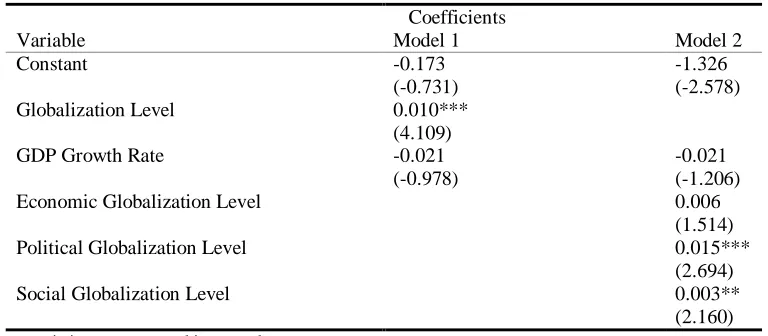
The results of the random effect panel data estimation results for both models are provided in Table
1.
Table 1.
The Random Effect Panel Data Estimation Results
Variable
Coefficients
Model 1
Model 2
Constant
-0.173
(-0.731)
-1.326
(-2.578)
Globalization Level
0.010***
(4.109)
GDP Growth Rate
-0.021
(-0.978)
-0.021
(-1.206)
Economic Globalization Level
0.006
(1.514)
Political Globalization Level
0.015***
(2.694)
Social Globalization Level
0.003**
(2.160)
t-statistics are presented in parentheses.
***,**,* denote statistical significance at 1%, 5% and 10% levels, respectively.
5
For detailed information on the KOF Globalization Indices please visit: http://globalization.kof.ethz.ch/
6
World Economic Outlook Database, April 2012 Edition.
862
The results obtained from Model 1 suggest that the globalization level of a country positively
effects firm performance at 1% significance level (p=0.0001). This result indicates that the overall
globalization level of a country improves firm performance and provides value enhancing effects
for the businesses operating under this environment. Hence, an increase in the overall globalization
level of a country may also be argued to provide improved prospects for emerging countries to
catch up with industrialized countries. However, an investigation of its single dimensions suggests
that this performance/value enhancing prospects mainly comes from the political and the social
globalization levels of a country.
As the results of Model 2 reveal, although all the three dimensions of globalization is found to
effect firm performance/value positively, the observed positive effect of the economic globalization
level of a country on firm performance/value is found to be insignificant (p=0.1348) at
conventional levels. This may reflect the possibility that although globalization forms a worldwide
market for companies, it comes with the expense of a booming competition which in turn brings
limits to the profitability gains of companies and may pinpoint that the competitiveness of
emerging market firms still lack behind their counterparts operating in more developed countries.
This result may also be interpreted as a support to Kaplinsky (2004) who argued that despite the
wide diffusion of productive capabilities to developing countries during the last several decades,
the growing importance of global buyers has squeezed both profit margins and incomes for
developing country producers.
On the other hand, the political and the social globalization levels of a country are found to have a
performance/value enhancing effect at 1% (p=0.0089) and 5% (p=0.0343) significance levels,
respectively. These results probably stem from the fact that merging politics enabled more
beneficial decisions to be taken for people all over the World especially for developing nations and
reflect the effect of the increased diffusion of ideas, norms, values, preferences, and even the
consumption patterns through the increased personal contacts and information flows, the increased
awareness of different cultural preferences and adaptation as well as the increased openness and
tolerance socially.
Besides, an examination of the estimated coefficients suggests that the most promising dimension
of globalization is the political globalization. This strong impact of the political globalization level
of a country on firm performance underlines once again the importance of inter-political relations
between governments, the political power and the political risk of a country on the performance of
firms.
CONCLUSION
This paper examines the impact of the overall globalization level of a country as well as its single
dimensions, specifically the levels of her economic, her political and her social globalization on
firm performance/value in emerging markets. Although, as argued by Naghshpour and Marie
(2008), emerging markets are more globalized than others, very little is known about the impact of
globalization on firm performance. Hence, in an attempt to contribute in fulfilling this gap, this
research focuses on E7 countries who are argued to constitute the major emerging countries in the
World.
863
by concentrating on the economic, the political and the social dimensions of the globalization
separately as well.
The findings indicate that both the overall level of globalization and its single dimensions improve
firm performance and value though the result for economic globalization is insignificant at
conventional levels.
These findings imply that the overall globalization level of a country not only
provide performance/value enhancing effects for the businesses operating under this environment,
but also offers improved prospects for emerging countries to catch up with industrialized countries.
However, a deeper evaluation of the research findings suggests that this performance/value
enhancing prospects mainly comes from the political and the social globalization levels of a
country. Actually, contrary to what might be expected, the economic globalization seems to fail in
providing statistically significant performance enhancing prospects for firms. The findings also
reveal that the most promising dimension of globalization seems to be the political globalization
and the social globalization seems to provide another important source of improved firm
performance.
Overall, these findings indicate that if emerging market policy makers wish to empower the
performance of their home country companies, they can take measures to increase the globalization
level of their countries, especially with regard to the political and the social globalization
dimensions, while taking precautions to enhance the competitiveness of home country firms seems
promising.
As a final remark, although this paper contributes to the existing literature in terms of the impacts
of the overall globalization level of a country as well as her economic, her political and her social
globalization levels on firm performance in emerging market settings through providing evidence
from E7 countries, the findings obtained provide a combined overview for the sampled countries.
However, as also argued by De and Pal (2011), the impacts of globalization across different
countries also depend on their existing productive capacity and quality. So, in an attempt to fill the
big picture, more country specific future research is crucially needed.
REFERENCES
Acheampong, Yvonne J., Epperson, James E., Park, Timothy A. and Lewell F. Gunter (2000)
“Globalization and Profitability Adjustment Patterns in International Food and Consumer Products
Industries” University of Georgia Department of Agricultural and Applied Economics Faculty
Series 00-16.
Akinola, Grace Oluyemisi (2012)
“Effect of Globalization on Performance in The Nigerian
Banking Industry” International Journal of Management and Marketing Research Vol.1, No.5,
pp.79-94.
Archibugi, Daniele and Simona Iammarino (2002)
“The Globalization of Technological
Innovation: Definition and Evidence” Review of International Political Economy Vol. 9, No.1, pp.
98-122.
Ardıç, Nurullah (2009)
“Friend or Foe? Globalization and Turkey at the Turn of the 21
st