Facilitating integration of technology into nature-based
education programming
Submitted to the Graduate Faculty of
North Carolina State University
in partial fulfillment of the
requirements for the Degree of
Master of Natural Resources
Assessment and Analysis Technical Option
Raleigh, North Carolina
2019
Approved by advisory committee:
Zakiya Leggett, Chair
Kathryn Stevenson
Interpretative design with technology in mind: Facilitating integration of technology into nature-based education programming
Lauren Lintz, Zakiya Leggett, Kathryn Stevenson, Lincoln Larson
Introduction
In the current Digital Age, readily available and rapidly expanding technology is shaping nearly
every aspect of daily life. Technology can improve home life through advanced security systems, cleaning with automated vacuums, and energy-efficient appliances, lighting, and heating and cooling systems. Time and distance are no longer obstacles when it comes to communication due to cell phones, social media, video conferencing, and emailing, with 96% of Americans owning cellphones according to the Pew Research Center’s survey in 2019 (Demographics of Mobile Device Ownership and Adoption in the United States). In addition, information can be accessed from virtually anywhere among the world’s 3.9 billion global internet users (Statica, 2019).
Despite numerous benefits to technology use, it may be negatively impacting people’s relationships with nature. For youth, the rise of technology has been identified as a key
contributor to the decline in nature-based activities and connectedness with nature (Larson et. al., 2018; Larson, Green, & Cordell 2011; Pergams & Zaradic, 2006), which can negatively impact children’s affective and cognitive development (Chassiakos et. al., 2016; Kellert, 2002).
Excessive technology use can also lead to troubling health and behavioral problems, such as attention difficulties, increased risk of mental illness, trouble sleeping, and obesity (Chassiakos et. al., 2016; Walter, 2013). In nature, technology can generate other problems by creating a false sense of security due to technological dependence, as well as loss of solitude and inability to “escape the grid” due to the omnipresence of technological innovations (Borrie, 2000; Dawson, 2007; Hendee & Dawson, 2001). For outdoor educators and interpreters, in particular,
competition with screens is a becoming a major challenge. Technology often creates a major distraction during programming. (Cole & Stanton, 2003; Goth, Frohberg, & Schwabe, 2009; Naismith, Sharples, & Ting, 2005).
(Crawford, Holder, & O’Conner, 2017; Crompton & Burke, 2018; Eliasson et al., 2011; Kacoroski, Liddicoat, & Kerlin, 2016).
The positive and negative impacts of technology on the human-nature relationship leads to disputes about its appropriate use in natural settings. This philosophical conflict exists on many levels, but is particularly conspicuous across age groups. Older adults are typically less likely to embrace technology without clear benefits, are concerned about the technology’s
user-friendliness, their privacy, and their ability to ask for help when using the technology (Heinz et al., 2013; Vaportis, Clausen, & Gow, 2017). On the other hand, a 2018 Pew Research Center survey shows that 95% of teens own smartphones and 45% admit being on them ‘almost constantly’. Four out of five students in a 2016 survey believe that technology improved their education, saved time, and boosted their grades (Hanover Research, 2017). This rise in technology has characterized an entire generation, commonly referred to as Gen Z, who have grown up in a world where technology has been intimately linked to nearly every aspect of the life experience. This prevalence of technology has driven how contemporary youth learn, think, and process information in ways that are fundamentally different from previous generations (Chassiakos et. al., 2016; Oblinger, 2003; Walter, 2013). The result is a cultural divide where older generations struggle to teach and communicate with the younger generations because youth are essentially speaking a different language: the digital language of texts, tweets, and instant messaging (Prensky, 2001). Conflicting viewpoints about the use of technology in nature make it
difficult for site managers and interpretive planners to come to a consensus on its usage in interpretive contexts. Accordingly, research is needed to understand how different views of technology use in interpretation emerge and persist, as well as how these conflicting perspectives might be reconciled to enhance education and interpretation opportunities in outdoor settings.
Numerous studies have attempted to explain innovation acceptance and adoption. The most commonly used and widely accepted models may be the Theory of Diffusion of Innovation (DOI) (Rogers, 1962) and the Technology Acceptance Model (TAM) (Dibra, 2015; Scherer, Siddiq, & Taneur, 2019; Taherdoost, 2018). Though not technology-specific, DOI theory describes three major components important in predicting how innovations are promoted: adopter characteristics, characteristics of an innovation, and the innovation-decision process. Adopters can be characterized according to how quickly they adopt a new innovation. The first to adopt new innovations fall within the Innovator and Early Adopter categories, followed by the Early and Late Majority, and ending with the Laggards being the most resistant to new
innovations (Rogers, 1962). The Technology Acceptance Model (TAM) sheds light on the innovation-decision process specific to technology use. According to Davis (1989), two key factors influence user’s decisions on the use of an innovation: perceived usefulness, which pertains to the belief that the innovation will enhance the user’s performance, and perceived ease of use, which pertains to the belief that the innovation is free of effort or easy to use.
characteristics of the innovation (e.g., adopter characteristics, perceived usefulness, perceived ease of use) to identify factors, such as societal pressures, individual values, and communal visions and goals, that influence perceptions and acceptance of technology use in nature (Obj. 2). After that, we used Ham’s (2013) TORE (Thematic, Organized, Relevant, Enjoyable) framework for interpretive design to create and implement a technology-based interpretive product that attends group perceptions and concerns about technology (Obj. 3). Finally, we documented how this process changed perceptions of technology in interpretive settings (Obj. 4). Our study can be separated into two phases. Phase 1 encompassed objectives 1 and 2 by focusing on
understanding participant perceptions of technology and what influenced those perceptions. Phase 2 addressed objectives 3 and 4 by applying the results from the previous phase to create and implement a technology-based educational tool and to observe and document community reactions to the product.
Methods:
Study Context
This study was conducted at Hart’s Mill Ecovillage and Farm in Mebane, NC
(www.hartsmill.org). This community is a regenerative farming community with 112 acres of fields, forests, streams, and nature trails. It intends to be a rural village; a close community with space to roam for residents of all ages and walks of life who are dedicated to environmental, social, and economic justice and regeneration. Members of the Hart’s Mill community range in age, with most being 50 years of age or older, and having various occupations including retired individuals, teachers, farmers, business managers, computer technicians, artists, and musicians. Hart’s Mill has adopted “sociocracy” as their governing model, meaning “governance by peers or colleagues.” This model includes a governance structure organized by circle groups sharing a specific purpose or aim with consent decision-making and feedback loops, where policies are designed with timeframes and evaluation criteria. Their circle groups include the general circle, membership and marketing circle, land stewardship circle, planning, design, and development circle, financial and legal circle, and governance and training circle. With their governing model calling for power equivalency and consent-based decision-making, it is important for the
community to come to a consensus regarding the implementation of technology within their community.
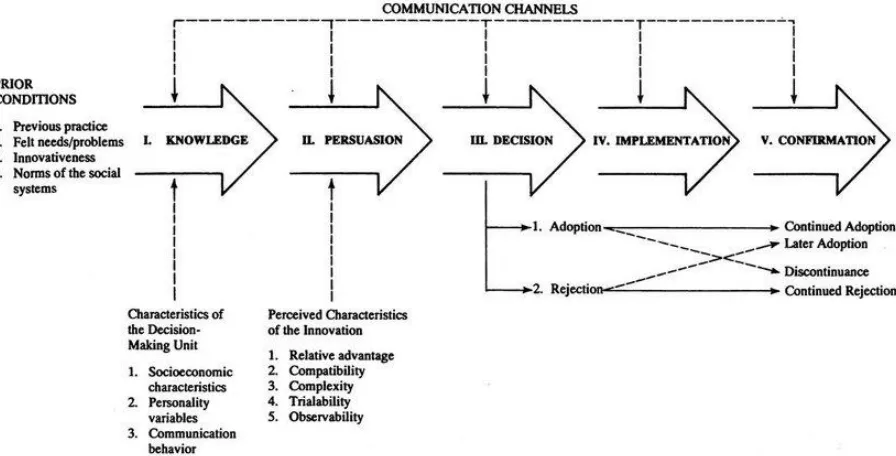
Figure 1: The Innovation-Decision Process Model (created by Rogers 2003) used to guide interpretive program design at Hart’s Mill
Phase 1: Community Perspectives Regarding Technology in Nature
Phase 1 of our study was designed to address objectives 1 and 2, which characterized community perceptions towards the use of technology as an environmental education tool and the factors that influenced those perceptions. All members were invited via email to participate in an initial focus group to establish design priorities for an interpretive productfor the community. With Hart’s Mill being a small community, only six members agreed to participate. Even though it was a small participant group, members from the general circle, land stewardship circle,
planning, design, and development circle, financial and legal circle, and governance and training circle were present allowing for a representative group of the community and their values. The only circle group not represented was the membership and marketing circle.
flexibility in organizing and describing the qualitative data, producing rich results without having to subscribe to a pre-existing framework.
Results:
Objective 1: Characterize how community members perceive technology use in nature
Even within the small group of participants, the data revealed three major categories of users based on Roger’s DOI typology regarding the use of technology in nature: early adopters supporting technology use, laggards vehemently against it, and majority adopters who could be swayed in their decision. Those in favor clearly recognized the benefits of embracing technology in a rapidly evolving world.
“I believe that the use of technology is important as the world becomes a more technological place.”
“I actually really like the idea of having technology available for those of us who can and want to use it. I mean I would have to learn. I have a smartphone but I’m not as smart as the phone.”
However, others were adamant that this type of technology intrusion would simply be a distraction.
“Minimize! In nature, we have the opportunity to use all of our senses, and in a wide, alert, many-directional way, that is just the opposite of being sucked into your phone. Don’t try to use technology as a bridge, learn to swim in the real world! When my students visit, phone are banned completely.”
“It strikes me as one of [those] deeply seductive temptations. And my experience with young people is that the phone sucks you in and it’s all over at that point.”
Others were a bit reluctant to fully embrace technology but liked having the option, allowing themselves and other recreationists to choose how they engage with nature.
“I’m open to [using technology in nature] provided that technology doesn’t diminish the sheer enjoyment of the natural world.”
“I am fine with [technology] as long as there are a variety of learning options for those who prefer Luddite options.”
Initially, the participants were far from consensus when it came to the use of technology in nature-based environmental interpretation.
Objective 2: Identify factors that influence perceptions of technology use in nature
in age, belonging to the laggard category, tend to be more resistant to technology adoption and focused on traditions and how things have always been done. Among the participants, gender and profession played no role in adoptiveness. Those in the early and late majority adoption categories provide interconnectedness in the social networks by deliberating on the innovation before making a decision towards adoption.
While some participants were resistant to technology use in general, they did see its utility (or perceived usefulness) in attracting new members, and particularly young members. As a community, they hoped to encourage membership among younger people and families; therefore, in their view, they had to consider the use of technology to attract those particular types of innovation adopters. This shift reflected a change of perspective from one of personal usage to one acknowledging the value of technology for others.
“I feel that if it’s an entry for people to come in with their phones so they learn something and then they’ll want to put their phone in their pocket and experience something. Then to me, that works.”
“I feel like I would like something that would make us more relevant to the younger generations. I think we need that, and I feel like it’s the gateway drug maybe.” However, others believed that using technology would take away from the nature experience and should be discouraged among its members. They believed that technology contradicted the culture Hart’s Mill hoped to instill, which revolves around direct experience with the land.
“If you make it easy for people to go into the forest with their phones, then they will never go in without using [technology] as a way of seeing [nature].”
“The part of the lesson is to precisely not bring the phone into the woods, rather than turn the woods into an adjunct world you access in the same way.”
“Can we start off with something non-technological? And upgrade when I die? I almost would rather it be less educational and more experiential.”
To some community members, the idea of having any kind of technology displayed along the trails raised concerns about aesthetic impacts.
“To me, walking through the woods and seeing [technology displayed] would be profoundly disheartening. The whole wild world is getting shrunk into something that is sized for technology and just a radical reduction. I wouldn’t even want to do it.”
Other members believed forms of technology could be useful for educating and providing current information dependent on how easy the technology would be to use by members and visitors.
“This would be a way of having a website where one could go and [access] some other learning that is related to [what the visitors saw along the trail]”
“What would be interesting too, is if over time we could work with it seasonally so that we can shift it to fall and spring.”
In the end, regardless of rationale, there was a significant divide among participants on their stances in support or in opposition to using technology in nature. Due to their dedication towards consent-based decision making, the participants (some reluctantly) concluded the focus group with an agreement to attempt a “trial run” for incorporating technology into their new interpretive program.
Phase 2: Integrating Technology into Interpretive Program Design & Implementation
Phase 2 of our study focused on addressing research objectives 3 and 4 by building on the final steps in Rogers’ (2003) Innovation-Decision Process model (Fig 1) and using results from the Phase 1 survey and focus group data to a) design an interpretive product for Hart’s Mill and b) document how this process changed participants’ opinions on the use of technology in
interpretive settings.
Objective 3: Integrate beliefs about technology and interpretive design principles to design and implement a technology-based educational tool
To address objective 3, we applied interpretive principals laid out in Ham’s (2013) TORE (Thematic-Organized-Relevant-Entertaining) approach to draft the main content and format for an interpretive program. Participants expressed a preference for a brochure linked to as
interpretive trail as the final product, with mixed feelings on how or if technology should be used in conjunction with the experience. We drew from participants’ survey and focus group
responses from Phase 1 to identify physical and cultural aspects important to Hart’s Mill members and the intended audience for the interpretive effort. In the survey and focus group, participants emphasized an active relationship, or partnership with the land, as an overarching principle. This thinking evolved into the following core theme: “Hart’s Mill is a living landscape where humans and nature are interconnected.” We located points along the trail to place markers that identified different ecosystems or points of interest at the site; these were organized within the brochure to tell a story for the visitors as they walked each trail. Each marker explained different sustainable management practices implemented by Hart’s Mill to make meaningful connections and increase relevance with their interconnectedness with nature.
Given the differing views on technology, we chose to present the Hart’s Mill members with two versions of the brochure. One included written and visual content associated with each of the 12 trail markers, along with a map of the trail (see Appendix A), but no form of technology
integrate QR codes at five of the twelve trail markers. These codes linked to additional resources on topics related to the specific stops on the interpretive trail (e.g., NC beekeeping, Hart’s Mill’s farming practices, slate geology). Because community members wanted to comply with
interpretive best practices by appealing to different learning styles (Brochu & Merriman, 2012), QR codes linked to a mix of websites, videos, and informational guides (see Appendix A for a copy of the brochure).
After initial drafting of the brochure, we held a second focus group with the Hart’s Mill members to obtain feedback and observe reactions to both versions of the brochure. The focus group was held outside on the trail system, which made participation in the focus groups feasible for more community members. Five of the six original participants were present, in addition to five more participants who ranged in membership levels and participated in different circle groups. At the beginning of the second focus group, participants were provided brochures with and without QR codes to refer to. The facilitator explained the purpose of the brochure and demonstrated how to use QR codes. Following the demonstration, participants discussed the brochures, provided feedback, and came to a consensus on which version they preferred to use.
The persuasion stage of Rogers’s Innovation Decision Process (Fig. 1) occurred during the first part of the focus group as they were exploring and discussing the brochures and QR codes, while the decision stage occurred at the end when the participants collectively decided on which version to use. Due to the informal outdoor setting, only field notes were collected by the facilitator, in addition to any edits and comments that participants wrote directly on the brochure drafts. These field notes reflect the journaling style of data collection often used as an
unobtrusive observational technique by researchers in park settings (Miles et al., 2013). Data from this second focus group and the corresponding field notes were again analyzed using open and axial coding.
Phase 2 Results:
Regardless of whether or not the brochure contained QR codes, initial reactions to the brochure were positive and enthusiastic. Members appreciated features of the brochure such as the trail map, brochure layout, color scheme, images, and overall informative content. When looking at the brochure with QR codes, some participants claimed not to notice them at first and asked “Where are they?” This is important to note considering many participants were worried about the aesthetic costs of using technology such as QR codes, fearing they would detract from the nature experience.
that the tangible technology-mediated benefits provided by immediate access to external resources far outweighed the minimal aesthetic costs.
After reading the brochure, a participant who had been strongly against the use of technology stated, “I personally wouldn’t use them, but I didn’t feel as if I was missing out on anything by not using [the QR codes]”. This reassured other members, who feared that visitors without smartphones would feel excluded or not have sufficient information for each marker. Additionally, another participant noted: “I really think these QR codes will make us more inclusive among younger generations.” Towards the end of the discussion, the facilitator demonstrated how the entire brochure could be converted into a QR code, resulting in one participant enthusiastically suggesting, “We should post that out here on the trail for those come to walk the trail but don’t have the paper version.”
Throughout the facilitator’s demonstrations and group discussion, the participants progressed through Rogers’ persuasion stage of the innovation diffusion process (Fig. 1) as they became interested in the innovation and gathered information about it. Successfully using the QR codes for the first time reinforced the perceived ease of use and low complexity of the innovation. In addition, the perceived usefulness and relative advantage of the QR codes was evident as participants noted the convenience of QR codes providing additional resources, the minimal space requirement within the brochure, the perceived appeal and inclusivity among younger generations, and ability to make the brochure available to anyone on the trail.
Collectively, these factors convinced many participants, including those who were initially reluctant, to support adoption of QR code technology into the interpretive brochure. Despite initial hesitation, the participants therefore reached the third stage of Rogers’ innovation decision process (Figure 1) and came to a collective decision to use the brochure with QR codes.
Discussion
Characteristics of the decision-making group and individual variations within adopter category characteristics set the stage for consensus building, allowing for conflicting perspectives to be addressed while moving towards informed and collective decisions. Members also rejected certain underlying socioeconomic assumptions (Rogers, 2003) that early adopters would be younger in age and laggards would have lower economic status and less years of formal
education resulting in lower intelligence and literacy rates. These deviations in education levels and economic well-being support increases in one’s willingness to adopt new innovations by increasing self-confidence, risk-taking behaviors, and receptiveness to novel information among adopters (Wejnert, 2002).
Wejnert’s (2002) study on adopter characteristics also explains how Hart’s Mill’s social and governing style allowed them to act as a small collective entity with high rates of interpersonal communication and social interactions. Such factors likely increased their willingness to adopt innovations and expedited their rate of adoption compared to other contexts where individual decision making is the norm. Additionally, participants’ social equivalence, network
connectedness, and interpersonal relationships aided in their willingness to adopt new technology (Wejnert, 2002).
Our study demonstrated how iterative, community engaged interpretive planning can help build consensus around technology use and selection and adoption of “best fit” technologies,
particularly when highlighting perceived usefulness and ease of use. Both the DOI and TAM models suggest that technologies with high usefulness and ease of use are more readily adopted than more complex technologies (Rogers, 2003; Davis, 1989; Scherer, Siddiq, and Tondeur, 2019). For example, Lai et al (2013) utilized the TAM method to evaluate teachers’ willingness to accept and adopt QR codes in outdoor settings, showing that the ease of use and usefulness of QR codes had a positive effect on teachers’ willingness to adopt them in the future. At Hart’s Mill, participants quickly saw the extended educational benefits of the QR approach, which allowed for a deeper level of engagement with topics of interest for visitors who chose to pursue that kind of free-choice learning. Gates (2019) highlighted similar benefits, noting how
technology can provide digital opportunities for visitors to engage with and learn from the interpretive program that extend beyond the site itself. The creation of two brochures, one with and one without QR codes, allowed for Hart’s Mill members to experience the benefits of having the QR codes before making a final decision. It also allowed for a more confident decision by reducing the risk of adopting new ideas, which can increase the rate of adoption through trialability and observability (Rogers, 2003).
The marriage of technology with high quality interpretive principles could also help to explain adoption in this context. Studies show that mobile devices can increase learning in informal settings when implemented as educational tools avoiding oversaturation of technology (Crawford, Holder, & O’Conner, 2017; Crompton & Burke, 2018; Eliasson et al., 2011;
process helped create a mentality receptive to potential adoption and facilitate the diffusion of innovation process.
Lastly, throughout the innovation-decision process, participants were introduced to QR codes multiple times and were given multiple demonstrations on how they were used. Studies show that the rate of adoption increases as the novelty of an innovation decreases and familiarity increases (Wejnert, 2002). While this study concluded with the decision stage to adopt the QR codes, the final stages of Rogers’ innovation decision process (implementation and confirmation) will occur as Hart’s Mill uses the brochure and receives feedback from both community
members and visitors. This feedback and evaluation could be used to inform future use of the QR-coded interpretive brochure or development and design of related products that may or may not incorporate technology.
Conclusion
Social trends suggest that technology will continue to increase, impacting both the time humans spend in nature and the interpretive programming designed to foster human-nature connections. Interpretive efforts must adapt and respond to these changes (for example, see InterpTech 2019). But how might this process be facilitated when many cringe at the notion of videophilia
technology-mediated experiences in nature (Pergams & Zaradic, 2006)? Our analysis of the interpretive planning exercise at Hart’s Mill demonstrates that individuals within the laggard category should not be discounted when it comes to technology integration, especially when a larger community network exists with diverse perspectives that could facilitate behavior change. Understanding where people are on the DOI spectrum should influence the choice of technology, leading to solutions that are compatible with the users’ needs and abilities. While people may enter with polarized views regarding nature-based technology, the TORE planning process can help people see how specific technologies might be best integrated to achieve consensus and advance interpretive goals.
References
Bollinger, D. & Shepard D. E. (2017) An investigation of mobile technologies and web 2.0 tools use in outdoor education programs. Journal of Outdoor Recreation, Education, and Leadership. 9(2), 181-196.
Borrie, W. T. (2000). Impacts Of technology on the meaning of wilderness. In: Watson, Alan E.; Aplet, Greg H.; Hendee, John C., comps. 2000. Personal, societal, and ecological values of wilderness: Sixth World Wilderness Congress proceedings on research, management, and allocation, volume II; 1998 October 24–29; Bangalore, India. Proc. RMRS-P-14. Ogden, UT: U.S. Department of Agriculture, Forest Service, Rocky Mountain Research Station.
Brochu, L. & Merriman, T. (2012) Certified Interpretive Guide Training Workbook. National Association for Interpretation.
Chassiakos, Y. R., Radesky, J., Christakis, D., Moreno, M. A., & Cross, C. (2016) Children and Adolescents and Digital Media. Pediastrics, 138(5), 1-18.
Cole, H., & Stanton, D. (2003) Designing mobile technologies to support co-present collaboration. Personal and Ubiquitious Computing, 7(6), 365-371.
Crawford, M. R., Holder, M. D., & O’Connor, B. P. (2017). Using mobile technology to engage children with nature. Environment and Behavior, 49(9), 959-984.
Crompton, H. & Burke, D. (2018). The use of mobile learning in higher education: A systematic review. Computers and Education 123, (2018), 53-64.
Dawson, C. P. (2007) New opportunities for educating future wilderness and wildland managers in a changing technological world. International Journal of Wilderness, 13(3), 36-39.
Davis, F. D. (1989) Perceived usefulness, perceived ease of use, and user acceptance of information technology. MIS Quarterly, 13(3), 319-340.
Demographics of Mobile Device Ownership and Adoption in the United States. (2019, June 12). Retrieved November 19, 2019, from
https://www.pewresearch.org/internet/fact-sheet/mobile/.
Dibra. M. (2015). Rogers theory on diffusion of innovation – The most appropriate theoretical model in the study of factors influencing the integration of sustainability in tourism businesses. Socia and Behavorial Sciences, 195 (2015), 1453-1462.
Dickson, T. J. (2004) If the outcome is predictable, is it an adventure? Being in, not barricaded from the outdoors. World Leisure, 46(4), 49-54.
Ewert, A. W., Schultis J. D. (1999) Technology and backcountry recreation. Boon to recreation or bust for management? Journal of Physical Education, Dance, and Recreation, 70(8), 23-28.
Gates, E. (2019). Digitizing Maslow: meeting visitors’ needs in the 21st Century. Legacy, 30(5), 12-14.
Goth, C., Frohberg, D., & Schwabe, G. (2006) The focus problem in mobile learning. In: Proceedings of the Fourth IEEE International Workshop on Wireless, Mobile, and Ubiquitous Technology in Education, 153-160.
Ham, Sam. (2013) Interpretation: Making a difference on purpose. Golden, Co. Fulcrum Publishing.
Hanover Research. (2017) 2017 Digital Study Trends Survey. McGraw-Hill Education.
Heinz, M., Martin, P., Margrett, J. A., Yearns, M., Franke, W. (2013) Perceptions of Technology among Older Adults. Journal of Gerontological Nursing, 39(1), 42-51.
Hendee, J. C., Dawson, C. P. (2001) Stewardship to address the threats to wilderness resources and values. International Journal of Wilderness, 7(3), 4-9.Kacoroski J., Liddicoat K. R., & Kerlin S. (2016) Children's use of iPads in outdoor environmental education programs. Applied Environmental Education & Communication, 15(4), 301-311.
Kacoroski, J., K. Liddicoat, and S. Kerlin. 2016. Children’s use of iPads in outdoor environmental education programs. Applied Environmental Education & Communication, 15(4):301–311.
Kahn, P. H., Jr. (2011). Technological nature: Adaptation and the future of human life. Cambridge, MA: MIT Press.
Kaufman, J. A., & McNay, G. D. (2017). At the intersection of technology and nature: The potential for a bright green future. Ecopsychology, 9(4), 253-259.
Kellert, S. R. (2002). Experiencing nature: Affective, cognitive, and evaluative development in children. In P. H. Kahn & S. R. Kellert (Eds.), Children and nature: Psychological, sociocultural, and evolutionary investigations (pp. 117-151). Cambridge, MA: The MIT Press.
Lai, H., Chang, C., Li, W., Fan, Y., Wu. (2013) The implementation of mobile learning in
outdoor education: Applications of QR codes. British Journal of Educational Technology, 44(2), 57-62.
Larson, L. R., Szczytko, R., Bowers, E. P., Stephens, L. E., Stevenson, K. T., & Floyd, M. F. (2018). Outdoor time, screen time, and connection to nature: Troubling trends among rural youth. Environment and Behavior, 00(0), 1-26.
Miles, Matthew B., A. Michael Huberman, and Johnny Saldana. 2013. Qualitative data analysis:
A methods sourcebook. Thousand Oaks: Sage
Naismith, L., Sharples, M., & Ting, J. (2005) Evaluation of CAERUS: A context aware mobile guide. In Proceedings of the 4th World Conference on mLearning, 112-115.
Pergams, O. R., & Zaradic, P. A. (2006). Is love of nature in the US becoming love of electronic media? 16-year downtrend in national park visits explained by watching movies, playing video games, internet use, and oil prices. Journal of environmental Management, 80(4), 387-393.
Peterson, T. R , Wittie, K., Enkerlin-Hoeflich, E., Espericueta, L., Flora, J. T., Florey, N., Loughran, T., & Stuart, R. (1994) Using informant directed interviews to discover risk orientation: How formative evaluations based in interpretive analysis can improve persuasive safety campaigns. Journal of Applied Communication Research, 22(1994), 199-215.
Prensky, M. (2001) Digital natives, digital immigrants Part 1. On the Horizon, 9(5), 1-6.
Oblinger, D. (2003) Boomers, Gen-Xers, and Millennials: Understanding the "New Students". EDUCAUSE review, (2003).
Rogers, E. M. (2010). Diffusion of innovations. Simon and Schuster.
Scherer, R., Siddiq, F., & Tondeur, J. (2019) The technology acceptance model (TAM): A meta-analytic structural equation modeling approach to explaining teachers’ adoption of digital technology in education. Computers and Education, 129, 13-35.
Schneider, J., & Schaal, S. (2018). Location-based smartphone games in the context of environmental education and education for sustainable development: fostering
connectedness to nature with Geogames. Environmental Education Research, 24(11), 1597-1610.
Siddiq, F., Scherer, R., & Tondeur, J. (2016) Teachers’ emphasis on developing students’ digital information and communication skills (TEDDICS): A new construct in 21st century education. Computers and Education, 92-93, 1-14.
Stangor, C., Jhangiani, R., & Tarry, H. (2014) Principles of social psychology. Minneapolis, MN: BCcampus OpenEd.
Taherdoost, H. (2018). A review of technology acceptance and adoption models and theories. Procedia Manufacturing, 22(2018), 960-967.
Tarng, W., & Ou, K. (2012). A study of campus butterfly ecology learning system based on augmented reality and mobile learning. In: IEEE Seventh International Conference on Wireless, Mobile and Ubiquitous Technology in Education, 62–66.
Vaportzis, E., Clausen, M. G., Gow, A. J. (2017) Older adults perceptions of technology and barriers to interacting with tablet computers: A focus group study. Frontiers in Psychology, 8(2017), 1-11.
Walter, P. (2013) Greening the Net Generation: Outdoor Adult Learning in the Digital Age. Adult Learning, 24(4), 151-158.
Appendix A