Department of ECE, Adhiyamaan College of Engineering, Hosur, Tamilnadu, India.
Real Time Face Recognition using
Raspberry Pi II
A.Viji1, A.Pavithra2
Department of Electronics Engineering, Madras Institute of Technology, Anna University, Chennai, India1
Department of Electronics Engineering, Madras Institute of Technology, Anna University, Chennai, India2
ABSTRACT: In present day human machine interface is increasingly emerged in demand and human activities is identified by the machine. When the machine identifies the human activities, it will improve the efficiency of task. Limited work is done in face recognition in real time. In this proposed method is to perform the face recognition using PCA algorithm with Haar cascade classifier. In this method we use three steps such as face detection using Haar cascade classifier, feature extraction using PCA algorithm, classification of images by Ada boost classifier. The novelty of this proposed method is implementation of Real time Face recognition using raspberry pi II and average accuracy of 93% is achieved at real time.
KEYWORDS: Face Recognition, Feature Extrcaction, PCA algorithm, Raspberry Pi,Viola Jones Detection.
I. INTRODUCTION
Nowadays face recognition is acquiring much importance by multimedia information access, real time applications, human machine interaction etc. the face recognition is one of the biometric methods that serve as important tool for real time applications. The face recognition is done by recognizing frontal images of human faces. Tim Ahonen et.al [2], 2006 pointed out a novel and efficient facial image representation using LBP features. The facial image is divided into several regions in which the feature extraction is performed by the LBP Feature extraction. The face recognition analysis is important component for most of the applications. Face recognition is already well studied but real time method is lacking as it performs efficiency of recognition. It will estimates image with even low quality images .Most of the work is based on frontal images with different illumination conditons.when face recognition isperformed in real time method, these conditions are not uniform.
In this proposed method, the face recognition is performed by using real time databases consisting of various poses and illumination conditions. The system that uses raspberry pi II as the size is found to be very small and light weighted .it is important that it requires very less amount of power supply.it is used for various applications such as smart home applications, surveillance, security issues etc.. This paper is organized as section 2 outlines the background work, section 3 discusses the proposed work, and section 4 reported the analysis and conclusion and future work in last section.
II. LITERATURE SURVEY
There are lot of decades in which this research works on recognition and analysis have been carried out for various applications related to human machine interaction.
Department of ECE, Adhiyamaan College of Engineering, Hosur, Tamilnadu, India.
feature descriptor are extracted by dividing facial images into various regions. In 2014 kamesh [5] used active appearance model and local binary pattern where AAM is generic based approach and local binary pattern is hybrid approach .
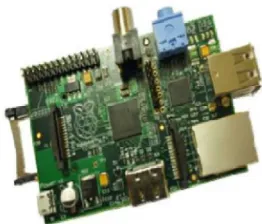
Figu.1: Circuit Board of Raspberry Pi II
After the extraction of features different classifiers are used for face recognition, such as support vector model SVM[3], neural networks,ada boost classifier ,least mean square etc. the software testing is done by creating real time databases .Each directory contains 30 images of individual. Later hardware implementation is performed by raspberry pi along with hardware set up.
III. PROPOSED METHOD
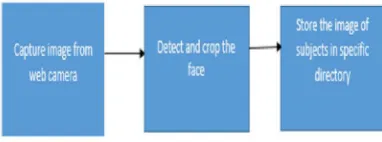
In this proposed method, the objective is to develop the real time face recognition from the facial images.it is performed using real time database which is collection of images from 10 subjects. The images of each subject is stored in specific directory with 30 images .Each image size is of about 100*130pixels. The viola jones detection algorithm is used for face detection whereas PCA algorithm is used for feature extraction and then Ada boost classifier is used for face recognition.Raspberry pi II is the credit card sized computer which contains system on chip Broadcom BCM 2836 with CPU,GPU,DSP,SDRAM .The CPU is made up of quad core ARM cortex running at 200 MHz. The architecture of proposed system is displayed in Figure 3 and explained as follows: The input image is captured from web camera and fed into the real time face recognition system as input. The real time face recognition is deployed with the Raspberry pi II which gives the identified image asoutput.This output is displayed in the monitor of the system .The operation of real time face recognition is displayed in Figure 1.
Department of ECE, Adhiyamaan College of Engineering, Hosur, Tamilnadu, India.
Figure 3. Creation of real time database
The algorithm for real time implementation of face recognition using raspberry pi II is explained as follows:
Step 1:Input image is captured from web camera
Step 2:The facial image is detected by using Viola – Jones face detection technique. The integral image is developed by using Haar wavelet concept to detect the face. It consider the different intensity of values of adjacent rectangular regions. The different areas of face have different intensity. Face is detected and pointed by using rectangular box.
Step 3:Feature extraction is performed by using the PCA algorithm. The training images is prepared for equal size and all images are centered. All images in the database is transformed into vector and placed in training set. The average face vector is calculated from images and it is subtracted from all original images in database. These values are stored in specific variable. The Eigen values and Eigen vectors are calculated. Keep the largest Eigen vectors that corresponding to the largest Eigen values that contains large characteristic features of image.
Step 4:The classification of image is performed by Adaboost classifier that provides classification learning task.it is very simple and flexible classifier that combines with any learning algorithm. It is powerful committee that combines the performance of many weak classifiers.
Figure 4.Real Time Face Recognition using Raspberry Pi II
Department of ECE, Adhiyamaan College of Engineering, Hosur, Tamilnadu, India.
IV. RESULTS AND DISCUSSION
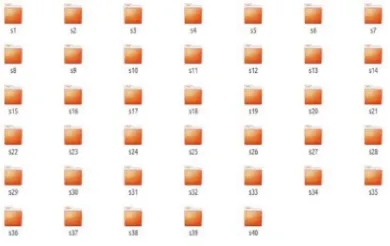
The result for creation of real time database are recorded. The real time database is created by using python . While executing it produces 30 images of each subjects. . Likewise, databases should be created for at least 10 individuals and it creates each image size of about 100*130 pixels of height and width.
Figure 5.Creation of Real Time database
Figure 6.Storing database of each individual in specific directory
Department of ECE, Adhiyamaan College of Engineering, Hosur, Tamilnadu, India.
Figure 8. Implentation using Raspberry pi II
Figure 9.Face recognition using Raspberry Pi II
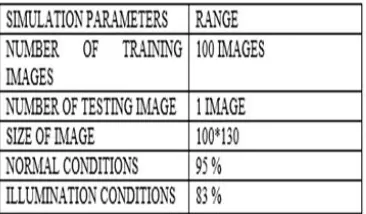
Table 1: Accuracy Of Proposed System
Department of ECE, Adhiyamaan College of Engineering, Hosur, Tamilnadu, India.
The accuracy of 93% is achieved by using Linux environment by average processing time of 100 ms with Raspberry Pi II (ARM1176JZF) as shown in Table 1. Implementation of real time face recognition in Raspberry pi II is novelty approach and it can be used for various application since raspberry pi II is very light weight and it needs only less power supply and it can be mounted on any device and used for various applications.
V. CONCLUSION AND FUTURE WORK
In this paper, we have proposed a method of Real time face recognition based on PCA algorithm using Raspberry pi II .we have achieved an overall accuracy of 95% with average processing time of 100 MS on Linux platform with python software coding using Raspberry Pi II (ARM1176JZF, 900 MHz).When the dispalyscreen is attached to the set up ,it can display face recognition under surveillance of hospitals,banks,authentication of entry etc. Our proposed work is more useful for society in various applications as face recognition plays major role. In future work, different algorithm for feature extraction can be implemented to improve accuracy of recognition. The face recognition with Raspberry Pi II can be applied for authenticated users in security basis. And it can be performed by various techniques inorder to achieve accuracy.
REFERENCES
[1] Paul V., Michael J., ‘Robust Real-time Face Detection’, International Journal of computer vision, May 2004, Volume 57, Issue 2, pp 137-154
[2] Ahonen, T., Hadid, A., Pietikainen, M., 2006. ‘Face description with local binary patterns: application to facerecognition’ IEEE Transaction on Pattern Analysis and Machine Intelligence 28, 2037–2041.
[3] An, W., Liang, M., (2013) ‘Fuzzy support vector machine based on within-class scatter for classification problems with outliers or noises.’ Neurocomputing 110, 101–110.
[4] Battaglia, F., Iannizzotto, G., Lo, Bello L., (2014) ‘A biometric authentication system based on face recognition and RFID tags’. Mondo Digitale 13 (49), 340–346.
[5] Kamlesh Mistry, Li Zhang, Siew Chin Neoh, Ming Jiang, Alamgir Hossain, BenoîtLafon, “Intelligent Appearance and Shape based Facial Emotion Recognition for a
[6] Humanoid Robot” Software, Knowledge, Information Management and Applications (SKIMA), 2014 8th International Conference, pp 1-8, Dhaka.
[7] Bernhard E.B., Isabelle M.G., Vapnik V., Vladimir N.,(1992). ‘A training algorithm for optimal margin classifiers’. 5th Annual ACM Workshop on COLT, Pittsburgh, pp.144–152.
[8] Devi, H.S., Laishram, R., Thounaojam, D.M., (2015). ‘Face recognition using R-KDA with non-Linear SVM for multi-view Database’. Procedia Computer Science 54, 532-541
[9] Korea.Wen-Hui Lin,Ping Wang, Chen-Fang Tsai (2016) ‘Face recognition using support vector model classifier for user authentication’
[10] Felipe Cid, Jos´e Augusto Prado, Pablo Bustos and Pedro Nunez, A Real Time and Robust Facial Expression Recognition and Imitation approach for Affective Human[10] Robot Interaction Using Gabor filtering, IEEE, Intelligent Robots and Systems (IROS), RSJ International Conference, pp 2188 – 2193, 2013. Paul V., Michael J., ‘Robust Real-time Face Detection’, International Journal of computer vision, May 2004, Volume 57, Issue 2, pp 137-154
[11] Michel F. Valstar, Member, IEEE, And Maja Pantic, Senior Member, IEEE, Fully Automatic Recognition Of TheTemporal Phases Of Facial Actions, IEEE Transactions On Systems, Man, And Cybernetics—Part B: Cybernetics, Vol. 42, pp 28 – 43,2012 [12] Peng Zhao-yi, Zhu Yan-hui, Zhou Yu, Real-time Facial Expression Recognition Based on Adaptive CannyOperator Edge