Effective and Efficient Re-optimization
Method for Data-Stream Partitioning at
Runtime
Shinde Sumit SudhakarP.G. Student, Dept. of Computer Engineering, Dhole Patil College of Engineering, Wagholi, Pune, India
ABSTRACT: Stream process has gathered interest for its ability to investigate giant amounts of information in time period. The rising quantity of information generated by connected devices and enterprise sensors makes it particularly vital for today’s analytic systems to scale expeditiously
.
The long-running nature of continuous queries poses new scalability challenges for dataflow processing.With tremendous use of distributed network and sensor network data is now getting generated in huge. This generated data is processed in terms of streams. In distributed knowledge stream process, partitioning input streams in keeping with the values of specific attributes, or partitioning keys a program with multiple queries is parallelized. Applying completely different partitioning keys to different queries needs re-partitioning. It cause further communication and reduce throughput. By adding Auto-parallelization technique this work is extended for compile-time to run-time. This Auto-parallelization technique involves locating regions in the application’s data flow graph that can be replicated at run-time to apply data partitioning, to achieve scale. This work, propose an elastic auto-parallelization solution that can dynamically adjust the number of channels used to achieve high throughput without unnecessarily wasting resources. A runtime re-optimization step supported the mining of temporal approximate dependencies (TADs) between partitioning keys. The partitioning strategy of a program powerfully affects its performance. A method that allocates completely different partitioning keys to serial queries would require re-partitioning the intermediate stream between the queries, inflicting additional communication. To avoid re-re-partitioning and minimize this additional communication price, existing optimization ways think about compile-time optimization to either reconcile conflicting needs or perform “look ahead partitioning. In compile-time question analysis and optimization is employed to acknowledge dependencies between the partitioning needs, or candidate keys, of serial queries and avoid re-partitioning. Because of their static nature, compile-time optimization ways fail to acknowledge “dynamic” dependencies that are solely valid inside a particular time window.KEYWORDS: Data-Stream Partitioning, Auto-parallelization, Runtime Optimization, TAD I. INTRODUCTION
answer is returned. So, stream-based applications push data to a system, that get must evaluate queries in response to detected events et.al.[5].
Data Stream Management Systems (DSMS) are gaining acceptance for applications that need to process very large volumes of data in real time.Detecting dependencies between the partitioning keys applicable to every question Re-partitioning may be avoided. Existing work for partitioning optimization analyse question query syntax at compile-time hence observe inter-key dependencies to avoid re-partitioning.The partitioning strategy of a program powerfully affects its performance.Compile-time optimization presents its static nature of computing. Because of their static nature, compile-time optimizationways fail to acknowledge “dynamic” dependencies that aresolely valid insidea particular time window.A method that allocates completely different partitioning keys to twoserial queries requires re-partitioning. To avoid this re-partitioning and to minimize this additional communication price, existing optimizationwaysthink about compile-time optimization to either reconcile conflicting needs or perform “look ahead partitioning”. In compile-time question, analysis and optimization concept is employedto acknowledge dependencies between the partitioning needs or candidate keys of serial queries hence avoid re-partitioning. As the world becomes more interconnected and instrumented, there is a bulk flow of data coming from various software and hardware sensors in the form of continuous data streams. Examples can be found in several domains, such as financial markets, telecommunications, manufacturing, and healthcare. In all of these domains there is an increasing need to gather, process, and analyse these data streams to extract insights as well as to detect emerging patterns and outliers.
Recognizing associate approximate dependency between vehicle and road segments, thatis merelyinvalidonce a vehicle enters a brand newsection, would enable a partitioning optimizer to uniformly partition all queries by section, therefore avoiding a pricey re-partitioning between vehicle-partition able and segment-partition able queries. This case is off-course not restricted to the Linear Road Benchmark, togetherwill imagine similar cases happening in numeroustypes of geospatial observance or analysis systems.As a result, those ways miss re-optimization opportunities that wouldadditionalcut backthe amount of re-partitioning. Samples of such thingsembody the Linear Road Benchmark (LRB), during which queries ispartitioned off either by vehicle or by road section.
In this project work, work shows tendency to extend existing compile-time optimizationways by adding a re-optimization step supported runtime dependency mining. For this purpose, outline temporal approximate dependencies (TADs) as dynamic, approximate dependencies between moving entities over a time window. Streaming systems, it necessitates taking advantage of host machine to achieve scalability. This requirement will become even more prominent with the ever increasing amounts of live data available for processing. Small indefinite quantity mining permitsthe invention of methods that use less re-partitioning, leading to reduced communication and probably higher outturn.. The increased affordability of distributed and parallel computing, thanks to advances in cloud computing and multi-core chip design, has made this problem tractable.
II. RELATED WORK
T. Johnson, M. S. Muthukrishnan, V. Shkapenyuk, and O. Spatscheck et.al. [4] Stated Data Stream Management Systems (DSMS) are gaining acceptance for applications that need to process very large volumes of data in real time. In particular, a single-server instance of our DSMS, Gigascope, cannot keep up with the processing demands of the new OC-786 networks, which can generate more than 100 million packets per second. This work, explore a mechanism for the distributed processing of very high speed data streams. The load generated by such applications frequently exceeds by far the computation capabilities of a single centralized server. Existing distributed DSMSs employ two mechanisms for distributing the load across the participating machines: partitioning of the query execution plans and partitioning of the input data stream in a independent fashion. This work present an alternative approach - query-aware data stream partitioning that allows for more efficient scaling. Presenting methods for analysing any given query set and choose the optimal partitioning scheme, and shows how to reconcile potentially conflicting requirements that different queries might place on partitioning. However, for a large class of queries, both approaches fail to reduce the load as compared to centralized system, and can even lead to an increase in the load.Concluding with experiments on a small cluster of processing nodes on high-rate network traffic feed that demonstrates with different query sets that our methods effectively distribute the load across all processing nodes and facilitate efficient scaling whenever more processing nodes becomes available.
N. Jain, S. Mishra, A. Srinivasan, J. Gehrke, J. Widom, H. Balakrishnan, U. Cetintemel, M. Cherniack, R. Tibbetts, and S. Zdonik et.al. [5] Describes a unification of two different SQL extensions for streams and its associated semantics. Time-based execution provides a way to model simultaneity while tuple-based execution provides a way to react to primitive events as soon as they are seen by the system. Used the data models from Oracle and Stream Base as examples. Oracle uses a time-based execution model while Stream Base uses a tuple-based execution model.
Arasu, S. Babu, and J. Widom, et.al. [6] CQL, a continuous query language, is supported by the STREAM prototype data stream management system (DSMS) at Stanford. Most of the CQL language is operational in the STREAM system. CQL is an instantiation of our abstract semantics using SQL to map from relations to relations, window specifications derived from SQL-99 to map from streams to relations, and three new operators to map from relations to streams.CQL is an expressive SQL-based declarative language for registering continuous queries against streams and stored relations. Beginning with presenting an abstract semantics that relies only on black-box mappings among streams and relations. From these mappings we define a precise and general interpretation for continuous queries. Work presents the structure of CQL's query execution plans as well as details of the most important components: operators, inter operator queues, synopses, and sharing of components among multiple operators and queries. Examples throughout the work are drawn from the Linear Road benchmark recently proposed for DSMSs. It also curate a public repository of data stream applications that includes a wide variety of queries expressed in CQL. The relative ease of capturing these applications in CQL is one indicator that the language contains an appropriate set of constructs for data stream processing.
III.IMPLEMENTATION DETAILS
A. Existing System:
In case of existing system, it is working to process data streams at compile time. System optimizes the data stream during compilation according to the value of specific attributes or desired partitioning key. As the need of re-partitioning increases because of applying independent re-partitioning keys, it cause extra communication overhead in turn reduce throughput of the system. Existing system analyse query syntax to detect inter-key dependencies at compile time to avoid re-optimization. But this methodology still maintains system nature static and not works over moving time period.
B. Problem Statement:
Adding a runtime re-optimization method to enhance the compile-time methods based on the mining of temporal approximate dependencies (TADs) between partitioning keys to achieve scalability.
C. Proposed System:
In proposed system our aim is to implement a data stream processing system which will re-optimize the queries at runtime by checking the dependencies to avoid re-partitioning by extending existing compile-time methods. This system will able to reduce the communication overhead caused by the static data stream processing system which is optimizing queries at compile time. Objective of this work is to check dependencies at runtime over moving time window by avoiding re-partitioning.
D. System Architecture:
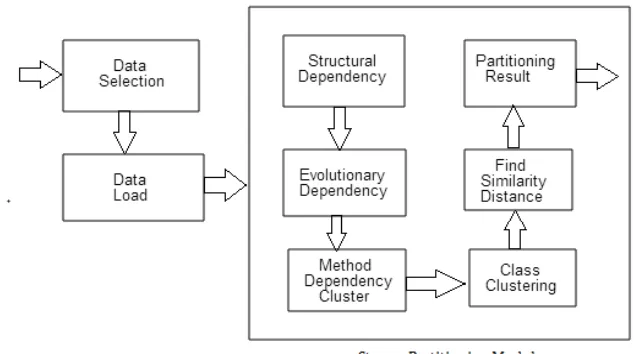
Following diagram shows system architecture.
Fig 1: System Architecture
E. Mathematical Model:
Existing System
Process: X Y: embedded traditional FD on R Tp: a pattern tableau
– attributes: X Y
– each tuple in Tp consists of constants and unnamed variable
Output:
A, B, C D, E (support, confidence)
Where support= count(A,B,C,D,E)/database_size Confidence= count(A,B,C,D,E)/count (A,B,C) Find all rules which satisfy minsupp
Find all itemsets which satisfy minsupp
Proposed System
TAD main function
Inputs: m-dimensional vectors X1,X2,…,Xn
Outputs: A partition of X1,X2,…,Xn into K clusters TAD (X1, X2,…,Xn)
Initialize (X1, X2… Xn); while (Num_Clusters>K)
for (each cluster Ci) //message sending Cj=Find_Nearest_Neighbor (Ci); Msg_Send (Ci,Cj);
for (each cluster Ci) //message receiving Cj=Msg_Rcv (Ci) // check message if (Cj not equal to NULL)
New Cluster C’= Merge (Ci, Cj); Num_Clusters= Num_Clusters-1;
Msg_Send (Ci, Cj) //send a message from Ci to Cj Ci.TO=j;
Cj.FROM=i;
Msg_Rcv (Ci) //check the message box if (Ci.FROM=Ci.TO=j) //find mutually returnCj;
else
F. Result Set :
The work is going to reduce the optimal partitioning for better performance of compile time and re optimization process. Performance evaluation of our TAD mining algorithm is required to confirm the feasibility of runtime re-partitioning method.
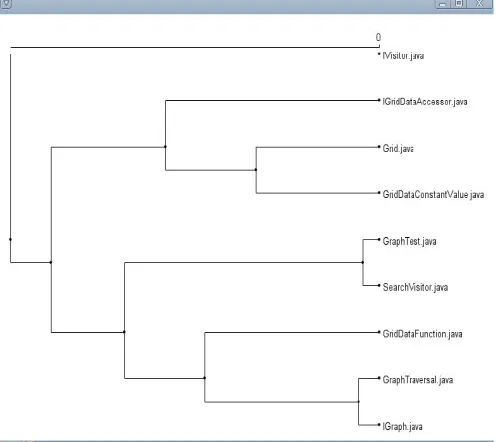
Fig. 2 Clustering Performance
Fig. 3 Partitioning Result IV.CONCLUSION
Adding customizable runtime dependencies, the Compile-time optimization method partition existing optimization methods and offers a runtime framework based on the mining phase. Windows dynamic dependencies between data stream query is defined. Used mining strategies reduce communication and potential re-partitioning, results in higher throughput.
V. FUTURE WORK
This work is at very early stage, hence implementation of the exception handling and related runtime strategy switching is a challenge. A real life evaluation need to be carried out for throughput and scalability. Performance evaluation of TAD dependency mining algorithm is required to conform the feasibility of runtime re-optimization method.
REFERENCES
1. EmericViel, Haruyasu Ueda, Data Stream Partitioning Re-Optimization Based on Runtime Dependency Mining,in ICDE Workshop 2014 978-1-4799-3481-2/14/ 2014 IEEE
2. Bugra Gedik, scott Schneider, Martin Hirzel, and Kun-Lung Wu, "Elastic Scaling for Data Stream Processing", in IEEE Transactions on parallel and distributed Systems, pp.1447-1463, 2014.
3. M. A. Shah, J. M. Heller stein, S. Chandrasekaran, and M. J. Franklin, "Flux: an adaptive partitioning operator for continuous query systems", in Proc. ICDE03, pp.25-26 2013.
5. N. Jain, S. Mishra, A. Srinivasan, J. Gehrke, J. Widom, H. Balakrishnan, U. Cetintemel, M. Cherniack, R. Tibbetts, and S. Zdonik, "Towards a streaming SQL standard", in Proc. VLDB Endowment, vol. 1, pp. 1379-1390, Aug. 2008.
6. StreamBase. (2013) StreamSQL Guide. [Online]. Available: http:// www.stream base.com /developers /docs/latest/streamsql
7. M. Cherniack, H. Balakrishnan, M. Balazinska, D. Carney, U. Cetintemel,Y. Xing, and S. B. Zdonik, "Scalable distributed stream processing, in Proc.CIDR03, 2003, pp. 257-268.
8. A. Arasu, M. Cherniack, E. F. Galvez, D. Maier, A. Maskey, E. Ryvkina,M. Stonebraker, and R. Tibetts, "Linear road: a stream data managementbenchmark", in Proc. VLDB04, 2004, pp. 480-491.
9. D. DeWitt and J. Gray, "Parallel database systems: the future of high performance database systems", in Communications of the ACM, vol. 35, pp. 85-98,Jun. 1992.
10. D. J. Abadi, Y. Ahmad, M. Balazinska, U. Cetintemel, M. Cherniack, J-H.Hwang, W. Lindner, A. Maskey, A. Rasin, E. Ryvkina, N. Tatbul, Y. Xing, andS. B. Zdonik. "The design of the borealis stream processing engine", in Proc.CIDR05, 2005, pp. 277-289.
BIOGRAPHY