ISSN(Online): 2319-8753 ISSN (Print): 2347-6710
I
nternational
J
ournal of
I
nnovative
R
esearch in
S
cience,
E
ngineering and
T
echnology
(A High Impact Factor, Monthly, Peer Reviewed Journal) Visit: www.ijirset.com
Vol. 7, Special Issue 4, April 2018
Smart Mobile App for Electrical Defects
V.P.Sreekantha Kumar1, U. Reshma2, S. Sowndarya3
Associate Professor, Department of Information Technology, KCG College of Technology, Chennai, India1
B.Tech. Students, Department of Information Technology, KCG College of Technology, Chennai, India2,3
ABSTRACT: The Smart Mobile Application for Electrical Defects is to make timely delivery and appropriate action
about the electrical defects occurring anywhere in the public places. Smart Mobile Application for Reporting Electrical Defects provides an open source application for reporting Electrical defects spotted anywhere in the public by any user who spots it. Every user can use this application to report the electrical defects through by signing up for once at the beginning using their information like Name, Contact number, a username and password. The Electricity Board official can sign up using their Employment ID, Employee name, contact number, username, and password. After signing up they can login with their username and password. While reporting the Electrical Defects the user will have to attach a detailed description about the defect spotted, an image of the defect and Location of that place will be automatically detected using the Global Positioning System (GPS). All these attachments will be sent to the cloud database. There in the cloud database the defects reports will be prioritized using the priority scheduling algorithm based on the priority assigned to the case of defect. If the case is emergency, then immediate alert will be given to the Electricity Board official as an emergency alert alarm in the mobile phone. If suppose the EB official is offline, then a phone call and an SMS will be sent to the EB official. The necessary actions will be taken by the EB official for the electrical defect. While reporting the defects if the EB official’s phone is offline or has a bad internet connection then during the times of emergency the defect will be reported using alerts through phone calls and details will be sent through SMS. Then they can use the details for primary processing then later they can use the internet to open application and then navigate to that place. After rectifying the defect, a feedback will be given to the User who reported the defect. This completes the process on rectifying the defect. Then over a period of time the EB official can view the data analyses report to detect the density of defects occurring over a particular region. By viewing this any preventive measures or extra concern can be given to that particular region.
KEYWORDS: Mobile Application, Electrical Defects, Electricity Board, Reporting Defects
I. INTRODUCTION
The main motivation of this project is to create a mobile application reachable to every person to report the electrical defects that occur at many places. Even though people spot electrical defects they are reluctant to report it to the Electricity Board (EB) officials through phone calls or in person. So many complaints are left unnoticed by the EB. Many Electrical accidents occur because less preventive measures are taken. If a mobile application is created with these features, it will help the EB to take more safety measures regarding the defects occurring around. Many electrical defects become accidents because of the less care given towards them. When they are brought into the notice of Electricity Board they can be rectified on time or either preventive measure can be taken to avoid future accidents. Even after complaining through phone calls just because there is no proof for the complaint the EB officials care less about rectifying the complaints. During the times of bad internet connection, the usage applications will be impossible so the application should be feasible with offline during the times of emergency. So while passing information during the times of emergency it should be available offline.
ISSN(Online): 2319-8753 ISSN (Print): 2347-6710
I
nternational
J
ournal of
I
nnovative
R
esearch in
S
cience,
E
ngineering and
T
echnology
(A High Impact Factor, Monthly, Peer Reviewed Journal) Visit: www.ijirset.com
Vol. 7, Special Issue 4, April 2018
report the defects they spot on any public places which is not going to affect them in anyway. Even after reporting the defects because of the lethargies of the EB officials come defects are less noticed. But if there is some proof about the defect report then the rectification process will be done accordingly. The process of passing information during the times of emergency if the internet connection is weak, so the information should be passed even at the times of offline also. This application is applicable to use even offline to pass the details about the defect to the EB officials if the EB official’s phone is offline. Many Electrical accidents occur because less preventive measures are taken. If a mobile application is created with these features, it will help the EB to take more safety measures regarding the defects occurring around.
II. LITERATURE SURVEY
From the base paper, the Application will provide interface to a common man to deliver his complaint and problem to municipal authority and let the authorities of municipal to address the problem early as possible. This application provides interface to register or lodge complaints. The complaint will go with an image of the issue with the sharing of the current location. The location of the complaint is tracked by using Global Positioning System (GPS) to the Municipal Authorities. And t project is to share large scale equipment and resources for computation, storage, information and knowledge for scientific researches. Because of the different objectives and high performance of computing environment, a scheduling algorithm is implemented that outperforms appropriate allocation map of jobs due to different factors.
III. EXISTING SYSTEM
The existing system is a mobile application which allows every citizen to complaint about all types of civic issues they face in their daily life using mobile application. In this paper the application will provide interface to a common man to deliver his complaint and problem to municipal authority and let the authorities of municipal to address the problem early as possible. This application provides interface to register or lodge complaints. The complaint will go with an image of the issue with the sharing of the current location. The location of the complaint is tracked by using global positioning system (GPS) to the municipal authorities. In this paper the proposed mobile based system minimizes the time of the website portal based complaint management system. The users have to just download this application in their mobile phone. Then user has to run the application on their mobile phone to start with a welcome screen. Then they have to lodge complaint. The complaint is routed to complaint processing system block. Then the complaint processing system interpret the citizen complaint to determine the exact nature of the complaint means the department name and a complaint type and other details like land mark, ward no and location which are mandatory required to lodge complaint.
IV. PROPOSED SYSTEM
ISSN(Online): 2319-8753 ISSN (Print): 2347-6710
I
nternational
J
ournal of
I
nnovative
R
esearch in
S
cience,
E
ngineering and
T
echnology
(A High Impact Factor, Monthly, Peer Reviewed Journal) Visit: www.ijirset.com
Vol. 7, Special Issue 4, April 2018
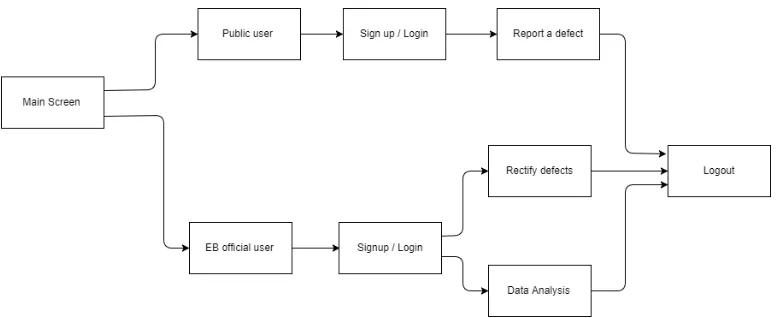
EB official can view the data analyses report to detect the density of defects occurring over a particular region. By viewing this any preventive measures or extra concern can be given to that particular region.
Figure 1: Function diagram of Smart Mobile App for Electrical Defects
V. METHODOLOGY
5.1 Algorithm
There are two main algorithms used in this system they are Priority Scheduling algorithm and the Naïve Bayes algorithm. The Priority scheduling algorithm is used for prioritizing the defects based on their emergency and priority. The Naïve Bayes algorithm is used for the data analysis for prediction of future defects occurring in the regions. The steps involved in the two algorithms are given as follows.
Priority Scheduling Algorithm:
Generally, priority scheduling algorithm is about scheduling the processes based in their priority and importance based on some criteria. In operating system, we use the priority scheduling for the allocating resources in CPU scheduling process. In the same way we are using the priority scheduling for allocating the particular steps of procedure based on their priority.
The priority scheduling algorithm steps goes as follows:
Step 1: Input the processes along with their burst time (bt).
Step 2:Find waiting time (wt) for all processes.
Step 3:As first process that comes need not to wait so
waiting time for process 1 will be 0 i.e. wt[0] = 0.
Step 4:Find waiting time for all other processes i.e. for
process i ->
wt[i] = bt[i-1] + wt[i-1].
ISSN(Online): 2319-8753 ISSN (Print): 2347-6710
I
nternational
J
ournal of
I
nnovative
R
esearch in
S
cience,
E
ngineering and
T
echnology
(A High Impact Factor, Monthly, Peer Reviewed Journal) Visit: www.ijirset.com
Vol. 7, Special Issue 4, April 2018
Step 6:Find average waiting time = Total waiting time / no of processes.
Step 7:Similarly, find average turnaround time = Total turnaround time / no of processes.
Naïve Bayes Classifier Algorithm:
It is a classification technique based on Bayes’ Theorem with an assumption of independence among predictors. In simple terms, a Naive Bayes classifier assumes that the presence of a particular feature in a class is unrelated to the presence of any other feature.
Step 1: Convert the data set into a frequency table
Step 2: Create Likelihood table by finding the probabilities
https://www.analyticsvidhya.com/wp-content/uploads/2015/08/Bayes_41.png
Step 3: Now, use Naive Bayesian equation to calculate the posterior probability for each class.
The class with the highest posterior probability is the outcome of prediction.
5.2 Modules
Signing up and login:
Signing up of public user and the EB official with essential attributes needed like username and password
Reporting the Electrical defect:
The defect report will have a detailed description about the defect, an image and location details
Prioritizing the defects:
Priority scheduling algorithm is used for scheduling the defects and report where the priority factor is decided by the nearest location which is found using the GPS location
Reporting to the EB official and Rectification:
Based on the priority the defect will be reported online and offline and the defects will be rectified, the EB officials can navigate to the location
Analyzing the previous data:
ISSN(Online): 2319-8753 ISSN (Print): 2347-6710
I
nternational
J
ournal of
I
nnovative
R
esearch in
S
cience,
E
ngineering and
T
echnology
(A High Impact Factor, Monthly, Peer Reviewed Journal) Visit: www.ijirset.com
Vol. 7, Special Issue 4, April 2018
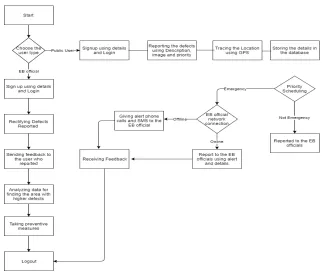
5.3 Flowchart
Figure No. 2 Flowchart of Smart Mobile App for Electrical Defects
VI. CONCLUSION
The results of this system isamobile application which can be used to report any electrical defects spotted in the public. The report will have a description, image and location which will be detected. The EB officials will be alerted based on the Priority of the defect. A feedback will be sent to the one who reported. Analyzing density of defects as per the need of the EB officials for prevention purposes.
REFERENCES
[1] Ankur Chandra, Shashank Jain, Mohammed Abdul Qadeer (2011), “An Application for Location Tracking and Sharing using GPS for JAVA Enabled Handhelds”, International Conference on Computational Intelligence and Communication Systems
[2] Gaurav Gawde, Sharvil Sarfare, Shreyash Naik, Vishal Mistry, Harshal Patil (2016) “Mobile Application for Resolving Citizens Complaints”, International Journal of Advanced Research in Computer Engineering & Technology (IJARCET)
[3] Swachil J. Patel, Upendra R. Bhoi (2014) “Improved Priority based Job Scheduling Algorithm in Cloud Computing usingIterative Method”, Fourth International Conference on Advances in Computing and Communications
[4] Tejaswita Badhe, Madhuri Birajdar, Sucheta Mapari & Prof. P. P. Jorvekar (2017), “Grievance Registration on Mobile Application under Smart City Project", Imperial Journal of Interdisciplinary Research (IJIR)