GENETICS | INVESTIGATION
Maintenance of Quantitative Genetic Variance
Under Partial Self-Fertilization, with Implications for
Evolution of Sel
fi
ng
Russell Lande*,1and Emmanuelle Porcher†
*Department of Life Sciences, Imperial College London, Silwood Park Campus, Ascot, Berkshire SL5 7PY, United Kingdom, and
†Centre d’Ecologie et des Sciences de la Conservation (UMR7204), Sorbonne Universités, MNHN, Centre National de la Recherche
Scientifique, UPMC, 75005 Paris, France
ABSTRACTWe analyze two models of the maintenance of quantitative genetic variance in a mixed-mating system of self-fertilization and outcrossing. In both models purely additive genetic variance is maintained by mutation and recombination under stabilizing selection on the phenotype of one or more quantitative characters. The Gaussian allele model (GAM) involves afinite number of unlinked loci in an infinitely large population, with a normal distribution of allelic effects at each locus within lineages selfed fortconsecutive generations since their last outcross. The infinitesimal model for partial selfing (IMS) involves an infinite number of loci in a large butfinite population, with a normal distribution of breeding values in lineages of selfing aget. In both models a stable equilibrium genetic variance exists, theoutcrossed equilibrium, nearly equal to that under random mating, for all selfing rates,r, up to critical value,
^
r;thepurging threshold, which approximately equals the meanfitness under random mating relative to that under complete selfing. In the GAM a second stable equilibrium, thepurged equilibrium, exists for any positive selfing rate, with genetic variance less than or equal to that under pure selfing; asrincreases above^
rthe outcrossed equilibrium collapses sharply to the purged equilibrium genetic variance. In the IMS a single stable equilibrium genetic variance exists at each selfing rate; asrincreases above^
rthe equilibrium genetic variance drops sharply and then declines gradually to that maintained under complete selfing. The implications for evolution of selfing rates, and for adaptive evolution and persistence of predominantly selfing species, provide a theoretical basis for the classical view of Stebbins that predominant selfing constitutes an“evolutionary dead end.”KEYWORDSpolygenic mutation; stabilizing selection; mixed mating; inbreeding depression; purging
M
ANY species offlowering plants, and some hermaphro-ditic animals, reproduce by a mixture of self-fertilization and outcrossing, often evolving to predominant selfing (Stebbins 1957, 1974; Harder and Barrett 2006; Igic and Kohn 2006; Jarne and Auld 2006). In such mixed-mating systems inbreeding depression for fitness is a critical determinant of mating system evolution (Lande and Schemske 1985; Charlesworth and Charlesworth 1987; Charlesworth et al.1990; Porcher and Lande 2005; Charlesworth and Willis 2009; Devauxet al.2014). Spontaneous deleterious mu-tations, as well as standing genetic variation, contribute to inbreeding depression and display a strongly bimodal
distribu-tion of allelic effects onfitness (Dobzhansky 1970; Fudala and Korona 2009; Bell 2010). Lethal and semilethal mutations in standing variation are on average nearly recessive, whereas mildly deleterious mutations have slightly recessive to nearly additivefitness effects (Simmons and Crow 1977; Willis 1999; Vassilievaet al.2000; Eyre-Walker and Keightley 2007).
Stabilizing selection on quantitative characters is thought to be prevalent in natural populations and, although it may be weak orfluctuating on many characters (Wright 1969; Lande and Shannon 1996; Kingsolver et al. 2001; Lande 2007), it may create a substantial component of the total inbreeding depression for fitness. Stabilizing selection on a quantitative character produces allelic effects on fitness that are mildly deleterious and slightly recessive (Wright 1935), in agreement with observations on the mildly deleterious component of in-breeding depression (Simmons and Crow 1977; Willis 1999). Under stabilizing selection on a quantitative character, an allele with an additive effect on the character may be either
Copyright © 2015 by the Genetics Society of America doi: 10.1534/genetics.115.176693
Manuscript received March 24, 2015; accepted for publication May 1, 2015; published Early Online May 11, 2015.
advantageous or deleterious, depending on whether the mean phenotype is above or below the optimum, and alleles at different loci with opposite effects on the character may compensate for each other in their effects on phenotype and fitness, even when the mean phenotype is at the optimum (Fisher 1930, 1958; Wright 1931, 1969). Charlesworth (2013) highlighted the difficulty of empirically distinguish-ing the relative contributions of unconditionally vs. condi-tionally deleterious mutations of small effect.
With respect to primary characters of morphology, phys-iology, and behavior that determine fitness, Wright (1921, 1969) showed for purely additive genetic variance in the absence of mutation and selection that inbreeding can in-crease the genetic variance up to a factor of 2. Lande (1977) modeled the maintenance of quantitative genetic variance by mutation under stabilizing selection for regular systems of nonrandom mating, including inbreeding with no vari-ance in inbreeding coefficient among individuals. In sharp contrast to Wright’s classical results, Lande (1977) found that a regular system of nonrandom mating has no impact on the equilibrium genetic variance maintained by mutation and stabilizing selection. Charlesworth and Charlesworth (1995) modeled the maintenance of quantitative variation by mutation under random mating vs. complete selfing for
different models of selection, concluding that complete selfing substantially reduces the genetic variance compared to random mating, but they did not model mixed mating.
Mixed-mating systems, such as combined selfing and outcrossing, introduce the serious complication of zygotic disequilibrium (nonrandom associations of diploid geno-types among loci) and variance of inbreeding coefficient among individuals (Haldane 1949; Crow and Kimura 1970). These complications are successfully encompassed only by models of unconditionally deleterious mutations (Kondrashov 1985; Charlesworth and Charlesworth 1998). A theory of the maintenance of quantitative genetic variance does not cur-rently exist for such mixed-mating systems. To account for zygotic disequilibrium in quantitative characters under mixed mating, we employ the selfing age structure of the population (the distribution among lineages of the number of genera-tions since the last outcrossing) introduced by Kelly (2007) into the Kondrashov (1985) model.
We analyze two models of the maintenance of quantita-tive genetic variance in a mixed-mating system of self-fertilization and outcrossing. In both models purely additive genetic variance is maintained by mutation and recombina-tion among unlinked loci under stabilizing selecrecombina-tion on the phenotype of one or more quantitative characters. The Gaussian allele model (GAM) involves a finite number of unlinked loci in an infinitely large population, assuming a normal distribution of allelic effects at each locus within lineages selfed for t consecutive generations since their last outcross. The in-finitesimal model for partial selfing (IMS) involves an infinite number of loci in a very large butfinite population, assuming a normal distribution of breeding values in lineages of selfing aget, with no assumption on the distribution of allelic effects
within loci. Aspects of the results common to both models are considered to be robust and have fundamental implications for the evolution of plant mating systems.
Basic Assumptions of the Models
The diploid population is partially self-fertilizing such that each zygote has a probability rof being produced by self-fertilization and probability 12r of being produced by outcrossing to an unrelated individual. There is no genetic variation in the selfing rate. Genetic variance in quantitative traits under stabilizing selection is assumed to be purely additive; in many cases dominance and epistasis can be largely removed by a suitable scale transformation,e.g., log-arithmic for size-related characters (Wright 1968; Falconer and Mackay 1996). The population is measured in each generation before selection on a (vector of) quantitative character(s),z. Under random mating the total additive ge-netic variance (or variance–covariance matrix) can be parti-tioned into two additive components G¼VþC:Diagonal elements ofVgive the genic variances of each character (twice the variance of allelic effects on each character summed over all loci), and off-diagonal elements ofVgive the genetic covarian-ces between characters due to pleiotropy (twice the covariancovarian-ces of allelic effects between pairs of characters summed over all loci with pleiotropic effects on the characters).Cis the variance– covariance matrix of twice the total covariance of allelic effects among loci within gametes due to linkage disequilibrium (non-random association of alleles between loci within gametes). In the absence of selection, inbreeding reduces heterozygosity, proportionally reducing additive genetic (co)variance within families and increasing additive genetic (co)variance among families (Wright 1921, 1969; Crow and Kimura 1970).
Individual environmental effects on the phenotype are assumed to be independent among individuals, normally distributed with mean 0 and variance E, and additive and independent of the selfing age or breeding value (total ad-ditive genetic effect summed over all loci in an individual). In any generation before phenotypic selection a cohort of selfing aget has genetic and phenotypic variances, respectively, of
Gt¼ ð1þftÞðVtþCtÞ (1a)
Pt¼GtþE: (1b)
multiplied by the variance of allelic effects within gametes (or the covariance of allelic effects at different loci within gametes). The genetic and phenotypic variances before selection in the population as a whole are denoted without subscripts as
G¼X N
t¼0
ptGt (1c)
P¼GþE; (1d)
wherept is the frequency of selfing agetin the population before selection.
Multivariate stabilizing selection on the individual phe-notype,z, is described by a Gaussian function of the individ-ual deviation from an optimum phenotype,u,
WðzÞ ¼exp
n
21 2ðz2uÞ
TV21ð z2uÞ
o
; (2)
where V is a symmetric matrix describing stabilizing and correlational selection (Lande and Arnold 1983), and super-scriptsT and21 respectively denote vector or matrix
trans-pose and matrix inverse. Using the normal approximation for phenotypes and breeding values, the mean fitness of a cohort of selfing agetis then
wt¼
R
ftðzÞWðzÞdz
¼pffiffiffiffiffiffiffiffiffiffiffiffijVgtjexp
21 2
z2uTgtz2u;
where ftðzÞ is the phenotypic distribution in the cohort of
selfing aget. Vertical barsjjdenote the determinant of a ma-trix and gt ¼ ðVþPtÞ2
1
: In subsequent formulas diagonal elements of theV-matrix are denoted asv2;and for indepen-dently selected characters the off-diagonal elements are 0. The general environment is assumed to be constant such that the mean phenotype always remains at the optimum,z¼u; so the meanfitness of a selfing age cohort simplifies to
wt¼
ffiffiffiffiffiffiffiffiffiffiffiffi
jVgtj
p
(3a)
and the population meanfitness is
w¼X N
t¼0
ptwt: (3b)
For independently selected characters, the mean fitness within each selfing age class is the product of the mean fitnesses of the characters, but this is not true for the population as a whole.
Gaussian allele model (GAM)
Mutation–selection balance for one character
We employ the mutation model of Kimura (1965) and Lande (1975, 1977) withnloci having completely additive
effects on a particular character. Each allele at a given locus mutates at a constant rate with the same distribution of changes in additive effect on the character, with no direc-tional bias. This produces a constant mutadirec-tional variance for the character, s2
m; without changing the mean phenotype.
Empirical estimates of the mutational variance, scaled by the environmental variance (or as here using E¼1) are typically about 1023–1024 (Lande 1975, 1995; Houleet al.
1996; Lynch 1996). Assuming weak stabilizing selection and a high mutation rate per locus, the distribution of allelic effects at each locus is approximately Gaussian (Kimura 1965; Bürger 2000). This is consistent with empirical ob-servations of high genomic mutation rates per character, on the order of 1021–1022observed for quantitative traits
in maize (Russellet al.1963), and the assumption thatnis much less than the total number of genes in the genome, on the order of n¼10–100 for the effective number of loci (Lande 1975, 1977).
For simplicity, we assumenunlinked loci with equal mu-tational variance, so that a single inbreeding coefficient applies to all loci affecting a given character within a given age class. Multiple characters are assumed to be genetically and phenotypically independent and subject to independent stabilizing selection. For multiple characters that differ in their parameters (number of loci, mutational variance, and stabilizing selection) a different set of recursions across the selfing age classes is required.
Gamete production from the selfing age classes
Summing the additive effects of alleles at exchangeable loci in Lande (1975, 1977), the genetic covariancect and genic variance vt of gametes produced by individuals in selfing
age classt$1 are
ct¼ 1 2
"
1þft 2 Ct2
121
n gt 2G 2 t # (4a)
vt¼ 1 2
h Vt2
gt 2nG
2
tþs2m i
: (4b)
a single class, ignoring kurtosis, can create artifactual oscilla-tions of genetic variance in thefirst two age classes. To elim-inate this artifact, we analyze selection acting separately on all possible types of outcrosses according to the selfing age of the parents.
Outcrossing by random mating among selfing age classes implies that for pairs of parents with selfing agesiandjthe frequency of the ij subclass of the outcrossed class 0, denoted as p0ij;is simply the product of the frequencies of parental age classes at the adult stage, after selection in the previous generation denoted by subscriptðt21Þ;
p0ij¼wiðt21Þ wðt21Þpiðt21Þ
wjðt21Þ
wðt21Þpjðt21Þ: (5)
The meanfitness of the outcrossed class as a whole is then
w0¼X N
i¼0 XN
j¼0
p0ijw0ij: (6)
The meanfitness of each outcrossed subclass,w0ij;depends only on its total genetic variance, but selection acts differently on unequal gametic contributions to the genic variance and covariance by parents of different selfing age. Gametes pro-duced by the outcross class, averaged over all subclasses, have genic variance and covariance
c0¼ 1
2w0 XN
i¼0 XN
j¼0 p0ijw0ij
h
ciðt21Þþcjðt21Þ 2
2g0ij
121
n h
ciðt21Þþviðt21Þ
i2
þhcjðt21Þþvjðt21Þ
i2!
i
(7a)
v0¼ 1
2w0 XN
i¼0 XN
j¼0 p0ijw0ij
"
viðt21Þþvjðt21Þ
2g0ij n
h
ciðt21Þþviðt21Þ i2
þhcjðt21Þþvjðt21Þ i2#
þs2m
2 ;
(7b)
where subscriptðt21Þdenotes the grandparental genera-tion. The relative frequencies and meanfitness of class 0ij
are obtained using the components of genetic variance for the outcrossed progeny of a mating between individuals of selfing age classes iand j, with a prime denoting the next generation,
C90ij¼ciþcj (8a)
V90ij¼viþvj (8b)
f90ij¼0: (8c)
These yield the total genetic and phenotypic variance (using Equations 1) and hence the meanfitnessw0ij (Equations 3) of the subclass.
Recursions for components of genetic variance
All selfing age classes after thefirst obey the recursions, for t$1;
C9tþ1¼2ct¼ 1þft
2 Ct2
121
n gt 2 G 2 t (9a)
V9tþ1¼2vt¼Vt2 gt 2nG
2
tþs2m (9b)
f9tþ1¼ 1
2vt
1þft 2 Vt2
gt 2nG
2
t
: (9c)
In the absence of selection and mutation Equation 9c reduces to the recursion of Wright (1921, 1969) for the inbreeding coefficient under continued selfing, ftþ1¼
ð1þftÞ=2:
The genetic variance components of the outcrossed class are twice the weighted average of gametic outputs from all selfing age classes:
C90¼2X N
t¼0 ptwt
w ct (10a)
V09¼2X N
t¼0 ptwt
w vt (10b)
f09¼0: (10c)
Finally, for thefirst selfing age classt¼1;
C19¼2c0 (11a)
V19¼2v0 (11b)
f19 ¼
1 2v0
XN
i¼0 XN
j¼0 p0ijw0ij
w0
viðt21Þþvjðt21Þ
2
2g0ij n
h
ciðt21Þþviðt21Þ i2
þhcjðt21Þþvjðt21Þ i2
:
(11c)
Age distribution of selfing lineages
p90¼12r (12a)
p9tþ1¼rwt
w pt: (12b)
Equations 1–12 constitute the complete recursion system for the evolution of quantitative genetic variance. For numerical computation it is necessary to truncate the age distribution of selfing lineages at some upper limit. This approach is often used in analyzing the demography of age-structured popula-tions (Caswell 2001). Recursion formulas for the frequency and genetic composition of the terminal selfing age class are given inAppendix A. The number of classes retained for nu-merical analysis should be sufficiently large that substantially increasing it does not appreciably affect the results.
Infinitesimal model for partial selfing (IMS)
To relax the critical but controversial assumption in the GAM of a normal distribution of allelic effects within loci (Turelli 1984; Turelli and Barton 1994) and to facilitate anal-ysis of correlated characters, we extend Fisher’s (1918) in-finitesimal model to encompass mixed mating in a large but finite population. Our infinitesimal model involves an infinite number of loci, with no assumption on the distribution of allelic effects within loci. It does, however, assume a Gaussian distribution of breeding values within each cohort of a given selfing age (justified by the central limit theorem as for the classical infinitesimal model under random mating). The ac-curacy of this assumption is monitored numerically, using the kurtosis of breeding values in the population.
Fisher’s (1918) infinitesimal model concerns an infinite population with an infinite number of loci each having an infinitesimal effect on a quantitative character. Selection then causes no change in allele frequencies at any locus, although it can change the mean phenotype and the linkage disequi-librium among loci (Bulmer 1971). The total genic variance,
V, in the population thus remains constant, but the total ge-netic variance,G, evolves because selection and recombina-tion change the total linkage disequilibrium variance among loci,C. Fisher’s infinitesimal model for an infinite population thus does not require mutation to maintain genetic variance. An unrealistic feature of the classical infinitesimal model of Fisher (1918) and Bulmer (1971) for an infinite popula-tion is that the equilibrium inbreeding depression due to stabilizing selection increases with the selfing rate of a pop-ulation, until at sufficiently high selfing rates stabilizing selectionfinally creates enough negative linkage disequilib-rium to purge the genetic variance (our unpublished results). This unrealistic feature of the classical infinitesimal model can be understood from the classical result of Wright (1921, 1969) for an infinite population with no selection or muta-tion, in which the equilibrium genetic variance increases as a linear function of the population inbreeding coefficient.
To obtain a more realistic infinitesimal model for partial selfing, we introduce the IMS in afinite population, in which
the genic variance, V, is maintained by a balance between mutation and random genetic drift. The IMS can then incor-porate the well-known influence of inbreeding in changing the effective population size and hence the genic variance maintained by mutation.
The IMS is derived from the GAM by letting the number of loci approach infinity,n/N, and simultaneously letting the effective population size under random mating become very large and the mutational variance become very small,
Neð0Þ/Nands2m/0, such thatNeð0Þs2mremains constant.
Under random mating the IMS has the same dynamics in response to selection as in the classical infinitesimal model of Fisher (1918) and Bulmer (1971), but more generally the IMS also allows the genic variance to adjust to changes in the selfing rate as follows. With these assumptions the recur-sions for the inbreeding coefficient as a function of selfing age, Equations 9c, 10c, and 11c, reduce to Wright’s classical formula for continued selfing,
f9tþ1¼1þft
2 : (13a)
The genic variance in the total population (or in any selfing age class) obeys the recursion
VðrÞ9¼
12 1
2NeðrÞ
VðrÞ þs2m;
whereNeðrÞis the effective population size at selfing rater. It is well known that a completely selfing population has an effective size half that under random mating (Charlesworth and Charlesworth 1995). More generally, using methods of Wright (1931, 1969), the effective size of a population with inbreeding coefficient fis NeðrÞ ¼Neð0Þ=ð1þfÞ: Substitut-ing this into the recursion for the genic variance and usSubstitut-ing Wright’s (1921, 1969) formula for the equilibrium inbreed-ing coefficient in a partially selfing population with no se-lection or mutation,f¼r=ð22rÞ;gives, asymptotically, the equilibrium genic variance maintained by mutation–drift balance in a large partially selfing population,
VðrÞ ¼
12r 2
Vð0Þ; (13b)
whereVð0Þ ¼2Neð0Þs2min agreement with previous results
on mutation–selection balance under random mating (Clayton and Robertson 1955; Lande 1980). For any given selfing rate, this equilibrium genic variance replaces the recursions (9b), (10b), and (11b). It is half as large for complete selfing as under random mating.
increased inbreeding coefficient in the population. As we show below, this allows stabilizing selection to purge quan-titative genetic variance from the population at high selfing rates and produces a realistic equilibrium inbreeding depres-sion that always decreases with increased selfing rate.
A great advantage of the IMS is that it can readily model the maintenance of genetic variability in correlated charac-ters under multivariate selection, with genetic correlations between characters due to a combination of pleiotropic mutation and correlational selection. A key ingredient of this generality is that in the IMS Wright’s recursion for the in-breeding coefficient under continued selfing (Equation 13a) applies to all loci in the genome regardless of their pleiotro-pic effects on different characters.
The IMS was used to investigate how pleiotropic muta-tion and correlamuta-tional selecmuta-tion changed the results. With many loci of low mutability, in the limit asn/Nwith very large effective population size, such thatVð0Þ remains con-stant, the GAM can be converted to a general multivariate IMS by interpreting various quantities as matrices rather than scalars, e.g., in Equations 4 rewriting gtG2t asGtgtGt
(Lande 1980; Lande and Arnold 1983). In the IMS, muta-tional and genic variance–covariance matrices can be simply transformed by rotation of axes to produce either selectively or genically independent characters [using eigenvectors of the correlational selection matrix g or the genic variance– covariance matrixVð0Þ]. Our numerical analysis of the IMS therefore focused on mutationally and genically indepen-dent characters under correlational selection.
In both models deviation from the assumption of a Gauss-ian distribution for either the allelic effects (GAM) or breeding values (IMS) within selfing age cohorts occurs due to mixing of genetic contributions among all selfing ages upon outcrossing. We considered the models to have good accuracy when the equilibrium kurtosis in the population remained close to that for a normal distribution (k¼3). For comparison to the numerical results we derived the equilib-rium kurtosis of breeding values in Wright’s (1921, 1969) neutral model of partial selfing in an infinite population with no selection or mutation, assuming normality of breeding val-ues within selfing age cohorts,k¼3ð12r2=4Þ=ð12r=4Þ( Ap-pendix B). Under random mating or complete selfing the
breeding value in the population is normal. The maximum kurtosis of 3½1þ ð22pffiffiffi3Þ2 3:215 occurs at selfing rate
r¼2ð22p3ffiffiffiÞ 0:536:Thus in Wright’s neutral model of partial selfing in an infinite population the deviation from normality of breeding values at equilibrium must be rather small.
Analytical and Numerical Results
Purging genetic variance by stabilizing selection under continued selfing
In both the GAM and the IMS under continued selfing, stabilizing selection purges the genetic variance, but the
details of how this happens and the extent of the purging differ in the two models, as shown below.
Continued selfing: In the GAM, assuming weak selection (v2Pt so thatg
t 1=v2) and small mutational variance
(s2
mE), Equation 9c can be expanded as a Taylor series to
first order in small terms and solved for a slowly changing quasi-equilibrium, which givesft 122s2
m=Vt:This can be
used with Equations 9a, 9b, and 1 tofind afirst-order ap-proximation for the asymptotic dynamics of the genetic var-iance and its components for large selfing age,G9tþ12Gt
2G2
t=v2þ4s2m:Thus under continued selfing in the GAM
the genetic variance approaches an equilibrium,
GN2
ffiffiffiffiffiffiffiffiffiffiffiffi
s2 mv2 q
: (14a)
This is smaller by a factor ofpffiffiffiffiffiffiffiffi2=nthan the weak selection approximation for the equilibrium genetic variance under random mating, G0 ffiffiffiffiffiffiffiffiffiffiffiffiffiffiffiffiffi2ns2
mv2 p
(Kimura 1965; Lande 1975, 1977).
For the GAM the above results with Equation 9a show that with continued selfing, althoughGt approaches a con-stant, both Vt and2Ct continue to increase indefinitely at
the asymptotic rate
lim
t/N
V9tþ12Vt
¼ 2lim
t/N
C9tþ12Ct
¼122
n
s2m:
(14b)
In view of the dynamics offt above Equation 14a, this con-firms that with increasing selfing age the inbreeding coeffi-cient approaches 1.
For the IMS, a similar analysis produces the asymptotic recursion for the genetic variance under continued selfing,
G9tþ12Gt2G2t=v2;the only solution of which is
GN¼0: (15)
Under continued selfing, purging of genetic variance in the IMS occurs solely by the accumulation of negative linkage from stabilizing selection; asft/1;increasing homozygosity reduces the effective recombination in proportion to 12ft
(Lande 1977) so that Ct/2V:By comparison, under ran-dom mating in the IMS, assuming weak stabilizing selection (gV1), the equilibrium genetic variance is approximately
G0 ð12gVÞV:
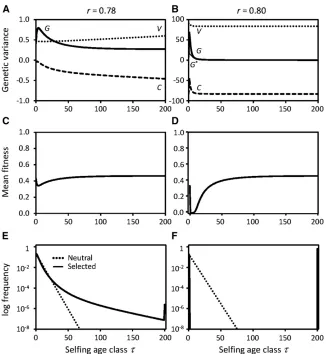
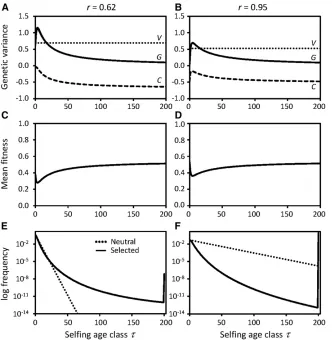
and low mean fitness (Figure 1, B and D). Similar effects occur in the IMS, but with restricted magnitude (Figure 2, B and D).
Mixed mating and the distribution of selfing ages:With partial selfing, the distribution of selfing ages in the population plays a crucial role in the dynamics of genetic variance. At a stable equilibrium the distribution of selfing ages (Equations 12) ispt¼ ð12rÞrtlt;whereð12rÞrtis the
probability of selfingtgenerations in a row in the absence of selection, andlt¼w2tQti¼201wifort$1;with l0 ¼1;is the relativefitness of lineages surviving to selfing aget.
Despite continued selfing and stabilizing selection even-tually purging the genetic variance in both models, at any given selfing rate in the population, the distribution of selfing ages determines the extent of purging of the genetic variance in the population as a whole. This occurs because shifts in the selfing age distribution change the balance of contributions of young and old selfing ages to the genetic variance at outcrossing (Equation 9), which is then trans-mitted through the selfing ages (Equations 8 and 10). A low or moderate rshifts the selfing age distribution to the left,
toward younger ages; a high rshifts the selfing age
distri-bution right, toward older ages. A crucial property of the relative survival function of selfed lineages is that the mean
fitness at each selfing age depends on selection on the whole organism rather than just a single character (Equation 11); this explains why selection on multiple characters affects the purging of genetic variance in each character, as illustrated in the numerical results.
Numerical examples of the mean fitness as a function of selfing age, and the selfing age distribution, are illustrated in Figure 1, C–F, and Figure 2, C–F, for the GAM and the IMS, respectively. At high selfing rate in the GAM the long-selfed lineages become reproductively isolated from the outcrossed lineages, as shown by the very lowfitness of intermediate self-ing ages and the nearly disjunct bimodal distribution of selfing ages (Figure 1, D and F). Similar effects occur in the IMS at high selfing rate, but to a lesser extent (Figure 2, D and F).
Equilibrium genetic variance in the population as a function of r
For intermediate selfing rates the complexity of the models precludes analytical solution. Recursions for the GAM and IMS were iterated numerically to characterize the equilib-rium genetic variance in the population as a function of population selfing rate for a wide range of parameter values. Below we describe the salient similarities and differences between the GAM and IMS, emphasizing the robust results common to both models. The accuracy of the assumption of
Figure 1 Purging of genetic variance under contin-ued selfing in the GAM for each of 25 identical independent characters under stabilizing selection. Components of genetic variance (A and B) and meanfitness (C and D) as functions of selfing age and distribution of selfing ages (E and F) for pop-ulation selfing rates below (r¼0:78;A, C, and E) or above (r¼0:8;B, D, and F) the purging thresh-old. Note the different scales in A and B. In B the genetic varianceGat young selfing ages and genic varianceVand covarianceCare not at equilibrium; their values depend on the number of generations simulated (here 500,000). In E and F dotted lines represent the distribution of selfing age classes in Wright’s neutral model. Other parameters:E¼1;
a normal distribution of breeding values within selfing age cohorts in both models was assessed using the kurtosis of breeding values for the population as a whole,k. To eluci-date patterns in the equilibrium genetic variance, we com-puted for the population as a whole the mean fitness (Equation 3b); the inbreeding depression, d(loss of mean fitness upon selfing vs. outcrossing); and the genetic vari-ance after selection within a generation,G* (Appendix B).
In the GAM, two types of stable equilibrium exist for the total genetic variance in the population. At an outcrossed equilibrium, over a wide range of selfing rates from 0 up
to a critical selfing rate,
^
r, termed the purging threshold, the genic variance,V, and linkage disequilibrium,C, evolve to nearly compensate for nonrandom mating, maintaining nearly the same total genetic variance,G, as under random mating. For selfing rates above^
rthe stable outcrossed equi-librium collapses to the purged equiequi-librium. At a purged equilibrium, selfing rates even slightly above the purgingthreshold cause a collapse of the equilibrium genetic vari-ance after selection within a generation,G*;to values equal to or less than those under pure selfing (Equation 14a). A stable purged equilibrium exists for all selfing rates.
The purged equilibrium exists and is stable at any selfing rate (r.0), but its stability becomes weaker and its domain of attraction smaller for lower selfing rates. At selfing rates below the purging threshold, r,
^
r; the initial condition ofgenetic monomorphism always leads to the outcrossed equi-librium; the purged equilibrium is attained from initial con-ditions with large negative linkage disequilibrium and small total genetic variance.
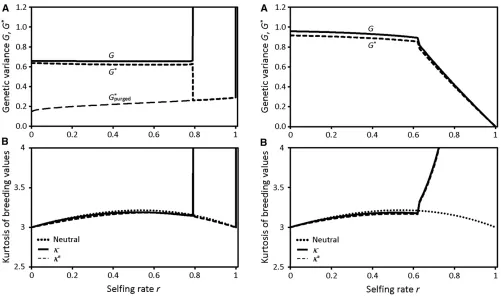
Figure 3 illustrates for the GAM that at selfing rates be-low the purging threshold, under weak stabilizing selection the equilibrium genetic variance after selection within a gen-eration, G*;is only slightly smaller than that before selec-tion, G. For selfing rates above the purging threshold, the
equilibrium genetic variance before selection,G, blows up to infinity. This occurs because of the unlimited negative link-age disequilibrium (compensatory mutations) and genic var-iance built up under continued selfing, which segregates in the second generation after outcrossing and recombination. However, the F2 recombinants among long-selfed lineages
are strongly selected against because of their large pheno-typic deviations from the optimum. For this reason, at self-ing rates above the purgself-ing threshold, the equilibrium genetic variance after selection within a generation,G*; col-lapses toG*purged;the purged equilibrium after selection. For
the same reason, at selfing rates above the purging thresh-old the equilibrium kurtosis of breeding value in the popu-lation,k, blows up, but the kurtosis after selectionk* nearly equals that for Wright’s neutral model. Thus, under the basic assumptions of the GAM, we consider the numerical results to be reasonably accurate at all selfing rates.
Figure 4 shows that for the IMS the equilibrium genetic variance in the population,G, also nearly equals that under random mating for selfing rates up to a purging threshold. Just above the purging threshold the equilibrium genetic variance dips sharply and then declines gradually with in-creasingr. The IMS displays only a single stable equilibrium genetic variance at every selfing rate. The kurtosis of breed-ing value in the population, both before and after selection, becomes large at selfing rates substantially above the purg-ing threshold. Because excess kurtosis increases the strength of selection on the variance (Turelli and Barton 1987), the IMS overestimates the genetic variance maintained at self-ing rates above the purgself-ing threshold. Qualitative differen-ces between the models at high selfing rates arise from constancy of the genic variance at any given selfing rate in the IMS, which limits accumulation of negative linkage dis-equilibrium under continued selfing (compare Figure 1A to Figure 2A).
Figure 5 and Figure 6 depict, respectively for the GAM and IMS, how stabilizing selection on multiple independent characters acts synergistically to reduce and sharpen the purging threshold in comparison to that for a single charac-ter under the same intensity of stabilizing selection per
char-acter. The sharpness of the purging thresholds has low sensitivity to substantial differences in strength of stabilizing selection among characters (not shown) due to their joint influence on and by the selfing age distribution. Figure 5 and Figure 6 also display the equilibrium inbreeding depression, d, and the meanfitness in the population, as functions of the selfing rate. For both models the meanfitness of the popu-lation at high selfing rates exceeds that at low selfing rates, consistent with the purging of genetic variance at high self-ing rates.
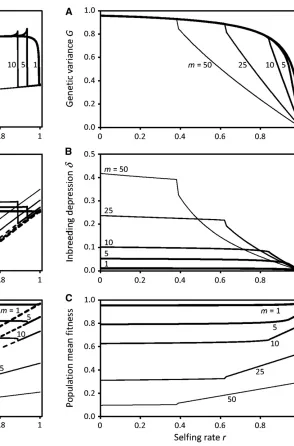
Figure 7 shows analogous results for the IMS with mul-tiple characters with no pleiotropy but under correla-tional selection on independent pairs of characters. The genetic covariance between pairs of mutually selected characters,B, is then caused solely by linkage disequilib-rium, and at high selfing rates their equilibrium genetic correlation, B=G, makes the multivariate distribution of breeding values conform closely to the shape of the fit-ness surface.
General approximation for the purging threshold
For selfing rates below the purging threshold, in both the GAM and the IMS the equilibrium mean fitness in the population at the outcrossed equilibrium remains nearly the same as under random mating,Wout:More remarkably,
Figure 3 Equilibrium genetic variance as a function of selfing rate for each of 25 identical uncorrelated characters under stabilizing selection in the GAM. (A) Total genetic variance before and after selection,GandG*: (B) Kurtosis of breeding values,k, before and after selection at the out-crossed equilibrium for r below the purging threshold, at the purged equilibrium forrabove the purging threshold, and in Wright’s neutral model. Other parameters are as in Figure 1.
in both models at selfing rates above the purging threshold the mean fitness nearly equals the product of the selfing rate, rand the equilibrium mean fitness under completely selfing,Wself:This can be seen most explicitly from the dot-ted lines for the purged equilibrium in Figure 5C and by extrapolation of the corresponding lines in Figure 6C and Figure 7D from their values at complete selfing back to the origin. The simplicity of these results indicates that in both
models the purging threshold,
^
rcan be accurately located by the intersection of these two lines,Wout^
r Wself:The purg-ing threshold can thus be accurately approximated as the ratio of meanfitnesses at equilibrium under random matingvs. pure selfing,
^
rWout
Wself: (16)
With many characters, the numerical analysis indicates a sharp purging threshold, and the analytical approximation is fairly accurate. A small inaccuracy arises, most notably in the GAM form¼5 or 10, becauseWout as a function ofr
dips slightly near the intersection withrWself: Figure 5 Equilibrium genetic variance after selection (A), inbreeding
de-pression (B), and population meanfitness (C), as functions of population selfing rate, for different numbers of characters in the GAM. When the selfing rate is below the purging threshold, two stable equilibria exist. The outcrossed equilibrium has relatively large genetic variance and inbreed-ing depression nearly independent of selfing rate (solid lines); it is reached when the population has initially low genetic variance and low linkage equilibrium. The purged equilibrium (dashed lines) has lower genetic var-iance, independent of the number of characters, and negative inbreeding depression forrjust above the purging threshold. Other parameters are as in Figure 1.
Discussion
Wright (1921, 1969) showed that for a neutral model of additive genetic variance, inbreeding increases the equilib-rium genetic variance in proportion to the average inbreed-ing coefficient in the population, so that complete selfing doubles the equilibrium genetic variance in comparison to random mating. Lande (1977) found for regular systems of mating, in which every individual performs the same type of nonrandom mating, that the equilibrium genetic variance maintained by mutation and stabilizing selection is indepen-dent of the mating system. In contrast, Charlesworth and Charlesworth (1995) analyzed the maintenance of quanti-tative genetic variance by mutations under stabilizing or purifying selection, concluding that complete selfing sub-stantially reduces the equilibrium genetic variance compared to random mating; despite neglecting linkage disequilibrium, theirfindings agree qualitatively with Equations 14a and 15. These disparate results are reconciled in our models of mixed mating, showing that in both the GAM and the IMS the equi-librium genetic variance remains nearly the same as under random mating for selfing rates up to the purging threshold, above which a substantial purging of the genetic variance occurs.
In the GAM two possible stable equilibria exist for the genetic variance as a function of the population selfing rate. The outcrossed equilibrium has genetic variance nearly equal to that under random mating and exists only for selfing rates below the purging threshold. The purged equilibrium has lower genetic variance after selection, approaching that in selfed lineages, and exists for all selfing rates; in long-selfed lineages the genetic variance remains constant but in the whole population the genetic variance before selection blows up (Figure 3A). Initial outcrossing between long-selfed lineages decreases the genetic variance by half (since
f0¼0), resulting in outcrossed F1hybrid vigor (“heterosis”);
subsequent selfing or outcrossing of these F1allows
recom-bination to express the accumulated genic variance previ-ously hidden by negative linkage disequilibrium, producing F2 breakdown in fitness. A similar process produces
in-creasing segregation variance and reproductive isolation between geographically isolated populations with identi-cal optimum phenotypes (Slatkin and Lande 1994; Chevin
et al. 2014).
In the IMS only a single stable equilibrium genetic vari-ance exists at any selfing rate; a purged equilibrium with reduced genetic variance exists only at selfing rates above the purging threshold (Figure 4A). Properties of the popu-lation at a purged equilibrium are similar in both models, but more extreme in the GAM with genic variance and neg-ative linkage disequilibrium (compensatory mutations) in-creasing indefinitely under continued selfing and stabilizing selection, whereas the constant genic variance in the IMS limits the negative linkage disequilibrium and the F2
break-down after outcrossing of long-selfed lineages. In any model of inheritance, finite population size must eventually limit the accumulation of compensatory mutations. The IMS is therefore likely to be more realistic for most quantitative characters, especially if effective population sizes are not very large. But if the GAM is accurate for even a single character, a stable purged equilibrium will exist at all posi-tive selfing rates (Figure 3A).
In both models the purging threshold approximately equals the ratio of the equilibrium mean fitness under random mating relative to that under pure selfing. Stabiliz-ing selection of quantitative characters in a constant envi-ronment with the mean phenotype at the optimum produces the highest meanfitness for the population with the lowest genetic variance, which occurs under pure selfing. Selfing
Figure 7 Equilibrium genetic variance before selec-tion in the IMS (A and B), along with inbreeding depression and population mean fitness (C and D), as functions of population selfing rate, for dif-ferent numbers of charactersmwith no pleiotropy subject to correlational selection betweenm=2 in-dependent pairs of characters. In the selection ma-trix (Equation 2) off-diagonal elements for pairs of characters under correlational selection are 0.5 times the diagonal elements (v2). The equilibrium
also increases the mean fitness by facilitating evolution of adaptive genetic correlations between characters by corre-lational selection and linkage disequilibrium as shown in Figure 7B (and by Lande 1984 for a regular system of in-breeding). The complexity of the phenotype and the overall strength of stabilizing selection on it are thus of paramount importance in determining the purging threshold. For a sin-gle character under moderately strong stabilizing selection the purging threshold occurs at a very high selfing rate (Fig-ure 5), but for a complex phenotype with many sets of char-acters under independent stabilizing selection, the purging threshold is considerably reduced (Figure 7A).
Genetic variance and inbreeding depression
Inbreeding depression is generally thought to be the main genetic factor counteracting Fisher’s automatic advantage of selfing and preventing the evolution of complete selfing in self-compatible species (Fisher 1941; Lande and Schemske 1985; Porcher and Lande 2005; Devaux et al. 2014). Pre-vious theory indicates that inbreeding can cause rapid purg-ing of inbreedpurg-ing depression due to nearly recessive lethals and that purging of inbreeding depression due to nearly addi-tive mildly deleterious mutations is more difficult and occurs to a lesser extent (Lande and Schemske 1985; Charlesworth
et al.1990; Landeet al.1994; Charlesworth and Willis 2009; Porcher and Lande 2013). Consistent with this is the observa-tion that highly selfing species show substantially reduced in-breeding depression (Husband and Schemske 1996; Winn
et al.2011).
Winnet al.(2011) found that species with intermediate selfing rates maintain a substantial inbreeding depression, comparable to that for predominantly outcrossing species. The constancy of average inbreeding depression maintained across a wide range of selfing rates below the purging thresh-old in the present theory is qualitatively consistent with these observations. Winnet al.(2011) suggest this may be due in part to selective interference with the purging of lethals at a high total inbreeding depression (Landeet al.1994). This seems especially likely if the observed average inbreeding depression for species with intermediate selfing rates, d¼0:58;underestimates the actual total inbreeding depres-sion,e.g., due to stronger inbreeding depression in wild vs.
experimental environments (Armbruster and Reed 2005). Porcher and Lande (2013) showed that a background in-breeding depression due to mildly deleterious mutations augments selective interference among lethals.
Charlesworth and Charlesworth (1995) reviewed limited available evidence indicating that predominantly selfing pop-ulations maintain lower quantitative genetic variance than predominant outcrossers on average. This agrees with our finding of reduced genetic variance after selection maintained at selfing rates above the purging threshold.
Evolution of selfing rate near outcrossed and purged equilibria
Inbreeding depression is an important genetic constraint that, in combination with ecological constraints, controls
evolution of the selfing rate by small genetic steps (Lande and Schemske 1985; Johnston et al. 2009; Porcher and Lande 2013; Devauxet al.2014). In the absence of ecolog-ical constraints, selection favors gradual evolution of de-creased selfing rate when the total inbreeding depression upon selfing, d, exceeds 0.5, which typifies species with low or intermediate selfing rates (Husband and Schemske 1996; Winn et al.2011).
At a purged equilibrium the inbreeding depression is reduced or even negative as in the GAM (Figure 5B and Figure 6B). F1 heterosis and F2 breakdown of fitness in
crosses between long-selfed lineages strongly select against outcrossing and augment the impact of reduced (or nega-tive) inbreeding depression favoring the evolution of in-creased selfing. Thisdelayed outbreeding depression among long-selfed lineages renders them reproductively isolated not only from their outcrossed relatives but also from each other. This mechanism forspeciation by predominant selfing
accords with the finding of Goldberg and Igic (2012) that phylogenetic transitions to predominant selfing often coin-cide with species originations. The models therefore indicate that in a large population the evolution of predominant selfing, at a purged equilibrium of quantitative genetic variance, is an irreversible evolutionary absorbing state (Bull and Charnov 1985; Charlesworth and Charlesworth 1998; Goldberg and Igic 2008; Galiset al.2010), supporting the view of Stebbins (1957, 1974) that predominantly selfing plant species generally oc-cupy terminal branches in plant phylogenies.
Stebbins also inferred that highly selfing species have an increased extinction rate and do not persist long in phylo-genetic time. The present theory shows that a population at a purged equilibrium maintains less genetic variance than a population at an outcrossed equilibrium; hence in a constant environment predominantly selfing populations have a higher mean fitness at equilibrium than under random mating. Long-term environmental trends or cycles, or extreme envi-ronments such as the edge of a species range [where new selfing species often arise from outcrossers (Wright et al.
2013)], may exert strong directional selection. Under this scenario, in comparison to populations at an outcrossed equilibrium, highly selfing populations with reduced genetic variance will lag farther behind changes in the optimum phenotype, with consequently a lower meanfitness through time and a higher extinction rate (Lande and Shannon 1996; Landeet al. 2003). Our model thus provides a theo-retical foundation for the classical view of Stebbins (1957, 1974) confirmed by recent empiricalfindings (Takebayashi and Morrell 2001; Goldberg et al.2010; Goldberg and Igic 2012; Igic and Busch 2013; Wright et al. 2013) that pre-dominant selfing constitutes an“evolutionary dead end.”
Acknowledgments
Balzan Foundation to R.L., the French Centre National de la Recherche Scientifique program PICS grant 5273 to E.P., and time on the computing cluster (UMS 2700 OMSI) at MNHN.
Literature Cited
Armbruster, W. S., and D. H. Reed, 2005 Inbreeding depression in
benign and stressful environments. Heredity 95: 235–242.
Bell, G., 2010 Experimental genomics of fitness in yeast. Proc.
Biol. Sci. 277: 1459–1467.
Bull, J. J., and E. L. Charnov, 1985 On irreversible evolution.
Evolution 39: 1149–1155.
Bulmer, M. G., 1971 The effect of selection on genetic variability.
Am. Nat. 105: 201–211.
Bürger, R., 2000 The Mathematical Theory of Selection,
Recombi-nation and Mutation. John Wiley & Sons, Chichester, UK.
Caswell, H., 2001 Matrix Population Models, Ed. 2. Sinauer
Asso-ciates, Sunderland, MA.
Charlesworth, B., 2013 Stabilizing selection, purifying selection
and mutational bias infinite populations. Genetics 194: 955–971.
Charlesworth, B., and D. Charlesworth, 1998 Some evolutionary
consequences of deleterious mutations. Genetica 102/103: 3–19.
Charlesworth, D., and B. Charlesworth, 1987 Inbreeding
depres-sion and its evolutionary consequences. Annu. Rev. Ecol. Syst.
18: 237–268.
Charlesworth, D., and B. Charlesworth, 1995 Quantitative
genet-ics in plants: the effect of the breeding system on genetic
vari-ability. Evolution 49: 911–920.
Charlesworth, D., and J. H. Willis, 2009 The genetics of
inbreed-ing depression. Nat. Rev. Genet. 10: 783–796.
Charlesworth, D., M. T. Morgan, and B. Charlesworth, 1990
In-breeding depression, genetic load, and the evolution of outcross-ing rates in a multilocus system with no linkage. Evolution 44:
1469–1489.
Chevin, L.-M., G. Decorzent, and T. Lenormand, 2014 Niche
di-mensionality and the genetics of ecological speciation. Evolution
68: 1244–1256.
Clayton, G., and A. Robertson, 1955 Mutation and quantitative
variation. Am. Nat. 89: 151–158.
Crow, J. F., and M. Kimura, 1970 An Introduction to Population
Genetics Theory. Harper & Row, New York.
Devaux, C., R. Lande, and E. Porcher, 2014 Pollination ecology
and inbreeding depression control individualflowering
phenol-ogies and mixed mating. Evolution 68: 3051–3065.
Dobzhansky, T., 1970 Genetics of the Evolutionary Process.
Colum-bia University Press, New York.
Eyre-Walker, A., and P. D. Keightley, 2007 The distribution of
fitness effects of new mutations. Nat. Rev. Genet. 8: 610–618.
Falconer, D. S., and T. F. C. Mackay, 1996 Introduction to
Quan-titative Genetics, Ed. 4. Longman, Essex, UK.
Fisher, R. A., 1918 The correlation between relatives on the
sup-position of Mendelian inheritance. Trans. R. Soc. Edinb. 52:
321–341.
Fisher, R. A., 1930 The Genetical Theory of Natural Selection.
Clar-endon Press, Oxford.
Fisher, R. A., 1958 The Genetical Theory of Natural Selection, Ed. 2.
Dover, New York.
Fisher, R. A., 1941 Average excess and average effect of a gene
substitution. Ann. Eugen. 11: 53–63.
Fudala, A., and R. Korona, 2009 Low frequency of mutations with
strongly deleterious but nonlethalfitness effects. Evolution 63:
2164–2171.
Galis, F., J. W. Arntzen, and R. Lande, 2010 Dollo’s law and the
irreversibility of digit loss inBachia. Evolution 64: 2466–2476.
Goldberg, E. E., and B. Igic, 2008 On phylogenetic tests of
irre-versible evolution. Evolution 62: 2727–2741.
Goldberg, E. E., and B. Igic, 2012 Tempo and mode in plant
breeding system evolution. Evolution 66: 3701–3719.
Goldberg, E. E., J. R. Kohn, R. Lande, K. A. Robertson, S. A. Smith et al., 2010 Species selection maintains self-incompatibility.
Science 330: 493–495.
Haldane, J. B. S., 1949 The association of characters as a result of
inbreeding and linkage. Ann. Eugen. 15: 15–23.
Harder, L. D., and S. C. H. Barrett, 2006 Ecology and Evolution of
Flowers. Oxford University Press, Oxford.
Houle, D., B. Morikawa, and M. Lynch, 1996 Comparing
muta-tional variabilities. Genetics 143: 1467–1483.
Husband, B. C., and D. W. Schemske, 1996 Evolution of the
mag-nitude and timing of inbreeding depression in plants. Evolution
50: 54–70.
Igic, B., and J. W. Busch, 2013 Is self-fertilization an evolutionary
dead end? New Phytol. 198: 386–397.
Igic, B., and J. R. Kohn, 2006 Bias in the studies of outcrossing
rate distributions. Evolution 60: 1098–1103.
Jarne, P., and J. R. Auld, 2006 Animals mix it up too: the
distri-bution of self-fertilization among hermaphroditic animals.
Evo-lution 60: 1816–1824.
Johnston, M. O., E. Porcher, P.-O. Cheptou, C. G. Eckert, E. Elle et al., 2009 Correlations among fertility components can
main-tain mixed mating in plants. Am. Nat. 173: 1–11.
Kelly, J. K., 2007 Mutation-selection balance in mixed mating
populations. J. Theor. Biol. 246: 355–365.
Kimura, M., 1965 A stochastic model concerning the maintenance
of genetic variability in quantitative characters. Proc. Natl. Acad.
Sci. USA 54: 731–736.
Kingsolver, J. G., H. E. Hoekstra, J. M. Hoekstra, D. Berrigan, S. N.
Vignieri et al., 2001 The strength of phenotypic selection in
natural populations. Am. Nat. 157: 245–261.
Kondrashov, A. S., 1985 Deleterious mutations as an evolutionary
factor. II. Facultative apomixis and selfing. Genetics 111: 635–653.
Lande, R., 1975 The maintenance of genetic variability by
muta-tion in a polygenic character with linked loci. Genet. Res. 26:
221–235.
Lande, R., 1977 The influence of the mating system on the
main-tenance of genetic variability in polygenic characters. Genetics
86: 485–498.
Lande, R., 1980 Genetic variation and phenotypic evolution
dur-ing allopatric speciation. Am. Nat. 116: 463–479.
Lande, R., 1984 The genetic correlation between characters
main-tained by selection, linkage and inbreeding. Genet. Res. 44:
309–320.
Lande, R. 1995 Mutation and conservation. Conserv. Biol. 9:
782–791.
Lande, R., 2007 Expected relativefitness and the adaptive
topog-raphy offluctuating selection. Evolution 61: 1835–1846.
Lande, R., and S. J. Arnold, 1983 The measurement of selection
on correlated characters. Evolution 37: 1210–1226.
Lande, R., and D. W. Schemske, 1985 The evolution of self-fertilization
and inbreeding depression in plants. I. Genetic models. Evolution
39: 24–40.
Lande, R., and S. Shannon, 1996 The role of genetic variability in
adaptation and population persistence in a changing
environ-ment. Evolution 50: 434–437.
Lande, R., D. W. Schemske, and S. T. Schultz, 1994 High
inbreed-ing depression, selective interference among loci, and the
threshold selfing rate for purging recessive lethal mutations.
Evolution 48: 965–978.
Lande, R., S. Engen, and B.-E. Sæther, 2003 Stochastic Population
Dy-namics in Ecology and Conservation. Oxford University Press, Oxford.
Lynch, M., 1996 The rate of polygenic mutation. Genet. Res. 51:
Porcher, E., and R. Lande, 2005 Loss of gametophytic self-incompatibility with evolution of inbreeding depression.
Evo-lution 59: 46–60.
Porcher, E., and R. Lande, 2013 Evaluating a simple
approxima-tion to modeling the joint evoluapproxima-tion of self-fertilizaapproxima-tion and
in-breeding depression. Evolution 67: 3628–3635.
Russell, W. A., G. F. Sprague, and H. L. Penny, 1963 Mutations
affecting quantitative characters in long-time inbred lines of
maize. Crop Sci. 3: 175–178.
Simmons, M. J., and J. F. Crow, 1977 Mutations affectingfitness
inDrosophilapopulations. Annu. Rev. Genet. 11: 49–78.
Slatkin, M., and R. Lande, 1994 Segregation variance after
hy-bridization of isolated populations. Genet. Res. 64: 51–56.
Stebbins, G. L., 1957 Self fertilization and population variability
in higher plants. Am. Nat. 91: 337–354.
Stebbins, G. L., 1974 Flowering Plants. Evolution Above the Species
Level. Edward Arnold, London.
Takebayashi, N., and P. L. Morrell, 2001 Is self-fertilization an
evolu-tionary dead end? Revisiting an old hypothesis with genetic theories
and a macroevolutionary approach. Am. J. Bot. 88: 1143–1150.
Turelli, M., 1984 Heritable genetic variation via mutation-selection
balance: Lerch’s zeta meets the abdominal bristle. Theor. Popul.
Biol. 25: 138–193.
Turelli, M., and N. H. Barton, 1987 Adaptive landscapes, genetic
distance and the evolution of quantitative characters. Genet.
Res. 49: 157–173.
Turelli, M., and N. H. Barton, 1994 Genetic and statistical
analy-ses of strong selection on polygenic traits: What, me normal?
Genetics 138: 913–941.
Vassilieva, L. L., A. M. Hook, and M. Lynch, 2000 The fitness
effects of spontaneous mutations inCaenorhabditis elegans.
Evo-lution 54: 1234–1246.
Willis, J. H., 1999 Inbreeding load, average dominance and the
mutation rate for mildly deleterious alleles inMimulus guttatus.
Genetics 153: 1885–1898.
Winn, A. A., E. Elle, S. Kalisz, P.-O. Cheptou, C. G. Eckert et al.,
2011 Analysis of inbreeding depression in mixed-mating
plants provides evidence for selective interference and stable
mixed mating. Evolution 65: 3339–3359.
Wright, S., 1921 Systems of mating. II. The effects of inbreeding
on the genetic composition of a population. Genetics 6: 124–
143.
Wright, S., 1931 Evolution in Mendelian populations. Genetics
16: 97–159.
Wright, S., 1935 The analysis of variance and the correlations
between relatives with respect to deviations from an optimum.
J. Genet. 30: 243–256.
Wright, S., 1968 Genetic and Biometric Foundations(Evolution
and the Genetics of Populations, Vol. 1). University of Chicago Press, Chicago.
Wright, S., 1969 The Theory of Gene Frequencies(Evolution and
the Genetics of Populations, Vol. 2). University of Chicago Press, Chicago.
Wright, S. I., S. Kalisz, and T. Slotte, 2013 Evolutionary
conse-quences of self-fertilization. Proc. Roy. Soc. Lond. Biol. Sci. 290: 20130133.
Appendix A
Truncation of the selfing age distribution
For selfing ages larger than some valueL, the genetic parameters within age classes should be nearly equivalent, so that all selfing age classes can be lumped into a single terminal class of age$L, which then becomes the upper limit instead ofNin numerical summations. Additional recursion formulas are then required for the frequency and genetic composition in the terminal age class.
Recursions for the genic variance and covariance (due to linkage disequilibrium) and the inbreeding coefficient in the terminal selfing age class are
C9L¼ p*
L212cL21þp*L2cL p*
L21þp*L
VL9¼ p*
L212vL21þp*L2vL p*
L21þp*L
fL9¼ p*
L21
ðð1þfL21Þ=2ÞVL212ðgL21=2nÞG2L21
þp* L
ðð1þfLÞ=2ÞVL2ðgL=2nÞG2L
p*L21V9L21þp*LVL9
:
The recursion for the terminal age class frequency is
p9L¼r
p* L21þp*L
;
wherep*
t ¼wtpt=wandw¼ PL
t¼0ptwt:
Appendix B
Population Statistics
Kurtosis
By assumption each selfing age cohort, and the population as a whole, has its mean breeding value at the optimum, so there is no skew (asymmetry) in the population. However, because the genetic variance within selfing age cohorts varies among selfing ages,t, the breeding value in the population will be leptokurtic. The standardized kurtosis of breeding value in the population is the weighted average fourth central moment within cohorts, divided by the square of the population variance in breeding value. For a normal distribution with variances2the fourth central moment is 3s4;with a standardized kurtosis
ofk¼3:Assuming that the distribution of breeding value within each selfing age (and within subclasses of the outcrossed class) is normal, the standardized kurtosis of breeding value in the population is
k¼3
n
1þ Var½Gt ðE½GtÞ2
o
¼
3XNt¼1ptG2tþp0
XN i¼0
XN j¼0p0ijG
2 0ij
XN
t¼0ptGt
2 :
For comparison, the kurtosis of breeding value in the population can be derived for Wright’s (1921, 1969) classical model of partial selfing with no selection and no mutation. The recursion for the inbreeding coefficient (Equation 13a) withf0¼0 has the solutionft ¼12ð1=2Þt:In the absence of selection the equilibrium selfing age distribution ispt¼ ð12rÞrt:The average
inbreeding coefficient in the population is then f¼PN0 ptft¼r=ð22rÞ in agreement with Wright (1921, 1969). With no
selection under any amount of outcrossing (r,1), the population eventually approaches linkage equilibrium,Ct¼0:The equilibrium kurtosis of breeding value in the population is k¼3ð12r2=4Þ=ð12r=4Þ:In Wright’s neutral model, as in the
GAM, atr¼0 or 1 the breeding value in the population is normal (k¼3). But in the IMS atr¼1;G¼0 (Equation 15) and sokis not defined.
Inbreeding depression
d¼12
XN
t¼1ptwt
ð12p0Þw0:
This formula can be evaluated from the model only for partial selfing, 0,r,1:For random mating and complete selfing,
r¼0 and r¼1; the equilibrium inbreeding depression can be obtained by calculating the phenotypic distributions of offspring that would be produced by experimental selfing and outcrossing.
Genetic variance after selection
With multiple loci and a high selfing rate, the average genetic variance in the population G blows up due to a bimodal distribution of selfing ages, with long-selfed lineages dominating. This blowup is caused by accumulation of linkage dis-equilibrium in the long-selfed lineages. The large genetic variance expressed by recombination and the decay of linkage disequilibrium in the early selfing age classes reduce their meanfitness. With sufficiently high selfing rates thefirst few selfing age classes are rare, because of the low outcrossing rate and their reduced fitness. The genetic variance in the population as a whole after selection is
G*¼1
w XN
t¼1 ptwt
Gt2gtG2t
þp0X N
i¼0 XN
j¼0 p0ijw0ij
G0ij2g0ijG20ij 2
4
3 5;