Vol. 3, Issue 3, March 2015
Performance Comparison of POLY Protocol
with Existing CDS Protocols
Shimrose S.Mulla, Prof.Dr.S.V.Sankpal
Student, Dept.of E&TC, D.Y.Patil College of Engineering & Technology, Kolhapur, India Professor, Dept. of E&TC, D.Y.Patil College of Engineering & Technology, Kolhapur, India
ABSTRACT: this paper consist of Performance Comparison of Proposed protocol with existing CDS Based Topology
Control Protocols, In H-V and H-V-D environment. In this paper, we show that in the network, formation of Polygon can provide a reliable and energy efficient topology. Which is the need of mission critical WSN Applications. Based on this logic we propose a new topology control protocol. We call it as Poly protocol. We compare the performance of new protocol with CDS Rule-k & A3; the two CDS based TC protocols. The given simulation results show that Poly performs better in terms of different metrics such as message overhead, energy overhead, Residual Energy etc. It will also show that it achieves better connectivity under dynamic network topologies along with it the Reliability of Poly is also defined & compared it with other CDS-based techniques
KEYWORDS: Wireless sensor networks, Topology control, Network reliability, Energy efficiency, CDS Protocols.
I. INTRODUCTION
Wireless Sensor Networks [6] have different types of applications one of those is Mission Critical WSN Applications (Homeland security, forest Fire detection etc).In such types of applications Reliability the protocols plays an important role. Currently there are CDS based Topology Control Protocols are used for these applications. These applications require the network topology to provide a certain desired level of reliability. This reliability should however be achieved while keeping in mind the fundamental energy consumption constraint of a WSN. In this context, there is one principle which emerged as the most popular method for energy efficient topology control (TC) in WSNs that is Connected Dominating Set (CDS).In Topology construction two phases are involved one is topology construction and another is topology maintenance. In topology construction , a desired topological Property is established in the network while its connectivity is maintained. When topology construction is over, topology maintenance starts in which nodes starts to switch their roles to handle for topological changes.
CDS size is a critical parameter which controls the compromise between reliability and energy efficiency. For instance, for small CDSs, some nodes carry the load of the network traffic and in result reduce their batteries quickly. The positive side of a small CDS is that more nodes can go to sleep mode. While both of these metrics energy efficiency and reliability are equally important for mission-critical WSNs, existing CDS-based routing protocols cannot simultaneously cater both metrics. This paper describes Performance Comparison of different CDS based topology control protocols for wireless sensor networks Such as A3, CDS Rule-k with a new Protocol, referred to as the Poly protocol.
II.RELATEDWORK
Vol. 3, Issue 3, March 2015
network topology is guaranteed, while the network energy [4] consumption is minimal. The most famous way of forming a reduced subset of nodes is to form a hierarchal topology. In the hierarchal approach, reduced subsets of nodes are given more responsibility on behalf of the majority of nodes in the network. The reduced subset of nodes can be formed with well known connected dominating set (CDS) with nodes in a CDS forms a backbone which are responsible for relaying information for rest of the nodes in the network. Many Topology Control (TC) protocols have been proposed in the literature with emphasis on either energy efficiency or network reliability [7] while both of these metrics are equally important for mission-critical WSN deployments, existing CDS based topology construction protocols have not been designed to collectively cater for both metrics. As a solution a new protocol is proposed to achieve better Energy efficiency and Reliability.
III.CDSBASEDTOPOLOGYCONSTRUCTIONPROTOCOLS
There are various Topology Construction Protocols such as A3, CDS Rule-k and EECDS. But In this paper we are Considering A3 and CDS Rule-K for the comparison. The energy efficiency is achieved [2] and The Topology can be constructed by controlling the transmission power of WSN nodes. Another approach is to make use of geographical location of the nodes. The drawback of these approaches is the fact that power control and location Update is difficult to realize in practical WSN Implementation. Many mechanisms are proposed in which a vertex dominating it and all the adjacent vertices forms a cluster in the graph. A similar Dominating Set (DS) based solution is proposed in [4] which uses the concept of independent dominating sets. Both of these protocols have led to the concept of Connected Dominating Set (CDS) based topology construction protocols for the generation of energy-efficient topology in WSNs. We are concentrating two from these-A3 and Rule-k. Which are briefly explained below:
A.CDS-Rule K Protocol
CDS-Rule K, proposed in [3], it exchange the neighbor’s lists to among a set of nodes by using marking and pruning rules. If there is at least one pair of unconnected neighbors present node remains marked and unmark itself if it determines that it’s all neighbors are covered & higher priority is given to them. The node’s level in the tree decides its higher priority. Some nodes are part of the virtual backbone. In CDS-based topology construction schemes, this is responsible for passing packets in the WSN. Non-CDS nodes conserve energy by turning off their transceivers. CDS size is a critical parameter which controls the compromise between reliability and energy efficiency. For instance, for small CDSs, some of the nodes carries the load of network traffic and consequently reduce their batteries fast [5]. The positive side of a small CDS is that more nodes can go to sleep mode. While both of these metrics energy efficiency and reliability are equally important for mission-critical WSNs, existing CDS-based routing protocols cannot simultaneously cater both metrics [1-3].
B.A3 Protocol
The authors of [1] have proposed a topology construction protocol which gives an exact way to form a suboptimal CDS.A3 selects active nodes which are at the farthest distance from the parent based on the signal strength and remaining energy. This allows some nodes to be selected in the CDS tree which creates problems in long distance communication. One known strategy to save energy in WSNs is that of Topology Control (TC). TC consists of two phases: the topology construction, which finds a reduced topology while maintaining important properties of the network, such as coverage network and connectivity, and second is topology maintenance scheme, which makes changes in reduced topology when it is unable to provide the requested service any longer. These two mechanisms have to work in iterative manner up to the extent that the network energy is consumed, and both will increase the network lifetime compared with a continuously run WSN without topology control.
IV.THEPROPOSEDPROTOCOL:POLY
Vol. 3, Issue 3, March 2015
Due to our main focus on mission-critical applications, two Fundamental design constraints that we impose on a topology construction protocol are: (1) its resultant topology should provide a desired level of packet delivery reliability, and (2) its energy efficiency should be comparable to or less than existing CDS-based topology construction protocols. To satisfy these constraints, the new protocol arranges the nodes in such a way that they form a closed path among a set of nodes. The closed path provides a reliable and energy efficient topology because:
1) The sink node gets polygenic redundancy with its neighbours which allows the nodes to use an alternative path in case of random link failures, and
(2) It forms an active node set nodes comprising a polygon allowing leaf nodes to enter into the dormant/ sleep mode. An additional advantage of polygenic is that the topology construction protocol does not need the position or orientation information of the nodes.
In t hi s w o r k i t i s showed that, in the network i f p o l ygo n i s for me d i t wi l l provide a reliable and energy efficient topology. Following figure shows the topology formation in poly protocol. Where the area is assumed of 300 by 500m.In which the node are deployed in H-V and H-V-D Randomly to create the topology. For instance, for small CDSs, some nodes carry the load of the network traffic and in result consume their batteries q u i c k l y . The positive s id e of a small CDS is that more nodes can go to sleep mode. While both of these metrics-Energy efficiency and reliability – are equally important for Mission-critical WSNs, existing CDS-based routing protocols cannot simultaneously cater both metrics. This paper describes different CDS based topology control protocols for wireless sensor networks. The protocol, referred to as the Poly protocol, models the network as a connected graph and finds the number of polygons present in the network.
As shown in the bellow figure nodes are deployed randomly and one initial node is defined who starts the topology formation process. By exchanging the hello messages among the remaining nodes. The red nodes indicate exchange of hello messages within all nodes. The algorithm of the Protocol is explained in [8].We compare these protocols in following section with their results which we have obtained the comparison of this protocol This is how we proposed a new topology control protocol based on the idea of polygons. The performance o f poly will be compared wi t h three prominent CDS based topology protocols namely K, A3.The evaluation of all the four protocols will show that the new protocol has improved reliability and energy efficiency.
Fig: 1
To evaluate t he protocols u n d e r consideration, we use the MATLAB simulator which provides simplicity and flexibility. Following are the metrics used in evaluation process:
Message overhead
Vol. 3, Issue 3, March 2015
Energy overhead
The fraction of the network energy expended during construction of the topology is called energy overhead. While maintaining the topology this metric is very important.
Residual energy
Residual energy is defined as the ratio of energy in the active set of nodes to the total network energy at the end of an experiment. Residual energy is a measure of network lifetime. As the residual energy falls below a certain threshold value, the probability of network partitioning increases.
Connectivity
From the sink node the number of nodes which are disconnected after the activation of topology maintenance technique is nothing but connectivity. This parameter measures the effectiveness of a topology construction protocol. If connectivity values equals zero, the protocol is at its best. Higher values of connectivity show that the protocol is unable to provide a backbone which is capable of collecting data from the sensor nodes in the network.
V.SIMULATIONRESULTS
Simulation results are described in three subsections. First, we evaluate all the four protocols in two ideal grid environments observed in controlled indoor deployments: the Grid V and the Grid V-D topologies. In the Grid H-V topology, nodes can communicate with their horizontal and vertical neighbours, while in the Grid H-H-V-D topology; nodes can communicate with their diagonal neighbours.
Residual Energy Message Overhead
(a) (b) Fig 2
A. Grid Topology & Impact of Node density
In the case of Grid V topology, we assumed a network of fewer nodes than that of us assuming for Grid H-V-D, we increased the network size. In the Grid H-V topology, nodes can communicate with their horizontal and vertical neighbours, while in the Grid H-V-D topology; nodes can communicate with their diagonal neighbours. We compare the protocols Performances under varying node densities assuming that:
(1)The nodes are randomly deployed, and (2) The protocols only construct the topology
The message overhead, energy overhead and residual energy results are shown in Fig.2 (a) (b) (c) respectively. We can also observe the impact of varying node densities. When as the density increases the Message overhead and Energy overhead the no of Messages exchanged rise exponentially for all Protocols. Pole performs better in all considered metrics.
0 0.2 0.4 0.6 0.8
H-V H-V-D
CDS Rule-k A3
Poly
0 0.5 1 1.5 2 2.5
H-V H-V-D
CDS Rulek A3
Vol. 3, Issue 3, March 2015
Energy Overhead
Fig 2 (c)
Energy overhead of CDS-Rule K is higher than A3 and Poly, as shown in Fig. 2(c). It is a fact that node density is increased the energy consumption is increased because of number of received packets increased. While, Poly still has lower energy consumption due to its strategy for topology discovery. As mentioned earlier, Poly does not use any messages explicitly sent to a parent node by its children. Instead, it overhears the broadcast at the parent node to get aware of its children. A3 protocol has fewer messages overhead when compared with all the other three protocols.
Fig. 2(a) shows the residual energy of all three protocols. Usually, because of high energy overhead lead to lower residual energies. However, we observe that A3 which has low message and energy overheads has significantly less residual energy. On the other hand, and CDS-Rule K protocols have less residual energy due to high energy overhead. Poly provides better residual energy when compared with two protocols.
B. Connectivity
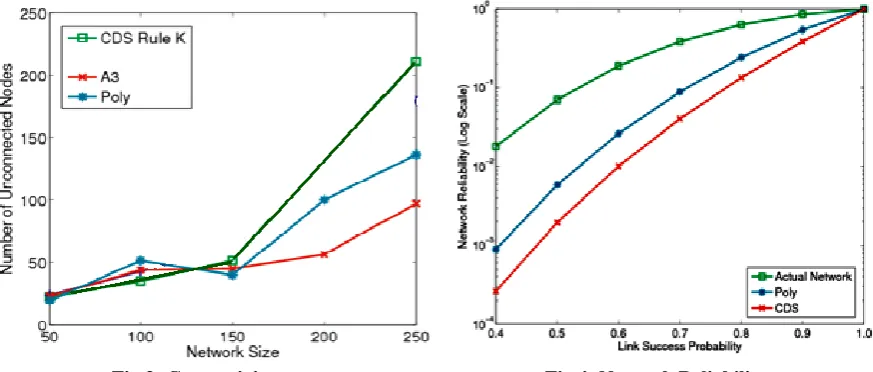
Below Figure shows the number of unconnected nodes while maintaining the topology. Here in CDS-Rule K, if there is at least one pair of unconnected neighbors, nodes remained marked. It’s Because of this higher number of unconnected nodes are created on comparing with other two protocols. While A3 has less unconnected nodes because of its process of node selection. This is based on signal strength metric. Performance of Poly in larger networks is better than CDS-Rule K. However, it indicates that the number of unconnected nodes increases as the network size gets bigger.
Fig 3: Connectivity Fig 4: Network Reliability 0
0.2 0.4 0.6 0.8
H-V Grid H-V-D Grid
CDS Rule-k
A3
Vol. 3, Issue 3, March 2015
C.Network Reliability
The Wireless Sensor Network (WSN) comprising of several sensor nodes and a sink node. The sensor nodes continually sense data from the environment and send them to the sink node. In most settings, tens to thousands of such sensor nodes are distributed throughout a region of interest, where they self-organize into a network through wireless communication and collaborate with each other to accomplish a common task. The sink receives all the information fr o m these sensor nodes, processes it and sends them to the end user.
In WSNs critical event data collected by the sensor nodes need to be reliably delivered to the sink for successful monitoring of an environment. Therefore, given the nature of error prone wireless links, ensuring reliable transfer of data from resource constrained sensor nodes to the sink is one of the major challenges in WSN. Here Reliability is nothing but probability that the sensor nodes can communicate with each other in case of random link failures. Hence, reliability is another critical parameter that measures the redundancy of the protocol. So as it is important factor in Mission critical WSN Applications.
The following Figure shows the graph that we obtained for the three protocols it compares the reliability of poly protocol with CDS based protocols. The decrease in the link probability causes a proportional decrease in the network reliability. However, the Poly protocol provides better network reliability as the link probability is decreased. Existing CDS-based protocols have considerably lower network reliability because each link in these topologies serves as a bridge link, and therefore does not provide any redundancy in the network.
VI. CONCLUSION
In this paper we propose an energy efficient topology control protocol named POLY. This creates Polygons in the network to form a CDS. The simulation results that we obtained are used to compare the performance of the proposed protocol with the CDS protocols-cds Rule k, A3.The simulation results Shows that Poly performs better in selected metrics than existing CDS Protocols. And it also provides High network reliability.
REFERENCES
[1] P.M. Wightman and M.A. Labrador, “A3: A Topology Construction Algorithm for Wireless Sensor Network”, in Proceedings IEEE
Globecom, 2008
[2]Z. Yuanyuan, X. Jia, and H. Yanxiang,”Energy efficient distributed connected dominating sets construction in wireless sensor networks”, in Proceedings of the ACM International Conference on Communications and Mobile Computing, pp. 797-802, 2006.
[3] J. Wu, M. Cardei, F. Dai, S. Yang,Extended dominating set and its applications in ad hoc networks using cooperative communication,IEEE Transactions on Parallel and Distributed Systems 17 (8) (2006) 851–864.
[4]V. Rodoplu, T.H. Meng, Minimum energy mobile wireless networks, IEEE Journal Selected Areas in Communications 17 (8) (1999) 1333–1344.
[5]M. Gerla, J.T. Tsai, Multicluster mobile multimedia radio network, ACM Wireless Networks 1 (3) (1995) 255–265.
[6] F. L. Levis, “Wireless sensor networks” Associate Director for Research Head, Advanced Controls, Sensors, and MEMS Group
Automation and Robotics Research Institute The University of Texas at Arlington 7300 Jack Newell Blvd. S Ft. Worth, Texas 76118-7115.
[7]Muhammad Adeel Mahmood and Winston Seah, Reliability in Wireless Sensor Networks: Survey and Challenges Ahead, School of Engineering and Computer Science, Victoria University of Wellington, Wellington, New Zealand.
[8]Hassaan Khaliq Qureshi Sajjad Rizvi, Muhammad Saleem, Syed Ali Khayam, Veselin Rakocevic, Muttukrishnan Rajarajan ,”Poly: A reliable