ISSN(Online): 2320-9801
ISSN (Print) : 2320-9798
International Journal of Innovative Research in Computer
and Communication Engineering
(An ISO 3297: 2007 Certified Organization)
Vol. 3, Issue 9, September 2015
Survey of Data-Driven Composition for
Service-Oriented Situational Web Application
Nikhil Darade, Kiran Gaikwad, Priyanka Yadav
B.E. Student, Dept. of Computer Engineering, Dr. D. Y. Patil Institute of Engineering and Technology Savitribai Phule
Pune University, India
ABSTRACT: The broad range of opportunities to construct “situational” web applications from web deliver services is obtain by the confluence of services computing and web 2.0. However, wide number of services and intricacy of compositions constraints causes manual composition tough to application developers, who might be non-professional programmers or client. This paper presents well-ordered data-driven approach to aid situational application development. We first design a method to deduce beneficial information from various sources to extort service capabilities with set tags. This helps user’s composition goal by simple queries, without going deeper into technical details. A planning technique take out composition solutions which may leads to specific goals.
KEYWORDS: Situational applications, service composition, data-driven
I. INTRODUCTION
Web services are the application design to support interoperable peer-to-peer interaction over a network.
The web server are the method of communication between heterogeneous system, and service oriented architecture become the large framework for building web system in the era of new web. In the data driven composition the two different conclusion are combined & then this result are shown as a single conclusion where it leads as the application is result which will help user to get desired output.
In data driven is the method which allow user to find out the possible output through his search depend on his geographical location & the query or the input stream he find. There is a tremendous amount of web content available today, but it is not always in a form that supports end-users’ needs. For example, it is easy to find a list of hotels in San Jose, but it is not so easy to sort them by distance to the San Jose convention centre. To do this today, an end-user would have to manually enter in each address into a mapping service and write down the distances for each, or manually construct software to do the same. There are two key observations here. First, all of the data and services needed to accomplish the goal above already exist, but they are not in a form amenable to her needs. Second, it is extremely unlikely that a web site will be able to support all the needs of all of its end-users. For these cases, we argue that it is better to provide tools that can help end-users help themselves. What is interesting is that there is a rapidly growing community of web programmers creating so-called “mashups” that combine existing web-based content and services to create new applications. One of the earliest and best known mashups is housingmaps.com, which crawls rental listings from the Craigslist community web site and puts them on top of Google Maps. Rather than having to go through each of the text listings and manually entering each address into a map service, this mashup makes it easy for end-users to see a map of all the available rentals.
II. LITERATURE SURVEY
ISSN(Online): 2320-9801
ISSN (Print) : 2320-9798
International Journal of Innovative Research in Computer
and Communication Engineering
(An ISO 3297: 2007 Certified Organization)
Vol. 3, Issue 9, September 2015
2. ZENG Sen , HUANG Shuangxi, FAN Yushun,” Service-Oriented Enterprise Network Performance Analysis”. In this paper the combination of MDA, SOA, and PAO enhances the predictability, agility, flexibility, robustness and measurability of the SOE and SOEN. Complementary approach using MDA, SOA, and PAO methods enables convenient reconfiguration to improve enterprise integration in a service-oriented computing environment.
3. Yucong Duan,Yuan Cao, Xiaobing Sun,” Various “aaS” of Everything as a Service”. In this paper An unified view of XaaS can aid efficient classification of services for service registration, discovery, and composition. The current presentation focus on listing and classifying related work by year order to show the original routine of evolution from the past to present. In future, We are going to search into detail the current investigation through combining more sources such as Gartner Hype Cycles and domain knowledge ontology, etc.
4. Chaocan Xiang, Panlong Yang_, Xuangou Wu, Hong He, and Shucheng Xiao, “QoS-Based Service Selection with Lightweight Description forLarge-Scale Service-Oriented Internet of Things”. In this paper,Comparinf to others mechanisms,our technique makes better matching accuracy greatly by considering the complete meaning of the predicates, while dramatically lessening the time cost due to the lightweight QoS description.
5. Massimiliano Di Penta,”Search-Based Optimization Techniques in the Context of SOA and Cloud Computing”.This paper describes that, in recent years, search-based optimization techniques have been used to deal with a number of problems related to service oriented architecture: dynamic composition and binding. search-based optimization techniques can be used for automatic reconfiguration of applications and for optimizing the deployment of load in cloud infrastructure.
6. Anton V. Riabov, Eric Bouillet, Mark D. Feblowitz, Zhen Liu and Anand Ranganathan,” Wishful Search: Interactive Composition of Data Mashups”. IBM T. J. Watson Research Center 19 Skyline Drive, Hawthorne, NY 10532, USA. In this paper, the MARIO (Mashup Automation with Runtime Orchestration and Invocation) tool is introduced where it is for the composition of the data. The advantage of this paper is that the rapid generation of the tag based search for the automatic goal driven composition. The MARIO tool enables the user which has some knowledge of programming or not at all for the composition of the data. They use the MARIO for the composition of the YAHOO Pipes components. They also reduced the knowledge engineering work required upfront for the tag-based component description approach.
III. MOTIVATION
A. Motivating Example
We first present a composition summary to illustrate our motivation.
In this scenario, suppose a American tourist decides a
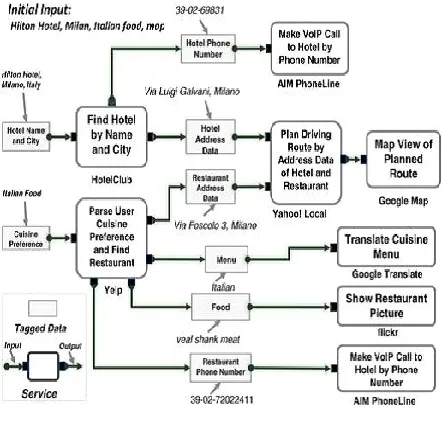
Travel schedule in Chennai city by combining several relevant services. Initially, he may consider reserving hotels and finding Italian restaurants. Just like using search engine, he could use a set of tags as query keywords, like “Chennai, Kamat hotel, Italian Food”. These tags will be interpreted as requests, and associated with relevant services. For example, tags “Chennai, Kamat hotel,” are consumed by a hotel search service like Hotel Club and Google Map as inputs. There might be several hotels related to the tag “Kamat hotel,” the returned restaurants are many as well. The tourist himself can check the returned results and select one, for example, the Chennai, Kamat hotel, similarly, he can choose Haven Sampoorna restaurant from Yelp, using the tags “Italian food” as his food preferences.
Now, the tourist is shown by the results from already selected three services (Hotel Club, Yelp and Google Map), including information like name, address and telephone of the hotel and restaurant. He may be inspired to explore more services that can be linked with these two services. He is likely to select the address, telephone to explore new interesting opportunities. For example, he might add the address of Kamat Hotel, the address of Haven Sampoorna
ISSN(Online): 2320-9801
ISSN (Print) : 2320-9798
International Journal of Innovative Research in Computer
and Communication Engineering
(An ISO 3297: 2007 Certified Organization)
Vol. 3, Issue 9, September 2015
Yahoo! Local Search service can be introduced, since it can generate the routine between two spots on the map. Then Hotel Club, Yelp and Yahoo! Local Search are composed by means of their tagged data dependency. Similarly, he can draw in VoIP service (such as AIM Phone Line) to make call reservation of hotel and restaurant, when he selects the telephone numbers. Another interesting recommendation is Google Translation service to translate the menu, as the tag “Italian”, can also be interpreted as a language. Such an option can help foreigners to translate the menu to his native language, so as to better understand the listed foods. Furthermore, when the tourist browses the menu, he can add new tags “Veal Shank Meat”. Then, flickrPhoto Search service can be composed with Yelp for retrieving related pictures of the food, current restaurant and comments from other users. In this way, the tourist can iteratively refine his travel plan by adding or modifying the tags, and some emergent composition opportunities will be dynamically found. Finally, he could select one of the presented flow alternatives, e.g., Hotel Club, Yelp, Yahoo! Local, Google Map and Google Translate, and run this flow on the composition engine. We illustrate all the composition process in Fig. 1.
Fig. 1 Motivating Example
IV. SYSTEM ARCHITECTURE
We further present our visual composition environment for recognize the tag-based composition. Our prototype is made upon our existing browser-based composition middleware, called iMashup. It facilitates developers to create mashup applications with on-the-fly design assistance.
ISSN(Online): 2320-9801
ISSN (Print) : 2320-9798
International Journal of Innovative Research in Computer
and Communication Engineering
(An ISO 3297: 2007 Certified Organization)
Vol. 3, Issue 9, September 2015
There are three stakeholder types in our approach, as shown in Fig. 1.
• Service providers play the role of publishing services and applications onto our service repository, called Service Community Platform.
• Application architects take charge of maintaining services and service-oriented situational applications, and encapsulating some reusable task templates. Both service providers and application architect can leverage tag-based semantics to describe services or applications.
• Developers can develop situational mashup applications with the help of our composition assistances. Our development process can be generally described as
A. Tag extraction and clustering:
Tags are extracted from multiple sources, including service textual documentation, user-generated comments and queries, etc. Browsing such a large size of tags is really tedious, and tag ambiguity might cause mistakes. Therefore, a semi-supervised technique is proposed to cluster tag-based taxonomy as unified semantic foundation.
B. Tag semantics derivation:
Service providers and application architects are responsible of annotating tag based semantics to describe service capabilities, including functionalities, input and output data, and other useful information. This aims to make services compatibly composed by the Tag-Link model.
C. Composition planning:
In Composition planning there are 3 operations are performed as follows:
i)Interpretation of queries & generate goal:
A composition engine interprets tag queries, and generates appropriate solutions that can contain or accomplish the goal.
ii)Graph based planning: Our composition engine employs a graph-based planning technique to generate possible composition recommendations.
iii)Generate composition recommendation: This process retrieves prefabricated composition logics from task templates, or generates potentially new alternatives.
Recommendations might be either individual services, or a set of services connected by data flows.
V. IMPLEMENTATION
A. Composition User Interface
ISSN(Online): 2320-9801
ISSN (Print) : 2320-9798
International Journal of Innovative Research in Computer
and Communication Engineering
(An ISO 3297: 2007 Certified Organization)
Vol. 3, Issue 9, September 2015
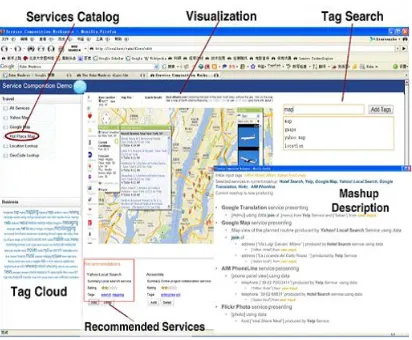
Fig 3 Composition UI Interface
2.1 Initial Goal Representation Interface
The web browser based composition UI is shown in Fig 3.Initially, a Tag Cloud will be presented, which shows all services in current Service Community Platform. The tags in larger fonts than others are the Feature Tags that introduce to high-level concepts for an application domain, such as Weather, GeoInfo, News, Food, and Hotel. These tags show much coarse-grained goals that might depend upon further refinement by adding other tags. To begin composition, the developers can elect one or more tags from the tag cloud, or type in some tags as keyword queries, to find their described goals. For example, considering the example (Section II), the tags {Chennai, Kamat Hotel, map} refer to the user inputs. They compose the initial goals.
2.2 Recommendation Alternatives and Composition Visualization
When the queries are submitted, the Service Advisor will plan a set of optional composition answers that can compose the goal. This will result in the changes of the tag cloud. Each solution is a service flow containing a set of “Tag Links”, which not only has to consist of all tags involved in the goal, but also may bring new tags as potential relevant goals. The developers can select and view each alternative solution.
The composition solution can be directly deployed in the browser, while our event-driven composition runtime middleware interprets the composition logics and deals with the underlying technical issues (such as syntactic and protocol).For example, when the recommendation consisting of Hotel Search, Yelp and Google Map is selected, the composition results will be immediately presented.
2.3 Goal Refinement
The developers can then refine their goals by adding, modifying and removing tags to change their goals. Suppose developers select the tag “Chennai, Kamat Hotel”, and “Haven Sampoorna” restaurant. Once accomplished, the tags for the hotel and restaurant information (such as “ViaLuigi Galvani, Milano”, “Via Foscolo 3, Milano”, etc.) are automatically added to the current goal. Each time the current goal is changed; the UI will generate new recommendations, and synchronize the tag cloud to display relevant tags. For example, the Yahoo! Local Search service is suggested to guide the travel between the hotel and the restaurant, according to the geographical tags. In this way, the developers can iteratively search and refine their goals to assemble the application for the motivating example (Section II).
2.4 Output Description
ISSN(Online): 2320-9801
ISSN (Print) : 2320-9798
International Journal of Innovative Research in Computer
and Communication Engineering
(An ISO 3297: 2007 Certified Organization)
Vol. 3, Issue 9, September 2015
data [A’s input tag] produced by SB”. For example, the statement “flickrPhoto service presenting [Photo] using data food [“VealShank Meat”] produced by Yelp Service” describes how flickrPhoto and Yelp interact with each other.
VI. CONCLUSION
In conclude, this survey paper the survey of the data driven composition of the service oriented situational web application recommend to use. Main goal of this paper is to “search as your query”. So with the help of application it allows the user to get the desired output with the help of his input stream or the find queries, which will combined to satisfy his requirement.
REFERENCES
[1] B.W. Boehm, “A View of 20th and 21st Century Software Engineering, ”Proc. 28th ACM Int’l Conf. Software Eng. (ICSE ’06),pp. 12-29, 2006.
[2] S. Adams, “The Future of End User Programming,” Proc. 30thACM Int’l Conf. Software Eng., 2008.
[3] J. Yu, B. Benatallah, F. Casati, and F. Daniel, “Understanding Mashup Development,” IEEE Internet Computing, vol. 12, no. 5,pp. 44-52, Sept. 2008
[4] D. Benslimane, S. Dustdar, and A.P. Sheth, “Services Mashups: The New Generation of Web Applications,” IEEE Internet Computing, vol. 12, no. 5, pp. 13-15, Sept./Oct. 2008.
[5] D.E. Simmen, M. Altinel, V. Markl, S. Padmanabhan, and A. Singh, “Damia: Data Mashups for Intranet Applications,” Proc.ACM SIGMOD Conf., pp. 1171-1182, June 2008.
[6] J. Wong and J.I. Hong, “Making Mashups with Marmite: Towards End-User Programming for the Web,” Proc. ACM SIG Conf. Computer/Human Interaction (CHI ’07), pp. 1435-1444, May 2007
[7] E. Bouillet, M. Feblowitz, Z. Liu, A. Ranganathan, and A. Riabov, “A Tag-Based Approach for the Design and Composition of Information
Processing Applications,” ACM SIGPLAN Notices, vol. 43, no. 10, pp. 585-602, Sept.2008
[8] Yilei Zhang, Zibin Zheng, and Michael R. Lyu,” An Online Performance Prediction Framework for Service-Oriented Systems” Student Member, IEEE
[9] ZENG Sen , HUANG Shuangxi, FAN Yushun,” Service-Oriented Enterprise Network Performance Analysis”. [10] Yucong Duan,Yuan Cao, Xiaobing Sun,” Various “aaS” of Everything as a Service”.
[11] Chaocan Xiang, Panlong Yang_, Xuangou Wu, Hong He, and Shucheng Xiao, “QoS-Based Service Selection with Lightweight Description forLarge-Scale Service-Oriented Internet of Things”
[12] Massimiliano Di Penta,”Search-Based Optimization Techniques in the Context of SOA and Cloud Computing”