Review Article Open Access
Layer of Protection Analysis on Sterilization
Process Using Ethylene Oxide
Gurkan Karakas
1, Woo Jong Shin
2and Kyoshik Park*
3 1Chemical Engineering Department, Middle East Technical University, Turkey2Department of Anesthesia and Pain Medicine, College of Medicine, Hanyang University, Korea 3Chemical Engineering Department, Myongji University, Korea
Received: January 17, 2018; Published: January 29, 2018
*Corresponding author:Kyoshik Park, Chemical Engineering Department, Myongji University, Myongji-ro 116, Yongin-si, Gyeonggi-do, Korea,
Tel: ; Email:
ISSN: 2574-1241 Biomed J Sci & Tech Res
Introduction
Ethylene oxide (EO) has been widely used as a low-temperature sterilant since the 1950s. It has been the most commonly used process for sterilizing temperature-and moisture-sensitive medical devices and supplies in healthcare institutions in the United States. EO kills microbes by disrupting life-sustaining molecules. Commercially sterilized medical products must meet stringent U.S. Food and Drug Administration (FDA) safety regulations that address product sterility (i.e., microbial levels) and acceptable levels of EO residue. Analytical techniques are used to identify, assess and address risks within the pharmaceutical industry such as HAZOP together with complementary quantitative method [1]. In order to guarantee the safety of pharmaceutical product, some kinds of risk analysis and risk assessment is studied recently [2]. HAZOP analysis is a process hazard analysis method that has been widely applied to the chemical processing industries including EO plant [3].
EO is a hazardous chemical and is both flammable and toxic, listed in 29 CFR 1910.1047in the USA regulation. It is classified
as highly hazardous chemicals in the Process Safety Management
(PSM) and Hazardous Air Pollutant (HAP) in regulations under the
Clean Air Act (CAA). The flammable range of EO/air mixtures is 2.6 -100%under ambient conditions and its flames can accelerate very rapidly [4-6]. It is difficult to design and install reliable explosion
control systems, particularly when adding EO to existing process equipment. In order to avoid explosions, facilities must maintain lower EO concentrations entering furnaces below the LFL. National Fire Protection Association (NFPA) codes require facilities to dilute EO concentrations transported to furnaces to less than 25% of the LEL, or 6,500ppm [7]. A typical chamber concentration during sterilization is generally applied between 220,000 and 440,000ppm
(400-800 mg/L), which is a very explosive concentration. The acute
(short-term) effects of EO to humans is as follows; central nervous system (CNS) depression, irritation of the eyes, and mucous membranes.
The chronic (long-term) exposure may cause irritation of the eyes, skin, and mucous membranesand problems in the functioning of the brain and nerves [8]. A study conducted by the National Institute for Occupational Safety and Health (NIOSH)showed that Abstract
Layer of protection analysis (LOPA) was conducted on toxic and flammable hazard of sterilization process using ethylene oxide. Hazard
associated with the process were studied using HAZOP and scenarios were developed by applying the HAZOP result. For each scenario,
independent protection layers (IPLs) were identified and their frequencies were estimated. Three additional IPLs were considered such as
personal protection equipment, monitoring device, and ventilation window. By adding such IPLs, the risk was estimated to be reduced to less than chances per million.
Keywords: Layer of protection analysis (LOPA); Sterilization Process; Ethylene Oxide; Independent Protection Layer (IPL); Risk
long term exposures to EO increases the risk of bone cancer in men
and breast cancer among women [9]. EPA has classified ethylene
oxide as a probable human carcinogen. International Agency for Research on Cancer (IARC), a part of the World Health Organization,
classifies EO as a Group 1 human carcinogen (sufficient evidence of
a cause and effect relationship between exposure to the material and cancer in humans). The Occupational Safety and Health
Administration (OSHA) of the USA defines permissible exposure
limit (PEL) is 1ppm, averaged over an 8-hour workday and short-term exposure limit (STEL) must not exceed 5ppm for 15minutes [10]. In addition, employers are required to take certain actions (e.g., conduct medical surveillance and periodically monitor worker exposures) when employee exposures exceed 0.5ppm averaged over an 8-hour workday.
Evaluating hazard and assessing risk of hazardous facilities are one of the most important activities to keep the site safe. Several studies have been conducted such as on how to review the current methodologies for plant layout optimization and to resolve facility siting issues [11], on how to reduce accidental exposure to various regents that are toxic, explosive, or carcinogenic [12], or on how to apply on an advanced layers of protection analysis (LOPA) method to assess the risk of a chemical process [13]. The layer of protection
analysis (LOPA) was introduced in the 1990s as a method for semi-quantitative risk assessment, having advantages of both qualitative and quantitative method of risk evaluation as has been described in the CCPS textbook [14]. LOPA is known to be a powerful analytical tool for assessing the adequacy of protection layers used to mitigate process risk.
EO sterilization process
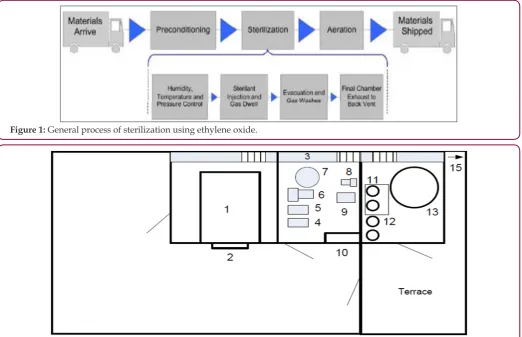
Because of the variability of products, packaging, load density, etc., each product type (e.g., tubing, catheters, containers, syringes, bandages) requires a unique treatment cycle to ensure sterilization. Figure 1 shows general process of sterilization using ethylene oxide. Cycle variables include EO concentration, duration of exposure, temperature, and humidity, vacuum applied during sterilization, and inerting and gas washing cycles required removing oxygen and residual EO respectively. In the studied case, the ethylene oxide sterilization system comprised of 3m3sterilization chamber equipped with external heating jacket, access door, vacuum
system, and humidification system, nitrogen inserting system, EO
gas delivery system, exhaust system and ethylene oxide removal system. The equipments are located in separate containment areas equipped with ventilation (Figure 1).
Figure 1: General process of sterilization using ethylene oxide.
The Sterilization System
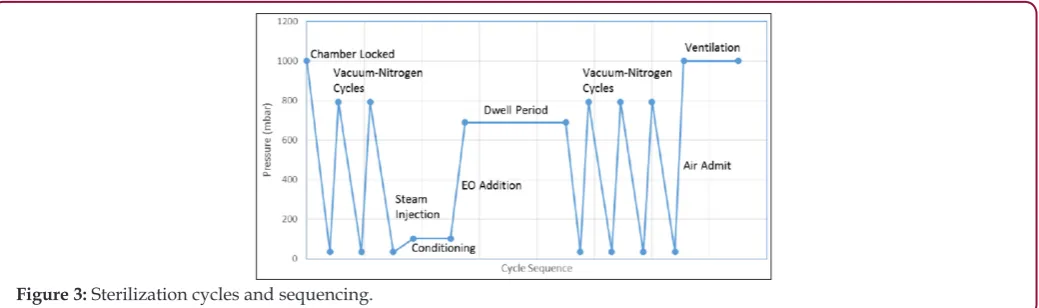
The layout of sterilization department applied to this study is shown in Figure 2.The sterilizer is isolated from the other sections
of the production facility. The system is located on the top floor of 3 story building. The confinement, which stores EO, N2cylinders
[11,12] and splitter-reactor [13] are located in terrace section out of the building. Three sections of sterilizer are separated by wall and all three sections have separate locked doors against unauthorized access. The air ventilation system has separate grills [14] and negative pressure is applied by ventilation fan which sucks air from all three sections and exhaust is located outside of the building [15]. The process can be monitored and controlled from outside [10] by graphical user interface and PLC system. In addition, the system log is kept by the printer connected to the system. The process parameters and operational mode can 6 only be changed by authorized person, which is assessed by 5-digit user
codes. Calibration and major process parameters can only be tuned by service engineer through higher level access codes (Figure 2).
Cycle Phases
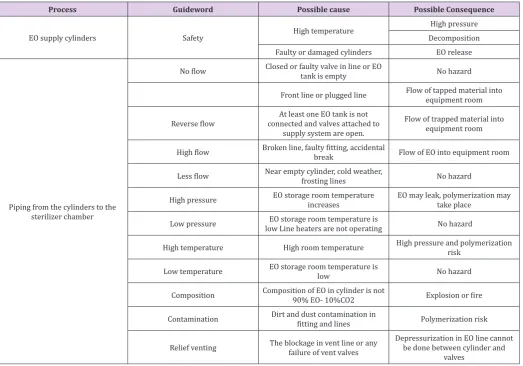
The sterilization cycle is initiated by two stepvacuum-N2 cycle for inerting. Steam is injected to achieve desired humidity level within the chamber to condition the products and to improve the sterilization effectiveness. EO is charged from pressurized 80 pound cylinders as 10%-90% ethylene oxide in carbon dioxide housed in cabinets located alongside each chamber. Products are
exposed to 400-800 mg/l EO concentration while the chamber
is maintained at 37-55oC, 30-80% relative humidity for a pre-determined period between 2-4 hours called the “dwell” phase. The pressure on dwell phase depends on the concentration of ethylene oxide in gas cylinders and adjusted ethylene oxide concentration within the sterilization chamber.
Figure 3: Sterilization cycles and sequencing.
If 90% EO-10% CO2gas mixture is used, the typical dwell
phase concentration of 680mg/lis achieved at 600 mbar pressure.
Therefore, a positive pressure around 4 bars is applied for 10%EO-90% CO2gas mixture is used. At the end of this phase, the chamber gas mixture is evacuated to the acid scrubber that removes EO. Approximately 60% of the EO is exhausted from the chamber during this phase of the cycle. The chamber then undergoes a series
of nitrogen and/or air washes to remove the remaining EO. Figure
3 illustrates the sterilization cycle sequencing described in this section (Figure 3).
Storage, Transportation and Changing EO and N2
Cylinders
The design intent is safely store, transport of EO gas and safely changes EO cylinders. General recommendations for installing new cylinders are as follows;
a. The cylinders [1-2], vent valves and lines, shut off valves, gas regulators, pressure transducers, transducer cables and sockets, pneumatic valves, line heaters and pneumatic tubings-connectors should be labeled and numbered and also indicated in the written operating procedure.
b. EO line from cylinders to the sterilizer cabinet should have vent line which is connected to the exhaust ventilation system.
EO Piping from the Cylinders to the Sterilizer Chamber
The intent of this system is to transfer EO gas to the sterilizer unit.
EO Dosing System
The intent of this system is to vaporize EO gas and dose appropriate amount of EO into the sterilizer chamber.
Operation of Sterilizer
The design intent is to sterilize plastic and metal medical products under controlled conditions without any release of gas into working environment.
EO Stripper and Hydrolysis Reactor
The residual EO is adsorbed in packed adsorption column and catalytically converted into ethylene glycol before disposed.
Utilities and Process Lines in Sterilization System
EO sterilizer involves the flow of air, nitrogen, steam, condensate and water. Consequences of deviation in these flows are considered
in this section. Nitrogen is used for inerting the sterilization system and air is used to break the vacuum. The HAZOP analysis of air and
nitrogen flow nodes is also essential. In addition, the steam supply, humidification, and heating the sterilization chamber with hot
Reliability of Ventilation
The equipment room, loading room, utilities room and storage room are ventilated by a dilution ventilation system. Also the vent stream from EO cylinder changing operation is connected into the ventilation system.
EO Monitoring System
The EO gas detector is placed in EO storage room and continuously detects and monitors EO concentration in air.
Hazard Evaluation
Typical Hazards Associated with the Sterilization
Process
Table 1: The typical hazards of EO sterilization process.
Steps to Follow Remarks
Prevent overfeeding to the reactor
Workers/Employers Store and handle EO properly
Deal with leaks and spills Be prepared for rescue
Workers Prevent skin and eye contact
Use respiratory protection and other PPE
Analyze and develop written procedures
Employers Implement engineering controls
Install emergency equipment Provide respiratory protection and PPE
Provide training Prepare workers for rescue
The typical hazards associated with the sterilization process using EO are listed in Table 1. Both workers and employers are recommended to pay attention to prevent overfeeding of the reactor by EO, to store and handle EO properly, and to deal with leaks 11 and spills. The typical hazards for workers and employers are recommended to follows are in the table (Table 1).
HAZOP Study
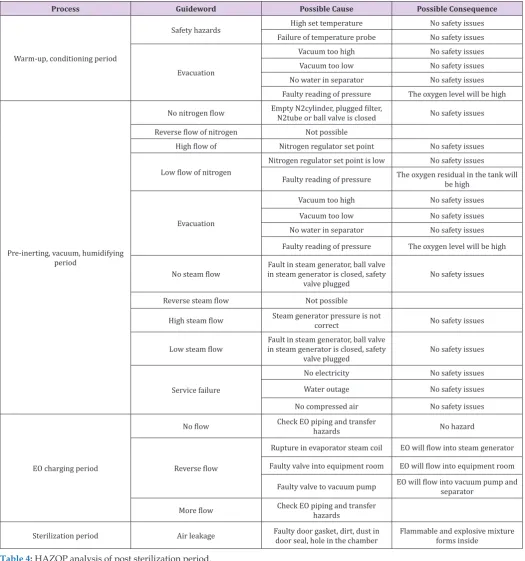
The sterilization process was under HAZOP study to find out
hazards of the whole system including sterilization, supplying, storage, and ventilation system (Tables 2-4).
Scenario Development
Based on the HAZOP study, the following accident scenarios were developed including overdosing to the reactor, release to loading area, release to equipment area, and leak at storage of EO.
Table 2: HAZOP study EO supply system.
Process Guideword Possible cause Possible Consequence
EO supply cylinders Safety High temperature
High pressure Decomposition Faulty or damaged cylinders EO release
Piping from the cylinders to the sterilizer chamber
No flow Closed or faulty valve in line or EO tank is empty No hazard
Front line or plugged line Flow of tapped material into equipment room
Reverse flow connected and valves attached to At least one EO tank is not supply system are open.
Flow of trapped material into equipment room
High flow Broken line, faulty fitting, accidental break Flow of EO into equipment room
Less flow Near empty cylinder, cold weather, frosting lines No hazard
High pressure EO storage room temperature increases EO may leak, polymerization may take place
Low pressure low Line heaters are not operatingEO storage room temperature is No hazard
High temperature High room temperature High pressure and polymerization risk
Low temperature EO storage room temperature is low No hazard
Composition Composition of EO in cylinder is not 90% EO- 10%CO2 Explosion or fire
Contamination Dirt and dust contamination in fitting and lines Polymerization risk
Maintenance Leaks from valves, fittings, pressure transducers, regulators, etc. The EO concentration in working environment increases
Safety Major leaks High concentration of EO in working environment
Security Unauthorized entrance into equipment room Gas leak, explosion, fire
EO transfer into the sterilizer
No flow Check HAZOP analysis of piping system
Reverse flow Not possible
More flow Failure in valves to the sterilizer Pressure and EO dose exceeds the set point
Failure in transducers Failure of door gasket
Less flow Check HAZOP analysis of piping system Check HAZOP analysis of piping system
Less pressure
Failure OF LINE HEATERS Check HAZOP analysis of piping system
Gas regulators set points are low No hazard Failure of steam valve on
evaporator Pressure and EO dose exceeds the set point Failure of steam valve on
evaporator Liquid EO on chamber Failure of steam valve on
evaporator Liquid EO on chamber Low temperature EO Same as less pressure
Service failure Power failure Sequence stops -valve closed Air compressor failure Sequence stops -valve closed
Steam generator failure Same as less pressure Vacuum service failure Sequence stops
EO transfer into the sterilizer
No flow Check HAZOP analysis of piping system
Reverse flow Not possible
More flow Failure in valves to the sterilizer
Pressure and EO dose exceeds the set point
Failure in transducers Failure of door gasket
Less flow Check HAZOP analysis of piping system Check HAZOP analysis of piping system
Less pressure
Failure of line heaters Check HAZOP analysis of piping system
Gas regulators set points are low No hazard Failure of steam valve on
evaporator Pressure and EO dose exceeds the set point Failure of steam valve on
evaporator Liquid EO on chamber Failure of steam valve on
evaporator Liquid EO on chamber Low temperature EO Same as less pressure
Service failure Power failure Sequence stops -valve closed Air compressor failure Sequence stops -valve closed Steam generator failure Same as less pressure
Table 3: HAZOP analysis of EO dosing into the sterilizer.
Process Guideword Possible Cause Possible Consequence
Warm-up, conditioning period
Safety hazards High set temperature No safety issues Failure of temperature probe No safety issues
Evacuation
Vacuum too high No safety issues Vacuum too low No safety issues No water in separator No safety issues Faulty reading of pressure The oxygen level will be high
Pre-inerting, vacuum, humidifying period
No nitrogen flow Empty N2cylinder, plugged filter, N2tube or ball valve is closed No safety issues
Reverse flow of nitrogen Not possible
High flow of Nitrogen regulator set point No safety issues
Low flow of nitrogen
Nitrogen regulator set point is low No safety issues
Faulty reading of pressure The oxygen residual in the tank will be high
Evacuation
Vacuum too high No safety issues Vacuum too low No safety issues No water in separator No safety issues Faulty reading of pressure The oxygen level will be high
No steam flow Fault in steam generator, ball valve in steam generator is closed, safety
valve plugged No safety issues Reverse steam flow Not possible
High steam flow Steam generator pressure is not correct No safety issues
Low steam flow Fault in steam generator, ball valve in steam generator is closed, safety
valve plugged No safety issues
Service failure
No electricity No safety issues Water outage No safety issues No compressed air No safety issues
EO charging period
No flow Check EO piping and transfer hazards No hazard
Reverse flow
Rupture in evaporator steam coil EO will flow into steam generator
Faulty valve into equipment room EO will flow into equipment room
Faulty valve to vacuum pump EO will flow into vacuum pump and separator
More flow Check EO piping and transfer hazards
Sterilization period Air leakage Faulty door gasket, dirt, dust in door seal, hole in the chamber Flammable and explosive mixture forms inside
Table 4: HAZOP analysis of post sterilization period.
Process Guideword Possible cause Possible consequence
Post sterilization period: I- vacuum
Vacuum too high Surge of EO to separator and stripper
Vacuum too low Problem in outlet valve Water in vacuum ring is hot No safety issues
1stnitrogen wash
No nitrogen flow filter, Nitrogen tube or ball valve is Empty nitrogen cylinder, plugged
closed No safety issues
Reverse nitrogen flow Not possible
High nitrogen flow Nitrogen regulator set point is high No safety issues Low nitrogen flow Nitrogen regulator set point is low No safety issues
2nd- Vacuum
Vacuum too high Surge of EO to separator and stripper
Vacuum too low Problem in outlet valve Water in vacuum ring is hot No safety issues
No water in separator Failure in inlet valve or water service No safety issues
2nd Nitrogen wash
No nitrogen flow filter, Nitrogen tube or ball valve is Empty nitrogen cylinder, plugged
closed No safety issues
Reverse nitrogen flow Not possible
High nitrogen flow Nitrogen regulator set point is high No safety issues Low nitrogen flow Nitrogen regulator set point is low No safety issues
3rd- Vacuum
Vacuum too high Surge of EO to separator and stripper
Vacuum too low Problem in outlet valve Water in vacuum ring is hot No safety issues
No water in separator Failure in inlet valve or water service No safety issues
Air admit
No air flow Plugged air filter No safety issues
Reverse air flow Not possible No safety issues
High air flow Not possible No safety issues
Low air flow Plugged air filter No safety issues
a. Overdosing To The Reactor
i. S01: Failure in valves at inlet part→ Failure in pressure transducer →Pressure and EO dose exceeds the set point →
Overdosed
ii. S02: Failure in valve at inlet part→ Failure in pressure transducer → Failure of door gasket → Overdosed
b. Release To Loading Area
i. S11: Small scale leak through sterilizer door gasket → detector malfunction → loading/unloading work exposed to higher than 1.0ppm EO→ workers’ exposed probability
ii. S12: Small scale leak through sterilizer door by the
process air failure → detector malfunction → loading/unloading work exposed to higher than 1.0ppm EO→ workers’ exposed
probability
iii. S13: Small scale leak through sterilizer door by the
electricity failure → detector malfunction → loading/unloading work exposed to higher than 1.0ppm EO→ workers’ exposed
probability
iv. S14: Small scale leak at the equipment area → detector malfunction → equipment area exposed to lower than 6,500ppm (25% of the LEL) → sealing failure between the equipment area and loading/unloading room→ workers’ exposed probability
c. Release To Equipment Area
i. S21: Small scale leak by pipeline failure → detector malfunction → equipment area exposed to higher than 6,500ppm (25% of the LEL) → ignition
ii. S22: Small scale leak by compartment failure (gasket,
joints, or valve stems) → detector malfunction → equipment area exposed to higher than 6,500ppm (25% of the LEL) →
ignition
iii. S23: Small scale leak by reverse flow via air inlet → detector malfunction → equipment area exposed to higher than 6,500ppm (25% of the LEL) → ignition
iv. S24: Small scale leak by pressure switch malfunction → detector malfunction → equipment area exposed to higher than 6,500ppm (25% of the LEL) → ignition
v. S25: Small scale leak by electricity failure → detector malfunction → equipment area exposed to higher than 6,500ppm (25% of the LEL) → ignition
vi. S26: Small scale leak by air failure → detector malfunction → equipment area exposed to higher than 6,500ppm (25% of the LEL) → ignition
d. Leak at Storage of EO
storage area exposed to higher than 6,500ppm (25% of the
LEL) → ignition
ii. S32: Small scale leak by fitting failure → bad ventilation → storage area exposed to higher than 6,500ppm (25% of the LEL) → ignition
iii. S33: Small scale leak by heating pipe line by sunlight
→ bad ventilation → storage area exposed to higher than 6,500ppm (25% of the LEL) → ignition
iv. S34: Small scale leak by unintended open of valve → bad ventilation → release of trapped EO→ ignition
Likelihoods of Events
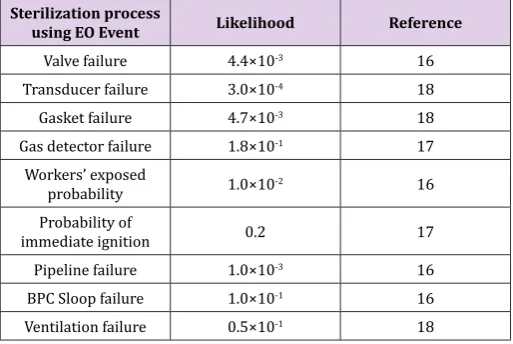
The likelihood data are given in Table 5 for the sterilization process (Table 5).
Table 5: Likelihood data for sterilization process using EO Event.
Sterilization process
using EO Event Likelihood Reference
Valve failure 4.4×10⁻³ 16
Transducer failure 3.0×10⁻⁴ 18
Gasket failure 4.7×10⁻³ 18
Gas detector failure 1.8×10⁻¹ 17
Workers’ exposed
probability 1.0×10⁻² 16
Probability of
immediate ignition 0.2 17
Pipeline failure 1.0×10⁻³ 16
BPC Sloop failure 1.0×10⁻¹ 16
Ventilation failure 0.5×10⁻¹ 18
Determining The Frequency of Scenarios
The frequency was determined for each scenario and the results are described below. The frequency ranges from 5.3×10⁻³(f
23) to 8.5×10⁻⁶ (f
11,f12,f13) are associated with the release to equipment or loading area, ranges from 5.8×10⁻¹⁰(f
01) to 6.2×10⁻¹²(f02) associated with overdosing to the reactor, and ranges from 1.5×10⁻⁵(f
31, f32, f33) to 6.5×10⁻⁶(f
34) associated with leak at the storage. a. Overdosing to The Reactor
3 4 3 1 10
01 4.4 10( )(3 10 )(4.4 10 1.0)( 10 5.8 1) 0
f = × − × − × − × − = × −
3 4 3 1 2 12
02 4.4 10( )(3.0 10 )(4.7 10 )(1.0 10 1.0 10)( ) 6.2 10
f = × − × − × − × − × − = × −
b. Release to Loading Area
3 1 2 6
11 4.7 10( )(1.8 10 ) 1.( 0 10 ) 8.5 10
f = × − × − × − = × −
3 1 2 6
12 4.7 10( )(1.8 10 ) 1.( 0 10 ) 8.5 10
f = × − × − × − = × −
3 1 2 6
13 (4.7 10 )(1.8 10 1.)( 0 10 ) 8.5 10
f = × − × − × − = × −
1 1 2 3 7
14 1.0 10 1.8 10 1.0 10 4.7 10 8.5 10( ) ( ) ( ) ( )
f = × − × − × − × − = × −
c. Release to Equipment Area
(
)
3 1 5
21 1.0 10 1.8 10( )( ) 0.296 5.3 10
f = × − × − = × −
( )
3 1 4
22 4.7 10( )(1.8 10 ) 0.296 102.5
f = × − × − = × −
( )
1 1 3
1.0 10 1.8 10( )( ) 0.296 5.3 10
f = × − × − = × −
( )
2 1 4
24 1.0 10( ) 1.8 10( ) 0.296 5.3 10
f = × − × − = × −
( )
2 1 4
25 1.0 10( ) 1.8 10( ) 0.296 5.3 10
f = × − × − = × −
(
)
2 1 4
26 1.0 10 1.8 10( )( ) 0.296 5.3 10
f = × − × − = × −
d. Leak at Storage of EO
( )
3 1 5
31 1.0 10 0.5 10( )( ) 0.296 1.5 10
f = × − × − = × −
( )
3 1 5
32 1.0 10 0.5 10( )( ) 0.296 1.5 10
f = × − × − = × −
( )
3 1 5
33 1.0 10 0.5 10( )( ) 0.296 1.5 10
f = × − × − = × −
( )
3 1 5
34 (4.4 10 ) ( 0.5 10 ) 0.296 6.5 10
f = × − × − = × −
Result and Discussion
Based on the HAZOP study and developed scenario, countermeas-ures can be obtained to reduce hazards in the sterilization process us-ing EO. Among the developed scenarios, overdosus-ing to the reactor
may cause off-specification of the product and is little harmful to
workers and facility, and no further analysis is needed. EO release can be very harmful to cause toxic exposure to the workers or be-came explosive. The EO release to the equipment chamber, loading area, and storage area can intoxicate workers or can be exploded. The scenario associated with the release to loading area has likeli-hood ranged from 8.5×10⁻⁶ to 8.5×10⁻⁷. The scenario with frequency of 8.5×10⁻⁶ corresponds to either small scale leak through sterilizer door by the process air failure or by the electricity failure followed
by loading/unloading work exposed to higher than 1.0ppm EO with
detector malfunction [16-18].
If adequate personal protection equipment (PPE) is available together with monitoring system, then the frequency can be improved to the level of 10-6. The scenario associated with the release to equipment area has likelihood ranged from 5.3×10⁻³ to 5.3×10⁻⁵. The scenario with frequency of 5.3×10⁻³corresponds to
small scale leak by reverse flow via air inlet followed by equipment
area exposed to higher than 6,500ppm (25% of the LEL) with detector malfunction, then ignited. If adequate ventilation windows are added, then the frequency can be improved to the level of 10-6. The scenario associated with the leak at storage area has likelihood ranged from 1.5×10⁻⁵ to 6.5×10⁻⁶. The scenario with frequency of 1.5×10⁻⁵ corresponds to small scale leak by fitting failure followed by storage area exposed to higher than 6,500ppm (25% of the LEL) with bad ventilation, then ignited. If adequate ventilation windows are added, then the frequency can be improved to the level of 10-6.
Conclusion
Risk of per 1million is generally acceptable one. Risk of EO
gas release followed by EO intoxication or explosion at loading/
unloading area and equipment area can be reduced by adding PPE (Personal protection equipment, SIL 1, or) and monitoring system (SIL 2, or) together. Risk of EO gas release followed by EO intoxication or explosion at gas storage facility can be reduced by adding ventilation windows of SIL
Acknowledgment
and the Ministry of Trade, Industry & Energy(MOTIE) of the Republic of Korea (No. 20174010201160).
References
1. M Angel de la O Herrera, AS Luna, AC Augusto da Costa, EMB (2015) Lemes, J. Loss Prev. Proc. Ind., 35(5): 1.
2. T Sandle (2016) Pharmaceutical microbiology - essentials for quality assurance and quality control, 233.
3. W Feng, Y Zhaoa, O Yanga, J Cai, M Deng (2013) J. Loss Prev. Proc. Ind, 26(6): 1399.
4. LG Hess, VV Tilton (1950) Industrial & Engineering Chemistry 42(6): 1251-1258.
5. (1994) NFPA 325, Fire hazard properties of flammable liquids, gases and volatile solids.
6. MG Zabetakis (1965) Flammability characteristics of combustible gases and vapors, Bulletin 627, US Bureau of Mines.
7. (2007) NFPA 86, Standard for ovens and furnaces.
8. (2007) American Chemistry Council, EO product stewardship manual (3rd edn).
9. (1981) DHHS (NIOSH) Publication Number 81-130, Ethylene oxide (EO): evidence of carcinogenicity.
10. (2012) OSHA Standards- 29CFR, Part 1910-1047, Ethylene oxide 25. 11. S Jung (2016) Korean Journal of Chemical Engineering 33(1): 1. 12. R Singh, HJ Lee, AK Singh, DP Kim (2016) Korean Journal of Chemical
Engineering 33(8): 2253.
13. S Tong, ZZ Wu, RJ Wang, YQ Duo (2016) Korean Journal of Chemical Engineering 33(8): 2291-2297.
14. (2001) CCPS, Layer of protection analysis: simplified process risk assessment, New York, USA, 71.
15. (1989) CCPS, Guidelines for process equipment reliability data - with data tables, New York, USA, 33.
16. (1995) AEA/CS/HSE R1403, BLEVE probability of an LPG road tanker during unloading.
17. C Zhu, J Jiang, X Yuan (2012) Procedia Engineering 45: 435.
18. FP Lees, S Mannan (2012) Loss Prevention in the Process Industry (3rd edn).
Submission Link: http://biomedres.us/submit-manuscript.php
Assets of Publishing with us
• Global archiving of articles
• Immediate, unrestricted online access • Rigorous Peer Review Process • Authors Retain Copyrights • Unique DOI for all articles
http://biomedres.us/ This work is licensed under Creative