DOI: 10.1051/epjconf/20147601027
C
Owned by the authors, published by EDP Sciences, 2014
Numerical study of the structure flow of the gas-vapor
mixture in a channel with injection of water droplets
Eugene Maslov1,a, Irina Zharova2, Boris Borisov1, and Natalya Fedotova1
1Tomsk Polytechnic University, Tomsk, Russia
2Tomsk State University, Scientific Research Institute of Applied Mathematics and Mechanics, Tomsk,
Russia
Abstract.Mathematical modeling algorithm for the numerical analysis of the dynamics and evaporation of the water droplet which is injected into a gas-vapor flow is offered. The algorithm was tested with the help of the problem solution about a viscous fluid flow in a plane channel of constant cross section. It was shown that the proposed mathematical model and implementation algorithm are adequate to the physics of the investigated process. It was shown that the proposed mathematical model and implementation algorithm are adequate to the physics of the investigated process. Results of numerical study of the flow structure of the gas-vapor mixture in the channel with injection of water droplet under varying the initial droplet parameters are given.
1. Introduction
Technological processes in a number of systems of energy installations are related to the stream of the working medium as a multiphase flow. We need minimize thermal and hydraulic losses, and to provide a rapid and complete combustion of the fuel components, and to provide specified operating parameters of the outlet working medium for improve the efficiency of such systems. A detailed study of the occurring in heterogeneous multiphase flows processes allows to find the best of a constructive solution for the ultimate goal. Problem to define the basic flow parameters of the combustion products of organic fuels, in which water is present in a different states of aggregation is one of the most actual at the moment. Presence of water in the mixtures may be due to the thermochemical reactions to form of water vapor. Injection of fine droplets is carried out in a number of energy technologies to achieve the required thermodynamic flow parameters. In particular, the injection of water allows you to adjust gas-vapor mixture parameters at the inlet into the appropriate turbine area. The following problems arise in this case:
– it is necessary to exclude the possibility of droplet deposition on the channel walls; – it is necessary to implement the conditions of the complete water evaporation;
aCorresponding author:[email protected]
EPJ Web of Conferences
Table 1. Characteristics of a medium.
Fluid Characteristics
Density,kg/m3 Dynamic viscosity, Pa·sec
Thermal conductivity, W/(m·K)
Heat capacity, J/(kg·K)
Glycerin 1.26·103 1.49 0.28 2.43·103
Water 103 10−3 1 4.2·103
Air 1.2047 18.2·10−6 0.0257 1.005·103
Table 2. The flow velocity in the initial section of the channel.
Glycerin Water Air
uin, m/sec 3.55 3·10−3 4.53·10−6
– it is necessary achieve to homogenization working medium with a value of the dryness degree, which provide minimal mechanical flow impact on the turbine blades and the maximum value of the internal efficiency of the turbine.
Numerical modeling allows us to study the basic laws of processes in heterogeneous multiphase flows in power installations and to identify the mutual influence of various factors a priori. This allows to find new approaches to the implementation of promising engineering solutions during the design of energy systems.
The purpose of this work is the numerical analysis of the dynamics and of heat transfer when introducing water droplet with different initial conditions into a stationary saturated vapor flow or into superheated vapor flow.
2. Mathematical modeling of the gas-vapor mixture flow in a cylindrical
channel with injection of water droplets
We consider the cylindrical channel of constant cross section. Numerical analysis was done on the basis of a mathematical model [1]. The fluid flow is described by the stationary Navier-Stokes equations for a compressible viscous heat-conducting gas. Droplet dynamics is described by the equation of motion in the velocity field of the steady flow of gas, taking into account the viscous drag forces and taking into account the gravity force. Thermal state of a drop is described by the thermal conductivity equation. The velocity of evaporation of a liquid from the surface droplet was determined by Knudsen-Langmuir relation. A flow was considered irrotational with parabolic velocity profileuinand constant temperature Tinat the channel input. The adhesion and adiabatic conditions were specified at the channel output.
Numerical solution was implemented by control volumes method. Numerical solution was implemented by control volumes method. Boundary conditions on the channel surface were implemented with help of border functions by using empirical relationships for flow with low Reynolds numbers [2]. Differential equations were approximated by implicit Five-Points scheme. Scheme QUICK against the flow was used to approximate of the convective terms, procedure PISO was used to calculate the flow field. The diffusion terms were approximated by the central second order scheme.
The algorithm was tested with the help of the problem solution about a viscous fluid flow in a plane channel of constant cross section [3]. The results of mathematical modeling of flow near the wall of the channel were compared with the numerical results [3,4] and experimental data [5]. The flows of fluids with different properties in a channel (see Table1) were analyzed at a fixed value of the Reynolds number Red =fuind/f ≡150 (in analogy to [3]). Values of the characteristic size
channel,d =(0.03÷0.3) m, and of the flow velocityuin=(4.53·10−6 ÷ 3.55) m/sec (Table2) were
Figure 1. Velocity profiles in different sections of the flat channel. –•– – Theoretical and experimental results [3–5]; — Calculation by model [1].
EPJ Web of Conferences
Figure 3. Isobars of flow glycerin (a) and of flow air (b).
The profiles of the longitudinal velocity component in various sections along the channel are shown in Fig. 1 (curves correspond to values of r/d=(0.044, 0.208, 0.833, 3.333, 7.50, 13.5), r is the current value of the radius, d is a diameter). Comparative analysis showed that velocity profiles are differ slightly for different environments in different channel sections in this range of output velocities
uin=(4.53·10−6 ÷3.55) m/sec. Mismatch ofthe obtained resultsand given data in [3–5] in the range
of sectionsr/d=(0.208÷3.333) is connected to the use of border functions for the implementation of the numerical solution algorithm.
The velocity and pressure fields were analyzed on the basis of the proposed model and algorithm of numerical implementation. The structure features of flows in the channel of mediums with significant viscous interaction between the phases were identified. There are the results of one of calculation variants for the glycerin flow and air flow in the channel when diameter d =0.05 m and a length
L=0.35 m in Figs.2 and3. It was found that the flow of air and water have a layered structure, in contrast to the glycerin flow in considered conditions.This is because the glycerin is more dense and viscous medium compared to air and water.
Figure 4. Scheme of solution area.
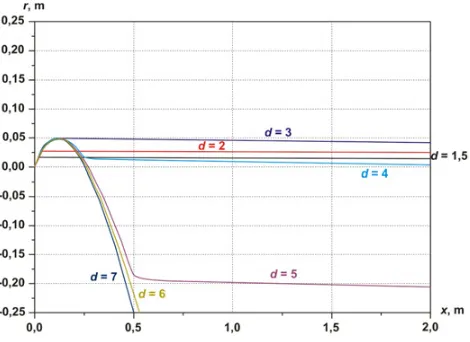
Figure 5. Trajectory of movement of various initial droplet diameter, Vinj = {1; 1}m/s.
3. Analysis of the structure of gas-vapor mixture flow during the
injection of water droplets in the channel
The proposed algorithm of mathematical modeling was used for numerical analysis of the dynamics and evaporation of the droplet of water injected into a gas-vapor flow. Parametric study was conducted under the following conditions: channel length isLx=2 m; channel cross-sectional radius isLr =0.25 m; gas
mixture temperature isTf =100◦C; initial flow velocity isuin=10 m/sec; the initial temperature of
the injected droplet of water isTinj =20◦C. Scheme of solution area is shown in Fig.4.
The initial parameters of the droplet were varied under studies: diameter isdp0 =(1÷7)·10−3m, coordinates areX0= {0; (−0.2÷0.2)}m, the velocity of injection droplet is Vinj(Vxp=1 m/s,Vrp=
(−0.5÷3) m/s;Vxp andVrpare longitudinal and transverse components of the velocity vector).
EPJ Web of Conferences
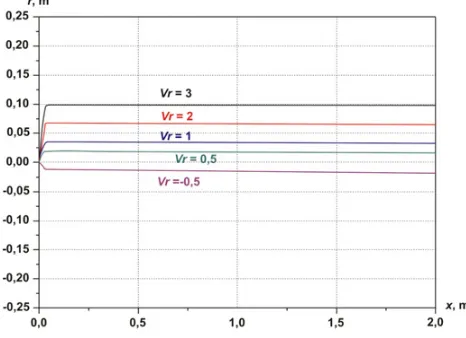
Figure 6. Droplets trajectories under the different initial velocity,dp0= 2·10−3m.
4. Conclusion
Analysis of the results showed that the water droplets with initial diameters less than 5 mm was completely vaporized at injection into the gas-vapor mixture flow on the axis of symmetry of the channel (Fig.5) for the given parameters of the study. It is necessary increasing the gas-vapor flow velocity for the complete evaporation of droplets of larger diameter in order to avoid their deposition on the channel walls with further formation of a liquid film.
Droplet with diameterdp0=2·10−3m completely evaporate in the axial region when their injection from the origin into the channel have an initial velocityVinj = {1; (−0, 5÷3)}m/s (Fig.6).
We obtained that droplets with initial diameter dp0≈5 mm can as evaporate so and can precipitate on the channel walls in this velocities range of injection. Droplets with initial diameterdp0≥6 mm are precipitated completely on the channel wall.
Work is done at the expense of subsidies in the framework of the program to improve the competitiveness of TPU.
References
[1] E. Maslov, I. Zharova,V. Terekhov. Russian Physics Journal, 53, 182 (2010)
[2] H. Versteeg, W. Malalasekera. An introduction to computational fluid dynamics. The finite volume
method (Longman Scientific & Technical, 1995)
[3] I. Vinogradova, V. Zubkov. Mathematical Modeling, 14, 3 (2002)
![Figure 1. Velocity profiles in different sections of the flat channel.[ – • – – Theoretical and experimental results3–5]; — Calculation by model [1].](https://thumb-us.123doks.com/thumbv2/123dok_us/8193503.1368492/3.482.135.351.295.618/figure-velocity-proles-different-sections-theoretical-experimental-calculation.webp)