Recognition of Polish Derivational Relations Based on Supervised Learning
Scheme
Maciej Piasecki, Radosław Ramocki, Marek Maziarz
Institute of Informatics, Wrocław University of Technology,
[email protected], [email protected], [email protected]
Abstract
The paper presents construction ofDerywator– a language tool for the recognition of Polish derivational relations. It was built on the basis of machine learning in a way following the bootstrapping approach: a limited set of derivational pairs described manually by linguists in plWordNet is used to trainDerivator. The tool is intended to be applied in semi-automated expansion of plWordNet with new instances of derivational relations. The training process is based on the construction of two transducers working in the opposite directions: one for prefixes and one for suffixes. Internal stem alternations are recognised, recorded in a form of mapping sequences and stored together with transducers. Raw results produced byDerivatorundergo next corpus-based and morphological filtering. A set of derivational relations defined in plWordNet is presented. Results of tests for different derivational relations are discussed. A problem of the necessary corpus-based semantic filtering is analysed. The presented tool depends to a very little extent on the hand-crafted knowledge for a particular language, namely only a table of possible alternations and morphological filtering rules must be exchanged and it should not take longer than a couple of working days.
Keywords:recognition of derivational relations, Polish, wordnet, plWordNet, morphology learning
1.
Introduction
Derivational relations (e.g. aspect, deminutivity or young being) are numerous in Slavic languages, encode seman-tic information and are important for the construction of lexical semantics resources. However, morphological anal-ysers rarely provide extensive description of derivational relations, and for some languages, e.g. Polish, do not en-compass them. Handwritten rules are typically used for the description of derivatives, but their construction is time-consuming. Instead, we aim at constructing an analyser of derivational relations for Polish based on the bootstrapping approach and supervised training on the basis of a limited set of examples. The task of the analyser is to recognise a word form as a derivative and identify its derivational base and the precise relation linking them. The starting point are derivational relations described inplWordNet– the largest Polish wordnet, but the algorithm should be open to any set of relations and different languages.
Works dedicated to derivational morphology learning are relatively rare. Derivational rules are mostly extracted as a part of the general morphology learning task. In this field, two groups of methods can be distinguished (Walther and Nicolas, 2011): aimed at automated construction of morphological analysers and extraction of morphological models (e.g. segmentation and rules). e.g. (Golénia et al., 2010). In the first group, most methods are based on un-supervised learning from large annotated corpora. Combi-nations of different methods of statistical analysis are used in order to identify affixes, stems and word form families, e.g. (Schone and Jurafsky, 2001), Minimum Description Lengthconcept is often used in discovering segmentation, e.g. (Kohonen et al., 2009), cf overview in (Walther and Nicolas, 2011). Methods supported by declared linguis-tic knowledge were also proposed, e.g. for Polish (Sagot, 2009). Walther and Nicolas (2011) presented corpus-based extraction of derivational rules. Only derivative candidates above some minimal frequency in the corpus were
consid-ered. 62,158 derivative candidates were extracted from 37.5 million token French. 1,511 new derived French lemmas were identified after ranking candidates. Manual evaluation of a small sample of 100 lemmas resulted in: 42 lemmas and relations identified as correct, and 43 lemmas definitely incorrect (many due to foreign words and typos). Contrary to corpus based approaches we aim at using a limited but manually annotated set of derivational pairs and to build an analyser as a tool for automated expansion of the data pre-pared by linguists.
In a similar way to our goal,memory based learning, e.g. (van den Bosch and Daelemans, 1999), and transformation-based learningparadigms, e.g. (Oflazer et al., 2001) were applied to limited training data. The latter was even plied to Polish, but no evaluation was reported. Both ap-proaches are relevant to our goal, however, Polish deriva-tional rules can be reduced to: prefix and suffix, in rela-tion to the derivative base stem combined with a limited set ofinternal stem alternations(Rabiega-Wi´sniewska, 2009). Moreover, prefix and suffix occur very rarely together in the same rule. Rules of this scheme can be directly im-plemented in a transducer. Morphological guessers based on transducers extracted from anotated data were success-fully applied to Polish, e.g. for Polish (Daciuk, 2001) and a large scale Polish guesser calledOdgadywacz(Piasecki and Radziszewski, 2008) of high precision and recall. However, transducer guessers have problems with alternations (store exact word parts) and with prefixes (are mostly built on the basis of a tergo indexes). We propose solutions to both problems.
2.
Derivator
analyser called Derivator. It is next used in expanding derivational relations inplWordNet. The process is started with applying Derivator to a large set of Polish lemmas, next derivatives are recognised together with their deriva-tional bases and the relations. In each iteration rules learned from the described derivational pairs are applied to all Pol-ish lemmas in order to filter out other derivational pairs ful-filling the trained patterns. Supervised learning algorithm is preferred in this scheme to obtain high precision deriva-tional rules from a limited set of examples.
2.1. Learning
Derivative relations are manifested in Polish and other Slavic languages by relatively regular processes of trans-forming derivative bases (word forms) into derivatives by adding suffixes (mostly) and prefixes (less often, only for some types). Thus Polish derivative relations are encoded in a similar way to morphological oppositions: the differ-ences between a morphological word form and the lemma (morphological base form) is mostly expressed by a suffix and only some of them by a prefix. For a word form not included in a morphological dictionary values of its gram-matical categories (e.g. case, number, gender etc.) can be ‘guessed’ (predicted) on the bases of extracting from the analysed word form a prefix and/or suffix.
The starting point for the learning algorithm was
Odgadywacz– a large scale, high accuracy morphological guesser for Polish which generates morphological descrip-tions for unknown Polish word forms with relatively high accuracy on the basis of suffixes learned from annotated ex-amples (Piasecki and Radziszewski, 2008). The guesser is based on a deterministic transducer which takes a reversed sequence of letters of a word and returns morphological de-scription attached to the leaf node, in case it was reached, or a branch node which was a final node for some word form during learning.
The guesser learning is divided into two phases: transducer tree building and pruning. First, a transducer path is built for each reversed word form and each letter. Nodes that were terminal for some word form are marked. Next, all final non-branching path parts are cut off, but all terminal nodes are preserved. Information concerning lemmas (mor-phological base forms) is acquired in a form of reconstruc-tion rules: the number of letters to be cut off from a word form and a suffix to be added. The rules are stored in the terminal nodes together with the tags.
On the basis of word form frequency list collected from a large corpus, morpho-syntactic tags and base form recon-struction rules and morphological specifications are added to the terminal nodes. Generalisation can be improved by pruning some terminal nodes, e.g. those with the smallest number of training examples.
In order to expandOdgadywacz intoDerivatortwo prob-lems had to be solved: internal stem alternations and con-struction of derivatives on the basis of both: suffixes and prefixes (sometimes both, too). Representation of suffixes and prefixes has been provided by training two guessers ap-plied in parallel in reversed directions, but only one at a time for the given training example, see the algorithm be-low.
Support for stem alternations had to be added to the
Odgadywaczalgorithm. The idea is to find a sequence of alternations that makes the derivational base overlapping on its ending or beginning with a derivative. The identi-fied sequences are applied to the derivational bases before passing the training data to the suffix-based, or prefix-based guesser. The sequences are stored in the guesser nodes to-gether with the relation tag. Thus, a derivational rule is learned in a form of a suffix / prefix and associated sequence of alternations that can affect the whole word form not only the suffix/prefix. The recorded alternations are used for re-constructing derivative bases during guessing.
Learning algorithm
Input:L =ha derivative, a relation tag, a derivative basei, T – table of alternations (a mapping: letter sequences to letter sequences (up to 4 letters))
For eache=hd, r, bi ∈L:
1. tp=sequence of at mostksubstitutions fromT such thattpmakesP a longer shared beginning ofdandb.
2. ts =as in the above but in the relation to a shared endingS
3. Iflength(P)≥length(S)
• then addhd, r+tp, tp(b)ito the training set of the normal guesser,
• else addhrev(ts(d)), r+ts, rev(b)ito the train-ing set of the ‘reversed’ guesser.
Table of alternations (in the form defined by linguists) con-tains N lines. In each line there areKn letter sequences defining alternation group. Alternation rule is a mapping from one letter sequences to another. Every alternation groupnis used to buildK2
n−Kn alternation rules, that is all two-element permutations. Below there are two exam-ples of alternation group expanded into alternation rules:
• hch sz chii: (ch, sz), (ch, chi), (sz, ch), (sz, chi), (chi, ch), (chi, sz)
• ho ói: (o, ó), (ó, o)
In steps 1–2, the longest ending and beginning shared by the derivative and its base are identified. But, we assume that alternations can occur in any position andT(127 pos-sible alternation groups defined by a linguists, full list of alternation groups is attached at the end of this paper) is used to iteratively extend the found shared beginning and ending.
Alternation rules application algorithm
Input: hd, bi– derivative and it’s base (in case of longer shared ending letters ofdandbmust be reversed),R– list of alternation rules, k– maximum number of alternation rules that can be applied to the derivative base (in our ex-periments we used 3)
Output:t– list of applied rules and modified derivative base b
For eachr∈R: Iflength(t)≥k:
return(t, b)
If sharedPrefixLength(d,w)≥sharedPrefixLength(d,b): 1. addrtot
2.b=w return(t, b)
E.g., for the derivative´swiecznik‘candlestick’ and its base
´swieca‘candle’ the mapping[’cz’/’c’]is added totp: b =‘´swiecza’ andP =‘´swiecz’. Here are another exam-ples:
• a pairdolatywa´c‘(about flying objects) reachimpf’ –
dolecie´c‘reachpf’ includes two alternations [‘la’/‘le’] and [‘t’/‘c’],b=‘dolatie´c’ andP =‘dolat’,
• for a pairpszczelarz‘beekeeper’ –pszczoła‘bee’ three mappings [‘cze’/‘czo’], [‘le’/‘ła’] and [‘la’/‘le’],b = ‘pszczela’ andP =‘pszczela’ are found,
• a deminutive form bułeczka ‘nice/little (bread) roll’ and its basebułka‘roll’ have two alternations [‘łe’/‘ł’] and [‘cze’/‘k’],b=‘bułeczea’ andP =‘bułecz’.
In step 3 the lengths of the shared beginning and ending are compared in order to decided which guesser to use. Longer beginning means suffix-based derivation and the normal guesser. The reversed guesser is used in the case, e.g., zrobi´c‘to doperf’ –robi´c‘to doimperf’. The prefix-based guesser is simulated by reversing the letter order in both elements of the training samples: the derivative and its transformed base.
2.2. Application – Derivative Base Recognition
We assumed that the input is a word form which is possibly a derivative. The task is to identify its derivative base, if exists, and the derivational relation (including its subtype) which links them. For an input word there is no informa-tion which guesser –Derivatormodule – to use: the suffix or the prefix-based one, if any (the input does not need to be a derivative). Thus, both modules must be applied in parallel and the appropriate result selected on the basis of the available knowledge sources.
First of all, we can expect thatDerivatorproduces proper Polish word forms. Thus, we appliedMorfeusz SGJP1– a
Polish morphological analyser of extensive coverage – to filter the output: only words recognised by it are accepted. As this procedure is limited only to the lemmas covered by
Morfeusz, we tested also corpus based filtering, see Sec. 4.. Morphological filtering applied next is based on the obser-vation that for most deriobser-vational relations we can formulate constraints on the acceptable morphological characteristics of the derivational pair, e.g. forinhabitantonly nouns in the nominative case are accepted on both sides and the deriva-tive cannot be in the non-animated gender, while the base gender is not restricted, see the rules in the appendix. Recognition algorithm
Input: a lemma l, Derivator modules, R – morpho-syntactic filtering rules.
1. lis delivered to both modules (to one of them in a re-versed form) that return a set of triples:hb, t, riwhere
1http://sgjp.pl/morfeusz/
bis a base as reconstructed by the guesser,ta sequence of substitutions associated with the guesser node dur-ing learndur-ing,r– relation tag.
2. For each triple:
(a) bis transformed by the reversed sequence of sub-stitutionst.
(b) if b was generated by the prefix-based guesser than it must be reversed.
3. Triples:hl, r, biare filtered:
• landbare first morphologically analysed – non recognised pairs are discarded,
• and next all morphological descriptions (forms can be ambiguous) are compared with the filter-ing rules forr– at least one pair of descriptions must match the rule.
In step 3, non-words or non-lemmas, that are often gener-ated by the guesser modules, are filtered out from the result. Morphological filtering limits the intrinsic lexical over-generation of the guessers. Very often words or non-lemmas are generated as potential derivative bases, espe-cially for input lemmas that are not derivatives. However, the filtering based on an existing analyser blocks the pos-sibility to go beyond the word forms covered by it. An alternative is filtering based on the lemma frequency list collected from a large corpus. Its influence is discussed in the evaluation section.
3.
Derivational relations in plWordNet
Derivational pairs already described in plWordNet were a basis for the evaluation. plWordNet2 is the largestword-net of Polish and one of the largest in the world, the ver-sion from 06.09.2011 (including about 70000 synsets and 100000 lexical units) was used during evaluation.
The relation set for plWordNet includes derivational re-lations that are regular (“from several hundred to sev-eral thousand occurrences in lexicon”, see (Maziarz et al., 2011a, p. 175), (Maziarz et al., 2011b)). We give frequency data after (Grzegorczykowa and Puzynina, 1998) who makes use of the ‘lexicon’ frequencies in (Doroszewski, 1969).
Femininity (N-N) is a relation linking nouns denoting females with their bases referring to male counterparts:
Xderivate–Ybase is ‘X is female Y’. A suffix -ka (
psy-cholo˙zka ‘female psychologist’ < psycholog ’psycholo-gist’) forms almost fully productive type3. Sufixes-ini/-yni
(władczyni’female ruler’ <władca’ruler’),-ica(tygrysica
‘female tiger’ <tygrys‘tiger’) or -a (markizaf. ‘marquise’ < markizm. ‘marquis’) are also very frequent (Grzegor-czykowa and Puzynina, 1998, p. 422-5). All formations taken together account for 1745 instances of this relation in
plWordNet.
Markedness (N-N relation) connects nouns such that a
markedone denotes objects of almost the same type as does
2plwordnet.pwr.wroc.pl
3The type -ka accounts for 913 instances
its counterpart (umarked base) but with additional proper-ties. The most productive types of markedness are: Diminutivesdenotes positive emotional marking or small size. The meaning could be defined thus: ‘Xderiv is a
lit-tle or pleasant Ybase’. This relation subtype is very fre-quent in Polish. -Ek/-ik(-yk),-koand-kaare the most fre-quent affixes: piesek ‘little or pleasant dog’ <pies‘dog’,
kocyk‘little or pleasant blanket’ <koc’blanket’,serduszko
<serce‘heart’,kostka<ko´s´c‘bone’ (Grzegorczykowa and Puzynina, 1998, 425-6). From historical perspective some formations could be considered as derived, such cases we used to treat from the synchronic point of view: e.g., word
młotek‘hammer’ was derived frommłot‘heavy hammer’ with suffix -ek, it will be ridiculous nowadays to say that
młotekis ’small or pleasantmłot’ and this relation instance is not included inplWordNet.
Augmentatives express negative emotional marking and grand size of denotatum, and its paraphrase is: Xderiv is
huge or terrible Ybase’. Suffixes of augmentatives are
-uch,-isko(-ysko) or-al:staruch‘terrible old man’ <starzec
‘old man’, komarzysko ‘huge or terrible mosquito’ < ko-mar‘mosquito’,nochal<nos‘nose’ (Grzegorczykowa and Puzynina, 1998).
Young being names youth of derivative’s denotatum and may be paraphrased as: ‘Xderivis young Ybase’. Two for-mants are used (their distribution is regionally conditioned):
-˛eand-ak, e.g.: ptasz˛e’young bird, esp. nestling’ <ptak
‘bird’,koci˛e‘kitten’ <kot’cat’,kociak‘kitten’ <kot‘cat’,
psiak‘pup’ <pies ‘dog’ (Grzegorczykowa and Puzynina, 1998, pp. 429-30).
Role(N-V) refers to thematic roles of predicate arguments, e.g., agent, object, instrument etc. The most frequent is an agent subtype with suffixes-acz(badacz‘researcher’ <
bada´c‘to research’), -ca (władca’ruler’ <włada´c’rule’),
-iciel (pocieszyciel ‘comforter’ < pocieszy´c ‘to comfort, to console’), -ator (restaurator ‘restorer’ < restaurowa´c
‘restore’). Also (less frequent) backward (paradigmatic) derivation occurs in that subtype (szpieg‘spy’ <szpiegowa´c
‘spy’). Suffixal and parafigmatic formations account for above 3500 instances in (Doroszewski, 1969), cf. (Grzegor-czykowa and Puzynina, 1998, pp. 398-416). InSłowosie´c
the pointer was used 4072 times and is a most favourite subtype among editors.
Role inclusion(V-N) expresses also thematic roles of pred-icate arguments, but those evoked by a verb structure. This derivation type is relatively frequent inplWordNet: 1262 instances. According to (Wróbel, 1998, pp. 577-83) in-strumentandresult are the most frequent subtypes in Pol-ish, e.g. (soli´c ‘to salt’ < sól ‘salt’, dziurkowa´c ‘to per-forate’ < dziurka ‘hole’), nextobject (kartkowa´c ‘to leaf through’ <kartka‘a sheet’) andsubject(s˛edziowa´c‘to ref-eree’ <s˛edzia‘referee’) come (the rest types are less pro-ductive). The assumptions find confirmation in plWord-Net data statistics.
Cross-categorial synonymyis of extreme frequency. The relation is a type oftransposition(two related words differ only in their parts of speech).
N-V subtype links deverbal nouns (gerunds) with their bases. We account for regular type on -anie,-enie, -cie:
granie‘playing’ <gra´c‘playimpf’,zapełnienie‘filling’ <
zapełni´c ’fillpf’, bicie ‘hitting’ < bi´c ‘hitimpf’ (Grzegor-czykowa and Puzynina, 1998, pp. 393-8). InplWordNetwe have 1334 instances of the relation.
N-Adjtype refers to deadjectival nouns on -o´s´c: blado´s´c
‘paleness’ < blady ‘pale’, władczo´s´c ‘imperiousness’ <
władczy ‘imperious’, mało´s´c ‘smallness’ < mały ‘small’; this type is regular. In (Doroszewski, 1969) there are noted about 3500 such derivatives, but because of the productiv-ity of the formation, there potentially could be much more such derivatives (Grzegorczykowa and Puzynina, 1998, p. 417). InplWordNet we have 1513 instances of the forma-tion.
State/feature bearer (N-Adj) and state/feature (Adj-N) are both very productive in Polish. The meaning of the relation linkingXN-YAdjcould be articulated in following way: X is/has feature Y. The most frequent suffixes (more than 100 lemmas in (Doroszewski, 1969)) are-ec(głupiec
‘a fool, idiot’ < głupi ‘fool’),-ka (dziczka‘ rootstock’ <
dziki ‘wild’), -ak (dziwak‘freak’ <dziwny‘strange’), -ik
(n˛edznik‘scoundrel’ <n˛edzny ‘poor’), these relations are represented by about 600-800 instances (Grzegorczykowa and Puzynina, 1998, p. 420-1). Till now we have intro-duced 219 feature bearer relations intoplWordNet. Inhabitant (N-N) describes X as an ‘inhabitant/dweller of Y’, where Y is the base denotatum. Inhabitant names are formed on the basis of geographical proper names (for countries, regions, cities, towns, villages and parts of the world) with such suffixes as -aninand -czyk or with paradigmatic backward derivation: Amerykanin ‘Ameri-can’ < Ameryka‘America or USA’,Panamczyk ‘Panama-nian’ <Panama‘Panama’,Bułgar‘Bulgarian’ <Bułgaria
‘Bulgaria’ (Grzegorczykowa and Puzynina, 1998, pp. 437-8) (147 instances inplWordNet).
Aspectuality (V-V) expresses aspectual differences and
Aktionsarten. Two subtypes are present inplWordNet: 9145 instances of pure aspectuality (only aspectual differences,
wykopa´c ‘to digpf sth up’ - wykopywa´c ‘to digimpf sth up’), 3979 instances of secondary aspectuality (aspect dif-ferences + lexical meaning shift,za´swieci´c‘to startpf shin-ing’ -´swieci´c’shineimpf’).
Derivationality groups all derivational relations that are not included in the above subtypes.
4.
Evaluation
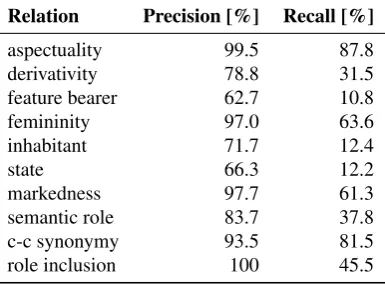
First, a modified 10-fold cross validation was performed on the level of main relations without distinguishing subtypes. Pairs for each relation were randomly divided into 10 sub-sets. One subset per relation was used for testing in each iteration. The results are presented in table 1. The lower recall is caused by a small number of examples for many subtypes and also by long and detailed pseudo-suffixes gen-erated in order to distinguish different pairs: subtype and alternation sequence presented during learning, e.g. suffix
Relation Precision [%] Recall [%]
aspectuality 99.5 87.8
derivativity 78.8 31.5
feature bearer 62.7 10.8
femininity 97.0 63.6
inhabitant 71.7 12.4
state 66.3 12.2
markedness 97.7 61.3
semantic role 83.7 37.8
c-c synonymy 93.5 81.5
role inclusion 100 45.5
Table 1: Coarse-grained cross-validation results.
fromMorfeusz SGJP. In the first experiment, the feasibil-ity of the bootstrapping approach in terms of the gain re-ceived from manually annotated examples was analysed.
Derivator was trained twice: first on data acquired from
plWordNetthe version 18.08.2011 (15718 examples) – ba-sic training set– and the second time on version 06.09.2011 (17971 example, 14% more) –extended training set(it was used in Tab. 1). Both versions were next applied to the whole lemma list. Derivatortrained on the basic training set recognised 158363 potential derivational pairs while the one based on the extended set 166600 pairs. The difference, gain obtained from the manually added pairs to the word-net, is 8237 pairs, while there were 2253 new derivational pairs added by linguists to the wordnet. An algorithm for the selection of new pairs to be added manually in a way increasing the gain is required.
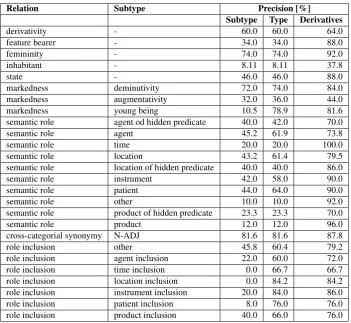
Not all pairs recognised by Derivator are correct. For the evaluation of precision, we selected a subset of 26727 recognised pairs such that the generated derivative base has only one sense inplWordNet. Derivational relations can be valid only for specific senses of the base and in the case of the monosemous bases, evaluators do not need to con-sider different possible senses. Precision for the selected subset was checked manually. For each derivational sub-type a sample of at most 50 pairs was randomly selected (for smaller subtypes all pairs were included). Samples were evaluated by linguists and they were asked to assign pairs to the three classes: CorrectSubtype, CorrectType– a pair does not represent the subtype returned byDerivator
but another subtype of the same type, e.g. the pair is not a
role:toolbut arole:objectinstance,Derivatives(a different type of derivation),non-derivationalpair, see Tab. 2. Con-cerning the limited number of the training examples, the precision of the identification of derivatives is on a good level, mostly above 80%. Only for a few subtypes, the pre-cision is unacceptable or lower. The main reasons are: too limited sets of training examples and too broad dictionary ofMorfeuszincluding many proper names.
A possible solution for the second problem is filtering based on the lemma frequency in a large corpus. Lemma fre-quencies were collected for the corpus of 1.5 billion words. The filtering of lemmas occurring less than 10 times ap-plied to the samples evaluated earlier by linguists elimi-nated 25% of non-derivational pairs recognised by Deriva-tor. While the obtained results were perceived as better by
linguists, the precision was insignificantly lower. Rare lem-mas were eliminated from both proper (e.g.królobójczyni
‘king’s assassinf emale’ –femininity–królobójca‘king’s as-sassin’) and improper pairs, e.g.bisiorka‘a kind of duck’ –femininity– bisior ‘byssus (a kind of cloth)’. However, many errors were caused by proper names that are enough frequent and were not filtered out, e.g.d˛ebica‘town name’ –femininity–d ˛ab‘oak’.
The comparison of the general high precision with these of the subtype level shows problems with precise differentia-tion among different kinds of semantic associadifferentia-tions.
5.
Further Research
The presented approach is a relatively simple and it is based on automated extraction of transducers extended with in-ternal stem alternations from annotated word pairs. How-ever, the learned derivational rules are productive and ex-press good overall accuracy. The list of possible internal stem alternations is the only language dependent element. Further increase of the precision would be difficult with-out semantic filtering of the pairs – a lemma pair matching the derivational rule does not need to be semantically as-sociated, e.g.fryzyjczyk‘Frisian’ –fryz ‘frieze’,bednarka
‘cooperage’ is not related by femininity tobednarz‘cooper’ (even that the suffix -ka is typical for that relation), or it represents a different relation than the one of the rule, e.g.
przepychaczka‘declogger’ is not a feminine from przepy-chacz‘plunger’. In many cases erroneous pairs can be elim-inated only on the basis of their semantic properties. The filtering can be based on the wordnet structure or a kind of semantic, corpus-based filtering and sense identification. Appropriate selection of the new manually described ex-amples in a way maximising the expected gain achieved in trainingDerivatoron extended data is need in order to optimise human workload and guarantee exploration of dif-ferent derivational rules.
Acknowledgments
Work financed by the Polish Ministry of Education and Sci-ence, Project N N516 068637.
6.
References
J. Daciuk. 2001. Computer-assisted enlargement of mor-phological dictionaries. InProc. of Finite State Methods in Natural Language Processing Workshop, 13th ESS-LLI, Helsinki August 2001.
W. Doroszewski, editor. 1969. Słownik j˛ezyka polskiego, volume I-X. PWN, Warszawa.
B. Golénia, S. Spiegler, and P. Flach. 2010. Unsuper-vised morpheme discovery with ungrade. In Carol Pe-ters, Giorgio Di Nunzio, Mikko Kurimo, Thomas Mandl, Djamel Mostefa, Anselmo Peas, and Giovanna Roda, ed-itors,Multilingual Information Access Evaluation I. Text Retrieval Experiments, volume 6241 of LNCS, pages 633–640. Springer.
Relation Subtype Precision [%] Subtype Type Derivatives
derivativity - 60.0 60.0 64.0
feature bearer - 34.0 34.0 88.0
femininity - 74.0 74.0 92.0
inhabitant - 8.11 8.11 37.8
state - 46.0 46.0 88.0
markedness deminutivity 72.0 74.0 84.0
markedness augmentativity 32.0 36.0 44.0
markedness young being 10.5 78.9 81.6
semantic role agent od hidden predicate 40.0 42.0 70.0
semantic role agent 45.2 61.9 73.8
semantic role time 20.0 20.0 100.0
semantic role location 43.2 61.4 79.5
semantic role location of hidden predicate 40.0 40.0 86.0
semantic role instrument 42.0 58.0 90.0
semantic role patient 44.0 64.0 90.0
semantic role other 10.0 10.0 92.0
semantic role product of hidden predicate 23.3 23.3 70.0
semantic role product 12.0 12.0 96.0
cross-categorial synonymy N-ADJ 81.6 81.6 87.8
role inclusion other 45.8 60.4 79.2
role inclusion agent inclusion 22.0 60.0 72.0
role inclusion time inclusion 0.0 66.7 66.7
role inclusion location inclusion 0.0 84.2 84.2
role inclusion instrument inclusion 20.0 84.0 86.0
role inclusion patient inclusion 8.0 76.0 76.0
role inclusion product inclusion 40.0 66.0 76.0
Table 2: Manual evaluation of pairs with new derivative and monosemous base.
O. Kohonen, S. Virpioja, and M. Klami. 2009. Allomorfes-sor: towards unsupervised morpheme analysis. In Eval-uating systems for multilingual and multimodal informa-tion access, 9th Workshop of the CLEF, pages 975–982, Berlin, Heidelberg. Springer.
M. Maziarz, M. Piasecki, J. Rabiega-Wisniewska, and S. Szpakowicz. 2011a. Semantic relations among nouns in polish WordNet grounded in lexicographic and se-mantic tradition. Cognitive Studies Études Cognitives, 11:161–181.
M. Maziarz, M. Piasecki, S. Szpakowicz, J. Rabiega-Wi´sniewska, and B. Hojka. 2011b. Semantic relations between verbs in Polish Wordnet 2.0. Cognitive Studies, 11:183–200.
K. Oflazer, S. Nirenburg, and M. McShane. 2001. Boot-strapping morphological analyzers by combining human elicitation and machine learning. Computational Lin-guistics, 27:59–85.
M. Piasecki and A. Radziszewski. 2008. Morphological prediction for polish by a statisticalA Tergoindex. Sys-tems Science, 34(4):7–17.
J. Rabiega-Wi´sniewska. 2003. A new classification of pol-ish derivational affixes. In Investigations into Formal Slavic Linguistics. Contributions of FDSL V, Leipzig University. Peter Lang GmbH.
J. Rabiega-Wi´sniewska. 2009. On the root-based lexicon for polish. In M. Marciniak and A. Mykowiecka, editors,
Aspects of Natural Language Processing, volume 5070 ofLNCS, pages 61–82. Springer Berlin / Heidelberg.
B. Sagot. 2009. Building a morphosyntactic lexicon and a pre-syntactic processing chain for polish. In H. Vetu-lani, Z.t; Uszkoreit, editor, Human Language Technol-ogy. Challenges of the Information Society. Springer. P. Schone and D. Jurafsky. 2001. Knowledge-free
induc-tion of inflecinduc-tional morphologies. InNAACL. ACL. A. van den Bosch and W. Daelemans. 1999.
Memory-based morphological analysis. InACL.
G. Walther and L. Nicolas. 2011. Enriching morphologi-cal lexica through unsupervised derivational rule acqui-sition. In Proc. of the Inter. Workshop on Lexical Re-sources (WoLeR) at ESSLLI. Ljubljana.
H. Wróbel, 1998. Gramatyka współczesnego j˛ezyka polskiego. Morfologia, volume 2nd, chapter IV: Słowotwórstwo. Czasownik, pages 389–468. PWN.
A
Appendix
Alternation groups
nai,hro rai,hło łai,hko kai,hgo gai,hcho chai,hpie pai, hbie bai,hfie fai,hwie wai,hcie tai,hdzie dai,hsie sai,hzie zai,hnie nai,hrze rai,hle łai,hcze kai,h˙ze gai,hsze chai, h˛e ˛ai,hd t -´s´ci,hje jo jói,hpie pio piói,hbie bio biói,hmie mio miói,hwie wio wiói,hcie cio ciói,hdzie dzio dziói, hsie sio siói,hzie zio ziói,hnie nio niói,hrze rzo rzói,hle lo lói,hcze czo czói,h˙ze ˙zo ˙zói,hsze szo szói,hje jai,hpie piai,hbie biai,hmie miai,hwie wiai,hcie ciai,hdzie dziai, hsie siai,hzie ziai,hnie niai,hrze rzai,hle lai,hcze czai, h˙ze ˙zai,hsze szai,har erz eri,hłu ło oł uł eł łu il ół łói,hzg ˙zd˙zi,hst szczi
Morpho-syntactic filtering rules
[aspektowo´s´c:aspektowo´s´c czysta DK-NDK] inf:imperf -> inf:perf
[aspektowo´s´c:aspektowo´s´c czysta NDK-DK] inf:imperf -> inf:perf
[aspektowo´s´c:aspektowo´s´c wtórna DK-NDK] inf:imperf -> inf:perf
[aspektowo´s´c:aspektowo´s´c wtórna NDK-DK] inf:imperf -> inf:perf
[synonimia_mi˛edzyparadygmatyczna:synonimia mi˛edzyparadyg-matyczna N-ADJ] subst:*:nom:* -> adj:*:nom:*
[synonimia_mi˛edzyparadygmatyczna:synonimia mi˛edzyparadyg-matyczna N-V] subst:*:nom:* ger:*:nom:* -> inf:*
[synonimia_mi˛edzyparadygmatyczna:synonimia mi˛edzyparadyg-matyczna Pact-V] pact:*:nom:* -> inf:*
[nacechowanie:istota młoda] subst:sg:nom:* -> subst:sg:nom:* [nacechowanie:deminutywno´s´c] subst:sg:nom:* depr:sg:nom:* -> subst:sg:nom:* depr:sg:nom:* subst:pl:nom:* depr:pl:nom:* --> subst:pl:nom:* depr:pl:nom:*
[nacechowanie:ekspresywno´s´c | augmentatywno´s´c] subst:sg:nom:* depr:sg:nom:* -> subst:sg:nom:* depr:sg:nom:* subst:pl:nom:* depr:pl:nom:* -> subst:pl:nom:* depr:pl:nom:* [˙ze´nsko´s´c] subst:sg:nom:f:* -> subst:sg:nom:m1:* subst:sg:nom:m2:* subst:sg:nom:m3:* subst:sg:nom:n:* [rola:agens|subiekt] subst:*:nom:* -> subst:*:nom:* ger:*:nom:* subst:*:nom:* ger:*:nom:* -> pcon:* pant:* pact:*:nom:* ppas:*:nom:* inf:*
[rola:pacjens|obiekt] subst:*:nom:* -> subst:*:nom:* ger:*:nom:* subst:*:nom:* ger:*:nom:* -> pcon:* pant:* pact:*:nom:* ppas:*:nom:* inf:*
[rola:narz˛edzie] subst:*:nom:f:* subst:*:nom:m1:* subst:*:nom:m3:* subst:*:nom:n:* -> subst:*:nom:* ger:*:nom:* subst:*:nom:f:* subst:*:nom:m1:* subst:*:nom:m3:* subst:*:nom:n:* -> pcon:* pant:* pact:*:nom:* ppas:*:nom:* inf:*
[rola:miejsce] subst:*:nom:f:* subst:*:nom:m3:* subst:*:nom:n:* -> subst:*:nom:* ger:*:nom:* subst:*:nom:f:* subst:*:nom:m3:* subst:*:nom:n:* -> pcon:* pant:* pact:*:nom:* ppas:*:nom:* inf:*
[rola:wytwór|rezultat] subst:*:nom:f:* subst:*:nom:m3:* subst:*:nom:n:* -> subst:*:nom:* ger:*:nom:* subst:*:nom:f:* subst:*:nom:m3:* subst:*:nom:n:* ger:*:nom:f:* ger:*:nom:m3:* ger:*:nom:n:* -> pcon:* pant:* pact:*:nom:* ppas:*:nom:* inf:* [rola:czas] subst:*:nom:f:* subst:*:nom:m3:* subst:*:nom:n:* -> subst:*:nom:* ger:*:nom:* subst:*:nom:f:* subst:*:nom:m3:* subst:*:nom:n:* -> pcon:* pant:* pact:*:nom:* ppas:*:nom:* inf:*
[rola:podtyp nieokre´slony] subst:*:nom:* -> subst:*:nom:* ger:*:nom:* subst:*:nom:* ger:*:nom:* -> pcon:* pant:* pact:*:nom:* ppas:*:nom:* inf:*
[rola:agens przy niewyra˙zonym predykacie] subst:*:nom:f:* subst:*:nom:m1:* subst:*:nom:n:* -> subst:*:nom:* ger:*:nom:*
subst:*:nom:f:* subst:*:nom:m1:* subst:*:nom:n:* -> pcon:* pant:* pact:*:nom:* ppas:*:nom:* inf:*
[rola:miejsce przy niewyra˙zonym predykacie] subst:*:nom:f:* subst:*:nom:m3:* subst:*:nom:n:* -> subst:*:nom:* ger:*:nom:* subst:*:nom:f:* subst:*:nom:m3:* subst:*:nom:n:* -> pcon:* pant:* pact:*:nom:* ppas:*:nom:* inf:*
[rola:wytwór | rezultat przy niewyra˙zonym predyka-cie] subst:*:nom:f:* subst:*:nom:m3:* subst:*:nom:n:* -> subst:*:nom:* ger:*:nom:* subst:*:nom:f:* subst:*:nom:m3:* subst:*:nom:n:* -> pcon:* pant:* pact:*:nom:* ppas:*:nom:* inf:*
[zawieranie_roli:zawieranie agensa|subiektu] pcon:* pant:* pact:*:nom:* ppas:*:nom:* inf:* -> subst:*:nom:* ger:*:nom:* [zawieranie_roli:zawieranie pacjensa|obiektu] pcon:* pant:* pact:*:nom:* ppas:*:nom:* inf:* -> subst:*:nom:* ger:*:nom:* [zawieranie_roli:zawieranie czasu] pcon:* pant:* pact:*:nom:* ppas:*:nom:* inf:* -> subst:*:nom:f:* subst:*:nom:m3:* subst:*:nom:n:*
[zawieranie_roli:zawieranie miejsca] pcon:* pant:* pact:*:nom:* ppas:*:nom:* inf:* -> subst:*:nom:f:* subst:*:nom:m3:* subst:*:nom:n:*
[zawieranie_roli:zawieranie narz˛edzia] pcon:* pant:* pact:*:nom:* ppas:*:nom:* inf:* -> subst:*:nom:f:* subst:*:nom:m1:* subst:*:nom:m3:* subst:*:nom:n:*
[zawieranie_roli:zawieranie wytworu | rezultatu] pcon:* pant:* pact:*:nom:* ppas:*:nom:* inf:* -> subst:*:nom:f:* subst:*:nom:m3:* subst:*:nom:n:*
[zawieranie_roli:podtyp nieokre´slony] pcon:* pant:* pact:*:nom:* ppas:*:nom:* inf:* -> subst:*:nom:* ger:*:nom:* [stan|cecha] pact:*:nom:* ppas:*:nom:* adj:*:nom:* -> subst:*:nom:*
[nosieciel stanu/cechy] subst:*:nom:f:* subst:*:nom:m1:* subst:*:nom:m2:* subst:*:nom:n:* -> pact:*:nom:* ppas:*:nom:* adj:*:nom:*
[mieszkaniec] subst:*:nom:f:* subst:*:nom:m1:* subst:*:nom:m2:* subst:*:nom:n:* -> subst:sg:nom:*