Computing Semantic Text Similarity Using Rich Features
Yang Liu
1, Chengjie Sun
1, Lei Lin
1, Yuming Zhao
2and Xiaolong Wang
1 1Harbin Institute of Technology, Harbin Heilongjiang 150001, China
2
Northeast Forestry University, Harbin Heilongjiang 150040, China
{yliu,cjsun,linl,ymzhao,wangxl}@insun.hit.edu.cn
Abstract
Semantic text similarity (STS) is an essential problem in many Natural Language Pro-cessing tasks, which has drawn a considerable amount of attention by research community in recent years. In this paper, our work focused on computing semantic similarity between texts of sentence length. We employed a Sup-port Vector Regression model with rich effec-tive features to predict the similarity scores between short English sentence pairs. Our model used WordNet-Based features, Corpus-Based features, Word2Vec-based features, Alignment-Based feature and Literal-Based features to cover various aspects of sentences. And the experiment conducted on SemEval 2015 task 2a shows that our method achieved a Pearson correlation: 80.486% which outper-formed the wining system (80.15%) by a small margin, the results indicated a high cor-relation with human judgments. Specially, among the five test sets which come from dif-ferent domains used in the estimation, our method got better results than the top team on two of them whose domain-related data is available for training, while comparable re-sults were achieved on the rest three unseen test sets. The experiments results indicated that our solution is more competitive when the domain-specific training data is available and our method still keeps good generalization ability on novel data.
1
Introduction
Semantic text similarity is a fundamental challenge in many Natural Language Processing tasks, such as Machine Reading, Deep Question Answering (Narayanan & Harabagiu, 2004), Automatic Ma-chine Translation Evaluation (Papineni, Roukos et al., 2002), Automatic Text Summarization (Fattah & Ren, 2008) and Query Reformulation (Metzler,
Dumais et al., 2007), etc. Previous researches on semantic text similarity have been focused on doc-uments and paragraphs, while comparison objects in many NLP tasks are texts of sentence length, such as Video descriptions, News headlines and beliefs, etc. In this paper, we study semantic simi-larity between sentences. Given two input text segments, we need to automatically determine a score that indicates their semantic similarity. The difficulties of this task lie on several aspects. First, there were no existing effective measures to repre-sent repre-sentences which could be understood by com-puters without losing any information. Second, even with good representations, it’s very hard to find a metric which can fully compare the equiva-lence between two sentence representations. Third, similarity itself is a very complex concept, and se-mantic space is also hard to define and quantize. Given the same pair of sentences, different people may mark different similarity scores; this incon-sistency is derived from people’s judgments of dif-ference. Although with these difficulties ahead, a lot of methods have been proposed to handle this problem in recent years. And our efforts mainly focused on trying to combine different existing approaches to represent a sentence, and hope to cover as many aspects of sentence as possible on semantic level.
In this paper, we exploited WordNet-Based, Corpus-Based, Word2Vec-based, Alignment-Based and Literal-Alignment-Based features to measure se-mantic equivalence between short English sentenc-es. We used a SVR model to combine all of these similarities and predict a final score between 0~5 to denote the magnitude of semantic similarity. And the experiment conducted on SemEval 2015 task 2a shows that our method achieved a Pearson correlation: 80.486% which outperformed the win-ing system (80.15%) by a small margin. Experi-mental results demonstrate the effectiveness of our approach.
44
Feature Category Feature Name
WordNet-Based Path_similarity, Res_similarity, Lin_similarity, Wup_similarity
Corpus-Based LSA_similarity, IDF_LSA_similarity, Freq_LSA_similarity,
Text_LSA_similarity, LDA_similarity, RIC_Difference
Word2Vec-Based W2V_similarity, IDF_W2V_similarity, S2V_similarity,
Text_W2V_similarity
Alignment-Based Alignment_similarity
Literal-Based EditDistance_similarity, ShallowSyntatic_similarity, DifferLen_Rate, Dig-it_similarity, Digit_in_Fea, No_overlap_Fea, Neg_Sentiment_Fea
Table 1 Feature sets of our system configuration
2
Related Work
Previous efforts have focused on computing se-mantic similarity between documents, concepts or phrases. Recent natural language processing appli-cations show a stronger demand of finding effec-tive methods to measure semantic similarity between texts of variable length, and extensive method have been proposed in these years. Related work could roughly be divided into five major cat-egories: Word co-occurrence methods, Corpus-based and Knowledge-Corpus-based methods, String simi-larity methods, Descriptive feature-based methods and Alignment-based methods.
Word co-occurrence methods are usually used in Information Retrieval (IR) systems (Manning, Raghavan et al., 2008). This method is based on the hypothesis that more similar documents would have more words in common. This method has some drawbacks when used in sentence. As sen-tences are relatively short compared to documents, they would share fewer words in common; moreo-ver, IR systems often exclude function words in their method while these words carry structural information in sentences (Li, McLean et al., 2006), which eventually may lead to unsatisfactory results.
Many methods combined both corpus-based and knowledge-based measures to reach a better result. Two well-known corpus-based methods are Latent Semantic Analysis (LSA) (Dumais, 2004) and Hyperspace analogues to Language (HAL) (Burgess, Livesay et al., 1998). Another effective corpus-based measure is Explicit Semantic Analy-sis (ESA) (Gabrilovich & Markovitch, 2007). ESA is a method that represents the meaning of texts in a high-dimension space of concepts derived from Wikipedia. As this methodology explicitly uses the
knowledge collected and organized by humans, common-sense and domain-specific world knowledge are considered in it which leads to sub-stantial improvements in measure semantic simi-larity between sentences, and it is also easy to interpret by human. Knowledge-based methods are often based on semantic networks such as Word-Net. Some well-known knowledge-based measures include: S&P’s Measure, Wu&Palmer Measure, Leakcock&Chodorow’s Measure, Renik’s Measure, Lin’s Measure and Jiang’s Measure.
As to String-based similarity, Islam et al. pro-posed a normalized and modified version of the Longest Common Subsequence (LCS) string matching algorithm to measure text similarity (Islam & Inkpen, 2008). Combined with a corpus-based measure, their methods achieved a very competing result.
Descriptive feature-based methods uses prede-fined features to capture information contained in the sentence. Then feed these features into the classifier, this supervised method achieved best in SemEval 2012 (Šarić, Glavaš et al., 2012).
For alignment-based methods, Sultan et al. (Sultan, Bethard et al., 2014a) proposed an effec-tive solution to align words in monolingual sen-tences which achieved state-of-the-art performance while relying on almost no supervision and a very small number of external. Based on the output of word aligner, they taking the proportion of their aligned content words as the semantic degree of the two sentences. This simple unsupervised meth-od leads to state-of-art results for sentence level semantic similarity in SemEval 2014 STS task.
3
Feature Generation
The core idea of our method is to use the combina-tion of word similarities to estimate sentence simi-larity, as lots of effective methods have been proposed to measure word-to-word similarity in recent years. Our features could roughly be divided into five categories: WordNet-Based features, Cor-pus-Based features, Word2Vec-based features, Alignment-Based feature and Literal-Based fea-tures. Generally, Word2Vec-Based methods also can be regarded as Corpus-Based methods, to ex-plore the effectiveness of deep learning based methods, in our paper, we separately classified Word2Vec-Based features into a category. Fea-tures used in our model are shown in Table 1.
After combination of these features, we got a very competitive result, which indicated that dif-ferent features capture difdif-ferent aspects of seman-tics in sentences. We will look into these features in detail in the following sections.
3.1
WordNet-Based FeaturesWordNet (Miller, 1995) is a widely used semantic net of English, and it is an effective tool to find synonyms of nouns, verbs, adjectives and adverbs. WordNet is particularly well suited for similarity and relatedness measures, since it organizes nouns and verbs into hierarchies of is-a relations (Pedersen, Patwardhan et al., 2004). In this paper, these similarity measures were tried in our experi-ments. After selection, four of them were kept in our final model: Path_similarity, Res_similarity, Lin_similarity, and Wup_similarity. We provided below a short description for each of these metrics first, and then explain how these measures were used in our evaluation of sentence semantic simi-larity.
The main idea of the Path_similarity measure (The Shortest Path based Measure) is that the simi-larity between two concepts can be derived from the length of the path linking the concepts and the position of the concepts in the WordNet taxonomy (Meng, Huang et al., 2013). Formally, the Path_similarity between concepts 𝑐1and 𝑐2 is de-fined as following formula:
𝑆𝑆𝑆𝑝𝑝𝑝ℎ(𝑐1,𝑐2) = 2∗ 𝑑𝑑𝑑𝑑_ max−𝑙𝑑𝑙(𝑐1,𝑐2) (1)
where the deep_max is the maximum depth of the taxonomy and 𝑙𝑑𝑙(𝑐1,𝑐2) is the length of the
shortest path from synset 𝑐1 to synset 𝑐2 in Word-Net.
Res_similarity (Resnik’s Measure) is a similari-ty measure based on information content. It as-sumes that similarity is dependent on the corpus that generates the information content.
𝑆𝑆𝑆𝑟𝑟𝑟(𝑐1,𝑐2) =−𝑙𝑙𝑙𝑑�𝑙𝑙𝑙(𝑐1,𝑐2)�=𝐼𝐼(𝑙𝑙𝑙(𝑐1,𝑐2))
(2)
where 𝑙𝑙𝑙(𝑐1,𝑐2) is the lowest common subsume of 𝑐1 and 𝑐2.
Lin_similarity (Lin’s Measure) (Lin, 1998) is a similarity measure based on the Resnik measure, which adds a normalization factor consisting of the information content of the two input concepts:
𝑆𝑆𝑆𝑙𝑙𝑙(𝑐1,𝑐2) = 𝐼𝐼2∗𝐼𝐼(𝑐1)+𝐼𝐼(𝐿𝐼𝐿(𝑐)2) (3)
Wup_similarity (Wu & Palmer’s Measure) (Wu & Palmer, 1994) measure is based on the depth of two given concepts in the WordNet taxonomy and that of their Least Common Subsumer (LCS), the similarity score of two concepts is defined as fol-lowing formula(Resnik, 1999):
𝑆𝑆𝑆𝑤𝑤𝑝(𝑐1,𝑐2) = 𝑑𝑟𝑝𝑝ℎ2∗𝑑𝑟𝑝𝑝ℎ(𝑐1)+𝑑𝑟𝑝𝑝ℎ(𝐿𝐼𝐿)(𝑐2) (4)
In our experiment, we used the NLTK1 toolkit (Bird, 2006) WordNet APIs to calculate WordNet-based similarities. Based on WordNet and Brown corpus (to obtain IC through statistical analysis of Brown corpus), we generated the four WordNet-based features following the same steps proposed in (Liu, Sun et al.).
Issues that required attention is that the results of Res_similarity measure needs to process nor-malization to make sure the value lies in the inter-val [0.0, 1.0].
Figure 1 A simple example of word alignment using knowledge-based similarity measures
1
Parameters num_topics passes update_every alpha eval_every
Values 400 10 1 ‘auto’ 10
Table 2 Parameter setting of LDA model
Figure 1 is an example of how we find the most probable sense in second sentence which has the maximum WordNet similarity with word in first sentence.
3.2
Corpus-Based FeaturesLatent semantic analysis (LSA) is a technique for comparing texts using a vector-based representa-tion learned from a corpus. A term-document ma trix describes the occurrences of terms in docu-ment. The matrix is decomposed by singular value decomposition (SVD). SVD is a factorization of a SVD decompose the term-by-document matrix into three smaller matrixes like follows:
𝑋=𝑈𝑈𝑉𝑇 (5)
real or complex matrix in linear algebra. In LSA, where U and V are column-orthogonal matrixes
and Σ is a diagonal matrix containing singular va l-ues. Now, columns in U could be preserved as the semantic representations of words. Similarity is then measured by the cosine distance between their corresponding row vectors. To make full use of the semantic information in LSA model, we proposed several methods to compute the sentence similarity based on LSA. These features incude: LSA_similarity,Text_LSA_similarity,
IDF_LSA_similarity and Freq_LSA_similarity. In our experiment, we directly use the LSA model provided by SEMILAR 2 (Ștefănescu, Banjade et al., 2014). The model was decomposed from the whole 2014 Wikipedia articles. One word is represented as a 200-dimension real value vector. We call it “LSA vector” in the rest of the paper. LSA_similarity represent a sentence by summing all LSA vectors of words appeared in the sentence and then averaged it with the length of the sentence. Thus we can get vector representations 𝑉1 and 𝑉2 of the two sentences. The LSA_similarity could be measured with cosine similarity between the two vectors.
The Cosine similarity is defined as follows:
𝐼𝑙𝑙_𝐷𝑆𝑙(𝑉1,𝑉2) = ‖𝑉𝑉11‖‖𝑉∙𝑉22‖ (6)
2
http://www.semanticsimilarity.org/
Text_LSA_similarity measures similarity be-tween two sentences 𝑆1 and 𝑆2 using the following scoring function (Mihalcea, Corley et al., 2006):
Sim(𝑆1,𝑆2)
= 1 2 (
∑𝑤∈{𝐿1}�𝑆𝑚𝑚𝑆𝑆𝑆(𝑤,𝑆2)∗ 𝑆𝑑𝑖(𝑤)�
∑𝑤∈{𝐿1}𝑆𝑑𝑖(𝑤)
+ ∑𝑤∈{𝐿2}�𝑆𝑚𝑚𝑆𝑆𝑆(𝑤, 𝑆1)∗ 𝑆𝑑𝑖(𝑤)� ∑𝑤∈{𝐿2}𝑆𝑑𝑖(𝑤)
)
(7) 𝑆𝑚𝑚𝑆𝑆𝑆(𝑤,𝑆)
= MAX {𝐼𝑙𝑙_𝐷𝑆𝑙(𝐿𝑆𝐿(𝑤),𝐿𝑆𝐿(𝑤_𝑙))},𝑤_𝑙 ∈ 𝑆 (8)
This similarity score has a value between 0 and 1, with a score 1 indicating identical text segments, and a score 0 indicating no semantic overlap be-tween two texts.
We also generated two weighted features: IDF_LSA_similarity and Freq_LSA_similarity.
𝐼𝐷𝐼𝑉(𝑆) = � 𝐼𝐷𝐼(𝑤)∗𝑙𝑙𝑛𝑆𝐿𝑆𝐿(𝐿𝑆𝐿(𝑤)(𝑤))
𝑤∈𝐿 & 𝑤∉𝐿𝑝𝑆
(9)
where StW is the predefined stop words list,LSA(w) is LSA vector of w and IDF(w) is the inverse doc-ument frequency of w.
𝑊𝐼𝑆𝑉(𝑆) = � 𝑊𝐼(𝑤)∗𝑙𝑙𝑛𝑆𝐿𝑆𝐿(𝐿𝑆𝐿(𝑤)(𝑤))
𝑤∈𝐿 & 𝑤∉𝐿𝑝𝑆
(10)
where 𝑊𝐼(𝑤) is the word frequency of w. In our experiment, the inverse document frequency and word frequency of each word is computed on Wik-ipedia corpus dumped in December of 2013.
After got the vector representations of sentenc-es, the cosine distance between two vectors is the value of two features.
In our experiments, we use the gensim3 toolkit
(Řehůřek & Sojka, 2010) to find the topic distribu-tion of each sentence, and the cosine distance of the vectors could be regarded as the topic similari-ty of the sentence pair. The parameter setting in the experiment is shown in Table 2.
RIC_Difference measures difference of mation content the sentences bearing. In infor-mation theory, the inforinfor-mation content of a concept can be quantified as negative the log likelihood -logp(c). In our work, the information content of a word w is defined as:
𝑆𝑐(𝑤) = ln∑𝑤′∈𝐶𝑓𝑟𝑟𝑓(𝑤′)
𝑓𝑟𝑟𝑓(𝑤) (11) where 𝐼 is the set of words in the corpus and 𝑖𝑛𝑑𝑓(𝑤) is the frequency of the word 𝑤 in the corpus. We use the Wikipedia to obtain word fre-quency. And the Information Content difference between two sentences 𝑆1 and 𝑆2 could be quanti-fied as:
𝑅𝐼𝐼(𝑆1,𝑆2) = 𝑀𝐿𝑋�∑𝑤∈𝐿(∑1𝑆𝑐(𝑆𝑐𝑤()𝑤− ∑) 𝑤∈𝐿2𝑆𝑐(𝑤)�
𝑤∈𝐿1 , ∑𝑤∈𝐿2𝑆𝑐(𝑤))
(12)
3.3
Word2Vec-Based FeaturesWord2Vec (Mikolov, Chen et al., 2013) is a lan-guage modeling technique that maps words from vocabulary to continuous vectors (usually 200 to 500 dimensions). Recently, word embedding has shown its ability to boost the performance in NLP tasks such as syntactic parsing and sentiment anal-ysis. In our work, we employ this technology to represent a word and use several different methods to combine these word vectors to represent a sen-tence. These generated features include:
W2V_similarity, IDF_W2V_similarity, Text_W2V_similarity and S2V_similarity. Similar
to generation of LSA-based features, we generate W2V_similarity Text_W2V_similarity is similar to Text_LSA_similarity, computed using the same formula. Only replace the maxSim with the follow-ing formula:
𝑆𝑚𝑚𝑆𝑆𝑆(𝑤,𝑆)
= MAX {𝐼𝑙𝑙_𝐷𝑆𝑙(𝑊2𝑉(𝑤),𝑊2𝑉(𝑤𝑟)),𝑤𝑟∈ 𝑆}
(13)
3
http://radimrehurek.com/gensim/
Furthermore, to improve our performance, we also used the recently proposed-Sent2Vec (also known as paragraph vector) (Le & Mikolov, 2014) to represent a sentence. Paragraph Vector is an un-supervised learning algorithm that learns vector representations for variable length pieces of texts such as sentences and documents. In our experi-ment, we use the open source code Sentence2vec4 to train paragraph vectors on Wikipedia. And the cosine distance between two paragraph vectors denote the sentence semantic similarity. This fea-ture is called S2V_similarity. In our development stage, we observed that if more corpora were given to train Sent2Vec, this feature could be more effec-tive.
3.4
Alignment-Based FeaturesAlignment_similarity is a similarity measure based on monolingual alignment. We first align related words across the two input sentences. And the proportion of aligned content words is regarded as their semantic similarity. In our model, we di-rectly used the monolingual word aligner provided by (Sultan et al., 2014). The aligner is based on the hypothesis that words with similar meanings repre-sent potential pairs for alignment if located in simi-lar contexts. More details about the aligner may refer to the paper, we didn’t discuss here. Based on the alignment results, we can compute the similari-ty using the following formula:
𝑙𝑠𝑙(𝑆1,𝑆2) = 𝑙𝑐𝑎(𝐿1) +𝑙𝑐𝑎(𝐿2)
𝑙𝑐(𝐿1) +𝑙𝑐(𝐿2) (14)
where 𝑙𝑐𝑝(𝑆i) and 𝑙𝑐(𝑆i) are the number of content words and the number of aligned content words in 𝑆𝑙. We didn’t achieve as good results as in the
pa-per, the reason may because that we didn’t consid-er some stopwords in that filed.
In our experiments, we also used plenty of style-related features, we call it “literal-based” fea-tures. Here, we give a short description to each of them.
3.5
Literal-Based FeaturesEditDistance_similarity is based on the hypothesis: two sentences that look more similar are closer in semantics. So we use the Levenshtein Distance
4
over characters to measure the similarity between two sentences.
DifferLen_Rate measures the difference of length of two sentences which can be regarded as evidence of comparing the similarity between sen-tences.
Shallow Syntactic Similarity considers the simi-larity in terms of English voices. After Part-Of-Speech tagging to each sentence, we use the Jac-card Distance to compute the syntactic constituent overlap.
Neg_Sentiment_Fea is feature measures shal-low sentiment of sentences, we manually chose a list NEG_SENTIMENT = {‘no’, ‘not’, ’nev-er’, ’little’, ‘few’, ‘nobody’, ‘neith’nev-er’, ‘seldom’ ‘hardly’, ‘rarely’, ‘scarcely’} to judge the senti-ment, the appearance of word in this list indicating an opposed meaning, if only one word in the list appeared only once in this pair of sentences, we think that this pair of sentences expressing oppo-site meaning.
Digit_in_Fea is a binary feature which cares about whether there is digit numbers appeared in only sentence in the pair. To our intuitive, if only one sentence obtain numbers in it and another con-tains only text, then human annotators tend to give a lower score to this pair. So, if Digit_in_Fea of a pair of sentences was set to ‘1’, this can be inter-preted to give classifier a signal to give a lower similarity score.
Digit_similarity could be regarded as comple-ment to feature Digit_in_Fea. We implecomple-mented a simple algorithm to extract numbers from text.and then compares the difference of numbers appeared in two sentences.
No_overlap_Fea measures whether two sen-tences are totally different in terms of words ap-peared in the sentences. Although this hypothesis is not always true, but we observed that this as-sumption is correct under most cases and this fea-ture still contributes to our overall performance.
4
Experiments
We conduct our experiments on the SemEval 2015 STS English subtask. Given two sentences of Eng-lish text, 𝑆1and𝑆2, we need to compute how similar 𝑆1 and 𝑆2 are, returning a similarity score between
0.0 (no relation) to 5.0 (semantic equivalence), indicating the semantic similarity between two sen-tences.
4.1
DatasetsIn SemEval 2015 2a, the trial dataset comprises the 2012, 2013 and 2014 datasets, which can be used to develop and train models. The details of the da-taset refer to (Agirre & Banea, 2015).
4.2
Evaluation MetricsThe official estimation is based on the average of Pearson correlation. This metric is determined as:
𝜌𝑋,𝑌= ∑ 𝑋𝑌−
∑ 𝑋 ∑ 𝑌 𝑁
��∑ 𝑋2−(∑ 𝑋)2
𝑁 ��∑ 𝑌2−(∑ 𝑌) 2 𝑁 �
(15)
where X is the golden-standard scores vector, and Y is the output of SVRs.
4.3
Results and DiscussionTo achieve a better result, we trained three Support Vector Regression models to predict similarity scores on different test sets, we used all the da-tasets (except SMT of 2013, we got worse perfor-mance after added it, so we exclude SMT in our final model) before 2015 as training set for the first three test sets which are unseen data for the classi-fier. This classifier was denoted as Clf-1. For head-lines and images, all headhead-lines / images data sets appeared before were used as training sets. The trained classifier was denoted as Clf-2 and Clf-3 respectively.
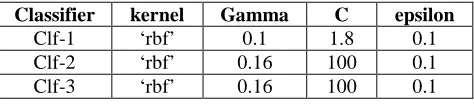
In terms of implementation, we used Scikit-learn5 toolkit(Pedregosa, Varoquaux et al., 2011) to do the classification and the parameter settings for three SVR models are shown in the following table, we chose these parameters by experiences, Clf-2 and Clf-3 used the same setting, and a better result may be achieved through fine tuning:
Classifier kernel Gamma C epsilon Clf-1 ‘rbf’ 0.1 1.8 0.1 Clf-2 ‘rbf’ 0.16 100 0.1 Clf-3 ‘rbf’ 0.16 100 0.1
Table 3 Parameter settings of our three classifiers
After the prediction of the similarity scores of sentences, we conducted a post-processing step to boost and correct results, we truncate at the
5
Data Set Ans-for Ans-stu Belief Hdlines Images Mean
All features 0.7381 0.7644 0.7377 0.8521 0.8650 0.8049
w/o WordNet-based 0.7356 0.7516 0.7260 0.8450 0.8560 0.7959
w/o Corpus-based 0.7150 0.7850 0.7389 0.8387 0.8620 0.8032
w/o Word2Vec-based 0.7460 0.7498 0.7366 0.8510 0.8536 0.7989
w/o Alignment-based 0.7278 0.7551 0.7168 0.8355 0.8614 0.7926
w/o Literal-based 0.7175 0.7320 0.7501 0.8240 0.8618 0.7879
Table 4 Performance of different feature combinations (exclude one kind each time)
Feature Set Ans-for Ans-stu Belief Hdlines Images Mean
All features 0.7381 0.7644 0.7377 0.8521 0.8650 0.8049
WordNet-based 0.6813 0.7252 0.7289 0.7509 0.8352 0.7541
Corpus-based 0.6182 0.6245 0.6652 0.7257 0.8254 0.7043
Word2Vec-based 0.6065 0.7305 0.6904 0.7365 0.8369 0.7381
Alignment-based 0.6675 0.7789 0.6699 0.7891 0.7872 0.7560
Literal-based 0.6666 0.5725 0.5235 0.5493 0.3326 0.5123
Table 5 Results of comparing the importance of different kinds of features on SemEval 2015
mes to keep the score in [0.0, 5.0], and an addi-tional step similar to the details in (Bär et al., 2012). The post-processing step contributed a 0.1% im-provement in our overall performance.
Test Set Winning team Our System
answers-forums 0.7390 0.7381
answers-students 0.7725 0.7644
belief 0.7491 0.7377
headlines 0.8250 0.8521
images 0.8644 0.8650
Weight Mean 0.8015 0.8049
Table 6 Performances of our model and winning system on SemEval 2015 STS test sets
Table 4 reported the results of our method on SemEval 2015 Task 2a, from which we can know that our method outperformed the winning system by a big margin on the headlines, but only slightly better on the images. The reason may because that in the winning system, images was already achieved a very high accuracy, but due to the in-complete use of the semantic information, didn’t perform as well as in headlines. As our method used more sufficient features, our approach achieved both state-of-the-art results on headlines and images. The winning system mainly based on word alignment, which guaranteed very good gen-eralization ability, but much of the semantic
infor-mation contained in the training set was not used, while these information can also contribute to the system performance, especially for domain-specific test set, in other word, our method can be used to verify this idea. For the first three datasets, our method may achieve much better performance if more domain-specific data was given for learn-ing. Overall, our system performed slightly better than the wining system in terms of average Pearson correlation.
To compare the importance of each kind of fea-ture, we separately exclude one kind of them in our model and compare new model’s performance.
The results are shown in Table 5. And the per-formance of using only one kind of feature showed in Table 6.
important role in our approach, it provide a good out-of-sample generalization as the loss function typically leads to a sparse representation of the decision rule which makes our model more robust on novel data. And we think that the appropriate choice of kernel function in SVR may also help a lot in the model.
5
Conclusion
In this paper, we presented our approach to evalu-ate semantic similarity between short English sen-tences. We employed a Support Vector Regression model combined with WordNet-Based features, Corpus-Based features, Word2Vec-based features, Binary Features and some other features to predict the semantic similarity score between sentence pairs. Our experiment results showed a high corre-lation with human annotations which outperformed the top system in SemEval 2015 task 2a. We also observed that our method performed much better compared to winning system on two test sets whose domain-specific data is available for train-ing, results also indicated that our solution still maintains good generation ability on novel datasets which means this technique could be well general-ized to other data domains. While the context of the sentence is unavailable and the information about the tone of sentence was eliminated by us (most modal particles and punctuations appeared in sentences were treated as stop words in our pro-cess), our model could not distinguish the tone of sentence, for example we may give a high similari-ty score to a sentence pair consists of a declarative and an imperative if they shared many words. This situation was not considered in feature generation stage, but will be researched latter. Our future work will include the refinements of training effec-tive representations for words and sentences on corpus (LSA, Word2Vec and Sent2Vec), the ex-pansion of stop word list through adding proper selected domain-specific stop words and the re-implementation of a well-designed feature selec-tion process to simplify our model. We hope that these measures could be helpful for improvement, make our model more robust and improve our method’s generalization ability as well.
Acknowledgments
The authors would like to thank the anonymous reviewers for their helpful suggestions and com-ments. This work is supported by the National Natural Science Foundation of China (61300114 & 61572151) and Natural Science Foundation of Hei-longjiang Province (F201132).
References
Agirre Eneko, & Banea Carmen. (2015). SemEval-2015 task 2: Semantic textual similarity, English, S-panish and pilot on interpretability. Paper presented at the Proceedings of the 9th International Workshop on Semantic Evaluation (SemEval 2015), June.
Bär Daniel, Biemann Chris, Gurevych Iryna, & Zesch Torsten. (2012). Ukp: Computing semantic textual similarity by combining multiple content similarity measures. Paper presented at the Proceedings of the First Joint Conference on Lexical and Computational Semantics-Volume 1: Proceedings of the main conference and the shared task, and Volume 2: Proceedings of the Sixth International Workshop on Semantic Evaluation.
Bird Steven. (2006). NLTK: the natural language toolkit.
Paper presented at the Proceedings of the COLING/ACL on Interactive presentation sessions. Blei David M, Ng Andrew Y, & Jordan Michael I.
(2003). Latent dirichlet allocation. the Journal of machine Learning research, 3, 993-1022.
Burgess Curt, Livesay Kay, & Lund Kevin. (1998). Explorations in context space: Words, sentences, discourse. Discourse Processes, 25(2-3), 211-257. Dumais Susan T. (2004). Latent semantic analysis.
Annual review of information science and technology, 38(1), 188-230.
Fattah Mohamed Abdel, & Ren Fuji. (2008). Automatic text summarization. World Academy of Science, Engineering and Technology, 37, 2008.
Gabrilovich Evgeniy, & Markovitch Shaul. (2007).
Computing Semantic Relatedness Using Wikipedia-based Explicit Semantic Analysis. Paper presented at the IJCAI.
Han Lushan, Kashyap Abhay, Finin Tim, Mayfield James, & Weese Jonathan. (2013). UMBC EBIQUITY-CORE: Semantic textual similarity systems. Atlanta, Georgia, USA, 44.
Islam Aminul, & Inkpen Diana. (2008). Semantic text similarity using corpus-based word similarity and string similarity. ACM Transactions on Knowledge Discovery from Data (TKDD), 2(2), 10.
Le Quoc V, & Mikolov Tomas. (2014). Distributed representations of sentences and documents. Paper presented at the Proceedings of NIPS 2013
based on semantic nets and corpus statistics.
Knowledge and Data Engineering, IEEE Transactions on, 18(8), 1138-1150.
Lin Dekang. (1998). An information-theoretic definition of similarity. Paper presented at the ICML.
Liu Yang, Sun Chengjie, Lin Lei, & Wang Xiaolong. yiGou: A Semantic Text Similarity Computing System Based on SVM. Paper presented at the Proceedings of the 9th International Workshop on Semantic Evaluation, pages 80-84, Denver, Colorado, USA.
Manning Christopher D, Raghavan Prabhakar, & Schütze Hinrich. (2008). Introduction to information retrieval (Vol. 1): Cambridge university press Cambridge.
Meng Lingling, Huang Runqing, & Gu Junzhong. (2013). A review of semantic similarity measures in wordnet. International Journal of Hybrid Information Technology, 6(1), 1-12.
Metzler Donald, Dumais Susan, & Meek Christopher. (2007). Similarity measures for short segments of text: Springer.
Mihalcea Rada, Corley Courtney, & Strapparava Carlo. (2006). Corpus-based and knowledge-based measures of text semantic similarity. Paper presented at the AAAI.
Mikolov Tomas, Chen Kai, Corrado Greg, & Dean Jeffrey. (2013). Efficient estimation of word representations in vector space. Paper presented at the ICLR, 2013.
Miller George A. (1995). WordNet: a lexical database for English. Communications of the ACM, 38(11), 39-41.
Narayanan Srini, & Harabagiu Sanda. (2004).
Answering questions using advanced semantics and probabilistic inference. Paper presented at the Proceedings of the Workshop on Pragmatics of Question Answering, HLT-NAACL, Boston, USA. Papineni Kishore, Roukos Salim, Ward Todd, & Zhu
Wei-Jing. (2002). BLEU: a method for automatic evaluation of machine translation. Paper presented at the Proceedings of the 40th annual meeting on association for computational linguistics.
Pedersen Ted, Patwardhan Siddharth, & Michelizzi Jason. (2004). WordNet:: Similarity: measuring the relatedness of concepts. Paper presented at the Demonstration papers at hlt-naacl 2004.
Pedregosa Fabian, Varoquaux Gaël, Gramfort Alexandre, Michel Vincent, Thirion Bertrand, Grisel Olivier, . . . Dubourg Vincent. (2011). Scikit-learn: Machine learning in Python. the Journal of machine Learning research, 12, 2825-2830.
Řehůřek Radim, & Sojka Petr. (2010). Software framework for topic modelling with large corpora. Paper presented at the Proceedings of the LREC 2010
Workshop on New Challenges for NLP Frameworks, pages 45–50, Valletta, Malta, May 2010. ELRA Resnik Philip. (1999). Semantic similarity in a
taxonomy: An information-based measure and its application to problems of ambiguity in natural language. J. Artif. Intell. Res.(JAIR), 11, 95-130. Šarić Frane, Glavaš Goran, Karan Mladen, Šnajder Jan,
& Bašić Bojana Dalbelo. (2012). Takelab: Systems for measuring semantic text similarity. Paper presented at the Proceedings of the First Joint Conference on Lexical and Computational Semantics-Volume 1: Proceedings of the main conference and the shared task, and Volume 2: Proceedings of the Sixth International Workshop on Semantic Evaluation.
Ștefănescu Dan, Banjade Rajendra, & Rus Vasile. (2014). Latent semantic analysis models on wikipedia and tasa. The 9th Language Resources and Evaluation Conference (LREC 2014).
Sultan Md Arafat, Bethard Steven, & Sumner Tamara. (2014a). Back to basics for monolingual alignment: Exploiting word similarity and contextual evidence.
Transactions of the Association for Computational Linguistics, 2, 219-230.
Sultan Md Arafat, Bethard Steven, & Sumner Tamara. (2014b). DLS@CU: Sentence Similarity from Word Alignment. Paper presented at the Proceedings of the 8th International Workshop on Semantic Evaluation, pages 241-246, Dublin, Ireland