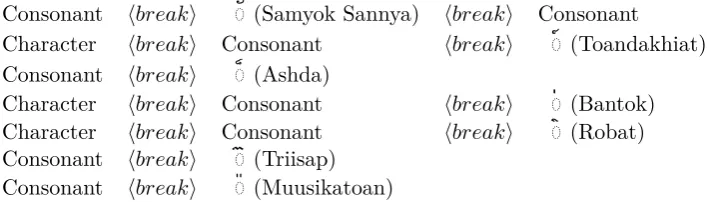
method-Consonant ⟨break⟩ ◌័ (Samyok Sannya) ⟨break⟩ Consonant
Character ⟨break⟩ Consonant ⟨break⟩ ◌៍ (Toandakhiat) Consonant ⟨break⟩ ◌៏ (Ashda)
Character ⟨break⟩ Consonant ⟨break⟩ ◌់ (Bantok) Character ⟨break⟩ Consonant ⟨break⟩ ◌៌ (Robat) Consonant ⟨break⟩ ◌៊ (Triisap)
Consonant ⟨break⟩ ◌៉ (Muusikatoan)
Figure 1: Syllable breaking heuristics.
Rule 2: Remove one or two break points for some character combinations or patterns as in Figure 1. If any of the patterns in Fig-ure 1 match, all of the⟨break⟩’s in the pat-terns are removed.
Using these heuristics, the segmentation into syllables can be made perfectly accurate with full coverage of the language.
An example of the syllable segmentation of a Khmer sentence (meaning: A Japanese company has a very successful experience) is as follows:
Input:
�កមហ៊ុនជប៉ុនមនពិេ�ធន៍េជគជ័យ�ស់
Output:
�ក ម ហ៊ុ ន ជ ប៉ុ ន ម ន ពិ េ� ធ ន៍ េជ គ ជ័ យ � ស់
2.4 Conditional Random Fields
This section describes a supervised approach to Khmer work segmentation based on conditional random fields.
To created the training corpus, manual word segmentation was performed on 5,000 randomly selected Khmer sentences from the general web domain. Manual word segmentation was based on four types of Khmer words, these are: single words, compound words, compound words with a prefix, and compound word with a suffix. We used the CRF++ toolkit 3 to build the CRF
model. We used a bootstrapping approach to create a large manually segmented corpus.
3http://taku910.github.io/crfpp/
First, we trained a CRF model from 5,000 manually segmented Khmer sentences. Then we used the trained CRF model to segment new raw (unsegmented) and manually corrected the seg-mentation. This data was then used to train an improved CRF model. In this way iteratively increased the quantity of manually segmented training data. The process was terminated when the manually annotated data set size reached 103,694 sentences. This final training corpus was broad in scope and included 3,445 sentences from the agriculture domain, 791 sentences from biology domain, 71,296 sentences from BTEC corpus, 2,916 sentences from the Buddhism re-ligious domain, 1,256 sentences from the eco-nomic domain, 99 sentences from history do-main, 8,374 sentences from the Khmer story domain, 665 sentences from law, 747 sentences from the management domain, 9,817 sentences from the news domain, 3,286 sentences from the research and science domain and 1,002 sentences from other domains.
The feature set used in the CRF model (character uni-grams) was as follows (wheretis the index of the character being labeled):
Character unigrams:
{wt−2, wt−1, wt, wt+1, wt+2}
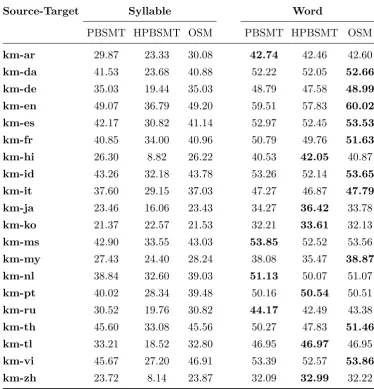
Source-Target Syllable Word
PBSMT HPBSMT OSM PBSMT HPBSMT OSM
km-ar 29.87 23.33 30.08 42.74 42.46 42.60
km-da 41.53 23.68 40.88 52.22 52.05 52.66 km-de 35.03 19.44 35.03 48.79 47.58 48.99 km-en 49.07 36.79 49.20 59.51 57.83 60.02 km-es 42.17 30.82 41.14 52.97 52.45 53.53 km-fr 40.85 34.00 40.96 50.79 49.76 51.63 km-hi 26.30 8.82 26.22 40.53 42.05 40.87
km-id 43.26 32.18 43.78 53.26 52.14 53.65 km-it 37.60 29.15 37.03 47.27 46.87 47.79 km-ja 23.46 16.06 23.43 34.27 36.42 33.78
km-ko 21.37 22.57 21.53 32.21 33.61 32.13
km-ms 42.90 33.55 43.03 53.85 52.52 53.56
km-my 27.43 24.40 28.24 38.08 35.47 38.87 km-nl 38.84 32.60 39.03 51.13 50.07 51.07
km-pt 40.02 28.34 39.48 50.16 50.54 50.51
km-ru 30.52 19.76 30.82 44.17 42.49 43.38
km-th 45.60 33.08 45.56 50.27 47.83 51.46 km-tl 33.21 18.52 32.80 46.95 46.97 46.95
km-vi 45.67 27.20 46.91 53.39 52.57 53.86 km-zh 23.72 8.14 23.87 32.09 32.99 32.22
Table 2: BLEU scores for translating from Khmer.
the experiments in this paper we used the im-plementation of hierarchical model provided by the Moses machine translation toolkit (both the hierarchical decoder and training procedure pro-vided by the experiment management system), using the default settings.
3.4 Operation Sequence Model (OSM)
The operation sequence model is a model for sta-tistical MT that combines the benefits of two state-of-the-art SMT frameworks, namely n -gram-based SMT and phrase-based SMT (Dur-rani et al., 2015). It is a generative model that performs the translation process as a lin-ear sequence of operations that jointly generate the source and target sentences. The operation
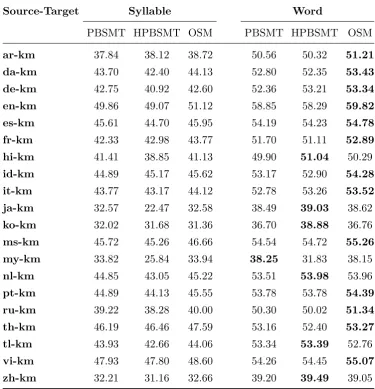
Source-Target Syllable Word
PBSMT HPBSMT OSM PBSMT HPBSMT OSM
ar-km 37.84 38.12 38.72 50.56 50.32 51.21 da-km 43.70 42.40 44.13 52.80 52.35 53.43 de-km 42.75 40.92 42.60 52.36 53.21 53.34 en-km 49.86 49.07 51.12 58.85 58.29 59.82 es-km 45.61 44.70 45.95 54.19 54.23 54.78 fr-km 42.33 42.98 43.77 51.70 51.11 52.89 hi-km 41.41 38.85 41.13 49.90 51.04 50.29
id-km 44.89 45.17 45.62 53.17 52.90 54.28 it-km 43.77 43.17 44.12 52.78 53.26 53.52 ja-km 32.57 22.47 32.58 38.49 39.03 38.62
ko-km 32.02 31.68 31.36 36.70 38.88 36.76
ms-km 45.72 45.26 46.66 54.54 54.72 55.26 my-km 33.82 25.84 33.94 38.25 31.83 38.15
nl-km 44.85 43.05 45.22 53.51 53.98 53.96
pt-km 44.89 44.13 45.55 53.78 53.78 54.39 ru-km 39.22 38.28 40.00 50.30 50.02 51.34 th-km 46.19 46.46 47.59 53.16 52.40 53.27 tl-km 43.93 42.66 44.06 53.34 53.39 52.76
vi-km 47.93 47.80 48.60 54.26 54.45 55.07 zh-km 32.21 31.16 32.66 39.20 39.49 39.05
Table 3: BLEU scores for translating into Khmer.
4 Results
4.1 Evaluation Criteria
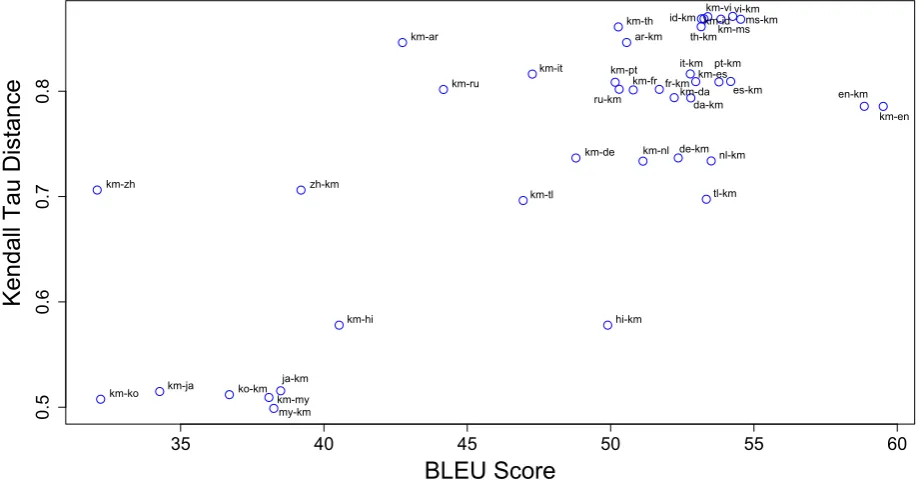
We used two automatic criteria for the evalua-tion of the machine translaevalua-tion output. One was the de facto standard automatic evaluation met-ric Bilingual Evaluation Understudy (BLEU) (Papineni et al., 2001) and the other was the Rank-based Intuitive Bilingual Evaluation Mea-sure (RIBES) (Isozaki et al., 2010). The BLEU score measures the precision of n-grams (over alln≤4in our case) with respect to a reference translation with a penalty for short translations (Papineni et al., 2001). Intuitively, the BLEU score measures the adequacy of the translations and large BLEU scores are better. RIBES is
N-Gram-based and Phrase-based Statistical
Ma-chine Translation. Computational Linguistics,
41(2):157–186.
Madeline Elizabeth Ehrman. 1972. Foreign Service Institute, Dept. of State.
Chea Sok Huor, Top Rithy, Ros Pich Hemy, and Vann Navy. 2007. Word bigram vs orthographic syllable bigram in khmer word segmentation. Hideki Isozaki, Tsutomu Hirao, Kevin Duh,
Kat-suhito Sudoh, and Hajime Tsukada. 2010. Auto-matic evaluation of translation quality for distant
language pairs. In Proceedings of the 2010
Con-ference on Empirical Methods in Natural Language Processing, EMNLP ’10, pages 944–952, Strouds-burg, PA, USA. Association for Computational Linguistics.
M. G. Kendall. 1938. A new measure of rank
corre-lation. Biometrika, 30(1/2):81–93.
G. Kikui, E. Sumita, T. Takezawa, and S.
Ya-mamoto. 2003. Creating corpora for
speech-to-speech translation. In Proceedings of
EUROSPEECH-03, pages 381–384.
Philipp Koehn and Barry Haddow. 2009.
Edin-burgh’s Submission to all Tracks of the WMT2009 Shared Task with Reordering and Speed
Im-provements to Moses. In Proceedings of the
Fourth Workshop on Statistical Machine Trans-lation, pages 160–164.
Philipp Koehn, Franz Josef Och, , and Daniel Marcu.
2003. Statistical phrase-based translation. In In
Proceedings of the Human Language Technology Conference, Edmonton, Canada.
Philipp Koehn. 2004. Statistical significance tests for machine translation evaluation.
Craig G. Nevill-Manning and Ian H. Witten. 1997. Identifying hierarchical structure in sequences: A
linear-time algorithm. CoRR, cs.AI/9709102.
F. J. Och and H. Ney. 2000. Improved
statisti-cal alignment models. In ACL00, pages 440–447,
Hong Kong, China.
Franz J. Och. 2003. Minimum error rate training for
statistical machine translation. In Proceedings of
the 41st Meeting of the Association for Computa-tional Linguistics (ACL 2003), Sapporo, Japan. K. Papineni, S. Roukos, T. Ward, and W.J. Zhu.
2001. Bleu: a Method for Automatic Evaluation
of Machine Translation. IBM Research Report rc22176 (w0109022), Thomas J. Watson Research Center.
Andreas Stolcke. 2002. SRILM - An Extensible
Lan-guage Modeling Toolkit. InProceedings of the
In-ternational Conference on Spoken Language Pro-cessing, volume 2, pages 901–904, Denver.
Suos Samak Surabaya Jabin and Kim Sokphyrum. 2013. How to translate from english to khmer us-ing moses. IJEI.
Ye Kyaw Thu, Andrew Finch, Yoshinori Sagisaka, and Eiichiro Sumita. 2013. A study of myanmar word segmentation schemes for statistical machine
translation. Proceeding of the 11th International
Conference on Computer Applications, pages 167– 179.
Christoph Tillmann. 2004. A unigram
orienta-tion model for statistical machine translaorienta-tion. In
Proceedings of HLT-NAACL 2004: Short Papers, HLT-NAACL-Short ’04, pages 101–104, Strouds-burg, PA, USA. Association for Computational Linguistics.
Channa Van and Wataru Kameyama. 2013. Khmer word segmentation and out-of-vocabulary words detection using collocation measurement of
re-peated characters subsequences. GITS/GITI
Appendix A. RIBES Scores
Source-Target Syllable Word
PBSMT HPBSMT OSM PBSMT HPBSMT OSM
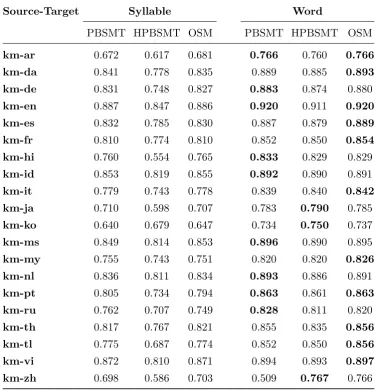
km-ar 0.672 0.617 0.681 0.766 0.760 0.766 km-da 0.841 0.778 0.835 0.889 0.885 0.893 km-de 0.831 0.748 0.827 0.883 0.874 0.880
km-en 0.887 0.847 0.886 0.920 0.911 0.920 km-es 0.832 0.785 0.830 0.887 0.879 0.889 km-fr 0.810 0.774 0.810 0.852 0.850 0.854 km-hi 0.760 0.554 0.765 0.833 0.829 0.829
km-id 0.853 0.819 0.855 0.892 0.890 0.891
km-it 0.779 0.743 0.778 0.839 0.840 0.842 km-ja 0.710 0.598 0.707 0.783 0.790 0.785
km-ko 0.640 0.679 0.647 0.734 0.750 0.737
km-ms 0.849 0.814 0.853 0.896 0.890 0.895
km-my 0.755 0.743 0.751 0.820 0.820 0.826 km-nl 0.836 0.811 0.834 0.893 0.886 0.891
km-pt 0.805 0.734 0.794 0.863 0.861 0.863 km-ru 0.762 0.707 0.749 0.828 0.811 0.820
km-th 0.817 0.767 0.821 0.855 0.835 0.856 km-tl 0.775 0.687 0.774 0.852 0.850 0.856 km-vi 0.872 0.810 0.871 0.894 0.893 0.897 km-zh 0.698 0.586 0.703 0.509 0.767 0.766
Source-Target Syllable Word
PBSMT HPBSMT OSM PBSMT HPBSMT OSM
ar-km 0.826 0.824 0.825 0.870 0.866 0.876 da-km 0.846 0.839 0.844 0.875 0.870 0.876 de-km 0.838 0.832 0.846 0.873 0.875 0.875 en-km 0.875 0.869 0.880 0.905 0.899 0.907 es-km 0.849 0.845 0.852 0.880 0.877 0.881 fr-km 0.840 0.838 0.839 0.874 0.865 0.871
hi-km 0.821 0.809 0.823 0.854 0.861 0.853
id-km 0.845 0.847 0.848 0.879 0.877 0.881 it-km 0.843 0.842 0.850 0.874 0.873 0.878 ja-km 0.744 0.650 0.737 0.771 0.764 0.773 ko-km 0.734 0.735 0.734 0.770 0.781 0.767
ms-km 0.851 0.849 0.856 0.883 0.882 0.884 my-km 0.730 0.687 0.730 0.755 0.740 0.750
nl-km 0.851 0.846 0.855 0.882 0.882 0.886 pt-km 0.852 0.849 0.856 0.881 0.879 0.880
ru-km 0.826 0.816 0.825 0.864 0.862 0.868 th-km 0.850 0.849 0.851 0.867 0.865 0.867 tl-km 0.840 0.829 0.840 0.875 0.875 0.877 vi-km 0.860 0.860 0.865 0.879 0.880 0.882 zh-km 0.751 0.748 0.755 0.788 0.791 0.782