A Listenability Measuring Method for an Adaptive Computer-assisted
Language Learning and Teaching System
Katsunori Kotani
Shota Ueda
Kansai Gaidai University / Osaka, Japan
Ryukoku University / Shiga, Japan
[email protected]
Takehiko Yoshimi
Hiroaki Nanjo
Ryukoku University / Shiga, Japan
Ryukoku University / Shiga, Japan
Abstract
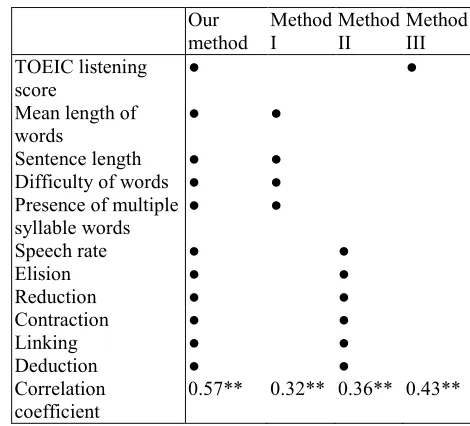
In teaching and learning of English as a foreign language, the Internet serves as a source of authentic listening material, enabling learners to practice English in real contexts. An adaptive computer-assisted language learning and teaching system can pick up news clips as authentic materials from the Internet according to learner listening proficiency if it is equipped with a listenability measuring method that takes into both linguistic features of a news clip and the listening proficiency. Therefore, we developed a method for measuring listening proficiency-based listenability. With our method, listenability is measured through multiple regression analysis using both learner and linguistic features as independent variables. Learner features account for learner listening proficiency, and linguistic features explain lexical, syntactic, and phonological complexities of sentences. A cross validation test showed that listenability measured with our method exhibited higher correlation (r = 0.57) than listenability measured with other methods using either learner features (r = 0.43) or other linguistic features (r = 0.32, r = 0.36). A comparison of our method with other methods showed a statistically significant difference (p < 0.003 after Bonferroni correction). These results suggest the
effectiveness of learner and linguistic features for measuring listening proficiency-based listenability.
1
Introduction
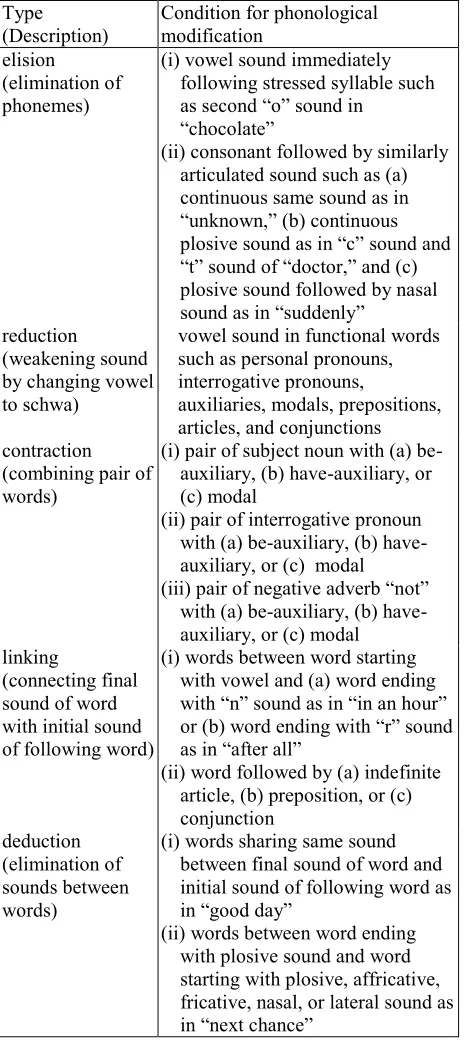
Although listenability of authentic listening materials can be measured with readability measuring methods using lexical, syntactic, and discourse features (Flesch 1950, Graesser et al. (2004), and Shen et al 2013), our listenability measuring method uses phonological features as well as lexical and syntactic features. Phonological feature accounts for listenability in terms of speech rate and phonological modification. The natural speech rate for native speakers reduces listenability for learners because learner processing speed is slow due to the lack of automation of mental language processing. Phonological modification refers to sound change such as the elision observed
in the second vowel sound of “chocolate” (Roach
2001). Phonological modification has been reported to increase listenability for native speakers, but reduce it for learners (Henricksen 1984).
In addition to linguistic features such as lexical, syntactic, and phonological, our method also uses learner features, which account for the listening proficiency. Unlike native speakers, the listening proficiency greatly differs among individuals (Saville-Troike 2006). That is, listening material can be appropriate for a learner but not for another. Therefore, it is necessary to measure listenability based not only on linguistic features but also learner features.
2
Relevant Study
Fang (1966) developed a listenability measuring method for native speakers based on a linguistic feature showing the presence of multiple-syllable words. With this method, a sentence including more multiple-syllable words is judged as more difficult. The effect from single-syllable words is suppressed because such words are assumed to be ineffective for listenability.
Unlike Fang (1966), Messerklinger (2006) took into account individual differences of background knowledge in measuring listenability for native speakers. According to Messerklinger (2006), the following features should also be taken into account in measuring listenability: speech rate, length of pause, sentence length, repairing, accent, and intensity.
Similarly to Messerklinger (2006), Kiyokawa (1990) also took into account properties of a listener. What this study focused on was not
background knowledge, but the overall proficiency of EFL learners. This method measured listenability for learners at the intermediate level
based on Kiyokawa’s vocabulary list, which
defines words that intermediate-level learners should have learnt. Words not listed in this list were regarded as difficult for intermediate-level learners. In addition, Kiyokawa (1990) used sentence length as another linguistic feature.
Although Kiyokawa’s listenability method was
developed for intermediate-level learners, what has not been thoroughly examined in the previous studies is the listenability for learners at different proficiency levels. Fang (1966) and Messerklinger (2006) discussed listenability for native speakers of English, assuming that listening proficiency does not differ much among native speakers. However, learners have different proficiencies; thus, individual differences of listening proficiency should be considered. Therefore, we address this remaining problem.
3
Features for Measuring Listenability
3.1
Learner FeatureLearner features must show the listening proficiency. This study uses scores of English language tests for determining the listening proficiency. The English language test used in this study was the Test of English for International Communication (TOEIC) because this test is a major English language test for university learners in the country where the experiment takes place.
Because TOEIC consists of a listening section and reading section, a learner acquires two scores. Our method uses TOEIC listening scores (the range of scores: 5-495) as a learner feature.
3.2
Linguistic Feature4.2
LearnersNinety university EFL learners (males: 48 and females: 42) took part in the data collection task. They were paid for their participation. The mean age was 21.5 years (standard deviation (S.D.) 2.6). The learners were asked to submit valid TOEIC scores, taken that year or the year before. Learners were equally divided into three groups of TOEIC scores: low score group (below 475), middle score group (from 480 to 725), and high score group (above 730). That is, 30 learners were chosen for each group. TOEIC scores were used as the proficiency benchmark, because the EFL learners were recruited not only for this study but also for another study on measurement of readability (Kotani et al. 2012, 2013). The EFL learners were also confirmed for basic computer literacy such as typing with a keyboard and controlling a mouse because they needed to use a computer in the data collection task.
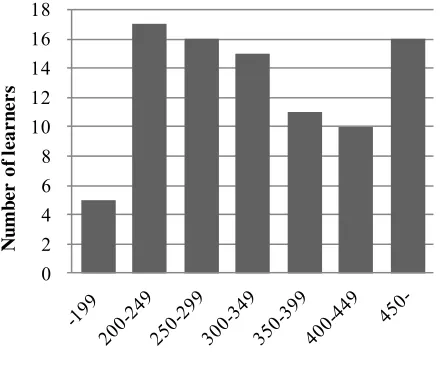
The mean TOEIC listening score for the 90 learners was 334.8 (S.D. 97.6). Figure 1 shows the distribution of the number of learners for TOEIC listening scores, which follows a double-peaked distribution at scores between 200 and 249 (n = 17) and scores above 450 (n = 16). The distribution was skewed due to the small number of learners below a score of 200. Kolmogorov-Smirnov test showed that the distribution did not follow the normal distribution (K=1.24, p=0.04). An investigation into the effect on measurement error due to the skewed distribution is for future study.
0 2 4 6 8 10 12 14 16 18
Nu
m
b
er
o
f
le
a
rn
er
s
TOEIC listening scores
Figure 2: Distribution of TOEIC listening scores
4.3
MaterialsThe materials used in this study were news clips because they are often used as listening practice materials for university EFL learners. Each news clip included five multiple-choice comprehension questions to let learners work on the listening task as they would in an actual English language test. These questions were made in the format of Nation & Malcher (2007): two true questions to choose a correct description about the article; two false questions to choose an incorrect description about the article; and one content question to choose a correct brief description of the article.
The news clips were chosen from the two types of sections in the Voice of America (VOA) site (http://www.voanews.com): the special section for English learners and the editorial section. News clips in the special section were made for learners, while news clips in the editorial section were made for native speakers of English. The former news clips consisted of short, simple sentences using the 1,500 basic vocabulary of VOA, and avoiding idiomatic expressions. By contrast, the editorial
section’s news clips were made without any
restriction on vocabulary and sentence construction as long as they were appropriate as news clips for native speakers of English. The speech rate of
special section’s news clips was two-thirds slower
than the editorial section’s news clips, which were
read aloud at a natural speech rate, approximately 250 syllables per minute, according to Robb & Gillon (2007).
Elision Reduction Contraction Linking Deduction Mean 0.13 0.38 0.00 0.04 0.19 S.D. 0.14 0.10 0.02 0.07 0.17 Minimal 0.00 0.13 0.00 0.00 0.00 Maximal 0.63 0.75 0.17 0.40 0.75 Occurrence
(n) 63 80 2 32 69
Table 3: Descriptive statistics of linguistic features for phonological modification
Table 6 summarizes the ratio of the number of instances with error values 0.0-1.0 to the number of instances (6,804). As expected from the results in Table 5 and Figure 3, our method had more instances with error up to 1.0 than other methods. These results also suggest the effectiveness of our method.
Our
method Method I Method II Method III Ratio 0.65 0.51 0.54 0.54
Table 6: Ratio of error up to 1.0
5.3
Discussion on Our MethodThe standardized partial regression coefficients in Table 4 show that listenability mostly depends on the TOEIC listening score. This result suggests that the TOEIC listening score is useful in measuring listenability for learners.
Among the five phonological features for phonological modification, elision and reduction had no statistically significant effect, contrary to our expectation. As Henricksen (1984) suggested, it was expected that phonological modification reduces listenability for learners as seen in the positive effect from linking. However, the presence of a negative effect from contraction and deduction suggests that phonological modification can increase listenability for learners as well as native speakers.
The standardized partial regression coefficients showed the unexpected effect of sentence length. Sentence length is a well known linguistic feature for explaining syntactic complexity of a sentence and has been used for measuring listenability as well as readability. However, sentence length had no statistically significant effect on listenability. An unexpected effect was also observed in the mean length of words. Assuming that longer words convey complex meanings, word length is a primary linguistic feature for measuring readability (Flesch 1950). However, as the negative value of the standardized partial regression coefficient shows, longer words increase listenability. We believe that this divergence between readability and listenability arises from the different recognition styles. Reading requires letter recognition, while listening requires sound recognition (Rayner & Reichle 2010, Vandergrift 2011). Hence, learners may not fail in letter
recognition, but fail in sound recognition. However, the learners did not fail in sound recognition probably due to longer words. These results suggest that listenability is not parallel with readability.
6
Conclusion
We proposed a method for automatically measuring listenability for EFL learners. Unlike the previous studies on listenability, our method directly takes into account the listening proficiency as well as linguistic features, which consist of mean length of words, sentence length, presence of multiple-syllable words, speech rate, difficulty of words, and presence of phonological modification (elision, reduction, contraction, linking, and deduction)
In an experiment, our method showed higher correlation between listenability scores assigned by learners and scores measured using other methods, which partially used learner and linguistic features. With our method, linguistic features for phonological modification were extracted from transcriptions of news clips. When transcription is unavailable, our method must use automatic speech recognition. Thus, we need to examine the validity of our method when using speech recognition for future work.
Acknowledgments
This work was supported in part by Grant-in-Aid for Scientific Research (B) (22300299).
References
Chall, J. S. and Dial, H. E. 1948. Listener Understanding and Interest in Newscasts. Educational Research Bulletin. 27(6): 141–153+168. Fang, I.E. 1966. The Easy Listening Formula. Journal of
Broadcasting & Electronic Media, 11(1): 63–68. Flesch, R. 1950. Measuring the Level of Abstraction.
Journal of Applied Psychology, 34: 384–390. Graesser, A. C., Danielle S. M., Max M. L., and
Zhiqiang C. 2004.. Coh-Metrix: Analysis of Text on Cohesion and Language. Behavior Research Methods, Instruments, and Computers, 36: 193-202.
Hubbard, P. 2004. Learner Training for Effective Use of CALL. In S. Fotos and C. Browne (Eds), New Perspectives in CALL for Second Language Classrooms: 45–67, Lawrence Eribaum, Mahwah, NJ. Kiyokawa, H. 1990. A Formula for Predicting
Listenability: the Listenability of English Language Materials 2. Wayo Women's University Language and Literature, 24: 57–74.
Kotani, K., Yoshimi, T., Nanjo, H. and Isahara, H. 2012. Applicability of Readability Formulae to the Measurement of Sentence-level Readability, Proceedings of International Conference of Education, Proceedings of 5th International Conference of Education, Research and Innovation (ICERI): 6023–6031.
Kotani, K., Yoshimi, T. and Isahara, H 2013. Application of Reading Data in an Integrated Learner Corpus, Procedia–Social and Behavioral Sciences, 95: 513–521.
Meng, X.L., Rosenthal, R. and Rubin, D.B. 1992. Comparing Correlated Correlation Coefficients. Psychological Bulletin, 111(1): 172–175.
Messerklinger, J. 2006. Listenability. Center for English Language Education Journal, 14: 56–70.
Nation, P. and Malarcher, C. 2007. Reading for Speed and Fluency. Compass Publishing, Seoul, Korea. Petrides, J. R. 2006. Attitudes and Motivation and their
Impact on the Performance of Young English as a Foreign Language Learners. Journal of Language and Learning, 5(1): 1–20.
Rayner, K. and Reichle, E. D. 2010. Models of the Reading Process. Wiley Interdisciplinary Reviews: Cognitive Science, 1(6): 787–799.
Roach, P. 2001. English Phonetics and Phonology. Cambridge University Press, Cambridge.
Robb, M. P. and Gillon, G. T. 2007. Speech Rates of New Zealand and American English-speaking children. Advances in Speech-Language Pathology, 9(2): 1–8.
Saville-Troike, M. 2006. Introducing Second Language Acquisition. Cambridge University Press, Cambridge. Schmid, H. 1994. Probabilistic Part-of-Speech Tagging
Using Decision Trees. In Proceedings of International Conference on New Methods in Language Processing: 44–49. Manchester, UK. Shen, W., Williams, J., Marius, T., and Salesky, E. 2013.
A Language-Independent Approach to Automatic Text Difficulty Assessment for Second-Language Learners. In Proceedings of the 2nd Workshop on
Predicting and Improving Text Readability for Target Reader Populations: 30–38. Sofia, Bulgaria.