DOI : https://doi.org/10.32628/IJSRCSEIT
Software Psuedo Random Number Generators to Hardware True Random
Number Generators: a transition in Data-Security
Shreenabh Agrawal
Class X A, The Chanda Devi Saraf School, Nagpur, Maharashtra, India ABSTRACT
Objective of research: To understand the basic issues in data security during vital transactions related to money or critical data in e-business and to statistically test the efficiency of PRNG –Pseudo Random Number Generators versus TRNG- True Random Number Generators used for Cryptography.
Experimental set up: A prototype of TRNG was designed. The Schematic component architecture of the prototype, the number generation code and the C Inspired Algorithm have been presented. 5000 numbers were generated using it. Another set of 5000 numbers was generated using an online PRNG.
Statistical testing: The numbers thus generated were tested by Kolmogorov Smirnov Z test for uniformity and Runs Test for Median and Mean for randomness. The results were displayed in tabular format.
Results: The statistical analysis showed that the performance of TRNG was better than PRNG for both uniformity and randomness.
Keywords : Randomness, PRNG, TRNG, Cryptography, Kolmogorov Smirnov Z test, Runs Test
I. INTRODUCTION
With a major shift of traditional industry to the e-industry and major e-industry giants shifting online for business, the concern for data security is a major one (Buchanan, 2017). The entire business loop from the industry to the customer and back is at risk of data leakage and manipulation due to cyber attacks. To be able to survive such cyber attacks, the random numbers used for cryptographic functions have to be truly random such that they cannot be deciphered either by forward or backward tracking. There has been a lot of research in this area of random number generation since last few decades. Researchers have come a long way from mathematical sequence numbers to quantum random numbers. Earlier, most of the requirements were handled using software generated random numbers but due to their security concerns hardware random number generators came into being. They used either physical, chemical or
environmental phenomena for generating their output. This was termed as ‘Entropy Source’. As the seed based pseudo random numbers had a high risk of getting compromised, true random number generation became the need of the hour.
II. METHODS AND MATERIAL
PRNG (Pseudo Random Number Generator) vs TRNG (True Random Number Generator):
random numbers based on a seed. A seed is the first input given to an algorithm which the algorithm uses to generate random numbers which can be given manually or decided by the computer. Due to this, in a PRNG, after some numbers, the sequence starts repeating. Another drawback of PRNGs is that for a particular seed and particular algorithm, only certain numbers are generated while many numbers are never generated .
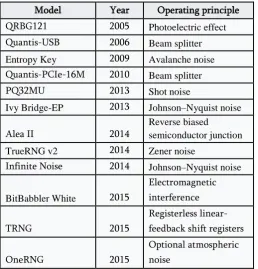
To overcome such discrepancies, another method of generating random numbers is by using TRNGs. They analyse some physical phenomenon or artificial disturbances called 'noise' and generate numbers accordingly. They are capable of generating high quality random numbers. A simple example of TRNG can be a dice rolling machine or a shuffled card reader machine. At times, it can be very difficult to construct a highly efficient TRNG and statisticians often resort to complex phenomena like radioactive decay to generate such numbers. Some commonly available TRNG’s and their operating principles are mentioned in Table 1 below:
Table 1: True Random Number Generators Model Year Operating principle QRBG121 2005 Photoelectric effect Quantis-USB 2006 Beam splitter
Entropy Key 2009 Avalanche noise Quantis-PCIe-16M 2010 Beam splitter
PQ32MU 2013 Shot noise
Ivy Bridge-EP 2013 Johnson–Nyquist noise
Alea II 2014
Reverse biased semiconductor junction
TrueRNG v2 2014 Zener noise
Infinite Noise 2014 Johnson–Nyquist noise
BitBabbler White 2015
Electromagnetic interference
TRNG 2015
Registerless linear-feedback shift registers
OneRNG 2015
Optional atmospheric noise
TrueRNG Pro 2015
Reverse-biased semiconductor junction
ChaosKey 1.0 2016
Reverse biased
semiconductor junction PQ4000KS 2016 Shot noise
TrueRNG v3 2016
Reverse-biased semiconductor junction
SwiftRNG Pro 2018
Reverse biased Zener diodes
Source:
https://en.wikipedia.org/wiki/Comparison_of_hardwa re_random_number_generators
The following basic differences are reported related to PRNGs and TRNGs:
Table 2: PRNG vs TRNG
Description PRNG TRNG
True Randomness No Yes
Equal Probability of All Numbers No Yes Non-degradable Randomness Yes No
Cost-effective Yes No
Portable Yes No
Decentralized Yes No
Easy to use Yes No
Randomness on demand service Yes Yes Problem of artificial whitening Yes No Insecure delivery of numbers Yes No Risk of breach of secrecy Yes No
Data security issues related to PRNGs:
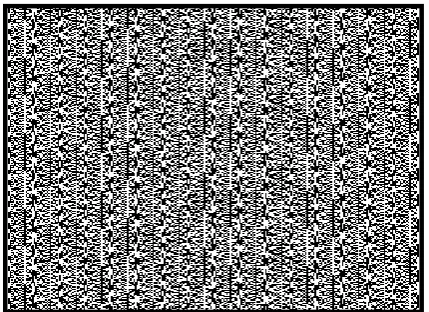
loophole was discovered by them after discovering that the time of the day and the process IDs were used to generate the random keys. In November 2007, Dorrendorf et al. from the Hebrew University of Jerusalem and University of Haifa published a paper which presented serious weaknesses in Microsoft's approach at the time. The paper's conclusions were based on disassembly of the code in Windows 2000, but according to Microsoft applied to Windows XP as well. A discrepancy was observed in the safety feature of the random numbers by Allen (2008) in his study. The picture (1) below is a bitmap image of the random numbers which are produced by the PHP rand () function in Microsoft Windows. It shows a clear connection and repetition of the numbers generated by the PRNG.
Picture 1: Bitmap image of Random Numbers A similar flaw was also discovered in Play Station 3. In December 2010, a group calling itself 'fail0verflow' announced recovery of the private key used by Sony to sign software for the PlayStation 3 game console. The attack was made possible because Sony failed to generate a new random nonce for each signature (Borza, 2011). A more recent setback was uncovered involving Bitcoins- the e-currency. In August 2013, it was revealed that bugs in the Java class SecureRandom had flaws in implementations of Bitcoin on Android. When this occurred the private key could be recovered, in turn allowing stealing Bitcoins from the containing wallet (Chirgwin,2013).
Experimental Method to empirically test PRNG vs TRNG:
To test the propositions of researchers in support of TRNG, a prototype of a TRNG was designed. The prototype comprised of 3 components -an entropy source that produces random inputs from a non deterministic hardware process at around three 3-digit inputs per second , an Arduino board that uses a C inspired program to distil the triplet of 3 digit random inputs into a triplet of two digit high quality random inputs combining them algebraically into a 6 digit high quality nondeterministic random number and a serial monitor that displays the output for the end user.
Figure 1: Schematic Component Architecture and Process
prediction due to its narrow range of possible values. The triplets of two digit raw entropy samples generated by the entropy source are thus reduced to a single 6 digit high quality nondeterministic random number.
Figure 2: Number Generation Code
Algorithm designed using C inspired program on pinMode(LDR1, INPUT); pinMode(LDR2, INPUT); pinMode(LDR3, INPUT); }
void loop() {
LDR1Value = analogRead(LDR1); LDR2Value = analogRead(LDR2); LDR3Value = analogRead(LDR3); DigitfromOTP1();
void DigitfromOTP1() {// Deletes
hundred’s digit from LDR1 input
if(LDR1Value<100) { OTP1=LDR1Value; }
else if(LDR1Value>100 && LDR1Value<200) {
OTP1=LDR1Value-100; }
else if(LDR1Value>200 && LDR1Value<300) {
OTP1=LDR1Value-200; }
else if(LDR1Value>300 && LDR1Value<400) {
OTP1=LDR1Value-300; }
else if(LDR1Value>400 && LDR1Value<500) {
OTP1=LDR1Value-400; }
else if(LDR1Value>500 && LDR1Value<600) {
OTP1=LDR1Value-500; }
else if(LDR1Value>600 && LDR1Value<700) {
OTP1=LDR1Value-600; }
else if(LDR1Value>700 && LDR1Value<800) {
OTP1=LDR1Value-700; }
else if(LDR1Value>800 && LDR1Value<900) {
OTP1=LDR1Value-800; }
else if(LDR1Value>900 && LDR1Value<1000) {
OTP1=LDR1Value-900; }
else if(LDR1Value>1000 &&
LDR1Value<1024) {
OTP1=LDR1Value-1000; }
}
void DigitfromOTP2() {// Deletes
hundred’s digit from input of LDR2
if(LDR2Value<100) { OTP2=LDR2Value; }
else if(LDR2Value>100 && LDR2Value<200) {
OTP2=LDR2Value-100; }
else if(LDR2Value>200 && LDR2Value<300) {
else if(LDR2Value>300 && LDR2Value<400) {
OTP2=LDR2Value-300; }
else if(LDR2Value>400 && LDR2Value<500) {
OTP2=LDR2Value-400; }
else if(LDR2Value>500 && LDR2Value<600) {
OTP2=LDR2Value-500; }
else if(LDR2Value>600 && LDR2Value<700) {
OTP2=LDR2Value-600; }
else if(LDR2Value>700 && LDR2Value<800) {
OTP2=LDR2Value-700; }
else if(LDR2Value>800 && LDR2Value<900) {
OTP2=LDR2Value-800; }
else if(LDR2Value>900 && LDR2Value<1000) {
OTP2=LDR2Value-900; }
else if(LDR2Value>1000 &&
LDR2Value<1024) {
OTP2=LDR2Value-1000; }
}
void DigitfromOTP3() {// Deletes
hundred’s digit from input of LDR3
if(LDR3Value<100) { OTP3=LDR3Value; }
else if(LDR3Value>100 && LDR3Value<200) {
OTP3=LDR3Value-100; }
else if(LDR3Value>200 && LDR3Value<300) {
OTP3=LDR3Value-200; }
else if(LDR3Value>300 && LDR3Value<400) {
OTP3=LDR3Value-300; }
else if(LDR3Value>400 && LDR3Value<500) {
OTP3=LDR3Value-400; }
else if(LDR3Value>500 && LDR3Value<600) {
OTP3=LDR3Value-500; }
else if(LDR3Value>600 && LDR3Value<700) {
OTP3=LDR3Value-600; }
else if(LDR3Value>700 && LDR3Value<800) {
OTP3=LDR3Value-700; }
else if(LDR3Value>800 && LDR3Value<900) {
OTP3=LDR3Value-800; }
else if(LDR3Value>900 && LDR3Value<1000) {
OTP3=LDR3Value-900; }
else if(LDR3Value>1000 &&
LDR3Value<1024) { prototype. Another 5000 numbers were generated with the help of an online PRNG. The numbers were tested statistically using Kolmogorov Smirnov Z test for uniformity and Runs test of Means and Median for randomness.
III. RESULTS AND DISCUSSION
Statistical Analysis:
Table 3 : Kolmogorov-Smirnov Z Test for testing Uniform Distribution
PRNG TRNG
Kolmogorov-Smirnov Z 0.709 0.516 Asymp. Sig. (2-tailed) 0.696 0.953
Interpretation: From the table above it is seen that random numbers generated using the TRNG are highly significant (asymptotic significance =0.953) thus proving that they follow a uniform distribution with equal probability of presence of every number.
a) Runs Test based on Median
Table 4: Runs Test based on Median PRNG TRNG
Z 1.698 0.255
Asymp. Sig. (2-tailed) 0.090 0.799
Interpretation: From the table above it is seen that on testing with Runs Test based on median, random numbers generated using the TRNG are highly significant (asymptotic significance =0.799) thus proving that they are statistically significant.
a) Runs Test based on Mean
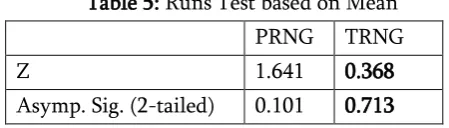
Table 5: Runs Test based on Mean
PRNG TRNG
Z 1.641 0.368
Asymp. Sig. (2-tailed) 0.101 0.713
Interpretation: From the table above it is seen that on testing with Runs Test based on mean, random numbers generated using the TRNG are highly significant (asymptotic significance =0.713) thus proving that they are statistically significant.
IV.CONCLUSION
To prevent cyber attacks and keep data safe in crucial industries such as banking, defence, education
(online exams/ evaluation), fundamental research, infrastructure (simulation), etc, the industry needs to shift from PRNGs to TRNGs as they provide a reliable solution to the issues related to randomness of numbers for data security.
V. REFERENCES
[1]. Allen B, “Are the numbers really random?”, https://www.random.org/analysis/ (2008)
[2]. Borza M, “The Sony PlayStation 3 hack deciphered: what consumer-electronics designers can learn from the failure to protect a billion-dollar product ecosystem”, https://www.edn.com/
Home/PrintView?contentItemId=4368066 (2011)
[3]. Buchanan W.J., Woodward A & Helme S., “Cryptography across Industry sectors”, pg 145 -162,
https://doi.org/10.1080/23742917.2017.1327221 (2017)
[4]. Chirgwin R, “Android bug batters Bitcoin wallets”,
https://www.theregister.co.uk/2013/08/12/ android_bug_batters_bitcoin_wallets/ (2013) [5]. Dorrendorf L, Gutterman Z, Pinkas D.,
“Cryptanalysis of the Random Number
Generator of the Windows Operating System”, https://eprint.iacr.org/2007/419.pdf (2007) [6]. Goldberg I and Wagner D, “Randomness and the
Netscape Browser”, Dr. Dobb's Journal, http://www.ddj.com/windows/184409807 (1996)
Cite this article as : Shreenabh Agrawal, "Software Psuedo Random Number Generators to Hardware True Random Number Generators : a transition in Data-Security ", International Journal of Scientific Research in Computer Science, Engineering and Information Technology (IJSRCSEIT), ISSN : 2456-3307, Volume 5 Issue 2, pp. 558-564, March-April 2019.