CSEIT1846201 | Published – 08 May 2018 | May-June 2018 [ (4 ) 6 : 1061-1065 ]
National conference on Engineering Innovations and Solutions (NCEIS – 2018)
International Journal of Scientific Research in Computer Science, Engineering and Information Technology
© 2018 IJSRCSEIT | Volume 4 | Issue 6 | ISSN : 2456-3307
1061
Congestion Management In Deregulated Power System Using
Heuristic Search Algorithm
Vishal P Kalas1, Dhanush S2, Kallappa A3, Kumudeesh K C4 1,2,3UG Student, EEE Department, PESITM, Shivamogga, Karnataka, India
4Assistant Professor, EEE Department, PESITM, Shivamogga, Karnaataka, India
ABSTRACT
The impact of restructuring in the field of communication sector has brought an evolutionary change in power sector too. This revolutionary idea has brought about competition in this sector with an aim of reduction in the electricity price. The competitive environment not only benefits the utilities and customers however it kindles some of the technical issues, typical one being the transmission congestion. It is considered to be tenacious since it admonish system security and may result in inflation of electricity prices effecting in feeble market condition. The explication to the dispute of congestion has been furnished in this paper. To minimize the congestion cost, an effective multi objective approach is proposed to endorse generator rescheduling and FACTS technology using a metaheurisitc optimization algorithm, symbiotic organic search algorithm. The choice of most sensitive generators to reschedule real and reactive power is realized using real power transmission congestion distribution factor
I.
INTRODUCTION
With the rise in mechanization, sophistication and enrichment of lifestyle, the obligation on the electrical power has enlarged. Due to hasty increase of load and deficiency of requisite resources, the dispute of power smashup and power outages occur.
The power sector is controlled to clear this sprouting need for electrical power along with atoning the economical and security factors. The amendments passed in ‘‘The Electricity Act 2003’’, pave the way for taking measures contributive to the development of power industry, concurring competition therein, mitigation of electricity tariff affirming transparent, efficient and environmental amiable policies.
has inspired greater utilization of transmission lines. While the producers and consumers of electric power ought to sell and buy in extent that would antecedent the transmission lines to operate at or beyond at least one of the transfer limits, the system is said to be congested. Congestion in transmission lines result in forbidding the existence of new contracts, sequential blackouts, augmentation of electricity prices and moreover it enforce the system security and reliability. Thereupon a control strategy is very much indispensable to attenuate the transmission line congestion satisfying security limits in a merest time. Congestion management is such a strategy to alleviate congestion in the lines perhaps sustaining the system security. Independent system operator (ISO) is solely responsible to handle congestion for it is the most discerning and significant deed as it hazards the system security and has the liability to cause rise in electricity prices eventuating in sloppy power market. The Congestion management methods utilizes phase shifters, transformer taps and FACTS devices such as Thyristor Controlled Series Compensator (TCSC) to mitigate congestion whereas some of the rarer methods are generator rescheduling, prioritization and curtailment of loads. In this system, a multi objective optimization approach known as Particle Swarm Optimization (PSO) is taken to mitigate the congestion caused in the lines.
1.1 Deregulation In Power System
Electric deregulation is the process of changing rules and regulations that control the electric industry to provide customers the choice of electricity suppliers who are either retailers or traders by allowing competition. Deregulation improves the economic efficiency of the production and use of electricity.
1.2 Objectives of The Deregulated Power Market 1. To provide electricity for all reasonable
The restructuring process starts with the unbundling of the originally vertically integrated utility. This essentially leads to separate the activities involved in an integrated power system leading to creation of functional partition amongst them. For example, the unbundling of power industry involves separating transmission activity from the generation activity. Further, distribution can be separated from transmission. Thus, these three mutually exclusive functions are created and there are separate entities or companies that control these functions. Then, the competition can be introduced in the generation activity by allowing other private participants in this segment. In contrast to the vertically integrated case where all the generation is owned by the same utility, there is a scope for private players to sell their generation at competitive prices.
II.
PARTICLE SWARM OPTIMIZATION IN
CONGESTION MANAGEMENT
In the course of every generation, two values are updated for each particle viz. the best position or fitness value it has attained earlier called as the position best or pbest and the best value attained by any other particle in the population called as global best or gbest. In a N-dimensional space, every particle is considered to be a solution whose prominent and subordinate degree are evaluated by computing its fitness value. The particles have the liability to hold memory of the best positions they have attained during the course of traverse in search space and share this information to the other particle.
Considering N dimensional space, the particles are generated randomly and it posses two parameters :
(1)
position of the particle Xi = (Xi1,Xi2, …, Xin) and(2)
velocity of the particle, Vi = (V i1, Vi2, …, Vin).Based on the information about its pbest and gbest values the particles update their positions and velocities using the following equation,
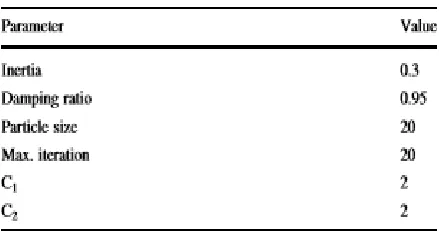
where, x represents inertia weight, rand1 and rand2 represents random values between 0 and 1, C1 = 2 and C2 = 2 called as acceleration constants, k represents the iteration number (Table 2.1).
Table 2.1 PSO Parameter
The step by step process in PSO algorithm is summarized below,
1. Prepare the line data, bus data and all the relevant datas of the bus system to be considered along with the parameters of PSO. 2. Impose congestion in the bus system and run
NR power flow for the given generation and load pattern.
3. Generate a random set of control variables using PSO procedure for instance incremental and decremental generation shift, TCSC parameters satisfying the limits. The values obtained are enforced in the system data.
4. Run NR power flow.
5. Determine if the constraints are being satisfied exempting, add the penalties and find the fitness function.
6. Till the specified no. of iterations, find the velocity of the particle, add the velocity of the earlier iteration result to access a new set of population, run NR power flow and calculate the fitness value as stated in the previous step. 7. Output the solution of the best generation
pattern and terminate the process.
2.1 Modeling of TCSC
Installing of FACTs device in electric utilities will maximize active power flow across existing transmission corridors. These devices are capable of controlling the parameters such as voltage magnitudes and their angles, line impedances, active power and reactive power so the continuous variation of line impedance can be achieved by using TCSC and there by maintaining the active power flow in the transmission line at particular level. TCSC is one of the best known FACTs controllers, and it has been in use for many years. TCSC consists of parallel combination of capacitor and thyristor controlled reactor. In actual, TCSC system comprises a combination of many cascaded TCSC modules. In a network, various parameters are considered for load flow analysis, which requires TCSC modeling.
Figure 2.1. Equivalent model of TCSC
It consists of anti-parallel connections of thyristors and combination of inductor and capacitors. This is a series connected device and which can be proved supportive in reducing net losses, provide voltage support, enhancing transient stability. As per operating principle of TCSC, it has ability to control active power flow in transmission line.
2.2 Wireless Technology
Being competitive, information interchange between utilities and ISO is necessitous to meet technical
challenges. Here an advanced metering
infrastructure (AMI) was suggested which benefits the utilities to collect and exploit metered datas in perceptive aspect. The consumers can realize their electricity price, billing and prepayment alarm in case of abnormalities and so on. The AMI system utilizes multi communication media like global systems for mobile communications (GSM) and
general package radio service (GPRS).
Correspondingly the similar two way
communication benefits during congestion
management also. When the system is subjected to congestion, the suggested method does simultaneous optimization of rescheduling the real power as well as locating TCSC at appropriate location. The optimized rescheduled data’s are collected in collecting terminal unit which consists of microcontroller board, a backup battery and communication module such as GSM or GPRS.
The microcontroller is decked with input–output interface and communication ports. Serial port devices such as RS. 232 or RS. 485 can be employed for this level of data transmission.
This information can be transmitted through (1) GSM that can impart short message service (SMS) which is applicable for less data exchange applications or (2) GPRS that employs data rates in the range of 56–114 Kb/s and provides stable connection to the internet for mobile phone and computer users. Henceforth the generating stations whose generators are to be rescheduled to alleviate congestion are thereby informed through wireless communication. Apart from GSM or GPRS, WiMax a long range wireless communication technique can also be used for this power applications.
2.3 14 Bus Test System
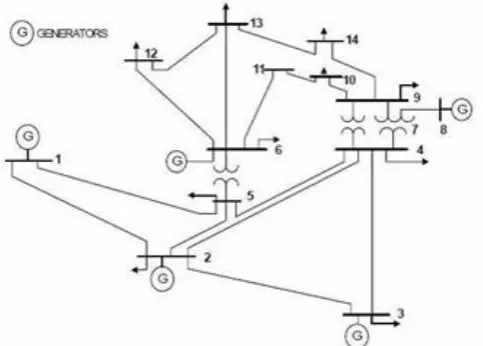
Figure 2.2. Single line diagram for 14 bus system
The Figure 2.2 shows the one line diagram of the 14 bus system. The system includes 5 generator buses, 9 load buses and 20 transmission lines. The overloading transaction results in some of the lines to operate beyond their limit. After optimization with PSO algorithm, the line flows are reduced i.e., congestion has been relieved.
III.
CONCLUSION
IV.
RESULT
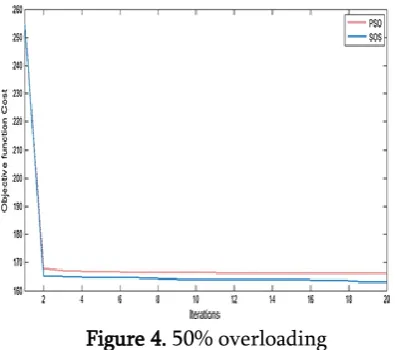
The proposed objective has been tested on IEEE 14 and IEEE 30 bus systems considering three congestion cases (1) bilateral transaction (2) multilateral transaction and (3) overloading. It results in the condition of modifying the transactions. Hence the entire system is divided into various zones depending on the sensitivity of line flows in the congested lines.
Figure 4. 50% overloading