Extracting Synonyms from Dictionary Definitions
Tong Wang and Graeme Hirst
Department of Computer Science
University of Toronto
Toronto, ON, M5S 3G4, Canada
tong,gh
@
cs.toronto.edu
Abstract
We investigate the problem of extracting synonyms from dictionary definitions. Our premise for using def-inition texts in dictionaries is that, in contrast to free-texts, their composition usually exhibits more regular-ities in terms of syntax and style and thus, will pro-vide a better controlled environment for synonym ex-traction. We propose three extraction methods: two rule-based ones and one using the maximum entropy model; each method is evaluated on three experiments — by solving TOEFL synonym questions, by compar-ing extraction results with existcompar-ing thesauri, and by la-beling synonyms in definition texts. Results show that simple rule-based extraction methods perform surpris-ingly well on solving TOEFL synonym questions; they actually out-perform the best reported lexicon-based method by a large margin, although they do not corre-late as well with existing thesauri.
Keywords
Lexical semantics, synonym extraction, dictionary definition mining, maximum entropy classification
1 Introduction
1.1 Motivation
Synonymy is one of the classic lexical semantic relations based on which lexical semantic taxonomies such as Word-Net (Fellbaum et al., 1998) are constructed. Despite their usefulness in various NLP studies, such taxonomies are usually considered expensive resources since they are of-ten manually constructed. Consequently, much research effort has been devoted to automatically extracting words of certain semantic relations from various free-text corpora (e.g., Hearst 1992; Lin 1998, etc) or even building an entire taxonomy (e.g., Chodorow, Byrd, and Heidorn 1985).
Meanwhile, identifying characteristic features for syn-onymy is non-trivial. Many studies in this direction have started out with intuitively appealing ideas, but in practice, there are always surprises for intuition. Dependency rela-tions used by Lin (1998) relate two nouns if, for example, they often serve as the object of the same verb. When it comes to adjectives, however, the relation established as such is no longer guaranteed to be strict synonymy, since two adjective antonyms may modify the same noun as well. As another example, when two words in one language are often translated into the same word in another language, it seems very natural to regard the two words as synonyms in
the source language (Wu and Zhou, 2003), but the mapping on the lexical level between languages is far from bijective, which in turn leads to many exceptions to the hypothesis.
The difficulties in finding features for strict synonymy partly come from the syntactic and stylistic diversity in free-texts — this is the motivation behind using dictionary definitions as a resource for synonym identification. Un-like the extraction strategy used by Hearst (1992), where hyponyms would necessarily follow the phrasesuch as:
NP0such as{NP1,NP2,...,(and|or)}NPn
∀i=1,2,...,n,hyponym(NPi,NP0)
there seems to be much fewer patterns, if any, to follow for using synonyms in free-text writing.
In contrast, in the composition of dictionary definitions, there is usually much more regularity in terms of how syn-onyms of the word being defined should and would appear. Consequently, dictionary definition texts, as a special form of corpora, can provide a better “controlled” environment for synonym distribution and thus, it would presumably be easier to find characteristic features specific to synonymy within definition texts. Given this assumption, our goal is to find synonyms for a give word (target word) from the collection of all definition texts in a dictionary and subse-quently evaluate the quality of the proposed synonyms.
1.2 Related Work
One of the first attempts at extracting synonyms (or seman-tically related words in general) from dictionary definitions is that of Reichert et al. (1969)1, where aninverted indexof
a dictionary is built to relate adefiniendum(the word being defined, pl.definienda) to itsdefinientia(defining words). Despite the coarse definition of relatedness, the idea itself proved to be inspiring in formalizing the problem in graph-theoretical language, with words corresponding to nodes and edges pointing from definienda to definientia.
On the basis of this graph (usually referred to as a dictio-nary graph), many interesting variants have evolved from the original idea of inverted indexing. Taking the graph as the web, Blondel and Senellart (2002) employed an al-gorithm similar to PageRank (Brin et al., 1998), and sim-ilarities between words can be computed using their adja-cency matrix. Alternatively, the problem can be viewed from an information theory perspective and formalized to propagate information content instead of endorsement (Ho 1Unfortunately, we have not been able to access the original work of Reichert et al. (1969); we resort to the description of their method by Amsler (1980) instead.
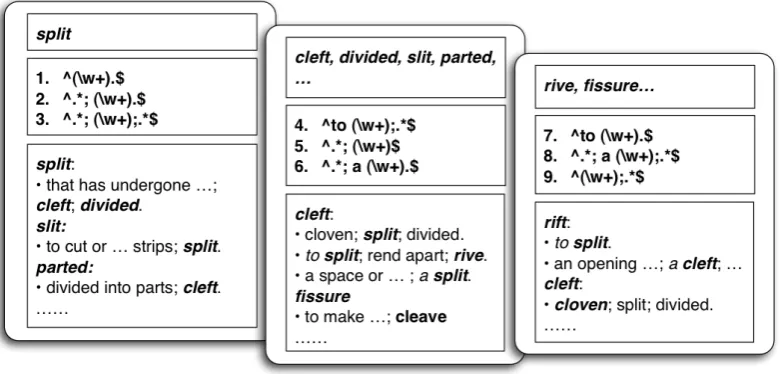
Fig. 1:Bootstrapping between synonym extraction and pattern finding. The three rounded squares in the horizontal layout represent three iterations of bootstrapping; within each of these, the three vertically distributed squares list, from top to bottom, the extracted synonyms, newly-added regular expression patterns, and related definitions, respectively.
phase above. In general, if a wordAis synonymous toB
andBtoC, it is usually fair to deduce thatAis a synonym of
C. In the context of dictionary definitions, however, the va-lidity of such deduction is severely compromised, because the input to the extraction process is word tokens under dif-ferent senses and/or even of difdif-ferent POS.
Similar to IIE, there are easy remedies for confusions on POS, e.g., by specifying a POS with a target word (say,
adjectiveforsplit) and looking only for definitions under the specified POS. In view of transitivity, most words fol-lowing any of our patterns (e.g., cleft) can be safely as-sumed to have the same POS as that of their corresponding definienda, and starting from these words, we can follow definitions under the same POS (e.g.,cleftas an adjective instead of a verb) for further extraction. For word senses, however, this assumption is no longer valid, since universal specification of word senses is unavailable in most dictio-naries.
A more general solution to this problem is to find tran-sitive closure, corresponding to circles in the dictionary graph. This idea is based on the hypothesis that definitions are circular in nature (Jurafsky and Martin, 2008). Starting from a given target word, transitivity is applied regardless of POS and word sense differences; once we encounter the target word again5, we consider every word on this circle
synonyms to the target word. As is shown in later experi-ments, where the extracted words are compared with exist-ing thesauri, this approach almost triples precision at rela-tively low cost in recall.
2.3 Extraction using Maximum Entropy
Although PbE exhibits excellent precision in extracting synonyms (as all three experiments suggest in Section 3 below), relying solely on the limited number of patterns will again bring up the issue of coverage. This motivates5Or any of the words from the first round of PbE, which are usually highly synonymous to the target word
more-general learning methods that would treat definition texts in a less-specific way.
As an initial attempt at machine learning approaches for processing dictionary definitions, we formulate the syn-onym extraction task as a classification problem: each word in a piece of definition text is a decision point, and a maximum entropy (MaxEnt) classifier is employed to de-cide whether or not it is a synonym of the corresponding definiendum.
The training data is based on 186,954 definition items (pairs of definiendum with corresponding definientia) in theMacquarie Dictionary. After POS-tagging, any word in a given definition text is labeled as a synonym of the definiendum if the word is (1) of the same POS as the definiendum, and (2) in the same WordNet synset as the definiendum. This labeled data would be partitioned and serve as both the training data for MaxEnt and the gold standard for the synonym labeling task in Section 3.3.
We choose the opennlp.maxent implementation of the classifier with generalized iterative scaling (GIS) capac-ity6. We use lexical features (e.g., previous, current, and
next word), unigram POS features (e.g., previous, current, and next POS), and bigram POS features (e.g., previous and next POS bigrams). In addition, another group of fea-tures describes the position of each decision point by an integer counter starting from 1 to the length of a defini-tion text. In order to capture the critical separators dis-cussed in PbE (e.g., semicolons), a second position counter is also included, which resets to 1 whenever encountering any separators. In the definition ofabbreviation: reduc-tion in length; abridgment., for example, the first counter assigns integers 1 to 6 to all definientia (including puncua-tions “;” and “.”), whereas the second counter assigns 1 to 4 to definientia up to the semicolon but 1 and 2 toabridgment
and the period.
Note that, in order to make fair comparisons with IIE and PbE, it is necessary to incorporate the dictionary graph into
MaxEnt method. Specifically, given a target wordt, after extracting synonyms from its own definientia, we again go through other words’ definitions in the dictionary; ift ap-pears in the definition of another wordwand is classified as a synonym, thenwis taken as a synonym oft.
2.4 Interpretation of the Methods in Terms
of the Dictionary Graph
So far in our discussion, the dictionary graph has been as-sumed to beundirected. For IIE, if we are to take the graph asdirected(with edges pointing from definienda to defini-entia), then the in-neighbors of a target word are those re-lated by an inverted index, and the out-neighbors are sim-ply all its definientia. We will see how these two types of relatedness perform differently in Section 3.
In contrast, PbE and MaxEnt make fine distinctions about which part of the definitions to relate a target word to. For out-neighbors (words in the definientia of the target word), PbE and MaxEnt pick out words following specific patterns (either regular expression patterns or, implicitly, patterns learned by a classifier), as opposed to IIE which takes all definientia indiscriminately; for in-neighbors, IIE relates them all regardless of how or where the target word appears in other words’ definitions, while PbE and Max-Ent, again, follow their respective patterns.
3 Evaluation
3.1 Solving TOEFL Synonym Questions
Originally introduced by Landauer and Dumais (1997), TOEFL synonym questions have gained much popularity in NLP studies as a task-driven evaluation for synonymy or semantic relatedness. The commonly used data set contains 80 questions, on which Jarmasz and Szpakowicz (2004) evaluated nine semantic similarity methods, not including a later work by Turney et al. (2003) with an accuracy of 97.5% — the highest in all reported results so far.The popularity of this experiment partly resides in its straightforward setup and easy interpretation of results. Each question consists of one question word and four choices, one of which is a synonym to the questions word and thus, the correct answer. For a given question, we use the three extraction methods to extract synonyms for each of the five words (question word and the four choices), fol-lowed by computing the cosine similarity between the syn-onym set of the question word with those of the choices. The choice with the highest-scoring synonym set is pro-posed as the correct answer.
Ideally, due to the transitivity of synonymy, if two words are synonymous themselves, they would have a number of synonyms in common, which in turn would give a better score in the TOEFL synonym questions. Two practical is-sues, however, proved to be adversarial to this assumption. Firstly, finding the right answer does not necessarily de-pend on synonymy; relatedness, for example, is also tran-sitive by nature. In fact, if overlapping is the only concern, one can even use sets of antonyms for finding the synony-mous choice, since synonysynony-mous words share antonyms as well as synonyms. Fortunately in TOEFL synonym ques-tions, the choices are either synonymous or unrelated to a question word, and thus, such considerations will not harm the performance on solving the questions.
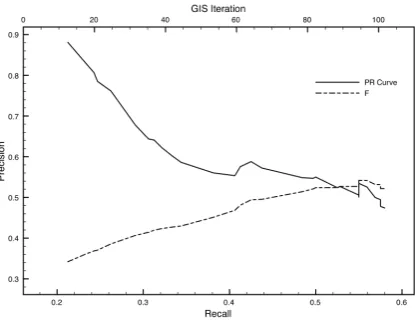
Fig. 2: Precision-recall curve and F with respect to Max-Ent GIS training iterations (ranging from 10 to 100)
Secondly, as mentioned earlier, if the target word is in-frequent, it will have a low in-degree in the dictionary graph, and this is especially the case for TOEFL synonym questions, which tend to test the participants on a more-challenging vocabulary of relatively low-frequency words. Consequently, as it turned out in the experiment, there are often cases where the extracted set of words for the ques-tion word does not overlap with any of those of the choices. The notion ofrecallis thus borrowed to denote the percent-age of questions that can be solved without such ties.
Another feature specific to the TOEFL synonym ques-tion task is lemmatizaques-tion, since many of the words in these questions are inflected. As we will see shortly from the results, using these inflected words as target words for ex-traction gives drastically different performance from using their corresponding lemmata.
Table 1 shows the performance of various methods on the TOEFL synonym questions task. The result is reported in terms of precision, recall and F; accuracy is also included since all other published results are reported in terms of ac-curacy. For comparison, we separate the extraction result of IIE into in-neighbor-only, out-neighbor-only, and a com-bination of the two (see Section 2.4 for their differences).
The two variants of IIE with only in- or out-neighbors (IIEin or IIEout) perform more or less the same in terms
of F, but are complementary in precision and recall. Out-neighbors are definition texts with many stop words, which are helpful in overlapping and hence the high recall (fewer ties), whereas the low frequency of the target words in TOEFL tests results in fewer in-neighbors, and thus fewer chances of overlapping and more ties.
When using the lemmatized words as target words, there is a 25% increase in recall; the best result for IIE is achieved when it is combined with lemmatization, result-ing in an accuracy of 85% — better than any lexicon-based method reported in theACL wiki7. When definition texts
are combined with PbE results, precision increases by an additional 3.4 percentage points, giving the best accuracy of 88.3% on this task.
In contrast, although it is a more-sophisticated model, MaxEnt fails to perform as well; neither precision nor
re-7http://aclweb.org/aclwiki/index.php?title=TOEFL
Table 1: Performance on solving TOEFL synonym questions. IIEinandIIEoutdenote variants of IIEwith in-neighbors
only and with out-neighbors only, respectively;IIEwithout subscripts corresponds to the originalIIEmethod (with both in- and out-neighbors).
IIEin IIEout IIEin+Lemma IIE+Lemma PbE+Lemma PbE+DefText MaxEnt+Lemma
Precision 100.0 51.3 93.8 87.2 93.6 90.6 55.0
Recall 50.0 97.5 75.0 97.5 77.5 97.5 54.6
F 66.7 67.2 83.4 92.1 84.8 93.9 54.8
Accuracy 50.0 50.0 70.4 85.0 72.5 88.3 30.0
call is outstanding, with an accuracy of 30% — slightly better than the simplest baseline of random guessing (25% in accuracy). In general, the number of training iterations
iin the GIS algorithm has a positive correlation with the average number of words ¯nextracted from each definition (Figure 2): ¯nis less than one wheni=10, resulting in a recall as low as 15%; the best result is achieved at 80 iter-ations. Error analysis reveals that the words proposed by MaxEnt are far from synonymous to their corresponding definienda — partly due to the raw quality of training data as discussed in Section 3.3 below.
Performance does not improve significantly when incor-porating the dictionary graph into MaxEnt (only about 1% increase in F, not reported in Table 1).
3.2 Comparing with Existing Thesauri
In addition to the indirect, task-driven evaluation by solv-ing TOEFL synonym questions, we set up a second ex-periment in which the extracted synonyms will be directly compared with existing thesauri. The goal is to evaluate the degree of synonymy among the extracted words.In order to compare with published results, we try to set up this experiment as close to that of Wu and Zhou (2003) as possible. The thesaurus of choice is artificially constructed, combining WordNet andRogets II: The New Thesaurus8; target words are chosen from theWall Street
Journalaccording to different POS (nouns, adjectives, and verbs) and frequency (high, medium, and low). For each target word and each extraction method, there will be two sets of synonyms: one extracted by a given extraction method, the other from the combined thesaurus. The goal is to see how the automatically extracted set correlates with the one from the thesaurus.
With all the different POS and frequencies, the scores reported in precision, recall, and F for all three extrac-tion methods populated a table of over 100 cells9. Here,
we only focus on comparisons between IIE and PbE , and how their performance varies according to target word fre-quency (Figures 3 and 4). We also compare all three meth-ods with published results (Figure 5).
Since POS is not of primary interest here, we average the results across the three different POS. Figure 3 shows how IIE compares with PbE across different target word fre-quencies. On average, PbE has slightly better precision and drastically better recall, resulting in F scores approximately 3–5 times as high as those of IIE. The performance of IIE is apparently “spiked” at medium target word frequency, con-forming to our previous hypothesis that IIE would
under-8Available athttp://www.bartleby.com/62/
9Available athttp://www.cs.toronto.edu/∼tong/syn ex/
combo thesaurus.pdf
Fig. 3: Inverted index extraction versus pattern-based extraction when compared with existing thesauri. High,
Medium, andLowrefer to different frequencies of target words in theWall Street Journal.
perform when the target word frequency is too low or too high. In contrast, PbE exhibits “smoother” performance especially in precision and F score10.
Precision of PbE increases as target word frequency decreases. We speculate that this is because the degree of polysemy of a word is approximately in proportion to its frequency; high-frequency words, being more polyse-mous, would have more chances of “digressing” to various branches of different senses; they also tend to appear in many different words’ definitions under different senses. This is especially true when transitivity of synonymy is ap-plied with no constraints. We will show shortly how tran-sitive closure on the dictionary graph helps alleviate this problem.
The drop of recall in PbE with respect to frequency can be explained by different in- and out-degree of target words of different frequencies. Words of higher frequency would not only have a higher out-degree (due to their polysemy), but also a higher in-degree since they are more likely to ap-pear in other words’ definitions. In contrast, low-frequency words would have fewer senses and thus smaller numbers of definitions; if they are too infrequent to appear in other words’ definitions, then these few definitions of their own would be the only source for synonyms, which would, not surprisingly, result in lower recall.
Figure 4 shows the improvement in PbE performance by finding transitive closure as mentioned in Section 2.2.2. Recall drops to about half of the original values after using transitive closure (denoted PbE tc in the graph), but mean-while precision is more than tripled in all frequencies. It is interesting to observe how precision responds differently to frequency change before and after using transitive closure: 10Even recall, which seemingly drops drastically as frequency decreases,
Fig. 4: Performance before and after using transitive clo-sure on pattern-based extraction (denotedPbEandPbE tc, respectively). High, Medium, and Low refer to different frequencies of target words in theWall Street Journal.
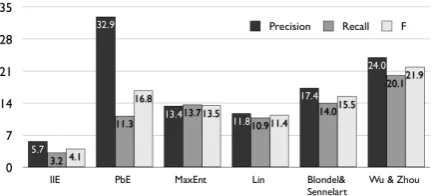
Fig. 5:Comparing with published results on the combined thesaurus experiment
without transitive closure, precision increases as frequency decreases, while after transitive closure is introduced, it varies in the opposite direction. This indicates that using transitive closure is most helpful for high-frequency target words. This is, again, due to their polysemy and better chances of “digression”, and thus, transitive closure indeed helps to effectively eliminate false positives introduced by such digressions; low-frequency words would already have relatively better precision due to their having fewer number of senses, and transitive closure appears less helpful in this case.
Figure 5 shows how our methods compare with other published results. IIE is outperformed by all other meth-ods by large margins. PbE has the best precision (32.9%) but falls behind that of Wu and Zhou (2003) in terms of F due to low recall. MaxEnt has better recall than both IIE and PbE, but F score is not as good as that of PbE. Re-sults of Blondel and Senellart (2002) is included as an ex-ample of dictionary-based method for comparison, and Lin (1998) as an example of corpus-based approach11. Wu and
Zhou (2003) combines the methods of Blondel and Senel-lart (2002) and Lin (1998), as well as a novel method us-ing bilus-ingual resources, achievus-ing the best result among all methods being compared here.
3.3 Definition Text Labeling
Recall that the MaxEnt model labels synonyms in a piece of definition text for a given target word; in fact, PbE and IIE could also be viewed as processes of labeling synonyms in definition texts in more or less the same way. The basic
11Results of both Blondel and Senellart (2002) and Lin (1998) are re-ported by Wu and Zhou (2003).
Fig. 6:Performance on synonym labeling in definitions
idea of this third experiment is to see how well each method performs in such a labeling task.
Note that in terms of synonym extraction, the former two experiments (Section 3.1 and 3.2) are the main approaches for evaluating the extraction quality of various methods; this section, in contrast, stresses more the nature of the training data for the MaxEnt model.
The data is prepared in the same way as described in Sec-tion 2.3; it does not necessitate any human labeling, though at the cost of the quality of synonym labels (to be discussed at the end of this section).
The labeling criteria for the three methods follow the discussion in Section 2.4: IIE takes all definientia as syn-onyms, while PbE takes only those following certain pre-specified patterns. MaxEnt makes predictions for each defining word based on its training. We also introduce a baseline that chooses a defining word as a synonym if it shares the same POS as that of the definiendum.
The results are presented in Figure 6. The baseline and IIE both have 100% recall according to the experiment setup. IIE and PbE are both outperformed by the baseline. PbE has the highest precision and meanwhile, the lowest recall due to its dependence on specific patterns.
Due to the low quality of the training data, MaxEnt did not perform as well as expected. POS tags have many dis-crepancies, partly because the tagger is not trained on defi-nition texts. On the other hand, using WordNet to create the gold standard in synonym labels also appears to be error-prone. For example, in the definition of ability (power or capacity to do or act...), poweris labeled as a synonym ofabilitywhilecapacityis not, since it is not in the same synset as that ofability. There are also cases where words in insignificant positions within the definition text happen to be in the same synset as that of the definiendum. All such cases will eventually confuse the learning process of MaxEnt.
4 Conclusions and Future Work
We proposed three methods for extracting synonyms from dictionary definition texts: by building an inverted index on the dictionary, by matching and bootstrapping regular ex-pression patterns that synonyms tend to follow, and by de-veloping and training a maximum entropy classifier. Their performance was evaluated in three experiments: by solv-ing TOEFL synonym questions, by comparsolv-ing against ex-isting thesauri, and by labeling synonyms in definitions.
even better at 88.3% — almost 10% higher than that of the best reported lexicon-based method.
Nonetheless, when compared with existing thesauri, the quality of the extracted synonyms is not as satisfactory. In addition, the results from this comparison do not correlate well with those of the TOEFL synonym question task: sim-ple extraction schemes, such as IIE, can perform well on the TOEFL task while failing badly in the comparison ex-periment, whereas on the other hand, the advantage of PbE and MaxEnt is not fully reflected in the TOEFL task. This leads to the question of whether the TOEFL task, though given the name ofsynonymquestions, is indeed indicative of strict synonymy.
Freitag et al. (2005) generated over 23,000 questions through an automated process to compensate for the small number of questions available in the original TOEFL syn-onym questions data set; although the number of questions is important, it would also be interesting to devise a set of questions that include related but not synonymous words as decoys among the choices, in hope of better evaluating the degree of strict synonymy in the extracted word sets.
As claimed earlier, the maximum entropy model is de-veloped as an initial step towards a machine learning treat-ment of definition text mining; it would be interesting to employ other classifiers in the future and compare their per-formance.
Finally, an interesting observation on the extracted words reveals that, due to the Australian provenience of the
Macquarie Dictionary, all extraction methods have gener-ated some synonyms unique to Australian English or cul-ture (such astoilet-dunny). This phenomenon provided ev-idence for the adaptability of dictionary-based methods in different domains or cultures.
Acknowledgements
This study is supported by the Natural Sciences and En-gineering Research Council of Canada. Discussions with Gerald Penn helped shaping an important part of this pa-per, and we are sincerely grateful to all anonymous review-ers for their insightful and generous comments.
References
R.A. Amsler.The structure of the Merriam-Webster Pocket Dictionary. PhD thesis, The University of Texas at Austin, 1980.
V.D. Blondel and P.P. Senellart. Automatic extraction of synonyms in a dictionary. Proc. of the SIAM Workshop on Text Mining, 2002.
S. Brin, L. Page, R. Motwami, and T. Winograd. The PageRank citation ranking: bringing order to the web. InProceedings of ASIS98, pages 161–172, 1998. M.S. Chodorow, R.J. Byrd, and G.E. Heidorn.
Extract-ing semantic hierarchies from a large on-line dictionary.
Proceedings of the 23rd Annual Meeting on Association for Computational Linguistics, pages 299–304, 1985. A. Delbridge et al. The Macquarie Dictionary. Macquarie
Library, McMahons Point, NSW, Australia, 1981.
C. Fellbaum et al.WordNet: An electronic lexical database. MIT press Cambridge, MA, 1998.
D. Freitag, M. Blume, J. Byrnes, E. Chow, S. Kapadia, R. Rohwer, and Z. Wang. New experiments in distri-butional representations of synonymy. Proceedings of the 9th Conference on Computational Natural Language Learning, 2005.
M.A. Hearst. Automatic acquisition of hyponyms from large text corpora. InProceedings of the 14th Confer-ence on Computational Linguistics – Volume 2, pages 539–545. Association for Computational Linguistics Morristown, NJ, USA, 1992.
N.D. Ho and F. C´edrick. Lexical similarity based on quantity of information exchanged - synonym extrac-tion. Proceedings of the Research Informatics Vietnam-Francophony, Hanoi, Vietnam, pages 193–198, 2004. M. Jarmasz and S. Szpakowicz. Roget’s Thesaurus and
Semantic Similarity1. Recent Advances in Natural Language Processing III: Selected Papers from RANLP 2003, page 111, 2004.
D. Jurafsky and J.H. Martin. Speech and Language Pro-cessing. Prentice Hall, 2008.
T.K. Landauer and S.T. Dumais. A solution to Plato’s prob-lem: the latent semantic analysis theory of acquisition, induction, and representation of knowledge. Psycholog-ical Review, 104(2):211–240, 1997.
D. Lin. Automatic retrieval and clustering of similar words.
Proceedings of the 17th International Conference on Computational Linguistics, pages 768–774, 1998. P. Muller, N. Hathout, and B. Gaume. Synonym extraction
using a semantic distance on a dictionary. Proceedings of TextGraphs: The Second Workshop on Graph Based Methods for Natural Language Processing, pages 65– 72, 2006.
R. Reichert, J. Olney, and J. Paris. Two Dictionary Tran-scripts and Programs for Processing Them – The En-coding Scheme, Parsent and Conix., volume 1. DTIC Research Report AD0691098, 1969.
P.D. Turney, M.L. Littman, J. Bigham, and V. Shnay-der. Combining independent modules to solve multiple-choice synonym and analogy problems. Proceedings of the International Conference on Recent Advances in Natural Language Processing (RANLP-03), pages 482– 489, 2003.