Analyses Tools for Non-head Structures
Sirine Boukédi
Faculty of Sciences Economy and
Management of Sfax
[email protected]
Kais Haddar
Sciences Faculty of Sfax
[email protected]
Abstract
Syntactic analysis is a fundamental phase in NLP (Natural Language Processing) do-main. This phase occurs in several applica-tions and at different levels. Moreover, it wasn’t spilled in domain research, espe-cially for Arabic language. In fact, most of researchers working on Arabic language treated simple structures and neglected complicated ones such as relatives, coordi-nation, ellipse and juxtaposition. In this text, the present work lies within the con-struction of a HPSG (Head-driven Phrase Structure Grammar) grammar treating Ara-bic coordination. The established grammar is specified on TDL (Type Description Lan-guage) and experimented with a parser gen-erated by LKB (Linguistic Knowledge Building) system.
1
Introduction
The study on Arabic language showed that coor-dination is one of particular structures. It is fre-quent in different corpus and occurs with many other phenomena. The interaction with the other structures makes the study very delicate. For this reason, it wasn’t spilled in research domain.
Based on a large literature, most of existing researchers treated coordination structure for Roman languages except some works such as (Haddar, 2000) and (Maaloul et al., 2004). In fact, Arabic coordination is very complicate. It covers many forms and different structures. Therefore, there is a big problem in the categori-zation of Arabic coordination.
Moreover the last researchers found a problem in the choice of the adequate formalism repre-senting the different forms of coordination struc-tures. But most of related works used HPSG. The
choice of this formalism is justified. In fact, HPSG offers a complete representation for lin-guistic entries.
Therefore, our work aims to find an adequate typology classifying Arabic coordination struc-tures and to construct a HPSG grammar repre-senting the different forms of coordination. This grammar will be validated on LKB system.
In the present paper, we start by describing some related works treating coordination struc-ture. Then, we adapted HPSG grammar to repre-sent the different forms of our phenomenon, based on a proposed typology. It should be noted that the established grammar treated simple sen-tences and complex ones representing the differ-ent forms of coordination except cases of interac-tion with ellipse phenomenon. Finally, we vali-dated our grammar on LKB system after specifi-cation in TDL. According to the obtained results, we evaluate our grammar and we enclose our work by a conclusion and some perspectives.
2
Previous works
The study on previous works showed that re-searchers on coordination structure started since 1970, such as (Hudsan, 1976), (Postal, 1974) and (Rau, 1985), for many languages. The different researches used various grammars. Some works used the GCCA (Applicative Categorical Com-binatory Grammar), other works used GI (Inter-active Grammar) and other ones were based on HPSG Grammar. But most of them, used this last one (HPSG formalism).
For French language, we can mention (Biskri and Desclés, 2006) who studied coordination structure of similar constituents, based on GCCA grammar. Moreover, (Le Roux and Perrier, 2006) studied constituent and non constituent structures based on XMG tools, a compilation tool, and used the GI formalism.
For Portuguese language, (Villavicencio et al., 2005) studied the coordination of nominal phras
es. They identified different strategies of analyses based on the HPSG formalism.
For Bulgarian language, we can mention the work of (Osenova and Simov, 2005) who studied the coordination phenomenon and its interaction with ellipse forms based on HPSG grammar. It should be noted that the formalization was en-coded in XML.
According to our research, the study showed that most of the related works treated the coordi-nation of Roman language. But, there is some works treating Arabic coordination such as (Haddar, 2000) and (Maaloul et al., 2004). The proposed typology is similar in most of the re-lated works. The difference between them ap-pears in the choice of the grammar and the anal-ysis tools.
For Arabic works, for example, Haddar (2000) studied syntactic analyses of Arabic co-ordination based on ATN (Augmented Transition Network) and (Maaloul et al., 2004) studied the coordination of Arabic constituent based on HPSG grammar. This grammar was tested and validated on a constructed system, AICOO.
Based on the proposed typology, these related researches working on Arabic coordination didn’t treat all forms of this structure. Therefore, the originality of our work is to construct a HPSG grammar covering all the possible forms of coordination and its interaction with the other phenomena such as the ellipse one. In the follow-ing paragraph, we present the proposed typology of Arabic coordination that we adopted from the related works.
3
Proposed typology for Arabic
coordi-nation
According to some linguists such as (Abdelwa-hed, 2004) and (Dahdeh, 1992), the coordination phenomenon joins two or several elements with a particle of coordination (conjunction).In Arabic, there exist nine conjunctions ( ،نكل،ىتحّ ،مثّ ،ف ،و لب،لا،وأ،مأ).
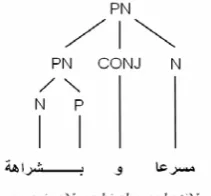
Based on some related works (Haddar, 2000) and (Maaloul et al., 2004), coordination structure in Arabic can be subdivided, like Roman lan-guages, in two categories: coordination of con-stituent and coordination of non concon-stituent. The first category covers cases when the conjunction joins two or several well formed constituents. These constituents can have similar or different categories. The figure 1 represents the coordina-tion of similar constituents. The figure 2 repre-sents the coordination of different constituents.
Figure 1. Coordination of constituents having simi-lar categories.
As shown in Figure 1, the conjunction” و, and” joins two compounds having the same category, two defined nouns “ذاتسلأا, the professor” and “ذيملاتلا, the pupils”.
Figure 2. Coordination of constituents having dif-ferent categories.
However in Figure 2, the same conjunction joins two different compounds. The first one “اعرسم, quickly” is an adverb, the second one “, ةھارشب, with gourmandize” is a reduction phrase “ بكرم رجلاب, reduction phrase”.
For the second category, coordination of non constituent, the conjunction joins two or several constituents where one of them is incomplete. In fact, it represents the case where there is interac-tion with the ellipse phenomenon.
According to some references, there exist four forms of ellipse: Right Node Raising, Left Node Raising, Gapping and VP-ellipse. The first form: Right Node Raising, designed the case when the first element that should be at the right of the second compound, is missed.
The second form: the Left Node Raising de-signed the case when the second element is missed in the left of the second compound of coordination phrase.
Finally, for the last form, VP-ellipse, it repre-sented the case when the verbal phrase is missed and replaced by a proverb like “كلذك, also”.
Based on the proposed typology for the Arabic coordination, we adapted the HPSG grammar. In fact, based on some references such as (Godard, 2006), the coordination phenomenon is a non head structure. Its representation differs from other phenomena. So it necessitates a particular structure. In the following paragraph, we present the HPSG grammar and the different modifica-tions brought to this formalism to represent Ara-bic language. Then, we present the HPSG struc-ture of Arabic coordination.
4
HPSG for the Arabic language
HPSG is a unification grammar (Pollard and Sag, 1994). It is characterized by a reliable modeling of the universal grammatical principles and a complete representation of linguistic knowledge.
HPSG grammar is based on two essential components: AVMs (Attribute Value Matrix) and a set of immediate domination schemata (DI schemata). An AVM is based on a set of features characterizing a lexical entry. The DI schemata, describe a syntactic phenomenon. It should be noted that to compose the various phrases, a set of principles should be verified (i.e., HFP Head Feature Principle).
HPSG grammar was conceived for Roman languages. To use it for Arabic language, we pre-sent in the following paragraph the modifications made to HPSG. These modifications were made on the features and schemata level.
4.1 Arabic features
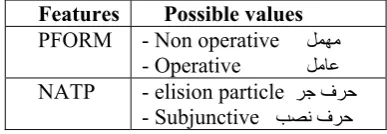
Referring to previous projects (Elleuch, 2004), (Bahou et al, 2005) and (Abdelkader et al., 2006), we have kept some features and have added some others according to the proposed type’s hierarchy. As example, we present, in ta-ble 1 below, the features characterizing the Ara-bic particle.
Features Possible values
PFORM - Non operative لمھم
- Operative لماع NATP - elision particle رجفرح
- Subjunctive بصنفرح
Table 1. Arabic particle features
Indeed, an Arabic particle can be operative particles or non operative. The coordination par-ticles are classified as non operative parpar-ticles. In
fact, it didn’t specify any constraint to the con-joint compounds.
The modifications brought to this formalism cover not only the features but also the different schemata of the HPSG grammar. In the follow-ing paragraph, we present as example the con-ceived schema for Arabic coordination.
4.2 Arabic schemata
HPSG grammar is based on six schemata. In this work, we adapted each schema to represent an Arabic syntactic phenomenon (the simple one). In the context of our work; we present the con-ceived schema for Arabic coordination.
To represent coordination structure, a compli-cate phenomenon, we have represented, at first, the simple one. In fact, coordination interacts with different others phenomenon. All other rep-resentations were headed structure. However, the coordination has a particular structure. In fact, according to some references, the coordination is a non headed structure. Godard (2003) showed that the conjunction can’t be the head of the phrase. In fact, a coordination particle is non op-erative. Thus, it can’t specify conjunct elements. Therefore, we developed a ternary non headed rule for the coordination phenomenon to obtain the representation below:
Figure 3. Coordination schema
As represented in figure 3, this structure doesn’t contains three non headed daughters: two Fils-conj representing the two compounds of the coordination phrase دلولا, (‘aalwaladu, the boy) and تنبلا, (‘aalbintu, the girl) and the Fils-conjonction representing the coordination parti-cleو, (wa, and).
To validate our constructed grammar with LKB system, we specified it in TDL (Type De-scription Language). The choice of LKB plat-form is justified. In fact, it generates automati-cally a reliable parser. Some related works such as (Garcia, 2005) used this system and they ob-tained good results.
5
TDL specification
According to (Krieger and Schäfer, 1994), the TDL syntax presents an important similitude with the HPSG representation. Therefore, the TDL specification was simple. At the present time, our grammar covers the first category of coordination mentioned in section 3: coordina-tion of constituents.
To specify this grammar, we specified the lex-ical entries AVMs, the type hierarchy and the syntactic rules representing the different forms of coordination and all possible simple sentences (verbal and nominal).
In the following paragraph, we present an ex-ample of TDL specification of an AVM and some schemata.
5.1 TDL specification of an AVM
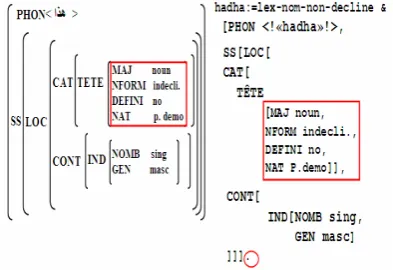
From a HPSG representation, the TDL specifica-tion of an AVM is very simple. We present in the following figure the specification TDL of “اذھ, that” (hadha).
Figure 4. TDL Specification of "that” (hadha, اذھ)
In fact, the symbol “:=” designates that “اذھ”, (hadha, this) is an instance of indeclinable nouns. The different constraints are added by the symbol &. The feature structures are delimited by brackets [ ]. Besides, the various attributes values are separated by commas “,” and the full stop ". " designates the end of the AVM.
5.2 TDL specification of a schema
To specify the syntactic rule of Arabic coordina-tion, we started by rules representing simple phenomenon. For the coordination structure, we specified two different rules. The first one repre-sents verbal phrases and sentences. The second one represents nominal phrases and sentences. In the following figure we present the TDL specifi-cation of the coordination of nominal phrases.
Figure 5. TDL Specification of the coordination rule
As represented in this figure, this rule joins nominal phrases. It extends from the type regle-tern-sans-t. This type of rules represents non headed structures. In fact, before implementing this syntactic rule, we specified this type of rules. (Figure 6):
Figure 6. TDL Specification of the type rule regle-tern-sans-t
In fact, regle-tern-sans-t is a ternary rule hav-ing two non-headed daughters joined with a par-ticle of coordination.
Following the phase of specification TDL, we tested the adapted HPSG grammar with the LKB system. In the next paragraph, we give an idea about this system. Then we describe the experi-mentation and the evaluation of this grammar.
6
Experimentation and evaluation
LKB system is a parser generation tool, proposed by (Copestake, 2002). This system can run on Windows or on UNIX. But the version on Win-dows can’t support Unicode. In fact, LKB is written in LISP using Motif. Therefore, we have added Trollet (TROndheim LingLab Engineering Tool), a tool for multilingual grammar develop-ment. It is easy to extend and can be used only on UNIX system. Therefore we installed Ubunto system. Then we install LKB and Trollet. Thus LKB is embedded in Trollet and invisible for the user. This tool replaced the LKB window.charges the grammar on LKB. In fact, it indicates the name and the root of each grammar file. In the following paragraph, we describe the stages of syntactic analysis. Then, we present the ex-perimentation of the constructed grammar.
6.1 Stages of syntactic analyses
After charging the constructed grammar on LKB, this system offers a generated parser to analyze a simple sentence or a corpus of sentences. But, it should be noted that this corpus must be seg-mented in sentences. In fact, LKB system didn’t have a module segmenting the tested corpuses.
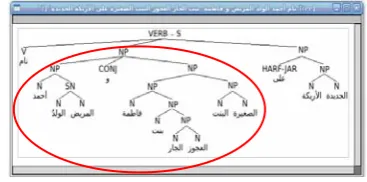
To analyze a simple phrase, we have to unroll the “parse” menu and choose the “parse input” order. Thus, the LKB system generates a zone of text to type the sentence and as result, a deriva-tion tree appears. The following figure represents the result of a sentence’s analysis.
Figure 7. Derivation’s tree of a verbal sentence
The derivation’s tree in figure 7 is a represen-tation of the following verbal sentence:
ىلعةريغصلاتنبلازوجعلاراجلاتنبةمطافوضيرملادلولادمحأمان
ةديدجلاةكيرلأا
ahmadu the sick boy and fatimatu the girl of the old neighbour, the little girl, are slept on the new couch
As shown in Figure 7, with TROLLET, we re-solved the problem of transliteration. Contrary to the LKB on Windows, this system on UNIX can now support Arabic language except that the reading direction of the tree is false. Indeed an Arabic sentence must be read from the right to the left. At the present time, we are looking for a solution for this problem.
The choice of this sentence as example is jus-tified. It represents the interaction of the coordi-nation structure with various syntactic phenom-ena (i.e. annexing, description). In fact, the sub-ject (circled in red in the figure) is a coordination of constituents joining two nominal phrases.
To analyse a corpus of sentences with LKB, we should specify to it two paths: the path of the file containing the sentences (corpus.txt) com-posing the corpus, and the path of the file that will contain the results (results.txt). In
Figure 8. Extract of results.txt
Figure 8 represents our test corpus containing 500 sentences which are extracted from different linguistic resources and containing coordination structures using different particles (ـف ,مث ,و). It should be noted that in “results.txt”, LKB repre-sents the total time of analyses and for each ex-ample; it represents the number of tree’s deriva-tion and the number of nodes in the creaderiva-tion of the derivation’s tree.
According to the obtained results, we evalu-ated our work. This evaluation is described in the following paragraph.
6.2 Evaluation
To test our HPSG grammar, we used a corpus of 500 sentences. This corpus was created from a lexicon of 2000 words. It covers different sen-tences containing coordination structures using different particles. As we have mentioned before, LKB system or TROLLET didn’t have a seg-mentation module to cut sentences composing the corpus. At the present time, it is done manu-ally. Therefore, we missed much time in this phase. But, we are looking for a segmentation tool toad it to our system.
At the present time, we treated only constitu-ent’s cases and we are working on ellipse phe-nomenon and its interaction with the coordina-tion one. According to the file “results.txt”, we obtained the following results.
Number of deri-vation’s trees (n)
Number of sentences having n analysis
0 50 1 420 2 30 500
In fact, 84% of sentences were analyzed cor-rectly. The failure cases (0 analyzes) are due to the absence of rules treating some particular syn-tactic phenomena (i.e., relative phenomenon, coordination phenomenon). In fact, at the present time we treated constituent structures. We have not yet treating ellipse phenomenon and its inter-action of the coordination phenomenon. The am-biguous cases (2 analyzes) are due to a no pre-cise specification of the constraints specification of some syntactic rules.
7
Conclusion and perspectives
In this article, we proposed a typology for coor-dination structure in Arabic language. Based on this hierarchy, we adapted the HPSG grammar. In fact, we defined a particular structure for this phenomenon. Then we specified syntactic rules treating simple sentences and coordination struc-tures. The specified grammar was validated with the LKB system. The experimentation was done on a corpus of 500 sentences. According to the obtained results, we evaluated our grammar.
As perspectives, we are going to treat ellipse phenomenon and its interaction with coordina-tion structures. Then, we will treat other particu-lar phenomena and specify more constraints to eliminate the ambiguous cases. Moreover we consider developing lexical rules to make our lexicon extensional. Furthermore, we aim to con-struct a converter permitting to convert the lexi-cal entries of XML in TDL in order to facilitate the development of the lexicon.
References
Abdelkader A., Haddar K., and Ben Hamadou A. 2006, study and analyses of nominal sentences in HPSG, TALN, Louvain, 379-388.
Abdelwahed A. 2004, ‘alkalima fy ‘attourath
‘alli-saany ‘alaraby , يبرعلايناسللاثارتلايفةملكلا , Aladin
library, Sfax – Tunisie, 1-100.
Bahou Y., Hadrich Belguith L., Aloulou C. and Ben Hamedou A. 2005, Adaptation and implementation of HPSG grammars to parse non-voweled Arabic
texts, Faculty of Economics and Management of
Sfax.
Blache P. 2001, Propriety grammar : constraints for NL, Hermès Sciences, Paris.
Biskri I., Desclés J., 2006, coordination of different
categories in French, Quebec university, Canada.
Bourigault D.and Fabre C. 2000, Linguistic approach
for syntactic analyse of corpuses, Sémantisue et
corpus, 131-151.
Copestake A. 2002, Implementing Typed Feature
Structure Grammars, CSLI Publications, Stanford
University.
Dahdah A. 1992, تاحولولوادجيفةيبرعلاةغللادعاوقمجعم , Librairie de Nachirun ebanon, 5ème edition.
Elleuch S. 2004, syntactic analyse of arabic language
based on HPSG formalism, DEA memory on
In-formation system and new technology, 55-88. Garcia O. 2005, Une introduction à l’implémentation
des relatives de l’espagnol en HPSG–LKB,
Re-search memory.
Godard D. 2003, Syntacyic problems of coordination
and recent propositions in syntagmatic grammars,
study journey in the university of Paris 7.
Haddar K. 2000, Formel caracterization of Arabic ellipse and recouvrement processus in Arabic
lan-guage, University of Tunis II – Sciences Faculty of
Tunis.
Hudson R. 1976, Conjunction Reduction, gapping and
right-node raising, 535-562.
Krieger H. and Schäfer U. 1994, TDL: A Type
De-scription Language for HPSG, Part 1 and Part 2,
Research Report, RR, 94-37.
Le Roux J., Perrier G. 2006, coordination
modelisa-tion in Interactive grammars, TAL, Volume 47,
n° 3, 89-113.
Maaloul H., Haddar K., and Ben Hamadou A. 2004,
Arabic coordination: HPS analyse, MCSEAI 2004,
8th maghrébine conference on GL and IA, Sousse, Tunisie : 487- 498.
Osenova P. and Simov K., Special Linguistic
phe-nomena in the Bulgarian HPSG_based Treebank,
BulTreeBank Project, Linguistic modelling labora-tory, IPP, Bulgarian Academy of Sciences. Pollard C. and Sag I. 1994, Head-drive phrase
struc-ture grammars, CSLI series, Chicago University
Press.
Postal P. 1974, On raising, MIT Press,
Cam-bridge/MA.
Rau F. L. 1985, the understanding and generation of
ellipses in a natural language system, Berkeley
Ar-tificial Intelligence Research project.
Villavicencio A., Sadler L. and Arnold D. 2005, An HPSG account of closest conjunct Agreement in
NP Coordination in Portuguese, Proceedings of